The All-I’ll-Ever-Want Christmas Doll

The All-I’ll-Ever-Want Christmas Doll By Patricia C. McKissack, illustrated by Jerry Pinkney, 2007.

Nella lives with her parents and her two sisters, Eddy Bernice and Dessa, during the Great Depression. The three sisters usually get along well and share everything with each other. Shortly before Christmas, Nella tells her sisters how badly she wants a Baby Betty doll as a present, but they tell her it’s useless to wish for that because they’ll never be able to get one during the Depression.

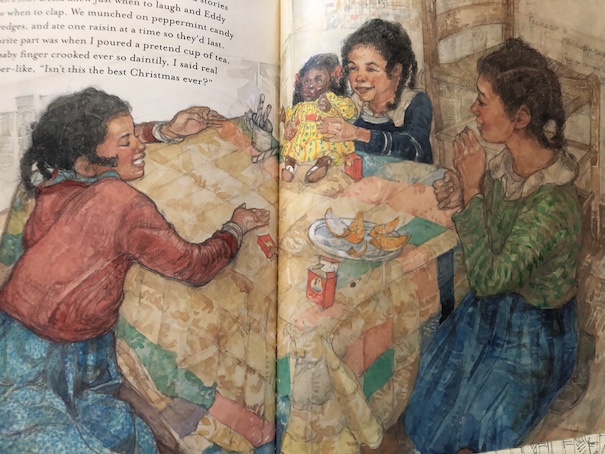
Nella decides to write a letter to Santy Claus anyway, asking for Baby Betty. On Christmas morning, the girls’ mother gives each of them a little bag of treats with peppermint sticks, nuts, oranges, and raisins. Then, their father gives them one special present: a Baby Betty doll.
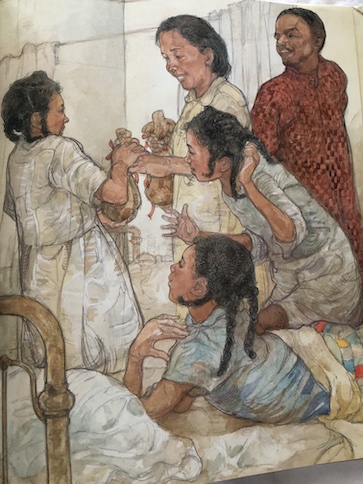
The girls are overjoyed by this special present of a doll because store-bought presents are rare in this time when so many people struggle with money and families like theirs can’t afford much. The girls are all so eager to play with the doll that they start to fight over who gets to have her first until their father breaks up the fight and their mother confiscates the doll until the girls resolve the argument

Nella persuades her sisters that the only reason they got the doll was because she wrote the letter asking for one, while they didn’t think it would even work. Nella was the one who wanted the doll the most from the beginning. Because of that, her sisters agree that the doll belongs to her and leave her to play with the doll all by herself.
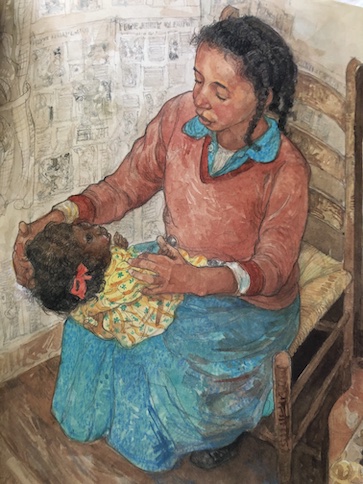
At first, Nella enjoys having her dream doll all to herself, but dolls can’t sing along with songs or clap or laugh at stories, like sisters can. Nella thought that Baby Betty was all that she wanted for Christmas, but she comes to realize that, even better than having the best doll in the world, is having someone to share in the fun.
My Reaction

This is a sweet Christmas story about how people are more important than presents. At first, Nella thinks that all she wants is that special doll, but having the doll all to herself isn’t as much fun as sharing her with her sisters. The doll is pretty, but she can’t do much more than sit there and blink her eyes. Nella needs her sisters to talk to and laugh with.

I like how the author set this story during the Great Depression. A story about siblings learning that it’s more fun to share rather than keep toys to themselves could take place at any time, but the fact that this is set during the Great Depression and the girls know that presents this nice are rare. This family is poor during a time when many people are out of work and money is tight for almost everyone. At the beginning of the story, the girls help their mother to line the walls of their house with newspapers to keep out the drafts, so the readers know they are very poor. The newspaper wallpapers are seen in the backgrounds of the pictures throughout the book, reminding readers how poor the family is. They consider themselves lucky just for betting the simple treats to eat, which we’re told are better than they’ve had other years. The girls know that they are incredibly lucky to get even the one doll for Christmas, and there was no way they could expect their parents to buy one for each of them. The girls fight over the doll because they are all so thrilled to get their hands on her, and they all can’t wait to play with her. We are told that the girls are usually pretty good about sharing with each other, but this sudden appearance of an unusually good present during a time of deprivation is just overwhelming for them.

Nella seems a little selfish at first for wanting the doll for herself, but her sisters agree that it was her particular wish. It was her idea from the beginning to ask for the doll, and it seems unfair to her that her sisters each try to claim it. Fortunately, it doesn’t take Nella long to realize that it’s more fun to have other people to play with and decides to share the doll with her sisters. The girls work out their differences, and they have a much better time when they all join the pretend tea party with the doll.

The book shows the family as being very close-knit. The parents were paying attention to the girls’ wishes when they chose their special Christmas surprise. The father is involved with the girls’ lives, telling them bedtime stories and dealing with their fights, and the mother helps the girls to realize what’s important and work out their differences. Their family doesn’t have much, but I liked the way the parents helped the girls learn how to think of each other, appreciate each other, and share with each other.

Thanksgiving on Thursday

Magic Tree House

There is a letter to the readers at the beginning of the book, where the author briefly describes the history of the Thanksgiving holiday and how it started as a three-day harvest festival and didn’t become a regularly-celebrated holiday until President Lincoln declared it as a national holiday of thanksgiving to be celebrated annually on the last Thursday in November in 1863. The separate prologue to the book explains that Jack and Annie have started learning magic, and they’ve been going on a series of missions to find different types of magic.

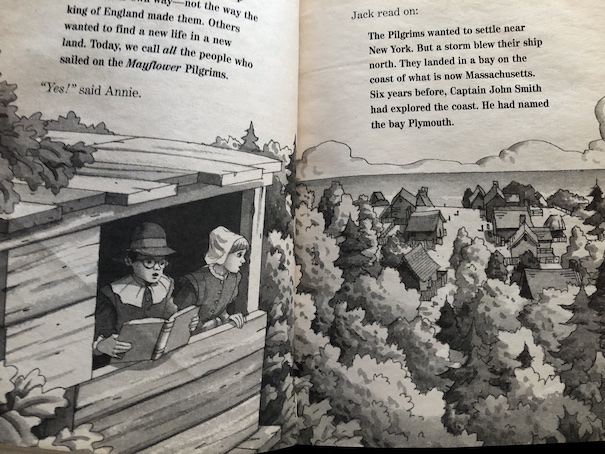
It’s Thanksgiving, and the children know that they will be leaving for their grandmother’s house soon, but they can’t resist going to the tree house to see if there’s another message from Morgan. There is a message that tells the children that they are about to find a new kind of magic. A book in the tree house takes the children back in time to the first Thanksgiving in the American colonies.

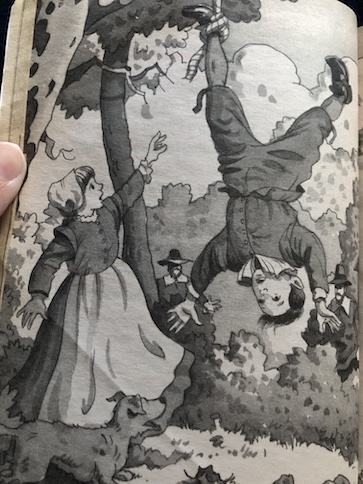
They read about the Pilgrims and the voyage of the Mayflower, and they realize that they are now in 17th century Plymouth. Annie remembers how her class at school put on a play about Thanksgiving, and she gets excited, thinking about how they’re about to meet some of the people they studied in school. She dashes off, eager to get a look at them, although Jack thinks they should pause and work out a plan before they approach anyone. Unfortunately, Jack gets caught in a hunting snare.

A group of people, Pilgrims and Native Americans, come to see what got caught in the snare, and they find Jack and Annie. When they question the children, Jack isn’t sure exactly what to say, so he tells them that they came from “a village up north” and that they’re here to learn how to grow corn. Remembering something else from the book, he claims that his parents sailed to the colonies with Captain John Smith when he and Annie were babies. Captain Standish says that Squanto knew Captain John Smith and that he might remember them. To the children’s surprise, when Governor Bradford asks Squanto if he remembers two babies called Jack and Annie who sailed with Captain John Smith, he says he does. Jack wonders if he’s mistaking them for two other children from the past.

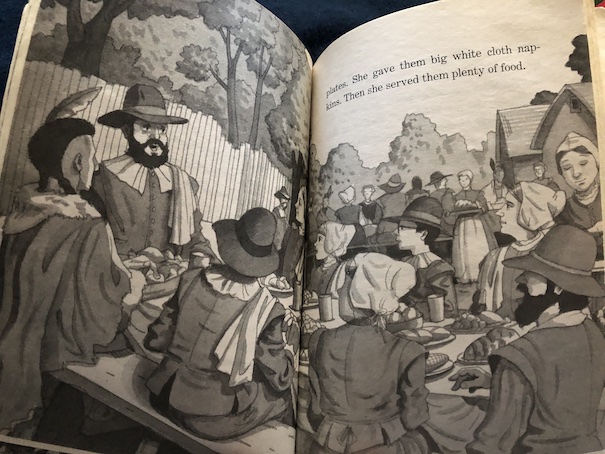
The children witness the arrival of Chief Massasoit and his men. Priscilla tells the children that they were invited to join the harvest festival (something that historians debate), but they weren’t expecting such a large group, and they wonder if they’re going to be able to feed everyone. The Wampanoag say that they will go hunting to provide more food, but the Pilgrims say that they will also gather more food.

Jack and Annie are invited to join the food-gathering efforts, although it’s difficult for them because they’re not used to hunting and fishing, like 17th century children would be. Annie thinks it won’t be so bad because they’ve helped their parents prepare for Thanksgiving before, but the types of food at this harvest festival are very different from the “traditional” Thanksgiving food the children would have expected, and the methods of preparing them are old-fashioned. Jack and Annie find themselves trying to catch eels and find clams and trying to tend things cooking over an open fire. The children’s efforts don’t go well, and at first, they’re afraid that they’ve ruined the feast, but the magic they came to seek saves everything.

The magic that the children find is called the “magic of community.” Even though Jack and Annie think that they haven’t contributed much, and they burnt the turkey they were trying to cook, their mishaps haven’t ruined the feast because the entire community was helping all the time. Because everyone contributed something, there is enough for everyone. Besides learning how the first Thanksgiving was different from the holiday they know, Jack and Annie learn about cooperation, how people share and support each other.

At one point, Jack asks Squanto why he says that he remembered them. Squanto seems to realize that Jack and Annie aren’t quite what they said they were, but he says it wasn’t really them that he was remembering. He explains a little about his own past and what it felt like to be an outsider in a strange place, reminding the children to remember that feeling and to be kind to others in the same situation.

I liked the author’s noted about the history of the Thanksgiving holiday. For another book that explains the first Thanksgiving feast from the point of view of both the Pilgrims and their Wampanoag guests, I recommend Giving Thanks by Kate Waters.

Jingle Dancer

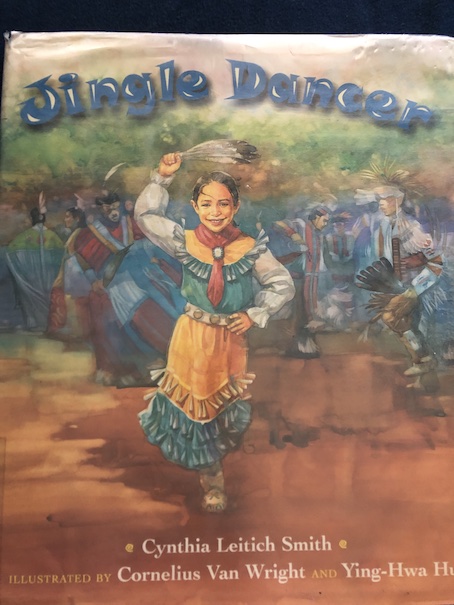
Jingle Dancer by Cynthia Leitich Smith, illustrated by Cornelius Van Wright and Ying-Hwa Hu, 2000.

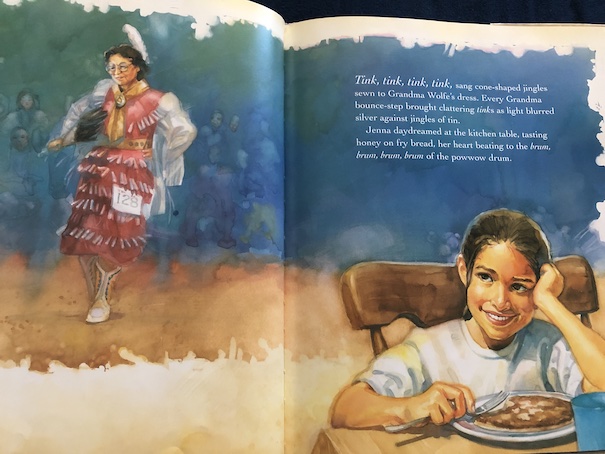
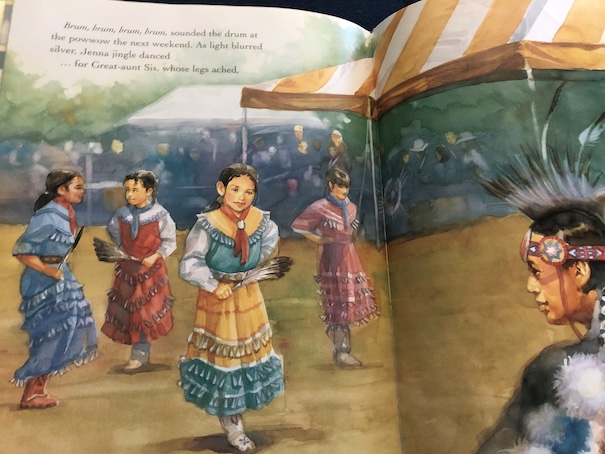
Jenna is inspired to become one of the jingle dancers at the powwow because her grandmother has been a jingle dancer. She loves the way the little cone-shaped bells on the dancers’ costumes sing!

Her grandmother tells her that there won’t be enough time to get the tin for making the jingles for her costume this time, but next time, she can dance with the Girls group.

Jenna knows how to do the dance because she has watched old videos of her grandmother dancing and has practiced. However, she can’t really do a proper jingle dance without the jingles for her dancing costume.

However, her grandmother isn’t the only person Jenna knows who has been a jingle dancer. Other women in Jenna’s family and among her family’s friends have also been jingle dancers, and not all of them dance anymore. Perhaps, with their help, Jenna can get the jingles she needs in time for this powwow!

The book is available to borrow and read for free online through Internet Archive.

My Reaction

I liked the way the book showed how Jenna’s family and friend supported her and helped her to take part in a tradition that they have all shared. They can’t all be there to see Jenna when she dances, but Jenna dances for all them, her dress covered in borrowed jingles!

A section in the back of the book explains more about Jenna’s tribe and the traditional dance shown in the story. The story is set in Oklahoma, and Jenna is part of the Muscogee (Creek) Nation and has Ojibway (Chippewa/Anishinabe) ancestry. Elements of both tribal cultures appear in the story. The tradition of jingle dancing originated with the Ojibway people, and the book describes details of the costume (called “regalia” in the book) that women and girls wear to perform the dance. The book also contains a glossary of words that appear in the story with some additional details about their significance.

I think this story is a fun way to introduce readers to Native American traditions that may not be familiar to them. I also enjoyed the pictures, which have a lovely, dream-like quality to them.

Button Soup

Button Soup by Walt Disney Productions, 1975.

This is a retelling of a traditional folktale, sometimes called Button Soup and sometimes Stone Soup. The basic story is the same, but sometimes, it uses a stone and sometimes a button. All of the characters in this particular version of the story are represented by Disney characters.

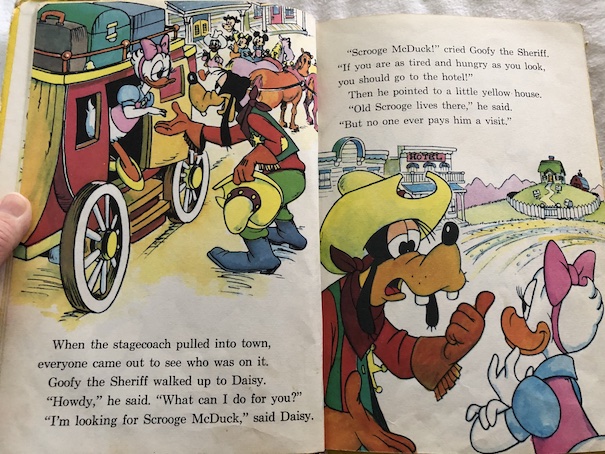
Scrooge McDuck’s niece, Daisy, is coming to visit him. The Sheriff welcomes her when her stagecoach comes into town, but seeing how tired and hungry she is, he warns her that she’s not going to find much comfort at her uncle’s house because Scrooge is stingy. However, Daisy says that she is sure she can handle Uncle Scrooge.

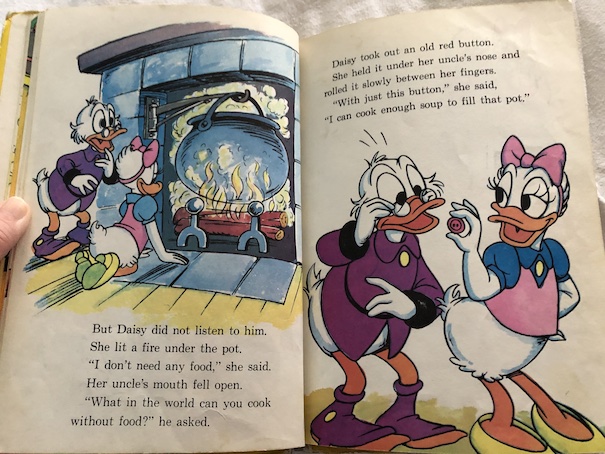
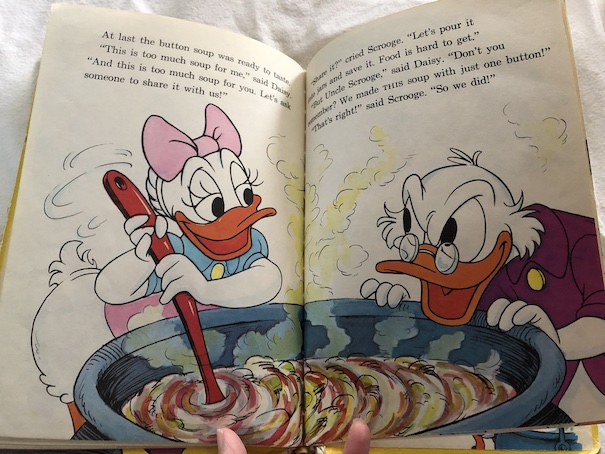
When she gets to Scrooge’s house, he’s not happy to see what he has unexpected company and tries to deny that he has any food to share. Daisy knows that Scrooge isn’t really that poor, so she takes out a big pot and begins making soup. Scrooge asks her what she’s planning to cook without food, and Daisy claims that she can make a whole pot of soup with just one button.

Scrooge is curious to see what Daisy’s button soup is like, so when she asks him for a little salt and pepper, he gives it to her. Then, she says that she once made the soup with an old soup bone, and Scrooge gives her a soup bone, too.

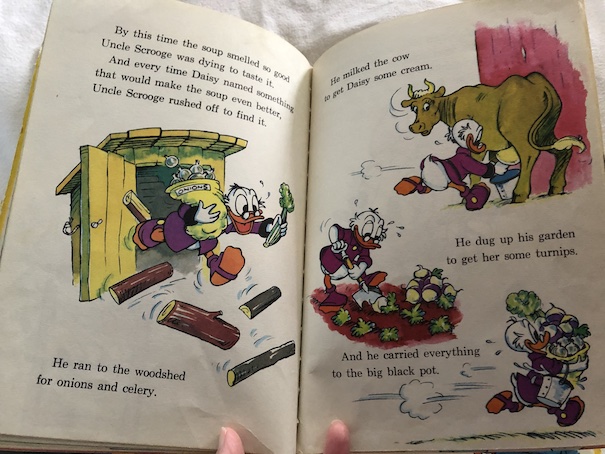
Each time that Daisy suggests another ingredient, Scrooge rushes to get it for her, eager to see what Daisy will do with the soup, which smells better and better as they go. (The pictures also show just how much food Scrooge is hiding. In reality, most of that would spoil before he could use it all, since he’s only feeding himself.)

When the soup is ready, Daisy points out that there is more than they’ll ever eat, so they should invite some other people to share it. Scrooge wants to save the soup in jars instead, but Daisy points out that it’s easy to make more because they did it with just one button.

They end up inviting the whole town to share the soup, and Scrooge is pleased that he has such a clever niece.

This book is available to borrow and read for free online through Internet Archive along with other versions of the story.

Stone Soup

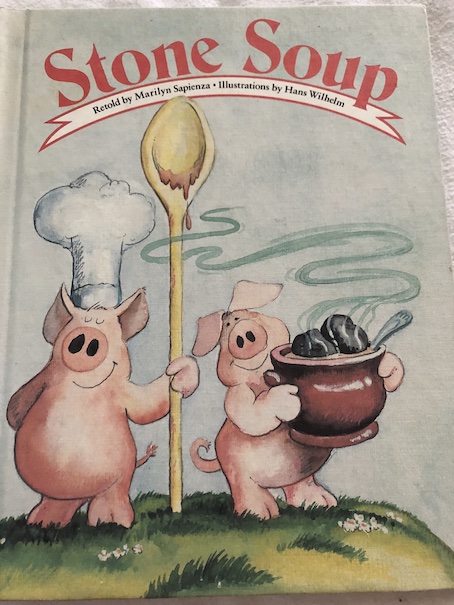
Stone Soup retold by Marilyn Sapienza, illustrations by Hans Wilhelm, 1986.

This is a retelling of a traditional folktale, sometimes called Stone Soup and sometimes Button Soup (and other names). The basic story is the same, but sometimes, it uses a stone and sometimes a button. All of the characters in this particular version of the story are represented by animals. Some of the pictures are in color, and some are black-and-white.

Max and Molly are backpacking across country, and they are getting tired and hungry when they spot a village. Hoping to get something to eat there, they decide to approach the villagers and ask for food.

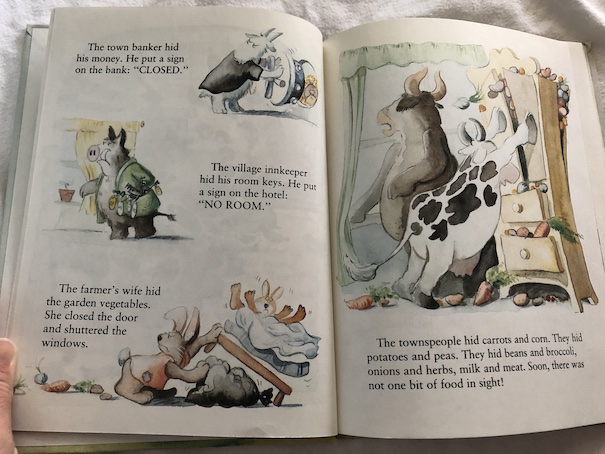
However, the villagers are not friendly, and the last thing they want is to share their food or anything else with strangers. As soon as they see Max and Molly coming, they quickly hide their food and anything else the travelers might want them to share. (I’m not sure why the innkeeper closes his hotel as soon as he sees potential customers coming. You can’t stay in the hospitality industry very long like that.)

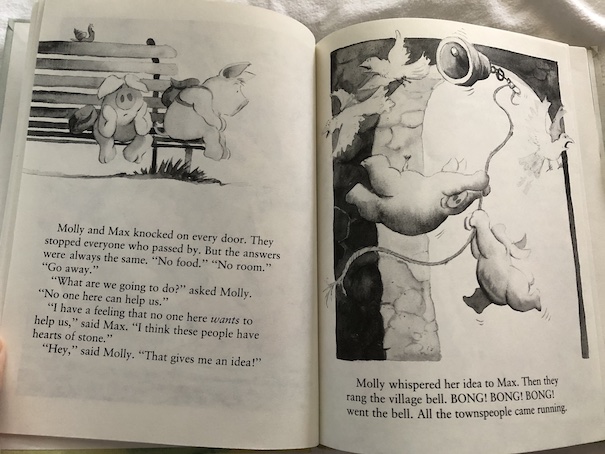
When Molly and Max get into town, all of the villagers pretend like they’re starving and refuse to help Molly and Max. However, they see through the villagers’ act and come up with a plan of their own.

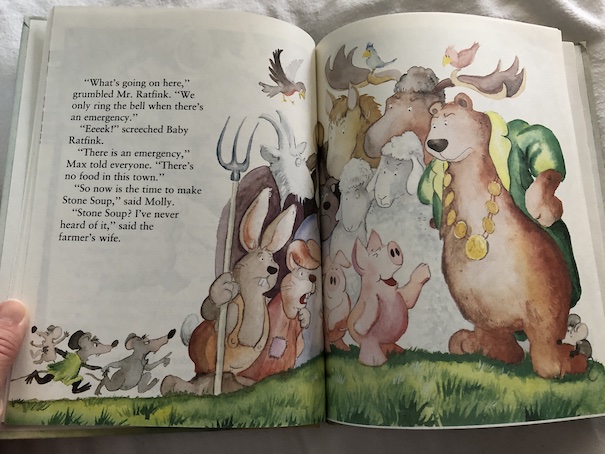
They ring the village bell to call of the people in the village. At first, the villagers are irritated because the bell is only for use in emergencies, but Molly and Max say that having no food is an emergency and that they have a plan to solve it. They are going to teach the villagers to make Stone Soup.

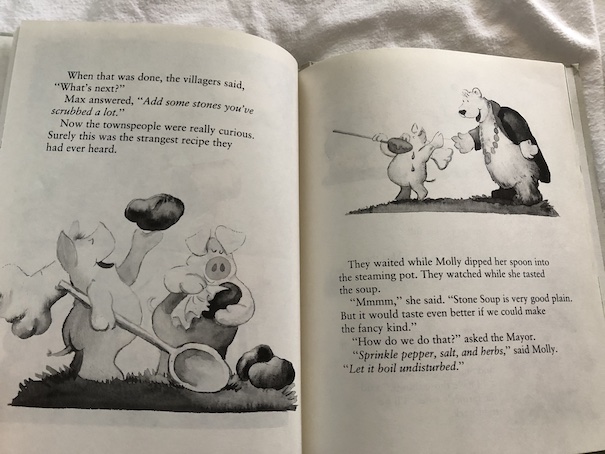
The villagers say that they’ve never heard of Stone Soup, and Molly says that it’s a secret recipe that she’s willing to share. It starts with a pot of hot water and some stones. Molly makes a show of tasting the “soup” and says that it’s good, but it’s even better if you make “the fancy kind.”

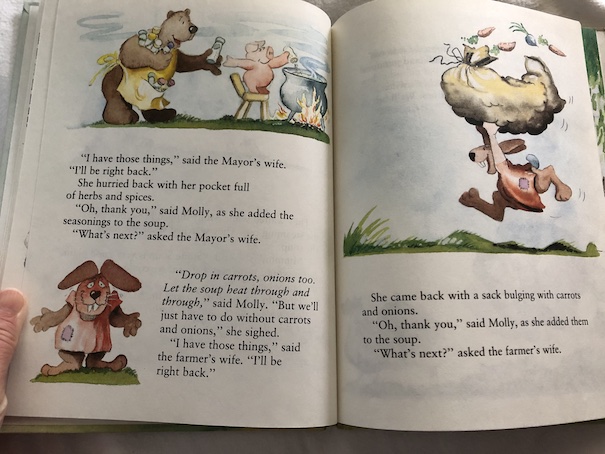
When the villagers ask how to make the fancy kind, she asks for some salt, pepper, and herbs. After the mayor’s wife supplies those, Molly asks for some carrots and onions. When she says that she supposes that they’ll have to do without them, the farmer’s wife steps up and offers some.

Little by little, Molly and Max coax the villagers into supplying other ingredients, almost without realizing what they’re doing. In the end, the Mayor of the village says that it’s the best soup he’s ever tasted, and it’s amazing, considering that it was only made with stones and water.

The moral of the story is that everyone benefits when people are wiling to share. Everyone gets a share of the soup, but when they start serving it, the villagers also provide other food to eat alongside it, and they all have a feast. The innkeeper gives Molly and Max a room for the night, and when they leave in the morning, they remind the villagers to “Share Stone Soup with everyone.”

In the back of the book, there is the complete recipe for Stone Soup, with rhyming steps. It doesn’t have details, like amounts and cooking times and temperatures, but I suppose someone could use these general guidelines to make an improvised soup. Really, I think the meat should be precooked if you’re adding it as a final ingredient. Otherwise, the veggies would be overdone before the meat is fully cooked.

There are many different versions of this story that have been made into picture books. I haven’t been able to find a copy of this particular book available to read online, but you can find various versions other versions of the same story online through Internet Archive.

Happy Birthday, Molly

American Girls

MollyBirthday

Happy Birthday, Molly! By Valerie Tripp, 1987.

MollyBirthdayEmily

Molly is excited because she has just learned that an English girl will be coming to stay with her family for a while.  The girl, Emily, is one of the child evacuees from London.  Really, she’s supposed to be staying with her aunt, who also lives in Molly’s town, but her aunt is in the hospital with pneumonia and won’t be able to take her for another couple of weeks.  In the meantime, Molly and her friends are eager to meet her, imagining her to be something like the English princesses, Elizabeth and Margaret Rose.

The girls have a fascination for England after all the things they’ve seen in movies and newsreels.  Recently, they saw a newsreel about bomb shelters in England.  Inspired by what they’ve seen, the girls make a pretend bomb shelter under an old table and enjoy pretending that they are like the people in the newsreel.  Molly’s brother, Ricky, says that it isn’t very realistic, and the girls say that they’ll have to ask Emily when she comes.

MollyBirthdayBlackOut

However, Emily turns out to be very shy and quiet.  She’s pale and skinny and hardly talks at first.  When the girls show her their “bomb shelter”, she doesn’t want to play in it.  Molly thinks that maybe Emily doesn’t like them, but her mother reminds her that, in World War II England, bomb shelters aren’t places to play.  Emily is the same age as Molly, and the war has been going on since she was a little kid.  Molly’s mother points out that Emily probably doesn’t remember much about life before the war.  Emily is accustomed to bombings and danger all around her, and Molly’s mother compares her to a flower “who’s not sure it’s spring yet.  It will take some time for her to realize it’s safe to come out now.”

Emily goes to Molly’s school, and their classmates are fascinated with her.  This fascination makes Emily even more shy than she would be otherwise as kids try to imitate her accent and ask her questions about what it’s like to see buildings bombed.  To the America kids, the war seems exciting, and they want to know what it’s like to see it up close, but Emily dodges their questions.

Molly finally comes to understand why Emily is so evasive when their town has a blackout drill.  When the drill starts, a siren sounds, and everyone has to go down into their basements until they get the signal that it’s all clear.  Molly is surprised to see that Emily is actually frightened by the drill, but everyone assures her that it’s just for practice, not because Illinois is actually going to be bombed.  In Molly’s family, it’s almost like a game, but Emily has memories of real bombings during the Blitz.  As they sit in the basement during the drill, Emily explains it to Molly: the fear, the explosions, destroyed buildings, people getting hurt or killed.  Molly and her friends thought it was exciting to hear about the war in newsreels, but living it is an entirely different thing.  The drill and everyone’s questions about what bombings are like bring back bad memories for Emily.

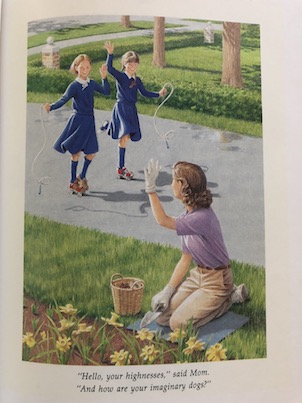
As Molly comes to understand Emily’s feelings more, Emily opens up to her.  The girls discover that they share a fascination with Princess Elizabeth and her sister Margaret Rose.  They start playing a game where they pretend to be the princesses, dressing alike in blue skirts and sweaters.  Because the princesses have pet dogs, the girls also pretend that they have dogs, using jump ropes as leashes for their imaginary pets.

MollyBirthdayPrincesses

Molly’s birthday is approaching, and she offers to let Emily share in her party and help plan it.  She’s curious about what people in England do on their birthdays, and the idea of an English tea party sounds great to her friends.  However, Molly doesn’t like the way that Emily describes English birthdays, and the types of sandwiches that the English tea with tea don’t sound very good.  Worst of all, Emily says that, at her last birthday before the war rationing started, she had a lemon tart instead of a cake.  Molly can’t imagine her birthday without a birthday cake.  Mrs. Gilford, the housekeeper, has been saving up rationed goods for her cake this year, and it’s what she’s been looking forward to the most!

Sharing things with Emily becomes more of a trial for Molly, and when the girls argue about their countries’ contributions to the war effort, they get into a fight and Molly starts thinking that she doesn’t even want Emily at her birthday party.  However, Molly’s mother points out to the girls that the war effort is a team effort.  A couple of special birthday surprises help the girls to make up, including something extra special that helps Emily to heal further from the trauma of the war.

In the Molly, An American Girl movie, Emily plays a larger role than she did in the books.  This is the only book in the series where Emily appears.  Her story was changed somewhat for the movie, too.  In the movie, she says that her mother was killed in a bombing.  In the book, her parents are both still alive, and it was her dog who was killed.  Molly doesn’t learn that until the end of the book when her family gives the girls a pair of puppies as a present, and Emily tells her about her pet dog who died.

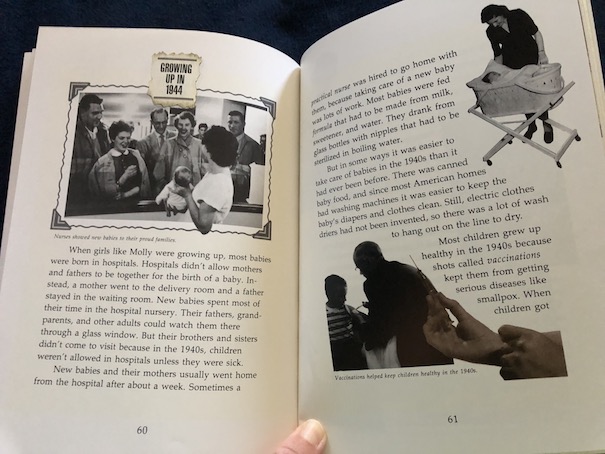
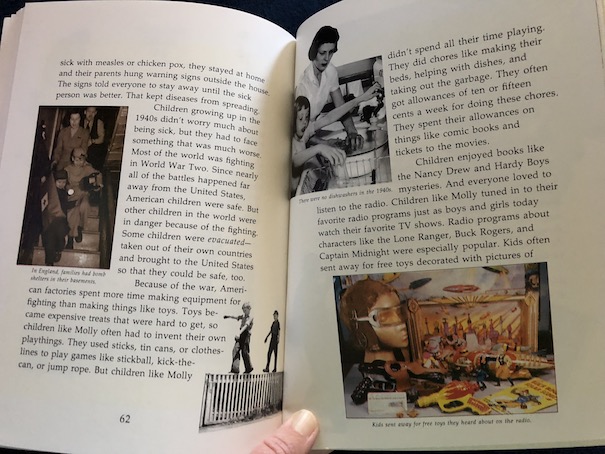
In the back of the book, there’s a section with historical information about what it was like to grow up in the 1940s.  It explains how women used to stay in the hospital for about a week after giving birth, and sometimes, they could hire a practical nurse to help them at home as well.  Canned baby food was a new invention, and vaccines helped to prevent disease.  Back then, people still got smallpox shots because the disease hadn’t been eradicated, but there was still nothing to prevent chicken pox or measles, so children with those diseases had to be kept at home with warning signs out front to tell people to stay away from the quarantined house.  (Note: My father was born in 1944, the year that this series takes place, and he said that throughout his early childhood, parents who knew of a child who had chicken pox would deliberately take their children to visit and get the disease.  It wasn’t that they really wanted their children to get sick, but since there was no way to prevent the disease at the time, they had to accept that it was inevitable that their child would catch it eventually, and chicken pox is somewhat peculiar in that there is a kind of age window in which the disease isn’t likely to be too bad.  If you waited too long, and the child got older or even to adulthood without getting it, it was bound to be much worse when they eventually caught it.  So, if your child was about the right age for getting it, in early childhood but no longer a baby, people thought it was best to get it over with so they could benefit from the lifetime immunity afterward.  This remained true even up through the 1980s, my early childhood, which is why I have a permanent scar on my face from the disease.  Now, there are vaccines to prevent it, although I understand that some people still have chicken pox parties in places where the vaccine isn’t readily available. If you have the option, go for the vaccine.  Preventing chicken pox also prevents shingles.)

MollyBirthdayHistorical1

The historical section also talks about child evacuees, like Emily, and what teenagers did during the 1940s.  It was around this time that people began looking at the teenage years as being a distinct phase of life, and businesses began specifically catering to teenagers.

The book is currently available online through Internet Archive.

MollyBirthdayHistorical2