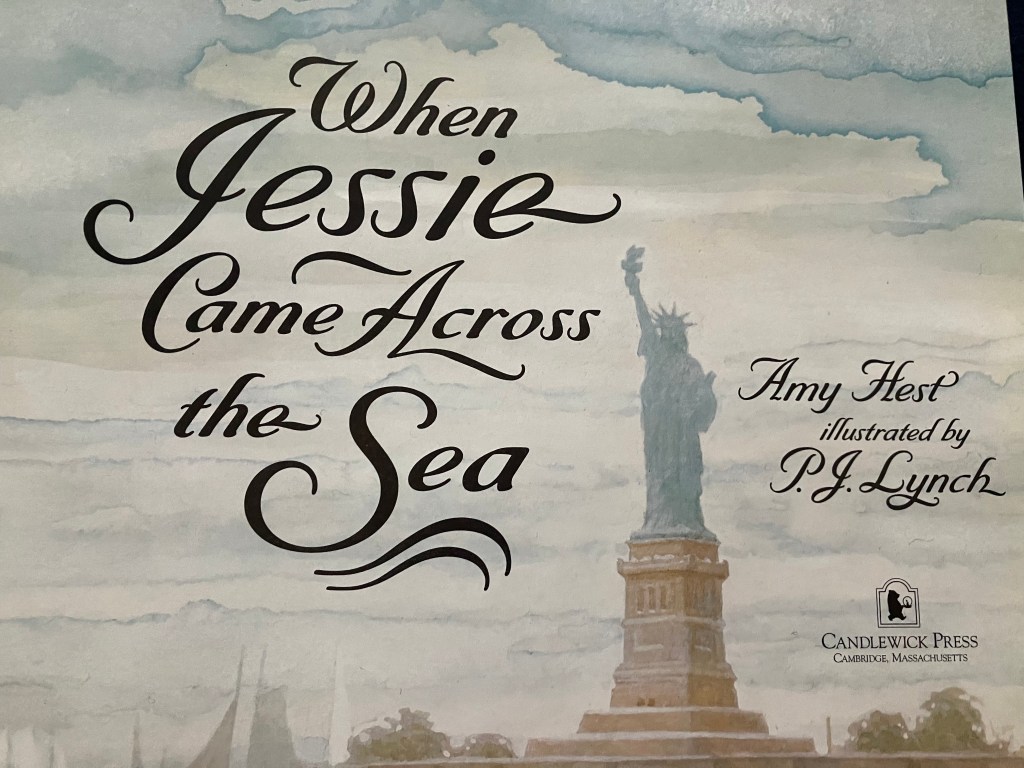
When Jessie Came Across the Sea

Jessie and her grandmother live in a small, thatched cottage in a small village. The little village is poor, and so are Jessie and her grandmother. Jessie’s parents died when she was a baby. Jessie’s grandmother raised her, and she insists that Jessie have lessons with the village rabbi, like the boys in the village. Jessie can read and write, and she also tries to teach her grandmother. Her grandmother makes a little money by sewing lace, and she teaches Jessie how to sew. Although they don’t have much, they are basically content with their lives.

Then, one evening, the rabbi makes an important announcement. His brother, who was living in America, has died. Before his death, he sent a ticket for a ship traveling to America to the rabbi, asking him to join him in America. Now that his brother is dead, there is no need for the rabbi to go to America, and he would rather stay in the village with his congregation. However, he thinks that someone else should use the ticket his brother sent.

Various villagers ask rabbi if they can use the ticket, offering reasons why each of them would be the best person to go. They brag up their best qualities, boasting about how strong, smart, and brave they are. The rabbi knows that they’re boasting, so he just tells them that he will pray about it and let them know his decision tomorrow.
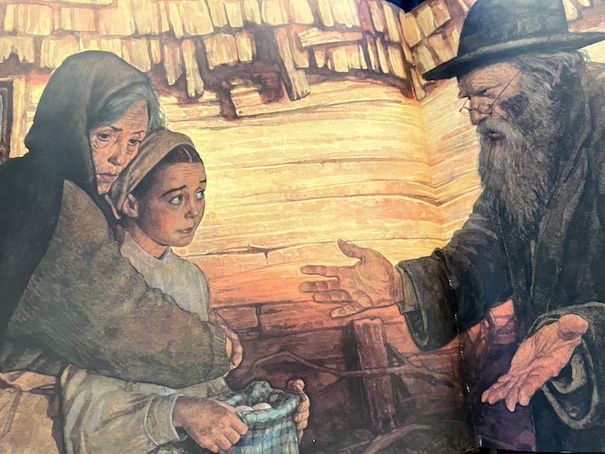
The next day, he goes to see Jessie and her grandmother and tells them that Jessie should be the one to go to America. His reasoning is that his brother’s widow owns a dress shop in New York City. Jessie can work there, and she would be a comfort to a lonely widow. Jessie doesn’t really want to leave her grandmother, and her grandmother fears to send her, but her grandmother can see the rabbi’s logic. She knows that this is an important opportunity for Jessie.

So, Jessie leaves her village and sets sail on a crowded ship for America. On the ship, Jessie is scared, lonely, and seasick. As Jessie spends time with the other passengers, she makes a few friends, and she sews a few small items for them. A boy named Lou, who is a shoemaker’s son, makes a pair of small shoes for a baby, and he and Jessie also become friends.
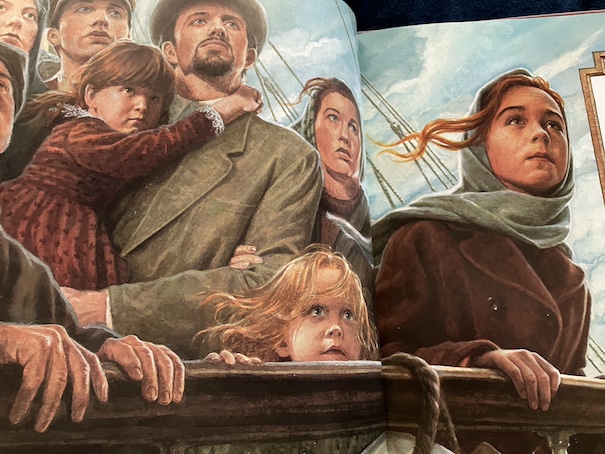
Finally, their ship arrives at New York. Everyone crowds around the rails of the ship to see the Statue of Liberty and their first glimpse of America. The ship docks at Ellis Island, and the passengers disembark to be inspected and questioned by immigration officials.
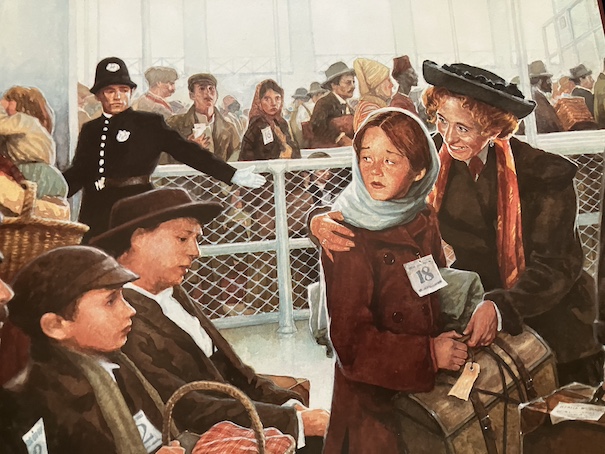
The rabbi’s brother’s widow comes to meet Jessie. She is a friendly woman, and she asks Jessie to call her Cousin Kay. Cousin Kay shows Jessie around the city. It’s a crowded, confusing place with fascinating sights, although the streets aren’t paved with gold, as Jessie has heard. Cousin Kay runs the dress shop out of her home, and she pays Jessie to sew for her. Jessie likes watching the busy street outside while she sews, and she saves the money she earns in a jar.

When Jessie puts some lace on a plain white dress, turning it into a lovely bridal gown, the shop becomes popular with young women who are getting married and looking for similar gowns.

Cousin Kay also insists that Jessie go to school and learn English. It isn’t easy, but Jessie learns. She likes walking around the city and going to the local library. Gradually, Jessie begins feeling more at home in New York, and she builds a new life for herself there. One day, she runs into Lou again in the park, and they begin meeting there regularly. Lou proposes to Jessie, and Jessie uses the money she has saved to buy a ticket so her grandmother can come to America for their wedding.

The book is available to borrow and read for free online through Internet Archive.

I remember reading this book when I was young! I was really older than the target audience when it was first published, but I enjoyed the story. It’s one of those books that I think takes on more significance when you’re older and understand more of the history behind the story. We don’t know exactly where Jessie is from because the book never says, but her journey resembles the kind of journey that many people made during this same period of history. We don’t know the year, either, but it appears to be set in the late 19th century or early 20th century.

Although coming to a strange country, alone and unable to speak the language, is a scary experience, Jessie is fortunate because there is a friendly and caring person waiting there for her, and she has a job lined up that suits her skills. In real life, not everyone was so fortunate, and it was more of a struggle for them to get established in their new home. Jessie still has to struggle with homesickness and missing her grandmother, but her life changes for the better because she took the chance to go to a new country and start a new life. Readers can emphasize with Jessie’s fears and uncertainty as she starts out on her journey and celebrate with her when things work out for the best.

The pictures in the book are beautiful! Readers really get the sense that they’re seeing another time, with Jessie’s tiny village, the crowded ship in the rain, and busy New York City, more than 100 years ago. Even when the environment and circumstances are harsh, the pictures are charming.

There is a note in the beginning of the book for parents and teachers about how they can use this book to spark discussion with children. They can use the opportunity to invite children to learn how their own families arrived in America, because this book was originally intended for an audience of young American readers, and most people who live in the United States (with the exception of Native Americans) are descended from people who came from somewhere else. It’s an opportunity for children to learn their family’s history and to see how it compares with that of other people, whose families also made a decision to come here and start over, going through their own struggles along the way. There is also some general advice about sharing books with children, and making a point of surrounding children with books and reading aloud to them.
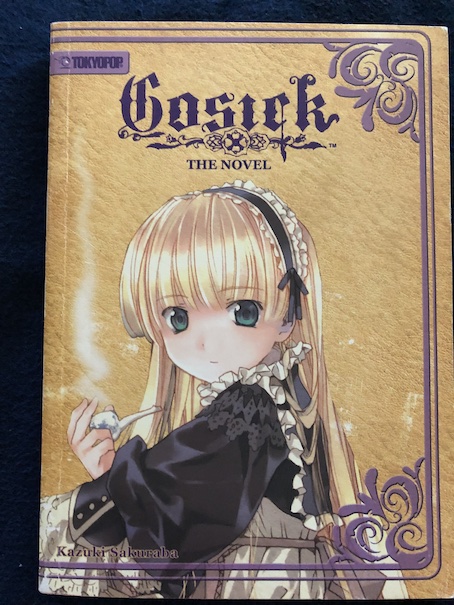
Gosick: the Novel

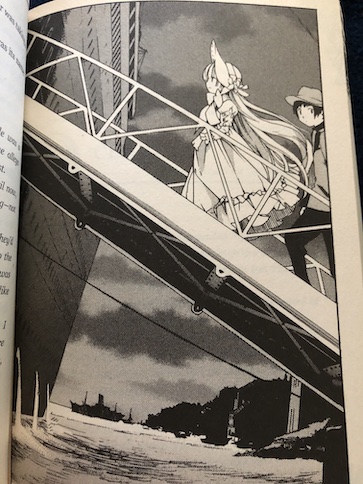
The year is 1924, and a boy from Japan named Kazuya Kujo is attending a prestigious boarding school called Saint Marguerite Academy, in the small European country of Sauville (fictional). The students at this school have an obsession with ghost stories. Kazuya is a very serious boy, and he doesn’t see the appeal of all of these gruesome stories, although his friend, Avril Bradley (an international student from Great Britain) loves them and insists on sharing scary stories with him. Part of the reason why Kazuya doesn’t like all the scary stories is that other students insist on calling him “the Reaper” based on a character from one of the more popular ghost stories. However, he’s not the only student at school who stands out, and some of the school’s ghost stories have more truth behind them than Kazuya would have dreamed.

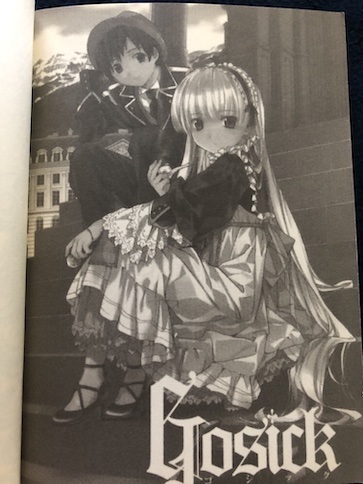
There is one seat in Kazuya’s class which is always empty. That seat belongs to Victorique, and Kazuya is one of the few people at the school who has ever seen her. Victorique never comes to class, preferring to spend her time reading and studying by herself in the conservatory at the top of the library. One day, when their teacher gives Kazuya some papers to take to Victorique, Avril tries to ask Kazuya what Victorique is like. Kazuya doesn’t want to explain much about Victorique, just saying that she can be blunt and kind of mean, which is true. Victorique is brilliant, a child genius, and she looks like a little china doll, but she’s not easy to get along with. She’s temperamental and not used to dealing with other people in general. She smokes a pipe, like Sherlock Holmes, and makes deductions using her “fountain of knowledge”, even about places she hasn’t been and things she hasn’t witnessed, like Nero Wolfe.

Victorique is not allowed to leave the school grounds (for reasons which are explained as the series continues), and aside from Kazuya, there’s only one other person who visits her: her older half-brother, a local police detective. He never admits that he gets help from Victorique on his cases, and he typically prefers to act like he’s talking to Kazuya rather than speak to Victorique directly. Victorique, who is often bored, enjoys solving puzzles and mysteries, so she does give her brother help, although there is little affection between them.

One day, Victorique’s brother, Grevil de Blois, comes to consult with her, through Kazuya, about the murder of an elderly fortune teller. After hearing a description of the murder, Victorique correctly realizes that the fortune teller was killed by her maid. However, that isn’t the end of it. Kazuya thinks that it’s unfair that de Blois always takes the credit for Victorique’s solutions to mysteries. This time, when he finds out that the grateful family of the fortune teller has given de Blois a yacht as a present and that he’s planning to spend the weekend on it, Kazuya decides that he’s going to make de Blois share this present with Victorique. Victorique is normally forbidden to leave the school grounds, but with Kazuya threatening to reveal the true secret of his success, de Blois agrees to take Kazuya and Victorique with him on the weekend yachting trip. Neither of the two kids really likes de Blois, and the thought of spending an entire weekend with him, even aboard a luxury yacht isn’t great, but it is one of the rare opportunities Victorique has to leave the school.

Victorique has rarely been anywhere other than the mansion where she was born and the school, so everything is new and fascinating to her as they take a train to the seaside to meet de Blois at the yacht. When they get there, de Blois informs them that they’ve been having trouble understanding the maid who murdered the fortune teller because she only speaks Arabic, but apparently her motive was revenge for something she calls “the box.” Then, de Blois suddenly gets word that the maid has escaped. He has to leave the kids aboard the yacht, but he tells them to just stay there and wait for him.

Victorique realizes that the yacht once belonged to the fortune teller and that some of her belongings are still on it. Among them, they find a strange invitation to a dinner party called “Evening at the Bottom of the Box” on a luxury cruise ship anchored nearby. The invitation also mentions that the main dish will be rabbit. This is chilling because it is known that the fortune teller kept rabbits and periodically allowed her dog to hunt them. It was part of her fortune telling – she would predict things based on which rabbits survived the hunt and which did not. (There is a graphic description of this at the beginning of the book that I hated. Although I found the overall mystery intriguing, there are some very gross and violent things in it.) Since they are bored and want to learn what the mystery is about, Victorique and Kazuya decide to use the invitation and attend the dinner in the fortune teller’s place.

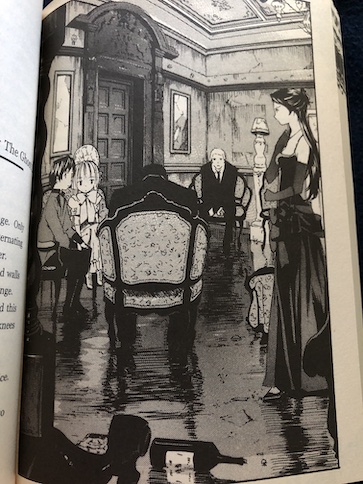
When Victorique and Kazuya join this mysterious dinner party on the luxury ship, Kazuya suddenly recognizes that the name the of ship is the same as the one of a ghost ship in one of the scary stories that Avril told him at school! The ghost stories that have been going around the school have more truth to them than Kazuya or even the students who are obsessed with them have guessed. Some dark things have happened in the history of Sauville which have become part of its local legends. Events that resemble the ones that happened years before and are described in the ghost story are starting to repeat themselves. There is at least one murderer among the dinner party guests, and someone is playing a deadly game. Now, Victorique and Kazuya will have to play along to find the answers and save their own lives!

This is the first book in the Gosick series of Japanese light novels and one of only two that were published in English. There is a full set in Japanese, of course, and I think the German language translation is also a complete set. There is an English translation of this first book available to read for free online at Internet Archive. Because not many copies were published in English, English copies are collectors’ items and can be expensive. As of this writing (September 2023), the cheapest copies on eBay are about $30, and they can go for much higher on Amazon. All of the stories in the series have been made into an anime, and that is available in the US on Amazon Prime. Because of the violence in the story, I would recommend this book and the anime for teens or young adults. It’s not for young kids!

This was the first book in this series that I read, one of only two published in English. The first time I read it, I was surprised at how many tropes of old ghost stories and detective stories that the series references. Victorique uses a pipe, which is an obvious reference to Sherlock Holmes and his famous pipe, but Victorique is also frequently a Nero Wolfe type of detective, relying on an assistant to go places that she can’t go and give her information. She spends most of her time amassing knowledge through reading, and she is able to use that knowledge to make order out of the “chaos” of a mystery.

The basis of this mystery is in fortune telling, and at the beginning of the story, Victorique is reading a book about fortune telling. She explains to Kazuya Kujo how fortune telling actually works. Basically, it’s all about psychology. People think that fortune telling works because they believe it will work, and they make things happen to cause the predicted future to happen. It’s like all prophecies are self-fulfilling prophecies – they may or may not have happened except that people believed that they would, so they made sure they did. People remember and record accurate predictions because those are the most exciting and amazing, and they forget all the inaccurate ones. Fortune tellers are also good at reading people and telling people what they want to hear, which is what they already think will happen or what they’re hoping and working to make happen.

Fortune telling is at the heart of the mystery. Mysteries in this series tend to have over-the-top plots, and this one is no exception. The grudge against the fortune teller and the other guests invited to the dinner goes back to when the fortune teller staged a very large experiment in fate at the request of some very wealthy and influential clients. This past fortune telling experiment was along the lines of the ones that she did with rabbits, only it was with human children. As I said, there are violent and gruesome aspects of this story, and in this case, they were playing with human lives.

As with other books and stories in this series, the ghost stories that the kids pass around at school turn out to have at least some basis in fact. Sauville (remember, it’s a fictional country) and some of its leading citizens have violent histories. There is a long history of conspiracies, power struggles, and general skullduggery in this place. Because of the citizens’ long obsession with stories and legends, much of what has happened there has become legendary, and important people have used the citizens’ superstitions and stories to obscure the truth. Solving the crime means exposing what really happened and the truth behind the legends.

What I found most interesting about this story was its references to some classic characters in detective fiction and ghost stories, and I appreciated Victorique’s thoughts on the nature of fortune telling and human expectations. In the end, it may be more important what people believe and work to make true than what was actually predicted. However, I have to admit that the over-the-top plots of these mysteries are probably a large part of why this series wasn’t printed beyond the second book in the United States. In the beginning of the book, there is also a reference to Kazuya being suspected of a crime. This incident was in the Gosick manga, not the light novels. It is shown in the anime, but I don’t think the manga was printed in English.

Blue Bay Mystery

The Boxcar Children

#6 Blue Bay Mystery by Gertrude Chandler Warner, 1961, 1989.

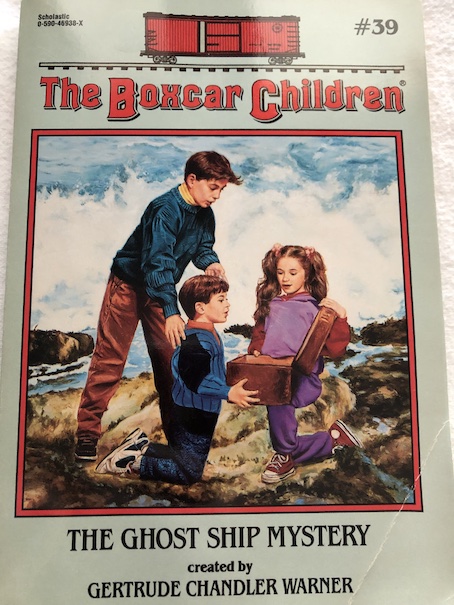
Grandfather Alden has a surprise for his grandchildren. He is arranging a special trip for them as an extension of a business trip of his. A business associate of his, Lars, has a ship going to Tahiti, and he offered to let them come along. However, rather than just having a tour of Tahiti, which would be pretty exciting by itself, Lars is going to take them to camp out on a tropical island. Lars found this island while escaping from a shipwreck himself. No one lives there, but there is plenty of fresh water and edible plants and no dangerous animals. Not every family would like to be on an uninhabited island when they could be in Tahiti, but the kids love camping out and do-it-yourself activities. Grandfather Alden has also invited the children’s friend, Mike Wood (who was introduced in a previous book), to join them. Mike is the same age as Benny.

The trip will take place during the school year, so their grandfather has arranged for the children to bring along some school supplies and lessons to study while they’re on the boat to the island. The lessons help not only to pass the time while they’re traveling but also to enhance it. They have science lessons about marine animals and how parts of the ship, like the radio room, work. Violet tells the others about how she’s been reading about Captain Cook and how he realized that eating certain types of food, like citrus fruit and sauerkraut, helped to prevent scurvy, even though he didn’t realize that the reason is that those foods are rich in vitamin C.

Once they reach the island, their grandfather says that they won’t have time for school lessons because they will have to set up their shelter and learn how to fish and forage for food, although he considers those to be educational lessons as well. They bring some supplies and tools with them so they won’t have to forage for everything, but the kids like assembling their own shelter and improvising things, like they did when they made their own home in a boxcar in the first book. They eat out of shells they find, whittle their own spoons, and use a huge turtle shell they find as a cooking pot.

However, they soon realize that they are not as alone on the island as they thought. Some of their food disappears, and they find some colored stones arranged in patterns. There is a stone with a carved face, sort of like the Easter Island heads, and the turtle shell they find has been carved with a knife. Later, they encounter a myna bird who keeps repeating the phrase, “Hello, Peter!” Someone taught the bird the phrase in English, but who is on the island, and why does this person seem to be hiding from them?

The book is available to borrow and read for free online through Internet Archive (multiple copies).

My Reaction and Spoilers

In the early Boxcar Children books, the children aged as the series progressed. After the death of the original author, when other authors continued the series, the children became frozen in age, but this book is one that was written by the original author. At the beginning of the story, the children’s grandfather mentions that the two oldest children, Henry and Jessie, are in high school, showing that they’ve aged about two or three years from the first book. This remark about the children’s ages only appears once at the beginning of the book, and their increasing ages aren’t really reflected in the story. The lessons the children have on the boat seem to be roughly about the same subjects, although it seems like the children’s lesson books aren’t identical because Violet seems like she’s the only one with the lesson about Captain Cook and scurvy.

This book also varies a little from the other books in the series because the children’s grandfather plays a larger role than usual. One of the hallmarks of the Boxcar Children books is that the children usually do things by themselves, with as little adult help or interference as possible. However, this time, their grandfather is with them on the island, sharing the adventure with them.

As with other vintage children’s mystery series, the early books of this series sometimes lean more toward adventure than mystery. The mystery in this story is pretty light, and the solution is pretty straight-forward. The children eventually find the person who’s camping out on the island with them. The person turns out to be a boy who was also shipwrecked. There was an adult sailor with him before, but the boy, Peter Horn, says that he went swimming one day and never came back, so he’s been alone ever since. The others say that he might have been attacked by a shark but they don’t dwell on it very long, as they do any time someone’s death is mentioned in one of the books in the series, so it doesn’t get too sad. Peter says his parents went overboard while they were escaping the shipwreck, and he doesn’t know whether they’re still alive. Mr. Alden says that he read about some people being rescued from a shipwreck, so it’s possible that they’re still alive. When they return to the mainland, Peter is reunited with this parents for a happy ending.

The Ship That Never Was

ShipThatNeverWasThe Ship That Never Was by Mickey Spillane, 1982.

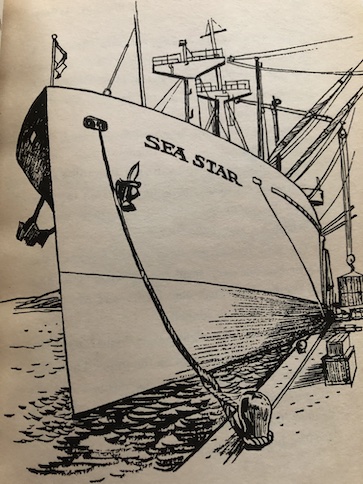
Larry Damar and Josh Toomey are sailing in a boat off the coast of Peolle Island in the Caribbean when they rescue an old man from what seems to be a skiff. But, as soon as they get him aboard their own boat, they realize that what they thought was a skiff is actually more of a long boat, and it looks old. Very old.

They take the old man, who is suffering from exhaustion, to their fathers. While the old man rests, they inspect the boat and confirm that it is an antique. Oddly, from the condition of the wood, they believe that it has been resting in water for some years, but not salt water. It’s the kind of longboat that would have been carried aboard larger naval ships from a couple hundred years earlier. The name on the side of the boat, HMS Tiger, is familiar, but they heard that it was lost at sea ages ago. The old man is also carrying what appears to be some very old documents, but they are unable to read them, and when the old man speaks, they’re not quite sure what language he’s speaking.

They send a message to Sir Harry Arnold at the antiquities department of the British Naval Archives about the boat and the old man. When he arrives, he confirms that the longboat came from the HMS Tiger, a three-masted ship built in England in 1791. The Tiger was considered a jinxed ship because of everything that went wrong during its construction and its maiden voyage. Because of that, no one wanted to sail on it again or even work on the ship to dismantle it. So, the builder decided to send the boat on one last voyage by itself. He and his men loaded up the ship with supplies as if it had a crew aboard and then set it adrift, watching it sail off majestically, without a crew. Everyone had assumed that it would have eventually sunk, damaged by the weather, but apparently, it survived for longer than anyone had suspected.

Since no one can understand his language, the old man, who calls himself Vali, draws pictures to explain to them where he came from. Vali indicates which island he came from, and according to his other drawings, he lived there with many other people until many of them were killed in some kind of storm. He also draws a picture of a young girl with a crown on her head. Then, Larry’s dad, Vincent, recognizes the seal on a signet ring that Vali shows them. Vincent has read about the history of the country of Grandau (fictional country), and he recognizes its royal seal.

About 200 years before, Grandau was overrun by a neighboring country. Members of the royal family of Grandau escaped the invasion along with some loyal servants and tried to flee across the Channel to England to seek sanctuary. However, they were only in an old fishing boat, and it was thought that it sunk in a storm before they reached England because such a small craft would be unlikely to have survived. Grandau has not been a happy country since then. Over the years, they have been ruled by a series of dictatorships, and it has been in an almost constant state of unrest.

Now, the presence of the longboat from the HMS Tiger presents a much more intriguing theory of what happened to King Tynere of Grandau and his people. By an unbelievable coincidence (your suspension of disbelief is required for this story), the royal family’s attempted escape to England happened around the same time that the HMS Tiger was sent off alone and fully equipped for its final voyage. It now seems that the desperate people on the fishing boat were saved by encountering this grand, unmanned ship that no one else wanted, that everyone feared was jinxed. Grandau was not a seafaring nation, so the people were probably unable to actually sail the ship, simply letting it drift until they found land. Eventually, they arrived at an island in the Caribbean, and their descendants have been living there ever since in anonymity, until the disaster that prompted Vali to risk venturing out for help.

Unfortunately, their attempts to determine what language Vali was speaking and where he came from have also come to the attention of the wrong people. The government currently in power in Grandau has been working hard to stamp out the history and culture of the country in order to tighten its hold on the people, although their hold has never been more than tenuous, just like all the other dictatorships since Grandau’s royal family fled. Now that word has reached them that members of the royal family that the people of Grandau mourn may actually still be alive, they are determined to eliminate them before they can return to their ancestral home.

The author of this book, Mickey Spillane, is best known for his Mike Hammer series of hard-boiled mysteries for adults, and some of his hard-boiled style shows in this adventure book for children. This book is also part of a short series, although I don’t have the first book, The Day the Sea Rolled Back. In that book, Larry and Josh are helping their fathers hunt for sunken treasure, but their efforts are being sabotaged by a pair of treasure-hunting brothers.

Mystery Aboard the Ocean Princess

MysteryOceanPrincessMystery Aboard the Ocean Princess by Robin Gottlieb, 1967.
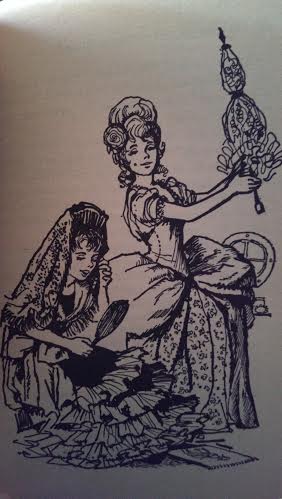
Jill Washburn is about to make her first trip to Europe on the same ship as a priceless painting!  Her Uncle Chow and Aunt Rose have invited her to accompany them on the cruise ship to Europe over the summer because her cousin Connie isn’t enthusiastic about the trip, and they thought that the girls would be good company for each other.  Lately, Connie has been trying to act ultra-sophisticated, declaring anything and everything that she doesn’t think is cool to be simply “tedious” (Connie loves big words, and “tedious” is her pet word).

Jill is fascinated by the presence of the famous painting on the ship, a painting of a young Spanish prince by Goya, “Don Manuel Osorio de Zuñiga.”  Jill loves art, and her ambition in life is to be an art teacher, like her father.  She has also read about recent art thefts in the newspaper and wonders whether Don Manuel is at risk during its journey.  She can’t help but seek out the room where the painting is kept and talk to one of the guards about security.  The guard just tells her that he appreciates her concern but that everything is under control.  But later, Jill finds the guard meeting secretly with a mysterious man by the lifeboats.

MysteryOceanPrincessPicCould the two men be plotting to steal the painting?  Jill persuades Connie to help her investigate and spy on the them, but things aren’t what they seem.
A mysterious gift left in Uncle Chow and Aunt Rose’s cabin frames Jill’s aunt and uncle for art theft.  Although Connie thinks their snooping has caused enough problems already, Jill thinks that the only way to clear their names is for her and Connie to find the real thieves.  With the ship’s costume ball coming up, Jill comes up with a daring scheme to get the thieves’ attention and hopefully get them to reveal themselves.  One thing is for sure: Connie was wrong about this trip being “tedious.”

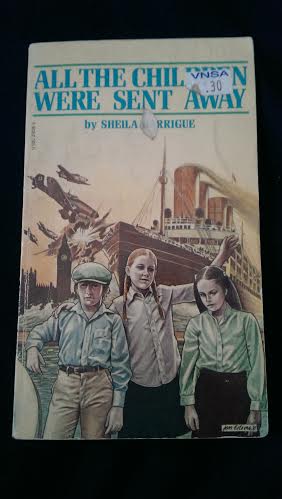
All The Children Were Sent Away

It’s 1940, and Sara Warren’s parents are sending her to stay with her uncle in Canada until the war is over.  With the increasing bombings of England, her parents have decided that it’s just too dangerous for Sara to stay, and her uncle has written, asking them to send her.  Many other British families are sending their children away to escape the bombings, and Sara travels to Canada on a ship with other British child evacuees.  All of them are worried about the families they’ve left behind and what it’s going to be like, living in another country.  They also worry about whether or not they’re ever coming back.

Sara’s escort for the trip is Lady Drume.  She is a bossy, over-bearing woman with very definite ideas about how children should be raised.  She doesn’t like Sara to talk to the sailors on the ship because they can be “impertinent,” and she doesn’t want her to play with the other children because they’re “guttersnipes!”  She even refuses to attend the lifeboat meeting or let Sara go without her!  To Sara’s mind, Lady Drume is as bad as any Nazi.

Sarah still manages to make friends with some Cockney children, Ernie and Maggie, seeing them whenever she can get away from Lady Drume, and an old sailor called Sparky makes sure that she understands safety on board the ship and attends the lifeboat drills.

But, when Lady Drume forces Sara to cut her hair after she’s been waiting so long for it to grow out, Sara decides that’s the last straw!  With the help of her friends, Sara hides from Lady Drume on the ship.  In the process, she learns something about Lady Drume which changes some things for the better, although it takes an outbreak of measles for Lady Drume to really understand and appreciate Sara.

This book is available to borrow and read for free online through Internet Archive.

Part of trouble with Lady Drume and her behavior is that she’s actually very afraid.  She doesn’t like to talk about lifeboats or life jackets because the war and the possibility of sinking frighten her.  She deals with problems by being brusque and trying to ignore frightening things, charging on ahead with whatever seems like a practical course of action to her.  It’s not even just the war but the changing world around her that frightens Lady Drume, a woman who’s used to knowing who’s who and what’s what and getting things done the way she likes them.  But, the rigors of their journey and their mutual vulnerability when they’re sick help lower Lady Drume’s barriers.  Lady Drume isn’t a bad person, and in the end, she arranges a special surprise for Sara to make her exile from England more bearable.

The end of the story is a brief section explaining Sara’s return to England, having been away for a few years, and her feelings at seeing how England and her parents have changed during that time.

There is a sequel to this book that shows what happened during Sara’s time in Canada called The Eternal Spring of Mr. Ito.  It focuses on suspicion of Japanese people following the bombing of Pearl Harbor.  There were Japanese internment camps in Canada as well as the United States during World War II.

Sheila Garrigue’s books about child evacuees from England were partly based on her own experiences as a child evacuee during World War II, as explained in her obituary after her death in 2001.