The Egyptian Cinderella

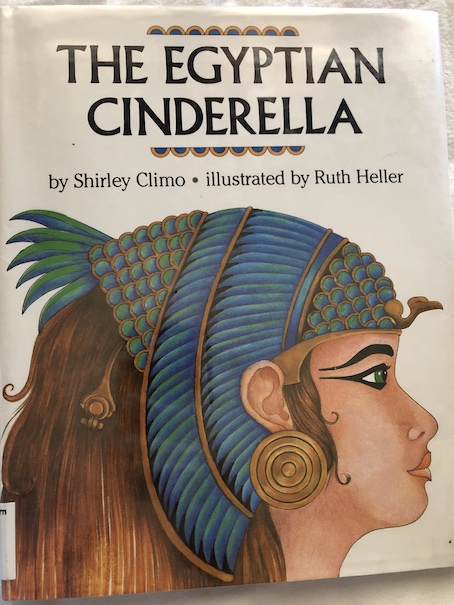
The Egyptian Cinderella by Shirley Climo, illustrated by Ruth Heller, 1989.

Rhodopis is a slave girl in Egypt. When she was young, she was abducted from her home in Greece by pirates, who sold her into slavery. Her blonde hair and green eyes make her look very different from the Egyptian servants, and none of them like her.

Most of Rhodopis’s friends are animals, and in the little free time she has, she likes to dance. The elderly man who owns her sees her dancing and has a special pair of rose-red gold shoes made for her so she can wear them while she dances. However, the Egyptian servants are all jealous of her for getting this special gift.
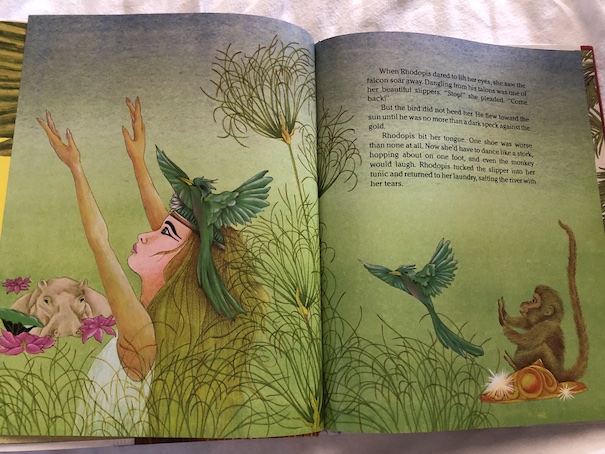
One day, the servants all leave her behind when they go to a special court held by the Pharaoh. While they are gone, a falcon snatches one of Rhodopis’s slippers and flies away. The falcon flies to the court and drops the slipper in the Pharaoh’s lap. The Pharaoh takes this as a sign from Horus that the girl who owns that shoe is destined to be his wife and immediately begins searching for her.

When he finds Rhodopis, the servant girls protest that she is not Egyptian and is only a slave, but the Pharaoh compares her green eyes to the color of the Nile, her light hair to papyrus, and her pink skin to a lotus flower. In his eyes, there could not be any other girl who could represent Egypt, and her slave status doesn’t matter.

The book is available to borrow and read for free online through Internet Archive (multiple copies).

My Reaction

I remember loving this book when I was a kid! I always liked fairy tales and folktales, and I think this was one that was introduced to me by our school librarian, probably around the time it first came out in 1989. For a long time, I was unaware that the same author also wrote other books based on variations of the Cinderella story: The Korean Cinderella, The Persian Cinderella, and The Irish Cinderlad. One of the fascinating things about the story of Cinderella is that variations of the story about a girl (usually, it’s a girl, although there are some variations with a boy) who is abused by her stepmother and stepsisters but who triumphs in the end when she marries a king or a prince, who identifies her as the girl he loves by a lost shoe, have appeared in cultures around the world. The classic one that most of us know is the French version by Perrault, but there are other versions of the story that are older.

There is an author’s note in the back of the book that explains that this Egyptian version of the Cinderella story is one of the oldest known Cinderella stories. The Roman historian Strabo recorded the story in the first century BC. The story is legend, but according to the author, Rhodopis was a real slave girl who married the Pharaoh Amasis in the sixth century BC (although accounts of her vary, and it can be difficult to separate history from legend).

The Elves and the Shoemaker

The Elves and the Shoemaker story adapted by Lucy Kincaid, illustrated by Gillian Embleton, 1981.

I loved to read this folktale when I was a kid! This particular copy was made specifically for beginning readers with large type and a section in the back that shows key words in the story with little pictures to explain what they mean. Aside from my nostalgic associations with this book, I also really enjoy the detailed, realistic pictures.

There was a shoemaker who worked very hard but never seemed to get much money for the shoes he made. He and his wife are on the verge of starvation, and he only has enough leather to make one final pair of shoes.

Before going to bed, he cuts out the leather for the last pair of shoes, planning to sew them in the morning. However, in the morning, he discovers that someone else has already sewn the shoes together, and the shoes are very fine quality. The shoemaker has no idea who finished the shoes for him, but they did an excellent job, and he is able to sell them for enough money to buy food and enough leather for two more pairs of shoes.

Once again, he cuts out the leather for the shoes, and again, in the morning, he discovers that someone else has sewn the shoes together. The shoes are excellent, and he is able to sell them for enough to buy leather for four more pairs.

This continues night after night, and the shoemaker’s business begins to prosper, but he and his wife wonder who is helping them. One night, they hide and watch to see who will come to do the sewing. As they sit up, waiting, they see a pair of small elves who enter through the window and begin sewing the shoes together.

The shoemaker and his wife want to thank the elves for their help. Noticing that the elves are wearing ragged clothes and have no shoes of their own, they decide to make the elves their own sets of clothes and shoes.

On Christmas Eve, they put the elves’ new clothes on the table where the shoemaker usually puts the shoes that need to be cut and watch to see what the elves do. The elves are overjoyed to see the new clothes, realizing that they are presents for them. They immediately put the clothes on and dance around with happiness, singing that they don’t need to work anymore.

That is the last time the shoemaker and his wife see the elves, but the shoemaker’s business continues to prosper.

In the Harry Potter series, J.K. Rowling used the device of gifts of clothing ending a house elf’s service to a particular household, but she didn’t invent that concept. It was already a feature of folktales like The Elves and the Shoemaker, which was one of the folk tales collected by the Brothers Grimm.

This book is available to borrow and read for free online through Internet Archive. There are also many other versions of the same story.

Scared Silly

ScaredSillyScared Silly by Eth Clifford, 1988.

Grandma Post has decided that Mary Rose and Jo-Beth Onetree are finally old enough and responsible enough to have an antique doll house that has been in their family for years. But Jo-Beth is irritated because her family thinks of Mary Rose as the responsible one, and Mary Rose doesn’t take her seriously. Jo-Beth is the dramatic one, a day dreamer.

Although Jo-Beth is determined to prove that she can be as practical and sensible as her older sister, neither she nor her father can resist a look at the Walk-Your-Way-Around-the-World Museum when they spot the sign for it on the way to their grandmother’s house to pick up the dollhouse.  Practical Mary Rose thinks they should just continue with their journey and not get distracted, especially because the weather has turned stormy. Then, the bridge they had to cross over collapses behind them, washed away by rising river waters, so they have no choice but to keep heading toward the museum and call for help.

The Walk-Your-Way-Around-the-World Museum is a museum dedicated to shoes from different periods of history and different parts of the world. It’s owned by the eccentric Harper family, who also owns the strange house nearby called Harper’s Abode. Gus Harper made his fortune in shoes, and he’s the one who came up who built the museum. He’s also an inventor who creates magic tricks for stage magicians, and he decorated Harper’s Abode with them, almost like a funhouse. His brother, Razendale Harper, lives there, too. Razendale was an actor, and he now teaches drama and entertains children at the local hospital while wearing giant rabbit costume. Their nephew, Erik, lives with them, and Daisy Dorcet manages the family’s affairs.

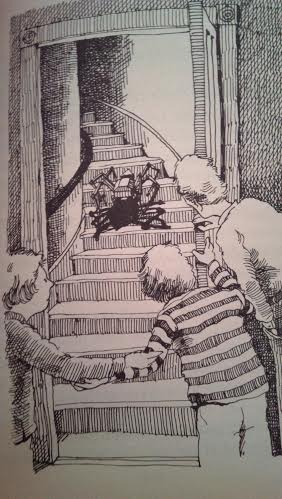
ScaredSillyPicWhile the Onetree family is visiting the museum, a pair of shoes that once belonged to a Chinese emperor disappears. Like the two Onetree sisters, Gus considers himself the sensible brother and doesn’t take Razendale, the dreamier sibling, very seriously. He thinks Razendale ran off with the shoes as a prank. But, Erik, who seems more sensible than either of his uncles, says that they can’t just accuse him without proof. Gus provides them with an invention that could settle the whole matter, but that depends on whether or not they can trust Gus.

This book is a little different from the others in the series in that there isn’t just one issue that the girls consider along with the mystery. Jo-Beth considers whether or not she’s going to remain a dreamer or try to be more sensible (at least, part of the time, like maybe once or twice a week). Mary Rose is surprised that Jo-Beth can come up with some sensible solutions when she puts her mind to it. Then, there’s the shoe thief, whose motives are more altruistic than anyone suspects and who raises the question of where certain museum artifacts actually belong.

This is part of the Mary Rose and Jo-Beth Mysteries series.  It is available to borrow and read for free online through Internet Archive.