This is the last book in the original Winnie-the-Pooh series. Although other authors later wrote other stories about Winnie-the-Pooh and his friends, at the end of this book, Christopher Robin goes away to school and has to leave his toys and animal friends behind. It’s implied that his friends will continue to live and play in the woods without him and that they’ll all continue to be friends, but the ending is a little bittersweet because Christopher Robin realizes that he’s growing up and that things are going to be changing.
Each chapter in the book is its own short story. I didn’t read the original Winnie-the-Pooh stories when I was a child, but I was already familiar with many of the stories in this book from the cartoon versions that I saw on tv when I was young. I still think of the Pooh Sticks game whenever I cross a foot bridge (although, living in Arizona, few of the ones I cross have water under them). I also still joke about what Tiggers like best from time to time. (Tiggers apparently like everything best until they actually try it, and then they discover that they don’t really like it at all, not unlike the way my dog feels when she begs for food I’m eating that she wouldn’t really like if she actually got some.)
The book is available to borrow and read for free online through Internet Archive (multiple copies).
Chapters:
Ch. 1: In Which a House is Built at Pooh Corner for Eeyore
On a snowy day, Pooh gets the idea of building a house for Eeyore because he’s the only one who doesn’t have a house. However, Eeyore had built a house for himself, and strangely, it has disappeared. When Eeyore gets Christopher Robin to help him investigate, they realize that Pooh and Piglet have mistakenly taken the materials Eeyore used for his house and used them to build a new house for Eeyore in a different location. But, the new location is better because Pooh and Piglet built the new house in a warmer part of the woods, and they did a better building job. Eeyore thinks that the wind blew it to its new spot, and the others let him think that.
Ch. 2: In Which Tigger Comes to the Forest and Has Breakfast
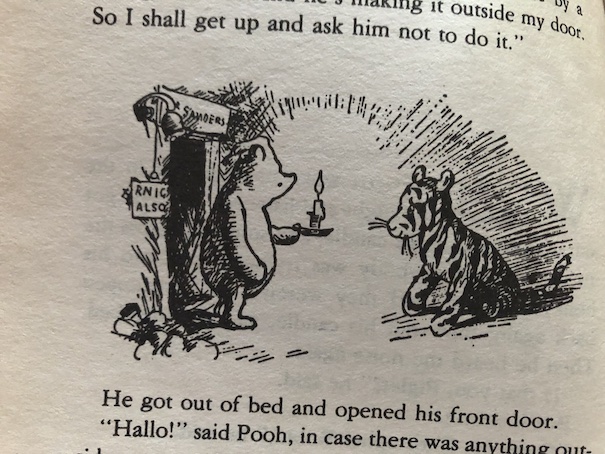
Pooh is woken up suddenly in the night by a strange noise. It’s Tigger, a very bouncy kind of tiger. They’ve never met before because he’s new to the woods, but Tigger knows Christopher Robin, so Pooh invites him to breakfast in the morning. However, Tigger doesn’t like the honey that Pooh serves for breakfast, so they go to see Piglet to see if Tigger likes acorns for breakfast. However, Tigger decides he doesn’t like those, either. They continue visiting friends to find things that Tigger will like. They finally find something Tigger likes when Tigger samples little Roo’s medicine, extract of malt, so Tigger decides that he will live with Kanga and Roo.
Ch. 3: In Which A Search is Organized, and Piglet Nearly Meets the Heffalump Again
Rabbit tells Pooh that he is organizing a search and tells him where to search without telling him what they’re supposed to be searching for. Confused, Pooh decides to look for Piglet to ask him what they’re supposed to be searching for. It turns out that Piglet has accidentally fallen down a hole, and Pooh falls into the same hole while looking for him. Pooh remembers that they dug holes like that as traps for Heffalumps, and they worry that they’re in a trap that the Heffalumps set for them. Fortunately, they accidentally find the person Rabbit was originally looking for.
Ch. 4: In Which It Is Shown that Tiggers Don’t Climb Trees
Tigger brags about all the things that Tiggers are good at doing, but it turns out that they’re not as good at climbing trees as he claims. Tigger and Roo get stuck in a tree, and the others have to help them get down.
Ch. 5: In Which Rabbit Has a Busy Day, and We Learn What Christopher Robin Does in the Mornings
Rabbit finds a note from Christopher Robin, but he has trouble reading it and figuring out what it means. Rabbit tries to figure out what Christopher Robin does every morning, and Eeyore tries to explain education to Piglet.
Ch. 6: In Which Pooh Invents a New Game and Eeyore Joins In
Pooh invents a game that involves tossing pine cones and sticks into the river next to a bridge and seeing which of them is the first to come out the other side of the bridge. While he and his friends are doing that, they find Eeyore floating on his back down the river because Tigger bounced him in. The others have to figure out how to rescue him.
Ch. 7: In Which Tigger is Unbounced
Rabbit has decided that Tigger’s bouncing has gotten out of control and that he needs to be taught a lesson. He tells Pooh and Piglet that they should take Tigger to a part of the woods he hasn’t been before, get him lost, and leave him there for awhile. Rabbit’s reasoning is that they can then rescue Tigger, and Tigger will be so grateful to them for rescuing him that he won’t be so bouncy. Pooh and Piglet have doubts about this plan, but they agree to help Rabbit. However, it turns out that Tigger’s don’t get lost, but Rabbit does, and Rabbit turns out to be the one who is grateful for a rescue.
Ch. 8: In Which Piglet Does a Very Grand Thing
One very windy Thursday, Pooh and Piglet decide to go around and visit their friends, wish them a happy Thursday, and have snacks with them. While they are visiting Owl, Owl’s tree falls over because of the wind. When the tree crashes, they’re trapped inside, and they have to figure out how to get out. Their plan requires Piglet doing something brave, which isn’t easy for such a small, timid animal.
Ch. 9: In Which Eeyore Finds the Wolery and Owl Moves Into It
With Owl’s tree down, Owl has to find a new place to live. Eeyore thinks that he’s found the perfect place: Piglet’s house. It’s a great house, but with Owl living there, where will Piglet live? Pooh says if Piglet’s house had fallen down, Piglet would come and live with him, so that’s what he can do now. Piglet is happy about living with his friend Pooh, so he decides that it’s okay for Owl to live in his house.
Ch. 10: In Which Christopher Robin and Pooh Come to an Enchanted Place, and We Leave Them There
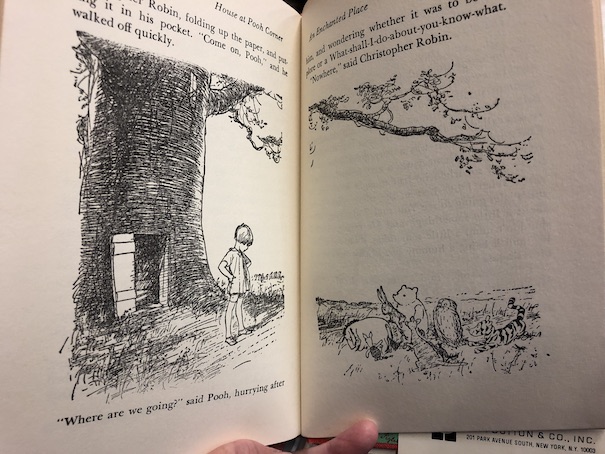
All of the animals know that Christopher Robin is going away somewhere soon, although they’re not quite sure where he’s going and why. The story doesn’t exactly say it,but it’s implied that Christopher Robin is going away to boarding school. All of the animals say goodbye to him, and Eeyore writes a poem for the occasion. Christopher Robin and Pooh have a quiet walk and talk together. While Christopher Robin realizes that he’s growing up and things are going to be changing, the two of them agree that they’ll never forget each other, no matter how old they get. They’ll always have their favorite place and continue to go there, and some part of them will always be playing together.
The Dark-Thirty: Southern Tales of the Supernatural by Patricia C. McKissack, 1992.
There are ten short, scary stories in this book, not thirty. The author explains in the beginning that the name of the book comes from an expression kids used when she was young. The “dark-thirty” was the last half hour of light before it became truly dark outside, when the kids had to hurry home so they wouldn’t be out after dark, when the monsters came out. The author was African American, and the stories in this book have African American themes. They were based on stories that the author heard from her grandmother when she was young.
This is a book that I remember a school librarian introducing to us when I was in elementary school, probably around age 10 or 11. My memories of it are a little vague. I had forgotten most of what the stories were about, although the title stuck with me, and I remembered thinking that I should read it again someday. I have to admit that most of the emotions that I experience while reading this book as an adult were anger and frustration. The sad truth is that those are the emotions that permeate much of African American history, from the harsh conditions of slavery to the injustices of racism, and those are the aspects of the stories that stand out to me most as an adult. As I recall, I did think more about the ghost parts of the stories when I was a kid, but I didn’t have as deep an understanding of the background of the stories then. Maybe part of the lesson here is that human monsters are more terrifying than anything supernatural, partly because it’s the people who are or should be closest to you in a shared humanity are the ones who have the most opportunity to cause harm, if that’s what they’ve decided to do. That’s a rather dark thought, but these are dark stories with dark themes.
On a lighter note, I found the stories that introduced pieces of folklore fascinating. I’ve had an interest in folklore since I was a kid, which is part of why this book stuck in my mind for so many years.
I wouldn’t recommend this book for kids younger than 10 years old because of the dark themes. There is also derogatory racial language in the stories (including the n-word), particularly used by the villains, which helps show why they’re villains. I think, before kids are ready for this book, they need to have some background information on the subjects of racism and slavery to understand what’s going on, and they should also know that there are certain words they shouldn’t use themselves, even if other people do.
The book is a Newbery Honor Book. It’s available to borrow and read for free online through Internet Archive.
Stories in the Book:
The Legend of Pin Oak
The story is set during slave days. Harper McAvoy, a plantation owner, has resented one of his slaves, Henri, since they were both young. Harper was neglected by his father after his mother died giving birth to him, and years later, when his father finally returned to their estate, called Pin Oak, he learned that his other had another son with a free black woman, Henri. Their father had hoped that the two boys might be friends and that Henri would help Harper run the estate one day, but Harper always resented Henri for being more like their father than he was and for receiving the attention that his father never showed him. After their father died, Harper thought that he could sell Henri and be rid of him forever, but Henri has actually been a free person all along because his mother was free.
When the slavers try to take Henri anyway, he and his wife run away with their baby. They apparently die jumping to their deaths at a waterfall, although some say that they actually turned into birds and flew away while Harper is killed pursuing them. Others think that Henri and his family may have survived by jumping into a cave behind the waterfall, although there is evidence that Henri didn’t know there was a cave there. Their fate is left ambiguous.
We Organized
As part of the government’s effort to get people back to work during the Great Depression, the Library of Congress employed writers to record the stories of people who had been slaves. This chapter is a poem based on one of those stories.
Justice
This story is about the Ku Klux Klan. A wealthy and influential man called Riley Holt is murdered. The identity of the murderer is unknown, but local people are so shocked and angry at the crime that they are determined to get “justice” … one way or another. A bitter and suspicious local man called Hoop Granger blames a young black man named Alvin Tinsley. However, Alvin has an alibi, and the chief of police, knowing that Hoop is a bully and a liar and has a history of pushing Alvin to take responsibility for things he’s done himself, asks Hoop if he has an alibi, too. He says that he was working at his service station and his friends will vouch for him, but Chief Brown doesn’t think much of any of them as witnesses.
Hoop is a member of the KKK, and to throw suspicion for the murder from himself, he convinces his fellow KKK members that Alvin is guilty and needs to be punished. They capture Alvin and lynch him, but before Alvin dies, he promises to come back and prove his innocence. Hoop and his friends tell everyone that Alvin hanged himself after confessing to Holt’s murder. Not everyone in town believes the story, but they have no way of proving it’s a lie, and the authorities seem satisfied with the explanation (mainly because the mayor’s son was also part of lynch mob, and the mayor is forcing everyone to cover for him). However, Hoop can’t forget what Alvin said about coming back to prove his innocence. He seems haunted by Alvin’s words. Soon, he starts seeing things and becomes convinced that Alvin is coming back for him. Is it really a restless spirit or Hoop’s own guilty conscience?
The 11:59
This story is about train travel and the Brotherhood of Sleeping Car Porters. The Brotherhood of Sleeping Car Porters had stories that they liked to tell each other, like this story about a phantom train called the Death Train or the 11:59.
A retired porter enjoys telling the younger porters stories about how the Brotherhood was formed and the truly great men among the porters. Many of his stories are tall-tales. One of his stories is about the 11:59. When a porter hears the whistle of this phantom train, he only has 24 hours left to live, and nobody can escape it. Not even old Lester.
The Sight
There’s an old superstition that babies who are born with a caul over their heads will have psychic abilities and could be able to see the future or spirits. A boy named Esau gets “the sight” and is able to tell the future from a young age. However, people with “the sight” have to be careful who knows they have that power because some people will try to use them for unethical purposes, which might cause them to lose their gift, and Esau’s father is a con man. Esau knows that his father can’t be trusted, but when he feels compelled to warn his father of danger, his father learns what Esau can do. His father forces him to help him win at gambling with his gift until the gift finally fades. Then, his father deserts him and his mother. Esau’s mother says maybe it’s just as well to lose the sight, and Esau agrees, not liking it when he sees that bad things are about to happen.
Years go by, Esau grows up, and he eventually becomes a soldier in WWII. He manages to make it home safely, but he is surprised by the sudden return of his gift just in time to save his family.
The Woman in the Snow
This story involves the bus boycott in Montgomery, Alabama in the 1950s.
Grady Bishop, a white man with a bad history and a chip on his shoulder, has recently started working as a bus driver, although he’s never happy when he has to take the less prestigious route through the city, where a lot of black people catch the bus. Driving makes him feel powerful, but he considers this route beneath him.
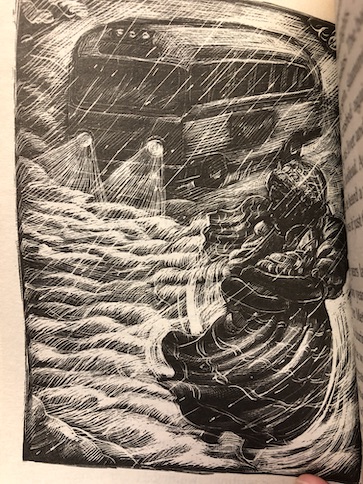
One day, during a bad snow storm, a poor woman with a sick baby begs him for a ride although she doesn’t have money to pay. She’s afraid if she can’t get the baby to the hospital, she’ll die. Grady refuses to give her a free ride, convinced that she’s making too much out of nothing and just trying to get a free ride. Later, he hears that the woman and baby froze to death in the storm. A year after that, he sees the same woman again on the same route. Startled, Grady crashes his bus and is killed.
Years later, a black bus driver has that route, and other drivers tell him about the ghost lady with the baby that they see whenever it starts snowing. He becomes the last person to see the ghost lady … because he’s the first to give her a ride.
The Conjure Brother
This story explains that “conjure women” were women who sold herbal cures and practiced folk magic to help people change their luck.
A girl named Josie is tired of being an only child and wants a brother. However, her mother shows no signs of being pregnant, even though Josie keeps asking her for a brother. When she hears a couple of women talking about the local conjure woman, Josie decides to go see her and ask if she can help her get a brother. The conjure woman gives her a set of instructions to follow, but Josie performs the ritual too early at night. Instead of getting a baby brother, Josie gets an older brother, called Adam. Her parents act like Adam has always been their oldest child. Adam is bossy, and some of the things that used to belong to Josie now belong to Adam. Josie starts to think of Adam as a pest and returns to the conjure woman to ask her to do something about Adam, but instead, she learns an important lesson about sharing her life and house with a sibling.
Boo Mama
This chapter talks about the tumultuous times of the late 1960s and the assassinations of Martin Luther King, Jr. and Robert Kennedy. Some people felt so overwhelmed by everything that was going on that they just wanted to “drop out” of society and ignore the chaos around them.
Leddy has been a social activist since she was in her teens, but then, her husband is killed in the war in Vietnam, leaving her with a young child. After the deaths of Martin Luther King, Jr. and Robert Kennedy soon after her husband’s death, Leddy feels completely overwhelmed. She’s been putting forth all of the effort she has for a long time, and the deaths of the man she loved and the people who inspired her feel like too much. She has a breakdown and starts questioning whether everything she and her friends have done has really accomplished anything. Deciding that she needs a change of scene for her and her son, she moves to a rural community in Tennessee.
At first, her young son seems to do better in the countryside, and Leddy finds the change of pace relaxing, but then, her young son disappears. He wanders away while his mother is hanging out the laundry. The locals put together a search party. They search for days, but all they can find is the boy’s teddy bear. Everyone is convinced that he’s dead, but Leddy can’t give up hope that her son is still alive. Her son does turn up, but he is strangely different. Where has he been, and what has happened to him?
The Gingi
There is an old superstition that “Evil needs an invitation.” Among the Yoruba people of West Africa, there is a belief that evil spirits need someone to welcome them into a house before they can enter, so they will try to trick unsuspecting people into giving them an invitation. They use special talismans called gingi to guard against evil.
A woman named Laura is fascinated by a strange statue that she sees in a shop window. However, when she tries to buy it, the shopkeeper says that she’s never seen it before and warns Laura that evil spirits sometimes disguise themselves to trick people into taking them into their homes. Laura thinks this is just superstition and insists that she wants the statue. The shopkeeper charges her a price that’s too high to discourage her from buying the statue, and it almost works, but for some reason, Laura feels compelled to buy it and pays for it anyway. Seeing that she can’t prevent Laura from taking the statue, the shopkeeper insists that she take a small complementary talisman and keep it with her. The talisman is a small doll, and she gives it to her young daughter to play with.
The Chicken-Coop Monster
The final story in the book is semi-autobiographical, inspired by the author’s feelings when her parents got divorced when she was a child.
A young girl named Melissa is upset about her parents’ divorce. Her parents send her to stay with her grandparents in Tennessee while they’re sorting things out, but she becomes convinced that there’s a monster living in the chicken coop on her grandparents’ property. She and her friends are part of a group called the Monster Watchers of America. Melissa’s grandmother doesn’t believe in the monster, but her grandfather teaches her an important lesson about facing up to life’s monsters.
This Mary Poppins book is supposed to take place during the first three books in the series. It’s a collection of incidents that take place in the park. Each chapter is a short story, and each of the stories can stand alone.
I thought that the stories were fun, but there are a few instances of racial language that I didn’t like in the original version of the book. At various points throughout the original version of book, Mary Poppins chides the children for things they’re doing by calling them “Blackamoors”, cannibals on an island, or “Hottentots. ” In other words, she’s implying that they’re being “savages.” I know that notions of “savage natives” appear in other old children’s books, but I don’t think it’s a good idea to give modern children these ideas, and I don’t like it that Mary Poppins uses racial words as insults for the children in the story. Fortunately, later printings of this book rewrote these scenes to remove inappropriate racial language.
When I was writing this review, I told my brother the plot of one of the stories in the book,Lucky Thursday, and we had a good laugh over it. It was a pretty funny story to read. My brother asked whether the story was supposed to have a moral or teach children anything. I thought about it, and I suppose that part of the moral could be “Be careful what you wish for”, but in the end, I don’t think any real lessons were learned.
The book is available to borrow and read for free online through Internet Archive (multiple copies).
Stories in the Book:
Every Goose a Swan – When everyone seems to be daydreaming and pretending that they’re someone they’re not, Mary Poppins tells the children a story about a vain goose girl and the others around her who have grand ideas about who they think they really are. When someone points out the realities of being the people they like to think they are, they all decide that maybe it’s better to just be themselves.
Faithful Friends – Miss Andrews, a neighbor of the Banks families, has been advised to go traveling for the sake of her health by her doctor. Before going away, she asks the Banks family to look after her “treasures” during her absence. Mrs. Banks puts them in the nursery because she knows that Mary Poppins will look after them, although Mary Poppins is a little put out by this extra duty. The “treasures” turn out to be a collection of random knickknacks, battered and incomplete. The children are particularly interested in a pair of hunters with lion friends, but one of them is mostly missing, and they think that the lion missing his hunter looks rather sad. By coincidence (apparently), they meet a couple of policemen who are reminiscent of the hunters. One of them used to live near a jungle but had to return home because he lost a foot, like the knickknack hunter. He’s been sad since he got back because he says he’s missing a friend. However, he gets his friend back when a loose lion suddenly appears in the park. When children get home, the missing hunter is back in the knickknack, and the lion looks happy.
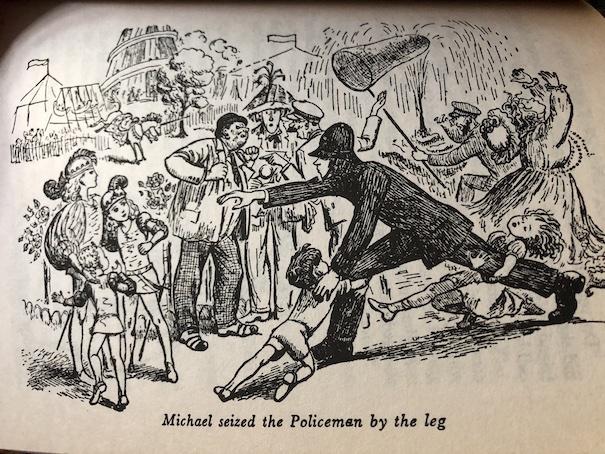
Lucky Thursday – Michael is unhappy because the other children got to go to the park while he had to stay home with a cold. The only interesting thing that happens is that he sees a strange cat out the window. Michael goes to bed in a bad mood, but the next day, all sorts of lucky things begin happening. However, it turns out that it’s not quite as lucky as he thinks. First, he doesn’t take care of some of the nice things he receives and loses them. Then, the mysterious cat leads him on what seems like a magical journey from the park to a castle of cats, and he is told that everything he’s received has been because he wished on the Cat Star the night before. Part of what he wished was just disgruntled grumblings, though, and part of the cats’ idea of fun and games is to make Michael answer riddles. If Michael answers the riddles correctly, he’ll get to marry one of the cat princesses, and if he doesn’t, he’ll have to work in the kitchen of the castle with other children who made foolish wishes. Michael does answer the riddles correctly, but he doesn’t want to marry a cat, and he has a desperate struggle to escape from the castle of the cats. He only manages to escape when he blows Mary Poppins’s whistle.
The Children in the Story – The park keeper isn’t very happy about the fair set up near the park because it always leaves such a mess. Mary Poppins and the children are also in the park, and Jane is reading aloud from The Silver Fairy Book. She and Michael start talking about the princes in one of their favorite stories. Then, the three princes come out of the story to see Jane and Michael. The princes say that Jane and Michael are the children in the stories they read, and they’ve entered their own book to visit them. They say that they’ve visited generations of other children before.
The princes have brought their unicorn with them, and when adults around them start noticing that there’s suddenly a real unicorn in the park, they start panicking and arguing among themselves about whether the unicorn belongs in the zoo, in a museum, or as a sideshow at the fair. The adults seem to feel like the princes and unicorn are vaguely familiar, but they can’t seem to remember why. Most adults forget about the princes when they get older, but not all. Bert the matchman remembers, and it turns out that Mary Poppins has also been nanny to the princes.
The Park in the Park – The children are playing in the park on a hot day. Jane is making little figures out of plasticine and a little park for them all. Michael is hungry, and the baker figure comes to life and gives him pie. The children get to know the other figures, and Jane is amazed that the characters have lives that she didn’t create for them. The figures don’t seem to remember that Jane made their little world, and Jane and Michael are astonished to realize that they have now become child-size in the little park she created.
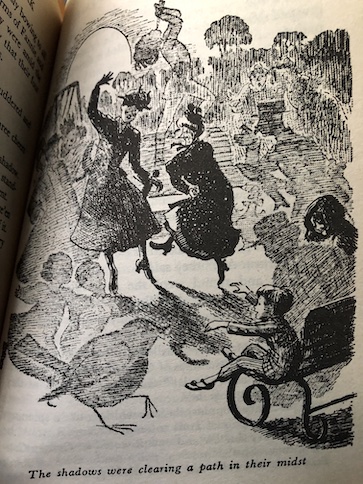
Hallowe’en – On Halloween, as the children are heading home with Mary Poppins with nuts and toffee apples, they meet the strange Mrs. Corey and her tall daughters. The children are told to be careful of stepping on shadows and that they should take care of their own shadows so they don’t run away. Mary Poppins hurries the children home and to bed, but the children find leaves that seem to be invitations to some kind of party. The children look outside and see shadows without people in the garden. The children follow the shadows, including their own, to the park. There, they see the shadows of everyone they know and even nursery rhyme characters. Mrs. Corey, her daughters, and Mary Poppins are there, and they explain that it’s the night before Mary Poppins’s birthday, and that’s what the celebration is about. They all dance with the shadows until Mrs. Boom arrives, upset, because her husband is distressed that his shadow is missing. Soon, other people also arrive to reclaim their shadows.
Mary Poppins Opens the Door by P. L. Travers, 1943.
This Mary Poppins book was written during World War II, and the author has an acknowledgement in the first chapter that things have changed because of the war. Like other Mary Poppins books, each chapter is its own short story, and the first one takes places on Guy Fawkes Day. A note at the beginning explains what Guy Fawkes Day is, and it also mentions that people haven’t celebrated it since the war began. However, the author says that she is sure that the situation is only temporary and that people will celebrate it once again after the war is over.
Sadly, people reading older versions of Mary Poppins books also have to be warned about the racial language. The stories are magical, but at the same time, one of the most grating things about the original printing of this book is that characters have a tendency to use racial language or racial terms as insults. When characters, even Mary Poppins, are irritated with each other, they’ll call people things like “Hottentot“, “black heathen”, “Blackamoor“, and similar things, implying that these people are behaving like “savages.” Some of the words the books use would be considered offensive by themselves, but it’s worse when they’re specifically used as insults. These incidents don’t take place in every story, but they happen throughout the original printing of this book, and they’re also found in other old Mary Poppins books. On a somewhat lighter note, I liked the character of Mrs. Clump, even though she’s an antagonist in one of the stories, because she used “vampire” and “pirate” as insults. If someone is going to use insults, I like them imaginative and funny like that. Fortunately, later reprintings of this book revised or removed the inappropriate racial language, so some people who grew up with the revised versions may not have even been aware that they were ever there.
This is the third time that Mary Poppins returns to the Banks household to be the children’s nanny. In the previous two books in the series, she came suddenly and left suddenly, without warning. Mrs. Banks finds it upsetting that Mary Poppins comes and goes so unexpectedly because she never knows if she can count on her to be with the children or if she will disappear suddenly. All the same, Mrs. Banks is always grateful when Mary Poppins comes because she’s so good at putting the household in order.
The book is available to borrow and read for free online through Internet Archive (multiple copies).
Stories in the Book:
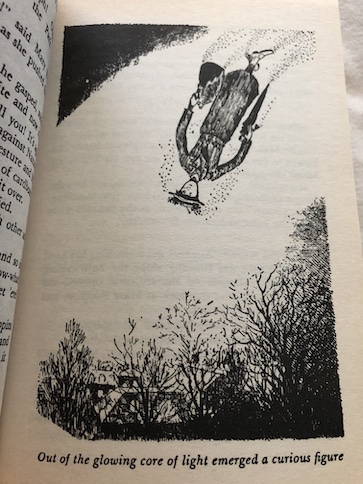
The Fifth of November – Mr. Banks is in a bad mood and declares that he won’t be home for dinner that night, upsetting his wife and children because it’s Guy Fawkes Day, and the family wants him to help set off fireworks. He won’t even shake hands with the chimney sweep, even though that’s supposed to be good luck. Part of the trouble is that the family is missing Mary Poppins, and they haven’t found anyone to replace her, leaving the house in disorder. Mrs. Banks considers hiring Mr. Banks’s old governess, but the children beg her not to because they know how strict she is. The discussion is interrupted by the chimney sweep. Mrs. Banks doesn’t remember scheduling the chimney sweep for the day, and the household staff panic at the idea of having to clean up after the chimney sweep. The chimney sweep offers to take the children to the park and set off some fireworks to give the household time to prepare for him, and the children eagerly accept. The chimney sweep and the park keeper set off fireworks with the children. For some reason, though, there are no sparks from the last rocket, and they can’t figure out why. As everyone else starts heading home, the children see something odd in the sky, a strange spark. It gets larger, and the children recognize it as Mary Poppins.
The children are overjoyed to see Mary Poppins again, and she takes them home. Mrs. Banks is also glad to see Mary Poppins again even though she’s still irritated at the way that Mary Poppins comes and goes suddenly without word or warning. Mr. Banks’s mood improves as well. Mary Poppins immediately starts making herself at home and putting things in order. She measures the children, but instead of learning their heights, she learns about bad habits they’ve developed. The children ask Mary Poppins if she’s going to stay with them this time, and she says that she’ll stay “until the door opens.” Jane is upset because the nursery door opens all the time, but Mary Poppins tells her that she means “the other door” without explaining what that means.
Mr. Twigley’s Wishes – When Mrs. Banks says that she needs to find a piano tuner, Mary Poppins recommends her cousin, Fred Twigley. She takes the children to Mr. Twigley’s house to see him. Mrs. Clump, the housekeeper, tries to send them away, but Mary Poppins pushes in anyway. Mr. Twigley has locked himself in a room. When Mr. Twigley finally lets Mary Poppins into the room with the children, they can’t see him at first. When Mary Poppins asks him what’s going on, Mr. Twigley explains that he’s been “wishing” and that he’s hiding from Mrs. Clump. He makes himself visible again and explains that, at certain times and under certain conditions, he has the ability to make seven wishes that come true. It’s a tricky business because it’s easy to waste wishes on whims and random thoughts. Mrs. Clump is scheming to marry him because she wants him to use his wishes to give her what she wants, and Mr. Twigley doesn’t want to marry her. When Mrs. Clump tries to come see him, Mr. Twigley suddenly wishes that he was somewhere safe, and he finds himself on one of the music boxes that he’s been making. Then, suddenly, the children also find themselves on music boxes. Mrs. Clump brings a policeman to deal with the chaos, and Mr. Twigley also traps Mrs. Clump and the policeman on music boxes. Mrs. Clump promises that she won’t try to force Mr. Twigley to marry her anymore if he lets her go. What Mrs. Clump had wanted Mr. Twigley to wish for her was a golden palace, so he shrinks her, turns her into a mechanical woman, and puts her into a music box golden palace.
The Cat that Looked at a King – Michael has a toothache the day after his birthday, and Mary Poppins says that it’s because he’s eaten too many sweets. Michael angrily tells Mary Poppins not to “look at him like that.” Mary Poppins says that “Even a cat may look at a king,” and the children and Mary Poppins talk about what the phrase means and if it’s true. A china cat from the mantelpiece comes to life and runs off. Mary Poppins tells the astonished children that the cat has gone to see the queen.
Mary Poppins begins telling the children a story about a king who thought that he knew practically everything, but he kept wondering about all sorts of random things that he doesn’t know. He would think of all sorts of random questions and then send his subjects out to find the answers for him. He kept everyone so busy with finding out random information and writing it down that ordinary tasks would be neglected. The queen feels neglected by the king, the kingdom is poor, buildings are crumbling because they aren’t being maintained, and the castle is infested with mice. Then, a cat comes to the castle and hunts the mice. Then, it sits on the king’s desk and stares at him. The king asks him what he’s doing, and the cat says that he wants to look at him. The king says the cat can look at him, and when the cat has had a good look, the king asks the cat what he thinks. The cat doesn’t think much of the king, and the king is offended because he thinks that his great knowledge deserves more admiration than that. The cat says that it knows everything, and the king says that’s impossible because even he doesn’t know everything. The cat says that cats know everything, and the king challenges the cat to prove it. The cat agrees to the challenge but sets the condition that whichever of them wins gets to govern the kingdom. As the king asks questions, the cat replies as if they’re all riddles. The king says that he’s not being serious and is missing the point, and the the cat says that all questions must have a point and his ridiculous questions don’t have one. The king is unable to answer any of the cat’s questions, but the queen, a page, and the prime minister can, so the cat says that he has the right to rule the kingdom with the help of the people who could answer the questions.
However, the queen, the page, and the prime minister all refuse to serve the cat because they are all dedicated to the king. The king repents of his foolish pride in his supposed knowledge and says that he’s not sure of who he is really anymore. The cat tells the king to look at him, and the king sees his own reflection in the cat’s eyes. When he sees himself, the king remembers that he’s actually King Cole, a merry old soul, and that he has no need of all these useless facts he’s been obsessing about. The cat says that he will let King Cole have the kingdom back if he can be allowed to visit the queen sometimes, and they agree.
The Marble Boy – Mary Poppins takes the children to the park, and although she doesn’t want to admit it, she is irritated that an old man is sitting in her favorite seat, reading a book. When the man closes the book and gets up, a statue of a boy with a dolphin suddenly leaps down from its pedestal and begs him not to stop reading yet because he’s been reading over the man’s shoulder and wants to finish the story. The shocked man apologizes but says that he has to get home to tea. The marble boy asks him if he can have the book, and the man is reluctant to part with it because he’s been wanting to read it for years, but he finally hands it over and leaves.
Jane and Michael ask the marble boy who he is and how a statue can read and jump off its pedestal. The boy says that his name is Nelius. He is an ancient statue from Greece that was separated from the rest of his family. He is often lonely, but he likes observing people in the park and reading over their shoulders. Mary Poppins, who Nelius says he knows because she’s an old friend of his father, tells Nelius to get back on his pedestal, but Nelius begs her to let him play with Jane and Michael awhile longer. Mary Poppins agrees that he can play with the children for the afternoon, but then, he has to get back on his pedestal before he’s missed.
Nelius enjoys spending time with Jane and Michael and going to the book stall with them. However, he does attract unwanted attention. Mrs. Lark sees his dolphin and thinks that he’s cruelly removed a fish from the water, and she says that she’s going to report him. Various people worry because Nelius is running around naked, so Mary Poppins gives him her jacket to wear. At the end of the afternoon, Nelius gives Jane the book the man gave him, asking her to let him read it over her shoulder, and he gives Michael some money that the man at the book stall gave him to buy clothes. By now, people have noticed that the statue is missing, and the mayor is demanding that the park keeper explain the situation.
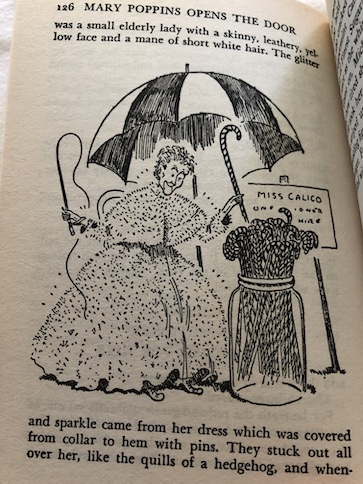
Peppermint Horses – Jane and Michael take their father’s walking sticks because they want to play horses with them, like they’re riding hobby horses. Mary Poppins gives the the walking sticks back to Mr. Banks and takes the children and Robertson Ay, who works for the Banks family, on errands. The children get tired of walking and start getting cross. Then, they see a woman named Miss Calico with what looks like a bunch of large candy canes and a sign that says she has horses for rent. The children are confused because they don’t see any horses. It turns out that Miss Calico’s candy canes are magical mounts that people can ride. Mary Poppins rents some of these peppermint horses for the children and Robertson Ay, and they ride them home through the sky, along with other people they know. Mary Poppins rides on her umbrella instead because she never uses walking sticks. The children want to keep their magical candy canes forever and continue to ride them, but they’re only rented. Miss Calico comes around at night and collects them.
High Tide – Mary Poppins takes the children to visit Admiral Boom and his wife because their parents want to borrow a bottle of port from them. They give them the port and a seashell for the children to enjoy. Michael is curious about what port tastes like, and Jane is fascinated by the seashell. She says that she would like to go see the sea.
That evening, while Mary Poppins is still having her half day out, the children hear a voice from the seashell telling them to dive in. They do and find themselves under the sea. The voice from the shell was a trout, and the trout introduces them to other sea creatures and takes them to a garden party that the creatures are having to celebrate high tide. Of course, Mary Poppins turns out to be the guest of honor.
Happy Ever After – It’s New Year’s Eve, and Michael wants to know what happens between the first chime at midnight and the last chime because he’s been told that the old year ends at the first chime and the new one starts at the last chime. Mary Poppins refuses to answer. She takes the children’s toys away from them, lines them up, and puts open books in front of them, also without explaining why, just telling the children to go to sleep.
The children wake up at the first chime of midnight and see their toys come to life. The toys lead the children to the park, where they see all sorts of storybook characters. (Friday from Robinson Crusoe is a rather uncomfortable character.) They explain that the period between the first chime and last chime of midnight on the New Year is called “the Crack”, and it’s the only time of year when characters can come out of their books, provided that they’re left open, and all be friends with each other, even if they’re enemies in their stories. It’s the only time when they truly have Happily Ever After. So, they all have a party to celebrate the Crack, and naturally, Mary Poppins is the guest of honor.
The next day, Michael asks Mary Poppins if they’ll ever have happily ever after themselves, and she says that depends on him.
The Other Door – Mary Poppins’s friends show up to say goodbye to her, although they try not to let the children know that Mary Poppins is about to leave. They all have a dance together, and Mary Poppins takes the baby home from the park before the other children. Jane and Michael realize that Mary Poppins is about to leave when her friends talk about “the door.” They rush upstairs to the nursery, but they don’t see her until Jane spots her in the reflection of the nursery in the window. The door in the reflection is the “other door” that she’d been talking about, and that’s the door that Mary Poppins goes through to leave. The children’s parents come into the room, and the children tell them that Mary Poppins is gone. Mrs. Banks is upset, but Mr. Banks dances because he likes the music from her goodbye party, which is still going on. The family thinks that they see a shooting star, but that’s Mary Poppins leaving. Still, they make a wish not to forget Mary Poppins.
More Scary Stories to Tell in the Dark collected from folklore and retold by Alvin Schwartz, drawings by Stephen Gammell, 1984.
This is the second book in a series of popular ghost stories and American urban legends. Many of us who were children in the 1980s and 1990s heard these stories on school playgrounds, at summer camps, or at sleepovers, even if we didn’t read them in this book first. I found the stories in the first book in the series to be more familiar to me from my childhood than the ones in the second book, but there are still many popular and familiar ghost stories here. There is a section at the beginning of the book where the author/compiler discusses why stories like these have been popular for generations. In the back of the book, there is another section with more detailed information about the origins of the stories and their variants.
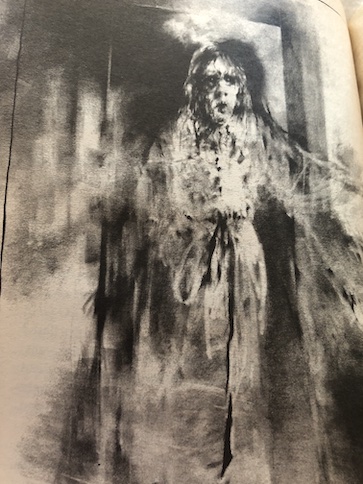
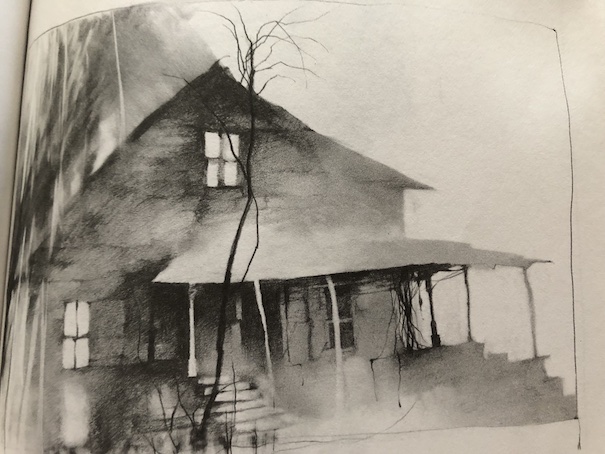
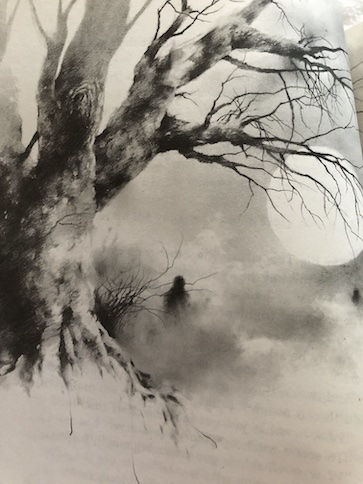
The drawings in the book also complement the stories well. They’re all in black-and-white and have an ethereal look, as those they were composed of spirits or smoke.
The book is available to borrow and read for free online through Internet Archive (multiple copies).
Stories Included in the Book:
The stories are divided into sections by theme or by the effect that the stories are supposed to have.
When She Saw Him, She Screamed and Ran
This section has stories about ghosts.
Something Was Wrong – A man is walking down the street, but for some reason, everybody is afraid of him. What’s wrong?
The Wreck – A guy meets a girl at a dance … only to learn that she was killed before she got there.
One Sunday Morning – A woman goes to church on Sunday but discovers that this isn’t a normal church service.
Sounds – Some fishermen take shelter in an empty house during a storm and hear the sounds of a past murder.
A Weird Blue Light – The crew of a ship during the Civil War witness something very strange, possibly the ghost of a pirate ship.
Somebody Fell From Aloft – The ghost of a murdered sailor gets his revenge.
The Little Black Dog – A murderer is followed by the ghost of a dog.
Clinkity-Clink – A grave digger steals the silver dollars laid on the eyes of a corpse, but the dead woman wants them back. (This story is supposed to end with a jump scare, like ghost stories told aloud around a camp fire.)
She Was Spittin’ and Yowlin’ Just Like a Cat
This is a selection of strange stories about different topics.
The Bride – The famous story about a bride who plays hide-and-seek and accidentally gets locked in a trunk.
Rings on Her Fingers – A thief tries to steal the rings from a dead woman, only she may not be quite as dead as everyone thinks.
The Drum – Two young girls meet a gypsy girl with a special drum that controls dancing figures. The girls want the drum, but the gypsy girl says that she’ll only give it to them if they do bad things.
The Window – One dark night, Margaret sees something with glowing eyes outside her window. What is it?
Wonderful Sausage – A butcher murders his wife and turns her into sausage.
The Cat’s Paw – A woman turns herself into a cat.
The Voice – A girl hears a voice in her room at night, but nobody is there.
When I Wake Up, Everything Will Be All Right
This section has stories about dangerous and scary places.
“Oh, Susannah!” – A university student thinks her roommate is humming at night, but her roommate is already dead.
The Man in the Middle – A girl sees three men on the subway late at night, but something’s wrong with the one in the middle.
The Cat in a Shopping Bag – A woman accidentally runs over a cat, and she puts the body in a bag to dispose of, causing a thief to get a terrible shock.
The Bed by the Window – A room at a nursing home has only one bed by the window. When one man kills another to get the view, he gets a shock.
The Dead Man’s Hand – A group of nursing students resent a fellow student who seems too perfect and decide to play a prank on her.
A Ghost in the Mirror – This story explains the spooky sleepover game Bloody Mary. Kids (typically girls) go into a dark or diml-lit room and look in a mirror to see a scary face appear. (This is actually a psychological trick, sometimes referred to as the “strange-face illusion“. Humans instinctively look for faces and facial emotions, and when someone can’t see their own face in the mirror very well because the room is too dim, their mind will try to reconstruct the missing details and interpret them, creating some strange illusions, like it’s someone else’s face when it’s just their own. The book doesn’t explain that, but that’s basically what “Bloody Mary” really is.) In the game, the identity of “Bloody Mary” and what she’ll supposedly do if you see her varies. This story explains different versions of the ghost story associated with the game.
The Curse – A fraternity initiation results in the deaths of two pledges and a curse on the remaining members.
The Last Laugh
This section has spooky stories with a humorous twist.
The Church – A man takes shelter in an abandoned church during a storm and thinks that he sees ghosts inside, but they aren’t what they appear to be.
The Bad News – Two old friends who love baseball and wonder if there’s baseball in heaven. There’s good news, and bad news.
Cemetery Soup – A woman makes soup with a bone she finds in the cemetery.
The Brown Suit – A woman thinks that her dead husband would look better in a brown suit for his funeral, and the funeral parlor comes up with a bizarre solution.
BA-ROOOM! – A spooky song.
Thumpity-Thump – People move into a spooky house and hear a mysterious thumping noise.
Scary Stories to Tell in the Dark collected from folklore and retold by Alvin Schwartz, drawings by Stephen Gammell, 1981.
This collection of creepy stories was a popular staple of my childhood! The stories included in the book are not original stories but popular ghost stories and American urban legends that were spread around by word of mouth before being collected and written down. Many of us who were children in the 1980s and 1990s heard these stories on school playgrounds, at summer camps, or at sleepovers, even if we didn’t read them in this book first. The very popularity of these stories was part of the popularity of this particular book and others in its series. The stories were frightening yet familiar, and reading them as an adult brings a sense of creepy nostalgia and Halloweens past. There is a section at the beginning of the book where the author/compiler discusses why stories like these have been popular for generations. In the back of the book, there is another section with more detailed information about the origins of the stories and their variants. The back of the book recommends these stories for ages 9 and up.
The drawings in the book also complement the stories well. They’re all in black-and-white and have an ethereal look, as those they were composed of spirits or smoke.
The book is available to borrow and read for free online through Internet Archive (multiple copies). There is also an audiobook copy.
Stories Included in the Book:
The stories are divided into sections by theme or by the effect that the stories are supposed to have.
Aaaaaaaaaaah!
This section has stories that are meant to make listeners jump at the end, like the kind people like to tell around camp fires, and there are tips for how to deliver the jump scares at the end.
The Big Toe – A boy finds a toe that seems to be growing in his garden, and his family decides to eat it (God only knows why), but that’s just the tip of something bigger …
The Walk – Two men walking down a road are each frightened by each other.
“What Do You Come For?” – A ghostly man comes down the chimney, part by part … and he comes for YOU!
Me Tie Dough-ty Walker! – A boy and his dog wait for a ghostly head that falls down a chimney.
A Man Who Lived in Leeds – A spooky rhyme.
Old Woman All Skin and Bone – A popular spooky song.
He Heard Footsteps Coming Up the Cellar Stairs
These are all stories about ghosts.
The Thing – Two friends see a frightening thing crawl out of a field, and it turns out to be prophetic.
Cold as Clay – A farmer separates his daughter from the man she loves, but when the man dies, his ghost makes sure that she gets safely home.
The White Wolf – When wolves are killing farmers’ livestock, a man becomes wealthy by hunting them. Then, a ghostly wolf takes its revenge.
The Haunted House – A preacher rids a haunted house of its ghost and brings her murderer to justice.
The Guests – A pair of travelers are looking for a room for the night. An elderly couple offers to let them stay in their house, but the travlers get a shock the next morning.
They Eat Your Eyes, They Eat Your Nose
These are an assortment of stories, and some are kind of gross-out stories. I never liked the gross-out scary stories when I was a kid, but I know some kids were really into them.
The Hearse Song – An old, traditional scary song that has several variations. “Don’t you ever laugh as the hearse goes by, For you may be the next to die.”
The Girl Who Stood on a Grave – Some kids at a party say that the graveyard down the street is scary, and one of them claims that if you stand on a grave, the person inside will reach up to grab you. A girl at the party doesn’t believe it and accepts a bet to go stand on a grave with frightening results.
A New Horse – A farmhand tells his friend that a witch turns him into a horse and rides him at night, and his friend finds a way to put a stop to it.
Alligators – A woman claims that her husband turns into an alligator at night and is turning their two sons into alligators as well. People don’t believe her, but there’s more truth to her story than they know.
Room for One More – A man has a prophetic dream that saves his life.
The Wendigo – A man on a hunting trip hears the wind calling to his companion. What does it mean?
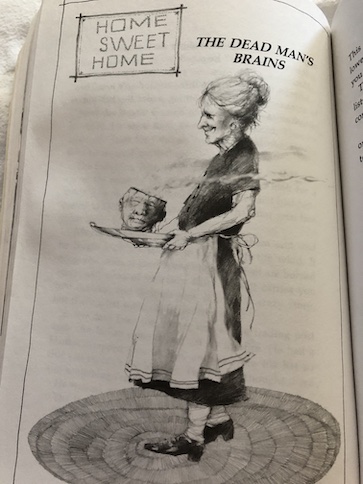
The Dead Man’s Brains – This story is actually played as a game, and it’s especially popular on Halloween. Many of us have played some version of the game, where someone describes the body of a dead person, giving people weird and creepy things to feel that are supposed to be body parts. In reality, the “body parts” are common things, usually food, like peeled grapes to represent eyes, etc.
“May I Carry Your Basket?” – A man walking home late at night helps a strange woman to carry her basket, but what’s inside the basket is truly terrifying!
Other Dangers
These are more modern horror stories and urban legends than the earlier ones in the book, and they focus less on old ghosts and more on the dangers of modern society.
The Hook – This is a popular story at camps and sleepovers! A young couple is listening the radio in their car when they hear about an escaped murderer. The girl gets frightened and wants to go home, and it’s only when they get there that they realize how close they came to being his next victims.
The White Satin Evening Gown – A girl wants to go to a dance but doesn’t have much money for a dress to wear. When she finds a dress that she can rent cheaply, it turns out that there is something very wrong with it.
High Beams – A girl realizes that she’s being followed as she drives home alone at night, but her pursuer isn’t the one she should be afraid of.
The Babysitter – A young babysitter keeps getting strange calls … and they’re coming from inside the house.
Aaaaaaaaaaah!
Even though this section has the same name as the first section, the stories in the final section of the book have humorous twists.
The Viper – One of my old favorites! The characters in The Haunting of Grade Three tell this story to each other. A woman keeps getting calls from a man calling himself “the viper.” Who is he, and what does he want?
The Attic – Rupert is looking for his dog when something happens to him on the way to check the attic that makes him scream.
The Slithery-Dee – A short rhyme.
Aaron Kelly’s Bones – Aaron Kelly is dead, but he doesn’t feel dead enough to stay in his coffin and won’t go back there until he does.
Wait Till Martin Comes – What will the cats do when Martin finally comes?
The Ghost with the Bloody Fingers – When dealing with a ghost, sometimes the practical approach is best.
#2 The Secret Secret Passage created by A. E. Parker, written by Eric Weiner, 1992.
At the end of the previous book of solve-it-yourself mini-mysteries, it looked like Mr. Boddy had been murdered, but at the beginning of this book, he explains that he was only knocked unconscious. All of the books in the series follow this pattern from this point on – Mr. Boddy seems to be murdered in the final story, but he’s okay again in the next book, mimicking the pattern in the Clue board game, where players solve our host’s murder in his mansion over and over again. There’s generally a humorous twist to how he survives and explains the situation.
The book is available to borrow and read for free online through Internet Archive.
Stories in the Book:
The Secret Secret Passage – Professor Plum accidentally stumbles on a secret passage in the mansion that nobody knows about it. As various other guests either try to rescue Plum or try to follow his explanation of what happened to him, they also get trapped in the secret secret passage, until someone eventually tries to shoot Professor Plum over it.
The Challenge – Colonel Mustard is in a bad mood because he lost a tiddlywinks tournament and starts challenging everyone to a duel. Mr. Boddy and the other guests try to calm him down, but Mr. Green, who won the tournament provokes him into losing his temper. The two of them actually fight a duel, and readers are challenged to keep track of which weapons they use. (Of course, everyone survives the duel to appear in the other stories.)
The Joke Contest – The guests start telling each other jokes, but then they start to argue about who’s the best at telling jokes. To settle the matter, they decide to vote on it by secret ballot. Mrs. White wins, but Miss Scarlet is angry about losing. She wants to get back at whoever voted against her, and then, she realizes who it must be.
Mrs. White’s Horrible Plan – Mrs. White discovers that all of the other guests have left her something in their wills, and she makes a plan to eliminate them, but it has unintended consequences.
Boddy Language – Mrs. Peacock is so obsessed with good manners that she gets upset about the new mystery movie that Mr. Boddy funded and wants to show to his guests when she finds out that there is a scene where a white horse walks through a mud puddle. She just can’t stand any kind of “filth” in films. Mr. Boddy refuses to call off the showing of the movie, so she decides that she’s going to do something about it herself, but various others notice her attempts and thwart her. Readers are asked to figure out which weapon she was holding when she was thwarted for the last time.
Plum’s Plasma – Professor Plum has invented a fantastic cure for injuries, and after a series of injuries involving the knife, the other guests could sure use it … if readers can help Plum remember which room he left it in.
A Show of Talent – Mr. Boddy and his guests are putting on a talent show. Unfortunately, because the guests include the various weapins from the Clue game intheir acts, people end up getting hurt.
Trick or Treat – Mr. Boddy invites his friends to a Halloween party, but when they all show up in costume and start scaring each other, Mr. Boddy has to admit that he’s confused about who is who. Can you figure out who’s wearing each costume?
The Wrong Briefcase – Professor Plum is going to give the guests a scientific lecture about relativity, but when he goes to check his lecture notes, he discovers that he has the wrong briefcase. This briefcase is full of money! Professor Plum’s first thought is that he must have picked up the wrong briefcase while he was at the bank and that he should call the bank to let them know. However, the other guests try to persuade him to keep the money … and share it with them. When that fails, naturally, they decide to steal it from Plum themselves.
Mr. Boddy’s Pyramid – Mr. Boddy has decided that, when he dies, he wants to be buried in the style of an Egyptian pharaoh. He’s had a pyramid built for the purpose on his property with secret doors and hidden chambers full of treasures that he plans to have buried with him. Of course, he tells his guests all about it, asking them to make sure this last request of his is fulfilled. Also of course, someone tries to kill him for the treasure.
#1 Who Killed Mr. Boddy? created by A. E. Parker, written by Eric Weiner, 1992.
This book is a collection of short solve-it-yourself mini-mysteries based on the Clue board game. It’s the first in a series that uses the setting, characters, weapons, and other tropes from the board game. Each book in the series contains short mysteries that the reader is urged to attempt to solve before the characters do. The solutions to the mysteries come after each chapter.
The book, like others in the series begins with Reginald Boddy greeting you and welcoming you to his mansion. Then, he tells you about his other guests and asks you to be on the lookout for clues in case anything suspicious happens.
Most of the mysteries involve a crime of some kind, but not all. In the final chapter of the book, it seems like Boddy, our host, has been murdered, and the reader has to solve his murder, just like in a game of Clue. However, Mr. Boddy doesn’t actually die. It becomes a pattern in the series that he seems to have been killed in each book, but he always survives somehow to reappear in other books in the series.
The book is available to borrow and read for free online through Internet Archive.
Stories in the Book:
Who Killed Pitty-Pat? – Someone has killed Mr. Boddy’s annoying parrot!
Who Stole Miss Scarlet’s Diamonds? – Miss Scarlet asks Mr. Boddy to put her diamonds in his safe. Mr. Boddy is sure that he’s the only one who knows the combination to the safe, but someone else finds out.
Happy Birthday, Mr. Green – It’s Mr. Green’s birthday. Various guests give him presents that are the weapons in the Clue game, but Professor Plum really takes the cake by telling Mr. Green that one of his presents is a time bomb (which he says that he thought would be really exciting), and he can’t remember which room of the mansion it’s in. Can the guests find it before it goes off?
The Ghost of Mrs. Boddy – The guests hold a seance to try to contact Mr. Boddy’s late wife, Bessie. Mr. Boddy is happy when the seance is successful and his wife gives raps to indicate that she’s happy and waiting for Mr. Boddy. However, after he goes to bed, the guests realize that one of them was faking the raps just to make Mr. Boddy happy. (A rare instance where they care about his feelings.) Can you find the faker?
Hide and Seek – During a game of hide-and-seek, Mrs. White is accidentally knocked unconscious at the same time that the mansion catches fire. Can you help the other guests find her in time to save her?
Where There’s Smoke, There’s Fire! – There’s another fire in the mansion, and one of the guests is responsible. Can you determine from their statements which of them caused the fire?
The Secret Changes Hands – Mr. Boddy forms a photography club with his friends. However, Professor Plum, desperate for money to fund his research about which animal blinks the most, takes the opportunity to spy on Mr. Boddy and learn the secret of his discovery for making extra-long-lasting gumdrops to sell to a rival company. Unfortunately, he’s not the only one interested in Mr. Boddy’s secrets, and after he photographs Mr. Boddy’s secret documents, other people try to steal his roll of film. Can you find the person who ends up with it?
The Sleepwalking Killer – A member of Mr. Boddy’s house party starts sleepwalking. After having a midnight snack in the kitchen, this person finds a gun and thinks that they’re supposed to shoot someone. Who is the mysterious sleepwalker?
Miss Feather’s Gossip Column – One of Mr. Boddy’s guests writes a gossip column about the others. Since the gossip columnist is obsessed with analyzing everyone’s manners, it isn’t hard to figure out that it’s Mrs. Peacock. When the others confront her, she refuses to retract the article, and the other guests later try to attack her while wearing masks. Mrs. Peacock demonstrates that she knows who all of the masked people are and invites the reader to figure out who is who.
Who Was Fiddling Around? – Mr. Boddy invites his guests to join him for a musical evening. However, a strange, hunchbacked woman also shows up and plays the violin. Then, Mr. Boddy’s rare Stradivarius violin disappears. It seems that the strange woman took it, but who was the strange woman, really?
The Night the Maid Became a Zombie – Someone hypnotizes Mrs. White to steal Mr. Boddy’s new statuette.
April Fools – A series of April Fools jokes seems to end in murder.
Who Killed Mr. Boddy? – Mr. Boddy tells his friends how much he’s appreciated their companionship since his wife’s death and reveals that he’s made them all heirs in his will. Naturally, someone plots to kill him.
Encyclopedia Brown Gets His Man by Donald J. Sobol, 1967, 1982.
The Idaville police department has an excellent record, but that’s because the chief of police’s ten-year-old son is Encyclopedia Brown. People praise Chief Brown, and Chief Brown doesn’t feel like he can admit how much help his son gives him because he doubts anyone would believe him. Encyclopedia himself doesn’t want to admit to other people that he helps his father figure out tough cases because he doesn’t want to seem too different from the others kids at school. However, Encyclopedia also has a detective business, helping the neighborhood kids to solve their problems for only 25 cents a day, plus expenses.
I always liked Encyclopedia Brown books when I was a kid! There are a couple of instances in this book of underage kids smoking, but I’d like to point out that smoking isn’t portrayed as a good think. Bugs is shown smoking in a picture, but he’s a young hoodlum and Encyclopedia’s nemesis, not one of the good guys in the stories. In another case, there’s a kid who smokes coffee grounds with a homemade pipe because he’s too young to buy tobacco. At first, he thinks he’s clever for figuring out how to do that and sneak a smoke without his mother’s knowledge, but it ends up getting him into trouble, and he promises Encyclopedia that he’ll give it up if he helps him out. Encyclopedia doesn’t lecture him, but he does refer to smoking as “burning your lungs”, so it seems that he isn’t in favor of it.
The book is available to borrow and read for free online through Internet Archive (multiple copies).
Stories in the Book:
The Case of the Marble Shooter
Algernon Kehoe is a master at marbles, but when he beat Bugs Meany, Bugs took all of his marbles, including his best shooters. Can Encyclopedia get Algernon’s marbles back?
The Case of Bugs Meany, Detective
Bugs Meany resents Encyclopedia for interfering with his schemes, but he can’t fight him directly because Encyclopedia’s detective partner, Sally, is the toughest and most athletic girl in their grade at school, and she’s beaten Bugs in a fight before. However, this time, he thinks he’s come up with a great way to get revenge – turn his gang, the Tigers, into a rival detective agency and beat Encyclopedia at his own game.
Someone steals a violin from the kids’ friend, Mario, and Bugs shows off that he can get it back before Encyclopedia and claim the reward for finding it. Of course, the kids’ first thought is that Bugs stole the violin himself. Can they prove it?
The Case of the Underwater Car
Encyclopedia and some friends want to go camping, and his mother tells him that he ought to ask Benny to go as well. Encyclopedia and the other kids like Benny, but they don’t like to camp with him because he snores badly. Sure enough, that night, Benny snores again, and Encyclopedia and the other boys have trouble getting to sleep. Encyclopedia leaves the tent for awhile and witnesses a bizarre car accident. The car misses a turn in the road, and the driver jumps out, screaming for help. The driver claims that he fell asleep at the wheel and that he woke up just in time to save himself. He says that his back is now badly injured, and he’s making a large claim on his insurance. However, Encyclopedia knows how to prove that the whole accident was staged.
The Case of the Whistling Ghost
A boy named Fabius hires Encyclopedia because he thinks his camera was stolen by a ghost. Fabius likes to study bugs, and he went inside the old, abandoned Morgan house to see if he could find any interesting bugs there. He was about to photograph a spider when a white ghost came down the stairs, making scary noises and an odd whistling sound. Fabius got spooked and ran off, leaving his camera behind. Later, when he got up the nerve to go back for his camera, it was gone.
The Case of the Explorer’s Money
A famous explorer dies, and a large amount of his money disappears. With so many people coming to his estate to attend an auction of the explorer’s belongings, how can Encyclopedia figure out how the thief plans to evade the searches being conducted by the police and get the money out of the estate?
The Case of the Coffee Smoker
A friend of the kids is being blackmailed. Someone is threatening to tell his mother that he’s been secretly smoking coffee grounds (because he’s too young to buy tobacco and thinks he’s found a clever way around the problem). He promises to kick the habit if Encyclopedia can stop the blackmailer. It isn’t hard to figure out who the blackmailer might be, but proving it will take more thought.
The Case of the Chinese Vase
A friend of Encyclopedia’s has a job cutting lawns to earn extra money for his family. While he’s working on a job, someone breaks an expensive vase in his client’s house, and they accuse Encyclopedia’s friend of doing it. Encyclopedia knows that it was actually the daughter of the house who did it, even though he wasn’t in the house at the time himself. How?
The Case of the Blueberry Pies
This year, there’s been a change to the pie-eating contest because local mothers think that the usual eating contest is gross and unhealthy. To make it healthier, they’ve limited the eating portion to two pies and added a race portion to the event. (Because running is a good thing to do immediately after eating two whole pies quickly?) However, one of the contestants seems to win too easily. How did they cheat?
The Case of the Murder Man
Cicero, a boy actor, wants to put on a mystery play with himself as the star as entertainment for an interfaith youth gathering. The problem is that he doesn’t have a good mystery story in mind, and he recruits Encyclopedia to write one that the audience can solve along with the characters.
The Case of the Million Pesos
Encyclopedia’s friend, Tim Gomez, is worried about his uncle, who is in jail in Mexico. He’s a famous baseball player, but he’s been accused of robbing a bank. Tim thinks his uncle was framed by a man named Pedro Morales because the woman he loved married Tim’s uncle instead, and he’s jealous. Tim’s uncle has an abili, but it’s not one that would be easy to prove. Even though the robbery occurred in another country, Tim asks Encyclopedia to consider the problem and see if he can think of something that will help.
Encyclopedia Brown, Boy Detective by Donald J. Sobol, 1963, 1982.
The Idaville police department has an excellent record, but that’s because the chief of police’s ten-year-old son is Encyclopedia Brown. People praise Chief Brown, and Chief Brown doesn’t feel like he can admit how much help his son gives him because he doubts anyone would believe him. Encyclopedia himself doesn’t want to admit to other people that he helps his father figure out tough cases because he doesn’t want to seem too different from the others kids at school. However, Encyclopedia also has a detective business, helping the neighborhood kids to solve their problems for only 25 cents a day, plus expenses.
This is the very first book in the series and introduces the character and how he begins solving mysteries. It also explains how he meets his detective partner Sally Kimball and his neighborhood nemesis Bug Meany, who is the leader of a gang of boys called the Tigers.
The book is available to borrow and read for free online through Internet Archive (multiple copies).
Stories in the Book:
The Case of Natty Nat
In Encyclopedia’ first case ever, he helps his father to find the real criminal in a robbery case.
The Case of the Scattered Cards
Deciding after his first success that he wants to be a detective, Encyclopedia starts his own detective business out of his garage. His first client is a boy named Clarence, whose tent has been stolen by Bug Meany and his gang of friends called the Tigers. This is the first time that Encyclopedia meets Bugs, who becomes his neighborhood nemesis.
The Case of the Civil War Sword
Bugs Meany offers to trade a sword that he says dates from the Civil War and was once owned by Stonewall Jackson to a boy in exchange for his bike. A real antique sword would be world a great deal more than a bike, but Encyclopedia can tell that it’s a fake.
The Case of Merko’s Grandson
Sally Kimball is one of the prettiest and most athletic girls at school, and she’s also one of the smartest. She wants to prove that she’s as smart as any boy and challenges Encyclopedia to a mystery-solving contest. It’s boy against girl, with Bugs Meany and the Tigers surprisingly rallying behind Encyclopedia. (Bugs has reason to resent Sally, who beat him in a fight after he was bullying another kid. He resents her more than he resents Encyclopedia.) Encyclopedia solves the mystery that Sally poses for him, but rather than becoming another nemesis, Sally joins Encyclopedia’s detective agency.
The Case of the Bank Robber
Encyclopedia and Sally go down to the bank to open an account for the earnings from the detective business, and they witness a robbery in progress. They see the robber collide with a blind beggar and run off, but when the police catch up with the robber, he doesn’t have the money from the robbery with him. A visit with the blind beggar settles what happened.
The Case of the Happy Nephew
A man with a criminal history is accused of robbing a shop. He says that he’s innocent because he only just returned from a long car trip, but his small nephew accidentally proves that can’t be true.
The Case of the Diamond Necklace
Chief Brown is embarrassed because a necklace that he was supposed to guard was apparently stolen from an event where it was supposed to be auctioned off. Encyclopedia notices an inconsistency in the witness statement that proves what really happened.
The Case of the Knife in the Watermelon
A member of a local gang of kids broke into the storeroom of a grocery store and tried to rob it. (It’s the Lions this time instead of the Tigers. First, I think it’s funny that they have the same name as a benevolent club, and second, I want to make a joke about how there should be a third gang in their town call the Bears – Lions, Tigers, and Bears, oh my!) Fortunately, he was frightened away before he took anything, but in his getaway, he accidentally tripped and stabbed a watermelon with his knife, leaving the knife behind. The owner of the grocery store becomes Encyclopedia’s first adult client (other than his father), hiring him to figure out which kid in the gang it was.
The Case of the Missing Roller Skates
Encyclopedia had Sally’s roller skates because he was fixing them for her, but before he can give them back, they’re stolen from the dentist’s office during his appointment. Encyclopedia tracks down the thief!
The Case of the Champion Egg Spinner
A kid has been winning an egg spinning contest against other kids after convincing them to bet some of their prized possessions. The other kids ask Encyclopedia to find out how he’s been winning.
















 Jestress's Forgotten Books and Stories