A Wizard’s Dozen

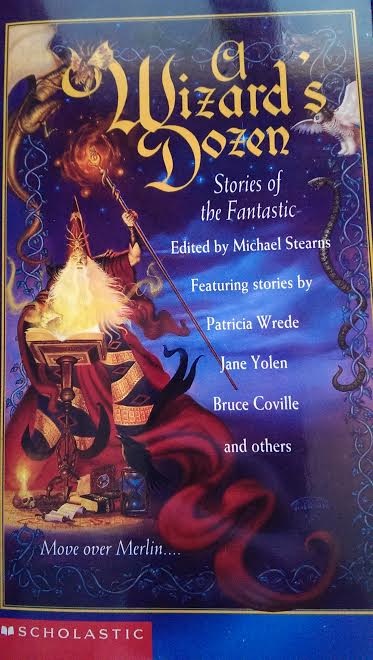
WizardsDozenA Wizard’s Dozen: Stories of the Fantastic edited by Michael Stearns, 1993.

This is a collection of fantasy stories (roughly middle school level) by different authors.  The tone of the stories varies from light and humorous to dark and serious.  The stories in this collection are:

The Sixty-two Curses of Caliph Arenschadd by Patricia C. Wrede

Caliph Arenschadd has a temper, but unlike other rulers, who have been known to cut off people’s head when they’re angry, Arenschadd is also a wizard.  Because he likes to show off his magic, he has thought of something more creative than executing people: a list of curses to inflict on those who anger him.  As people get him angry, he progresses through the curses in the order that he thought of them, each one worse than the last.  Worse still, he also inflicts the curses on the families of people who annoy him, which is how Imani, the young daughter of the caliph’s vizier has experienced so many at her young age.  However, the caliph has made a serious miscalculation in his latest curse.  This time, he has turned the vizier and his family into werewolves without being able to remove the curse.  As far as anyone knows, it’s impossible to cure lycanthropy.  As the vizier and his family find themselves becoming a threat to those around them, can Imani and her friend Tumpkin find a way to break the curse?

Fairy Dust by Charles De Lint

When Marina’s friend Jason manages to catch a real, live fairy in a jar, she tries to convince him to let it go, but he refuses.  He wants to keep it, just overnight.  But, the fairy ends up dying, and suddenly, Jason himself is severely ill.  Marina is sure that Jason is suffering from a fairy’s curse, but is there anything she can do to save him?

This experience touches on Marina’s absent father, an impractical dreamer, although it does turn out that he has taught Marina an important lesson, and she learns for herself that when she sees someone doing something that she knows is wrong, it is also wrong for her to keep silent.

The Princess Who Kicked Butt by Will Shetterly

In a mystical kingdom, people’s names tell everyone something about their destiny and character.  When a new princess is born in the kingdom, the Fairy Who Was Good With Names comes to bestow a new name on her.  However, the fairy sneezes and no one clearly hears the name that the fairy gave her.  Thinking that the fairy said the princess was “the Princess Who Read Books,” the king and queen make sure that she has plenty of reading material while she’s growing up and don’t give it much more thought.  Later, when the Evil Enchanter tries to force the princess to marry him and her parents to hand over the kingdom, the princess’s true name and her real skills become known.

The Sea Giants by Betty Levin

A great-grandmother translates whale songs for her family to tell them an ancient story: There was once a family that was barely surviving on small fish, small prey, and the little berries that they were able to forage for themselves.  The father wished that he were bigger, stronger, and more powerful so that he could catch bigger prey for his family.  One day, the father and mother paddled out to sea in search of food, and they met a group of giants in their own canoe.   The giants took them back to their own village and gave them food, but although the food they were offered was much larger than anything they could catch themselves, next to the giants, it was about as small as the small prey that the people ate back home.  After while, the couple returned home to their children, guided by a strange gray dog which turns out to be a porpoise.  From then on, the family’s luck begins to change, and they do become more prosperous.  However, the father is unable to forget about the giants, and he feels called to join them again.

Efrum’s Marbles by Joy Oestreicher

Efrum is a giant, but he’s no ordinary giant.  Although Efrum is big (being a giant), he hasn’t grown at all since the age of six.  He is over 30 years old, and he is still a child, which is weird, even for a giant child.  He spends his days playing with other giant children, and his favorite game is marbles.  In fact, he has a favorite marble.  No one knows quite what this marble is made of because no one has ever seen another like it.  It’s strange, and it kind of looks like . . . an eye?  Then, a young giant girl named Brinda plays marbles with Efrum, and for the first time ever, Efrum is tempted to let someone else win his precious, mysterious marble, which clever Brinda realizes may be the first step in helping Efrum to grow up.

“Come Hither” by Tappan King

Meg hates being the middle child in her family.  Her older sister is praised for being responsible, and her younger sister is pampered.  Meg feels like getting into trouble is the only way that she can get attention.  When she gets into trouble and is grounded from her older sister’s birthday party, she decides to amuse herself by messing with her sister’s computer.  She makes a mistake while typing and ends up receiving an invitation from a mysterious elf to join her for a party in his land.  Has Meg just made a serious mistake?

With His Head Tucked Underneath His Arm by Bruce Coville

In a kingdom constantly at war, few young men survive to become old.  Young Brion escapes for a time by pretending to be crippled, but one day, his pretense is exposed, and he is executed for refusing to fight.  However, Brion’s death doesn’t prevent him from returning to end the suffering of his land and hopefully save more people from his fate.

The Queen’s Mirror by Debra Doyle and James D. MacDonald

This is a re-telling of the story of Snow White.  An older servant tells the young princess about the history of the magic mirror, which belonged to the princess’s grandmother, who ordered her own daughter’s death because she feared and resented her beauty.  There are no dwarves in this version, and it’s a slightly different take on the story.  There are hints that the events in the story repeat with the generations.

The Breath of Princes by Alan P. Smale

When Stephanie is kidnapped from her town by a dragon, the dragon tries to convince her that being a dragon’s prisoner is a much better fate than the one that awaits her in small-town life: drudgery, boring marriage, children, etc.  Of course, he plans to eat her eventually, when he gets tired of her.  Young men try to rescue her, but in a way, Stephanie fears that one of them will succeed.  If they do, she will no doubt be obligated to marry the rescuer, and considering what some of them are like, it might even be worse than being eaten by a dragon.  The man she has always dreamed about is a prince she was lucky enough to meet once, but no prince has come to save her.  There may be a way for Stephanie to save herself from either fate, but she has to sacrifice her innocence in the process.

Harlyn’s Fairy by Jane Yolen

Harlyn lives with her Aunt Marilyn, and when she spots a fairy in the garden one day, her aunt begins to worry about her.  Harlyn’s mother is mentally unstable and prone to paranoid delusions, so Aunt Marilyn keeps a close eye on Harlyn.  She discourages her from reading fantasy stories (although Harlyn loves them) for fear of the effect they might have on her mind.  But, Harlyn really did see a fairy.  The question is, what is she going to do about it?

Lost Soul by Vivian Vande Velde

A young man meets a beautiful, mysterious woman by a stream.  She charms him so much that he no longer loves the woman he was going to marry.  In fact, he is so obsessed with her that he can think of nothing else.  What will he do when he realizes that she doesn’t feel the same?  Is she even . . . human?

The Way of Prophets by Dan Bennett

The royal family of the Stuard Isles has a tradition.  At the age of seventeen, each of them must make a journey alone along an old road known as The Way of Prophets.  The things that they see and the things that happen to them along their journey tell them what their destinies are.  They learn what really matters to them and find a focus for their time as rulers.  So many centuries have passed that no one can be quite sure where the original Way of Prophets was, so mostly, the journey takes on a kind of symbolic meaning, but there are stories that say that, every once in awhile, a young ruler finds their way to the true Way of Prophets, and the kingdom changes in some important way.  When Prince Ransom sets out, he hopes to find the true path himself.  However, when he does, it doesn’t turn out to be quite what he imagined, and it makes him question what he really wants most from his destiny.

I love this story for what the prince’s father told him, “When I am gone, when you take the throne, you will be powerful.  That is guaranteed.  Your knights and armies will make sure of it.  And you will be loved and respected.  That, too, is guaranteed.  No matter what you say and do, there will always be those ready to smother you with love and respect, if you let them, simply because you wear the crown.  Because of who you are, Ransom — because of who you will become when I am gone — you need never be hungry or alone.  But there is no guarantee that you will matter.”  If what Prince Ransom wants most is to matter, can the Way of Prophets make it happen?

Faith by Sherwood Smith

Faith tells her friends fantastic stories all the time.  She comes from a poor family with a lot of problems, so most people assume that she just makes up stories to try to make her life sound better than it really is and avoid thinking about the problems.  Usually, her two best friends don’t mind much, but lately, Melissa has been getting tired of hearing Faith talk about how her dog can talk or how her radio can tune in to Middle Earth.  She’s growing up and losing patience with fantasy stories.  Even the girls’ other friend wishes that Faith would stop asking them to believe these wild stories.  Then, after a visit to the trailer where Faith lives, she begins to change her mind.

The book is currently available online through Internet Archive.
A Year Down Yonder

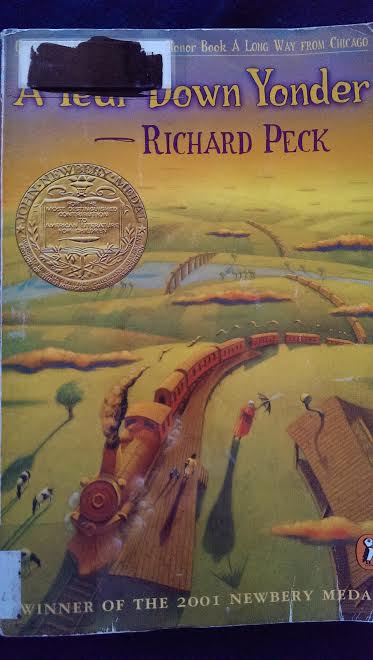
YearDownYonderA Year Down Yonder by Richard Peck, 2000.
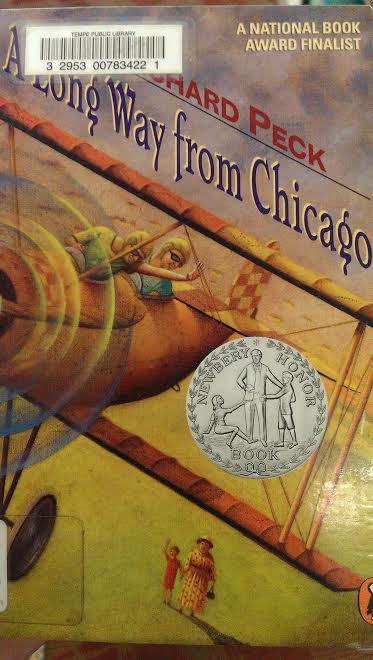
This is the sequel to A Long Way from Chicago. The story takes place shortly after the Great Depression, in 1937.

Times are still hard, and a recession has left a lot of people out of work again. Mary Alice’s father is out of work, and her brother Joey is out west working for the Civilian Conservation Corps. Because her family has to move to a smaller apartment, fifteen-year-old Mary Alice leaves Chicago to stay with her Grandma in the country for the year. Times are hard in Grandma’s small town as well, but Mary Alice’s Grandma is as wily and eccentric as ever.

Like the first book, this book is really a series of short stories about Mary Alice’s adventures with her Grandma during their year together. The stories generally have a hilarious turn as Grandma gets the better of everyone, often in the name justice or a good cause.  (Although, Grandma’s sense of justice is debatable since it involves “borrowing” pumpkins from the neighbors in the dead of night and other questionable activities.)

These stories present a detailed picture of rural life during the 1930s, from pranks played on Halloween to how Armistice Day was celebrated in the years following World War I, when people were still alive who had strong memories of that war. The stories also capture some of the personalities and politics of life in a small town, from a disreputable family of outcasts to the local elite, who have more money than the others and brag about having ancestors who fought in the Revolutionary War (which may or may not be so).

Rich Chicago Girl: Mary Alice arrives in Grandma’s small town and is enrolled in the local school.  She meets the class bully, and Grandma helps her to deal with her.

Vittles and Vengeance: At Halloween, Grandma gets revenge against a group of pranksters and raids her neighbors for ingredients to make the school Halloween party better.

A Minute in the Morning: Armistice Day, November 11, has more meaning for people who have actual memories of The Great War (World War I).  Grandma makes sure that those who can afford it pay what they owe to the veterans of that war and shows Mary Alice the price that some soldiers paid for supporting their country.

Away in a Manger: Mary Alice is picked to play Mary in the school’s Christmas Nativity play.  The baby Jesus turns out to be a surprise for the whole town, and Grandma arranges a special surprise for Mary Alice.

Hearts and Flour: The head of the local branch of the DAR pushes Grandma to make cherry tarts for their annual tea in honor of George Washington’s birthday.  Since she will neither allow Grandma to join the DAR (because Grandma doesn’t have the proper lineage) nor pay Grandma for her work (she thinks Grandma should ‘volunteer’ her services as part of her patriotic duty), Grandma insists that if she bakes, she must host the tea as well . . . with a couple of special surprise guests.  Meanwhile, a handsome new boy named Royce joins Mary Alice’s class at school.

A Dangerous Man: An artist working for the WPA rents a room from Grandma, treating Mary Alice and Royce to a scandalous but hilarious sight when his subject matter gets out of hand.

Gone with the Wind: A tornado sweeps through the town, and Grandma and Mary Alice go to check on residents who live alone.  Mary Alice also prepares to return home to her parents in Chicago.

Ever After: The final story in the book is about Mary Alice’s wedding, years later, toward the end of World War II.

This book is a Newbery Award winner.  There are multiple copies currently available online through Internet Archive.

A Long Way from Chicago

LongWayChicagoA Long Way from Chicago by Richard Peck, 1998.

Joey and Mary Alice live in Chicago during the Great Depression, but every summer, they go to stay with their grandmother in a small town in Illinois. At first, the kids think that staying with their grandmother will be boring, but they soon find out that Grandma is anything but. She’s an eccentric woman who doesn’t let anyone boss her around and doesn’t have much respect for any rules but her own. Although she’s pretty tough, Joe and Mary Alice learn that, deep down, Grandma really does care about other people and tries to help them, even though she often gets into a lot of trouble in the process. Each chapter is a short story from each of the summers that the kids spend with their grandmother, from 1929 to 1935:

Shotgun Cheatham’s Last Night Above Ground (1929): When a reporter comes looking for information about a recently deceased local character, Grandma volunteers to hold a wake for him in order to teach everyone a lesson about truth and gossip.

The Mouse in the Milk (1930): When a group of local pranksters needs to be punished, Grandma decides to play a little trick of her own to get even.

A One-Woman Crime Wave (1931): Grandma turns to trespassing and illegal fishing in her quest to feed the hungry.

The Day of Judgment (1932): Grandma enters a baking contest at the county fair for the glory of her home town and a chance to ride in an airplane.

The Phantom Brakeman (1933): Mary Alice tries to help a young woman escape from her abusive mother, and Grandma brings a ghost story to life for the sake of young love.

Things with Wings (1934): Effie Wilcox, a neighbor of Grandma’s, loses her house to the bank, but Grandma comes to the rescue by demonstrating the power of rumors.

Centennial Summer (1935): As Grandma’s town celebrates its centennial, Grandma decides that uppity Mrs. Weidenbach, the banker’s wife, needs to be taught a lesson.

The Troop Train (1942): Joe, now much older, has enlisted in the Army Air Corps during World War II. As the train taking him to his basic training passes Grandma’s town, she’s there to wave to him.

During the course of the stories, the author includes details about how Prohibition and the Great Depression affected people and other details about life in the early 1930s. This book is a Newbery Honor Book.  There are multiple copies available online through Internet Archive.

Eleven Kids, One Summer

ElevenKids

Eleven Kids, One Summer by Ann M. Martin, 1991.

People who recognize the name Ann M. Martin probably know it from the Baby-sitters Club series, although she has written more than just that.  This book is the sequel to Ten Kids, No Pets, which introduces the Rosso family.  I’ve read the book, although I don’t currently own a copy.  Mrs. Rosso has a system for everything (which is important in a family with so many kids, especially since Mr. Rosso is absent-minded), and one of the first systems she invented was the system for naming her children.  She chose their names from a book of baby names in alphabetical order, giving the first A name under the girls’ section to her first child (Abigail), the second name under B in the boys’ section to her second child (Bainbridge) and so on.  It was an efficient system, but many of the children have strange names now, which fits their eccentric family life.  Fortunately, the children assert their own personalities and give themselves nicknames, which also is part of their family life.  In the first book, the Rosso children decide that they really want a pet, something they’re forbidden to have because their parents think it will be too much to handle with their big, busy family.  By the end of the book, they do succeed in getting a pet, and their mother gives birth to her eleventh child.

In Eleven Kids, One Summer, the entire Rosso family (including the cat Zsa-Zsa) is spending the summer in a rented house on Fire Island.  Like the first book, the second is series of short stories, one about each child in the family and how they spend the summer.  Because the children are all part of the same family, the stories all connect, but splitting them up gives some focus to each of the children and allows readers to see events from different perspectives (which is important to really get the full story of some of the things that happen over the summer).  The special things about summer vacation are the possibilities for adventure and the experiences that may change you by summer’s end.

Abigail and the Train-Trip Disaster — Abigail, the oldest child in the family and the most responsible, introduces her family for the benefit of new readers and talks about their chaotic trip to the island where they will be spending the summer.  Even though traveling with such a large family can be a hassle, it gives her the chance to meet a movie star and make some new friends.

Calandra and the Mystery Next Door — Calandra (called Candy) is the dreamy, imaginative child in the family.  She becomes convinced that the old house next to her family’s beach house is haunted.  There’s just something odd about the place, and it’s starting to give her nightmares.

Faustine and the Great Fish Protest — Faustine has always loved animals.  When she watches some fishermen on the island and sees the way fish flop around before they die, she gets angry and decides to become an animal rights activist.  From this point on, she refuses to eat meat or wear anything made of animal products.  But, the hardest part of having a cause that you care deeply about is accepting that not everyone else will feel the same way.

Hannah and the Ghosts — Hannah feels like the odd child out in her family.  None of the other children really share her interests, and she doesn’t have a close, special friend.  That’s why she plays practical jokes on the others.  She’s bored, and feels the need to liven things up and get attention.  Some of her jokes are mean, though.  Hannah knows that Candy thinks the house next door is haunted, so she’s decided to convince her that it’s true.  At least, until Hannah finds the friend she really needs.

Ira and the Hospital Adventure — Ira catches Lyme disease when he is bitten by ticks and has to go to the hospital.  At first, he’s very scared, but everyone does their best to cheer him up.

Janthina and the Beauty Treatment — Jan feels bad sometimes because she used to be the baby of the family, and since Keegan was born, she doesn’t get as much attention.  When her grandparents come to visit, she hopes for some extra attention and maybe that special pink Puffin’ Pal doll that she wants. Instead, her grandparents bring along her aunt and uncle and younger cousins.  What can Jan do to get some attention?

Dagwood and the Million-Dollar Idea — Dagwood (called Woody) is looking for ways to earn extra money.  There are just so many things he wants to buy!  One of his brothers, Eberhard (called Hardy), gives him the idea of going into business, and when he spots some young children getting money for drawing things on seashells, he realizes that he can do the same thing.  In fact, he can do better by making animals out of seashells.  If only some of the other boys on the island would just leave him alone.

Gardenia and the Movie on the Beach — Ever since Abbie met the teenage movie star and learned about the movie that they’re making on the island, various members of the Rosso family have spent time talking with the movie people and their friends and watching the filming.  Now, all the Rosso kids get a chance to be extras in a crowd scene on the beach.  But, that’s not enough for Gardenia.  She wants to be a star!

Bainbridge and the Case of the Curious Kidnapping — Bainbridge (he’s never found a good short form for his name) is fourteen years old and interested in girls.  Things are going well with the girl he’s just made friends with, but their time is cut short when she has to leave the island suddenly due to do a family emergency.  With nothing better to do than do help Woody sell his seashell creations, Bainbridge thinks his last days on the island are going to be dull.  Then, he meets Blaire, a pretty girl with a name almost as strange as his own (so she says).  But, while he’s talking to her, his baby brother Keegan disappears!

Eberhard and the House of the Cursed — Hardy wants to be a detective and loves opportunities to practice his skills.  His sleuthing senses are on high alert after Hannah runs off with Keegan while Bainbridge is talking to a pretty girl and is found following Keegan’s stroller as it seems to roll by itself down the boardwalk.  Hardy knows Hannah’s tricks and figures that she’s up to something.  Then, Candy asks him to help her clear up something that’s been bothering her all summer: the mystery of the haunted house next door.  Although everyone has told Candy that it’s not really haunted, that it’s just her imagination and some mean tricks of Hannah’s, Candy is still convinced that there’s something mysterious about the place.  She thinks that the ghosts there might have even influenced Hannah to do the things she’s done. Detective Hardy is on the case!

Keegan and the End of Summer — As a baby, Keegan doesn’t understand a lot, but he loves his family, and he listens as Abigail explains to him that summer is over, and it’s time for them to go home.

This book is currently available online through Internet Archive.

Wayside School Gets a Little Stranger

WaysideStrangerWayside School Gets a Little Stranger by Louis Sachar, 1995.
Just when you didn’t think it was possible . . .

Having finally managed to remove all of the cows from Wayside School (see the last story in the previous book in the Wayside School Series), Louis declares that Wayside School is ready for the students to return.  Everyone is glad because they were all sent to far more normal schools while Wayside was closed, and they hated it.  Nothing normal ever happens at Wayside, the school that was built sideways (and has a missing floor, where all the really strange stuff happens).

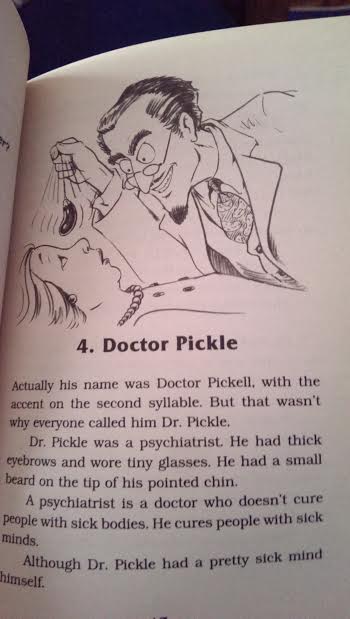
But, things are about to get stranger yet.  The school hires a new school counselor (they probably needed one) named Dr. Pickell (or Dr. Pickle, if you prefer).  He takes the job when he can’t practice psychiatry anymore because of his tendency to play practical jokes on people while they’re under hypnosis.  Can he finally cure Paul of his desire to pull Leslie’s pigtails?

WaysideStrangerPic1Meanwhile, the principal declares that “door” is a very bad word and that everyone should say “goozack” instead.  Mrs. Jewls tells the children to write poems about colors, but some colors rhyme better than others.  Kathy tries to convince everyone that Santa doesn’t exist.  Miss Zarves (who also doesn’t exist), laments about how difficult teaching really is.

Then, the children learn something really surprising: Mrs. Jewls is expecting a baby!  She has to take a break from teaching, and the children have a series of substitutes who are stranger than Mrs. Jewls.  Mr. Gorf turns out to be Mrs. Gorf’s son, and he wants revenge.  Mrs. Drazil turns out to be Louis’s old teacher, the one he was always afraid of, and she wants revenge.  Mrs. Nogard is an unhappy person who wants to make other people unhappy . . . until she realizes that isn’t what she really wants.  Wayside School may be strange, but it does have happy endings!

By the way, anyone notice what the substitutes’ names spell backward?

This book is currently available online through Internet Archive.

More Stories from Grandma’s Attic

This is the second book in the Grandma’s Attic Series (I’ve only read two of them, although there are more in the series than that).  Like the first one, grown-up Mabel shares stories from her childhood with her granddaughter: short, humorous stories about life on a farm during the 1800s, often with a moral to them (the stories typically have Christian themes).  The stories are entertaining, thoughtful, and mention interesting details about life in the past.  Watch what happens when Mabel and her friend try to play “mother” to a piglet!  Also, is it possible that the doll Mabel found in the mud is actually . . . alive?

This book is available to borrow and read for free online through Internet Archive.

The Nuisance in Ma’s Kitchen

Mabel helps to nurse an ailing baby goat, but when the goat is better, she has trouble accepting that it’s time for it to return to the barn with the other goats.

Grandma’s Sampler

Mabel learns that it’s better to be careful and to fix mistakes early when her over-confidence jeopardizes her chances of winning a contest with her sampler.

Mrs. Carter’s Fright

Mabel and Sarah Jane love babies!  They admire Mrs. Carter’s new baby so much when she comes to visit that they’re inspired to pick a “baby” of their own from a litter of piglets.  But, when they borrow Mrs. Carter’s baby carriage for their “baby,” they accidentally give everyone a fright!

When Grandma Needed Prayer

Young Mabel questions the need to pray on a busy morning, but when she and her friend get lost later, they come to understand the importance of being able to stop and pray.

The Stranger

A stranger comes to the farm and visits with them one day.  He seems to know them, and doesn’t introduce himself.  While he helps them with chores and spends a pleasant evening with them, no one is willing to admit that they don’t know who the man is.  Who is the mysterious stranger?

The Big Snow Storm

When Mabel’s Ma is sick during a big snow storm, the family doesn’t know how they’ll manage to get help for her.  But, ironically, the storm actually brings help to them.

Grandma and the Slate

Mabel’s brother, Roy, gets a new slate to write on for school.  Mabel admires it and wants to try writing on it herself, but Roy teases her that she’s just too young.  Then, when Roy makes a bargain with Mabel to give her the slate if she does something for him, he ends up getting more than he bargained for.

A Pig in a Poke

Grandma Mabel explains to her granddaughter that the word “poke” used to mean a bag or sack.  If someone bought a pig in a poke, it meant that they bought something sight unseen, not knowing exactly what they were going to get or what quality it would be. Young Mabel once saw her brothers do that the day they bought a trunk that had been locked for years because the key was lost.  Will their trunk contain a fabulous treasure or just a disappointment?

Grandma’s Day Off

Young Mabel persuades her mother to let her have a day with no chores and finds out that a life of leisure isn’t all it’s cracked up to be.

How News Spreads

When Mabel’s family hears that the girl Sarah Jane’s brother wants to marry is buying cloth for a wedding dress, Mabel and Sarah Jane get the wrong idea.

Charlotte

Mabel finds a doll lying in a mud puddle and brings it home to play with.  But, Charlotte turns out to be an unusual doll.  Wait, did she just move?!

The Slate Pencil

Mabel finds a lost slate pencil at school. Even though she knows who lost it, it’s a nice pencil, and she’s tempted to keep it for herself.

What Shall We Write About?

Mabel and Sarah Jane want to write exciting stories like the ones in the magazines, but they don’t have anything interesting to write about.  Then, Sarah Jane finds a diary that her cousin Laura left behind when she visited.  Could it be a source of story material?

The Cover-Up

Roy is punished for teasing Mabel by having to wash the dishes (since he told her that she was such a baby and couldn’t do it right).  He tries to hurry through the chore and ends up breaking one of the plates.  Is there any way he can keep everyone from finding out?

The Haircut

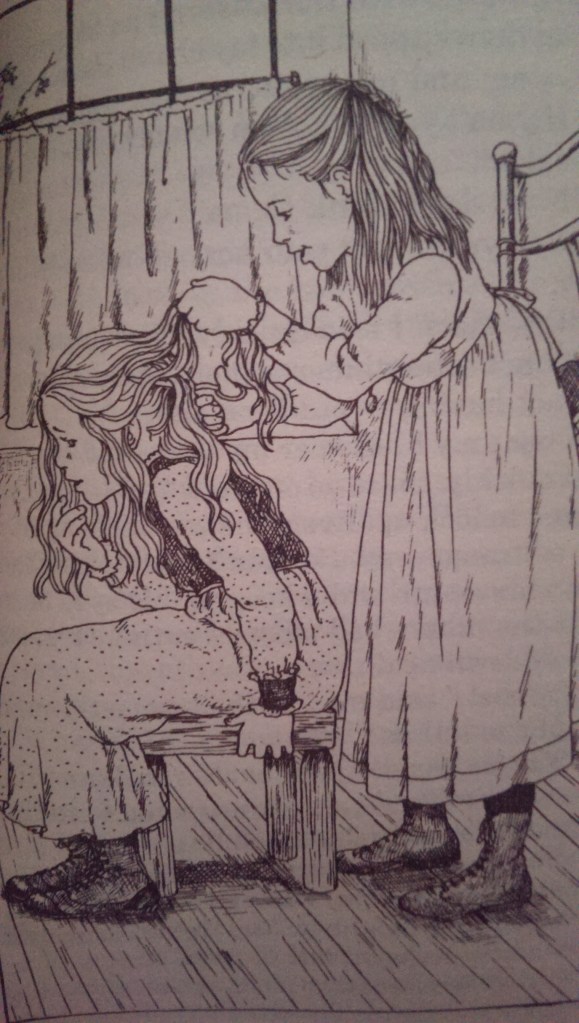
Mabel is honored when her friend, Sarah Jane, decides that she’d like to carry a lock of her hair in her new locket.  Unfortunately, Sarah Jane accidentally cuts off more of Mabel’s hair than she means to.  What will Mabel’s mother say when she sees it?  Or is there some way that they can cover it up?

Grandma Makes a Friend

Mabel resents the new girl in class, Alice, because the teacher gives Alice Mabel’s seat next to her best friend and Alice always seems to have nicer clothes to wear and everything.  But, hating people isn’t a healthy way to live your life, and Mabel’s mother convinces her to give Alice a second chance to be her friend.