Treasures From Grandma’s Attic

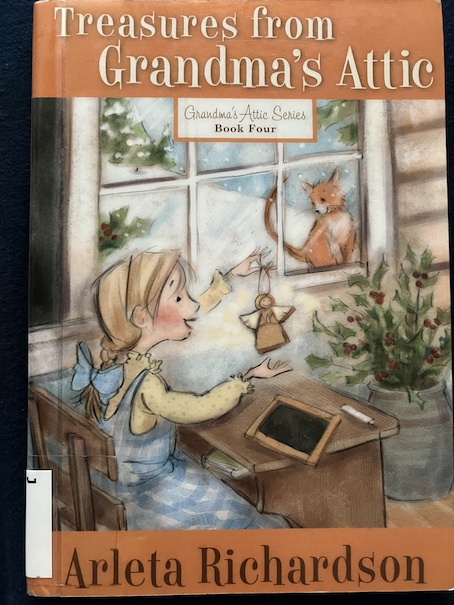
The Grandma’s Attic series by Arleta Richardson is based on her grandmother’s reminiscences about life growing up on a farm in Michigan during the 1800s.  This is the fouth book in the series, and like the first three, it’s a collection of short stories.

Usually, the stories are framed as grandmother, Mabel, telling her granddaughter some story about herself or her family when she was young, but in this book, the stories don’t have the framing element of the grandmother talking to her granddaughter. Instead, each story is just Mabel, talking about something that happened when she was young. Many of the stories in this book focus on things that happen at the small local school and lessons that they learn. The books don’t always say exactly how old the children are or what the year is, but the beginning of this book says that the year is 1886, and Mabel and Sarah Jane are thirteen and a half years old. The stories that follow the first one take place in order because characters and situations introduced in the earlier stories are referenced in the later ones.

Many of the scrapes the Mabel and her friend Sarah Jane are relatable, the kinds of minor trouble that many children (and even some adults) get into. I particularly liked the story about the fortune teller because it’s similar to something my mother told me about someone who heard something frightening from a fortune teller (or someone who claimed to be able to read palms). Even as an adult, this person similarly couldn’t get the idea out of their head once they heard something that they dreaded would happen, even though it never did. Fortunately, nothing truly tragic happens in any of the stories in this book or in the series in general. The stories are pretty calm, and many of them have a moral to them, many of them Christian-based.

The book is available to borrow and read for free online through Internet Archive.

Cousin Agatha

Mabel’s father’s Cousin Agatha invites herself to join the family for Thanksgiving, further inviting herself to stay through Christmas. Cousin Agatha is highly critical and difficult to get along with, so the family starts getting nervous when she talks about wanting to stay with them for the long term. Mabel and her brothers consider doing things to irritate her so she won’t want to stay, but Mabel comes to realize that part of the reason why Agatha acts the way she does is that she’s a nervous and insecure person, starved for attention and affection.

A New Friend

A new girl named Mary comes to school, and when she gets a crush on one of Mabel’s brothers, she tries to make herself into Mabel’s best friend. However, when Mabel refuses to help her scheme to ingratiate herself to Mabel’s brother, Mary turns spiteful and tries to get Mabel in trouble.

Christmas Spirit

The children at school draw names for a gift exchange at Christmas. However, one girl, Hannah, is sour and grouchy, and she says that, if she doesn’t draw a name she likes, she won’t bring a gift. Mabel gets Hannah as her name, and she gives Hannah a gift, but when Mabel doesn’t get a gift herself, she blames Hannah. She later realizes that she’s misjudged the situation.

The Perfect Paper

Warren is a boy at school who shows off how well he does at school, and he makes it a point that he thinks boys are smarter than girls. Mabel prays that she’ll do better than Warren on their next math test to teach him a lesson, and at first, it seems to work. However, her father notices that one of the problems was marked incorrectly, meaning that Warren actually got a better score than she did. Mabel finds herself in the position of having to tell the teacher about it, but both she and Warren learn lessons about qualities that are more important than perfect test scores and the relative worth of boys and girls.

Wesley’s Lesson

Wesley is a big boy at school, and the others sometimes tease him or scold him about how much he eats. Wesley’s eating habits can sometimes be a problem when he eats things that everyone was supposed share (as in the Christmas story), but his size is mainly a problem when he’s careless. One day, he runs hard into Sarah Jane while playing, knocking her to the ground. He’s apologetic, but Sarah Jane is angry and embarrassed. She persuades Mabel to help her get some revenge and teach Wesley a lesson, but their teacher ends up teaching the girls a lesson about respecting their classmates’ feelings.
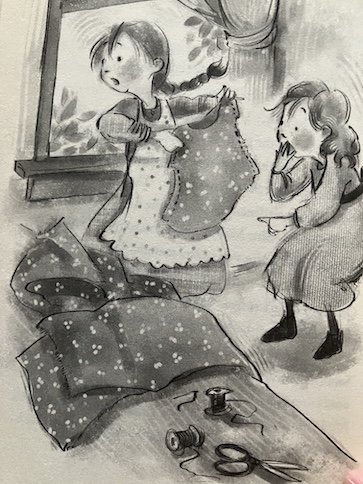
The Seamstress

Mabel wants a new dress for the ice cream social, but her mother doesn’t have time to make one. Mabel insists that she’s old enough to make a dress on her own, but her mother knows that’s harder than Mabel thinks.

The Autograph

Cousin Agatha sends Mabel a special present, a book autographed by the author. Mabel is eager to take it to school to show everyone, but her mother doesn’t think it’s a good idea. It turns into a problem when Warren offers to buy the book from Mabel. She loves the gift, but the money Warren promises her could mean more because she wants to buy something for her mother. Then, Sarah Jane suggests forging the author’s signature in a cheap copy of the same book. Does Mabel have it in her to be a forger?

The Farewell Party

The children learn that their teacher, Miss Gibson, will be leaving, and she’ll be replaced by another teacher, Mrs. Porter. The children at school aren’t happy about it because they like Miss Gibson, and they worry that Mrs. Porter might be mean or that she wouldn’t like them. The children decide that they can’t let Miss Gibson leave without having a farewell party for her, but they learn that the adults are planning a surprise of their own.

Really Responsible

Mabel starts thinking of all the things she’d like to do with her future. Sarah Jane thinks getting married is the best thing to do, but Mabel wants to do something that she can do on her own rather than having her role in life defined by the man she marries. Sarah Jane doesn’t think that she can do anything big like that on her own because she isn’t always reliable and responsible, and Mabel complains that nobody has any faith in her, but she worries that maybe Sarah Jane is right. Mabel’s mother uses a lesson from the Bible to show Mabel that, if she wants to prove that she’s responsible in big ways, she should prove herself responsible in small ones first. However, Mabel’s absent-mindedness soon gets her into trouble again!

The Tangled Web

Mabel is looking forward to a birthday party, but everything goes wrong from the moment she wakes up. It’s a rainy day, and Mabel is sick. Mabel’s mother insists that she stay home. Sarah Jane says that’s fine because the party has been rescheduled. The problem is that the party has been rescheduled to Sunday, and their families believe that Sunday should always be a day of rest. When the girls sneak out to the party without permission, they get caught up in their own scheme.

Gypsies

Mabel’s mother takes in a gypsy family temporarily because their baby is sick, and they need help. Their neighbors ask her if she’s doing the right thing because they think that gypsies can’t be trusted, and even Mabel’s brothers have heard that they’re thieves. However, Mabel’s father says that they shouldn’t assume things about other people because good and bad people can be found among any group, and Mabel’s mother points out that, whatever else they are, they’re human beings who need help. The gypsies themselves prove their own character when it’s time for them to leave, and they repay their hosts’ generosity.
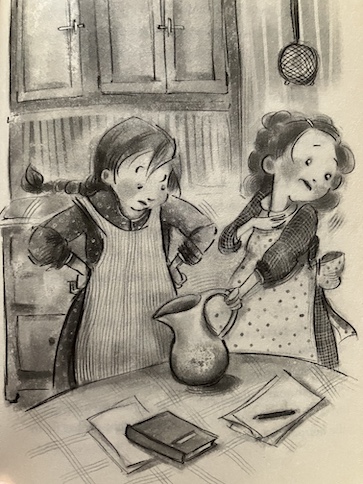
The Expensive Bookcase

When Sarah Jane’s father makes a new bookcase for her, Mabel decides that she’d also like one for her birthday. Mabel’s father agrees on the grounds that it will help Mabel to be more neat and tidy. However, the project turns out to be bigger than they thought when Mabel’s mother decides that Mabel could also use new curtains and new paint in her room, and then, Mabel decides that she would like her bed spread dyed to match. Mabel ends up owing her brother a surprising amount of favors in exchange for the work.

Monday’s Child

Mabel is fascinated by the poem about the days of the week that children are born on. Since Mabel was born on a Monday, according to the poem, she should be “fair of face.” Sarah Jane was born on a Friday, so she’s supposed to be “loving and giving.” Mabel’s mother says that it’s only a poem, not something to live by, and that beauty is as beauty does. The person who does the right thing is the most beautiful person. Mabel has trouble believing that until she sees a lovely girl at the general store who demonstrates the concept that beauty doesn’t bring happiness or character.

The Fortune-Teller

Mabel and Sarah Jane wonder about the future and what the fortune teller in town might have to say to them. Mabel’s mother warns her that curiosity can lead to trouble and that if she tries to have her fortune told, she might hear something she won’t like. However, the girls can’t resist seeing the fortune teller. Although the girls promise themselves that the fortune telling is just for fun and that they won’t take it seriously, when Mabel hears something that she doesn’t like, she has trouble getting it out of her head. Because she’s been primed to believe the prediction, she misinterprets something that she overhears.

Revenge

Mabel can’t find her cameo pin, and she blames her brother Roy because of his teasing and tricks he plays. Later, a comb disappears from her room, and Mabel again blames Roy. He doesn’t exactly deny that he didn’t take these things, although he implies that Mabel probably lost them herself. When a quarter disappears from the money that Mabel has been saving to buy a present for her mother, Mabel is sure that Roy is responsible, but she can’t spoil the surprise for her mother by admitting that she’s been saving money for a present. Mabel decides that she needs to take matters into her own hands and teach Roy a lesson but ends up teaching herself one.
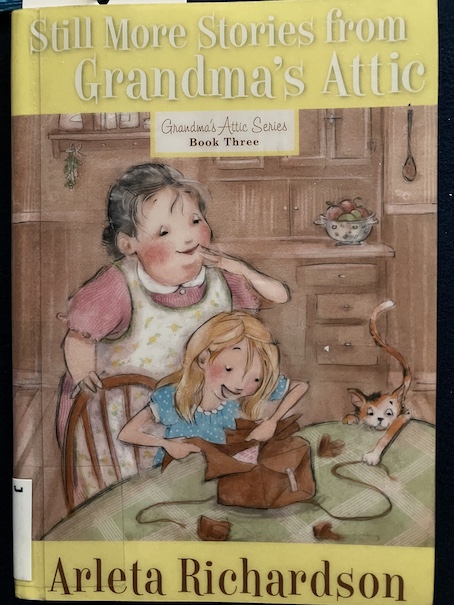
Still More Stories from Grandma’s Attic

Still More Stories from Grandma's Attic cover

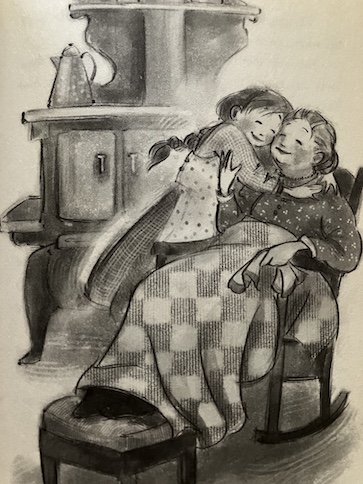
The Grandma’s Attic series by Arleta Richardson is based on her grandmother’s reminiscences about life growing up on a farm in Michigan during the 1800s.  This is the third book in the series, and like the first two, it’s a collection of short stories. Each of the stories are framed as a story being told by the grandmother to the granddaughter about something that happened when she was young, inspired by something the granddaughter is experiencing in her life. Some of them are funny stories, others are though-provoking, and many of them have a moral or life lesson to them. The grandmother, Mabel O’Dell, has two older brothers and a best friend, named Sarah Jane, and many of the stories center around things they did as children. There are Christian themes in the stories, and some of them contain Biblical references.

What I like are the small details about life in the past. We get to see children going about their farm choices and attending school in a one-room schoolhouse, and we get to see what was important to the children back then. The children in the story have their own wishes and plans, fun things they like to do in their spare time, things that worry or frighten them, and special occasions that they look forward to.

One thing that I would like address, though, is the religious aspects of the stories. Something that would probably stand out to modern readers is that the Bible readings and lessons aren’t restricted to home and church but are also taught in the school every day. There are some people in the 21st century who seek out private schools that still do this, and some people who wish public schools still did, but there’s an important aspect of this that I’d like to make clear to everyone: This is a small rural community with only a one-room schoolhouse and around 15 or so children at a time and a single church that everybody in the area attends.

Everybody there is the same religion, which is why this school and others from this time period, particularly in small communities, were completely comfortable incorporating Bible readings into their school lessons. There was nobody around whose beliefs were different from theirs. They could happily take it for granted that was the case because it definitely was. They didn’t have to give it a second thought or even much of a first one because they’d all see each other every Sunday in that one little church. There is no need to to accommodate diversity in communities where there isn’t any. We don’t see how the characters in these stories respond to people of different religions because they never meet any, at least not during the course of the stories in this book. I think some people who are nostalgic about that element forget that this is the primary reason why modern public schools don’t do things like that anymore, and there are definite trade-offs.

If you accommodate a group of diverse people, it’s true that you can’t concentrate on religious sub-groups in the same way and don’t get the reinforcement of beliefs that those people also receive at home and at church that make life seem consistent across all channels, but at the same time, if you live in a community that intensively studies its own beliefs and customs and has nothing else to accommodate, you have to forfeit the experience of learning more about the variety of people that exist in the wider world or the lessons that diverse groups learn about getting along with people who are different, not taking social agreement or a shared vision of life for granted, and learning to understand and accommodate people with concerns that you don’t necessarily share just because you care about how someone else feels and need to find a way work with each other. Nobody gets to have everything in life or learn everything in life, and putting all of your emphasis on one thing means passing up other opportunities. It’s just the way life is. Mabel and her friends learn many valuable things about life and the choices they make, but how to live in a diverse community with people who have different beliefs just isn’t one of them. They don’t talk about any of that because they don’t need to.

The books in the Grandma’s Attic series cater to a sense of nostalgia, which is pleasant, but I just wanted to remind readers that there are reasons why most people don’t live this way anymore and that most schools aren’t run this way anymore, and there are some benefits to new ways doing things that are a better fit for the world that 21st century people live in. Enjoy this “simpler time” for what it is, but just understand that there are things modern people experience that are worth something, too, and things we get to do with people who 19th century people who were being educated in one-room schoolhouses might not have even imagined meeting!

That being said, I do find this book charming and cozy. It makes for a relaxing read, and I think the morals and life lessons in the stories are positive ones. The characters in the stories do have some consequences for their childhood escapades, but nothing tragic or overly serious. It’s fun to see them getting into childhood scrapes, enjoying simple pleasures, and planning parties and special surprises for friends and family.

The book is available to borrow and read for free online through Internet Archive.

Still More Stories from Grandma's Attic girls making face cream

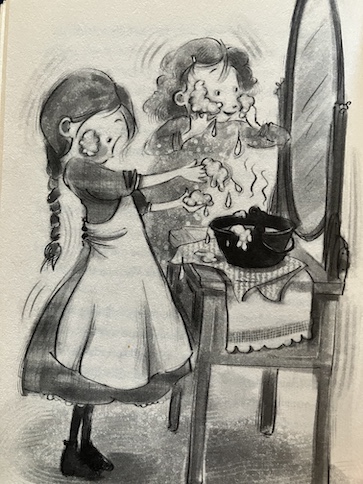
Face Cream from Godey’s Lady’s Book

Mabel and her best friend, Sarah Jane, attempt to make face cream from a recipe in a women’s magazine, with unexpected results!

It Rhymes with Mop

Mabel was often a careless and sloppy child, but she learns her less when her family has dinner with the minister and his wife.

High Society

Mabel is invited to come with Sarah Jane on a visit to her cousin’s house in the city. Sarah Jane’s relatives are more wealthy, and they have a big house with servants, but the girls come to realize that the high life in the city isn’t really the life that they want to live.

Still More Stories from Grandma's Attic girl climbing tree

The Dog Who Could Spell

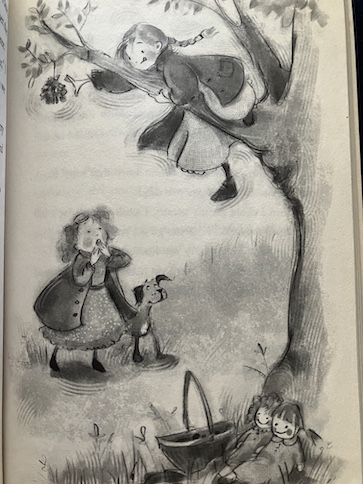
Mabel proves to Sarah Jane that her dog is smarter than she thinks when the girls get into trouble, and Mabel gets the dog to understand and fetch help.

The Wrinkled Stockings

Mabel and Sarah Jane are tired of wearing their heavy long underwear under their clothes because it wrinkles their stockings and makes them feel uncomfortable. Since it’s nearly spring, they decide to modify their long underwear for better comfort, but they’re sorry when they realize just how changeable the weather can be.

Whenever I’m Afraid

Grandma remembers a time when she was a child and found herself home alone while she was sick and how she comforted herself with prayer and the thought that God was looking after her.

Grandpa Hobbs

Grandpa Hobbs is a neighbor whose memory has become confused in his old age. He sometimes lives in the past and confuses past events and people with present ones. When he stays with Mabel’s family for a time, though, they are surprised at some of the things that he does remember!

The Spelling Bee

Mabel and her brother have a habit of leaving things where they don’t belong because they forget to put them away. When Mabel’s father decides that he will confiscate anything that’s not in its proper place, he takes something important of Mabel’s. However, in driving home the lesson about personal responsibility and accountability, Mabel’s father learns that he also needs to teach the children about forgiveness and mercy by demonstrating some himself.

Still More Stories from Grandma's Attic ink stain on dress

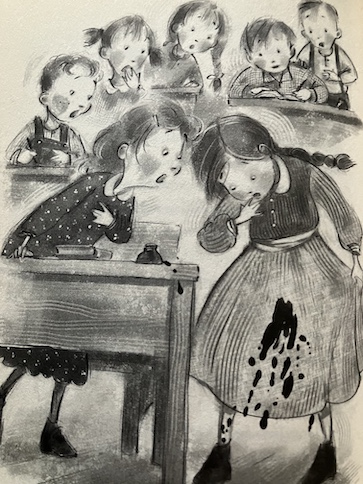
The Prettiest House in the Country

Mabel’s mother says that the house needs to be repainted, but Mabel’s father keeps putting it off. When she learns that he’s making plans to repaint the barn instead of the house, Mabel’s mother takes matters into her own hands.

My Own Boss

Mabel is tired of her parents always telling her what to do and insists that she wants to make some decisions about things herself. When her parents allow her to make some choices on her own, she learns that making choices means learning to live with the results.

The Harvest Home Festival

The kids in Mabel’s class at school each have to memorize something from the Bible to recite at the Harvest Home Festival. Mabel, being a procrastinator, puts off memorizing her piece until a couple of days before she recites it. However, when she has last-minute doubts about whether or not she’s really committed it to memory

The Surprise Birthday Present

Mabel’s father needs a new suit, but the family needs to raise the money to buy one for his birthday. At first, they don’t think they’ll be able to raise enough money to get him a new suit in time for his birthday, but Mabel finds something other than money that gives them what they need. The moral of this story is that God sometimes answers prayers in unexpected ways.

The Perfect Party

Mabel and Sarah Jane decide to throw a surprise birthday party for their teacher at school. They think they’ve got everything planned well, but they forget that, even at a surprise birthday party, sooner or later, someone has to tell the birthday person when to arrive.

Windfalls

Mabel and Sarah Jane are allowed to take apples that have already fallen from a neighbor’s trees (the “windfalls), but one day, they see what they think is the perfect apple to give to their teacher and try to make it fall on purpose. In the process, they end up getting into a scrape that Mabel knows she won’t be able to hide from her parents.

Homer Price

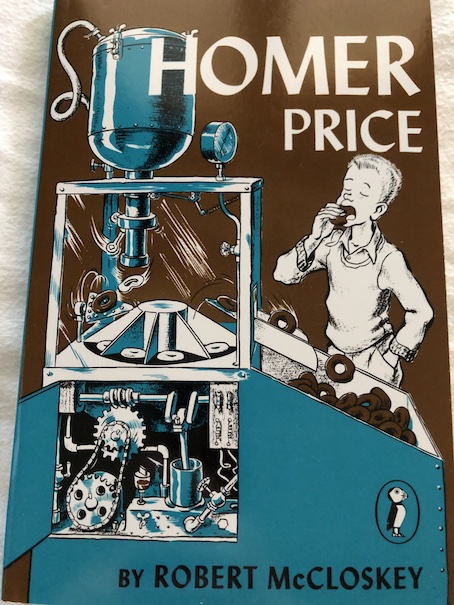
Homer Price is a collection of short, humorous stories about a boy who lives in a Midwestern town called Centerburg. His parents own a tourist camp with cabins and a filling station, and Homer helps out there with odd jobs. In his spare time, he has a hobby, building radios.

Many people remember this book specifically for the episode of the doughnut machine that goes out of control. Stories in the collection have been made into tv episodes or short films three times, and two of those are based on the doughnut machine story. (Sometimes, they appear on YouTube.) There is also a sequel to this book called Centerburg Tales: More Adventures of Homer Price.

It didn’t occur to me until I started reviewing the book for this site, but it was first written and published during WWII. The war doesn’t play any part in any of the stories in the book, but it occurred to me as a fun collection of stories that its first audience of 1940s children might have enjoyed as a break from the chaos of the world around them. Various aspects of 1940s society and culture appear in the stories in humorous ways, like the comic book superhero who resembles Superman (a character introduced in comic books in 1938), lunchrooms (small diner-style restaurants), and the concepts of advertising, mass production, and suburbs with prefabricated houses.

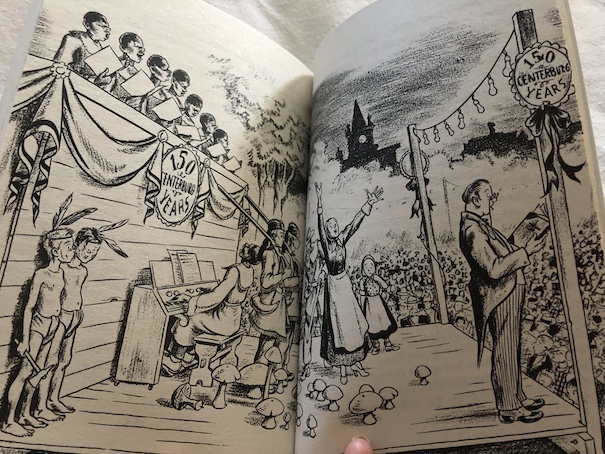
There is one incident that readers should be aware of that concerns descriptions of Native Americans. When the town holds its 150th anniversary celebration, Homer and his friends have roles in skits about the history of the town, playing Native Americans, and part of their costume involves dyeing their skin, which would be considered tasteless and racist in the 21st century. Their skit also includes a “scalping scene” (not really described, except saying that it “had to be modified somewhat”), which would also definitely not pass modern standards in any public performance. Because this is a collection of intentionally humorous stories, I’m not sure whether the author included this stereotypical depiction of kids playing Native Americans in a tasteless way to poke fun at such depictions or not, but I though it was worth mentioning for the benefit of people sharing these stories with children, so you know that part is there.

I didn’t notice anything particularly concerning about the depiction of black people in the book. Black people are included in the stories as members of the community without too much attention to the fact that they’re black. They’re simply part of the town, and nobody makes a big deal about them being there or refers to them by any derogatory names. One black boy finds a wealthy lady’s bracelet inside a doughnut in the doughnut machine story, and the local African Baptist Church choir performs at the town celebration.

The Case of the Sensational Scent

One evening, Homer gets his usual bedtime snack of milk and cookies and leaves some milk out for his pet cat. However, a skunk wanders in and finds the milk. Homer decides to try keeping the skunk as a pet, naming it Aroma. Aroma helps to thwart a gang of robbers.

Case of the Cosmic Comet

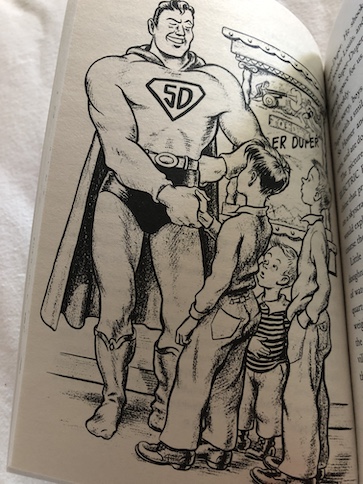
Homer and a couple of friends are reading comics and marveling over a superhero called Super Duper (who is sort of like Superman). Later, Homer’s friend Freddy says that there’s going to be a Super Duper movie playing in town and that Super Duper himself will be there. Homer isn’t quite as enthralled with Super Duper as Freddy is because he knows it’s just fiction, and he thinks the stories are kind of formulaic, but he agrees to come to the movie. When the Super Duper’s car crashes as he leaves, they see that the Super Duper is actually an ordinary human who doesn’t really have super strength and can get hurt. Fortunately, he isn’t hurt badly, and the boys take their disillusionment well, profiting from the help they give him.

The Doughnuts

Homer’s aunt and uncle own a lunchroom, and his uncle is a gadgeteer with a weakness for buying labor-saving devices. One of these devices is an automatic doughnut-making machine. One day, Homer’s uncle is trying to fix the doughnut-making machine, and he asks Homer if he can finish fixing it and make some doughnuts for him while he runs an errand (really, he’s going to play pinochle at the nearby barber shop) because Homer is good with mechanical devices. When Homer gets some help from a patron, mixing up masses of doughnut dough from her family’s old recipe and runs the machine, Homer has trouble turning off the machine. It just keeps making more and more doughnuts! What are they going to do with all these doughnuts, and will they ever get the machine to stop?

Mystery Yarn

Miss Terwilliger is locally known as a great knitter. She’s taught most of the local women how to knit, and everybody also loves her fried chicken. She has two admirers who would like to marry her, the local sheriff and Homer’s Uncle Telly, but she just can’t make up her mind which she would like to marry. When the Sheriff and Homer’s Uncle Telly compete to see which of them has the largest collection of string, the Sheriff arranges for the two of them to unroll their giant balls of string at the local fair to prove which of them has more string. They also decide that whichever of them win the contest will also win Miss Terwilliger … until they discover that Miss Terwilliger also collects string and is determined to enter the contest … and she just might be beat them both. All’s fair in love and string collecting, and to the winner go the spoils!

Nothing New Under The Sun

A strange man comes to town. He seems a little odd and kind of shy. The sheriff is a little concerned about who he might be. The stranger himself just makes an odd comment about having been away from people for a long time. The stranger might be a shy eccentric, but the sheriff is concerned that he might be some kind of fugitive. The sheriff talks to various people around town, and they all offer their advice about how to judge a person’s character and what they think about the stranger. Various people say that he reminds them of someone from a story, and the town librarian identifies the character they’re thinking of as Rip Van Winkle. Could this stranger really be an old man who fell asleep for 30 years in the mountains, like in the story? If so, what’s with the bizarre vehicle the stranger has? When Homer finally persuades the man to show him his car and tell him who he is, the story turns out to be stranger than fiction: he’s a man determined to literally “build a better mousetrap” and turns out to be a kind of modern-day Pied Piper.

Wheels of Progress

Centerburg is celebrating its 150th anniversary with a public celebration and the creation of a new suburb with mass-produced, prefab tract houses (the kind made fun of in the song Little Boxes by Malvina Reynolds, which “all look just the same”). The identical nature of the houses turns into a nightmare when the street signs aren’t ready in time for the grand opening celebration, confusing the townspeople.

Fun fact: The original name of the town is revealed to have been “Edible Fungus” after the edible fungus that kept the original settlers who founded the town alive. The choir in the story sings a song about it.

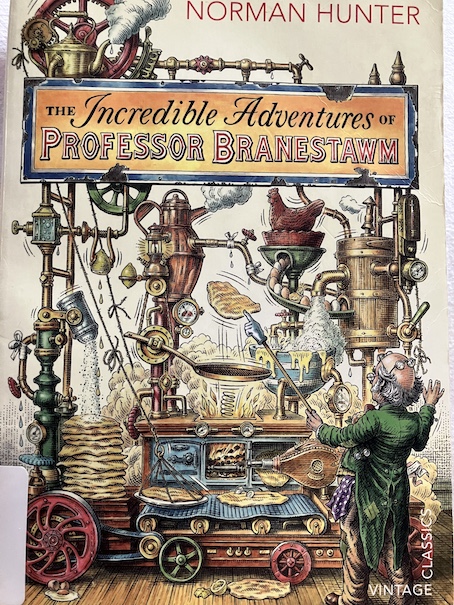
The Incredible Adventures of Professor Branestawm

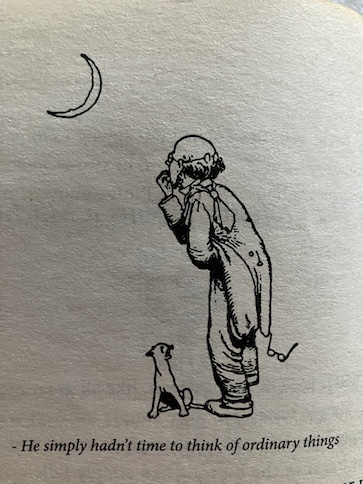
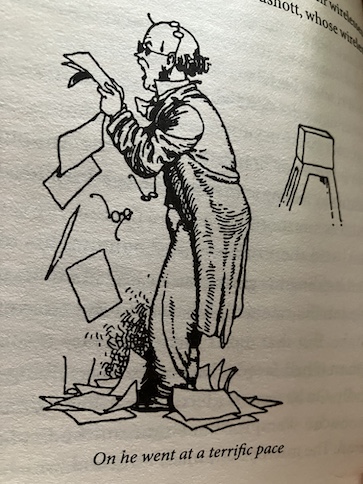
Professor Branestawm is a classic absent-minded professor. He’s is a balding man who wears several pairs of glasses, one of which is for finding the other pairs of glasses when he inevitably loses them. He’s a very clever man, but everyone knows that his inventions are likely to cause chaos. He’s not an easy person to talk to, so he doesn’t have many friends. His best friend is Colonel Dedshott, who is a very brave man.

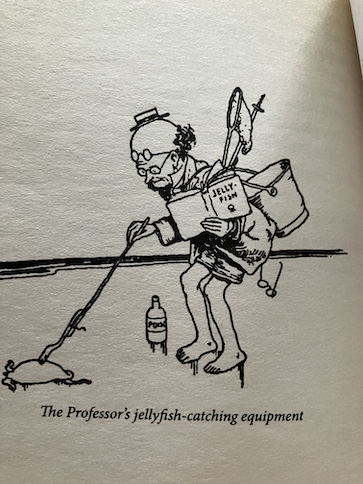
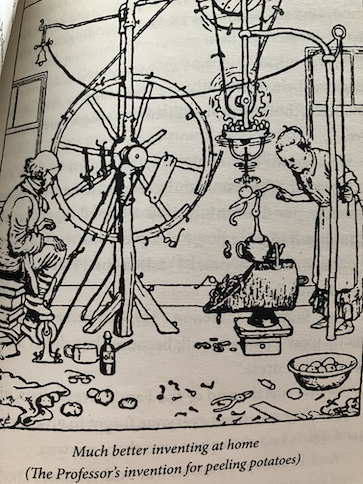
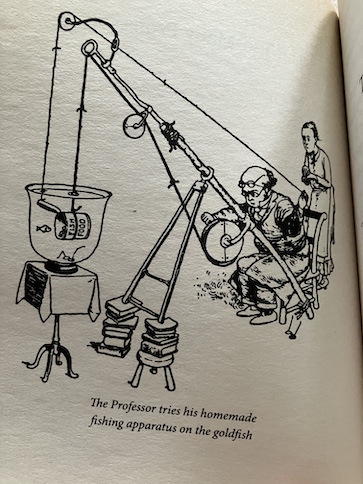
Every chapter in this book is about another of the Professor’s inventions and the adventures that the Professor, the Colonel, and the Professor’s housekeeper, Mrs. Flittersnoop, have with them and with various situations that the Professor creates with his absent-mindedness. The stories are accompanied by pen-and-ink drawings. I love the way almost every picture of the professor shows him shedding one or more of his many pairs of glasses and that the Colonel’s weapon of choice is a slingshot!

One day, Professor Branestawm invites the Colonel to his house to see his latest invention, which he says will revolutionize travel. When the Colonel arrives, Professor Branestawm explains his idea. First, he points out that, if you’re traveling somewhere, you’ll arrive in half the amount of time you ordinarily would if you travel there twice as fast. The Colonel says that makes sense. Then, Professor Branestawm says that, the faster and faster you travel, the sooner you arrive at your destination. That also makes sense. Further, Professor Branestawm says, you eventually start traveling so fast that you arrive before you even start, and if you go fast enough, you can arrive years before you start. The Colonel doesn’t really understand this, but he takes the Professor’s word for it. The Professor has built a machine that will allow them to travel that fast, and the Colonel is eager to try it. He suggests that they try going back in time to a party he attended three years earlier. The Professor insists that they take some powerful bombs with them, just in case of emergencies (don’t try to make sense of it, there isn’t any), and the Colonel has his trusty catapult (slingshot) and bullets with him.

It turns out that, rather than going to the party three years earlier, they arrive at the scene of a battle that took place in another country two year earlier. Although they already know how the battle turned out, the Professor and Colonel can’t resist joining in with their bombs and catapult, and they end up wiping out an entire army and changing the result of the battle in favor of the revolutionaries. The revolutionaries are so grateful to them for their help that they take them to the palace of their former king, put the two men on the enormous throne there, and make them the new presidents of the country. Professor Branestawm realizes that they’ve made a terrible mistake and changed history because the king’s army was the one that was originally supposed to win the battle. The Colonel, however, doesn’t care because he thinks it sounds like fun to be a president and can’t wait to do some ruling.

Of course, the ruling of the two presidents doesn’t go well. Neither one of them really knows anything about running a country. Since they blew up all the country’s troops, there are no troops left for the Colonel to review, and he ends up playing with toy soldiers. Meanwhile, the Professor really just wants to get back to his inventing. Eventually, the revolutionaries get tired of this and tell them that they’ve decided that they don’t want any presidents, so they’re giving them a week’s notice before they’re out of a job. The Professor and the Colonel try not to take any notice (ha, ha) of the revolutionaries’ attempts to dethrone them. This just leads to the revolutionaries trying to imprison them in the dungeon, so the Professor and the Colonel are forced to escape in the Professor’s machine, which takes them back to the exact time and location where they started. They arrive just as the Professor’s housekeeper brings them some tea, so they have their tea, go about their usual business, and leave it to the historians to deal with the complications of the two of them changing history.

When Professor Branestawm’s housekeeper puts a bottle of cough syrup with no stopper into the waste-paper basket, it accidentally creates a waste-paper monster! It turns out that it wasn’t really cough syrup in the bottle. It was a special life-giving formula that the professor invented. He only keeps it in a cough syrup bottle because cough syrup is the only thing that neutralizes the life-giving formula and stops it from bringing everything it touches to life, including the bottle holding it. Now that they’ve accidentally created a waste-paper monster, what can they do to stop it, especially since it seems to have the ability to use tools and is currently trying to saw down the tree where the Professor and his housekeeper are trying hide?

Professor Branestawm accidentally loses a library book about lobsters, so he goes to another library to get the same book. By the time that he needs to return the library book, he has found the first one and lost the second one. For a while, he manages to avoid library fines by continually returning and checking out the same book from both libraries because the libraries don’t notice which library the book is from. Of course, he eventually loses the first book, too. He tries to fix the situation by getting the same book from a third library and then one from a fourth library, when he loses the third book. Where will it all end? How many libraries will have to share this one book, and where on earth are all these books about lobsters going?
Professor Branestawm and his housekeeper go to the movies to see a documentary about brussels sprouts. (The housekeeper doesn’t care about brussels sprouts, but there’s a Mickey Mouse cartoon included with the feature, and she wants to see that.) When they get back, they discover that the house has been robbed! Professor Branestawm decides that he’s going to invent a burglar catcher, but the only burglar he catches is himself.

Professor Branestawm’s clock stops, so he takes it to a clock repair shop. It turns out that the clock has only wound down because the Professor has forgotten to wind it. The Professor decides that he’s going to invent a clock that will go forever and never need winding. (This story is set before clocks that don’t need winding became common.) The Professor does invent a clock that will never stop and never need winding, but he makes a critical mistake: the chimes never reset after they strike twelve. They just continue counting up and up, endlessly, with no way to stop them! Just how many times will they endlessly strike before something terrible happens?

The Professor visits a local fair and invites the Colonel to join him. The Colonel ends up winning most of the prizes for the various games, and the Professor accidentally gets left behind in the waxworks exhibit, being mistaken for a wax statue of himself. When the Professor decides that it’s finally time to get up and go home, the people who work in the waxworks think that a wax statue has come to life!

Professor Branestawm writes a letter to the Colonel, inviting him to tea, but because he is distracted, thinking about potatoes, he accidentally writes a muddled letter and then mails the paper he used to blot the letter instead of the letter itself. The message that arrives at the Colonel’s house is a backward, muddled mess, and he has no idea who sent it to him. Since it looks like it’s written in some strange language he doesn’t know, the Colonel decides to take it to the Professor to see if he can decipher it. The Professor fails to recognize the letter as what he sent and has forgotten that he sent it. Will the two of them figure out what the letter is about, or will they eventually just give up and have some tea?

Professor Branestawm’s housekeeper’s spring cleaning creates some chaos in the professor’s house, and the Colonel suggests that Professor Branetawm invent a spring cleaning machine. Predictably, the spring cleaning machine creates an even bigger mess and far more chaos.
Professor Branestawm invents a very smelly liquid that brings things from pictures to life. The things from the pictures go back to being pictures when the liquid dries. Of course, there are some things that cause big problems when they’re brought to life. Possibly the most chaotic pictures that come to life are pictures of the Professor and the Colonel and the professor’s housekeeper. Who is who and which is which?
Professor Branestawm is invited to give a talk on the radio, and the Colonel helps him to rehearse. However, because he gets mixed up, he almost misses his own talk, and when he finally gives it, he speaks too fast and discovers that the time slot for his talk is much longer than he thought it was. Listeners are confused, but everything is more or less all right when the Children’s Hour comes on.

The Professor and the Colonel are going to a costume ball. Since the Professor doesn’t know what to do for a costume, the Colonel suggests that the two of them dress as each other. This causes some confusion, and neither of them likes each other’s clothes. The Professor’s social skills aren’t even great at the best of times, and the truth is that he’d rather be inventing things at home in his “inventory” (pronounced “invEnt – ory” as in a laboratory where you invent things, ha, ha). Then, the Countess at the ball raises the alarm that her pearls are missing! Everyone is confused when they try to get “the Colonel” to find the thief, and he doesn’t seem to know what he’s doing. It takes a while for things to get sorted out, but at least the Professor and the Colonel develop a new appreciation for being themselves instead of being each other.

Professor Branestawm’s house has gotten so full of his inventions that it’s become difficult to live there, so he’s decided to move to a new house. Moving to the new house is an escapade, and when Professor Branestawm and his housekeeper get there, they discover that the water and gas haven’t been connected up yet. Professor Branestawm’s attempts to remedy the situation render the new house unlivable, so he is forced to move back to his older house.

Professor Branestawm invites his friends and various members of the community to his house for a party, where there will be tea and pancakes. Everyone is happy to go because of the promise of pancakes, but when they’re all there, Professor Branestawm reveals that the party is to unveil is newest invention: a pancake-making machine! As the library man predicts, the pancake-making machine goes wrong (just like the Professor’s other inventions), but it’s all right because the town council comes up with a new purpose for it.

Professor Branestawm takes a trip to the seaside. He asks the Colonel to join him and bring his book about jellyfish, but unfortunately, he neglects to tell the Colonel where he’s staying (partly because he forgot where he was supposed to stay and is actually staying somewhere else). When the Colonel tries to find the Professor, he accidentally mistakes an entertainer dressed as a professor for Professor Branestawm. When the entertainer isn’t acting like himself (so the Colonel thinks), the Colonel becomes worried and decides medical intervention is necessary.

The book is available to borrow and read for free online through Internet Archive (multiple copies). It’s the first book in a series about Professor Branestawm, and it was also adapted for television multiple times.

Kids won’t learn anything about real science from Professor Branestawm, but the stories in the book are funny and not meant to be taken seriously at all. Most of the stories are about some pretty silly things that don’t really mean much in the end, but when you think about it, the Professor’s antics do lead to some pretty serious consequences, from wiping out an entire army just for the fun of it (pretty horrific in real life) and changing the course of history to accidentally blowing up someone’s house with his perpetually-chiming clock. No matter what the Professor does, though, there never seem to be any lasting consequences.

Even when people around him brace themselves for when the Professor’s latest project inevitably goes wrong, everybody still thinks that the Professor is pretty clever. The Colonel always thinks the Professor is clever, and even when he knows that the Professor is bound to do something that’s going to cause chaos, he enjoys the excitement. The housekeeper sometimes goes to stay with her sister, Aggie, when the chaos and excitement get too much for her.

The stories are just meant to be enjoyed for their zaniness, and there’s no point in analyzing them much. You don’t have to worry about whether anything the Professor does makes sense or exactly how he got any of his inventions to work. You can just enjoy seeing how everything develops and watch the craziness unfold! It sort of reminds me of Phineas and Ferb’s summer projects, which cause some chaos but are ultimately funny and always disappear at the end of the day. Enjoying these stories is what they used to say in the theme song for the tv show Mystery Science Theater 3000:

“If you’re wondering how he eats and breathes
And other science facts,
Just repeat to yourself “It’s just a show,
I should really just relax …”

I can promise you that, no matter what happens in any of the stories, the Professor and his friends will ultimately be fine and will probably have a cup of tea (or “a cup of something”) afterward. This book was originally published in Britain the early 1930s, and it was read by children during the Great Depression. I can imagine that it might have given children then a good laugh and some escapism during troubled times.

Strangely, at least one of the Professor’s inventions, the clock that never needs winding, is a real invention that we have every day because time has moved on (ha, ha) since this book was originally written and published. In fact, it’s very unusual to find clocks that need to be wound these days. Of course, the part about the clock perpetually chiming more and more and blowing up when it gets to be too much is just part of the craziness of Professor Branestawm.

After the Sun Sets

This was my favorite book of fairy tales when I was a kid! I gave away my copy years ago and regretted it, but I was thrilled to find another copy later at an antique/vintage mall.

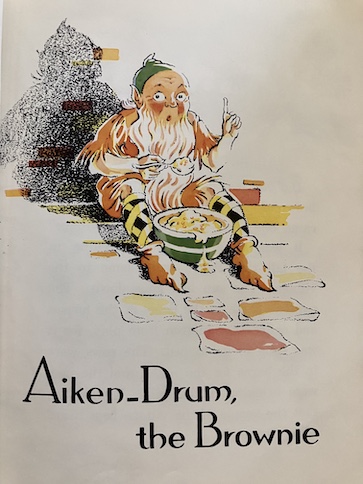
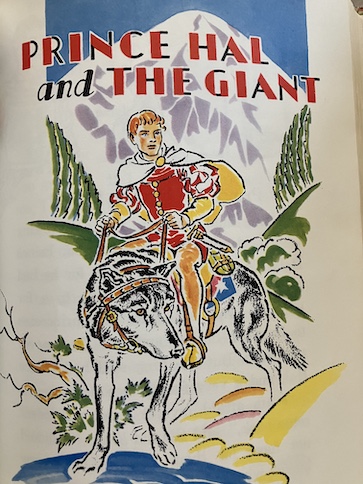
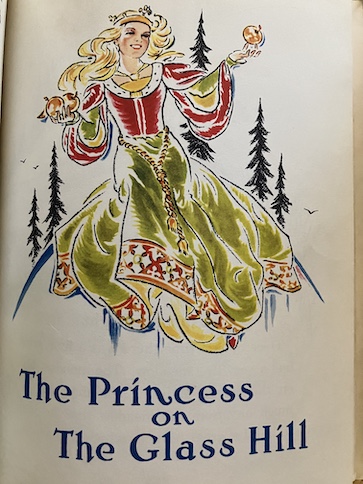
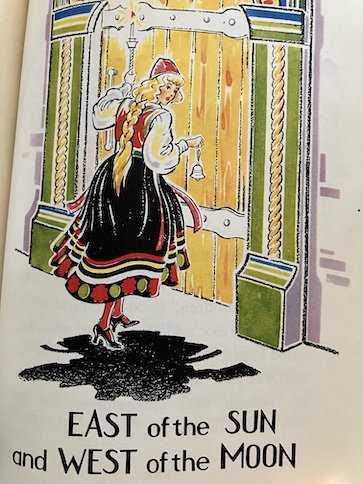
The collection includes some popular fairy tales that you can find in other fairy tale collections, like Cinderella, Brier Rose (the Sleeping Beauty story), and Hansel and Gretel. It also has some stories that are less commonly known these days, like Aiken-Drum, the Brownie and Prince Hal and the Giant. When I was young, my favorite stories in the book, the ones I read over and over, were Snow-White and Rose-Red, The Princess on the Glass Hill, and East of the Sun and West of the Moon.

One of the things that makes this collection unique is that it includes a section of poems at the back of the book. I love the one called Cinderella’s Song, and it was one of the reasons why I missed this collection so badly. I don’t think I’ve seen that poem in any other book.

The illustrations in the book are beautiful! I loved them as a child, and I still find them enchanting as an adult. Some are in black-and-white, but some are in full color.

I didn’t realize it when I was a kid, but this book is actually the third book in a series, The Wonder-Story Books, and it was a unit in The Row, Peterson Basic Reading Program. I have the 1962 edition, but the book is actually older than that. Its copyright was renewed multiple times.

The book is available to borrow and read for free online through Internet Archive. There is also an earlier edition of this book available through Internet Archive, and it doesn’t have the section of poetry included, so the poetry might only appear in the 1962 edition.

Aiken-Drum, the Brownie

Aiken Drum is a Brownie, a magical little man who likes to do chores for other people for little reward. Reward a Brownie too much, and he will leave.

Pat and the Fairies

Pat joins the fairies in a dance, and they loan him a pair of shoes when his wear out. When he later comes to return the shoes, he gets a wonderful reward. A greedy shoemaker tries to join the fairies in their dance and borrow a pair of shoes to get the same reward, but the fairies punish him when he tries to cheat them.

Change About

A husband grumbles about how little his wife accomplishes in the course of a day while she minds the house and their child and he works out in the fields. The husband and wife decide to switch places for a day to prove which of them works harder, and the husband has a surprise about what really happens at home while he’s away.

Cinderella

A girl who is abused by her stepmother and stepsisters receives magical gifts from her fairy godmother so she is able to attend the prince’s ball.

Snow-White and Rose-Red

A widow and her two daughters let a gentle talking bear spend the winter with them so he won’t freeze, but this bear is under a spell.

Snip, The Tailor

A tailor sets out to make his fortune. He uses his wits to defeat a pair of giants and win a castle and half the kingdom from the king.

Brier Rose

This is the Sleeping Beauty story. A young princess is cursed by a bad fairy. When she hurts her hand on a spindle, she and everyone in her castle falls asleep for a hundred years.

Prince Hal and the Giant

Prince Hal is the youngest of a king’s seven sons. The other six have left home to find brides and have never returned home. No one knows what happened to them. Prince Hal sets out to find what happened to his brothers. He finds out that they and their brides have been turned into stone statues in the house of a giant. Prince Hal must find a way to save them and the princess who has become the giant’s latest captive.

Hansel and Gretel

A pair of children are abandoned in the woods, and they find a strange house made of gingerbread. They are almost eaten by the witch who lives in the house.

The Princess on the Glass Hill

Every year on Midsummer Night, the hay disappears from a farmer’s field. Each of his sons tries to find out why, but each of them is frightened by the strange things that happen, until the youngest son faces the phenomenon and discovers a strange horse with a coat of mail that fits him perfectly. The same thing happens twice more so that the youngest son acquires three fine horses and three sets of mail. He keeps them secret at first, but later, he uses them to perform an amazing feat and ride to the top of a glass hill to win the hand of a princess.

East of the Sun and West of the Moon

A white bear comes to a family with many children and says that he will make them rich if the eldest daughter, Freda, will come with him. At first, she doesn’t want to go, but when she does, he takes her to a magical castle. Unfortunately, she disobeys the bear’s instructions while she’s there. He is under a witch’s spell, and Freda must find a way to undo the damage she’s caused and break his spell, following him to the witch’s castle by riding the winds, east of the sun and west of the moon.

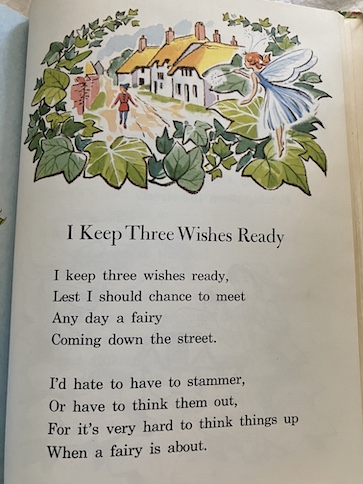
I Keep Three Wishes Ready by Annette Wynne – It’s good to know what you want to wish for, just in case you get the chance.

At the Zoo by A. A. Milne – There are many fascinating things to see in a zoo!

Some One by Walter de la Mare – Someone knocked at the door. Who?

Little Nut Tree by Mother Goose – A traditional rhyme about a magical tree. One of my favorites!

The Duel by Eugene Field – The gingham dog and the calico cat have a fight.

Queen Mab by Thomas Hood – About the fairy queen and how she gives pleasant dreams to children.

Cinderella’s Song by Elizabeth Madox Roberts – Cinderella confides her secret to her cat.

Trees by Harry Behn – Trees are wonderful things!

The Story of the Baby Squirrel by Dorothy Aldis – A child finds a baby squirrel and raises it. When it grows up, it runs away, but they think he’s probably still living with the other squirrels nearby. They sometimes see a squirrel who seems to be saying hello to them.

The Hens by Elizabeth Madox Roberts – It sounds like the hens are talking, but what are they saying?

Roads by Rachel Field – Roads might lead anywhere and to all sorts of wonderful things!

Washington by Nancy Byrd Turner – About George Washington. This one seems like an odd inclusion to me, adding a poem about a historical figure to a collection that has more fairy tale themes.

Mixed Magics

This book is part of the Chrestomanci series. Although most of the books in the series are longer novels, this book is a collection of four shorter stories, all set in the universe of Chrestomanci, where there are multiple dimensions with other worlds and series of worlds. The Chrestomanci is a powerful enchanter with nine lives (or, at least, he starts out with that many – he leads a dangerous life, or lives). The Chrestomanci’s job is sort of like the ultimate law enforcement for magic. He prevents the misuse of magic and stops evil magicians, especially ones who disrupt the balance between the worlds. The stories in this book focus on different characters, some of which were introduced in earlier books in the series. Of course, the Chrestomanci plays a part in every story. The book was published in 2000, but some of the stories were published in the 1980s in other sources.

I really like these stories because some of them clear up issues that were unresolved in other books in the series. Like Cat, I assumed that Christopher Chant became the Chrestomanci on the death of Gabriel DeWitt, his predecessor, who was introduced in The Lives of Christopher Chant. But, it turns out that Chrestomanci isn’t always a job for life. Gabriel DeWitt actually retired from the job and had years of happy retirement. One of the stories in this book shows Gabriel DeWitt at the end of his lives. He had several left at the end of his career, more than either Christopher Chant or Eric “Cat” Chant (who is Christopher Chant’s young cousin and the next nine-lived enchanter in line to be Chrestomanci) has now. (The Chants seem to have a tendency to lose lives faster than other Chrestomancis both because they are more reckless in their youth than DeWitt was and because their own relatives have either actively killed them more than once or put them in extreme danger for personal gain. They are a complicated family.) We get to see that even nine-lived enchanters don’t live much beyond the age their human bodies can manage. When they get very old, they repeatedly die of old age, over and over, until they use up the last of their remaining lives.

The book is available to borrow and read for free online through Internet Archive (multiple copies).

Following the adventures in Charmed Life, the Willing Warlock had his magical powers removed by Chrestomanci. With no way to pursue his usual work in magic, he turns to a life of crime. Unfortunately, he’s terrible at crime. He tries to steal a car and is almost caught by the police. He holds up a post office with a toy pistol and uses the money to pay a magician to send him to another world where he can have his magic again. When he reaches the new world, he can do magic again, and he attempts to continue his life of crime. It turns out that he isn’t any better at crime in the new world, though. He accidentally steals a car that also has a bossy little girl and an angry dog in it. There are some things that are worse than prison!

This book starts after the events in The Magicians of Caprona. Chrestomanci invited Tonino Montana to visit England and have some training at Chrestomanci Castle. However, Cat Chant and Tonino don’t get along when they first meet. Cat resents Chrestomanci making him responsible for Tonino, who is younger. His cousins and Janet think Tonino is nice, and Chrestomanci is interested in learning more about Tonino’s unique abilities. Cat knows that he has no real reason to resent Tonino, but he does because Tonino is now the center of everyone’s attention. As the next Chrestomanci and the youngest of the children who normally live at the castle, Cat has become accustomed to everyone paying attention to him and looking after him instead of the other way around. He doesn’t really want someone to be his responsibility.

It gets worse when Gabriel DeWitt, the former Chrestomanci, says that he wants to meet Tonino. The current Chrestomanci can’t go to see him just now, so he sends Cat to DeWitt with Tonino. Cat has met Gabriel DeWitt before, but he finds it difficult to talk to him because DeWitt is a very old man and an old-fashioned one, and Cat has to be on his very best behavior around him. When he first learned about being a Chrestomanci, Cat assumed that the new one didn’t take over until the previous one was dead, but Gabriel actually retired from the job when Christopher Chant’s training was complete, and he was ready to take over. However, now that Gabriel has gotten very old and sick, his remaining extra lives are leaving him as he repeatedly dies of old age. It’s alarming to Cat, who doesn’t want to watch him die. Yet, it’s important for Cat to see DeWitt one more time because DeWitt has something important to tell him.

DeWitt believes than an evil enchanter called Neville Spiderman is stalking him and that he’s trying to get hold of both Christopher’s and Cat’s extra lives. Everyone else thinks that DeWitt is imagining things because of his poor health. Neville Spiderman lived long before DeWitt himself, and everyone believes that he’s dead. DeWitt insists that Neville Spiderman has the ability to travel through time and tells the boys to warn Christopher of the danger.

However, as the boys take the train back to Chrestomanci Castle, their memories suddenly leave them. They become confused about exactly who they are and where they are going. All Cat remembers is that he’s supposed to look after Tonino. A stranger takes charge of them and delivers the boys to a strange house in London, where they are told that they are apprentices who have just arrived from the poor house.

The owner of this house is Neville Spiderman, who tells them that his workshop exists outside of normal time. He has managed to keep himself alive much longer than a normal person, and he is working on a spell to turn himself into a ten-lived enchanter in an attempt to become more powerful than any Chrestomanci. Part of the trouble is that he needs to know which of the boys is Eric Chant, and with their memories affected, neither of the boys is entirely sure, either. They can tell that they’re in danger and that Spiderman is planning to kill one or both of them. Spiderman needs two more souls from nine-lived enchanters to complete his collection. All that Cat remembers for certain is that he’s supposed to look after Tonino as the boys struggle to remember who they are and how to use their powers.

In this story, we learn that Tonino’s mother, Elizabeth, who was originally from England, was one of the children with magical abilities who were brought to Chrestomanci Castle to study and act as companions to Christopher Chant, the current Chrestomanci, at the end of The Lives of Christopher Chant. We also see Mordecai and Rosalie, two other characters from that book.

Although Carol Oneir is young, she is already famous for her dreams. She has the ability to control her dreams and make it possible for wizards to bottle her dreams and sell them for other people to enjoy. Then, on the night when she is about to have her 100th dream, she is unable to do it. Days go by, and she cannot seem to dream at all. Carol is very upset, but the doctors can’t seem to find anything wrong with her. Carol’s father is an old school friend of Chrestomanci’s, so he asks Chrestomanci if he can help Carol. After the adventure in the previous story, Chrestomanci is vacationing in the south of France with his family, and he asks his old friend and his wife to bring Carol to him there.

When Chrestomanci insists on talking to Carol alone, he discusses her methods for dreaming and her past dreams, evaluating them like a reviewer would a series of books. In a way, that’s what Carol’s dreams are, like stories or books meant to be enjoyed by other people while they sleep. Chrestomanci realizes that part of Carol’s problem is that she’s too self-conscious. Her dreams have all been made public, her mother constantly monitors her and urges on her success, and she is often interviewed for newspapers for details of her life. There are some private thoughts that Carol has had that she can’t bring herself to tell anyone, and something is happening in her 100th dream that she can’t even bring herself to tell herself.

When Carol tries to dream once more, she learns that all of the characters in her dreams are on strike. Her characters are angry with her for their living and working conditions. They get no time off, some of them get killed off in her dreams, her main hero and heroine don’t really want to marry each other, and none of them get credit or compensation for their work. Carol has completely misunderstood her characters. She has underestimated how real they are, and she has cast them in the wrong roles, ones that are really unsuited to their true personalities. They all need some time to be themselves and relax between story dreams. When it comes right down to it, so does Carol. She’s as much in a rut as her characters, and she also needs some time to develop her own personality and understanding of other people and to come up with new story concepts. Everyone needs a vacation and some privacy sometimes.

Carol’s characters drink alcohol in this story, something that shocks Carol herself because she never allows them to do that in the course of her dreams. Her dreams are meant primarily for girls her age, so they’re age-appropriate, but the alcohol use is part of the characters showing Carol that they have their own independent personalities and need time to themselves to do more adult things outside the setting of her dream stories.

The world of Theare is extremely orderly. Even their heaven and gods are very precise, with everyone knowing their rule and following detailed rules. Then, one day, the gods learn that the prophesied Sage of Dissolution has been born! According to the prophecy, this Sage will question everything and break down the order of this carefully-ordered world. The gods are fearful of the chaos this will bring, so they decide that they must put a stop to it by finding and killing the Sage before he can grow up and start asking his questions.

I’ve always found the different ways fantasy books approach the subject of religion interesting. Some fantasy authors try to ignore the issue altogether because they don’t want religious beliefs to disrupt the fantasy elements or change the way people look at them. Others try to invent or adopt religions that match the fantasy elements. The universe of Chrestomanci is based on the concepts of parallel worlds, different dimensions, and alternate realities, which leaves quite a lot of possibilities open. Religion or religious concepts enter into all or most of the books at some point. There’s a world that’s supposed to be “our” world, where things work like they do in real life, and Chrestomanci’s related world, where the religions that we know exist alongside magic, accepted as normal by their society. There are churches and cathedrals and clergy, and Chrestomanci himself seems to be a Christian, as established in earlier books. He attends church and is friendly with clergy members. When he was younger, he once thought that his mother might want him to grow up and become a missionary because of the way she talked about missionaries, and he says that he doesn’t believe in the “heathen” gods and goddesses of other worlds, initially not even believing that the girl he ends up marrying is really the avatar of a goddess in the world where she was born. It was eventually proved in The Lives of Christopher Chant that the goddess was real, at least within that particular world, although that story kind of hints that much of the magic Millie did was her own magic as a powerful enchantress, not necessarily the goddess’s. I’m still not sure whether Millie is still supposed to be one of the goddess’s incarnations or not, but since she’s living an independent life in another world now, it no longer seems to matter, except that her magic is very powerful. In this story, Christopher Chant, regardless of what his inner beliefs are, is not afraid to tell actual gods what he thinks of their plans when they’re in the wrong.

This particular story establishes the idea that, in this universe, religion and heaven and gods or goddesses are all individual to each individual world. Each world has its own Heaven and at least one god or goddess, and these are distinct from those in other worlds, so what’s true about each of these varies depending on the world where the story is set. (There may not be an over-arching God of the entire universe in this fictional universe, or if there is, there is no explanation of that.) In this particular story, all the religious rules point to order, and the gods themselves love rules. They are terrified of the concepts of disorder and chaos. However, when they decide that they’re going to eliminate the Sage of Dissolution, they have a problem. They’re not really sure which of the worlds he’s in or where exactly he will be asking all of his questions. They search and search, but they can’t seem to find him.

Then, one of the gods, Imperion, takes a break and visits the mortal woman he loves, Nestara. He is devoted and faithful to her, and he loves the small son they already have, Thasper. Thasper was very slow to learn to speak, but now that he has … he has started asking questions. To his shock, Imperion realizes that Thasper is the Sage of Dissolution. It’s just that nobody realized it until he gained enough ability to speak to start asking his questions. Imperion can’t bring himself to kill his own son, so he decides to take him to another world, out of the reach of the other gods. He tells Nestara that the other gods have approved of making Thasper a god, too, and he must take him to be the cupbearer of the Great Zond, the highest god. He puts Thasper into a sphere of forgetfulness to make him stop asking questions and makes sure to take Thasper to a world with kind people who will raise him. When he admits to the other gods what he’s done, they are satisfied that the problem of the Sage is settled and that he will not interfere with their orderliness.

Thasper spends several years in his sphere of forgetfulness, not aging, but when someone finds him, the spell ends. As soon as he is out of the sphere, he starts asking questions again. The people of this world don’t mind answering his questions, but they can tell that he’s not from their world. After a little experiment, they figure out that he is from Theare and that he was probably sent to their world because someone found him too disruptive. They return him to Theare and, through magic, convince a woman who has just lost her own son, that Thasper is her son. She and her husband take him in and raise him. He still pesters everyone with questions, and his new mother does her best to answer them.

Then, one day, Thasper receives a message from Chrestomanci (delivered by Cat, who is starting to travel through other worlds as part of his Chrestomanci training), who tells him that his situation is an odd one and that he should call him when he finally meets himself face-to-face. Thasper doesn’t know what means at first. For several years, Thasper develops a fascination for the rules of his world. Rules make an interesting intellectual exercise, and Thasper enjoys thinking about them and making up new games with new rules, the more complicated, the better. Then, Thasper begins seeing messages around town that ask questions and make him think about rules in new ways. All of the messages are signed the Sage of Dissolution. Fascinated, Thasper keeps trying to meet up with the Sage of Dissolution and see him in person, but it seems like he always just misses him. He is going to need Chrestomanci’s help to catch up with himself! At that point, Chrestomanci tells the gods how they would have brought about their own end if they had succeeded in defeating their own prophecy. Of course, seeing the gods for himself answers some of Thasper’s questions, but he can still ask others.

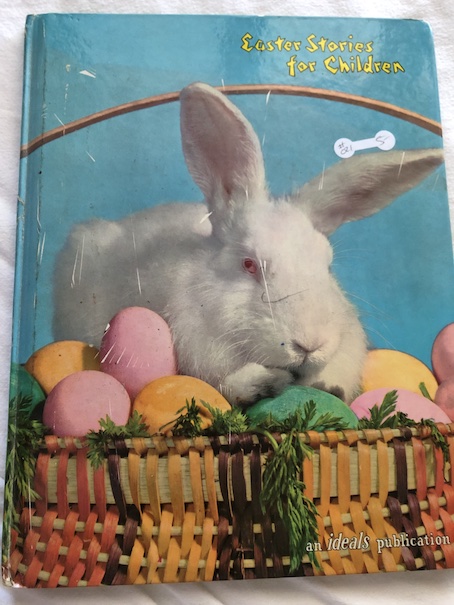
Easter Stories for Children

This book was published by Ideals, and if I remember right, is part of a series of holiday/seasonal books for children. (I don’t have a list of other books in the series, though.) It has short stories and poems about Easter. Largely, they’re not very religious in tone, tending to focus on fairies and the Easter bunny. I actually found all the references to fairies confusing because I never heard anybody talk about fairies being associated with Easter when I was a kid. On the religious side, there is one poem about prayer and a story about how the dogwood plant represents the crucifixion. There is also some information about how Easter is celebrated around the world.

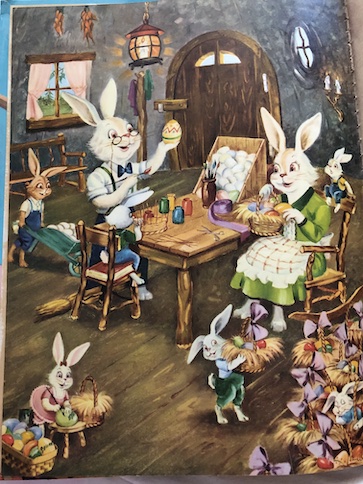
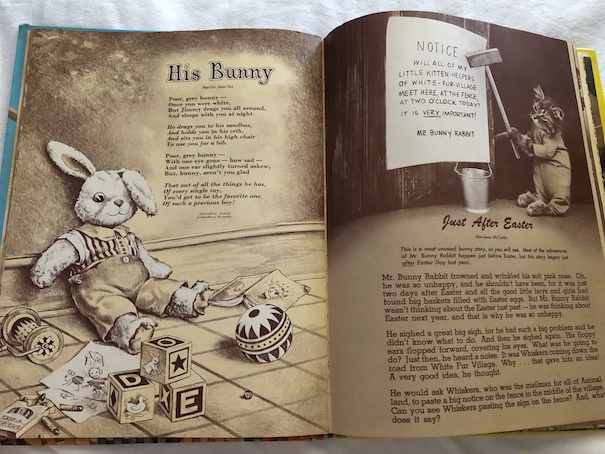
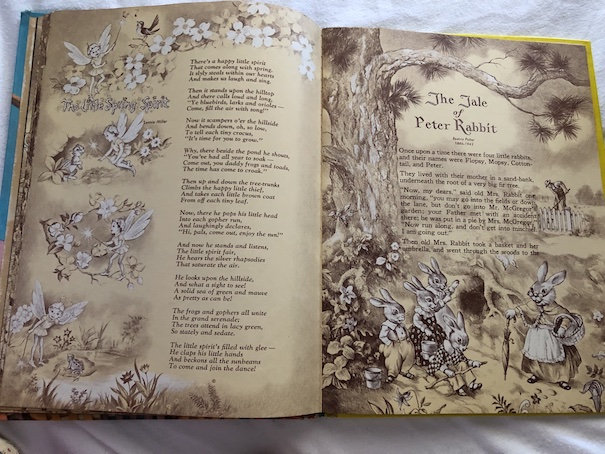
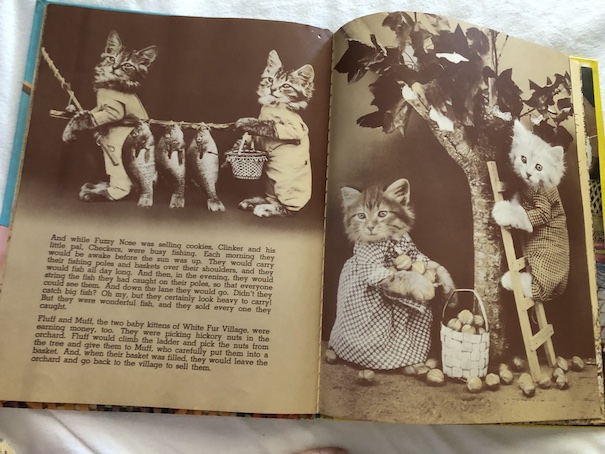
The pictures are in sepia tones. Mostly, they’re drawings, but there are also some photographs of cute bunnies and kittens wearing human clothes. The only full color pictures are on the inside of the front and back covers, and they’re scenes of rabbits painting Easter eggs. All in all, it’s a very cute book for Easter.

How the Forest Fairies Get Ready for Spring – “Written especially for you by SPARKIE” – All of the forest fairies have special tasks for getting ready for spring.

The Tale of Peter Rabbit by Beatrix Potter (1886-1943) – A classic children’s story about a bunny who disobeys his mother.

Just After Easter by Maryjane McCarthy – Mr. Bunny Rabbit is worried about next Easter because the farmer is having trouble affording grain to feed his chickens. If he can’t keep the chickens, where will they get their Easter eggs? This is the story that has pictures of bunnies and kittens in costumes with props. The kittens try various ways to raise money for the chickens.

The Legend of the Dogwood – author unknown – The legend is that the cross of Jesus’s Crucifixion was made from dogwood, but the plant felt badly about it, so Jesus made the plant too small to be used for such a purpose again and gave it a cross-shaped flower.

Easter in Many Lands – About Easter customs in different countries, and the origins of the word “Easter” and how symbols like bunnies and eggs came to be associated with Easter. This is my favorite section in the book!

The Story of the Colored Easter Egg by “Maryjane” – A fairytale about a kind queen and the origins of Easter eggs.

The Magic Pool by Dorothy Weiner – Bunnies color eggs in a magical pond fed by a rainbow.

Easter Bunny’s Secret by Mrs. Roy L. Peifer – The Easter bunny collects drops of paint that Jack Frost uses to paint leaves in autumn and saves them for Easter eggs, but when the paint gets spilled, he needs to get colors from other sources.

The Little Spring Spirit by Leonie Miller – The spirit of spring calls to plants and animals with the change of the season.

If Easter Eggs Would Hatch by Douglas Malloch – What would come out of an Easter egg? Brightly-colored chickens or maybe a little silver bunny?

In Cottontail Town by Marguerite Gode – A famly in Cottontail Town takes in an elderly rabbit and nurses him back to health. He starts a school there to teach the other rabbits how to paint Easter eggs.

The Gray Bunny’s Night – “As told by The big black Bumblebee” – A little gray bunny wants to be brightly colored for Easter, and his wish is granted by the queen of the fairies.

Hippety-Hop to the Barbershop by Claribel Ream – The Easter Bunny is going to the barbershop to deliver eggs and candy for the barber’s children.

Helping One Another by Mrs. Roy L. Peifer – The Little Red Hen helps the Easter Bunny to fill his basket for Easter.

His Bunny by Marilyn Jean Fais – About a little boy’s stuffed bunny. It can be hard on a toy to be a child’s favorite, worn and dragged everywhere, but it’s worth it!

Prayer by Ethel Romig Fuller – If we can hear songs from radio waves that travel through the air, God can also hear prayers.

Seed Thoughts by W. M. Walker – Good and kind thoughts produce good deeds, like plants sprouting from seeds, but selfish thoughts are like weeds that get in the way. Be careful what seed thoughts you grow in the garden of your mind!

Jack in the Pulpit by Mrs. Jessie S. Manifold – Spring plants and animals celebrate the Sabbath Day.

And He Hippety-Hopped Away by Rowena Bastin Bennett – The Easter Bunny delivers eggs and candy to children before sunrise.

Revenge of the Mummy

Clue

This book is a collection of short solve-it-yourself mini-mysteries based on the Clue board game. Each book in the series contains short mysteries that the reader is urged to attempt to solve before the characters do. The solutions to the mysteries come after each chapter.

Most of the mysteries involve a crime of some kind, but not all. Sometimes, characters try to steal things from each other, but there’s also a scavenger hunt, an ice cream tasting party, and a hot air balloon race.

In the final chapter of the book, it seems like Boddy, our host, has been murdered, and the reader has to solve his murder, just like in a game of Clue. However, Mr. Boddy doesn’t actually die. It’s a pattern in the series that he seems to have been killed in each book, but he always survives somehow to reappear in other books in the series.

At the end of the previous book of solve-it-yourself mini-mysteries, it looked like Mr. Boddy had been murdered, but at the beginning of this book, he explains how he survived. All of the books in the series follow this pattern. There’s generally a humorous twist to how he survives and explains the situation.

The book is available to borrow and read for free online through Internet Archive.

The Lion Ring – Mr. Boddy has obtained a new treasure for his collection: an ancient and valuable ring with a lion on it that once belonged to an African king. Naturally, his sticky-fingered guests all want it for themselves.

Full of Hot Air – Mr. Boddy and his guests are having a hot-air balloon race. Who will be the winner?

Urge to Earn an Urn – Mr. Boddy stops Mrs. White and Mrs. Peacock from arranging flowers in an old urn they found in the basement. It turns out that it’s a valuable Greek urn, and when the other guests realize it, someone plots to steal it.

Please Don’t Sneeze – Miss Scarlet is coming down with a cold and spreading it among the other guests. Mr. Boddy introduces them to his grandmother’s secret cold remedy.

For Goodness’ Snakes! – Mr. Boddy’s guests are frightened of his new pet boa constrictor, but when they try to catch the snake, the snake catches one of them.

The Inky Trail – Mr. Boddy has discovered that someone attempted to forge his signature on a $250,000 bond. Fortunately, the forger tried to use the pen that explodes ink if anyone other than Mr. Boddy uses it. Mr. Boddy thinks that it’s going to be easy to track down the ink-stained guest, but it’s more complicated than he thinks.

The Scavenger Hunt – Mr. Boddy’s guests are bored one evening, so he starts a scavenger hunt with them.

Screaming for Ice Cream – Mr. Boddy has an ice cream tasting party with his guests to determine the best flavor. However, not everyone is willing to eat certain flavors of ice cream. Readers have to determine who is the only person who tried every flavor.

Caught Bare-Handed – Someone attempts a daring but unsuccessful theft of Mr. Boddy’s priceless chandelier, which sends it crashing. Who was the attempted thief?

Revenge of the Mummy – Mr. Boddy shows his guests the mummy case that he has recently acquired. The guests are a little too fascinated after someone mentions that mummies were buried with their valuables. Mr. Boddy warns the guests that the mummy may get angry and seek revenge, but they don’t believe it … until someone has an encounter with the mummy.

The Screaming Skeleton

Clue

This book is a collection of short solve-it-yourself mini-mysteries based on the Clue board game. Each book in the series contains short mysteries that the reader is urged to attempt to solve before the characters do. The solutions to the mysteries come after each chapter.

Most of the mysteries involve a crime of some kind, but not all. Sometimes, characters try to steal things from each other, but there’s also an apple-bobbing contest at a Halloween party, a snowball fight, and a pie-eating contest.

In the final chapter of the book, it seems like Boddy, our host, has been murdered, and the reader has to solve his murder, just like in a game of Clue. However, Mr. Boddy doesn’t actually die. It’s a pattern in the series that he seems to have been killed in each book, but he always survives somehow to reappear in other books in the series.

At the end of the previous book of solve-it-yourself mini-mysteries, it looked like Mr. Boddy had been murdered, but at the beginning of this book, he explains how he survived. All of the books in the series follow this pattern. There’s generally a humorous twist to how he survives and explains the situation.

The book is available to borrow and read for free online through Internet Archive.

Murder in the Cockpit – Mr. Boddy wants to take his guests for a flight on his private jet, but a fight breaks out over seating arrangements.

Baby Booty – Mr. Boddy has to watch his young nephew for a while, and he bribes his guests into helping him. Various guests take turns trying to make baby Frank happy, and readers are asked to figure out who has Frank.

Dance Until You Drop – Mr. Boddy and his guests were planning to have a croquet tournament, but they had to cancel it due to rain. To cheer everyone up, Mr. Boddy starts a dance party, but a couple of his guests take advantage of the situation and steal Miss Scarlet’s necklace.

The Halloween Costume Caper – Mr. Boddy is having a Halloween party for his friends, and he wants everyone to come in costume. When the guests arrive, no one is sure who is wearing which costume, but their identities are gradually revealed during a highly competitive game of bobbing for apples, where the guests are trying to find the apple that contains a “gold nugget.”

The Snowball Effect – It’s snowing, and the guests are getting on each other’s nerves because they’re cooped up inside. To change the mood, Mr. Boddy enlists everyone in a snowball fight. It’s up to the readers to determine who won from the information given.

The Case is All Sewed Up – Mr. Boddy is having an heirloom quilt restored, but the guests become interested when he says that one his ancestors hid the family treasures in the quilt during WWI. What are the Boddy family treasures, and who gets their hands on them?

Pie in Your Eye – Mr. Boddy is holding a pie-eating contest with his friends that unfortunately ends in a food fight. But, who is the winner?

Pea is for Pretender – The guests are talking about fairy tales when Miss Scarlet says that, like the Princess and the Pea, she would bruise if she tried to sleep on top of a single pea. The guests decide to put her claim to the test, and Mr. Boddy promises her a crown if she really bruises from sleeping on a pea. However, Miss Scarlet enlists the help of another guest to fake the results of the test. Who is her confederate?

The Thanksgiving Murder – Thanksgiving starts off peacefully enough with various guests volunteering to help Mrs. White prepare the meal and set the table … at least until Miss Scarlet realizes that Mrs. Peacock has removed her valuable jade ring and set it aside while helping. After Miss Scarlet swipes the ring, it changes hands several more times as others notice and take it for themselves. It’s up to the readers to figure out who finally ends up with it.

The Screaming Skeleton – Mr. Boddy unveils his latest acquisition – a skeleton made entirely of platinum. He’s planning to sell it to a museum, but of course, his guests plot to either steal the skeleton (or parts of it) or intercept the money from the museum. But, knowing his guests as he does, Mr. Boddy has also installed a security device on the skeleton that screams when someone tries to touch it.