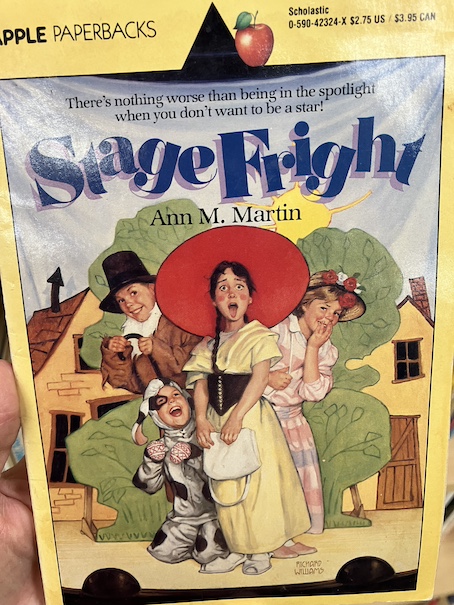
Stage Fright by Ann M. Martin, 1984.
Sara is a very shy girl, who tries her hardest not to be the center of attention, whether it’s being the magician’s assistant at her cousin’s birthday party or being forced to read a funny fortune aloud. She doesn’t like parties, even though her mother tries to encourage her to be outgoing and enthusiastic. Sara’s father understands and doesn’t try to force her to join in activities she doesn’t enjoy like her mother does. Her mother doesn’t think it’s “normal” for Sarah to not like parties and not want to join in party games. When her mother talks about her not being “normal”, Sara feels bad and gets even more worried. Her biggest help is that her best friend Wendy loves having people looking at her, and she’s happy to cover for Sara, drawing attention away from her when Sara gets uncomfortable.
Then, Sara’s teacher, Mrs. Fischer, announces that the class is going to put on a play for the end-of-the-school-year June Festival. Worse still, Mrs. Fischer has carefully selected plays for the class to vote on performing that will give everyone a speaking part so that they can all have the experience of performing. There’s no way Sara can dodge having a part, no matter which play they choose. Even worse than that, Wendy tells her that her family might be moving. Her father’s job wants to transfer him to Chicago. He’s trying to find a different job because his wife doesn’t want to have to leave her job, but if he can’t find another job, the family will have to move.
Sara talks to Mrs. Fischer about how much performing or even speaking in public bothers her, and she offers to do something else to support the play, like helping to make the scenery. Sara loves artistic and creative activities, so she would actually love set designing. However, Mrs. Fischer insists that Sara have a speaking role in the play. She says that she knows that public speaking is difficult for her, but that’s part of the reason why she wants her to do it. She says that, even though Sara hates doing it, she wants her to recognize that, even though she’s afraid, it doesn’t mean that she isn’t capable of doing it. There are many things that Sara and other students don’t want to do that they learn they really are capable of doing once they get started. Sara argues that she wouldn’t be any good at performing, and Mrs. Fischer says that being a great performer isn’t the goal. She doesn’t care whether Sara is any good at it or not; she just wants Sara to see that she can manage to do it. She’s hopeful that, once Sara sees that she can do it, even though she’s nervous about it, she will lose some of her nervousness and will find it easier to manage in the future when she has to speak up in front of other people. No matter what Sara says, Mrs. Fischer won’t let her out of performing in the play.
When the class begins to hold auditions, Sara sees that other students aren’t very good at performing. One speaks too fast when reading parts, and another has a lisp. Sara holds back from auditioning for any parts for as long as possible, and she notices that she’s not the only one. In fact, she sees that one of her classmates, Jennifer, slides lower in her seat to avoid being seen and chosen to audition, just like Sara always does when she doesn’t want to be noticed and picked to speak. It helps Sara to realize that she’s not the only one who gets nervous and doesn’t want to perform. When the teacher calls Sara, Jennifer, and the other kids hanging back up to the front to read parts, Jennifer even starts crying! Sara is surprised that Jennifer seems to be even more afraid than she is!
When it’s Sara’s turn to read a part, she purposely speaks too softly and messes up the line, hoping that Mrs. Fischer won’t want her to perform after hearing how badly she can do. Unfortunately, Sara’s mother overhears her talking to her pet cats about it later and gets angry at her for messing up on purpose. She says that purposely doing badly is a form of cheating, that she is “can’t tell you how ashamed I am”, and “Promise me you’ll try hard and get a good part so I can be proud of you,” which implies that she won’t be proud of her daughter if she doesn’t get a good part. When Sara’s father gets home and hears about what’s happened, he takes Sara’s side, pointing out that Sara’s mother knows how she feels about performing in the play and that it’s unreasonable to demand that also be good at it and enjoy it. Sara’s mother then gets mad at him, and they argue about it as they’ve argued about Sara’s shyness and her mother’s expectations of it before.
When Mrs. Fischer announces parts, though, Sara does get one of the minor parts. Mrs. Fischer privately tells Sara that she knows that she’s nervous but she’ll help her to overcome her stage fright, adding there are many famous performers who have also had to overcome stage fright. However, Mrs. Fischer’s ideas of advice for getting over stage fright, like taking deep breaths and picturing the audience in their underwear is pretty generic and not very helpful for Sara.
Is there a way for Sara to make it through her stage fright?
The book is available to borrow and read for free online through Internet Archive.
My Reaction and Spoilers
I didn’t read this book when I was a kid, but I was surprised to discover that another book that I read when I was young, Me and Katie (the Pest), is the sequel to this book. I had though that Me and Katie (the Pest) was a stand-alone book.
Sara and her cousin Carol and best friend Wendy are all writing a poem together called The Saga of Barbie and Ken in an effort to write the world’s longest poem. This poem is also mentioned in the book Me and Katie (the Pest) by Ann M. Martin, which is about Wendy feeling like her younger sister always outshines her. The events of Stage Fright take place before Me and Katie (the Pest) because we see the girls still writing the poem in this book and sending it to Sir Alec Guinness on the mistaken notion that he’s in charge of The Guinness Book of World Records. In Me and Katie (the Pest), the girls have realized their mistake and send it off to the real The Guinness Book of World Records. The girls say that their poem is 350 stanzas, so we never see the entire poem, but we do get a few stanzas throughout the book.
Sara is an Introvert and Her Mother Has Issues
I’ve read other books about shy kids and introverts and how they hate it when adults try to push them to be outgoing. This story reminded me a little of Our Teacher is Missing in that respect, although Sara is younger than the girl in that book. I spent most of the book being pretty angry at Sara’s mother because, first of all, nobody likes forced fun, and second of all, she’s pretty dang nasty about how she tries to force Sara to have fun in the way she thinks Sara should. It’s a pretty weird message when she says, in front of Sara, that she’s not “normal” or yells that she’s ashamed of her and that she has to do these things to make her proud, and then she expects Sara to suddenly love the thing she’s been unequivocal about hating and to be happy. She also clearly doesn’t listen to either her daughter or her husband when they try to explain how she comes across when she nags or throws fits or pouts about what Sara doesn’t like. Speaking of things that aren’t “normal”, I was thinking that the mother wasn’t normal when Sara thinks about the times when her mother doesn’t talk to her because she’s upset. So, Sara’s mother thinks that throwing a tantrum and pouting are “normal” in adulthood but stage fright, a very common fear among actual humans, isn’t? Yeah, I really hated the mother in the story. I have no trouble seeing why Sara finds her father easier to talk to.
At the end of the story, when Sara has gotten through the play, her mother is surprised that Sara still hates performing. She doesn’t throw a fit this time because Sara specifically asks her if she’ll be upset if she’s honest with her, a question that surprises her mother but shouldn’t because there hasn’t been a single time when she hasn’t gotten angry and upset at an honest opinion yet. Apparently, she assumed that, once Sara was in the play, she’d see that it was all “fun” and great and would start loving being in front of people, but that magical fantasy doesn’t happen, and the mother seems taken aback. Sara tells her that she hated being in the play, that it ruined the last few weeks for her with the anticipation of it, and that she hopes she never has to do this again, but having gotten through it this time, she is a little less afraid and knows that she can get through it if she does have to do something like it again. Her mother says that she just wants Sara to be happy, and Sara counters what if her father made her mother take horseback riding to be happy. Her mother hates horses and says horses would never make her happy, and Sara makes the point that this is the way she feels about plays. Finally, her mother gets the message.
Sara’s mother says that she isn’t really trying to be mean to Sara but that she knows some of the things that worry Sara, like attending parties or speaking up in class or in front of other people are things that she can’t avoid in life. It’s true that avoiding horses is a lot easier in late 20th century American life (the time when the story was written) than it is to avoid having to speak up in a group of people. It occurred to me that, if Sara had lived as part of a 19th century farm family, she probably would have been happier in some respects, and maybe her mother wouldn’t have bad-mouthed her desire to learn to knit. (Yes, the mom complains about that, too. She nitpicks everything Sara likes or wants to do.) However, it’s true that Sara has to learn to live in the world and society where she lives and to manage her fears. Sara admits that she does feel a little better, knowing that she can do it, although she’ll never really like it.
Actually, what really occurred to me about Sara’s mother is that she’s such a pain partly because she has unmanaged fears and personal issues. It comes out during the story that she wants Sara to be more outgoing, going to parties and taking part in projects like the play, so she’ll be more popular and have more friends. In fact, she’s pretty savage to Sara’s face about her only having two human friends (she doesn’t count the family cats, like Sara does), one of which is her cousin and one of which might move. That honestly is a really, really, mean thing to say, to make her feel bad about about the people she’s closest to, and I think it really comes from the mother’s insecurity. Sara is secure in her friendships with her cousin and best friend, and her cousin doesn’t think of it as some kind of pity relationship because they’re relatives. The mother is the only one disparaging it. Sara’s not worried about being popular at all. That’s an anxiety that her mother has. We don’t know what friendships Sara’s mother has or if she has any. They are not shown in the story. We also don’t know what kind of friendships she had when she was young, but I suspect that her anxieties about Sara’s popularity probably stem from one of these areas in her own life.
Nobody really needs to have a ton of friends. A few of the right kind of friends, who are supportive and enjoy common activities, are sufficient, and actually far more beneficial than having so many “friends” that a person doesn’t spend much time or get that close to any of them in particular. Sara feels more fulfilled in the activities that she shares with her friends, like writing the poem, that her mother tries to devalue than she does in the activities that her mother imagines would bring her fulfillment. From the way Sara’s mother talks, she has no idea what activities Sara has with her friends and makes no attempt to find out what Sara is really interested in. Also, far from bonding with other people about loving activities like the school play, Sara ends up bonding with Jennifer about their mutual nervousness and attempts to support one another during their ordeal. Sara has the capacity to bond with people over shared feelings and interests, but her mother doesn’t get it because she’s stuck on what she imagines Sara should be doing or what she thinks Sara should be feeling.
My Advice for Sara
The adults’ advice for Sara in dealing with her fears ranges from pretty generic to downright absent. Since Sara’s father seems to understand her feelings about talking in front of people and has dealt with this before himself, I’m surprised that he didn’t talk to her about his own experiences more. The only reason I can think of that he doesn’t is that the author doesn’t want him to help Sara resolve her problems too quickly. Sara’s mother is certainly no help, and even though the teacher claims she’s willing to help, she doesn’t have too much to say on the subject. The advice for Sara and the other shy/nervous kids to think of the audience in their underwear is no good for Sara because it’s the presence of the audience that bothers her, and she doesn’t care what they’re wearing.
As a life-long anxiety sufferer, I can think of much better ways to address Sara’s problem. First, dwelling on the source of the anxiety always makes it worse. What Sara really needs is something else to think about to replace the worrying thoughts. When Sara’s teacher tells the class to picture the audience in their underwear, that doesn’t help Sara because it just further reminds her that there is an audience. What would help her more would be a way to get her mind off the fact that there’s an audience there in the first place. There is something else that she could focus on, though: the story of the play. One of the tricks for getting through a presentation is to have something to say that’s worth saying. If a speaker gets really involved in their subject, they’re thinking about the subject and not about the listeners, and listeners can also hear when someone is getting enthusiastic about their subject. In this case, Sara should be thinking about the story of the play, not who’s listening/watching. We, as the readers of the story, never get the full story of what the play they’re presenting is about because the focus is on Sara and her emotions, but in real life, getting Sara to focus on the story could be one of the keys to helping her cope with her nervousness. Because Sara likes writing, like “The Saga of Barbie and Ken”, she probably also enjoys stories and telling stories.
Second, what the anxious person thinks about instead of the thing that causes the anxiety should be something pleasant or positive. To help worried and reluctant students to look at the play less as an ordeal to get through and more of a fun project, I think the teacher should have changed the focus from getting them to not be afraid of the source of their fear (the audience) to connecting with the source of the fun and enjoyment actors get from participating in a play. We call that type of performance a “play” because the actors are literally playing parts in a story. It’s like a big game of pretend, and I think it would help to get Sara to look at it from that perspective. It can be fun to pretend that you’re someone else and interesting to step into a story and see a story from the viewpoint of one of the characters.
When they’re doing the play, Sara is literally playing the part of a different person, a character named Nellie. Sara is playing the part, but it might help Sara to realize that audience isn’t seeing “Sara”; they’re seeing “Nellie.” Nellie has feelings of her own about the things happening in the story and things she wants to say about it, and as her actor, Sara’s job is to help Nellie say those things. Putting herself into her part and thinking about the story from Nellie’s perspective might further help Sara to separate herself from her anxious thoughts. If Sara can immerse herself in the story and her character and playing pretend along with her friends, Sara could well forget, at least temporarily, that there are other people watching. There would be times during the performance when she would be reminded of their presence, when the audience laughed or clapped, and I think the teacher should prepare her for that, but she should also know that she can always mentally return to playing the game of pretend and the feelings that she has when she’s thinking of these things. Using her imagination to refocus on story and the fun of playing pretend would give Sara an effective coping technique for this situation that she’s been lacking.
I get it that this story is meant to help show child readers that, even if they’re afraid of something or feel like they’re unprepared or inadequate to a task, they can still manage to get through it. It’s pretty good message. However, I think that the story also misses the opportunity to show how parents can ease kids into worrying situations and how kids can handle their worries by refocusing their thoughts and looking at situations from different perspectives.
If Sara’s mother wasn’t so focused on brow-beating her daughter into liking things, she could have used similar techniques to help Sara cope with parties and group games. The thing about children’s parties is that they’re crowded and chaotic, and kids’ games are often focused around some form of competition, bringing attention to both the winners and people who lose very badly. I can see why a shy introvert like Sara would find it overwhelming and difficult to cope. If it were me helping Sara, I think what I would do is to ease Sara into the concept of parties more gradually and also to show her that there are different types of parties. Maybe Sara finds boisterous kids’ birthdays difficult to handle, but that doesn’t necessarily mean that she hates all parties, and this would be an opportunity for her to see that. (See also the time travel story Mirror of Danger (Come Back, Lucy), which also has a quiet, old-fashioned kind of girl who has trouble handling her cousins’ modern party with pop music but likes an old-fashioned Christmas party with traditional parlor games.)
For example, because Sara is a young girl, I would have her invite a few friends to a relatively quiet tea party. Ideally, I would have her invite Carol and Wendy as her two closest friends and one other girl as a new person (maybe getting a recommendation from Wendy or Carol, if Sara couldn’t think of a fourth person). The extra person is there to help Sara expand her circle of friends and start getting accustomed to slightly larger groups, and one of the activities at the party could be a board game that works well with four people, a quieter sort of game from the usual games at kids’ birthday parties. The girls could have fun, dressing up a bit for the tea party or decorating some cookies, which is a quiet and creative activity that I think Sara would enjoy, while giving Sara a chance to see a different type of party.
After that, Sara’s mother could arrange a crafting party for Sara, her two best friends, and two additional guests. Sara and her friends like making crafts, and Sara mentions that they once sold some of them for some extra money. There are probably some other kids in Sara’s class at school who like arts and crafts, so they could expand Sara’s circle of friends by helping her to connect with other people based on that. It would still be a relatively quiet activity that Sara would like while beginning to involve her with more people, and maybe they could sell some crafts to raise money for an animal shelter, putting Sara more in touch with the community in a way she would find pleasant because she loves cats.
Later, I think her mother could help Sara arrange her first sleepover party with her two best friends and three other girls, for a total of six people. Sleepovers can get a bit boisterous, but a party of six isn’t huge, compared to kids’ birthday parties, which can sometimes be as big as their class at school or about half the class, and not all of the activities at a sleepover are boisterous. Girls at sleepovers will often watch a movie, bring their favorite music to share, or tell stories (like ghost stories) or do beauty activities, like braiding each other’s hair or painting their nails. They might get a little messy, with the girls making themselves snacks in the kitchen, and there might be some games like Truth or Dare that would require Sara coming out of her shell a little, but it would still be in a relatively small group of friends and have a different feel from a loud and crowded birthday party. One of the hallmarks of sleepovers is also as little adult interference as possible, so it could be a way of encouraging Sara to start taking the lead as hostess, showing the other girls the choice of movies they have to watch and what’s available to have for snacks, etc.
If about four to six guests at a party is all Sara can handle, I think it would be fine to let her do that until she feels comfortable and ready to move on to more or finds someone new she would particularly like to include. Some of that will probably happen organically as Sara gets older and meets new people or people she knows develop new interests. Because Carol is Sara’s cousin and lives nearby, Sara’s aunt and uncle could also be helpers in getting Sara more involved in parties and projects and coming out of her shell, helping Sara and Carol to host joint events in different styles with gradually increasing numbers of people. The two girls together (with Wendy’s help) can have a Halloween party and/or a Christmas party with seven or eight guests, and then, go on from there, to whatever limit the adults think their house or patience can accommodate. While it’s helpful to Sara to learn ways of enjoying group activities, I think it’s important to note that everyone, even adults, has an upper limit of people they’re willing and able to deal with at any one time. Anytime Sara doesn’t want to participate in a game as a player, she could be a helper or referee, so she’s participating in a different way, and I think she should be allowed to find fulfillment in different roles.
Rather than berating Sara for being shy and nervous, there are plenty of things her mother and teacher could have done that would have been much more helpful, giving Sara new ways of thinking about things and helping her ease into situations that she finds stressful and find the fun in them. Being creative and experimenting with different ways to look at situations or handle them is important to dealing with anxiety or helping someone else with anxiety, and helping to ease someone into activities that make them nervous takes planning. They just didn’t do much of that in this book, and it annoys me. I know the reason why they don’t is partly to make the story longer by not resolving Sara’s problems too quickly and partly to show kids that they can learn to cope with situations on their own, even when they’re not getting much support. It makes sense from a story perspective, but I still wish that some helpful adult would offer Sara some useful advice or guidance.
What Actually Helps Sara
In the story, because Sara isn’t get much advice or support in dealing with her stage fright, she has to figure it out for herself. Something that helps her is discovering that she can speak up to her friends when she feels the need. As Wendy worries about whether or not her family will move, she starts getting moody and irritable and taking it out on other people. When Wendy says something mean because she’s in a bad mood, Sara stands up to her, and Wendy and Carol are both surprised because Sara usually doesn’t stand up to anybody. Wendy often has to stand up for Sara on her behalf, but Sara says, if Wendy won’t stand up for her this time or may even not be there to stand up for her anymore, she’s just going to have to do it herself. Wendy apologizes for her behavior, and the the girls make up, but Sara begins to realize that, even though speaking up is difficult for her, she does have the ability to do it when she needs to and that it gets results.
This experience with Wendy helps Sara to speak up to her mother later and demonstrate that she can speak with maturity when her mother is in an angry, pouting phase. I wouldn’t be surprised if part of Sara’s hesitancy to speak up might actually come from fear of her mother’s volatility, but Sara realizes that, just because her mother yells and pouts doesn’t mean that she has to. Standing her ground on her feelings is an important tool to getting her mother to accept them or at least stop bullying her over them.
I thought that organic way of Sara building some confidence by learning that she can speak up when she really has something important to say and that people will listen to her was realistic and an important turning point for her character. It comes back to the concept that it’s easier to speak when you have something that’s worth saying.
Nostalgia
There are familiar pop culture references in the story that I remember from my own childhood in the 1980s and 1990s, like Malibu Barbie, Hostess Twinkies, and Roto-Rooter, which used to have ads on tv that would get stuck in your head.

