The Mystery in the Snow

The Boxcar Children

Boxcar Children Mystery in the Snow cover

The Mystery in the Snow by Gertrude Chandler Warner, 1992.

Boxcar Children Mystery in the Snow  arrival

The Alden children are disappointed because there is still no snow this winter, and they’ve really been looking forward to snow. Their grandfather tells them not to worry because, soon, they’ll have all the snow they want. A friend of his, Mr. Mercer, owns a ski lodge and has been urging him to visit and bring his grandchildren. There’s going to be a winter carnival there. The children are eager to go and have fun in the snow!

Boxcar Children Mystery in the Snow choosing teams

At the ski lodge, the Alden children meet a boy named Jimmy. Jimmy is a regular visitor to the lodge, but for some reason, he says that his parents never stay. There is also a girl called Freddie, which is short for Fredrica. Her parents aren’t at the hotel, either, because they’re visiting her sister, but she says that they will come later. Freddie could have gone to visit her sister, too, but she didn’t want to miss the fun at the ski lodge. She and Jimmy are both team captains for the winter games, which include skiing, skating, sledding, snow sculpting, and ice carving. Strangely, when the team captains get the box where kids are supposed to submit their names to join the teams, they can’t find the keys. The loss of the keys is worrying because, if they can’t find them, they won’t be able to get into the equipment shop for the equipment they need for the games. They still manage to put together the teams, and the Alden children also join.

Boxcar Children Mystery in the Snow  skates

Then, Mr. Mercer discovers that all four of the tires on his truck are flat. Grandfather Alden offers to drive him into town to get a pump for the tires and to talk to a locksmith about getting into the equipment shop.

While the adults tend to that, the kids talk about the try-outs for different events. The Aldens are all excited about different events. Violet notices that one girl, Nan, isn’t enthusiastic about the events at all and doesn’t want to try out for anything. Violet asks her why, and Nan says that joining in the games was her parents’ idea, not hers. They say it will be fun, but she never really enjoys herself at these things. She doesn’t think there are any events she can do, and she’d hate to be the one to lose an event for her team. To encourage her and build up her confidence, Violet suggests that they both sign up for the ice carving event, which doesn’t require a try out. Violet says that she doesn’t know how to do ice carving, and Violet says that’s fine because she doesn’t, either. She says that it would just be fun to try it out together. Nan points out that they would be competing against each other because they’re on opposite teams, but Violet says that doesn’t matter because they’re both equals, neither one of them knowing what they’re doing. Nan is cheered by Violet’s friendliness and signs up for ice carving.

Boxcar Children Mystery in the Snow  Watch the dog

Nan isn’t the only unhappy child involved in the games, and the Aldens begin to feel that the focus on competition instead of simply having fun in the snow is partly to blame. A boy named Pete is upset that he didn’t get selected for any of the events he tried out for, and he says he doesn’t want to be the time team’s time keeper, which is the default position. Pete says he no longer wants to be involved in any of it. Freddie is angry because she and Jimmy drew names for their team members at random, and she thinks that Jimmy ended up with most of the really good team members. She wants a way to even things out. When the Aldens ask Jimmy if his parents will come to the awards dinner at the end of the games, he seems upset and doesn’t want to talk about it much. They’re not sure if Jimmy is more upset about his parents not being there than he pretends or if he’s worried about the awards ceremony in general.

Boxcar Children Mystery in the Snow  smashed sculpture and footprints

It soon becomes apparent that someone is intentionally trying to sabotage the winter games. Someone smashes the snow sculptures that the Aldens made for their team. Then, someone steals a skier’s skis and ruins the ice sculpture made by the other team. The entire skating event has to be postponed when someone ruins the ice.

Who is doing these things and why? It could be someone who’s trying to make their team win the competition, but the sabotage has been aimed at both teams and at the event in general. Is it a kid who is unhappy with the contest or their position on their team? Jimmy seems eager to cancel events every time something goes wrong. Can the Boxcar Children figure out who is responsible?

The book is available to borrow and read for free online through Internet Archive (multiple copies).

My Reaction

Boxcar Children Mystery in the Snow  skis

There are themes in the story about competition and family. The Aldens aren’t accustomed to thinking competitively about other people because they’re used to doing things with each other cooperatively, as a team. Because they’re accustomed to thinking cooperatively, they are friendly with people on the other teams, like Nan, and they’re more focused on the fun of the events than on winning. That makes them different from some of the other kids, who are concerned about winning, but there are other issues in the book besides competition that matter more.

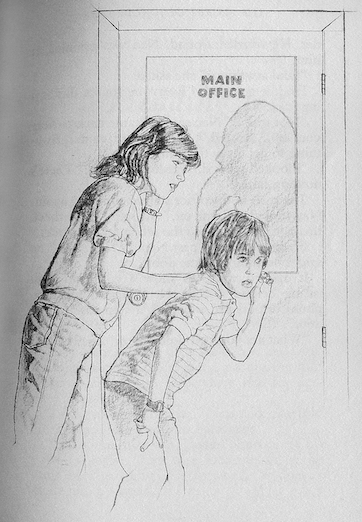
Boxcar Children Mystery in the Snow  knocking on the door

There are indications in the story that the parents of the children in the competition don’t always want the same things that their children want. Nan, for instance, didn’t even want to join contest, but her parents urged her to do it. Also, some of the children aren’t as good at others at conveying to their parents what they really want. When the most troubled child in the group finally manages to say what they really want, many things get straightened out.

I feel like there are many stories where the conflicts revolve around people who don’t really communicate with each other. In this story, there’s a character who blames others for not understanding how they feel, but even they have to acknowledge that they haven’t actually explained their feelings. They’ve just been expecting everyone else to know what they’ve been feeling. Some honest communication straightens out the problem, and that’s a good life lesson for kids and families.

Snowbound Mystery

The Boxcar Children

The school that most of the Alden children attend is closed temporarily because there was a fire and the building needs to be repaired. Henry is in college (this is one of the books in the early part of the series where the children age), but he doesn’t have to go back for another week, so the family is talking about what they’d like to do. Benny says that he wants to go up to the hunter’s cabin in the Oak Hill woods. Grandfather Alden belongs to the sportsman’s club that owns the cabin, but the hunters in the club don’t use it during the fall. It’s early for there to be snow, so Grandfather Alden thinks it will be okay. Grandfather Alden isn’t eager to go himself, but he thinks that it’s okay if the kids want to spend a week there.

The kids bring some food with them to the cabin, but they plan to buy more from the nearest store, which is a five-mile hike away. On their arrival, they choose the places where they’re going to sleep in the cabin, and they look through the cabin’s guest book for names they recognize. One name they recognize is the Nelson family. The Nelsons are the ones who own the store, and they kids wonder why they’ve visited the cabin three times recently because they wouldn’t have come there to hunt. They decide to ask the Nelsons about it when they go to the store.

The Nelsons are friendly and helpful at the store. When the kids ask about their trips to the cabin, Mr. Nelson just says that they sometimes like a change of scene. The cabin used to belong to the Nelson family before the sporting club bought it. However, the Nelsons’ young son, Pugsy, says that whenever they go to the cabin, they “look and look.” His parents stop him from saying more, but the Aldens wonder what the Nelsons could be looking for at the cabin.

The Nelsons give them useful advice about dealing with the squirrels at the cabin and about cooking. Mr. Nelson loves cooking and baking. In particular, he likes to make buns, but he makes an odd comment about how they’re not as good as they could be.

Back at the cabin, the Aldens find a hidden broom closet and a strange message that seems to be in some kind of code. They can’t understand what it means, and they wonder if this message could be what the Nelsons are looking for. Because they don’t understand the significance of the message, they’re not sure what to do about it. The Nelsons are nice, so the kids don’t want to think that they might be involved in anything bad, but if there’s an innocent reason for them to have this message, why are they being so secretive about it?

Although it is early for snow, a bad snow storm comes that leaves the Aldens snowbound in the cabin. Fortunately, they have plenty of supplies, and they can use their radio to hear about weather conditions. There are messages on the radio for people who have been separated from family members, and one of them is from the children’s grandfather, telling them to remain in the cabin and wait for help because he will get to them as soon as he can.

However, the Nelsons were also worried about the Aldens and made their ways through the snowy woods to check on them. The snow was worse than they thought, so now, the Nelsons are also stuck at the cabin with the Aldens. While they wait for their rescuers to arrive, the Aldens and Nelsons discuss the secret message and what the Nelsons are really looking for.

The book is available to borrow and read for free online through Internet Archive (multiple copies).

The Nelsons are actually a nice family, and there is an innocent reason for their behavior. Mr. Nelson’s father and grandfather also loved baking, and they had a special recipe that they used for making buns. Their recipe had a secret ingredient, but unfortunately, they both died before passing on their secret. Mr. Nelson thinks that, if he could make the buns like they did, he could become famous or at least earn more money for his family. He is a good baker, but the recipe is something special. The secret message is part of the recipe, but there’s still a missing piece of the puzzle. The Aldens and the Nelsons use their time when they’re snowbound in the cabin to look for the rest.

This story is equal parts adventure and mystery. Fans of the Cottagecore aesthetic will appreciate how the Aldens make do with the primitive conditions at the cabin, use plants as decoration, and gather nuts in the woods before the snowstorm.

Years after this book was published, another author wrote a cookbook based on food references in the Boxcar Children series, and she included a recipe for the buns in this story. The story never reveals the secret ingredient, and the author uses some shortcuts in preparing them, but it’s an easy recipe that kids can learn to make.

Charmed Life

This is the first book in the Chrestomanci series.  There are many different dimensions with duplicate worlds, and in each of those duplicate worlds, there is a copy of every person.  People’s lives can differ dramatically between the different worlds, but there is one person in each generation who has no duplicates in any of the other dimensions or worlds.  This person is called the Chrestomanci.  All of the talents, abilities, and lives that would have been spread among the duplicates across the other worlds are now centered on that one person, giving that person, literally, nine lives.  Very often, the Chrestomanci doesn’t realize that he’s a Chrestomanci until he actually dies . . . and fails to die because he uses up one of his spare lives and continues living with the others.

When young Eric Chant’s older sister Gwendolyn gives him the nickname Cat at a young age, saying that he has nine lives, he doesn’t understand that it’s literally true.  Then, he and Gwendolyn are unexpectedly orphaned during a boat accident.  Their parents drown.  Gwendolyn doesn’t because she’s a witch, and the water rejected her.  Cat thought that he was saved because he grabbed hold of Gwendolyn.  Gwendolyn knows differently.

After their parents’ deaths, Cat and Gwendolyn live with their downstairs neighbor for a time, receiving support from the town. Their neighbor, Mrs. Sharp, is also a witch, and she recognizes Gwendolyn’s talent. When she goes through the children’s parents’ things, she finds three letters from someone called Chrestomanci, and she recognizes immediately that they are important. Cat doesn’t fully understand who Chrestomanci is, but everyone regards him as an important person, so much so that they even hesitate to say his name out loud. His signature is valuable, and Mrs. Sharp offers the letters as payment for witchcraft lessons for Gwendolyn from the best tutor in the area, Mr. Nostrum. Gwendolyn breezes through the early lessons easily, and everyone in the neighborhood recognizes her talents. They are sure that Gwendolyn is destined for great things, and they are all eager to ingratiate themselves with her. A local fortune-teller even says that Gwendolyn will be famous and may be able to rule the world if she goes about it in the right way. The fortune-teller also tells Cat’s fortune, but his fortune is a warning that he is in danger from two sides. Cat is frightened and unsure what to think of it.

However, there is still the question about how the children’s parents knew Chrestomanci and what their father argued about with him in their letters to each other. Mr. Nostrum is particularly curious to know what the children know about Chrestomanci, having apparently tried to learn things about him through his signature and failing, but neither of the children can tell him much. Cat still isn’t sure exactly who Chrestomanci is, so he suggests that Mr. Nostrum just write to Chrestomanci himself to ask. It’s such a straightforward approach that it never occurred to either Mr. Nostrum or Gwendolyn to do that before. Gwendolyn ends up writing the letter to Chrestomanci herself, exaggerating her plight as an orphan to gain sympathy, and implying that Cat also drowned in the boat accident. When Chrestomanci arrives to see Gwendolyn, he is initially surprised to see Cat.

Although their relationship to Chrestomanci isn’t explained at first, Chrestomanci takes custody of the children and brings them to live at his castle with his own wife and children, Julia and Roger. Everyone tells the children how lucky they are because living with someone as important as Chrestomanci means hob-nobbing with other important people. Cat realizes that the reason why Gwendolyn wants to go to Chrestomanci is that she is serious about becoming famous and ruling the world. She sees life with Chrestomanci as the first step. Cat is more intimidated and homesick.

Life in Chrestomanci’s castle is quite different from what Gwendolyn expected, though. There is some kind of enchantment over the castle that muffles Gwendolyn’s powers, and that drives her crazy. Gwendolyn is contemptuous of Julia and Roger for being plain and fat, but both of them turn out to be better at magic than she is and are fully capable of standing up to her magical tricks and bullying. Worst of all, nobody seems impressed by Gwendolyn or thinks that she’s special, and Gwendolyn is accustomed to people thinking that she’s special and impressive.

Chrestomanci makes it clear that none of the children are supposed to be practicing magic unless they are under the supervision of their tutor, Michael Saunders. When Gwendolyn and Cat begin having lessons with Michael Saunders along with Julia and Roger, it becomes apparent that Gwendolyn is far behind in her normal subjects, like math and history, even behind Cat, who is younger. Gwendolyn airily tells the tutor that she never paid attention to such things at their old school because she was concentrating more on learning witchcraft. Michael Saunders tells her that she won’t have any more magical lessons until she catches up in her normal studies, and Chrestomanci backs up the tutor. Gwendolyn is infuriated because, not only is nobody treating her like she’s special and impressive, for the first time in her life, they are treating her like what she really is: a spoiled and naughty child.

Gwendolyn’s parents didn’t fully have the ability to impose consequences on Gwendolyn when they were alive, although they were a restraining influence. After they died, nobody tried to restrain Gwendolyn, only trying to ingratiate themselves so she would help them or they could use her for their own purposes. Although Cat has idolized his older sister, there are dark sides to her personality that he has never realized before, and he soon discovers that she has sinister intentions that involve him.

One day, Gwendolyn vanishes and is replaced by one of her duplicates from another world, where magic doesn’t exist.  This other version of Gwendolyn, who is called Janet, has no idea where she is or how she got there.  It is from her that Cat learns that there is no duplicate of himself in her world.  While Cat struggles to figure out what is happening, he helps the new girl to pretend that she is the usual Gwendolyn, although she actually has a very different, much nicer, personality. The more Cat tells Janet about Gwendolyn, the less Janet likes her or the idea of being her, which makes Cat nervous.

When Cat and the new Gwendolyn realize what Cat’s Gwendolyn intends to do, they will need the Chrestomanci’s help to stop her and for Cat to claim his true destiny, the one that Gwendolyn has been attempting to conceal from him all along.

The book is available to borrow and read for free online through Internet Archive (multiple copies).

One of the best parts of the book for me was the setting at Chrestomanci Castle. The idea of living in a castle with magical playmates who can make toy soldiers move on their own is exciting! Cat and Gwendolyn’s rooms in the castle sound like the kind of bedrooms that any kid might imagine having. Even though the castle is strange and sinister things are happening, there is also a kind of coziness to the atmosphere. The children have hot cocoa every morning in the nursery. (I’m not sure why Cat, Gwendolyn, and Janet don’t like hot cocoa. Having hot chocolate for breakfast every morning would have made me happy as a kid, although I admit that, if Chrestomanci and Millie are concerned about their children’s weight issues enough to limit their marmalade intake, that’s not really the best morning drink they could have. I would have suggested tea instead. While we’re on the subject, I didn’t like the way they kept going on about the kids’ weight issues.) They have their own old-fashioned schoolroom in the castle with their own private tutor. When they get allowance money, they can walk to the charming, old-fashioned town nearby and buy candy and other small items. Millie is a doting magical mother, and even though Chrestomanci can be a little intimidating and fussy about appearances, he seems to genuinely care about the children and isn’t above sticking his well-dressed head into the nursery to say good morning and check on them.

During his time at Chrestomanci Castle, Cat learns things about his parents and his sister that he never knew before. His parents were actually cousins, and marriages between cousins in magical families are frequently dangerous, especially when they have children. Chrestomanci is also their parents’ cousin, and the argument he had with their father through their letters was about preventing the couple from having children any children with magical abilities, a suggestion that insulted and angered their father. Their father later came to regret that when young Gwendolyn first started using her powers, and even her parents started to see that she was dangerous. They weren’t quite sure how she was using Cat, but they had the sense that she was using him to do her magic somehow. Nobody thought to take Cat’s nickname seriously until Janet started questioning the reason why Gwendolyn started calling him that.

The truth is that Cat is a nine-lived enchanter. Gwendolyn realized this when he died at birth but didn’t actually die, and even though she was young herself, she found a way to hijack his powers. From the time when he was a baby, she’s been using his powers as if they were her own. That is how Gwendolyn appears to be unusually powerful for her age, even though she’s never really had the patience to go through any of her lessons by the numbers, just glossing over the beginning parts. Cat has been unable to use his own magical abilities because Gwendolyn has been keeping them all for herself, so for a long time, he assumes that he doesn’t have any magic at all. Since Gwendolyn has been doing this for his whole life, Cat has grown accustomed to how it feels and doesn’t notice it until Janet puts together the clues and realizes what’s been happening. When Gwendolyn does particularly powerful magic, she even sacrifices one of Cat’s extra lives, which she placed in a little matchbook for easy use.

Cat is appalled when he finds out about it, and he doesn’t want to believe it at first. However, when he tries to light one of the matches and instantly catches fire, he is convinced. What is even worse is that Gwendolyn and her magic tutor are planning to use him as a human sacrifice to open the gateway to other worlds so that they and the other evil magicians can use their powers to control these other worlds. Gwendolyn is a malevolent narcissist and always has been. Cat is devastated when he learns how little Gwendolyn cares about him, but he manages to finally summon enough anger to stand up to Gwendolyn and take his powers back from her. Like other victims of narcissists, he has always been the stronger and more powerful of the two of them, but he needed some help to see it.

Unlike Gwendolyn, Janet is not a narcissist and is capable of feeling empathy and caring for others. She’s even capable of selfless acts and personal sacrifices for the sake of others when necessary. When Gwendolyn escapes and permanently seals herself in another world where she is a queen, Janet is stuck in Cat’s world, unable to return to her own. It’s a terrible blow for her to be separated from her parents, who are alive in her world. However, when Chrestomanci asks her if she will be okay and if she wants him to try to return her to her own world, she refuses the offer because she has discovered that the double who replaced her in her world is an orphan who badly needs a family. While Gwendolyn was even going to volunteer Janet, one of her other selves as a sacrifice if Cat wouldn’t do, Janet is willing to sacrifice her former life in her world for the sake of one of her other selves. Janet is really the kind of sister that Cat has needed all along. She says that she was supposed to have a younger brother in her world but that he died at birth, and she is fascinated to find Eric/Cat alive in this new world and get to know the brother she lost. Janet learns to love her new brother and to get along with Julia and Roger, becoming the kind of girl Gwendolyn really should have been to her family. She doesn’t have any magical abilities, but she discovers that she can help help her new family because life in her usual world (which is supposed to be our world) has given her a different perspective from theirs. She is the one who suggests to Chrestomanci that he stop using silverware made of actual silver, which impedes his powers, and use stainless steel instead. When Gwendolyn played magical tricks at dinner, Chrestomanci always had trouble dealing with it because he was holding silver, but if he uses stainless steel, he won’t have that problem again. Chrestomanci and Millie admit that they never thought of that because stainless steel cutlery isn’t common in their world.

I remember finding this story fascinating the first time I read it as a kid. There are some dark themes with Gwendolyn’s narcissism, the threats to the children’s lives, and even Cat losing a few more lives. Cat’s growth is central to the story. Once Gwendolyn’s toxic influence is removed from his life, he begins to see the truth about himself and how Gwendolyn has treated him. Cat had always looked to her for comfort as his sister and his last living relative (so he thought), but all along, she was the one who was most dangerous to him, and that’s a terrible betrayal. Once Cat starts to understand the situation, he begins to see his own potential, and he also has some new people in his life who show him better treatment. The castle is charming, the world is fascinating, and the story is thought-provoking about the different ways a person’s life can go in different circumstances. Other books in the series go into more detail about how the different worlds in this universe function and how they split off from each other in different series, based on the outcomes of important events.

Mystery by Moonlight

One moonlit evening, as Gail Foster walks home from the movies with her brothers, a pair of twins named Ted and Tim, and their friend, they pass the old house called Morgan’s Green. The old house was ruined by fire years before. The house hasn’t been repaired since the fire, but the owner, Miss Morgan, pays someone to maintain the grounds and to keep trespassers away. The old ruin bothers people in the neighborhood because Miss Morgan seems to have no intention of ever repairing it so anybody can live there again. For some reason, she seems to want it to just stand there, a ruined and empty eyesore.

As the children pass the house, Gail suddenly hears a knocking or rapping sound. She stops the boys and gets them to listen, but by the time they do, the sound has stopped. The children debate about what the sound could have been. One of her brothers worries that maybe someone has wandered into the old house and gotten hurt, but the other one thinks that maybe Gail just imagined the sound because she likes to write stories and recently wrote a scary one about a ghost. The brothers’ friend, a boy named Conan, has a job helping the groundskeeper at Morgan’s Green, and he says that he’ll check everything over when he goes to work there the next morning.

Gail feels uneasy about the idea of some unknown person being at the old house because the truth is that she has been secretly trespassing on the grounds herself. She went there one day when she was chasing her brothers’ dog, and she found an old, disused tool shed with a workbench inside. This forgotten shed struck her as a good place to go and write in secret. Her brothers have been teasing her about the stories she writes, so she could use a little privacy. Actually, she could use any privacy. Her brothers routinely sneak into her room, read her stories and her private diary, and even deface the diary and tell their friends what she wrote. Their father always tells Gail that the boys’ teasing and bullying is her fault because she makes it too easy and fun for them by showing her emotions, and her parents refuse for punish the boys for any of it or allow Gail to have a lock on her bedroom door to keep them out. It’s no wonder Gail feels the need to escape. Now, Gail worries that maybe someone (or some thing?) knows about her trespassing and that the knocking sound was some kind of warning for her to stop.

The next day, she reconsiders that idea, remembering that she has heard about thefts in the area lately. Maybe what she heard was actually thieves! Miss Morgan still has some furniture stored in part of the old house that might tempt a thief. Conan’s father is the local sheriff, and he hasn’t had leads on the robberies yet.

The next time that Gail goes to write in the old shed, Conan comes to talk to her. At first, she is worried that her secret hiding place has been discovered, but Conan tells her that he’s known about it for a while because he’s seen her going there before. Gail tells him how badly she needs a place with some privacy. He hasn’t told Gail’s brothers about it, and he says that he doesn’t care if Gail wants to continue using the shed.

Conan is also the only one who’s really taken the rapping that Gail heard seriously. Conan tells Gail that he’s looked around Morgan’s Green, but he hasn’t found any sign of whatever made the noise. However, he has some worse news. The groundskeeper at Morgan’s Green, Mr. Hopkins, has fired Conan, and he won’t even give Conan a reason. They’ve always gotten along well enough before, and Mr. Hopkins has never had any complaint about Conan’s work. Conan feels badly about getting fired, but all he can think of that’s changed lately is the rapping sound and the way he looked over the old house to see if he could find a source. It makes Conan wonder if Mr. Hopkins knows something about what caused the noise and wanted to keep him from finding out about it.

Gail wonders if Miss Morgan could be involved with the local thieves and told Mr. Hopkins to get rid of Conan to keep him from finding their secret hideout or something. The kids pause to consider what they really know about Miss Morgan. She does seem to have odd feelings about the old, burned house. It used to belong to her aunt and uncle, who didn’t used to socialize with the people in town much. After they died, Miss Morgan only lived in the house for a few years before it burned. Now, she doesn’t seem to want to either fix it up or sell it, and no one knows why or what she plans to do with it. However, the kids conclude that she has too much money of her own to get involved with thieves. Still, Conan wants to investigate the situation more because he’s sure something strange is going on at Morgan’s Green, and he wants to find out what it is and if it has something to do with him getting fired.

Gail volunteers to help him investigate, and Conan says that he wants to investigate with just her and not the twins. The twins don’t take things seriously and would be less likely to keep quiet about the whole operation. Conan and Gail do involve Gail’s friend, Lianne, because visiting her gives Gail a reason to walk past Morgan’s Green, both on her way to Lianne’s house and on her way back.

The kids see a strange young man hanging around Morgan’s Green with a sketch pad, and Gail learns that his name is Steve Craig. He’s an art student who makes custom Christmas cards to fund his education at design school. Even Gail’s parents have hired him to make a set of Christmas cards for them with a drawing of their own house on them. When Steve comes to talk to Gail’s parents about the sketches he’s made of their house, Gail mentions that she saw him at Morgan’s Green earlier and asks him why he was there. He says that he was fascinated by the house, but he doesn’t think it will do for his paintings. Gail asks Steve if he has a studio, and he says yes, that he has a room in the attic at his house where he had do his work and that it’s important to have a private place to work. Tim and Ted take this opportunity to jump in and publicly tease their sister about her writing again, the reason why she wants and needs some privacy (from them, specifically). Fortunately, Steve isn’t having any of that, and he makes it clear. The dinner guest speaks to the boys more severely than their father ever did, telling them the plain truth, for once, “You two boys don’t sound very understanding. I can see why your sister would need a place of her own for her writing. But then, you’re rather young. Gail will have to be patient with you.” (Oh, thank God! I hope those useless, idiot parents listened, too. I hated them by this point in the story.) The twins are stunned and embarrassed by this response because no one has ever said anything like this to them in their entire lives. (They would have if the parents weren’t useless twits with obvious favorites among their children. I enjoyed seeing someone tell the twins what they’re really like.) The parents say absolutely nothing. (Again, useless.)

Later that evening, Conan walks Gail home from Lianne’s house, and as they pass Morgan’s Green, they hear voices. They can’t catch everything the voices say, but they do hear one talking about “a few more days.” Who was it, and what’s happening for “a few more days”? When Gail tells Lianne what they heard, Lianne is afraid that maybe the place is haunted.

From Lianne’s parents, they learn that Mr. Hopkins has been moving furniture at the old house. Lianne’s parents think that Miss Morgan might have decided to sell the place after all. However, when Conan mentions that to his father, he talks to Miss Morgan, and Miss Morgan says that she didn’t know Mr. Hopkins was moving anything around at Morgan’s Green. She also doesn’t know anything about Conan being fired.

Mr. Hopkins looks kind of sinister when they hear this, but there are still other suspects and an interesting twist that reveals a secret that Miss Morgan herself has been trying to keep for years. There is a reason why she hasn’t wanted to sell Morgan’s Green, and the revelation of one mystery also reveals the other.

The book is available to borrow and read for free online through Internet Archive (multiple copies). This book is also still in print and available on Kindle through Amazon.

I liked the layers of mystery in the story and range of possible suspects. First, there is the mystery of why Miss Morgan doesn’t want to fix up and sell the house, why she’s left it empty and ruined for years. There is a reason that is revealed toward the end of the book. I liked the reason, which opens up some intriguing elements in the story and a device that the kids themselves use, although I felt like there could have been a little more priming for the reason if people had talked a little more about the aunt and uncle’s history. They were involved in something that Miss Morgan didn’t want to reveal, but surely at least some people in the area should have known about their interests in spiritualism and seances. A good book along some similar lines is The Talking Table Mystery.

Then, there is the question of who, aside from Gail, has been sneaking around Morgan’s Green and why. There are some thieves active in the area, which provide logical suspects, and there are some valuable pieces of art in the possession of the Morgan family that could make targets for thieves. However, Mr. Hopkins has also been acting strangely, and Steve Craig, as an art student, would have a special interest in art. Even though Mr. Hopkins and Steve are usually nice, they behave suspiciously enough to give readers more suspects to consider, and each of them turns out to know more about the Morgan family than they initially let on. Overall, I really liked the setting and mysteries in the story.

I have very strong feelings on the subject of teasing, and I was appalled at the way Gail’s parents allowed her brothers to treat her and her personal belongings. It wasn’t just that the boys were ribbing her a little about liking to write stories. They kept going into her room and not only reading her stories and making fun of what she says in them, but they also read her diary, actively deface her diary, and tell all of their friends about things in her private diary to invite public teasing. This is a serious privacy violation, and when she asks if she can have a lock on her door to keep them out, not only do the parents not punish the boys for any of this, her father says, “They only do it because you get so excited about it. You’re just too teasable, Gail.”

Oh, I see. It’s all Gail’s fault for having emotions and caring about her privacy and the fact that her parents are refusing either to help her or punish the boys for what they’ve done. Her parents always promise her that they’ll punish the boys “next time”, but each time “next time” arrives, they don’t! They’ve repeatedly broken promises, refused to actively parent their children, and enabled the twins’ bad behavior and abuse of their sister. They’re also gaslighting Gail, trying to make her think she is in the wrong for being a human. The father’s basically saying that it’s right for people to victimize others in any way they want as long as it’s easy and fun to do, and that the way bullies act is 100% the fault of the victim and 0% the responsibility of the bullies themselves. That’s the level of personal responsibility he teaches his sons. It’s the level of parental responsibility he shows for teaching his sons how to act and treat other people.

As I was reading, I couldn’t help but think that the father would probably be the first to holler if someone just walked into his room and started going through his drawers and finding those embarrassing things that adults often have hidden away from kids, and I can just imagine his response if that person told him they did it because he made it “too easy”, so it was all his own fault. I don’t know what things he might have hidden away specifically, although as an adult, I think I could make some decent guesses. (Just for starters, a search of the parents’ room would probably reveal what kind of birth control they use, if any, and whether or not they have any private reading material that would be unfit for kids and not safe for work. Should we also count the number of pairs of underwear the father has that have stains or holes?) I just know that everyone has something that they wouldn’t want the general public to see, whether it’s a private diary or clothes that we just can’t get rid of even if they might be embarrassing to wear or something that indicates much more personal habits that might change the way other people might see us if they were made public. The parents are either unable or unwilling to see how they would feel in Gail’s place and take an active role in teaching their sons how to act, imposing consequences for bad behavior.

Gail’s parents say that they worry that she spends too much time alone writing as it is to let her have privacy or a lock on her door, but privacy is also about trust. The fact is that Gail can’t really trust either her brothers or her parents, not with her private belonging and not even with her personal feelings. They repeatedly and deliberately disrespect and violate both and try to gaslight her like it’s her fault, and that’s deeply damaging to personal relationships. They say that they’re worried about her, but how can they be if they’re not in tune with her feelings and continually allow and support the boys in making her feel uncomfortable, embarrassed, disrespected, violated, and abused? The fact that they can’t figure that out or maybe do know it and just don’t care just makes me angry with them.

I don’t think the twins are bad for doing this kind of thing to their sister once, but I do think that they’re bad for doing it repeatedly, knowing that it causes her distress, because they enjoy her distress. Kids do act up and tease siblings, but it’s the parents’ job to lay down the house rules and enforce them and teach the children standards of behavior that they will carry out into the rest of the world with them. These parents are very deliberately not doing that and dodging every opportunity to do it, giving the twins the impression that what they’re doing it fine and fun and there’s no reason to ever stop. This father makes me sick because I can tell that he’s not stopping the boys from teasing their sister and violating her privacy because he identifies with them and is secretly enjoying his daughter’s distress himself.

Pain-in-the-butt people raise pain-in-the-butt kids, and if those boys don’t somehow get some personal awareness or get someone else to make them shape up, they’d be hashtag material in their later years and deeply offended that anyone sees a problem with their behavior because they’ve never had anybody give them consequences for their behavior in their entire spoiled lives. At every single misbehavior, they’ve experienced only excuses, justifications, and free passes from their parents. I’ve always hated this kind of attitude from people and every single person who does this because it does not get better with age alone. Without something to make them realize that there are reasons to restrain themselves, it just escalates until someone finally hits them with a consequence, and then, they’re stunned because it’s never happened to them before, just like the twins are stunned when Steve points out at dinner that they’re behaving badly and that they should think of their sister’s feelings. You can tell that nobody, certainly not the parents, has ever mentioned it to them before, ever. Just imagine them at age 50, explaining to a police officer, a set of angry parents, and a distraught teenager, that the 14-year-old girl they up-skirted made it “too easy”, they were “just having fun”, it was all her fault for being pretty and wearing the wrong clothes, and phones wouldn’t be equipped with cameras if there were any restrictions on how they could use them, no clue why everyone’s mad at them, because that’s the level of morality and personal responsibility, they were raised with. It’s good for people to get feedback on their behavior when they’re young and learning how to be around other human beings. If they don’t get any rules for behavioral standards or an emphasis on considering other people’s feelings during their formative years, they won’t have any basis for understanding behavioral standards, consequences, or human empathy later in life. The older they are when someone finally gives them a consequence for inappropriate behavior of any type, the angrier they typically get because they think they know what they’re entitled to as adults, and they just want the free passes and apparent tacit approval they always get.

The key is confrontation, facing behavior and the consequences of misbehavior directly and honestly. Maybe Gail’s parents are afraid to punish the boys because they think that punishing them would be a reaction to them and the volatile boys will just act up more, but that’s not really the case. The boys take their nonreaction as approval for what they’re doing and, in the father’s case, I think that might really be it. He strikes me as one of those awful people who thinks that nothing should matter when the boys are having fun, and it’s everyone else’s responsibility to deal with the situation because the people having fun shouldn’t be bothered. The mother at least says once that they shouldn’t be messing with Gail’s things, even though she does absolutely nothing at all about it, but I noticed that the father never says that even once and didn’t say anything to agree with his wife that the boys were doing something they shouldn’t.

The twins are shocked and embarrassed whenever anybody says something negative about the way they’ve behaved or even just calls it into question. They don’t know what to do when that happens because, apparently, nobody has ever said anything negative to them about their behavior or questioned them about it … certainly not their own parents. Even when Lianne is careful not to react much to one of the boys repeatedly taking her hat and throwing it in the gutter and in the street, the boy keeps on doing it three times in a row. The nonreaction doesn’t stop him. What finally stops him is Lianne asking him calmly what he’s trying to do. The boy is again shocked and embarrassed. It’s like he’s never had to think about his own actions before in his life. He probably hasn’t because his parents have never taught the twins that they should think about their actions, the consequences, and other people’s feelings before. It’s not just when people don’t react to them (like “Don’t feed the trolls”), it’s when someone actually says something to them that makes them take a hard look at what they’re doing that makes them realize that they’re just being mean and stupid and how that looks to everyone who sees them, and then, they get embarrassed. These are things that they need to hear from somebody, and they’re sure as heck not going to hear them from the people who are supposed to be raising them and teaching them how to function in life. The twins’ parents never say anything about how they should behave, never make them stop and think, and never talk to the twins about thinking of other people or thinking before they act. They let near strangers and other kids do that important piece of parenting for them, and at no point do they present any follow-up to these comments from other people to support the idea.

I found the twins and their parents to be the most stressful parts of the book. It’s partly by design because they represent obstacles for Gail to overcome and reasons for Gail to look for privacy and support outside of the family home. Her need to get away from them helps to move the action forward, but I still found them stressful because of how awful mean people and irresponsible parents are in real life. Like I said, they’re the kind of people who end up getting called out in hashtagged social media messages later and getting angry about it, like people haven’t been trying to deal with them for years, even decades, leading up to it.

The twins never become really great people by the end of the book, either. People are giving them direct messages and hints about their behavior, and there are brief moments when they show some effort to understand why peoples’ reactions to their bad behavior are embarrassing to them, but they never fully get the message, probably because the parents are still enabling them. They’re still kind of mean little twits at the end of the book. They also almost poison their dog by feeding her 21 pieces of chocolate, and they don’t seem very concerned about that, either. Apparently, that’s another thing that their parents never talked to them about. Gail is the one who is concerned about the dog and looks after it, not the boys or the parents. I get the feeling that even the twins’ friends are getting fed up with their babyish meanness, partly because Conan starts preferring to hang out with their more serious sister instead.

Fortunately, at least some of the other adults in the story are starting to get the idea that maybe Gail needs a little privacy, even though the parents aren’t caring enough and are deliberately ignoring Gail’s direct requests and other adults’ comments. Gail’s grandparents give her a diary with a lock on it, so they seem to know how much she likes to write and how much she needs a little privacy and protection from her brothers. She also finds a way to get a desk with a lock, so she can at least lock her work in her desk so the twins can’t get in the desk, even though they can still get in her room.

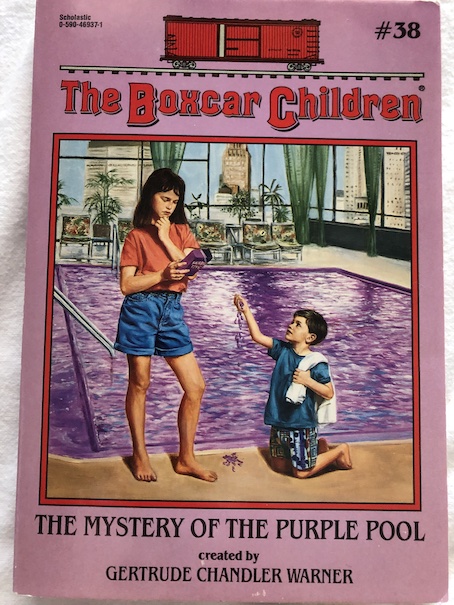
The Mystery of the Purple Pool

The Boxcar Children

The Boxcar Children are all bored, especially Benny. Grandfather Alden tells them that he has to go to New York City on business, and the children can come with him and see the city. That sounds like just the kind of excitement the kids need! Their grandfather calls the hotel where he’ll be staying and reserves a suite of room for all of them. Then, he tells the children to look through some guidebooks for the city and decide what they want to see there. He says that, during the time when he’ll be working, the two oldest children, Henry and Jessie, will be in charge. The children start looking through the guidebooks and talking about things they want to see in New York.

When they arrive at the Plymouth Hotel in New York, the children’s grandfather notices right away that the service isn’t how it usually is at this hotel. For some reason, their reservation was canceled, although they are still able to get rooms. Then, there are no bellhops to be found to carry their bags, and even the hotel management doesn’t know where they are. As they go to their room, they hear another guest complaining that his room wasn’t cleaned, even though the maid said that she’d cleaned it.

All of these things could be mistakes or signs of bad hotel management, but it soon becomes apparent that someone is deliberately trying to sabotage the hotel. When the children try to swim in the hotel pool, they find out that someone dyed the pool purple! Then, someone switches the sugar and salt in the hotel restaurant, ruining everyone’s breakfast. When the kids come back from sight-seeing, they see a crowd of people in the lobby, all complaining about various things missing from their rooms, like pillows and shower curtains. Then, the children get stuck in the hotel elevator when someone turns it off and have to call for help.

The Alden children have another mystery on their hands! Who could be the mysterious saboteur, and what would they want to harm the hotel? There’s a mysterious man who seems to be lurking around when bad things happen. There’s also a maid who is angry about her brother being fired from the hotel. The hotel manager isn’t always on hand to deal with things when they go wrong. There’s also an unfriendly woman who doesn’t like kids (named Karen before that name started to be used as a slang word for a disagreeable, complaining woman) and is always scribbling in her notebook, never letting anybody see what she’s writing. Any of them could be the culprit, or it could be someone they haven’t even thought to suspect.

The book is available to borrow and read for free online through Internet Archive (multiple copies).

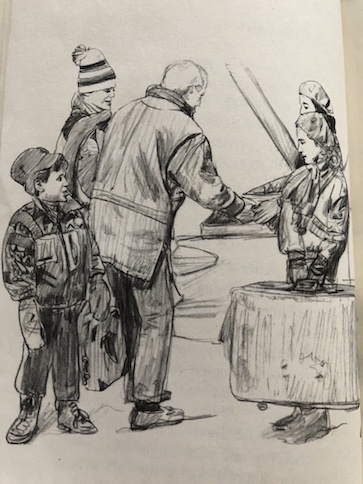
I remember reading this book and liking it when I was a kid. One of the hallmarks of The Boxcar Children series is that the children are always allowed their independence in their adventures. Their grandfather lets them explore the city completely on their own, even though the oldest child in the family is only 14 years old. Few people would let their children roam around New York City completely on their own these days, and they didn’t when I was a kid in the 1990s, either. Another guest at the hotel even lets his young son go sight-seeing with the Alden children when they haven’t known each other very long.

The kids have fun exploring the amenities at the hotel, too. The book draws attention to various aspects of staying at hotel, like suites with kitchenettes, hotel restaurants, pools and exercise rooms, and the snacks and toiletries you might find in your hotel room. I thought it was interesting how the book explains how you can call for help in an elevator if it gets stuck. Its a useful thing for kids to know.

One thing that occurred to me when I revisited this story was that it doesn’t mention the World Trade Center. They characters could have visited the original World Trade Center in the story because the book was published 7 years before it was destroyed in the September 11, 2001 terrorist attack, but the World Trade Center was not one of the sights that the children went to see. If it had been, it would have dated the story, but I can’t think of anything the children saw or did in the book that really dates it. The things they mention still exist in New York, and this story could still be set in the early 21st century.

Bicycle Mystery

The Boxcar Children

Boxcar Children Bicycle Mystery cover

Bicycle Mystery by Gertrude Chandler Warner, 1970.

Boxcar Children Bicycle Mystery fixing a bike

Grandfather Alden tells the Boxcar Children that their Aunt Jane has invited them to visit her on her farm. To make the trip more interesting for the adventurous kids, he suggests that they make the journey to Aunt Jane into a cross-country bicycle trip. There are motels along the route where they can stay, or they can came out. They won’t be able to take Watch the dog with them this time because he’s getting too old to follow their bikes that long distance, but the kids like the idea of the cross-country bike trip.
The cross-country trip gives the Alden children the chance to meet new people and have adventures. Along the way, they stop to help Mrs. Randall, a woman who is worried about having to fix dinner suddenly for her husband’s boss while her house is a mess. The Aldens see how upset she is while they’re shopping for food themselves, so they volunteer to help her. The boss’s visit turns out to be a success, and rather than coming to discuss a problem at work, he’s there to tell the Randalls that he’s considering Mr. Randall for a promotion. However, the Alden children have the feeling that there’s something else worrying Mrs. Randall that has to do with her son, Carl, who isn’t there. Every time Carl is mentioned, Mrs. Randall seems worried.

Boxcar Children Bicycle Mystery dog in the window

As the children continue on their way, they get caught in a rain storm and take shelter in an abandoned house. There, they find a little gray dog, who seems friendly and well-behaved. The dog is very hungry, and they share their food with him. The dog seems eager to follow them when they leave. They try to tell the dog to go home, thinking that he probably lives somewhere nearby, but he insists on going with them. Benny starts calling the dog Shadow for following them. The Aldens don’t think they can keep Shadow because they don’t think Watch would like them getting another dog, and they’re a little worried that letting him follow them might be taking him further away from wherever he lives, but they don’t know what to do but take care of him until they can figure out where he belongs.

Boxcar Children Bicycle Mystery injured boy

Later, they meet a boy who is minding a roadside vegetable stand who has a broken leg. The boy says that he feels badly because his father can use some help picking vegetables, too, but he can’t do much since he broke his leg. The Boxcar children offer to help, and the boy and his father are surprised that they’re willing to work for free. The kids say that they’re just out for adventure right now, and they don’t mind helping. The father, Mr. Smith, notices the way that Shadow whines constantly, even though he doesn’t seem hurt. They talk about the dog and wonder who the owner is. Mr. Smith thinks that, if someone didn’t want the dog, they probably could have sold him instead of abandoning him. His son, Roy, noticed something odd while he was minding the vegetable stand. A pair of girls commented that it was the same dog that they had seen in a parking lot earlier. Mr. Smith suggests that the kids ask Miss Lucy at the post office if anyone in the area has lost a dog because she knows everyone and everything that’s going on. When they ask Miss Lucy, she says that nobody in the area has lost a dog, and Shadow isn’t at all familiar to her. Shadow seems to be an unusual breed, and Miss Lucy thinks that he looks funny.

As the children travel further, they spot a sign for a dog show. They decide that they should go to the dog show and see if they can meet people who are interested in dogs and might know what kind of dog Shadow is. They meet a man who tells them that the dog is a young show dog, and he offers to buy the dog. When the kids say that they can’t sell Shadow because he doesn’t belong to them, the man and his wife seem suspicious, and the woman takes a picture of them and the dog.

When the kids finally reach Aunt Jane’s farm, Uncle Andy recognizes the dog as a Skye terrier. The kids finally manage to locate the dog’s owner, and it turns out to be a surprise.

The book is available to borrow and read for free online through Internet Archive (multiple copies).

My Reaction

This is one of the early Boxcar Children books, written by the original author. Because of the cross-country trip format, the book is somewhat episodic, with incidents taking place at different places where the children stop on their trip. The story has more elements of adventure than mystery, but the mystery element is there, too.

The Boxcar Children frequently have more independence from adult supervision than most kids have today, which is part of the appeal that the series has for kids. I think that most people who rent motel rooms would be concerned about renting rooms to children by themselves, but it’s important to point out that the word “kids” is relative. In the later books in the series, the kids’ ages are frozen, so the eldest, Henry, never ages past 14 years old. However, in the earlier books, like this one, the kids did age. In this book, Henry is college-aged, so he’s not exactly a kid anymore. The book doesn’t provide an exact age for him, but he’s probably 18 years old or older.

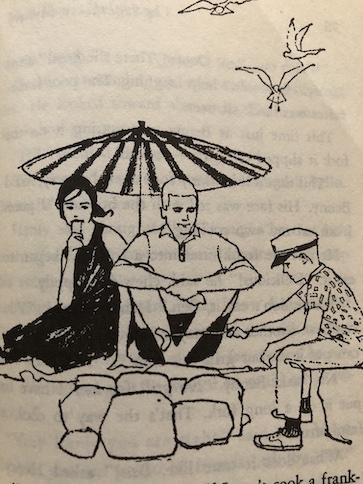
The Lighthouse Mystery

The Boxcar Children

The Lighthouse Mystery by Gertrude Chandler Warner, 1962, 1994.

The Boxcar Children and their grandfather have been visiting the children’s Aunt Jane. They are there to see her get married, and now they’re on their way home again. While driving home, they stop to look at a lighthouse and see a For Sale sign. The children are intrigued at the idea of owning a lighthouse, and their wealthy grandfather decides to ask a nearby storekeeper what he knows about the place. It turns out that the storekeeper has recently purchased the lighthouse himself, so it’s no longer for sale, but he’s willing to rent it out to visitors. The children’s grandfather is as fascinated at the idea of living in a lighthouse as the children are, so he decides to rent it for them to stay in.

During their first night at the lighthouse, the children’s dog, Watch, suddenly starts barking and growling. They can’t figure out what is upsetting watch, although Benny thinks that he smells food. They wonder if someone could be cooking something at the little old house near the lighthouse, but after a while, Watch calms down, and they all decide to go back to bed and check out the situation in the morning.

The next day, they go shopping for food, and the children find themselves looking suspiciously at everyone they meet, wondering if someone was near the lighthouse the night before. The first suspicious person they see is a man who almost knocks Violet over because he’s not looking where he’s going. Then, they meet a young man who seems angry about something. The storekeeper says that the young man graduated from high school early because he’s very smart, but his father won’t let him go to college. Grandfather Alden explains to the storekeeper that they had a prowler the night before, and he’s thinking about talking to the police about it. The children persuade their grandfather not to talk to the police because they want to investigate the mystery themselves.

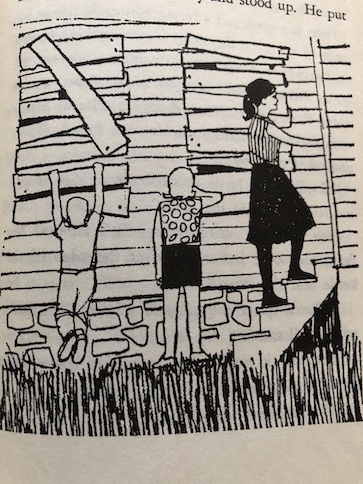
The next night, the children see a woman outside the lighthouse, but when they investigate, they can’t find anyone. They think maybe she went into the little house nearby. Later, they look through the windows of the old house, which are mostly boarded-up. Inside, they see food and cooking equipment, which means that someone might have been cooking there the night that Watch started barking. Strangely, they also see a microscope, seaweed, and something that looks like its glowing. They think maybe someone is doing an experiment of some kind. It could be the woman they saw, or it could be the clever but angry boy who isn’t allowed to go to college, Larry Cook.

When the town holds a special Village Supper, the children learn that Larry loves to cook. They make friends with him while helping him to prepare the food. As the kids become friendlier with Larry and talk with other people in town, they learn more about Larry’s father’s opposition to him attending college and how Larry has been trying to study on his own. They’re pretty sure that Larry is the one who’s been conducting some kind of experiment in the little old house, but what is he trying to do?

The book is available to borrow and read for free online through Internet Archive (multiple copies).

My Reaction and Spoilers

This is one of the early Boxcar Children books, written by the original author. Because it’s one of the early books, the children in the story age. In the books written by other authors after the original author’s death, the children’s ages are frozen, and Henry is always 14, but in this book, he’s in college. That means that he’s not too different in age from Larry, and the kids find out that the college Larry wants to attend is the same one that Henry attends.

At first, I thought that Larry’s father objects to him attending college because they can’t afford tuition, but someone else who knows the family says that Mr. Cook is just a selfish man. I’ve noticed that some people who never went to college take other people’s levels of higher education as some kind of personal insult, like people who go to college are just trying to make them look bad or somehow discredit their personal life choices. It doesn’t seem to occur to them that people might do things for themselves and make decisions for the sake of their own lives that have nothing to do with them in any way. I think that might be the kind of selfishness that the story is trying to describe. Mr. Cook is one of those people who makes everything about himself and feels the need to control other people’s lives to make himself feel good or justify his choices. I’ve also noticed that people who haven’t been to college often don’t understand how changing technology and job requirements cause people to need more education to do jobs that used to require less. They also don’t have the imagination to see how more education can help someone progress further and faster in their field or how it might open the door to new fields they haven’t experienced or even thought about. Because they haven’t sought more education themselves and aren’t accustomed to stretching themselves and looking for new ways to skill up, they don’t think that there might be possibilities beyond their scope. Mr. Cook even admits all of that later, saying, “I just made up my mind that he couldn’t go, and I hated to give in. You see I never had a chance for much schooling. I’ve done all right. I couldn’t see why Larry needed to go to college. A waste of money, I thought. I guess I’m quick to lose my temper and slow to change my mind.”

In spite of his selfishness, this acquaintance says that he thinks Mr. Cook really loves his son. He’s just accustomed to putting his son and his son’s future second to himself. What causes Mr. Cook to change is when Larry is in danger, out on the family’s boat in a storm. Faced with the prospect of losing his son completely, Mr. Cook promises that, if Larry is rescued, Larry can have whatever he want. College turns out to be the right course for Larry. It not only helps him to pursue his field of study but to connect with professors and students who also share his passions and love of learning. It suits him and the life he wants to live.

In some ways, this story is more adventure than mystery. By the time that Larry is rescued from the storm, the Aldens think they have a pretty good idea what Larry is trying to do, but Larry explains it all to them after his rescue rather than the Aldens needing to prove anything themselves. There is also no crime in this story. The mystery part is more about unexplained or mysterious circumstances. Larry hasn’t done anything wrong or illegal. He’s not even trespassing in the little house because his family owns it. Larry’s experiments combine his love of science with his love of cooking. He’s trying to produce new kinds of foods using seaweed and plankton that can help to feed the world.

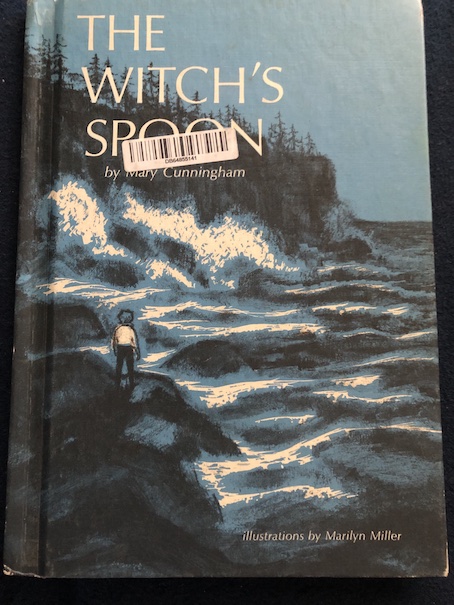
The Witch’s Spoon

The Witch’s Spoon by Mary Cunningham, illustrated by Marilyn Miller, 1975.

Tom and Lauren are spending a week with their grandmother at her beach cottage during the summer. They have visited the cottage many times before, and they love revisiting all their favorite places, the bunk beds on the cottage’s sleeping porch, like the tree where they always see baby owls (which they call the owl tree), and the place where they once found some lost coins (which they call the money spot). They know the cottage well, inside and out. This summer, though, there are a few things that are different.

The first thing that the kids notice that is different is that their Grandma has added a new item to her curio cabinet: a big silver spoon with a long handle. They ask their grandmother about the spoon, and she explains that it’s a witch’s spoon. She recently inherited it from the children’s Great-Aunt Hannah (that would be their grandmother’s sister), who used to live in Massachusetts. The spoon is a family heirloom from the time of the witchcraft trials in Salem (“when witches were thought to be as much of a problem to people as air pollution is now” – this is from the mid-1970s). Their grandmother says that there are good witches and bad witches, and good witches would use spoons like this one to stir love potions. Tom doesn’t believe in witches, but Lauren is fascinated by the spoon and the idea of love potions. She is sure that she senses magic from the spoon.

The next thing that will make the children’s visit here different from previous years is that their grandmother has decided that they’re old enough to have a June Day. June Days are a family tradition, and it’s not just because it’s June. During a June Day, the usual household rules are suspended for one day, and the children are allowed to go wherever they want and do anything they want, all on their own. Grandma says that she will prepare meals at the usual times, but for that day, it’s up to the children whether or not they show up for them, so they don’t need to interrupt their adventures. If the children aren’t there to eat their meals, Grandma will share the food with their nextdoor neighbor, Mr. Bunby. There are only a few safety rules that the children have to follow: they are expected to by careful when attempting any activity that might have an element of danger, and they have to leave their grandmother a note about the general area where they are going, like the beach or the nearby woods, so if they’re not back by dark, she’ll know where to look for them. The June Day ends when it gets dark, and the children must be home by then.

The grandmother understands that there is a certain element of risk in letting the children go off by themselves, and she reminds them that “every box has its pill.” That means that, while their children can choose what they’re going to do, they have to face the consequences of their choices, no matter what they might be, good or bad. “If you open the box and find a bitter pill, you have to swallow it.” Getting to make their own rules and decisions for a day doesn’t get them out of taking the consequences of whatever they do. If they get hurt or get into serious trouble, not only will they suffer the hurt or trouble they cause, but their parents may not let them come back next summer, so they need to keep that in mind when making their choices. Freedom still comes with responsibility, and that’s what the children need to be old enough to understand before they can have a June Day. Tom says that they understand, and that they won’t do anything too wild. Their grandmother tells them that they can have their June Day in two days, so they will have time to look forward to the treat and plan for it.

Tom and Lauren have different interests, so each of them decides to make up their own plans for a private adventure. Tom already knows what he wants to do for his June Day. There is a cave near the beach where the children usually aren’t allowed to go, but there are rumors that there is a giant cavern inside where pirates have hidden their treasure. Getting inside the cave will be difficult and involves an element of risk, but he is determined to spend his June Day hunting for pirate treasure. He doesn’t want to persuade Lauren to join him because he thinks she’ll be too scared to do it.

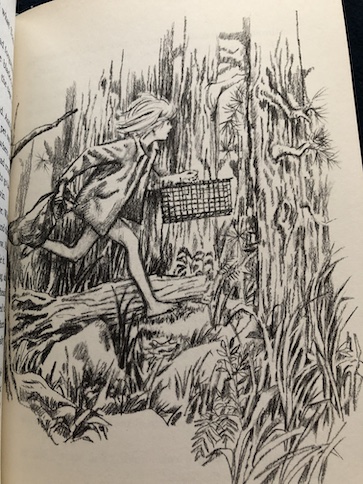
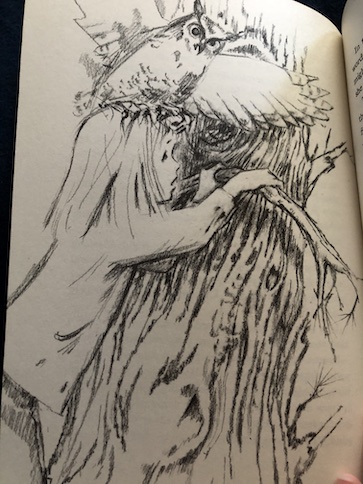
Meanwhile, Lauren thinks how she’s always wanted to hold a baby owl in her hands. She loves animals, and she decides that she’ll try to hold a baby owl on her June Day. She decides she won’t tell Tom about it, because he would probably think that was a silly thing to do. Lauren thinks that she even might try to make a baby owl a pet, just for the rest of the week.

There is one other thing that is different about this year, though. Their grandmother informs them that their cousin, Elizabeth, will be joining them at the cottage this year. Elizabeth’s father is the brother of Tom and Lauren’s father. Years ago, he moved to Italy and married a woman there, and they had only one daughter, Elizabeth. Unfortunately, Elizabeth’s parents died in a car accident, and Elizabeth has been living with her three aunts in Rome. She has never been the United States before and has never met either her grandmother or cousins, so the children’s grandmother has decided to invite her to visit this year.

Tom and Lauren aren’t thrilled at the idea of meeting their Italian cousin. It’s partly jealousy at sharing their grandmother with a girl they don’t really know. Elizabeth was named after their grandmother, and Lauren worries that Grandma will like her better because of that. Tom complains that she’ll probably be fat and smell like garlic because people in Italy eat a lot of spaghetti. It’s a mean thing to say, and even Lauren thinks it sounds ridiculous, but the children’s negative attitudes are also because they realize that Elizabeth’s presence will complicate their secret plans for their June Day. In order to have their secret adventures by themselves, they will also have to avoid their cousin trying to tag along.

In spite of their negativity and thoughts about playing pranks on Elizabeth so she won’t want to stay, Lauren realizes that she is also curious about this cousin and seeing what she’s like. When Elizabeth arrives the next day, she is a slim girl with dark hair, who doesn’t smell like garlic at all. Elizabeth speaks fluent English as well as Italian because she goes to an international school in Rome, so the children are able to talk to each other easily. Lauren feels jealous about the attention that their grandmother showers on Elizabeth, but Elizabeth is nice to Lauren. Elizabeth likes to knit, and she says that she would like to make a sweater for Lauren. Lauren asks her if she’ll have enough time because she’s only visiting for a week, and Elizabeth says that if it’s not finished by the time she has to leave, she will mail it to her. Lauren begins to feel a little sorry that she thought bad things about Elizabeth, but she also still feels jealous because of all the things Elizabeth knows how to do. Elizabeth can play the flute and wears pretty clothes as well as knitting and speaking multiple languages. Then, their grandmother announces that Elizabeth will be allowed to choose one item from her curio cabinet to take back to Italy with her. Tom and Lauren aren’t even allowed to open the curio cabinet without permission!

Their grandmother tells Tom and Lauren that they will each have a chance to choose something from the cabinet when they’re older. The only reason why Elizabeth is choosing now is that she lives far away and can’t come very often. Tom and Lauren each have favorite items in it that they tell Elizabeth to definitely not take before they get a chance to choose, and Lauren suggests that Elizabeth take the witch’s spoon. The witch’s spoon hasn’t been in the cabinet long enough for Tom or Lauren to have developed an attachment to it. Elizabeth is intrigued by the story that witches used it for making love potions, and their grandmother says that, in times of trouble, you can look into the bowl of the spoon and see answers. Elizabeth says that it’s an Italian tradition that a good witch gives children presents on January 6th (see The Legend of Old Benfana). She tries to see her deceased father in the spoon and is disappointed when she can’t. Their grandmother says that it might not be magical anymore or maybe people only saw in the spoon what they wanted to see.

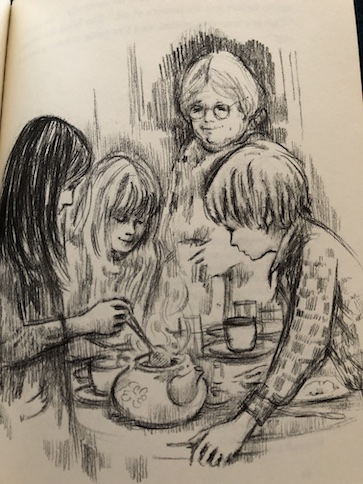
Tom and Lauren continue making their secret plans for their June Day, each kind of wondering what the other is planning to do. When the day arrives, they each get up early and put their plans into action before anybody can ask them what they’re going to do. Of course, their plans don’t turn out the way they thought. Lauren’s attempt to hold a baby owl and maybe make one a pet don’t take into account how the mother owl would feel about that. In the cave, Tom accidentally falls and drops his flashlight, so he’s trapped and unable to find his way out. Neither one of them was specific enough in their notes for anybody to find them quickly when they get into trouble. Fortunately, Elizabeth turns out to be not only a tag-along but a helpful partner in their adventures. Through their various adventures and disasters on this special June Day, the three children come to feel like they really are cousins. At the end of the story, the grandmother makes a special tea blend, and Elizabeth stirs it with the witch’s spoon, turning it into a love potion, but for family love.

I bought my copy of this book through Amazon. I haven’t found a way to read it online.

My Reaction and Spoilers

The book doesn’t say exactly where the story takes place, but I think it’s supposed to be the California coast because that’s where the author lived. The descriptions of the pine forest near the cottage and beach fit the California coast, and the same author wrote another book called The Rescue that takes place at a cabin in California.

The story has some nice cottagecore vibes, with the children having fun and adventures in nature. There are times that they reminisce about past summers at the cottage as well as enjoying the current summer. They once kept a lost, wild baby ferret as a pet temporarily one summer before releasing it back into the woods, and they always have to look for baby owls in the owl tree when they arrive at the cottage. They spend time at the beach, swimming, wading, sunning themselves, and looking for seashells. Lauren has a favorite type of seashell, called angel’s toenails. When Tom explores the cave, he likes seeing the stalactites, and he sees bats and a type of blind fish in the stream of the cave.

Few children these days have the same level of freedom that these children have at their grandmother’s seaside cottage, although for somewhat obvious reasons. Their grandmother speaks to them honestly and sincerely about the nature of risk-taking and accepting the consequences of their actions, but adults will realize that there are obvious problems with each of their plans for June Day. Even as a kid, I would not have tried to pick up a baby owl or keep one as a pet. Wild animals do not want to be made into pets, and they don’t want their babies to be picked up and held by humans. Owls are cute, but they are also birds prey with sharp beaks and talons and will fight back if they feel like someone is intruding on their personal space. Even my child self would have thought of that long before Lauren tries her June Day experiment. Of course, that’s mostly because my elders impressed on me that nobody should mess with wild animals. The reason why we know that certain things are bad ideas is that people actually tried them and found out from personal experience. Maybe some people have to try things themselves before they understand or believe why they’re bad ideas. I have to admit that I once tried to pick up a dead cactus pad when I was about four years old because I had the idea that dead things couldn’t hurt me, so I figured out that it wouldn’t hurt to touch dead cactus. That’s the Arizona version of this type of experimenting with interacting with the natural world, and I was very, very wrong. One benefit of this kind of hands-on experimenting is that the lessons you learn stay with you forever, but as the grandmother of this story says, you have to accept the results of your experiments, whether it’s a clawed head or a handful of cactus spines.

Tom is the one who takes the greatest risk in this story. When he first considers using the June Day to explore the cave, he knows that they’re not usually allowed to go there. The question that immediately came to my mind was why, and the obvious answer is that the adults know that the cave is too dangerous. Tom considers the difficulties of getting into the cave but not the dangers he can encounter inside. Just because the rules have been suspended for the day doesn’t mean that the dangers have also been suspended for the day, which was what their grandmother was trying to get the children to understand. It’s not unlike learning that cactus spines are just as sharp when the cactus is dead as when it was alive. Fortunately, Lauren and Elizabeth manage to rescue Tom without anyone getting hurt.

The adventures that Tom and Lauren end up sharing with Elizabeth help them bond as cousins. They also learn that, while Lauren has some unique skills and lives a very different kind of life in Rome that is exciting in its own way, she isn’t perfect and neither is her life. Elizabeth is an orphan who still misses her parents. The skills that she has are ones that she’s learned from her aunts, who each have their own standards for what Elizabeth should learn and do. Elizabeth’s aunts love her and care for her, but she isn’t always allowed to do what she wants. This summer represents an unusual amount of freedom for her, too.

I think Tom and Lauren might have taken Elizabeth’s sudden arrival better if their grandmother had prepared them for it instead of springing it on them without warning or discussion of how it would affect their summer plans. The grandmother might have also prevented some hard feelings by talking to all of the children about the gift for Elizabeth from the curio cabinet. I understand why Tom and Lauren wanted to prevent Elizabeth from suddenly taking things that they were attached to. If she had, it would have caused some hard feelings among the cousin. If I were the grandmother in this situation, I think I would have sat all three children down and told them that I wanted to give each of them a special gift from the cabinet. Tom and Lauren would have to leave their gifts in the cabinet for the present, partly because the heirloom Tom values most is a pearl-handled gun, and I think he’s too young to have that unsupervised. However, it would be understood that each of the children would own a special heirloom, and they could discuss their choices among themselves so there wouldn’t be hard feelings or the impression that one child was given more choice than the others.

There aren’t really occult themes in the story. The witch’s spoon only does one thing that appears like magic at one point, and there is a logical explanation for that. The love potion tea really just caps off the children’s day of adventure, when they bond over helping each other. The children know that the spoon probably really isn’t magic. The real magic in their imaginations and the time they spend together as family.

The Moon Jumpers

The Moon Jumpers by Janice May Udry, pictures by Maurice Sendak, 1959.

In this pleasant, relaxing children’s picture book, some children enjoy a beautiful summer evening! Some of the pictures are in black-and-white and some are in color, but the best pictures are the full-color, full-page illustrations. The illustrations are by Maurice Sendak, who wrote and illustrated Where the Wild Things Are. The story is told from the point-of-view of the children.

While their parents are in the house, the children go outside to enjoy the relative coolness of the evening. They run barefoot through the grass and play tag.

They climb a tree “just to be in a tree at night.” They set up their own camp, make up songs and poems, and tell each other ghost stories.

The moon is rising, and the children jump in the air, trying to touch it, although they know they can’t.

Eventually, their parents call them inside to go to bed. As the children go to bed, they say goodnight to the moon through their bedroom window.

The book is available to borrow and read for free online through Internet Archive (multiple copies). It’s a Caldecott Honor Book!

My Reaction

This is a nice, calm book that would make a good bedtime story on a summer night! It reminds me a little of Goodnight Moon, Time of Wonder, and The White Marble, which are other calm bedtime stories. It isn’t told in rhyme like Goodnight Moon, but it does show the beauties of summer and evenings spent outside, like Time of Wonder and The White Marble.

The Secret of Jungle Park

The Bobbsey Twins

#1 The Secret of Jungle Park by Laura Lee Hope (Stratemeyer Syndicate), 1987.

Before I begin, I’d like to acknowledge Sean Hagins, for supplying me with photos of this book! Usually, I take pictures of books myself, but I just couldn’t find a physical copy of this one. Sean is a big fan of the Bobbsey Twins, particularly the New Bobbsey Twins mysteries, and you can see some of his video reviews as well as videos about his photography work on his YouTube channel, SJHFoto. Thanks, Sean!

Twelve-year-old twins Nan and Bert Bobbsey are part of a rock band with some of their friends. They call themselves The Aliens, and they’re participating in a Battle of the Bands at the amusement park Jungle Park. Nan plays the keyboard, Bert plays the drums, and their friends, Jimmy and Brian, play guitars. Flossie, their younger sister, wishes that she could join the band, too, but she’s still too young. Flossie and her twin brother, Freddie, are there to help their older siblings get ready and watch them perform. (And, the case of the boys, use some fake blood to play a trick on the girls.)

While they watch the first bands perform, they see some smoke. At first, they think that it’s just a stage effect, but it becomes thicker, and they realize that something is really wrong! Most of the audience flees, but Bert stays behind to save his band’s equipment. Nan tells him it was a dangerous thing to do, but Bert says that he doesn’t think it was a real fire. Fire fighters come, and so does their police officer friend, Lieutenant Pike. Lieutenant Pike also tells Bert that he took a foolish risk, but he agrees with Bert’s impression that the smoke was actually caused by a smoke bomb. Even though a smoke bomb isn’t real fire, setting one off in a crowded auditorium can still be very dangerous because someone could have been hurt in the panic when everybody rushed out.

Lieutenant Pike confides in the children that the police have been called to the park three other times recently for other apparent accidents and problems. He says that if things like this keep happening, they might have to shut down Jungle Park due to safety concerns. The four Bobbsey Twins don’t think that’s fair. They love Jungle Park, and they want to catch the person who set the smoke bomb!

Lieutenant Pike lets the kids look around after the police and fire fighters are finished with the auditorium. There are two clues that they find: a black eye patch and a swizzle stick. Bert doesn’t think that the swizzle stick is much of a clue, but Freddie thinks it might mean something. The eye patch points to two possible suspects that the kids know about: a member of a rival band in the contest and a man the girls saw who was lurking around the dressing room area. Bert thinks that the rival band was trying to disrupt the contest so they would win, but the others aren’t so sure. It turns out that the guy with the eyepatch was hired by one of the owners of the park to make some repairs, but could he have been hired to do more than that? Could one of the owners have a reason to make sure the park closes? What about the woman who takes care of the animals at the park? She doesn’t seem happy about the conditions they’re kept in.

As the kids investigate their suspects, they get chased by elephants, hunt for a suspect in a fun house, tackle someone in a gorilla suit, and win the band contest!

The book is available to borrow and read for free online through Internet Archive.

My Reaction

Like Sean, this particular Bobbsey Twins series was the one that I read as a kid. I didn’t even know the difference between the New Bobbsey Twins series and the earlier series until I was older. The Bobbsey Twins series, like other Stratemeyer Syndicate series, is typically set contemporary to when the stories were written, so the New Bobbsey Twins series is set in the late 1980s and early 1990s, when they were originally written and published.

That time period was when I was a kid myself, so things that the kids did in the New Bobbsey Twins series were very like things kids my age were doing when I was a kid. A lot of kids wished that they could be part of a band. At one point, Flossie talks about something she saw in a teen fashion magazine. Flossie isn’t a teenage herself, but as I recall, teen magazines were largely popular with pre-teens (or “tweens”), who wanted to look like teenagers. Later, she pretends to be collecting signatures for Save the Whales, which was a popular and well-known cause at that time.

The mystery in this book was pretty good. I was sure from the beginning that the kid from the rival rock band wasn’t the park saboteur, but I wasn’t completely sure which of the adults was responsible for much of the book.