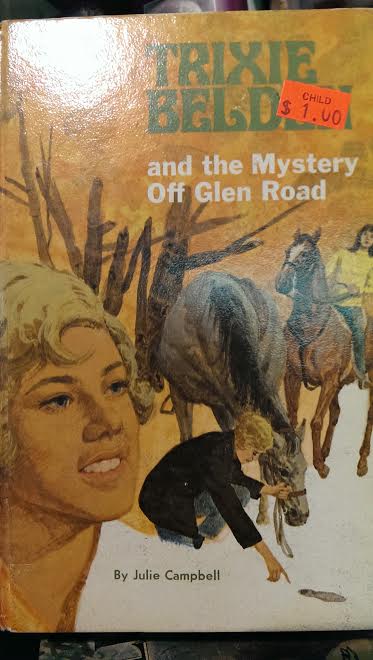
The Mystery Off Glen Road

Trixie Belden

tbglenroad#5 The Mystery Off Glen Road by Julie Campbell, 1956.

When their clubhouse is damaged by a storm shortly before Thanksgiving, the Bob-Whites realize that they will have get some money to fix it soon before the really bad winter weather comes. The Wheelers’ gamekeeper has recently quit, so they offer to patrol Mr. Wheeler’s game preserve for awhile to earn some extra money.

While Trixie and Honey are patrolling, they find a dead deer. They don’t tell anyone about it right away because their dogs, Patch and Reddy, were with the carcass when they found it. If the dogs killed the deer, they might be killed because people would be afraid that the dogs would go wild and start killing more animals. However, Trixie later finds signs that a human butchered and hauled away the carcass. There seems to be a poacher in the wood, and the dogs are innocent of the deer’s death, but how can Trixie and Honey tell the others about it when they tried to cover up the crime in the first place?

To make the situation more complicated, Trixie’s brother, Brian, wants to buy a used car from Mr. Lytell but doesn’t feel that he can spare the money until the clubhouse is fixed. To keep Mr. Lytell from selling the car, Trixie gives him an expensive ring that Jim gave her as security for the car. Since Trixie normally isn’t interested in jewelry at all, she pretends that she wants to wear it to impress Honey’s cousin, Ben, who is visiting for Thanksgiving. Trixie doesn’t actually like Ben at all, but it was the only excuse she could think of for getting her parents to take the ring out of her safe deposit box in the first place. Trixie’s reluctant efforts to fake a crush on Ben and act more girly add humor to the story.

The book is currently available online through Internet Archive.

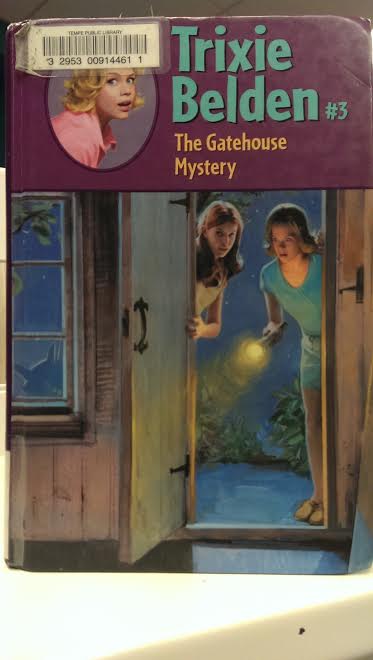
The Gatehouse Mystery

Trixie Belden

TBGatehouseMystery#3 The Gatehouse Mystery by Julie Campbell, 1951.

One day, Honey and Trixie decide to explore the old gatehouse on the property of Honey’s mansion. It hasn’t been used for years, and it is overgrown with vines. However, it looks as though someone has been there recently, and the girls find a diamond on the floor inside. There are signs of a scuffle, and the diamond looks like it was accidentally wedged into the floor. Have thieves been hiding out in that old cottage?

Honey thinks that they should turn the diamond over to the police, but Trixie wants a chance to investigate the crime first, just the two of them, and to prove to Jim and her brothers that she and Honey can be detectives as good as any man could. However, the boys become involved when someone attempts to enter Honey’s room at night to reclaim the diamond.

With their suspicions divided between the new gardener and the new chauffeur, the kids form a club they call the Bob-Whites of the Glen to investigate the matter and to trap the thieves.  This club continues for the rest of the series.

The book is currently available online through Internet Archive.

TBGatehouseMysteryPic

The Vandemark Mummy

The Vandemark MummyThe Vandemark Mummy by Cynthia Voigt, 1991.

The Vandemark Mummy is an exciting mystery with believable characters. The story includes a bit of history about Ancient Egypt and side plots about the complications of family life, the role of women in society, and the nature of ambition.

Twelve-year-old Phineas Hall and his fifteen-year-old sister, Althea, have recently moved to Maine with their father, Professor Hall, because he got a job working at the small Vandemark College. Moving and starting over in a new place is never easy, but the move is more difficult for the kids because their mother didn’t come with them. Their mother is an ambitious, career-oriented feminist, and when she was offered an important job working for a congressman in Oregon, she could not bring herself to turn it down in order to go to Maine with the rest of the family.

Although the entire family talked the situation over, and everyone agreed to the current arrangements, no one is really happy about it. Althea particularly feels hurt. Even though she has shared her mother’s feminist ideals, she’s hurt by her mother’s apparent selfishness and the seeming ease with which she abandoned the family. Althea believes that her mother should have compromised on her career this time because her husband has made compromises for her in the past. To make herself feel better, Althea spends her time studying one of the oldest feminists, the Greek poet Sappho. Phineas, on the other hand, is just trying to be a normal kid and fight off boredom while waiting for the summer to end and school to start. But, boredom is the last thing on Phineas’s mind when the mummy arrives at the college.

The wealthy patriarch of the Vandemark family dies and leaves his collection of Egyptian antiquities (one of many collections he had) to the college, including a real mummy. The Vandemark family is a little disappointed because they had hoped that the collection might go to a much more prestigious institution, even though Vandemark College is named for their family. To the joy of the Hall family, Professor Hall is put in charge of the collection, which will be put on display in a new addition to the college library. Professor Hall lets Phineas and Althea go through the collection with him and another professor, Ken Simard. Although at first the collection does not seem to be particularly valuable, except for the unusually good condition of the mummy and the funeral wreath, it seems to be a lot more valuable to someone. After a failed attempt to break into the collection, someone later manages to steal the mummy. Then, Althea suddenly disappears. The adults suspect that Althea might have run away because of the troubles in their family, but Phineas knows better and begins a desperate hunt to find his sister.

One of the best things about the book is that it really takes both kids to unravel the entire mystery: Phineas for his persistence and decisive action and Althea for her more mature understanding of the thief’s motives. Although, even at the end, their family’s situation isn’t completely resolved, the kids’ experiences give them a new perspective on things. It would be a great book for middle schoolers.

The book is available to borrow and read for free online through Internet Archive (multiple copies).

Themes and Spoilers

I debated about saying more because I didn’t want to spoil the story too much, but after thinking it over, I can’t give my full opinion of it in this review without talking a little more about what Althea and Phineas learned from their situation.  If you’d rather not know more detail, you can skip the rest of this.

On the one hand, I was a little disappointed at the lack of complete resolution to the family’s troubles because, by the end of the book, I really cared about the characters and wanted to know what would happen to them, but I think the author purposely left the story open at the end so readers could imagine for themselves what the characters are going to do next.  However, there is one thing that is pretty well established at the end of the story: whatever happens to their parents, whether their separation is temporary, as they’d originally planned, or whether they end up divorcing, Althea and Phineas are going to be okay because they still have each other, their father, and their new friends in their new town.

In the beginning, their mother’s absence is worrying because they will now have to cope without her, and they don’t know what is going to happen to their family in the long run.  But, part of the children’s self-sufficiency actually does come from their mother and things that she taught them, whether she is with them or not.  The book does mention little things they learned from their mother.  It’s subtle, but she’s still with them because of the influence she’s had in their lives.  The kids also develop more of an appreciation for their own resources and abilities, which makes them less fearful.  One of Althea’s early characteristics was a long-standing fear of the dark.  After her ordeals, her father and brother expected her fear to be worse, but she tells them that she is actually less afraid now than she was before because she has learned something about circumstances she can control and ones she can’t.  She says, “I think, there’s a difference between being scared and not knowing how you’ll do, and being scared but knowing you’ll do okay.”  As she notes, if she goes to bed at home with the lights off and decides that she really can’t stand it, she can always get up and turn them on again.  She has realized that she has control in her daily life and actions she can take to make things better, which she didn’t have during parts of their adventure.  It gives her confidence.

The kids also learn lessons about the nature of ambition and about their own feelings.  In the beginning, Althea is more vocal about how she feels about her parents’ separation.  She feels betrayed because, although she learned her sense of idealism from her mother and thought that they shared the same views, her mother has now done something which she views as a selfish act, rejecting her family and her family’s needs solely in the name of her personal ambitions.  Phineas, on the other hand, doesn’t seem to know what to feel or is afraid to show his true feelings at first, just trying to keep busy so he doesn’t have to think about it too much because he thinks that his parents’ marriage is only their business.

At the end, the two alter their positions somewhat, coming a little more into agreement with each other.  Althea has the chance to contrast her parents’ marriage and ambitions with that of the villain’s (without naming names), and she sees the difference in the way each of them responds to the same pressures.  Although her father may have been hurt by his wife’s reluctance to make sacrifices in her ambitions for the sake of his and her preference for separation over compromise, he still genuinely cares about her and understands her ideals and what she really wants to achieve.  The fact that it’s only a separation, not a divorce, is a sign that the parents still care about each other and respect each other and hope that they will be able to reconcile eventually.  The villain doesn’t have those feelings, and unlike either of Althea and Phineas’s parents, really is motivated solely by selfish ambition.

Ambitions often require sacrifice in order to achieve them.  Revealing exactly what the villain sacrificed would say too much, but this person does end up losing pretty much everything in the end.  For the sake of her ambitions, Althea’s mother sacrificed her place in the family.  Although she thought that it would only be temporary, the hurt she caused her family members will probably have longer-lasting effects. When she calls them to find out what’s been happening, she learns what she’s been missing and the ordeals her children have faced without her, which leave her feeling both worried and left out, feelings that her husband understands and explains to the children (“One of the things she knew, without knowing how it would feel, is that we’d be able to get along fine without her.”), which shows that he is still in tune with his wife’s feelings.  Toward the end of the story, she is upset and seems hurt that Althea is too tired and busy talking to the police to talk to her much other than to briefly reassure her that she is now safe.  At that point, Althea needs her mother’s comfort less than her mother needs reassurance from her.  Althea feels a little bad about not being able to soothe her mother’s feelings because she is no longer as hurt and angry with her as she was before, but Phineas tells her not to worry if their mother’s feelings are hurt right now because she owes her daughter some hurt feelings.  In other words, Phineas has finally learned that it’s okay for him to have feelings and an opinion about the things happening in his family and to show them.  He recognizes how hurt and confused his sister was at their mother’s apparent betrayal, and he has decided that it’s okay for their mother to see that hurt and feel a little of it herself so that she will understand what’s really happening and what her children are really going through. They have coped without her, but the fact remains that she wasn’t there for her family during their time of crisis.

You’ve probably noticed that I’ve been focusing more on the mother’s ambitions and questioning her motives more than the father’s in the story.  That’s partly because that is the focus of the story.  The children do not see their father as abandoning the family for the sake of ambition because he didn’t.  They make it clear that he has supported his wife’s ambitions in the past, often at the expense of his own.  He mentions that the attraction of this new position that he has accepted is that it’s “the first job in fifteen years that I’m not over-qualified for, and I plan to enjoy it . . .”  He is primarily a scholar and has felt under-challenged intellectually.  Because he’s an academic, his schedule is more in sync with the children’s school schedule, which is why both of the children chose to go with him rather than with their mother.  He also makes time for his children and even involves them in his work when possible, supporting Althea’s interests in history and philosophy, which he shares.

At one point, Althea says to her father, “You and Mom don’t have exactly the same set of values, you know.”  The mother of the family is more concerned with money, climbing the occupational ladder, and achieving higher positions, higher salaries, and more influence.  She sees these things as ways of furthering the cause of feminism, and often works long hours away from her family for her jobs. In the past, she has used the fact that she earns higher salaries than her husband to convince him and the rest for the family to make accommodations for the sake of her jobs.  Althea says that her mother’s arguments aren’t honest and that her lack of support for her husband’s career as well as her own are a betrayal of the “equality” that she supposedly believes in.  It isn’t that Althea is completely opposed to her mother’s ambitions so much as she disapproves of the way her mother goes about achieving them. Her mother is apparently more concerned with status than the intellectualism that her daughter and husband crave.  Much of the conflict in their values comes down to what they think they need to feel fulfilled in their lives.  Because the characters seem to need different things, they are having trouble living a shared family life.  That’s the situation for the Hall family, as the book describes it.

In the end, this book is bound to spark a lot of opinions and discussions about the characters and their views and much speculation about what will happen next for the Hall family.  Will one or both of the parents change their view of the situation, just as Althea and Phineas have?  Will the mother, who admits that the job she took wasn’t what she had expected it to be, decide to quit and rejoin her family?  If she does, what will her role in the family be now that Althea and Phineas have become more independent than they once were?  Another character, who I haven’t mentioned before, is a female reporter in their new town who befriends the family and helps them through their ordeals in the mother’s absence.  In some ways, her values seem more in tune with the father’s than the mother’s are.  Is it possible that she could be the children’s eventual stepmother if the parents separate permanently?  Or will she only ever be just a supportive family friend?  Families in real life experience changes like these as children grow older and begin to forge their own identities and values in the face of changes in their lives, reevaluating their parents’ decisions and making ones for themselves.
Secret of the Tiger’s Eye

tigerseyeSecret of the Tiger’s Eye by Phyllis A. Whitney, 1961.

Benita Dustin’s father is a writer, just like she hopes to be one day. When her father announces that they will live for a year in South Africa with his Aunt Persis so that he can do research, it sounds like a grand adventure. The trouble is that her father’s editor has given permission for her son, Joel, to accompany them because she thinks the experience would be good for him, too. Benita’s little brother, Lanny, gets along well with Joel, but Benita and Joel fight and tease each other almost constantly. Benita gets annoyed with Joel’s obsession with facts and information, and Joel thinks that Benita’s stories and flights of fancy are silly.

Aunt Persis’s house is wonderful with a beautiful tower room where Benita is allowed to stay. There is even a fantastic story about the ghost of a tiger that Aunt Persis’s husband shot years ago in India haunting the grounds of the house and the little cave in the garden. Although Joel scoffs at the idea of a tiger ghost, Benita is captivated by the story, especially when strange things begin to happen around the house. Benita learns about the tragic death of Aunt Persis’s adopted son, Malcolm, and the strange theft of the emerald diadem that Aunt Persis received from the rajah that her husband saved from the tiger years ago. However, she will need Joel’s help to make sense of the situation, a difficult prospect at the best of times but almost impossible to ask for after Joel plays a cruel joke on Benita and tries to get Lanny to help gang up on her.  Then, Benita’s father tells her something that changes everything, and all the time, someone with sinister intentions is watching and waiting . . .

The book is available to borrow and read for free online through Internet Archive.

My Reaction

Besides the mystery, there is also a subplot about the nature of hate and prejudice. In South Africa, at the time the story was written, apartheid was still in force. Benita makes friends with a girl of mixed race called Charis, and they talk about racial issues in South Africa and the U.S. during the 1960s. Although Benita wouldn’t think of being prejudiced against anyone on the basis of race, she finds it harder to understand people with different personalities, like Joel.  Although the story focuses on Benita and the lessons she learns, I personally found Joel and his mistakes harder to accept.  Both Joel and Benita need to learn to be more understanding of each other, but in a way, I think Joel is worse because of his deliberately cruel pranks and because he already knows a couple of things that Benita doesn’t which should have influenced his behavior. Joel is deliberately trying to pick fights, and the book never really explains what he expected to accomplish by that.  Everyone needs a motivation, and Joel never really explains his, so he comes off seeming like he’s just there to be a mean character for no real reason.

I also wish that the parents in the story had more frank and straight-forward discussions with the kids.  As a professional writer and a professional editor, they should have been able to settle the kids’ arguments about imagination vs. facts or at least put the situation into perspective by explaining what they do in their jobs.  After all, Benita’s father is going to South Africa specifically to do research.  In other words, even fiction writers need to have a nonfiction background and real facts to use as a basis for their fictional stories.  Realistic backgrounds give stories the grounding they need in order to feel real to readers.  (Although that does depend somewhat on the type of story.  Fantasy stories don’t need to be based on real life, although they do have to have a consistent logic within the story so readers feel like they can understand the world in which the stories take place and the rules by which the magic in the story works.  If the story is meant to be surreal, the internal logic can be more loose.)  Editors, like Joel’s mother, fact check stories as well as ensuring that they are compelling for readers, helping to make decisions about where fictional stories need to be factually correct and where the author can depart from the facts for the sake of the story.  I think that Benita and Joel really should have had a better grasp of their parents’ professions and the balance between fact and imagination in fiction.  Of course, if they did, there would be less conflict in the story.

Fortunately, Benita and Joel work out their differences while confronting the mysterious situation and become friends when they learn to allow each other to be themselves and to appreciate each other’s good points.

The Ghosts of Cougar Island

cougarislandThe Ghosts of Cougar Island by Peggy Parish, 1986.

This book picks up soon after the previous book in the series ends.

The summer is almost over, and soon, the Roberts children will have to leave Pirate Island.  Their grandfather tells them the story of nearby Cougar Island.  The members of the Cougar family are all deceased, but the last member of the family said that anyone who trespassed on the island would be haunted by the ghosts of the Cougar family who are buried on the island.  Although no one lives there now, some people have seen lights out on the island at midnight.  The children’s grandfather even tried to go there once when he was young but turned back when he heard terrible moans.  Liza, Bill, and Jed decide that they can’t possibly go home without trying to investigate this haunted island!

Strange things are happening on Pirate Island, too.  Someone has been stealing food from Hermit Dan, but someone has also weeded his garden.  On the one hand, he appreciates the help, but he can’t understand the thefts.

The children’s grandfather borrows a canoe for them, and the three of them take a trip out to the island.  Sure enough, they encounter the terrible moans and a horrifying sound like the rattle of bones.  Hermit Dan later offers them an explanation that helps set them at ease, but he can’t explain every mystery.  Another visit to the island answers some of the children’s questions and leaves them with others, and a terrifying time in the old abandoned Cougar mansion convinces them of one thing: There is still someone on Cougar Island who shouldn’t be there. Someone who ate the lunch the children left behind earlier. Someone who lights candles at night in the old abandoned Cougar mansion. Someone who may even be responsible for the thefts on Pirate Island.

The book is available to borrow and read for free online through Internet Archive.

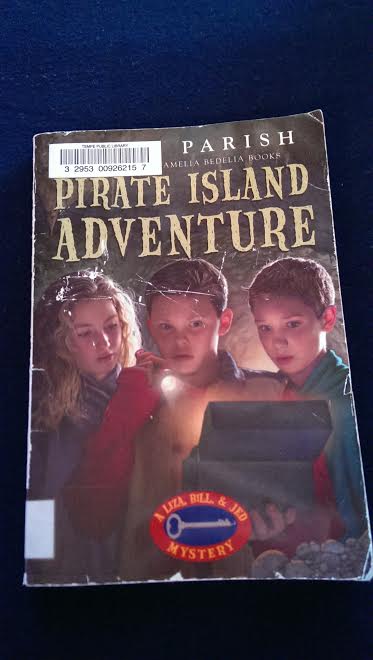
Pirate Island Adventure

pirateislandPirate Island Adventure by Peggy Parish, 1975.

The Roberts kids must solve another family treasure hunt! This time, they are staying with their grandparents at the family’s vacation home on Pirate Island. It has been many years since the family has been able to go there during the summer. For years, they rented the house out to a couple who lived there most of the time, and the grandparents could only go there when the couple left to visit relatives at Christmas. Now, the house is vacant again, and the grandparents have decided to take the Liza, Bill, and Jed there for the summer.

The last time that their grandfather spent the summer there as a child, his older brother decided to take something from every member of the family and make a treasure hunt just like the old family treasure hunt that the kids solved in Key to the Treasure. Just like that treasure hunt, other circumstances arose that kept the treasure hunt from being solved, so no one ever got back what grandfather’s brother hid. The only clue they have to the treasure now is a picture that grandfather’s brother drew. Since the children were able to solve the last treasure hunt, their grandfather is hopeful that they will be able to solve this one, too.

Unlike other treasure hunts that the Roberts kids solve, this treasure hunt does not involve codes and word games.  The clues are given in the form of drawings, most of which (unfortunately) are not shown to the readers.  The readers wouldn’t have a chance to solve the puzzles anyway because the objects in the drawings are things which the children’s grandfather has to recognize, places where he and his brother went as kids.  This book also introduces Hermit Dan, who appears in another book.

This book is part of the Liza, Bill, and Jed Mysteries series.

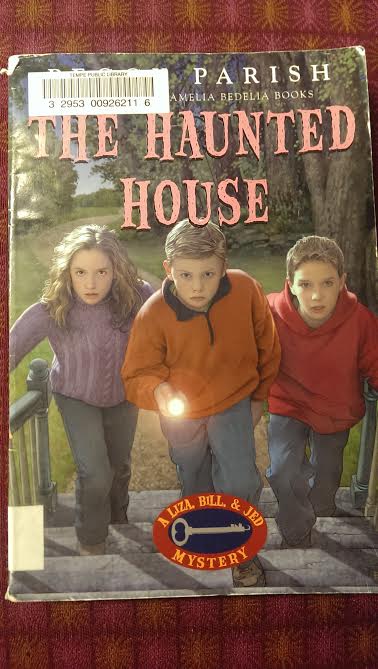
The Haunted House

hauntedhouseThe Haunted House by Peggy Parish, 1971.

The Roberts family is moving to a different house across town because they want a bigger place to live. Liza, Bill, and Jed are not very happy about moving, at least at first, because they will be farther away from their friends, especially Jimmy and Mary, who have been their best friends and next door neighbors. Liza is also worried because the house they will be living in is the old Blake house, which is rumored to be haunted. A couple of past caretakers have left because they claimed to hear ghostly noises.  The boys tease her about it, and their father insists that there is no such thing as ghosts.

The house is definitely much bigger than their old one, and there is a barn, a garden, and a large wooded area on the property. When they actually move in, the kids become fascinated with the old things in the attic, which the children are allowed to go through.  The kids also plan to start building a tree house.  The boys become excited about the house, but Liza is still nervous about the ghost stories.

Then, strange notes and coded messages appear for the children, starting with a note taped to Liza’s window in the middle of the night. Little presents are left for them in a hollow tree with promises of bigger surprises later. Who is sending these messages? Could it be the ghost?

Like other books in this series, there are coded messages and word games that the readers can solve alongside the children.  Some of them are easily recognizable, like word scrambles and Pig Latin, and others are a little harder.  The kids walk readers through their solutions, but readers can attempt the puzzles on their own first.

The book is available to borrow and read for free online through Internet Archive.

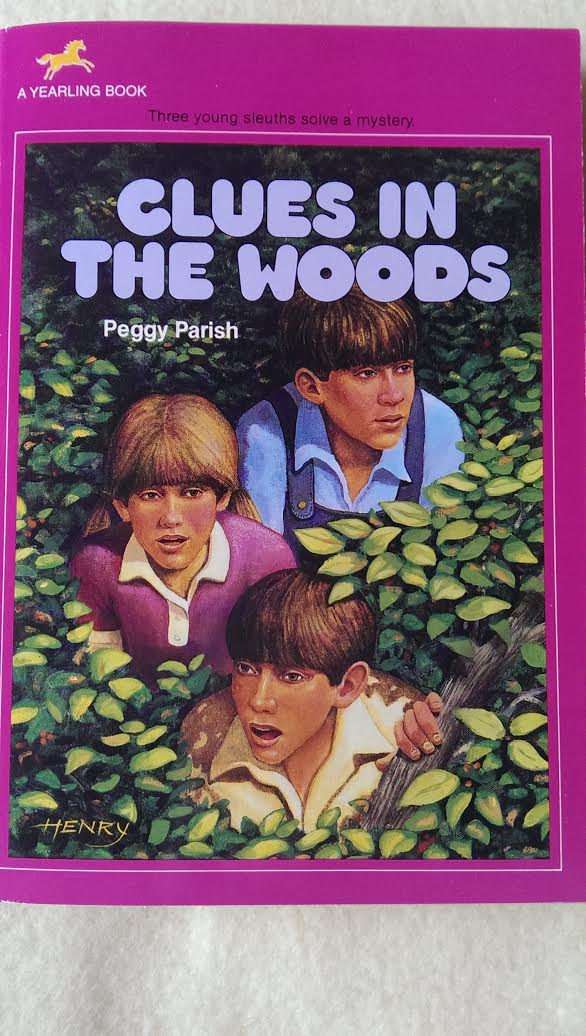
Clues in the Woods

clueswoods

Clues in the Woods by Peggy Parish, 1968.

While Liza, Bill, and Jed are staying with their grandparents, their grandmother starts saving table scraps to give to some neighboring children who have adopted some kittens but who don’t have much money to buy food for them.  Unfortunately, someone keeps taking the scraps when the grandmother leaves them by the back door.  The grandmother even tries leaving them inside the can by the back door to make sure that no other animals can get to them, but they still disappear.  Although it doesn’t sound as exciting to the children as solving their family’s old treasure hunt was, the Roberts children decide to take on the case for the sake of the poor kittens!

The kids try sitting up and night and watching from a window, but Bill’s impatience and temper keep them from seeing what happens at the right moment and causes them to accidentally break their grandmother’s lamp.

They adopt a puppy from a neighbor and keep him on the back porch, hoping that he’ll bark if anyone trespasses out back, but the puppy suddenly disappears!  Can the children find both the scraps thief and their poor puppy, Jelly Bean?

Just when the kids think that they have everything figured out, they learn something surprising that changes everything!

This book is part of the Liza, Bill, and Jed Mysteries series.  It is available to borrow and read for free online through Internet Archive.

clueswoodspic1

Key to the Treasure

keytreasureKey to the Treasure by Peggy Parish, 1966.

When twins Liza and Bill and their older brother Jed visit their grandparents for the summer, their grandfather tells them the story of a treasure hidden somewhere on their farm. Over a hundred years ago, their great-great-grandfather was friends with an Indian (Native American) woman. When she died, she left her belongings to him, including a feathered bonnet, a leather shield, a mask, and a doll.

When he grew up, he went away to fight in the Civil War. Before he left, he hid three of the items (the shield, the mask, and the doll) and made up a series of clues to help his children find them.  Unfortunately, the first clue was lost, and he never returned to tell his children where he hid the treasure. The only clue that was left was a picture of the feathered bonnet, a little pot, and a strange-looking key.  From then on, each generation in their family has tried to solve the puzzle. Since so many generations of their family have failed to find the treasure, Liza, Bill, and Jed don’t have much hope for success until they accidentally stumble on something that gives them their first clue.

keytreasurepic1Together, the three children quietly work on the clues, following each to the next.  They hope to surprise their grandfather with the solution to this old family mystery.  But, can they?
The clues to the treasure take the form of word games and codes (the first is a simple substitution code, and the other two are word games). Young readers will find it challenging to solve the codes along with the children in the book (Liza, Bill, and Jed walk readers through their solutions as they work on the puzzle, even showing how they correct for mistakes along the way), although older readers may find them rather easy.  It’s a good book for introducing children to codes and word games if they haven’t really encountered them before.  For the challenge of it, you can stop reading at each new puzzle and attempt to solve it before the kids do!

This is the first book in the Liza, Bill, and Jed Mysteries series.  It is currently available online through Internet Archive.

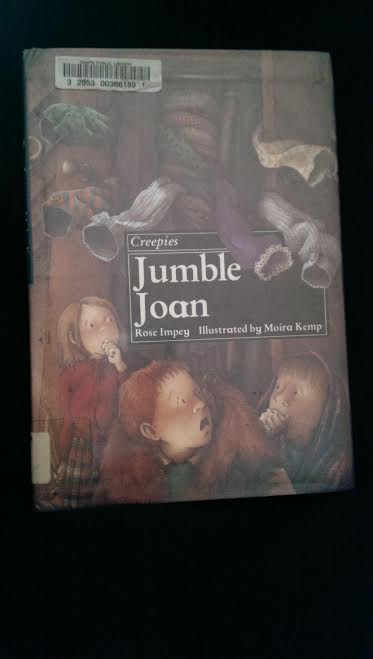
Jumble Joan

jumblejoanJumble Joan by Rose Impey, 1989.

A boy and his friend, Mick, take his little sister upstairs to explore their grandmother’s attic one evening.  The boys are hoping to scare the girl by telling her all sorts of creepy stories about the stuff they find in the attic, but if they’re scaring anyone, it might just be themselves.

A rocking horse becomes one of the dreaded “Ten O’Clock Horses” that might drag a child off into the night if she isn’t in bed on time.  An old stuffed parrot in a cage becomes “The Deadly Vampire Bat”, waiting to suck their blood.  But, the most sinister creature of all might be “Jumble Joan”, who hides by pretending to be a pile of old clothes, ready to steal away any little girls who might want to play dress up in their grandmother’s attic!

Although the brother narrates the story, the pictures show that his little sister knows exactly what the boys are trying to do, and she does things to turn the situation around.

This is one of the books in the Creepies Series.  Kids under the age of seven might find stories in this series a little scary because they focus on how stories about monsters can build in the imagination, even if you know that you made them up yourself.  Still, all of the books have good endings, and this one is pretty funny.

This book is available to borrow and read for free online through Internet Archive.