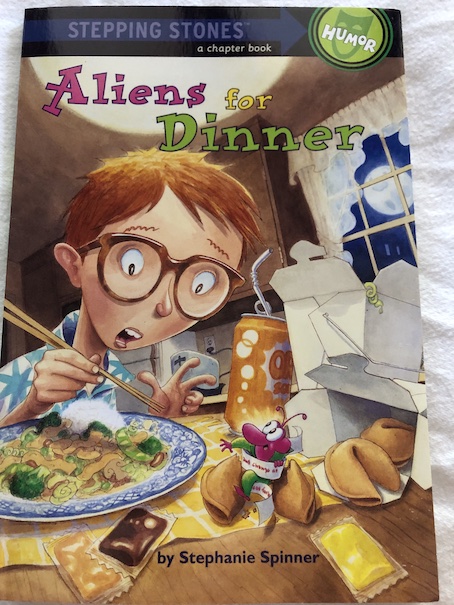
Aliens for Dinner by Stephanie Spinner and Jonathan Etra, 1994.
This book is part of the Aliens for Breakfast Trilogy, a short, easy chapter book series for elementary school children.
Richard Bickerstaff is unhappy because his mother has started dating a man named Bob Baxter. Richard thinks that Bob is weird, and he has an annoying habit of repeating himself. Then, one evening, when Bob is having dinner with Richard and his mother, Richard’s small alien friend, Aric, arrives with their Chinese food, hidden in a large fortune cookie. Aric is a commander of the Interspace Brigade, and they operate on a shoestring budget, so they often transport Aric in some form of food to save money.
Richard manages to slip away from his mother and Bob and takes Aric to his room, where Aric tells him about his latest mission. Earth is in danger from aliens from a planet called Dwilb. Dwilbs have a bizarre love of pollution, and pollution problems have gotten bad enough on Earth to attract their interest. The Dwilbs want to make Earth even more polluted so they can turn it into a pollution-themed amusement park for themselves called Toxic Waste Funland. Aric says that they’re so confident in their plan that they’re already running advertisements. Aric will need Richard’s help to stop them!
Richard asks Aric questions about what the Dwilbs are like. Aric says that they look like humans, but they have an odd habit of saying everything twice, and the repetition seems to have a hypnotic effect. Richard thinks that sounds familiar, and he remembers why when his mother and Bob come to say goodnight to him. Bob repeats himself! Richard starts to think that his mom might be dating an alien!
Meanwhile, the Dwilbs have caused a major oil spill nearby as part of their plan to pollute the planet further. Local people have been trying to help with the cleanup, but it seems like it’s just getting worse. Richard goes to take a look and sees Dwilbs splashing about in the oil, having fun! They love the oil spill, the exhaust from cars, and everything that’s dirty.
Richard asks Aric what they can do to stop the Dwilbs, but as often happens when Aric travels in the bizarre ways that Interspace Brigade sends him, has trouble remembering the Dwilbs’ weak point. While Aric struggles to remember, the Dwilbs start influencing the kids at Richard’s school, getting them hooked on a treat they call Sludgies. Under their influence, the kids start littering and stop caring about the environmental efforts their teacher is trying to talk to them about. Even Richard’s friend, Henry, is under their power and in no state of mind to help Richard.
Fortunately, there is a secret weapon right there at Richard’s school: the school principal and his ability to bore everyone almost to death. In the case of the Dwilbs, boredom is a serious threat!
My Reaction and Spoilers
The books in the Aliens for Breakfast Trilogy are humorous sci-fi stories, and the solutions to defeating the aliens always have some comic twist. The solution in this case is getting the school’s principal to speak to them and bore them out of their minds. Richard has to arrange for his principal to speak at a place where he knows all the aliens will hear him.
Richard has run into situations in previous books where strange people he knows turn out to be sinister aliens in disguise, and in this case, he thinks that Bob is one of the Dwilbs. However, there is a twist to this story. Bob isn’t one of the aliens. He’s a little odd, but he’s a human. His quirks just happen to resemble the Dwilbs. He has a habit of repeating himself, but he’s not at all bored by the way the principal speaks or the way Richard speaks when he imitates his principal. Bob is often a little boring himself. By the end of the book, Richard feels better about Bob when he discovers that Bob likes comic books as much as he does. The two of them start bonding by sharing comics. Bob has a collection of older comics that Richard has been wanting to read, and he lets Richard borrow them.
I like the references in the story to real franchises that fans of science fiction and comic books would know. Richard has a collection of X-Men comics.
The book was published in the 1990s, when I was still in school. I remember my teachers talking to us about environmental issues back them, especially about pollution and the importance of recycling. They often urged us to get involved and do our part to recycle and not litter. The environmental messages in this story, especially the ones Richard hears at school, bring back memories for me.
The Magic Nation Thing by Zilpha Keatley Snyder, 2005.
Abigail O’Malley’s life was turned upside down when her parents divorced when she was in kindergarten. They sold the family home, and her father went to live in Los Angeles and pursue his law career while her mother opened a detective agency. Abby isn’t fond of her mother’s detective agency and has no such ambitions herself. In fact, she would be satisfied if she just has a nice, normal family someday. She misses the nice house where her family used to live and doesn’t like the shabby Victorian house where she and her mother now live and use as the office of the detective agency. Abby envies her friend, Paige Borden, whose family has plenty of money and who life a much more “normal” life. Abby’s mother, Dorcas, isn’t too enamored of the Bordens, thinking that the family is boring. She wishes that Abby would become interested in joining her detective agency someday because the truth is that Abby isn’t quite normal herself, although she doesn’t like to think about it much.
Abby’s mother, Dorcas, says that Abby has an ability to notice information that other people miss, but that’s not quite it. Dorcas says that people in her family have had a “gift” for doing unusual things, like reading people’s minds or finding missing objects. Dorcas is convinced that Abby has inherited this “gift.” However, Abby denies having any such “gift.” As far as she’s concerned, she just occasionally gets hunches about things, and once or twice, they’ve turned out to be right. Abby resents the idea of a special gift partly because she thinks that her mother’s crazy desire to be a detective has something to do with her belief that she also has this special gift, and Abby doesn’t think she does. Abby doesn’t like to think about any of her relatives having been that strange. She just wants a normal family, like Paige’s.
However, Abby’s gift is re-awoken when her mother accepts a case involving a missing girl, who is believed to have been kidnapped by her own father because her parents are divorced. When Abby holds a locket belonging to the little girl, she begins to have visions, not unlike visions that she’s had at other times in the past. Mrs. Watson, who owned the day care that Abby used to attend said these vision episodes were just her imagination, which Abby used to think of as her “Magic Nation.” Abby has spent years trying to ignore it, but this is one of those times when it’s impossible to ignore. Abby has a vision of the little girl at Disneyland with her father. At first, Abby doesn’t want to admit the existence of this vision, but thinking about how worried the girl’s mother is, Abby casually suggests to her mother that, if the girl was taken in a custody dispute, her father might have decided to take her somewhere fun, like Disneyland, to try to win the girl’s favor so she’d want to stay with him. Her mother follows up on the hint, and with the help of the police, the girl is found and reunited with her mother.
That’s the end of the kidnapping case, but it’s only the beginning of Abby’s acknowledgement of her “gift.” Dorcas’s success in the kidnapping case brings more business to her detective agency. As Dorcas gets busier, Abby feels neglected, but Paige’s mother offers to look after her after school to help out, helping Dorcas to feel better about Abby’s friendship with the Bordens. Abby enjoys spending more time with Paige after school, and the girls even start getting along better with Paige’s annoying younger brothers, Sky and Woody. The youngest boy, Sky, particularly comes to like Abby when Abby intervenes after he makes the family’s intimidating cook angry by spilling juice in the kitchen. Abby sensed the boy’s fear and went to the kitchen to find out what happened. Although Abby still wonders how much of her “hunches” are really due to some kind of “gift” because they don’t work all the time, she increasingly realizes that what she still thinks of as her “Magic Nation thing” is not something that she can simply ignore.
Paige is fascinated by Abby’s mother’s work, and she particularly idolizes her pretty assistant, nicknamed Tree. When Abby tells her that her mother and Tree are investigating a case of arson, Paige talks her into coming with her on a little stakeout of their own, which messes up Tree’s actual stakeout and Dorcas’s plans. Dorcas is angry with the girls, and Abby finds herself using her “Magic Nation thing” to try to learn something about the arsonist and make up for ruining the stakeout. Abby does discover who the arsonist is, although she still doubts the reality of her “hunches.” When she shares that information with Tree, Tree also becomes aware of what Abby can do. Tree has known that Abby sometimes gets “hunches” about things, and although Abby still isn’t sure what to think about them, Tree says she’s noticed that Abby’s hunches pay off more than her mother’s do. Then, after the arsonist is caught and Paige goes overboard in her idolizing of Tree for catching the arsonist, Abby lets it slip that she was the one who figured out who the arsonist was.
Abby had been trying to keep this weird and questionable “gift” a secret, but once she tells Paige that she was the one who found the arsonist, she has to explain how she did it. To Abby’s surprise, Paige believes her about the “Magic Nation thing” and thinks it’s really cool. She’s noticed before that there are times when Abby seems to know things that other people don’t or learns things more quickly that most, and Paige thinks that’s a product of her “Magic Nation.” Paige is so enthusiastic about Abby’s “gift” that she thinks the two of them should start their own detective agency, and she starts trying to find cases for them to solve. Paige’s efforts to find an exciting mystery for Abby to solve don’t lead to much, and Abby finds herself doubting her “gift” and its usefulness again.
Then, Abby goes on a ski trip with Paige and her family, and young Sky disappears. Abby realizes that, whether or not her “gift” is real or reliable, she has to try again for Sky’s sake.
The book is available to borrow and read for free online through Internet Archive (multiple copies).
My Reaction
I like Zilpha Keatley Snyder books. She’s also the author of The Headless Cupid. This story is well-written and fun to read, and I enjoyed seeing how Abby comes to understand and accept her “gift” and make it work for her. I particularly liked the way that Abby comes to understand her “gift” and accept its limitations. There are points when Paige is disappointed or angry that Abby can’t use it to come up with all of the answers that she wants on demand, but Abby can’t make the “gift” do what her friend wants, and she makes it clear that Paige is going to have to accept that. Sometimes, Abby isn’t even interested in trying to use her gift in the way Paige wants, just like she isn’t really interested in using her gift to follow her mother’s profession. Abby comes to realize that an important part of learning to live with her gift is making it clear that this “Magic Nation thing” belongs to her – it’s her gift, to use or not use, as well as she can, in whatever way she sees fit. It’s her right to create her own boundaries, even refusing to talk about her “gift” when she doesn’t want to. The “Magic Nation thing” can’t be forced, and Abby herself won’t be pushed or bullied, either. This personal development is actually a bigger part of the plot than any of the mysteries that Abby solves or attempts to solve.
We don’t know what will happen with Abby and her “gift” after the story ends. There are hints that Abby might be willing to use her powers again, if the situation is important enough and she’s still able to do it. It seems that her mother no longer gets the visions that she used to get when she was Abby’s age, which is why her “hunches” don’t work out as well as Abby’s do now. Dorcas isn’t going to be able to rely on her “powers” to make her a great detective, but Abby comes to appreciate that her mother still enjoys her work and is pretty good at it, not because she’s relying on psychic powers, but because she works hard and is attentive to details. It’s possible that Abby’s powers will also fade as she grows up, but even if they do, it will be okay because Abby can also have a fulfilling life doing the things she loves and is good at. Dorcas is still more enamored of the idea of their shared “gift” than Abby is, but the reality is that neither of them really needs to rely on it. It might be there in the future, if they need it, but it’s not their only strength.
There are some contemporary cultural references in this story that help set the time of the story. Paige is a Harry Potter fan, Abby says that she has some Lemony Snicket books, and they refer to Jennifer Lopez, the Olsen Twins, Leonardo di Caprio, and Britney Spears.
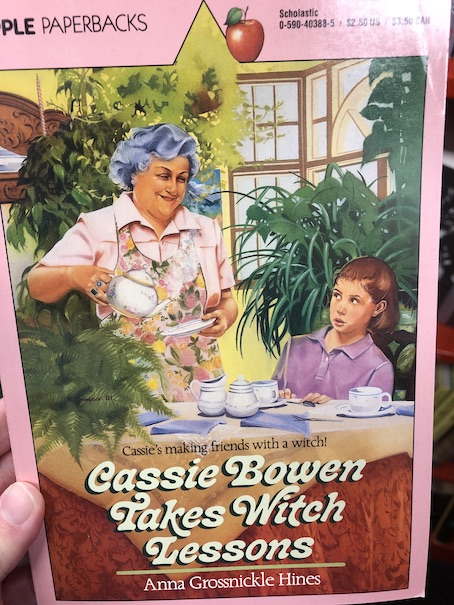
Cassie Bowen Takes Witch Lessons by Anna Grossnickle Hines, 1985.
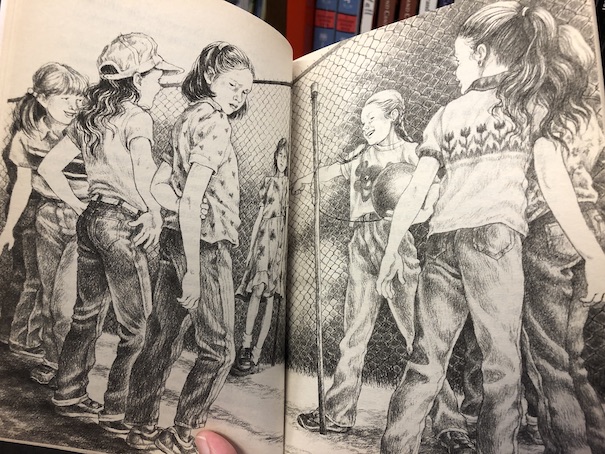
Cassie Bowen and Brenda Bolter have been friends for years, but lately, Brenda has been getting friendlier with Sylvia, another girl in their fourth grade class at school. Sylvia is a mean girl, and the favorite target of her meanness is Agatha Gifford, the new girl at school. Sylvia likes to call her “Saggy Aggy” and “Thrifty Gifford” because Agatha always comes to school wearing dresses that are too loose on her and Sylvia thinks that she probably got them at a thrift store. Most of the girls at school wear brand new jeans, not dresses. Agatha doesn’t bother to fight back when the other girls tease her, and Cassie doesn’t know what to say or do about it, even though the teasing makes her uncomfortable, too.
Even if the other girls are right about Agatha wearing used clothes, Cassie can understand. Cassie wears jeans like most of the other girls, but hers are actually hand-me-downs from an older cousin. (The story of my own youth, too. Thrift stores are the story of my present because I still don’t have much money, and anything I don’t spend on clothes is something I could potentially use to buy books, most of which will also be used because I like older books and because it maximizes my buying power. Life and budgets are about priorities.) Cassie’s mother hasn’t had money to buy new clothes since Cassie’s parents got divorced. The book is vague about what happened in Cassie’s family before the divorce, but Cassie’s father now lives in another state and doesn’t even write or communicate with the family, and he’s certainly not sending money. Cassie’s mother says that he’s got to sort out his life, and Cassie says that her father is kind of a “creep” now, but the book doesn’t go any deeper into it. It’s more important that Cassie’s family is now tight on money, and Cassie has mixed feelings about the divorce. On the one hand, she misses her father and wishes that the divorce had never happened, but on the other, she’s also angry with her father for his part in the divorce and the ways that he changed from the father she knew and loved before. Cassie’s mother says that everyone changes over time, and sometimes, when they change, they grow apart. Cassie will soon come to understand that better through her experiences with Brenda.
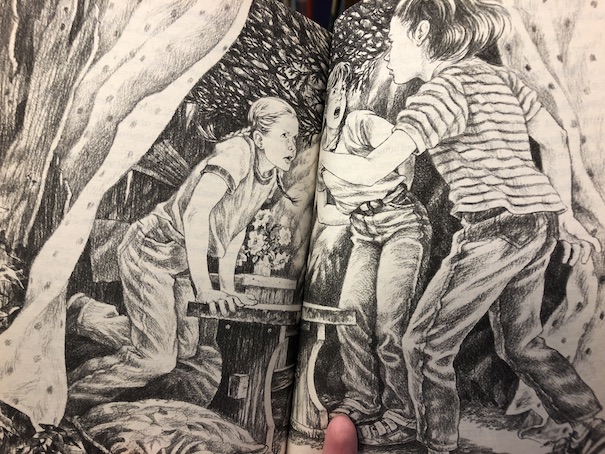
Cassie doesn’t like the ways that Brenda is changing, and she resents Brenda sharing the secret hideout they built with Sylvia without even talking it over with her. One day, when the girls are going to their secret fort, they pass the old house where Agatha lives with her grandmother. There are neighborhood rumors that Mrs. Gifford is actually a witch because her old house looks kind of creepy and she often does odd things, like talking to her plants. As the girls pass her house, they hear her talking to her flowers, and suddenly, Sylvia trips up Brenda so that she goes sprawling into the flower bed. As Mrs. Gifford laments about her flowers, Sylvia dramatically exclaims that they must pick some flowers and actually starts yanking more out of the bed until Mrs. Gifford angrily chases them off with a broom.
Cassie is appalled by the entire incident, although she admits that it was funny, watching Mrs. Gifford chase the other girls. Brenda is fascinated with Sylvia because of the daring way she likes to show off and grab attention, and it inspires her to do the same thing, finding ways to make fun of people or cause trouble. It upsets Cassie, who just wants Brenda to be the same Brenda she’s always known. Brenda also tells Cassie that Sylvia has amazing things in her room, like a collection of glass animal figurines. Sylvia even gives her one to keep. Also, Sylvia’s parents supposedly let her stay up as late as she wants, and she can usually get her way with them just by throwing a tantrum. Brenda thinks that all this is cool, which makes her different from the kids I knew growing up. Most self-respecting fourth graders were beyond tantrums and would have been called babies if they had admitted to having one at that age. Having great clothes and a lot of cool stuff in her room would have gone a long way, though.
When the children’s teacher, Mr. Gardner, assigns the kids partners to work on presenting a story to the rest of the class, Cassie hopes that she and Brenda will be partners so that things can be like they were before. However, Brenda and Sylvia end up being partners, and Cassie is assigned to Agatha. Cassie isn’t enthusiastic about it, and Agatha notices, but Cassie decides that she’s going to be as friendly as she can. She asks Agatha about which story she would like to present to the class because she doesn’t like reading that much, and Agatha says that she knows because she’s noticed that Cassie is better at math. Cassie is surprised that Agatha would know that, considering how new she is, and Agatha says that she envies her because she’s been having trouble with fractions. Agatha says that she really likes the story The Nightingale because it reminds her of a beautiful music box that her grandmother owns, and Cassie is fascinated.
One day, when Cassie’s brother is off playing baseball and Brenda and Sylvia are working on their project together, Cassie passes by Agatha’s house and is invited in. Cassie hesitates at first because the house is creepy, but she has to work on the project with Agatha, so she accepts. Agatha’s grandmother serves the girls rose hip tea and cookies. Cassie thinks that rose hip tea sounds weird at first, but it tastes nice. Mrs. Gifford is an eccentric lady, but rather sweet. She introduces Cassie to Roberto, her favorite plant. Part of the reason why she talks to plants is that she lived alone and was lonely before Agatha came to live with her. She is also a member of the same gardening club that Cassie’s mother belongs to. Cassie uses the cookies at tea to explain fractions to Agatha, and Mrs. Gifford shows Cassie her music box, which is beautiful. The music box is special to Mrs. Gifford because it was the last present her father gave her before his death, when she was about the age of the girls now. Cassie understands the feeling because she prizes the teddy bear that her father gave her before he went away.
The more Cassie learns about the Giffords, the less strange they seem, and she no longer believes that Mrs. Gifford is a witch. Agatha tells Cassie that she lives with her grandmother because her parents were killed in a car accident. The only other family she has is an older sister who is away at college, which is why Agatha can’t live with her. Cassie acknowledges that Agatha’s situation is worse than hers because, even though Cassie misses her father, she’s not an orphan. Agatha also explains that the reason why she wears those dresses to school is that her old school was a private church school, where all the girls were required to wear dresses. When Cassie explains to Agatha’s grandmother that there is no requirement about dresses at their school and that most of the girls wear jeans, Agatha’s grandmother is surprised and says that she didn’t realize, so she buys Agatha some new clothes, taking Cassie with them on their shopping trip.
The new clothes fit Agatha better, and Cassie hopes that they will help her fit in better at school, but Sylvia and Brenda won’t let up on the teasing. In fact, Sylvia seems irritated at Agatha dressing more normally and mocks her, saying, “What’s she trying to do? Act like a normal person?” Cassie tries to tell them that Agatha is normal, but they don’t believe her. Soon after, Brenda asks Cassie if she wants to hang out when she’s on her way to see Agatha again about their project. In an effort to get Brenda to ease up on Agatha, Cassie asks Brenda to come with her so that she can see for herself that Agatha and her grandmother are fine.
The Giffords are nice to Brenda, but during the visit, Mrs. Gifford’s special music box disappears. Agatha says that Brenda stole it, and Cassie gets offended by the accusation, saying that Agatha is making it up and telling her that she doesn’t want to be friends anymore out of loyalty to Brenda. Unfortunately … Agatha was right, and Cassie is shocked when she discovers the truth. Cassie retrieves the music box from Brenda, but with Brenda and Sylvia both angry at her for taking the music box back and Agatha and her grandmother probably mad at her for bringing Brenda to their house in the first place and siding with her over the theft, what is Cassie going to do?
I think the ending of the story is very realistic, although it does leave some things unresolved. Agatha does forgive Cassie for not believing her after Cassie returns the music box. Cassie doesn’t tattle on Brenda and Sylvia because they had accused her of being a tattletale earlier, but she does eventually tell her mother everything that has been happening with Sylvia and Brenda. Her mother reassures Cassie that she did the right thing, even if Brenda didn’t. She says that it sounds like Cassie is angry at Brenda for a lot of things besides this, and Cassie agrees that she doesn’t like it that Brenda is so mean sometimes. Cassie mother says that everyone changes, and sometimes, they change for the better and sometimes for the worse. Cassie doesn’t think she and Brenda will ever be friends again, and her mother says that someday Brenda will also get tired of Sylvia’s meanness, but even if she doesn’t, Cassie will find plenty of other friends. Cassie realizes that she and Agatha really do understand each other, and she’s glad when they make up. At school, Sylvia and Brenda both tease Cassie now, saying that she’s taking witch lessons from the Giffords. It hurts Cassie’s feelings to see her old friend turn against her, but she follows Agatha’s advice and ignores them.
Sylvia and Brenda are never punished for the things they’ve done, which is sadly the case for most of the little bullies I knew as a kid. However, it is nice that Cassie and Agatha realize that they are better friends for each other than either Brenda or Sylvia would have been. I noticed that there is also potential for them to be friends with other people in their class besides Brenda and Sylvia. When Cassie got to school at the end of the book, a girl named Stacy asked her if she wanted to play tether ball, which shows that other girls don’t think badly of her for hanging out with Agatha. I also wished that the book would show more of Pam, who had been Sylvia’s best friend at the beginning of the book before Sylvia and Brenda started hanging out. After being abandoned by Sylvia, perhaps she would also be open to making some new friends. Cassie and Agatha might have other options for making new friends.
There is no magic in the story or witchcraft of any kind. In fact, Brenda and Sylvia probably never really believed that Agatha or her grandmother are actually witches. It’s more that, for reasons of their own, Sylvia and Brenda were looking for someone to pick on, and the “witch” accusations were just their excuse. That’s why they were so irritated when Agatha started dressing like the other girls. If their excuse for bullying Agatha disappeared, they didn’t want to lose their ability to bully her. It was never about making Agatha dress or act like the other girls; it was always about Sylvia and Brenda’s need to have someone to victimize. The truth is that even if the Giffords had seemed less strange in the beginning, Sylvia and Brenda probably would either have picked on them anyway or maybe selected some other victim, perhaps going straight to Cassie as their first choice, because they were looking for a victim and would have found one eventually because that was always their goal.
First, a note about the copyright: the date I give is for the edition I own, which is an English translation of the original German book. The original copyright date for the story is 1949. This is the story that was the basis for Disney’s The Parent Trap, both the version with Hayley Mills (1961) and the later Lindsey Lohan version (1998). Neither movie completely follows the original story (although some of the dialog in the Hayley Mills version is almost word-for-word from the English version of the original story) because the settings are shifted to new locations, but both of them capture the concept of twins who were separated as infants by their divorced parents only to meet again years later by accident. As in the book, each of the twins has been living a different kind of life with one of their parents, but they decide to switch places so that each of them can meet the parent they’ve never known.
Lottie Horn is a very serious little girl. She can’t help it because she lives with her single mother, who spends much of her time working, and she relies on Lottie to take care of a number of household chores. But, her mother feels badly that Lottie has been growing up so quiet and serious, so to help her relax and make more friends her own age, she decides to send Lottie to summer camp at Bohrlaken on Lake Bohren.
Shy Lottie thinks that her summer is going to be horrible when she meets up with boisterous Lisa Palfy, a girl who strangely looks exactly like her. Lisa is shocked at the sight of this girl who looks so much like her, and after some teasing, joking, and staring from all the other girls, she loses her temper and kicks Lottie in the shin. The camp leaders decide to give the two girls beds next to each other, saying that they’ll just have to get used to each other. Lottie thinks that it’s going to be awful, but when Lisa sees how unhappy Lottie is, she apologizes and starts being nicer to her.
The two girls discuss their lives and their strange resemblance with each other, and some unsettling details are revealed. First, they learn that they not only share a resemblance but the same birthday. They also realize that they were both born in the same city, although Lottie now lives in Munich and Lisa lives in Vienna. This strange coincidence is troubling enough, but then each girl reveals that she lives with only one parent: Lottie lives with her mother, and Lisa lives with her father. Lottie has no memory of her father and no knowledge of what happened to him, where he might be, or even if he’s still alive. Lisa also has no memory of her mother, but she did once see a picture of her, a picture which her father hid somewhere after he found her looking at it. The girls start getting suspicious, so Lottie shows Lisa a picture of her mother, and Lisa confirms that it’s an identical copy of the picture of her mother she saw before. Lisa and Lottie realize that they are long-lost sisters.
Through the rest of the summer, the girls discuss their lives and parents in great detail and continue speculating about the reasons for their parents’ separation and why they were never told about each other’s existence. They are somewhat angry at their parents for not telling them the truth, but they each also want to know more about the parent that they have never really known and perhaps to learn the truth behind their parents’ separation. They begin hatching a plot to switch places so that Lottie can go to Vienna to meet their father and Lisa can go to Munich to be with their mother. They get little notebooks and fill them with as many details of their lives as they can think of so that each girl can seem to behave like the other, although they know it won’t be easy because they’ve lived very different lives. They don’t like the same foods, and Lottie knows how to cook, but Lisa doesn’t.
Still, the girls proceed with their plan. When it is time to leave camp, the girls dress as each other. Lisa puts her hair in braids as Lottie always does. Lottie lets her curls hang loose, like Lisa usually does. Then, each of them boards the train for the other’s city at the station.
Lisa is overjoyed to finally meet her mother in Munich. But, her mother has to work very hard as a photographic editor for a newspaper, and they don’t have much money. Lisa isn’t as good at cooking or taking care of household chores as Lottie is, so she finds it difficult to help, although she learns quickly.
In Vienna, Lottie meets her handsome but somewhat reclusive father. Her father is an opera conductor, but he’s also a composer who needs to spend much of his time alone in order to compose his music, which was the primary reason for the divorce. He always wanted to devote his life to the arts, and he felt that marriage and family life got in the way, although he dearly loves his remaining daughter and dotes on her.
But, life in Vienna isn’t that great for either Lottie/Lisa or her father. Rosa, the housekeeper who often looks after “Lisa” and takes care of their apartment only pretends to like her when her father is around and steals from the household funds. Also, in spite of finally having plenty of time along for composing music (which is successful), her father is lonely and unhappy. Although he doesn’t want to admit it at first, he misses the comforts of family life and the company of his wife.
Each girl, because of her different personality, manages to make changes in the life of the other and in their parents which are for the better, but the charade cannot continue forever. Lottie finds out that their father is considering marriage to a woman who doesn’t like her. Then, Lottie falls seriously ill. More than ever, she needs her mother . . . and her twin.
The book is currently available online through Internet Archive (they have multiple copies).
My Reaction and Spoilers:
The book is much less of a comedy than either of the two Disney movies, although there are some funny parts, like when Lottie (as Lisa) takes over the household accounts to stop Rosa’s stealing and ends up turning her into a much better housekeeper with her practicality. Surprisingly, Rosa actually starts respecting her more and even liking her better because of it.
Much of the focus of the book is how divorce affects children as well as parents, although there is room for debate on how each side views the issue, and some modern families may disagree with some of the points characters in the story make. The point of view of the story shifts between each of the girls and also between their parents and other characters to show different reactions to the situation.
The children are understandably upset at the entire issue and believe what their parents did was wrong. The girls admit that they do not think of either of their parents as evil or cruel, but they view the separation and lies that were forced on them without their consent as cruel. Lottie even has a nightmare which is a twisted version of Hansel and Gretel in which her father threatens to cut both her and her sister in half because it would only be fair for each parent to get half of each child. At camp, the girls see one of their friends crying, having just found out that her parents are going to get a divorce. Other girls at the camp call her parents mean for making the decision while she was away at camp and just springing it on her with no warning at all. For the children in the story, the worst part about parents divorcing is when they give little or no thought to how the children will feel or be affected by the decision and don’t even talk about the situation with them.
Some of that sentiment is echoed by adults in the story, although the adults are a little more ambivalent on the issue, knowing that different people and different circumstances must be judged on an individual basis. The adults try to do what they think is best for the children, but they make mistakes, partly because they are too absorbed in their own concerns to understand the entire situation, and they come to realize it. The overall sentiment of the book seems to be that, while marriages are made up of only two people, families are made up of more, including the children. When a couple divorces, it not only affects the marriage, but the whole family as well, and parents need to remember that.
Like the movies, the book also ends happily, and the father finds a way (with the help of Lottie) to balance his work life with his family life.




 Lisa and Lottie by Erich Kastner, 1969.
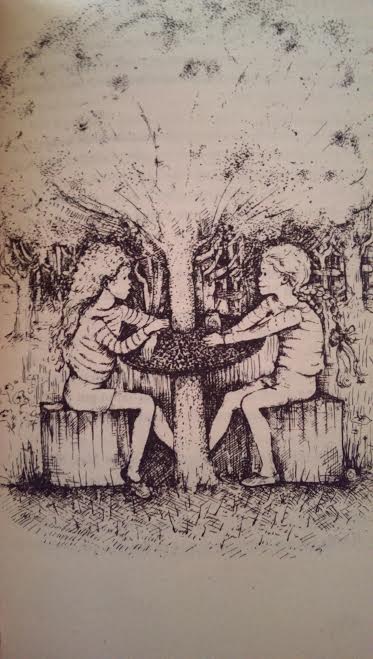 Through the rest of the summer, the girls discuss their lives and parents in great detail and continue speculating about the reasons for their parents’ separation and why they were never told about each other’s existence. They are somewhat angry at their parents for not telling them the truth, but they each also want to know more about the parent that they have never really known and perhaps to learn the truth behind their parents’ separation. They begin hatching a plot to switch places so that Lottie can go to Vienna to meet their father and Lisa can go to Munich to be with their mother. They get little notebooks and fill them with as many details of their lives as they can think of so that each girl can seem to behave like the other, although they know it won’t be easy because they’ve lived very different lives. They don’t like the same foods, and Lottie knows how to cook, but Lisa doesn’t.
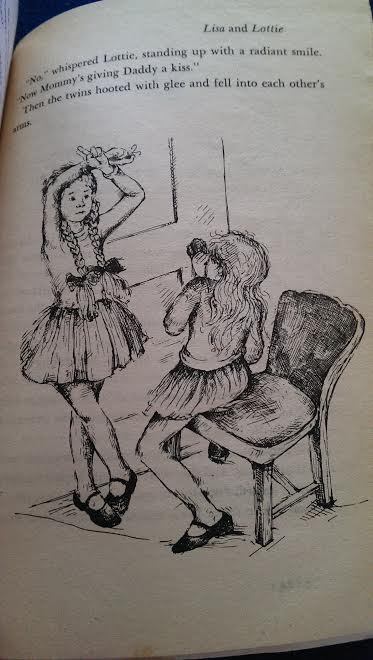 Lisa is overjoyed to finally meet her mother in Munich. But, her mother has to work very hard as a photographic editor for a newspaper, and they don’t have much money. Lisa isn’t as good at cooking or taking care of household chores as Lottie is, so she finds it difficult to help, although she learns quickly.
 The book is much less of a comedy than either of the two Disney movies, although there are some funny parts, like when Lottie (as Lisa) takes over the household accounts to stop Rosa’s stealing and ends up turning her into a much better housekeeper with her practicality. Surprisingly, Rosa actually starts respecting her more and even liking her better because of it.
 Jestress's Forgotten Books and Stories