The Christmas Doll

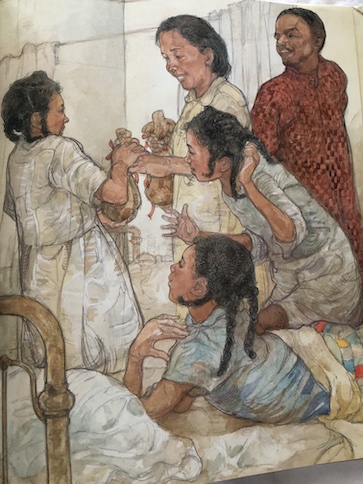
Young Lucy and Glory Wolcott are orphans in London during the Victorian era, 1848. Their parents died during a disease epidemic, and the penniless girls now live in a work house for orphans. They’ve been living there for 5 years, doing sewing for their support, although they are kept in terrible conditions there, with bad food. Then, another girl who lives in the work house dies of an illness, and people worry about the disease infecting others, as it did during the epidemic. Soon, other girls in the work house get sick. Lucy worries about her little sister, who is only 6 years old and already too thin from the bad food, will get sick and die, too. People begin saying that it may be safer living on the streets than being cooped up with the sickness.

The only comfort that Lucy and Glory have in their lives is each other and the story that Lucy tells Glory of her memories of Christmas with their parents. Glory was too young when their parents died to remember their parents or what life was like when their parents were alive, when they had someone to take care of them and actually had proper food. Glory loves the story that Lucy tells about the doll named Morning Glory that their mother gave her for Christmas but which was left behind when the girls were sent to the alms house and then to the work house when their parents died. Glory dreams that, someday, they’ll find that doll again. Lucy tells Glory that, when she finds her doll again, she’ll recognize her.

As more children at the work house die, Lucy increasingly fears that her sister will get sick and die. She thinks about running away from the work house with her sister, but she’s afraid of what they would do on their own. They don’t receive much food or care in the work house, and they’re subject to beatings and abuse, but what would they do on the streets, and how would they survive?

When Glory develops a cough, Lucy is sent to the sick ward at the work house, and Lucy is terrified that she will never come back. Both Lucy and Glory know that none of the girls who are sent to the sick ward with this cough have come back. Terrified, Lucy thinks that the only way to save Glory is to rescue her from the sick ward and get her out of the work house.

The two girls successfully run away, but once they’re on the streets, they have nowhere to go and don’t know what to do. They have nowhere to stay, and they have to sleep in the cold. Without food or money, Lucy trades a small pair of scissors that she brought from the work house for a couple of crumpets from a muffin seller, although a boy later tells her that the scissors were worth much more than that and that the seller took advantage of her. Lucy worries that they have no way to survive on their own because they don’t know what to do and have nothing else that they can sell or trade.

A kind washerwoman suggests to the girls that they go down to the river to join the mudlarks, who spend their days hunting for things to scavenge and sell in the mud at the river’s edge. Sometimes, she say, they find truly amazing things. With nothing else to do, the girls try it. The mud is smelly and disgusting, and at first, all they find are some old bones and bent nails. They’re about to give up when they find something that is truly amazing – a doll!

The doll is worn out, but its head is still good, and immediately, Glory declares that this is Morning Glory, the lost doll that has come back to them, just like the stories that Lucy has told her. With a heavy heart, Lucy realizes that they’re not going to be able to keep the doll. They have nothing else they can sell for money, and if they don’t sell the doll, they will have nothing to buy food and shelter.

At the suggestion of a rag and bone dealer, who is kind enough to let little Glory sleep by her fire for a time, Lucy takes the doll to a dollmaker. She hates having to do it and knows that it will break little Glory’s heart, but they are starving, and their lives are at stake. The doll is in such bad condition that only the head is worth something, and the dollmaker is prepared to offer Lucy a penny for it. That’s not much, but it’s more than Lucy was expecting. Then, something happens that changes everything for the better for Lucy and Glory.

The dollmaker notices the little morning glory flower embroidered on the apron Lucy is wearing. It’s actually Glory’s apron, and Lucy embroidered the flower for her because Glory was named after the morning glory flowers, just like her doll. The dollmaker asks Lucy who did the embroidery, and Lucy timidly admits that she did. At first, she worries that she shouldn’t confess that because she used thread from the work house to do it, and she would surely be punished for stealing if anybody knew. However, the dollmaker is impressed with Lucy’s sewing skills.

Then, before Lucy can leave the shop, the dollmaker gets word that Mary, the girl who sews the hearts on the dolls has been taken seriously ill and isn’t expected to survive. The disease that afflicted the girls in the work house is everywhere. The dollmaker worries because this particular doll shop is known for the signature hearts that are sewn onto their dolls, and the tradition is that only a girl can sew them, not an adult. Losing the girl who sews the hearts isn’t just sad but also serious for the doll shop because it’s only two weeks to Christmas, and they have a lot of orders to fill. If they can’t find another girl who can sew or break the tradition of the doll hearts, they won’t be able to complete their orders and will lose their shop’s reputation. Of course, it doesn’t take the the dollmaker long to realize that the solution to the problem is literally standing right in front of them.

Lucy is stunned when the dollmaker, Miss Thimbleby offers her the job of sewing the hearts on the dolls. It would only be through Christmas, but it would be regular work, something Lucy definitely needs. However, Lucy worries about what she will do with Glory. There doesn’t seem to be a place for her in the shop. Miss Thimbleby will let Lucy stay overnight in the shop to tend the fire, but Lucy isn’t supposed to let anyone else in after the shop is closed. Could she persuade Miss Thimbleby to let Glory in with her, or could Lucy find a place for Glory to be?

When Lucy returns to the rag and bone shop to talk to Glory, she discovers that the husband of the kind lady is much less charitable and has turned Glory out into the streets. In a panic, Lucy searches for her, losing their only penny out of her pocket. Eventually, she finds Glory with the boy who had told her that she was cheated over the matter of the scissors, Nick. Glory has told him about their escape from the work house, and Lucy sadly confesses her sale of the doll to Glory. Fortunately, Nick sees how Lucy’s new job at the doll shop can help them all.

Since the job requires Lucy to spend every night in the doll shop, tending the fire and keeping warm, Nick points out that Lucy can sneak him and Glory in after hours. In return for being allowed to sleep in the warm doll shop with the girls, Nick says that he will look after Glory during the day and that she can help him to make a little money that will help support them all. Nick is also a homeless orphan, and he get money catching rats and doing acrobatics on the streets. Glory doesn’t like the idea of the rats much, but Nick has her passing the hat while he performs on the streets. Her pitiful cough will help them get more charity.

It’s not an ideal situation, but Lucy agrees that this is the best way to manage things. Lucy continues to worry about her little sister, running around in the cold with Nick during the day, although they do have a warm place to sleep now. At night, Lucy lets Glory hold the doll Morning Glory, although she reminds Glory that the doll now belongs to the shop.

While working at the shop, Lucy notices that Miss Thimbleby also has a favorite doll, one that is never for sale. She calls this doll Charlotte and talks to it when she thinks nobody can hear here. The other women who work in the doll shop explain to Lucy that Charlotte, the real Charlotte, was Miss Thimbleby’s little sister. The sisters were orphans, like Lucy and Glory. Charlotte was much younger than Miss Thimbleby, and Miss Thimbleby raised her. Charlotte was the original hearts girl of the shop, the one who always sewed the signature hearts on the dolls and started the tradition. Sadly, Charlotte died young of an illness. The doll Charlotte was the very last one that the girl Charlotte gave a heart to before she died, and that’s why Miss Thimbleby refuses to sell it and sometimes talks to it, like she’s talking to her sister.

As Christmas approaches and Glory’s illness becomes worse, Lucy increasingly fears for her life. Glory’s illness is particularly bad on Christmas Eve. Miss Thimbleby has promised Lucy that, as part of the tradition of the hearts girl, Lucy may choose any unsold doll in the shop for herself on Christmas Eve. Lucy has her sights set on Morning Glory so she can return her to Glory, but a series of unexpected events and a generous, good-hearted decision from Glory lead to marvelous changes for the girls.

The book is available to borrow and read for free online through Internet Archive (multiple copies).

This story, set in a Dickensian London in the mid-19th century is touching and sometimes a bit tear-jerky, but it’s full of old-fashioned Christmas spirit! The book doesn’t minimize the risks to the children’s lives. The lives of poor people in this period were harsh, and children were vulnerable to being orphaned or even dying young of disease. The story even talks about children being taken advantage of by unscrupulous and uncaring adults, whether it’s being cheated out in a trade for food or the talk of children on the streets being kidnapped and forced into servitude as chimney sweeps. Parentless children on the streets wouldn’t know which adults to trust, and those realities are shown in the story. The children’s worries and hardships make the happy ending of the story touching.

Some readers might guess at the likely, most happy ending for the girls because there is one adult in the story who would have sympathy for a pair of orphaned sisters. The eventual fate of Morning Glory and whether her loss or gain would help Glory hangs in the balance for most of the story. The role Morning Glory plays in the ending of the story is important, and it’s Glory’s decision about Morning Glory that helps determine the girls’ fate and also touches two other lives. Don’t worry about the doll, though. The story works out well for the doll, being with someone who truly needs and appreciates her. The lives of all three children are changed for the better in the end, too.

The All-I’ll-Ever-Want Christmas Doll

The All-I’ll-Ever-Want Christmas Doll By Patricia C. McKissack, illustrated by Jerry Pinkney, 2007.

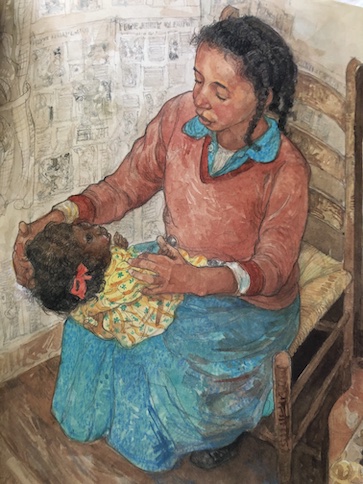
Nella lives with her parents and her two sisters, Eddy Bernice and Dessa, during the Great Depression. The three sisters usually get along well and share everything with each other. Shortly before Christmas, Nella tells her sisters how badly she wants a Baby Betty doll as a present, but they tell her it’s useless to wish for that because they’ll never be able to get one during the Depression.

Nella decides to write a letter to Santy Claus anyway, asking for Baby Betty. On Christmas morning, the girls’ mother gives each of them a little bag of treats with peppermint sticks, nuts, oranges, and raisins. Then, their father gives them one special present: a Baby Betty doll.

The girls are overjoyed by this special present of a doll because store-bought presents are rare in this time when so many people struggle with money and families like theirs can’t afford much. The girls are all so eager to play with the doll that they start to fight over who gets to have her first until their father breaks up the fight and their mother confiscates the doll until the girls resolve the argument

Nella persuades her sisters that the only reason they got the doll was because she wrote the letter asking for one, while they didn’t think it would even work. Nella was the one who wanted the doll the most from the beginning. Because of that, her sisters agree that the doll belongs to her and leave her to play with the doll all by herself.

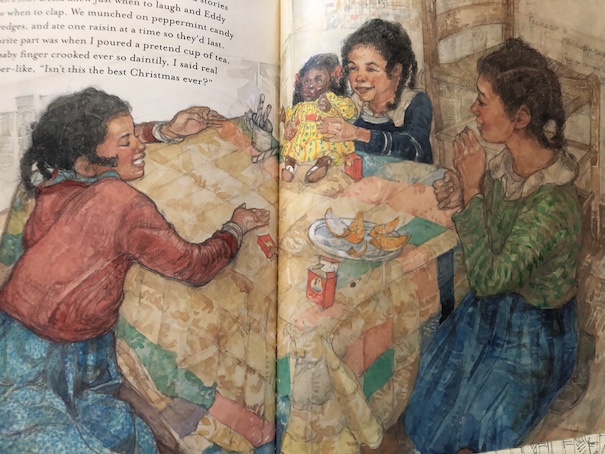
At first, Nella enjoys having her dream doll all to herself, but dolls can’t sing along with songs or clap or laugh at stories, like sisters can. Nella thought that Baby Betty was all that she wanted for Christmas, but she comes to realize that, even better than having the best doll in the world, is having someone to share in the fun.

My Reaction

This is a sweet Christmas story about how people are more important than presents. At first, Nella thinks that all she wants is that special doll, but having the doll all to herself isn’t as much fun as sharing her with her sisters. The doll is pretty, but she can’t do much more than sit there and blink her eyes. Nella needs her sisters to talk to and laugh with.

I like how the author set this story during the Great Depression. A story about siblings learning that it’s more fun to share rather than keep toys to themselves could take place at any time, but the fact that this is set during the Great Depression and the girls know that presents this nice are rare. This family is poor during a time when many people are out of work and money is tight for almost everyone. At the beginning of the story, the girls help their mother to line the walls of their house with newspapers to keep out the drafts, so the readers know they are very poor. The newspaper wallpapers are seen in the backgrounds of the pictures throughout the book, reminding readers how poor the family is. They consider themselves lucky just for betting the simple treats to eat, which we’re told are better than they’ve had other years. The girls know that they are incredibly lucky to get even the one doll for Christmas, and there was no way they could expect their parents to buy one for each of them. The girls fight over the doll because they are all so thrilled to get their hands on her, and they all can’t wait to play with her. We are told that the girls are usually pretty good about sharing with each other, but this sudden appearance of an unusually good present during a time of deprivation is just overwhelming for them.

Nella seems a little selfish at first for wanting the doll for herself, but her sisters agree that it was her particular wish. It was her idea from the beginning to ask for the doll, and it seems unfair to her that her sisters each try to claim it. Fortunately, it doesn’t take Nella long to realize that it’s more fun to have other people to play with and decides to share the doll with her sisters. The girls work out their differences, and they have a much better time when they all join the pretend tea party with the doll.

The book shows the family as being very close-knit. The parents were paying attention to the girls’ wishes when they chose their special Christmas surprise. The father is involved with the girls’ lives, telling them bedtime stories and dealing with their fights, and the mother helps the girls to realize what’s important and work out their differences. Their family doesn’t have much, but I liked the way the parents helped the girls learn how to think of each other, appreciate each other, and share with each other.

A Sweet Girl Graduate

Don’t let the cover of this book fool you! Yes, it’s a 19th century novel for young girls, and there’s a strong morality aspect to the story, which is common for Victorian novels, but the story is not nearly so sweet and flowery as the cover indicates. This book is Dark Academia over 100 years before the term “Dark Academia” was coined and the genre/aesthetic became what it is today.

The story begins on an autumn evening. Priscilla (often called Prissie as a nickname) lives in a small country cottage with her aunt and her younger sisters, and she is packing to go to a college for young ladies. Her aunt isn’t sure about this recent trend of girls getting an education, but she is still proud of her niece. They discuss some last-minute advice for Priscilla, and although her aunt doesn’t have much money, she promises her a little extra as an allowance while she’s away. Priscilla says that she’ll write to her aunt, although probably not very often because she will be busy studying.

Priscilla’s three younger sisters will be remaining at the cottage with their aunt while she is away. Aunt Rachel, called Aunt Raby, is very strict, and the girls aren’t allowed to have much fun, so Priscilla’s sisters will miss her while she is away. Priscilla says that she will be at college for three years, and that she will visit when she can, at least once a year. Then, when she graduates, she will look for a good job so she can make a home for herself and her sisters together.

The younger sisters don’t entirely know it yet, but the stakes are high in the success of Priscilla’s education. Their father died when Priscilla was only 12, and their mother died when she was 14, which is when they moved in with their aunt. That was four years ago because Priscilla is now 18. There was a bank failure before their parents’ death which wiped out their savings, so the sisters have been entirely dependent on their aunt and her farm for support. The aunt works hard and has provided for their basic needs, although the family has no luxuries, and there was never really any expectation that the girls would have any education at all. However, Priscilla loves to read and has a talent for learning, so she has been teaching her younger sisters as best she can. The local minister, noticing Priscilla’s talent for learning and feeling fatherly toward her, has given her some extra tutoring in the classics, and he is pleased at how well she has managed the material.

The problem is that the girls’ aunt is now ill. She will not die from her illness immediately, but there is no cure for what she has (which is never explicitly named), and she and Priscilla know that she will die from it eventually. Over a period of two or three years, she will gradually become weaker, and she is already showing signs of that weakness. The aunt’s farm is legally entailed for another relative, so Priscilla and her sisters will not inherit anything from her and will have to find some way of making their own living after their aunt is gone. Priscilla goes to the minister and explains the situation, saying that she will have to stop her lessons and begin seriously learning skills that will help her find a job and support her sisters. She regards learning as a luxury that she will now have to go without.

Her first thought is that she should improve her sewing and become a dressmaker, but the minister can see that she doesn’t have much talent in that direction. He tells her that, besides being a pleasure, learning can also be a means of making a living. He thinks that Priscilla has the talent to become a teacher because of her learning ability and her skill in teaching her sisters. However, to become a teacher, Priscilla will need to attend college and graduate. At first, Priscilla doesn’t see how she can afford college, but her aunt sells her watch and the little jewelry she has, and the minister helps her take out a loan to pay for her education. He also helps Priscilla to study to pass the entrance examinations at St. Benet’s College for Women. Priscilla will need to do well in college for her sake and for the sake of her sisters’ future. People are depending on her, and she doesn’t want their help and sacrifices for her to have this chance in life go unrewarded.

The rest of the book is about Priscilla’s first year at college. During that time, she suffers from homesickness and social awkwardness because she has not been schooled in the intricacies of social manners and social classes. She confronts prejudice from the other students because she is poor, and they pressure her to act like they do and spend money as recklessly as they do. Priscilla has to learn to resist these pressures and temptations. It isn’t too difficult for her because she finds many of the girls at college to be shallow and not serious about her studies, and she doesn’t really admire them. However, she is soon befriended by a girl named Maggie, who is outwardly charming but inwardly miserable and complex.

Maggie’s friendship is often toxic to other girls, and Priscilla can see that she isn’t always honest and that she is not as devoted to other people as they are to her. She uses people for attention and affection, but Priscilla becomes fascinated with Maggie because she comes to realize that Maggie has layers and some of them are genuinely noble. For reasons that Priscilla doesn’t fully understand, Maggie is deeply troubled by the death of another student who once lived in the room that Priscilla now has at their boarding house. It seems like everyone at the boarding house is haunted by memories of Annabel Lee, and Maggie was once Annabel’s best friend. Maggie is moody and fickle in her temperament, and she hasn’t been truly close to many people since Annabel died, although she can charm people into do giving her attention and doing things she wants them to do. Priscilla has to be careful not to let Maggie manipulate her into getting into trouble, but she also benefits from Maggie’s friendship and has a way of bringing out Maggie’s better side.

During the course of the story, Priscilla has to face girls who don’t really want her at the college and who try to sabotage her socially and pressure her to leave. She also has to remind herself of her goals and the reasons why she came to college. When Priscilla is accused of a theft, both she and Maggie receive help from some mutual friends to realize the truth of what happened and the identity of the real thief, and Maggie is forced to confront a painful incident from her past that is still haunting her and which is the major reason why she acts the way she does.

There’s a lot more to unpack here, and I want to cover the story in more detail. If you’d like to stop here and read it for yourself, you can skip the rest of this.

The book is now public domain. It is available to borrow and read for free online through Project Gutenberg and Internet Archive (multiple copies, including an audio version). Later versions of this book were published under the title Priscilla’s Promise.

When Priscilla gets to college, she settles into her boarding house, which called Heath Hall and is run by Miss Heath. It isn’t until she gets to the boarding house that Priscilla realizes just how nervous and homesick she is. Because of her nervousness and the strangeness of living in a new place, she doesn’t present herself very well to the other students at first.

When she clumsily drops a coin, another student, Maggie, picks it up for her, and this is their first introduction. Maggie can tell right away that Priscilla is nervous and frightened, and her immediately impulse is to take Priscilla under her wing. Nancy, Maggie’s best friend, cautions her about how she treats new students. There are other students Maggie has been friends with when they first arrive, but she treats them like novelties. She acts like a friend and mentor for a couple of weeks, winning the girls’ confidence and making it seem like the start of a lifelong friends, and then tires of them and simply drops them. Nancy doesn’t think it’s right for Maggie to do this to the new girls, although Maggie brushes off her concerns. Nancy likes Maggie because she can be very sweet and fun, but she also recognizes that Maggie can be trouble, and she is sure that Maggie is going to recklessly cause some problems before she is finished with her education.

Maggie and Nancy notice that there is someone moving into the bedroom next to Maggie’s in the boarding house, and Maggie is upset because that room belonged to Annabel Lee. Annabel Lee was another student at the boarding house who was very popular with the other girls, but she tragically died of an illness. Nancy is practical and says that they couldn’t very well expect that room to be simply left vacant now that Annabel is no longer there. It’s just natural that the boarding house would rent it out to someone else eventually. Maggie is more emotional and says that they ought to have left it as a shrine to Annabel and that she is sure that she will hate the person who lives there. Nancy sighs, and when Maggie goes into her room, Nancy decides to introduce herself to the person who now occupies Annabel’s room, who turns out to be Priscilla.

Priscilla is unaware of who Annabel was, and she is still struggling with her nervousness and homesickness. Because Priscilla is trying to cover up for how nervous and awkward she feels, her manner just strikes Nancy as being cold and awkward, which makes Nancy feel awkward while talking to her. Nancy briefly introduces herself but doesn’t stay to chat long, although Priscilla secretly wishes that she had.

Priscilla continues to make mistakes through her first evening at the school. When she goes down to dinner, she enters the dining hall through the door that is normally reserved for the dons (teachers), and she sits at a table where the higher level students normally sit instead of with the other freshmen. Other students in the dining hall start talking about the nerve of some freshmen, getting above themselves, but Priscilla nervously isn’t sure what they’re talking about. Fortunately, Maggie decides to step in and help Priscilla.

Maggie sits next to Priscilla and gently explains to her what she did wrong. Miss Heath gave Priscilla a list of rules when she moved into her new room, and there was nothing about any of this in those rules. Maggie explains that there are certain, unspoken rules and customs among the students. Even though the students are supposed to be modern, liberal, and democratic by the standards of their day as part of this new generation of women seeking a higher education, Maggie admits that, deep down, they are still very conservative. She says this classist side of themselves shows itself whenever someone breaks their unspoken rules and social customs or steps out of their proper place. Priscilla thinks that the students at this school are cruel if they expect someone new to know rules that aren’t written or spoken about and that she is starting to wish she hadn’t come. Maggie hurriedly soothes her, saying that they’re not really that bad, and she invites Priscilla to her room to talk later so she can explain some things to Priscilla that she will need to know.

Nancy also steps in and tells Priscilla that most of the students take their tea up to their rooms after the meal, asking her if she would like to do the same. Priscilla, still nervous, decides that she will skip the tea tonight. Nancy says that, since this is the first night, she will want to spend the rest of the evening unpacking and that other girls in the boarding house will come to call on her. Priscilla asks her why they’re going to do that. Having lived on a farm, in a family that wasn’t very socially active, Priscilla knows less about social manners than she does about anything else. She isn’t accustomed to informal visits from people. Visits for her are usually more formal occasions, and she particularly has no idea what she’s going to say to these strangers who will be coming to call on her. Nancy, seeing that Priscilla is nervous and doesn’t know how to cope with the social aspects of the school and life in the boarding house, tells her that these are simply informal visits so the other students can introduce themselves to the new person in the boarding house. Nancy offers that, if Priscilla would like, she can spend the evening with Priscilla and help facilitate these introductions. Priscilla nervously murmurs that she would like that.

The boarding house is more luxurious to Priscilla than anywhere that she has previous lived, but it also feels cold and un-homelike to her. The other girls are bright and chatty, and Priscilla finds them a little overwhelming. When the other girls come to visit Priscilla, they also comment about Annabel, who used to live there, and how the room looks more bare without her and her things. It seems like the other girls are there mostly to see the room and remember Annabel than to see Priscilla, and Priscilla is too shy to know what to say to any of them. One of the girls kindly says that the place will seem better once Priscilla has really moved in and has a chance to add her own decorations. Another girl says it will never be the same as when Annabel was there, but the kind girl suggests some shops where Priscilla can find some room decorations and offers to go shopping with her.

Then Nancy arrives and intervenes, seeing how overwhelmed Priscilla is and encouraging the other girls to leave. Nancy offers to help Priscilla unpack and goes to borrow some matches from Maggie because Priscilla doesn’t have any to light a fire. Priscilla accepts the matches but tersely declines the offer of help unpacking because she doesn’t want Nancy to see how meager her possessions are. Nancy awkwardly says that she will wait in Maggie’s room and that Priscilla can join them for cocoa later. It’s a custom of the boarding house for the girls to have cocoa in the evening, and they often invite friends in the boarding house to their rooms to share cocoa and chat before bed. Maggie later calls Priscilla to join them for cocoa but refuses to enter Priscilla’s room herself, still too affected by the memory of Annabel.

Priscilla goes to Maggie’s room, and the girls have cocoa together. Nancy isn’t there because she has gone back to her room to do some work, and Priscilla finds Maggie charming. Maggie has a way of putting people at ease, and Priscilla finds herself telling Maggie about herself and her reasons for wanting an education. Before she leaves, Priscilla asks Maggie about Annabel because of what the other students have been saying about her. To Priscilla’s shock and surprise, Maggie immediately becomes distressed and refuses to talk about Annabel, bursting into tears. Fortunately, Nancy arrives and reassures Priscilla that Maggie will be all right. As Nancy walks Priscilla back to her room, Priscilla asks her about Annabel. Nancy doesn’t really want to talk about Annabel, either, but she tells Priscilla that Annabel was a very popular girl at school who is now dead, and she says that it’s better if Priscilla doesn’t talk about her now.

All the same, the other students at the boarding house won’t stop talking about Annabel Lee. Although Priscilla doesn’t really believe in ghosts, it feels to her like Annabel still haunts the boarding house and her room in particular. Everyone seems to have memories of her, and Priscilla’s presence and her occupation of Annabel’s old room brings them out. Priscilla is often left with the awkward feeling that she has somehow usurped Annabel’s place, or at least, that other students feel like she has. She wishes that she had been given some other room in the boarding house. Even Annabel Lee’s name reminds her of the song by Poe, which is familiar to Priscilla and which is about a love that survives beyond death. (I think the author picked that name on purpose because of the song.)

Before that first evening is over, Priscilla realizes that she has misplaced her purse somewhere. This is serious because it has her key in it and the little money she has. She goes looking for it, and she overhears Maggie and Nancy talking about her. Maggie assures Nancy that Priscilla will not replace Nancy in her affections. Maggie calls Priscilla “queer” (in the sense of “strange”) and admits that she is nice to younger girls at college because she craves their affection. Maggie says that it gives her “kind of an aesthetic pleasure to be good to people.” She knows that she has an ability to inspire affection in other people, and she absolutely craves seeing the look of grateful affection she gets from the younger girls she helps at school. Nancy asks her if she ever returns the love that she receives from other people, and Maggie says that she does sometimes. She says that she is very fond of Nancy and kisses her.

(Note: This conversation isn’t necessarily proof that this is a lesbian relationship, which would have been not only shocking but actually illegal in England during the time period of this story. The book was published in 1891, and later in the 1890s, Oscar Wilde was tried and convicted for homosexual acts, although part of his conviction was also that he committed acts with underage boys, which would still get him a conviction by modern standards.

Certainly, lesbians did exist during this period of history, and it’s possible the author might know more about it than she could explicitly state and may be basing the characters’ feelings off of people she knew or met herself. However, modern readers might want to hold off firmly deciding what the real relationship between Maggie and Nancy is because there are other factors that are revealed later in the story. In particular, Maggie is a complicated character, who cultivates relationships for attention and to fill some dark emotional needs, and these relationships are not honest because there is not necessarily any real affection or romantic interest behind them. Maggie does have a male admirer, who we hear more about later, and we also eventually learn why her relationship with him is complicated.)

Priscilla, who is a sincere girl of strong morals and deep affection, is shocked at the way that Maggie and Nancy talk to each other and about her, and she quickly returns to her room without finding her lost purse. She is angry about what she’s heard because, although both Maggie and Nancy have been friendly to her and helpful that evening, Priscilla can see that neither of them really likes her or cares about her. Maggie was just pretending to be nice just to get attention, and Nancy is jealous of her for the attention that Maggie has given her. Although these types of feelings are completely alien to an inexperienced and unsophisticated girl like Priscilla, she has just had her first taste of toxic friendship, and she is about to learn more.

When Priscilla is unpacked, and her meager personal belongings begin to fill her room, she starts to feel a little more at home, and she even begins to enjoy some of the newness of the college experience. She has more freedom at college than she ever has before, although she realizes that there is still a routine to college life, and conscientious girls follow the routine and both the written and unwritten rules of college society.

The book explains that life at college is somewhat like life at school, but much less restrictive because the students are considered young ladies rather than little girls. The freshmen are about 18 years old and are expected to graduate at about age 21, so all of the students are expected to behave as young adults. They are not closely monitored, and no one hands out punishments to students for neglecting their studies or misbehaving in minor ways. (What happens when students misbehave in major ways is addressed later in the book.) Basically, as long as the students are not breaking any laws or explicit rules and are not causing anyone serious harm or seriously disrupting the life of the college, there is little intervention. The students are expected to manage their time at college and organize their social lives and relationships with others by themselves. They are also not restricted to the college or boarding house. They may leave the college at any time for shopping or social engagements, although it is considered polite to let Miss Heath know where they are going and when they will be back, and they must be back before lights out. Priscilla has never been to school before, and she finds the unwritten social rules and the personal machinations of the other girls the most difficult part of her education.

Every morning, the girls in Heath Hall get up and start the day with prayers in the chapel. Nobody makes them go to chapel, but they generally do anyway because it’s expected, and participation in the routine activities helps them get along better. Then, they go to breakfast, where they select the foods they want to eat because the meal is served in the style of an informal buffet. Then, the students look at the notice boards. There is one notice board for announcing the lectures for the day and another for student clubs and social activities. The students use these announcements to plan their day. The mornings are always for educational lectures. Sometimes, there are more lectures in the afternoon, but there are also sports, gymnastics, and social activities. Nobody checks attendance at any of the lectures or activities, and if someone chooses not to attend something, nobody checks up on them. They can have lunch whenever they like, between noon and two o’clock in the afternoon, and the students typically have their afternoon tea in their own rooms, sometimes privately and sometimes with guests. Students study privately in their rooms whenever they like, and there are club activities between tea time and dinner, for those who wish to participate.

Priscilla has difficulties with the other students because she refuses to participate in the social activities of the college or go shopping with the other girls when they invite her. She even turns down invitations from other girls to have cocoa with them in the evening and chat, like she did with Maggie that first night at the boarding house. Having learned more about what Maggie and Nancy are really like, she becomes cold and distant with them, discouraging their friendship, but she also turns down possible friendships with the other students.

One day, two of the students criticize her for being unfriendly and not participating in the social life of the college. Everyone has noticed that Priscilla hasn’t even put up pictures or decorative knickknacks in her room or even purchased comfortable easy chairs for visiting, like the other girls have. Nancy tries to defuse the building arguments and criticism by saying that they mustn’t criticize the “busy bees”, the serious, studious students at the college because they are the foundation the college was built on. However, the other girls complain that college is also for fun and socializing, and if Priscilla is smart, she’ll stop fighting it and start participating with the other students.

The other students are about to walk out on Priscilla during this argument, but Priscilla stops them and shows them what she really has in her room. She shows them her empty trunk and explains that she has no pictures or knickknacks to put up in her room. She also shows them the contents of her purse (which she did find after she lost it) and how little money she actually has. She hasn’t gone shopping with the other girls or bought things for her room because she simply can’t afford them. She is from a poor family, and she is serious about her studies because she has to be, and her future depends on it. She acts the way she does because this is the life she lives, and this is what is right for her and her situation. The other girls just don’t understand because most of the girls at college are from wealthier families, and they’re not in her position. Priscilla has realized that she’s different from the other girls, but she doesn’t admire the other girls because she has already seen that there are problems with their behavior and priorities. She openly lets them know that she isn’t intimidated by them and will not be pressured into acting like they do because she simply can’t. It wouldn’t help her with her life or goals. The other girls are embarrassed and a little ashamed of themselves for not realizing her situation and for their shallowness and frivolous privilege. They leave Priscilla without saying anything else.

Nancy reports this conversation to Maggie and says that she admires Priscilla for her bravery in standing up to the other girls. Nancy never liked those particular girls because they are shallow, but she never had the nerve that Priscilla had to tell them off in that matter-of-fact way. Maggie asks Nancy if she’s going to worship Priscilla now, and Nancy says no but that she still admires Priscilla’s bravery. Maggie says that she doesn’t want to hear more about it because she doesn’t like hearing things about “good” people and their virtues, something which bothers Nancy. Nancy tells her to stop pretending that she doesn’t like goodness and morality, but Maggie says she really doesn’t. Hearing about Priscilla especially bothers Maggie because, although Priscilla initially opened up to her, she has not shown that grateful admiration toward her since that first evening, when she overheard Maggie talking to Nancy.

Maggie also has an unhealthy attachment to the memory of Annabel, and it still seriously bothers her that Priscilla has Annabel’s old room. Maggie can’t bring herself to look into Priscilla’s room or be reminded about Annabel, for reasons readers still don’t fully understand. Everyone liked Annabel at school, and people are still haunted by her memory, but for some reason, it’s worse with Maggie than with anyone else. She privately thinks that she cannot really feel love since she lost Annabel. It seems like Maggie had a similar sort of unhealthy attachment to Annabel as Nancy now has to Maggie.

This is where we begin to learn what is really going on with Maggie and what makes her tick. Maggie is not a happy person on the inside. In fact, she thinks of herself as the most miserable student at the college. Inwardly, she doesn’t think of herself as being either a good or lovable person, in spite of her outward charm and ability to inspire people to love her. She doesn’t really love herself. That’s why she always craves expressions of love and devotion from others but doesn’t seem able to really form relationships with others and maintain them.

However, there is one thing that really makes Maggie come alive. She loves the intellectual life of college. She forgets her misery when she loses herself in reading and translating classical works. Even her joy of classical studies can’t entirely distract her from her worrying love life. It’s a somewhat open secret that Maggie has a male admirer who writes to her sometimes, and this is a source of jealousy for the other students, especially Nancy and Rosalind (another younger girl that Maggie has been cultivating as an admirer), who both view this young man as a rival for Maggie’s attention and affection.

Although Priscilla recognizes that Maggie is a false person who is mainly nice to other people for some selfish fulfillment, she can’t help but be fascinated by her charm and intelligence. Maggie tries harder to get Priscilla’s attention because she still craves attention and affection, and she views Priscilla’s reluctance to give her what she wants sort of like her playing hard-to-get. Priscilla’s attempts to ignore her just make her want to try harder to win the prize she craves.

Miss Heath, who doesn’t seem to understand some of the unhealthy admiration other students have for Maggie, encourages Priscilla to not burn out on her studies and to give herself time to make friends like Maggie and to enjoy the social aspects of school life. She says that she has seen other serious students take on too much, burn themselves out, and fail to finish their education before. Priscilla, who has never been to school before, takes Miss Heath’s advice seriously.

Maggie discovers that Priscilla loves flowers, and she uses them to appeal to Priscilla’s love of beauty. She uses aesthetics and intellectual discussion to appeal to Priscilla’s love of study and the pleasures of learning. Gradually, Priscilla finds herself become more of a friend to Maggie. She confronts Maggie about what she heard Maggie and Nancy say to each other on their first night in the boarding house, but Maggie brushes away Priscilla’s concerns. She claims that she only said those things to punish Priscilla for being naughty by eavesdropping. Soon, Maggie and Priscilla are doing many things together, from going to church services together to having cocoa in Maggie’s room in the evening and talking about their studies. It seems harmless enough, and some people are a little relieved because Maggie had given up doing many things that she used to do with Annabel, when she was alive, because they reminded her too much of Annabel. It seems like Priscilla has somehow inspired Maggie to do things that had become emotionally painful to her, and some people think it’s nice that Maggie has found a new best friend and is moving on.

However, as I said, not everyone understands Maggie’s toxic friendships, the unhealthy attachment some of the other students have had to both her and the deceased Annabel, and her manipulation of other people. The ones who do understand these things are some combination of jealous and troubled, and Priscilla, who is still relatively naive, hasn’t grasped the precariousness of her social situation. She has to learn to walk a delicate line between staying true to herself and her goals and between staying on good terms with her new friends. It’s fine for her to like other people, like Maggie, but not to be led astray by them. She has also attracted attention from some other students who resent her and feel threatened by her.

The two girls Priscilla told off earlier about their wanting her to participate in frivolous social activities and spending money are bitter about their embarrassment and how Priscilla made them them look shallow by demonstrating her poverty and virtue. They’ve been going around the school, telling everyone the story of what Priscilla said, but casting Priscilla in a bad light. They try to make Priscilla seem like a self-righteous prig who is trying to shame them for participating in normal social activities. Their fear is that, if other girls at college like Priscilla and decide to imitate her, austerity will become the fashion of the day. They think that they will either not be allowed to participate in their social activities and forced to keep their noses to the grindstone from now on or will be shamed for having nice things in their rooms while Priscilla doesn’t. They don’t want to be pressured to give up these things or forced to study as seriously as Priscilla does, so they do their best to ruin Priscilla’s social reputation, discourage other girls from being her friend, and try to get other students to gang up on her.

Their efforts are partly foiled because Maggie is popular, and Priscilla has become Maggie’s special friend. Nancy is also Priscilla’s supporter because she was present during their confrontation with Priscilla and stands up for her against the other students. Although Maggie and Nancy seem to have a toxic friendship with each other, and Maggie develops a series of toxic friendships with other students, Maggie and Nancy become Priscilla’s protection against even more toxic students. Miss Heath and the teachers at the college also appreciate Priscilla and her work at the college. However, unbeknownst to Priscilla, the more shallow girls still resent her and are plotting against her.

Rosalind knows of the unhealthy attachment other girls at college have to Maggie because she also shares it. Rosalind is one of the younger girls Maggie has cultivated as an admirer but has largely neglected since she became tired of her and more interested in Priscilla. Maggie and Annabel were once the college’s power couple/friendship duo, although Annabel was the more popular of the two. Other girls even save pictures and autographs of Maggie and Annabel as souvenirs, like they’re celebrities, and Rosalind herself has a picture of Maggie that she sometimes kisses.

Since Annabel’s death from a sudden illness, Maggie has been the undisputed social queen, although Maggie’s thrill at the attention she receives is somewhat dampened by her sense of loss because she was truly attached to Annabel herself. She craves attention and admiration and can’t help but pursue it, but she doesn’t feel like she really deserves it. Not all of the other students really admire Maggie. Some of them see her for the manipulative girl she really is, and they get sick of hearing the others rave about her or talk about poor, tragic Annabel.

However, Rosalind’s resentment of Maggie’s indifference to her after manipulating her affections has made her admiration of her turn to hate. She tells another girl that she’s thinking that she should tell Miss Heath about the unhealthy attachment other girls have to Maggie and get her to put a stop to this Maggie admiration cult. (I would have been in favor of this, but sadly, that’s not what Rosalind does.) Then, Rosalind and the girls who resent Priscilla get the idea of ruining Maggie’s friendship with Priscilla and bringing them both down this way.

Rosalind tries to find ways to embarrass Priscilla socially and drive a wedge between Priscilla and Maggie. One day, she convinces Priscilla to go into town with her to pay her dressmaker, insisting that the dressmaker needs her money for her sick mother and that she wants company on the errand. Nancy tries to discourage Priscilla from going because the weather is bad and Priscilla has a cough, but Priscilla says that Rosalind talked her into coming. Since she promised, she has to go. Rosalind makes Priscilla wait in the cold and drizzle while she goes inside to pay the dressmaker and then takes Priscilla on another errand to see a friend before they go back to the college.

When they get inside this friend’s house, Priscilla realizes that Rosalind has tricked her into attending a party instead of just paying a short visit to a friend. Priscilla is under-dressed for this party and damp from her time outside, which is embarrassing. To make matters worse, Rosalind simply abandons her in a corner. Priscilla can’t bring herself to leave the party without Rosalind because she would be in trouble for returning to the college without her when everyone knows that they left together, and she can’t bring herself to search the party for Rosalind and demand that they leave because she feels out of place in her shabby clothes. She hears the fancy, catty women at the party gossiping about other women and the frumpy “girl graduates” of the college. Fortunately, the hostess of the party realizes that Rosalind has been treating Priscilla shabbily and makes her comfortable with some tea.

Then, Geoffrey Hammond, the young man who has been writing to Maggie, recognizes Priscilla and comes to talk to her. Priscilla explains her predicament and how Rosalind tricked her. Not only has Rosalind deprived her of study time by getting her to come to town on her errand and to this party, but if they don’t leave the party soon, they won’t get back in time for dinner, which would break one of the written rules of the college. Taking pity on her, Hammond goes to find Rosalind and talk to her. When he returns, he says that Rosalind has told him that she already told the principal of their college that they would be late for dinner, so they are excused. Priscilla is angry that Rosalind did this without talking to her, and she starts to create a fuss, but Hammond quiets her down, realizing that she is making a scene. He knows that she was nastily tricked, but he says, since they can’t get back to the college in time for dinner now, it would be more socially graceful for her to enjoy this party as best she can and then have words with Rosalind when they get back to college.

The two of them spend the rest of the party discussing The Illiad and The Odyssey. Priscilla shines in intellectual discussions about the classics, so Rosalind is a little jealous when she sees how well Priscilla is doing. She tries to ruin the moment by pretending that Maggie gave Priscilla a letter to give to Hammond and that Priscilla has either lost it or is withholding it. However, Hammond knows that Priscilla didn’t even know she was coming to this party and doesn’t fall for Rosalind’s story, disapproving of her. On the way back to the college after the party, Priscilla lets Rosalind know exactly what she thinks of her mean trick.

Later, at a cocoa party at the college, Rosalind tells the other students about the party, emphasizing Priscilla’s awkwardness and disdain of the fun. Then, she accuses Priscilla of flirting with Geoffrey Hammond. Everyone knows that Geoffrey Hammond is Maggie’s young man. The other girls don’t think Maggie treats him well, and some of them think they would be better for him, but they know that he’s devoted to Maggie. Rosalind is trying to make Priscilla look like a boyfriend-stealer.

Meanwhile, one of the girls at the college, Polly, has gotten badly into debt. Although most of the girls at the college are pretty well-off, compared to Priscilla, even girls from wealthy families can get into trouble with money, if they’re not careful. Polly admits that her father told her not to spend above her allowance, but she is accustomed to spending freely. Now, she owes a considerable amount of money, and the only way she can think of to raise what she needs without telling her father what she has done is to sell some of the lovely things she’s bought to furnish and decorate her room and some of her fancy clothes. Her friends at the college, who all admire her nice things, are all eager to buy things from her. Their only concern is to remind her not to sell anything that would belong to the college, only her own belongings.

All of the girls at college, except for Priscilla, are invited to attend the auction. They exclude Priscilla because they know she doesn’t have money and they think “Miss Propriety” would snub the event and perhaps tell the principals about it. Really, the other students don’t think the principals of the college would approve of this auction, so they’re careful to keep the event secret from them. Originally, Maggie wasn’t planning to attend the auction, although she was invited, because she doesn’t know Polly and doesn’t care for this kind of auction. Then, Rosalind badgers her into going, saying that she has become too proper, self-righteous, and basically, no fun anymore. Maggie cares about her social reputation, so she decides to go to the auction, and to Priscilla’s surprise, she drags Priscilla with her. This turns out to be a bad thing for Rosalind because now Maggie is angry with her and determined to teach her a lesson.

Maggie doesn’t really want anything at the auction and resents being pushed into going, but because she is one of the richest girls at the college, she can afford to bid much higher for anything there than the other girls. She knows the things that Rosalind wants to buy for herself, so she purposely bids on the items that Rosalind wants. It’s bad enough when Maggie wins the bid for a sealskin jacket that Rosalind really wanted by bidding higher than Rosalind ever could, but it’s worse when Maggie intentionally ups the bid for some coral jewelry and then lets Rosalind win it at a price that’s higher than Rosalind can actually afford. Now, Rosalind owes money to Polly. Even worse, when Rosalind writes to her mother to ask for more money, her mother tells her to return the jewelry she bought and to send the money she’s already spent back to her. It was really more money than her mother could afford to give her, and she only lent it to Rosalind because Rosalind said that she could get a bargain on a sealskin coat, which is a valuable garment. The jewelry is more extravagance than Rosalind’s family can afford.

All of the girls who attended the auction get into trouble for being there because the activity wasn’t sanctioned by the college, and the heads of the boarding houses find out about it. That means that Priscilla is in trouble for attending, too, even though she didn’t buy anything. Nancy asks Maggie why she went when she knew it would probably be trouble, and Maggie says that Rosalind brings out her worst side.

Maggie hates herself partly because she knows that she has a good side and a bad side to her nature, and she finds it hard to manage or cover up her bad side. Sometimes, she just gets moody and temperamental. She doesn’t want to pretend to be good all the time, even though she knows she’s supposed to restrain her worst impulses to get along in society. That’s why she finds virtuous people so trying. She has a hard time struggling with her inner nature and doesn’t like herself. She can’t understand people who aren’t the same, who seem to find it easier and more pleasant to be good all the time and who aren’t subject to the same dark moods and temptations that she has. Even so, Maggie still considers good and proper Priscilla her friend because Priscilla is sincere in her friendship for Maggie and brings out more of her better side, and Nancy, who respects virtue, still loves Maggie, even knowing her complicated nature and how she feels about herself. So, while Maggie’s friendships with Nancy and Priscilla seemed toxic at first, when she was looking at it from the perspective of how she uses them to bolster her self-esteem, we start to see that there are positive sides to these relationships. Both Priscilla and Nancy care about Maggie, even when she struggles to care about herself or them, and they encourage Maggie to be a better version of herself.

The episode of the auction, while getting the girls into trouble is actually a turning point in Maggie’s character development. Polly, Maggie, Priscilla, and other girls from the auction are called before Miss Eccleston, the head of Polly’s boarding house, Katharine Hall, to explain themselves and the auction. Polly explains how she got into debt and couldn’t bring herself to ask her father for more money. Miss Eccleston lectures Polly about the need to manage her money better and avoid spending more than she can afford. Then, she questions Maggie about why she was at the auction because, as one of the senior students, she should know better. Maggie takes responsibility for her presence at the auction and also Priscilla’s, saying that Priscilla is only a new student at college and that she insisted that Priscilla come with her. Miss Eccleston asks Maggie what she bought at the auction and if she paid a fair price. Maggie admits that what she paid for the jacket was less than its true value. Maggie accepts responsibility for her actions and tries to shield Priscilla as much as possible from the fallout of the situation, not wanting her impulsive decisions to negatively affect her.

Miss Heath and Miss Eccleston lecture the girls about the importance of moral principles at the college, but Maggie stands up for herself and the other girls. She honestly admits that she is not proud of herself and her role in the situation. However, she points out that, although Polly’s debt was shameful and her abuse of the allowance from her father, her dishonesty about her spending to her father, and the secret auction were all improper, none of the students have actually broken any explicit rules of the college. Miss Heath and Miss Eccleston are concerned with disruptions to the the boarding houses and how the students’ behavior reflections on the college. Maggie’s argument is based on the fact that none of the students are children, and how they conduct their personal affairs isn’t the business of the college, even if they haven’t conducted themselves well here. Arguing with the heads of their boarding houses goes against their authority and is disrespectful, but Miss Heath and Miss Eccleston say that they understand Maggie’s point and will take it into consideration when they decide how they will proceed and what they will say to the college authorities.

The students themselves appreciate Maggie speaking up on their behalf, but they’re also divided in how they feel about the auction and even about Maggie’s defense of what they’ve done. Some of the students, who never took the auction seriously, think that Miss Heath and Miss Eccleston were making too much of the situation and that Maggie was right to tell them so. However, the more serious girls have realized that what they did was improper, and even though Maggie was trying to defend them from consequences, her defiance and disrespect of authority in the situation has broken one of the unspoken social rules of the college.

The social order that keeps everyone at college more or less in harmony has been shaken by the incident and by the students’ mixed feelings about the situation, and they’re not sure how to make it right. Some students think that the residents of Heath Hall should stand behind Miss Heath and Maggie and their position that, while the auction was inappropriate, the students have learned their lesson from the experience and should be treated leniently. Others think that it was all beyond the bounds of proper behavior, and they no longer wish to associate with Maggie because of her defiant attitude. The students who never attended the auction are irritated by the students who did because they think they are bringing scandal on the college, and by extension, on them. They don’t want to risk their families criticizing them or removing them from the school because they find out what happened and are scandalized by it. The students who weren’t at the auction didn’t do anything wrong, and they look down on the other girls for causing trouble. Everyone is unhappy that the harmony of the school has been shattered, and students are pressuring each other to take sides in the controversy.

Rosalind is even more vindictive toward Priscilla after the auction incident and tries again to blacken her name around the college. She tells the other students that Priscilla was the one who told the faculty about the auction and got them in trouble, even though Priscilla was there with them and is now in trouble, too. She also repeats the story of Priscilla flirting with Geoffrey Hammond at the party. Maggie knows that Priscilla said that Hammond was nice to her at the party, so she tries to ignore what Rosalind says, and Nancy makes it clear that she doesn’t want to hear Rosalind’s sour gossip.

The fallout of the auction incident causes some students to change their minds about their relationships with each other and some to change their behavior. Rosalind tries to ingratiate herself to Geoffrey Hammond because she likes him and tries to blacken Maggie’s name to him to ruin their relationship. Maggie’s affection for Priscilla sours when Priscilla insists on speaking privately with Geoffrey Hammond and that she doesn’t want Maggie to hear what she has to say. Maggie thinks that maybe Priscilla has designs on Geoffrey Hammond, but that isn’t the case. Really, Priscilla wants to have a frank talk with Hammond about both Rosalind and Maggie.

Priscilla likes Maggie, but having gotten to know her, she has a realistic sense of what Maggie is really like now, both her good side and bad side. She recognizes that Maggie is a flawed person, and this is what she doesn’t want Maggie to hear her say to Hammond. She tells Hammond that she finds Maggie fascinating because she has never before seen such a flawed person who also has such a sense of nobility. She doesn’t want Maggie to hear her speaking of her flaws, but like Nancy, Priscilla knows that Maggie has them and yet has likeable and honorable qualities, like the way she admitted her faults at the same time as she defended her fellow students to the heads of their boarding houses. Hammond understands what Priscilla means because he feels the same way about Maggie. Both of them also understand that Rosalind is dishonest, and Hammond believes Priscilla when she says that Rosalind is saying untrue things about Maggie to ruin her reputation.

Maggie’s behavior toward Priscilla becomes colder because of the suspicions that she harbors about what Priscilla said to Hammond. She continues to act as a friend, but she’s not as warm as she was becoming with Priscilla before. Hammond sees what’s happening between the girls, and he is critical with Maggie about the sealskin coat that she bought too cheaply from Polly. Maggie didn’t really want the coat originally, and she’s a little ashamed of having it, so she returns it to Polly. Polly says that she can’t afford to repay Maggie for it now because she really needs the money, but Maggie tells her not to worry about it. If she likes, she can consider the money a loan and repay her during the next school term, which pleases Polly. This is part of Maggie’s nobler side.

When Priscilla goes home for Christmas break and sees her aunt and sisters, they welcome her. Priscilla is astonished when she sees how rough and cramped the little cottage seems to her now that she has become accustomed to the beauty and comfort of the boarding house at college. When she notices how her aunt has become more sick, she feels guilty for her feelings. Her little sisters are upset about her returning to college, and one of them accuses her of forgetting about them and having fun in college rather than making any money. It’s true that Priscilla has been studying and not earning money yet, and she feels guilty that she hasn’t thought much about her aunt or sisters while she was away.

She confides all of this to the minister, and he says that he understands. He thought that she might have feelings like this because of all of the changes she’s been experiencing in her life and her new glimpse of the wider world and the possibilities of life that lay ahead of her. He says that what she is feeling is natural and that she’s over-analyzing it. Priscilla is just currently preoccupied by all the new experiences that she’s been having. She’s been adjusting to all the changes she’s experiencing, and her view of the world is wider now than the narrower one she had when she just lived on the farm.

Priscilla also tells him a little about her friendship with Maggie and how much influence Maggie can have over her, that sometimes she feels like she would do anything for her. The minister reminds her that she would also do anything for her aunt and sisters. This new relationship, like the new experiences she’s been having in college, is fascinating to her for its newness, but he doesn’t think that it has replaced her older and deeper affections. She may have temporarily found herself overwhelmed and preoccupied with everything that’s new to her, but what is deep and most important to her is what will last.

Priscilla worries whether it’s right for her to be away at college with her aunt so sick, but the minister insists that she go back to college and her studies because it’s still important to her future, and her aunt wants her to continue. Her aunt confirms this. She understands that Priscilla is bookish person, like her father. While she appreciates her niece’s care and devotion, she knows that her niece has a future ahead of her, and she wants her to build her future.

In spite of the now-strained friendship between Maggie and Priscilla and Rosalind’s resentment against them both, Priscilla must return to the college and finish her studies. Priscilla tells Maggie that she needs to give up the classical Greek studies that they both love and focus on modern languages instead. It pains her, but Priscilla knows that she has almost enough education for a teaching position, and she must focus on the most practical studies for getting a job as soon as possible for her sisters’ sake. For the first time, Priscilla fully explains to Maggie the true circumstances of her family. This revelation and their shared love of classical studies brings out Maggie’s better nature once again, and she is inspired to find a way to help Priscilla and her family.

However, Rosalind still has not returned the coral jewelry to Polly, has not paid Polly the money she still owes her, and has neither returned the money she borrowed from her mother nor obtained any more money from her. Rosalind is determined to keep the coral jewelry even though her mother has urged her to return it and get her money back, but she still can’t fully pay Polly for it. Polly has now gotten more money from her father during the Christmas break and wants her jewelry back, so she would be happy to buy it back from Rosalind for what Rosalind paid for it. It’s Rosalind’s pride and resentment that keeps her from returning the jewelry. When she has an opportunity to steal the money she needs to pay Polly what she owes from Maggie and frame Priscilla for it, she takes it, thinking that she can solve her money troubles and get revenge on the girls she hates.

Because Priscilla isn’t popular at college, many of the other students are inclined to believe the suspicions about Priscilla being a thief when the theft is discovered. Maggie initially worries that Priscilla might be the thief because she knows that Priscilla was in her room earlier and that Priscilla’s family badly needs money, but after observing Priscilla’s reactions and thinking it over, she regrets her suspicions. Nancy staunchly insists that she’s on Priscilla’s side. Even so, Priscilla is so embarrassed by the accusations that she wants to leave college, but Hammond persuades her to stay. He says that, if she leaves now, not only would she be depriving herself of her education, but running away would seem to confirm everyone’s suspicions. Hammond knows more about Priscilla than he has admitted because the minister who has been helping her is his uncle, and Maggie has told him things about Priscilla’s situation.

Maggie does some soul-searching and must confront her remaining feelings about Annabel’s death and about Geoffrey Hammond to resolve her feelings about Priscilla and herself. The truth is that Geoffrey Hammond was once a childhood friend of Annabel’s. Although Maggie is in love with him and everyone at college thinks of him as being her young man, she hasn’t felt free to express that love because, in her mind, she still thinks of him as being Annabel’s young man. Maggie is an orphan and an only child who is not close to her guardian, and before she met Annabel, she felt like she hadn’t truly known what love was. She just never had anyone to be close to before Annabel. Now that Annabel is gone, Maggie feels like she can’t truly love anyone else and has felt like it would be especially wrong to love Hammond, even though he expressed his love for Maggie before Annabel’s death. Maggie revealed to Annabel that Hammond had proposed to her shortly before Annabel’s death from typhus, and Maggie has felt guilty about it ever since, thinking that the shock of this revelation contributed to Annabel’s sudden death. This is a major root of Maggie’s self-loathing and rejection of budding relationships and real love. Maggie feels like she can’t accept Hammond and his love any more than she could originally accept Priscilla moving into Annabel’s old room. She almost wants to leave college herself because of it.

However, Maggie now can’t stand the idea of Priscilla giving up her classics studies, where she is sure she could shine as a scholar, and she tries to enlist Miss Heath in persuading Priscilla to continue. Meanwhile, Priscilla is not interested in Hammond for herself and tries to enlist Miss Heath in persuading Maggie to accept his marriage proposal because Hammond understands Maggie better than she thinks and genuinely loves her for it. Miss Heath says that she can’t make up the girls’ minds for them any more than the girls can make up each other’s minds. She knows that Priscilla has good reasons for focusing on practical subjects, and she doesn’t want to interfere with that, but she decides that she should talk to Maggie about Annabel. Fortunately, some of the other girls at the college are starting to suspect the truth about the theft of Maggie’s money, and an invitation to another party at the same house where Rosalind tried to embarrass Priscilla before reveals the truth to Maggie. Miss Heath’s final revelation about Annabel straightens out many things.

One of the reasons why I wanted to cover this book was because it’s an early example of Dark Academia from over 100 years before this genre/aesthetic gained a name and became popular in the 2020s. Although people think of Dark Academia as a modern genre/aesthetic, it was built on Victorian aesthetics and very old concepts that have previously appeared in literature:

  • The value of education (with the apparent conflict between learning for pleasure and learning for a profession and students who attend college for purposes other than education, like social activities)
  • Class differences among the students (a major reason for the differences in the students’ purposes for attending college and what’s behind many of the unspoken social rules of college life)
  • The nature of the friendships and relationships among the students.

Modern Dark Academia novels have all of these, but Mrs. L. T. Meade did it about 100 years earlier. Some aspects of human nature and education just haven’t changed much.

L. T. Meade was the pen name of Elizabeth Thomasina Meade Smith. She was born in Ireland and was the daughter of a Protestant minister. Later in life, she moved to London. She started writing at age 17, and she wrote more than 280 books in different genres. She was also a feminist and the founder and editor of Atalanta, a popular late Victorian literary magazine for girls. Although her writing was extensive, Meade is best known for her books for girls, especially school stories. Her school stories continued to influence school stories for girls after her death.

Modern readers of Dark Academia will appreciate all the literary references in A Sweet Girl Graduate, from classics like The Iliad and The Odyssey to Edgar Allan Poe and his poem Annabel Lee. Priscilla quotes the poem in the story, and I’m sure that the poem inspired the author to write about the memories of the dead student, which is why she gave the character that name.

In a modern Dark Academia book, a girl like Priscilla might be led astray by a girl like Maggie. However, in this book, Priscilla is not tainted by Maggie’s toxic friendship because she realizes that Maggie has toxic qualities, and she is determined to resist them. Early into her time at college, she makes it clear to the other girls that she won’t be pressured by them into changing herself, and that attitude is part of what keeps Priscilla from being too manipulated by Maggie. She does find Maggie’s charm harder to resist than the catty peer pressure of the other girls at college because it has more pleasant and helpful aspects. However, Priscilla has some very definite limits, and her knowledge that she has to be responsible and take her future seriously for her sisters’ sake as well as her own keeps her from doing anything too irresponsible.

Because Priscilla makes it clear that she won’t change herself to fit in for the sake of friendship or social cred, Maggie actually finds herself changing more to fit in with Priscilla. It isn’t harmful for Maggie to change because she is already unhappy with herself and truly needs to change the way she acts and the way she looks at life and love. She craves Priscilla’s attention and affection because it is harder to get than most people’s and also because, deep down, Maggie still craves a replacement for the love and support she had from her deceased best friend, Annabel, and someone who can help her redeem herself from the guilt she has felt ever since Annabel died.

Toward the end of the story, we learn that Maggie hates herself and cannot truly bring herself to feel affection for other people because she blames herself for Annabel’s death. Annabel died of a sudden but natural illness, but the day she fell ill was the day when Maggie told her that Hammond proposed marriage to her. Since Hammond was Annabel’s childhood friend, Maggie worried that maybe Annabel harbored feelings for him and that the shock of hearing that he really loved Maggie might have been too much for her in her weakened condition. So, although Maggie still craves love and affection, she has purposely shut herself off from returning affection to anyone, especially Hammond, since Annabel’s death.

By being her sincere self, Priscilla brings out Maggie’s better nature, reminds her that she has lovable qualities in spite of her imperfections, and shows her that not all relationships end in death or tragedy. Although Maggie starts out by being a toxic friend, Priscilla is the antidote to the toxicity, turning this story into one of redemption rather than corruption. Miss Heath completes Maggie’s self redemption and reconciliation with Annabel’s death by telling her that she spoke to Annabel shortly before she died. At that time, Maggie herself was sick, although she didn’t get as sick as Annabel did. Annabel told Miss Heath to tell Maggie that she was happy for her and Hammond. If Miss Heath had told Maggie what Annabel said immediately, it would have spared Maggie and the people around her a lot of pain. She just didn’t pass on the message because Maggie was sick at the time and because she didn’t fully understand what Annabel was talking about until Priscilla explained Maggie’s feelings to her.

When Maggie finds out that Rosalind was the thief, she confronts her and makes her apologize to Priscilla and leave the college. Maggie admits to Miss Heath that it was a bit high-handed of her to impose these consequences on Rosalind. Maggie may have overstepped her authority by sending her away from the college, but Miss Heath says that she approves of the way she handled the situation. If Rosalind had remained at the college instead of leaving quietly, Miss Heath would have had to take the matter to the college authorities, who would have publicly expelled Rosalind for her theft. A public expulsion would not only have embarrassed Rosalind and her family and brought legal consequences on Rosalind, but it would have also publicly embarrassed the college. It’s better for everyone if they can manage the situation quietly. Priscilla tells Rosalind that she forgives her before she leaves, and at the same time, because Victorian novels tend to deliver moral messages in strong terms, Priscilla also gives Rosalind a guilt trip about how “you have sunk so low, you have done such a dreadful thing, the kind of thing that the angels in heaven would grieve over” and reminds her of how her mother is going to feel when she finds out why Rosalind had to leave college. Rosalind says that she regrets not being Priscilla’s friend instead of her rival. She would be in a much better situation in the end if she had let Priscilla influence her for the better rather than becoming her worst to try to get the better of Priscilla.

I was left partly thinking that Maggie never really apologizes to Rosalind for the way she treated her. Maggie does feel guilty about what she did at the auction, driving up the prices so Rosalind would end up owing money. If she hadn’t done that, Rosalind might not have been motivated to steal the money. However, even before that, Maggie toying with Rosalind’s feelings, leading her on to get her attached to her and then dropping her, was messing with Rosalind’s mind. This was the sort of situation that Nancy feared and tried to warn Maggie about because Nancy understands even better than Maggie how strongly Maggie influences other people’s feelings. Maggie assumes that her temporary pets among the students will get over it when she leads them on, gets them somewhat emotionally dependent on he,r and then drops them, but some, like Rosalind, are damaged by the experience.

Nancy has a strong moral center, so even though there are times when she is too attached to Maggie and jealous about Maggie’s attention, she would never stoop to Rosalind’s kind of petty revenge. At first, Nancy’s relationship with Maggie seems more devoted than is healthy, but Nancy’s moral center is what keeps her from being corrupted by Maggie’s toxic friendship in the way that Priscilla’s knowledge of herself and her goals and situation save her from corrupting influences. Nancy loves Maggie, but even though she loves her, she’s not blind to Maggie’s flaws and not afraid to tell her when she thinks that she’s done something wrong or is taking a bad outlook. Victorian novels emphasize morality, and Nancy is one of the moral voices in the story. She sometimes acts as Maggie’s conscience and tries to help Maggie understand other people’s feelings, although Priscilla is the one who truly motivates Maggie to make changes to her life for the better. Nancy’s moral outlook and admiration for virtue also leave her open to admire other people besides Maggie, like Priscilla, and her admiration of Priscilla’s virtues is what soothes Nancy’s jealousy for her and makes her look at Priscilla as another friend instead of a rival.

The boarding house has a cozy, old-fashioned atmosphere, with fireplaces and stoves, tea and cocoa in the evening, and some charming room decorations. I thought it was interesting that the students all have beds that are meant to look like sofas, basically day beds. Priscilla is right that even the basic rooms are fairly luxurious. There are electric lights at the school, although the students also use fireplaces and candles.

However, Priscilla’s room also has that “haunted” quality because of the memories of the popular student who used to live there and died tragically young. When Priscilla first moves in, other students, especially Maggie, find it upsetting, and Priscilla gets the creeps because of the way the other students talk about Annabel and Annabel’s room. That haunted quality wears off as Priscilla makes the room more her own and asserts her own identity over it and her situation. Annabel’s haunting presence in the story ends when Maggie realizes that she did not contribute to Annabel’s death and that Annabel was her faithful friend to the end. She finally becomes reconciled to Annabel’s death and ready to move on with her life and accept the love of other people, including her new friends and the man she really loves and who has loved her all along. The story starts out Dark Academia but ends with Light Academia because the characters have learned important things about each other and themselves and are headed in better directions in life.

For part of the story, I had wondered if Maggie was going to go down the dark path in the story and if Geoffrey Hammond would turn his attentions to the equally intellectual but more virtuous Priscilla. However, I was relieved in the end that Maggie resolved her inner turmoil and that Hammond stayed faithful to her. Priscilla never tried to steal her friend’s boyfriend and was only concerned for their mutual welfare and happiness as her friends. I liked the happy ending and how the story ended with more cozy feelings than angst and regrets.

I don’t really think so. I can’t completely swear to it, but based on the time period, the habits of people at the time, and the ending of the story, I don’t really think that the author was trying to imply that. If they were lesbians or bisexual, there is nothing that states it explicitly, although modern readers could read that into the situation. I can’t 100% declare it’s impossible, but the original Victorian readers of this book probably wouldn’t have drawn that conclusion themselves because they were probably not inclined to think that way about people in general since that sort of thing would be a taboo subject that young Victorian women reading this story might not have fully understood.

The characters’ interactions can be open to that interpretation by modern readers, but there are factors of the time period and the characters themselves to take into account. It’s important to acknowledge that the ways people spoke to each other and interacted were different during this time period. For modern people, kisses between teenagers or adults who are not related to each other are almost always romantic, but this book shows that this is not necessarily the case. Many people kiss each other in platonic ways during the course of this book. It seems to be a general way for women in particular to greet each other or express affection. Many friends kiss each other, and there are even times when Miss Heath will give students a kiss, which college staff and faculty would never do in the 21st century because for fear of giving people the wrong impression. We don’t regard that kind of exchange as appropriate or professional in modern times.

Various characters are enamored of Maggie because Maggie is a charismatic character who knows how to attract attention and get people to admire her. However, in the end, Maggie accepts Hammond’s offer of marriage and admits that she really loved him all along. We don’t know whether Nancy, Priscilla or Rosalind end up with boyfriends/husbands or not. The story ends with Priscilla determined to finish her studies and support her sisters, and Rosalind leaves college in disgrace because of her theft.

What might look like romantic crushes between females in this book ultimately turn out to be extreme girl crushes or cult of personality/toxic friendships. It seems to me that Maggie’s charisma helped her build a kind of cult of personality among her fellow students, where she was almost hero-worshipped or treated as a kind of school celebrity. Some of her friends are jealous of rivals for her attention and possessive of Maggie, which could indicate something deeper, but it’s not definite. Many of the girls are inwardly insecure at this time of their lives and separated from family and other friends while they’re at college, and a major part of Maggie’s appeal is her ability to put people at their ease, soothe ruffled nerves, and get people to depend on her for a boost of self-confidence, affection, and reassurance. Maggie fulfills people’s emotional needs, when she isn’t too preoccupied with her own emotional turmoil, so the attachment the other students experience to Maggie may be a reflection of their need for that type of emotional support rather than romance.

I’m pretty sure this is the explanation for Rosalind because Rosalind is not particularly happy and confident by herself. She attaches herself to Maggie because she craves her support and possibly envies her for the money and social status. Rosalind gets in over her head at the auction because she’s trying to buy status symbols. She tries to embarrass Priscilla and blacken her reputation to make herself look better by comparison, but it ultimately fails because she goes too far and commits an actual crime. Even before then, not everyone liked her underhanded behavior and toxic gossip. I’m pretty sure that Rosalind was after Maggie’s friendship and was upset at being snubbed by her because she felt dependent on Maggie for her own popularity and insecure emotions.

Only three people in the story seem to see Maggie for what she is, both her good and bad sides, and love her for it. Those people are Nancy, Priscilla, and Hammond. Hammond’s interest is definitely romantic love. Priscilla is fascinated by Maggie’s complex and contradictory character, and she wants to see Maggie happy. Nancy might come the closest to romantic love, but even that’s not definite. It could still be devoted (and occasionally excessive) friendship. Like Priscilla, she seems to appreciate Maggie’s complex character, although she also tries to do a little damage control when she sees that Maggie is likely to leave some emotional messes behind her because of the way she handles her relationships.

If this book were made into a movie today (entirely possible because it’s public domain), it wouldn’t surprise me if at least some of the characters were interpreted as lesbians or bisexual. Personally, I just think that the author was trying to make more of a statement about charismatic personalities and emotional manipulation.
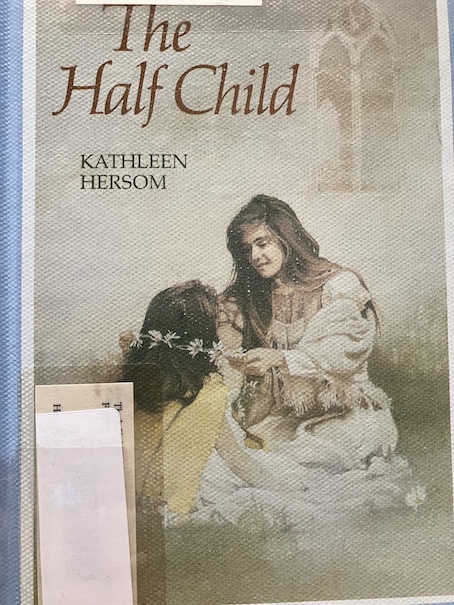
Mystery of the Strange Traveler

This book was originally published under the title The Island of Dark Woods.

Laurie Kane and her older sister, Celia, are traveling by train without their parents to visit their Aunt Serena in New York. Aunt Serena has invited the girls to come stay with her while their parents are traveling in Asia for one of their father’s newspaper assignments. In her letter to the family, Aunt Serena hints at exciting things that are happening. She used to be a schoolteacher, but she says that she’s starting a new business, and the girls can help her with it, although she won’t say what it is until they arrive. Also, Aunt Serena has recently moved to a new house. When their father sees where she’s living now, he’s intrigued because it’s the location of their “ancestral mystery.” He would tell the girls the story himself, but Aunt Serena says in her letter that she would like to be the one to tell them about it. There father says that Aunt Serena loves being tantalizing and mysterious. Laurie, who loves mystery stories, wonders about it all the way to New York.

Aunt Serena lives in a wooded area on Staten Island, near Clove Lakes Park. She has a small red brick house with another outbuilding on her property that she says used to be an old cobbler’s shop. Her new business idea is to turn it into a small bookshop. Laurie loves it immediately because she loves books. She wants to be an author herself, and Aunt Serena says that she might even get a chance to meet her favorite author, Katherine Parsons, because she lives in the area. Celia is the practical one, and she asks Aunt Serena all the practical questions about how she plans to get people to come to her little shop when there are no other stores around them to draw customers in. Aunt Serena says that she’s not expecting her shop to turn into a big business. It’s more of a small hobby business to bring in a little extra money and also be a fun activity.

Laurie and Celia begin unpacking some of the books that Aunt Serena will sell in her small shop, and Laurie is pleased to see a collection of books by Katherine Parsons. On the back of one of the books, there’s a picture of the author and a short biography. Laurie is pleased to note that Katherine Parsons is left-handed, like herself. There are times when Laurie has difficult with things because she’s left-handed, and she feels a kinship toward the author because she shares that trait.

Meanwhile, Celia has noticed that there is a boy next door, moving the lawn. Laurie is more interested in books than boys, so she doesn’t find this exciting news. Celia tries to get the boy’s attention, but he seems to be ignoring her. When he does seem to notice the girls, he turns away quickly, like he wants to avoid them. Celia points out to Laurie how the house where the boy is looks very different from the rest of the houses around it – big, old-fashioned, dark, and creepy. Laurie comments that it looks haunted, and their Aunt Serena surprises them by saying it is.

The boy, Norman, lives with his grandfather, Mr. Bennett, in the old house. Mr. Bennett is a difficult man, and Aunt Serena admits that she got on his bad side when she first moved to the area by asking him if she could buy his house. Aunt Serena admits that she didn’t actually want to buy Mr. Bennett’s house; she was only using her inquiry as an excuse to talk to him and maybe get a look inside the house. However, Mr. Bennett took offense at the inquiry.

There is another boy in the neighborhood called Russ Sperry, and he’s friendlier. His mother sends him to bring a cake to Aunt Serena, and Aunt Serena says that she hopes he will be friends with the girls and show them around. Russ stays awhile to have some cake and chat, and he mentions that Norman Bennett’s father is in South America because he has a job there, which is why he’s staying with his grandfather. Aunt Serena says that Norman’s mother is dead and that his father rarely comes home. She doesn’t approve of the lonely way Norman’s grandfather seems to be raising him because it seems like Norman doesn’t have any friends. Laurie thinks that Norman’s loneliness is at least partly his own fault because he seems to avoid contact with people when she and Celia try to approach him. Celia decides that Russ is cute, but Laurie finds herself intrigued by Norman, not because she wants to flirt with him but because there’s an element of mystery about him.

The girls try to ask Aunt Serena more about what she means when she says that the Bennett house is haunted, but she says that she would rather talk about that later. She gets the girls busy unpacking their belongings, arranging things in her shop, and talking to Russ about the area. Russ helps to explain the geography of Staten Island, and Aunt Serena tells the girls more about the history of the area. Aunt Serena mentions that there are dances in the park on Wednesday nights, which sounds exciting to Celia. When Laurie spots Norman passing by, wearing riding clothes, Russ explains that there are a couple of stables in the area, where people can rent horses. There are plenty of things for the girls to do in the area, and Aunt Serena begins planning an opening party for her bookshop, with Katherine Parsons there as a special guest to sign her books.

Laurie is excited about the party and the opportunity to meet Katherine Parsons, but she continues to think about the mystery of why Norman seems so unfriendly. Soon, other strange things start happening. One night, she sees a light in Aunt Serena’s bookshop, as if someone were sneaking around in there. However, when Laurie goes to wake Aunt Serena to show her, the light is gone, and the next day, there aren’t any obvious signs that anything in the shop was disturbed.

When Laurie has a chance encounter with Mr. Bennett, where she asks him if he’s ever seen the ghost that haunts his house, he says, no he hasn’t seen it. The ghost is supposedly a phantom stagecoach, but Mr. Bennett doesn’t believe it exists. Once Laurie knows that there’s supposed to be a phantom stagecoach, she tries to press Aunt Serena for more details, but Aunt Serena refuses to tell them the rest of the story until she can tell them on a gray, stormy day, when the atmosphere is right.

When a stormy day comes and Aunt Serena agrees to tell the story, she allows Celia and Laurie to invite Russ and Norman over to hear it, too. Norman comes to hear the story without his grandfather’s permission because he’s always known there was some story about the house, but his grandfather hasn’t wanted to talk to him about it. When Aunt Serena tells the ghost story, the connections between the Kane family and the Bennett family become clear.

About 100 years before, there was a stagecoach route that ran through this area. One stormy day, a stagecoach was passing through the area, and one of the passengers, a woman with an infant daughter, was seriously ill and had become delirious. The stagecoach driver sought help at the Bennett house. The Bennetts brought the sick woman inside the house, along with the infant daughter. The stagecoach driver sent a doctor to tend to the woman, but she died in the Bennett house. They had no idea who the woman was and were unable to trace her origins or family. If the woman had a husband or the infant girl had a living father, the man never showed up to inquire after his wife or to claim the baby. All the Bennetts had do go on were the meager possessions the woman was carrying with her, and the little girl herself, whose last name was unknown but the mother had called “Serena.”

At this point, Serena explains that this Serena was the ancestor of the Kane family, the great-grandmother of Celia and Laurie. Since nobody was able to discover where she and her mother came from or locate any relative, the Bennetts adopted the first Serena and raised her until she grew up, got married, and moved away from the island. However, local people still tell stories about the terrible day when the first Serena and her ill mother were brought to the area, claiming to have seen a ghostly stagecoach pull up to the Bennett house and a ghostly woman get out.

Laurie is intrigued by the mystery surrounding her family’s origins. Aunt Serena shows them some of the belongings that the first Serena’s mother had when she died, which have been passed down as heirlooms. There was a doll with doll clothes, a woman’s dress with bonnet and gloves, a sewing kit, a fan, an old novel the woman must have been reading at the time, and a purse containing a very old coin. The old coin is another oddity about this strange situation because it dates from before the Revolutionary War and would have been long obsolete by the time the woman died during the 19th century. Is it still possible to solve a mystery that’s about 100 years old? Will Laurie and her family ever learn who their ancestors really were? Why does Mr. Bennett not want them to visit his house or talk about the old mystery or the ghost story? Does he know more about them than he wants to admit?

The book is available to borrow and read for free online through Internet Archive.

The mystery in the story unfolds slowly, which might make people who are used to faster-paced modern stories a little impatient. Aunt Serena takes quite a while from the time when she first mentions that the house next door is haunted until she actually explains what the ghost is supposed to be and what the mystery surrounding their family is. However, Aunt Serena values atmosphere, so the story could appeal to people who don’t mind a slower-paced mystery as long as it has a good atmosphere.

When the mystery does begin, some parts are resolved quickly and others are more of a puzzle. The idea of an orphan with an unknown identity and a hidden past is always intriguing. The light in the bookshop at night, on the other hand, turns out to be less of a mystery, and Mr. Bennett’s reluctance to discuss the ghost story and the old mystery turns out to be nothing sinister. Mr. Bennett doesn’t really have any hidden knowledge about the orphaned child or her dead mother. It’s just that he’s a very reclusive person who craves peace and quiet so he can work on his private projects. He also has some resentment toward the Kane family because, while they used to be very close, Laurie’s grandfather was the one who inspired Mr. Bennett’s son to take a job in another country, which is why Mr. Bennett and Norman rarely see him. By the end of the story, though, things get patched up between them.

Every time the matter of the mysterious orphan and the question of whether or not the house is haunted by her mother is raised, Mr. Bennett has had to deal with a bunch of people and reporters stopping by his house, harassing him with questions and asking for tours of the place, and he’s sick of it. He doesn’t want Aunt Serena or the kids raising the issue again because he doesn’t want to deal with everybody’s questions anymore, and he has no more information to give anyone. As far as he’s concerned, the mystery is unsolvable because he thinks whatever trail there might have been has long since grown cold, and if it were ever possible to learn the dead woman’s identity or the real origins of the child, someone else would have figured it out a long time ago. However, Laurie tells Mr. Bennett that she thinks that there’s still a chance to figure it out, and that plays into one of the major themes of the story.

The atmosphere of the story is pleasant, with Aunt Serena’s cheery little house decorated with bowls of wildflowers and her little bookshop. Aunt Serena greatly believes in establishing atmosphere, creating scene, and setting a mood. On the stormy day when Aunt Serena finally tells the girls the local ghost story, she makes it a point to set the atmosphere for the story by making popcorn and lighting candles.

Like other books by Phyllis Whitney, this story is set in a real location and uses some of the history of that location. The original title of this book came from the original Native American name for Staten Island, Monocknong, which the fictional author in the story, Katherine Parsons says means “The Island of Dark Woods.” Mr. Bennett disagrees, though, saying that it actually might mean, “The Place of the Bad Woods,” and they debate about different possible translations and meanings of the phrase. The history of the Staten Island plays directly into the story because it turns out that Laurie’s ancestors were involved with the historical events of the area, particularly Santa Ana’s stay on Staten Island after the Battle of the Alamo in Texas that was part of the Texas Revolution against Mexico.

A couple of other points I’d like to make regarding history are about race in the story. Toward the end of the book, Mr. Bennett hires “a young colored woman” as a housekeeper. “Colored” is a dated term in the 21st century, but this book was written in the 1950s, when that was considered one of the more polite ways to refer to black people. The popular terms we use now (“black” as the informal generic term and “African American” as the formal term specific to black people of African descent who live in the United States) came into use after the Civil Rights Movement as people tried to distance themselves from older terms as a way to shed the emotional baggage associated with them. The housekeeper, Anna, becomes friendly with Laurie, and she offers her a new perspective and some helpful advice about a different approach to tracing her family’s roots. Anna enters the story late, so she doesn’t appear much, but she is helpful, and I didn’t notice anything particularly stereotypical about her, although I suppose the idea of a black person in domestic service might be kind of cliche.

The other thing I wanted to mention is that American Indians are referred to multiple times in the story when the characters discuss the island’s history. The characters always refer to them as just “Indians” instead of “American Indians” or “Native Americans”, which is typical of the 1950s. At one point, Celia and Laurie are discussing their role in the island’s history. Celia talks about how she was glad that she wasn’t around then because there were massacres and “the Dutch kept buying the island from the Indians and the Indians kept taking it back.” However, Laurie says that was “because the white men cheated them.” I appreciated that Laurie acknowledged that, and I think that this exchange not only highlights some of the stereotypical views people had in the 1950s about Native Americans and history, but also differences between the ways Celia and Laurie look at other people. I have more to say about that below, but Celia tends to cling toward accepted views and the general social rules of society while Laurie has a talent for empathy and looking at situations from another person’s perspective. I’ve noticed that the author, Phyllis Whitney, has used this technique in other books of hers to subtly challenge stereotypes, pointing out that different groups of people have their own perspective and their own side of the story.

This book is fun for book lovers. Laurie’s favorite author, Katherine Parsons, is fictional, but the story captures the spirit of book lovers. It turns out that Norman is a book lover, too, and Laurie is able to draw him out and bond with him over their shared love of books. Aunt Serena also praises Laurie for her ability feel empathy for other people, a quality that she believes comes partly from Laurie being a book lover. After all, readers are accustomed to the idea of seeing circumstances through the eyes of someone else and experiencing their thought processes when they read a story. Aunt Serena believes that one of the benefits of reading it that it helps to cultivate a person’s skills in using empathy to understand other people and that readers carry that technique over into the real world.

I will say, though, that Laurie’s story took an unexpected turn. Laurie is a book lover, but through her association with Katherine Parsons, she unexpectedly realizes that, while she’s always dreamed of writing stories and being published, she doesn’t actually like the writing process. She enjoys the stories other people have written, and she has a knack for understanding characters, whether real or on the page, but she’s surprised to realize that the routine of writing doesn’t appeal to her. She feels a little sad at the realization because it means giving up an old dream but also a little relief because her life is now open to more possibilities that she might like better.

I also enjoyed the relationship between the two sisters in the story. They get on each other’s nerves and fight with each other sometimes, but they also care about each other and make up with each other after fighting. Celia, as the older sister, is more interested in boys than Laurie is, and she has all kinds of social rules about how to talk to boys and how to get their attention. Laurie knows that Celia and her friends talk about these things a lot, but Laurie doesn’t really understand all of their little rules and thinks a lot of them sound silly, like the idea that girls can’t invite boys to things but have to wait for the boys to ask them or that they should pretend like they’re not too interested in a boy so the boy will approach them first. This book was written in the 1950s, so a lot of Celia’s social expectations about how girls and boys should act around each other sound dated, but I enjoyed Laurie questioning Celia’s rules.

Laurie thinks it more important to know about what specific people like and how to appeal to them as individuals than to adhere to more general social rules. This is especially apparent when the girls try to get Mr. Bennett to let them in his house and talk to him. When the sisters compete to ingratiate themselves to Mr. Bennett so they can get access to the house and talk to him about the mystery, their different approaches play on their concepts of social rules and human empathy. Celia tries a very conventional approach, trying to appeal to Mr. Bennett in a general way, but Laurie decides that “Mr. Bennett was too much of an individual to be governed by rules that worked for most people” and tailors her approach to him as an eccentric individual.

Celia’s idea is to make some homemade cupcakes and take them to Mr. Bennett as a gift because she believes in the old axiom that the way to a man’s heart is through his stomach. As Laurie suspects, though, this approach falls flat because Mr. Bennett isn’t interested in baked goods. Laurie has a better idea of what Mr. Bennett really likes because she has talked to Norman about him, and she decides that the way to get his attention is to demonstrate a shared interest in something he likes. Knowing that he likes nature more than anything else, she starts putting together a collection of interesting leaves and asks Mr. Bennett if he can help identify them. Mr. Bennett isn’t really impressed by her collection because she didn’t mount the collection properly, most of her collection is very common leaves that he thinks she should be able to identify if she knew anything about trees, and she also included a sample of poison ivy, which she should have known better than to touch. However, he is sufficiently amused by her efforts and her mistake to talk to her for a few minutes.

One of the major themes of the story is that “No man is an island”, meaning that people do need other people. Aunt Serena is concerned that Mr. Bennett’s obsession with solitude is hurting his grandson because he’s making it difficult for Norman to make friends. Mr. Bennett has forbidden Norman to bring any other kids to the house because he doesn’t want to deal with the noise and disturbance. Because she’s been a teacher, Aunt Serena knows that Norman needs more opportunities to socialize with his peers. Mr. Bennett doesn’t even seem to pay much attention to Norman himself because he’s too absorbed in his own work.

What Laurie points out to Mr. Bennett when Mr. Bennett tries to tell the kids that the old mystery is unsolvable is that a group of people working together can accomplish more than any one person, working alone. They don’t have many clues to the past, but just because they don’t all make sense to any one of them doesn’t mean that parts of them wouldn’t make sense to different people. By pooling their knowledge and consulting other people, they could still put together the pieces of the past.

Along the way, Laurie also makes Mr. Bennett realize that there are many things he doesn’t know about Norman. Even though he and Norman have been living alone together for a long time, Mr. Bennett hasn’t paid much attention to Norman or things Norman has been doing. Norman has felt lonely and neglected, although he hasn’t wanted to admit how much. When Mr. Bennett realizes that Norman is an artist and has been developing his skills to an impressive degree without him even seeing any of Norman’s projects, he realizes that he has been too absorbed in his own concerns and starts to make an effort to learn more about what’s happening in the lives of the people around him. This is a similar situation to a grandmother in another of the author’s books, Mystery of the Angry Idol.

The Summer Birds

The Summer Birds by Penelope Farmer, 1962.

Aviary Hall is an old, Victorian-era house in a small village in England. It doesn’t really have an aviary, although there are hummingbirds on display in a glass case in the drawing room. Like other houses of its type, it has greenhouses and a walled kitchen garden. Twelve-year-old Charlotte Makepeace and her younger sister, ten-year-old Emma, live there with their grandfather. Every morning, they walk to school, and they admire the birds in the area, wishing that they could fly like that themselves. One morning, they meet a strange boy on their way to school. Charlotte is cautious about meeting strangers, but Emma talks to the boy. Charlotte says that they should hurry, or they’ll be late for school. The boy says that he doesn’t go to school, so Emma invites him to come with them to their school. Charlotte isn’t sure what their teacher would think of the strange boy showing up, but they have to go or they will be late.

However, when they arrive at school, Charlotte gradually begins to realize that nobody seems to notice the new boy except for her and Emma. Other people just look past him, and nobody asks who he is. It’s like they can’t even see him. As the lessons at school continue, Charlotte’s attention wanders, and she finds the heat of the room uncomfortable. Then, the boy invites Charlotte to come away with him, promising that he will teach her more than she will learn in class.

At first, she thinks that people will notice if she leaves, but they don’t. She and the boy run away from the school, and Charlotte feels wonderfully free, like a bird. The boy asks Charlotte if she would like to fly like a bird. Charlotte doesn’t see how that’s possible, but they says that it is and shows her that he can fly. The boy teaches her some exercises to make sure she’s strong enough. Charlotte can’t fly at first, just falling to the ground when she tries, but when the boy urges her to continue trying, she gradually realizes that she is staying in the air longer and longer. They have a wonderful time on this adventure.

The boy is very mysterious about who he is although he asks many questions about Charlotte and her home and family. Charlotte asks the boy if the other kids from school can also learn to fly. The boy says that they have to learn one-by-one, but he will teach them individually, and it has to be a secret.

Then, suddenly, Charlotte finds herself back at school. No one has noticed that she was gone, not even Emma. At first, Charlotte wonders if it was all just a dream, but she discovers that she still has the ability to fly and has to be careful not to let other people see her feet leave the ground when she kicks her feet. Emma can tell that Charlotte has a secret, and she’s irritated when Charlotte refuses to tell her what it is. However, Charlotte knows that Emma will learn soon enough.

Emma learns to fly the next day, and gradually, other children at school also start to be able to see the boy and get their own flying lessons. Charlotte’s best friend, Maggot (a nickname, not her real name), seems particularly accepting of the strange boy and his strange powers of invisibility and flying. She seems to understand things about him, maybe even more than Charlotte does, saying that her uncle has told her about such things.

Their teacher discovers what they’re doing when she catches one of the children flying, and she questions them about it. The children don’t want to admit anything to her because they call swore an oath to keep it a secret, but the mysterious boy says that their teacher is all right and reveals himself to her. He explains that he taught the children to fly, and their teacher is surprisingly accepting of that. She asks if she can also learn, but the boy explains that he can only teach children. The teacher regretfully says that she suspected that might be the case, and the children begin to consider that their ability to fly might also fade with age. The teacher invites the boy to join their class for the rest of the term and seems to quietly support their flying adventures.

When school lets out for the summer, the children continue their flying adventures, still a secret from their parents. The boy, who has still not told anyone his name, is very strange, and not just because he can fly. Charlotte sees him eating insects, which he says he loves, and he doesn’t seem to understand things about school and ordinary houses. During an argument among the boys in the group, who don’t want to be bossed by the mysterious boy without reason, one of the boys, Totty, challenges the mysterious boy about who he really is, where he really comes from, and how he came by his flying magic. The other children are afraid to challenge the mysterious boy because they know that he is strange, they worry that there may be something evil about his magic (although they doubt it), and they fear losing the ability to fly.

The children decide to settle the conflict with a special challenge. If the mysterious boy wins the challenge, he wants to stay with them for the rest of the summer, being their leader and not explaining anything about himself. If Totty wins, the mysterious boy says he will explain who he really is and then leave, although he will let the children keep their ability to fly until the summer is over. The mysterious boy wins the challenge, but at the end of the summer, he makes them all an offer that could change their lives forever.

The book is the first book of the Aviary Hall Trilogy, although it isn’t as well-known as Charlotte Sometimes, which is the third book. It is available to borrow and read for free online through Internet Archive (multiple copies).

My Reaction and Spoilers

Although Charlotte and Emma are sisters, this is the only book in this short series in which they both appear together. Each of the other books focuses on each of the girls separately. Charlotte Sometimes, the best-known book in the series, is set when Charlotte goes away to boarding school, and the second book in the series, Emma in Winter, takes place while Charlotte is away at school, focusing on Emma, who is left at home. All three books focus on growing up and issues of personal identity, although they do it in somewhat metaphysical terms and with fantasy elements.

Charlotte Sometimes focuses on personal identity as Charlotte finds herself traveling back and forth through time, trading places with another girl who attended her school in the past. At times, Charlotte feels like she’s losing her identity as Charlotte and becoming more like the other girl. One of the things I liked about The Summer Birds was getting a glimpse of Charlotte just being in her own identity all the way through the book. The beginning of the book makes it clear that the other children at school think that Charlotte is a prig (someone who is rigidly well-behaved to the point of being obnoxious), but it also clarifies that it’s because she feels compelled to look after Emma and set a good example for her.

The two girls live with their grandfather Elijah, who is obsessed with astrology, and an elderly, lazy housekeeper. The book never really explains what happened to their parents, but it seems that Charlotte and Emma are orphans. It is established in Charlotte Sometimes that their mother is dead, and this book mentions that their father was a sailor. Their grandfather likes girls to be well-behaved, and Emma is anything but, so Charlotte keeps trying to teach Emma how to act to keep their grandfather happy and trying to smooth things over with their grandfather when Emma misbehaves. In Emma in Winter, Emma has to face up to the realities of her personal behavior and other people’s reactions to her behavior without Charlotte running interference or taking responsibility on her behalf. That’s her coming-of-age moment, and it leads her to become more mature, personally responsible, and better-behaved herself and to appreciate what Charlotte was trying to do for her.

Although each of the books in this short series can be read independently of each other, I think reading all of them adds some depth and understanding to the characters. Charlotte was always a very responsible and cautious person in Charlotte Sometimes, showing that there is continuity to her character, but knowing the history of why is that way makes her more understandable. Although the other children sometimes consider Charlotte a drag for pointing out things that they shouldn’t be doing, it’s Charlotte’s serious nature that causes the other children to question the offer that the mysterious boy makes them at the end of the summer.

We also get to meet Charlotte’s best friend in her home town in this book, a girl called Maggot, who never appears and is never even mentioned in Charlotte Sometimes. The reason why she doesn’t appear in later book is that she is the only one who decides to accept the mysterious boy’s offer at the end of the book, leaving with him to be forever young as a bird. Charlotte is tempted by the offer, but she realizes that accepting it would mean giving up everything else and everyone else in their lives. The children would be happy for a while in their freedom as birds, but they would eventually miss their parents, and their parents would grieve for them because they would never be able to return. Although the other children don’t always listen to her, she is able to persuade them that this is really a serious matter that is about their very lives, forever, not just a brief summer lark. In the end, Maggot is the only one who can accept the offer because she is the only one who has no one left in the village to miss. She is an orphan and lives with an uncle who pays little attention to her. It is implied that he would hardly notice if she left, whereas Charlotte and Emma’s grandfather really would miss them, even if he sometimes doesn’t like their behavior. Maggot was also always the most birdlike, and she probably knew that the boy was really a bird before the others did because her uncle is a gamekeeper.

There are still some questions left unanswered at the end of book, but that is typical of this series. Readers might have guessed that the boy was really a bird all along, but we still don’t really understand his magic or see what happens in the village after Maggot leaves with him. We don’t know for sure that Maggot’s uncle doesn’t miss her or try to look for her, what the other villagers decide happened to Maggot, or if the teacher ever tells anyone what she knows about the children flying or if she understands what happened to Maggot herself.

Overall, it’s a pretty slow-paced book. Most of the story feels like pretty low stakes until the part at the very end, where the boy offers to let the other children come with him to be young birds forever. Then, it becomes a serious question of whether they are willing to continue with their normal lives, growing up and losing their flying magic, or if they’re willing to give up everything and everyone they know and love forever to keep it. Even though most of the story is peaceful, I had the feeling from the beginning that there might be a sinister turn somewhere because the boy’s behavior didn’t always seem straight-forward and friendly, and he was definitely keeping secrets. I had the feeling that the mysterious bird boy wanted something from them or was going to try to get them to do something they shouldn’t eventually. It’s an interesting premise, although I still think that Charlotte Sometimes is the best in the series. Events in this book are also mentioned in Emma in Winter, when characters in the story discuss them with each other, showing that all of the local children still remember their flying adventures together and that the events in this book didn’t just happen in their imagination.

The Time of the Ghost

The Time of the Ghost cover

The Time of the Ghost by Diana Wynne Jones, 1981.

This isn’t a very long book, but it packs a lot in! This is both a time travel story and a supernatural ghost story, but with the odd twist that we don’t initially know who the “ghost” is, and she isn’t really dead. She’s trying to save her own life.

In the beginning, although this book is from the first person perspective, we don’t know quite who the narrator is. Even the narrator isn’t quite sure who she is or what has happened. Her last memory is that there was some sort of accident, and her mind doesn’t seem to be working right. Now, she seems to be walking through the countryside, but she can’t remember what happened earlier that day or even what she had for lunch. When she looks down to see what she’s wearing that day, she realizes in a panic that she can’t see herself. She has become a ghost!

It takes her some time to get her panicked thoughts together, but she gradually begins to recognize the countryside. She is surprised that she can look over a hedge, thinking that it was something she had always wanted to do before, and she must have grown. There is a small hut nearby, and she recalls that there is an old rag doll called Monigan inside. Exploring further, she finds herself at a school and locates a classroom she recognizes. To her surprise, she discovers that it’s a Latin class full of boys, and although she has no body, she is sure that she’s a girl, so this can’t be her class. However, she does recognize the teacher as someone familiar but also intimidating.

Leaving the classroom, she continues exploring the school, and she finds people she is sure are her family. She remembers that the woman is called Phyllis, and Phyllis is her mother. There are also girls called Imogen, Fenella, and Charlotte. The ghost thinks that these are her sisters and that her name is Sally because Phyllis seems to call her Sally, although nobody really seems to see her. Sometimes, people just seem to have a sense that someone is there, and the dog, Oliver, seems to know she’s there. Pieces of information click in the ghost’s mind. This family’s last name is Melford. The teacher in the Latin class is her father. Sally is short for Selina. Charlotte is called Cart as a nickname.

The ghost finds herself angry and hating her family. She wonders if she could have died in the accident she vaguely remembers and if she came back to get some sort of revenge on her family, but the idea horrifies her, and she’s sure that she wouldn’t have thought of it in other circumstances.

The ghost watches as Fenella goes to the little hut and pretends to worship the doll Monigan and call her forth, like the doll is some kind of oracle. The ghost remembers that Cart was the one who started this game a year before and that she always thought that it was a boring game. Cart started the game because the four sisters had been fighting over the doll or playing with it too roughly one day, and they had each grabbed an arm or leg and pulled the doll apart. Cart had felt guilty about that, so she sewed the doll back together (badly, because she’s bad at sewing), and she turned the doll into a kind of oracle that the girls would worship to make it up to the doll that she had been ruined. Now, the doll is moldy and mildewy from being left in the little hut for a year. Only little Fenella still plays this game, although the doll has never actually done anything magical when they’ve called on her.

Gradually, the ghost begins putting the pieces of her memories together. Her parents manage a boarding school for boys. The girls help out with chores at the school, but they’re mostly expected to stay out of the way. Although they attend a different school themselves, it feels like they never get a break from school because they live at one. They never even get summers off because there are summer courses for disabled children at the boarding school.

Sally the ghost listens to her sisters complaining about her in her absence. They resent her for being overly sweet and a perfectionist and for defending their parents when the other girls criticize them. Sally is angry with them for the things they say behind her back and for their constant bickering and drama. Imogen gets melodramatic and picks at her sisters because she’s worried about not achieving the music career she really wants. Cart keeps trying to shut Imogen down because she feels overwhelmed by sentiment and emotions, and admittedly, Imogen’s emotions are frequently overwhelming. This dynamic between Imogen trying to express her overwhelming emotions and Cart trying to shut her down is a large part of the quarreling between the girls. Fenella, the youngest of the sisters, is just being a silly little girl, and she is rather fed up with her older sisters. At one point, Sally finds a poem that Fenella wrote that explains her relationship with her sisters:

“I have three ugly sisters
They really should be misters
They shout and scream and play the piano
I can never do anything I want.”

It’s a pretty accurate description of what goes on in their house. All of the girls are loud and argumentative, and a large part of the tension in their house comes from the inability of any of them to do what they want to do. Sally notices some pictures on the walls and remembers their father (whom the girls only refer to as “Himself”, never as “father” or “dad”) yelling at them and calling them “bitches” for stealing art supplies from the school for drawing and painting. Imogen’s drama about her music career is because she’s not allowed to use the music room at the school for practicing, and she thinks that she’ll never get a chance to develop her abilities. The parents pay more attention to the students at the school than they do to their own daughters, even forgetting to leave the girls any supper sometimes. The girls’ home life is not happy, and that’s why they’re not happy with each other. The two oldest girls especially are not happy with their parents because of their neglect.

As Sally listens to her sisters talking about her, Cart and Imogen admit that they’re both jealous of Sally because she gets to be somewhere else that will be important to her future career. Sally wishes that they would say where she’s supposed to be because she can’t remember. She finds a few unfinished rough drafts of letters that she wrote to her parents, trying to tell them that life at the school didn’t have much to offer her and that she was going away, but Sally can’t imagine where she would have gone. One of the letters even says that her life is in danger, but from what?

There is a bright spot in the girls’ lives, and that’s a secret friendship they’ve developed with some of the boys at school. The boys visit them in the kitchen after dinner, and they have coffee together. As ghostly Sally watches one of these visits, the boys ask the girls what happened to Sally, which ghostly Sally is (literally) dying to hear. Sally’s sisters explain that Sally’s disappearance is part of a Plan the girls have.

It’s obvious that the girls’ parents neglect them. While Sally has always been defending their parents to the other girls, the other girls want to prove to her that their parents would never notice if something awful happened to one of them. A lot of the strange things that Sally has witnessed them doing that day are part of this Plan. Fenella has been going around the entire day with big knots tied in her hair, and their parents haven’t noticed. Fenella says that if they continue to not notice, she’ll act like she’s fallen seriously ill. Sally’s sisters say that Sally has gone to stay with a friend named Audrey Chambers, but their parents don’t know and still haven’t noticed that she’s even gone.

The sisters and the boys decide to try holding a seance for fun, and ghostly Sally uses this as an opportunity to communicate with them. Although she has some difficulty and misspells her message, she manages to convince Imogen that she’s the one communicating and that she’s dead. Imogen gets hysterical, but the others calm her down by phoning her friend’s house and confirming that Sally is there and that she’s fine. Ghostly Sally can’t understand it. She’s sure that she’s really Sally, but how can that be if Sally is definitely at her friend’s house?

Ghostly Sally seeks out living Sally, and to her surprise, she finds her, although she feels disconnected from this girl. She also learns that this Sally has been secretly doing things with a boy from the school, Julian, performing nighttime rituals with the doll, Monigan. Although ghostly Sally remembers having been friends with Julian, seeing him from outside herself makes her realize that Julian is actually sinister and disturbed. In her spirit form, she also realizes that their rituals with Monigan have stirred up something genuinely supernatural, apart from herself.

As things become more clear to her, the ghost begins to think that she was wrong about being Sally. She is still sure that she is one of the four sisters, neglected at her parents’ school, but she doesn’t think that she’s Sally after all, and that’s why she had no knowledge of Sally’s secret rituals with Julian and couldn’t remember where Sally was or what she was thinking. She also realizes that everything she has seen happened when she was younger. Somehow, after her accident, her spirit went back into the past, seeing things that she and her sisters used to do.

As the “ghost” wakes up in the hospital in the present day, she also realizes that she is not actually dead. She’s been having an out-of-body experience. Worse, her “accident” wasn’t really an accident. Someone tried to kill her. Julian, also older now in the present day, shoved her out of his car while they were driving somewhere. He was deliberately trying to kill her! Something that happened during that time in the past, during the time with the Monigan rituals and the girls’ Plan to confront their parents over their neglect led up to this attempted murder.

The “ghost” still can’t remember everything that happened in the seven years since then, leading up to the attempted murder, and she’s still confused about who she really is. She only senses that Monigan tried to kill her through Julian. Although the girls once thought that Monigan was just a game, Monigan is actually a real, evil spirit. Seven years ago, Monigan told them that it would claim a life, and now, Monigan is trying to do so. Can the “ghost” regain her memories and figure out what to do in time to save her life before the next attempt?

The book is available to borrow and read for free online through Internet Archive (multiple copies).

My Reaction

Earlier, I covered The Headless Cupid, in which children play at being witches and doing magical rituals that are clearly nonsense, but this book has children who are coerced by some ancient supernatural spirit into doing “real” occult rituals. The children’s rituals involve blood and cruelty to animals, which I didn’t like when I was reading the story. We don’t fully get to know what Monigan actually is, although there are indications that Monigan might be some kind of ancient goddess that craves sacrifices, especially human sacrifices. Monigan seems to remember receiving sacrifices before, in the distant past. Although Cart thinks that she invented Monigan, that Monigan is just a doll they tore, and that all of their rituals are just playacting, the “ghost” realizes that they were all being manipulated by the spirit called Monigan into thinking that. Monigan took advantage of the neglected children and their mentally ill friend for its own purposes. I think Monigan was based on Morrigan from Irish mythology. We are told in the story that this British boarding school is built on a site that has been inhabited from ancient times, and the girls’ father is obsessed with the archaeology of the area, which may also be responsible for stirring up this ancient spirit.

The intriguing part of this story is first that the readers aren’t sure whether or not the “ghost” is actually dead, and then, the readers as well as the ghost have to determine the ghost’s true identity. At first, the “ghost” thinks that she knows who she is, but then, she thinks that she was wrong. (Or was she?) Even when she is awake in the present day, her mind is still confused, and even two of her sisters, while they know that Julian’s attempt to kill her was part of Monigan’s curse, find it difficult to remember everything that happened when all of this started. The “ghost” has to go through the events of the past, with Monigan working against her all the time, to figure out what set off this threat against her before she runs out of time. She knows that Monigan plans to kill her before the day is over, and she doesn’t have much time left to break this curse or prevent it from happening in the first place. The “ghost” isn’t sure at first that she can change the past, but she gradually manages to get through to the other children and figure out a solution with the help of her sisters.

I found the parents in the story not just neglectful but actually cruel and infuriating. The father keeps calling his daughters “bitches” when he gets angry at them. When the girls appeal to their mother about how they’re not being fed and have to keep begging food from the school’s kitchen, the mother shuts her eyes and tells them to stop bothering the cook. The cook is also revealed to be stealing food from the kitchen herself, which may be the reason why both the girls and the students have little to eat, but when the girls tell their mother about it, their mother doesn’t want to hear about it. She just doesn’t want to go to the bother of finding another cook. I’m amazed that the girls haven’t actually died at some point before this or that social services hasn’t gotten involved. The girls do attend a different school from the one their parents manage, so they would have the opportunity to get help and attention from an outside source.

At one point, Fenella openly tells her mother that she’s neglecting them while she only pays attention to the boys at the school, and her mother says that girls can look after themselves while boys can’t. It’s like her mother looks at the girls like some people look at pet cats when they just let them roam and hunt for their own food. I don’t even approve of people neglecting their cats, like they don’t even have pets so much as a nodding acquaintance with feral animals. Even in the present day, when our “ghost” lies in a hospital bed after a murder attempt, their mother doesn’t come to see her because she’s too busy helping the boys at the school to pack their trunks. The father is openly hostile to his daughters, and the mother doesn’t seem to have any feeling or concern for them at all.

The concept of the book was interesting, but it’s not one that I would care to read again because I found it dark and frustrating, although it does end well. Things do improve for the girls in the past after their father discovers their weird rituals and sends them off to their grandmother’s house, angrily declaring that he never wants to see any of them again. The father’s rejection of them is actually a blessing. At their grandmother’s house, they get regular food and the attention that they desperately need. The mother partly redeems herself at the end of the book by coming to see her daughter after all, saying that she felt obligated to get the boys all packed but now that’s done, so she is free to stay with her daughter until she’s fully recovered. The girl does recover, and she begins reconciling herself to her past traumas, both the supernatural ones and the ones resulting from her parents’ neglect and her tumultuous relationship with her sisters.

One thing that the “ghost” accomplishes is that she gets a look at her past and herself as they really are, viewing herself and everything that happened from a neutral position as the “ghost.” Seeing herself from the position of a third person, she discovers that she doesn’t like the things she’s done or the person she’s been during these last several years. That’s why she has felt so disconnected from herself and her memories and why she couldn’t even recognize herself or the things she did in the past. The “ghost” is so upset with herself and ashamed of her life choices that she wonders if she’s really worth saving from Monigan. Fortunately, her sisters truly love her and know that she’s worth saving. Their bad choices and poor behavior to each other have been largely the result of their parents’ neglect, a trauma they all share and understand. Although the ghost doesn’t remember everything at first, the other sisters know that, after they went to live with their grandmother and received the attention and care they really needed, they all improved and their relationships with each other improved. They’ve been trying to move on from their past ever since, and they need to settle the matter about Monigan once and for all to truly be free to go forward in their lives. One of the sisters knows exactly what kind of sacrifice will finally appease Monigan and save her sister’s life.

Monigan wants something perfect as a sacrifice, but our “ghost” isn’t a perfect person. Nobody is perfect, and our “ghost” has become truly aware of her flaws and the nature of her troubled past through her out-of-body experiences. However, things can be perfect in someone’s imagination, and one of the sisters has a more powerful imagination than the others. Someone has a dream that is perfect, at least in her mind. When she gives Monigan that dream, she not only frees her sister from Monigan but herself from something that her future self has realized that she doesn’t really want. Both she and her sister have been clinging to things that were harmful to both of them, making them into the kind of people neither of them really wanted to be. It was their insecurity from their parents’ neglect that made them cling to things that they thought would make them special and distinct. Once they are free from these harmful influences, not only does Monigan stop trying to take their lives, but they are truly free for the first time to become something better. Monigan does claim one life at the end of the story, but in that case, it’s only justice.

The Christmas Tree Mystery

The Christmas Tree Mystery by Wylly Folk St. John, 1969.

A couple of days before Christmas, twelve-year-old Beth comes running to her 10-year-old sister Maggie, saying that she’s in trouble and needs her help. Beth doesn’t know whether Maggie can help at all, but she thinks she’s done something wrong and needs somebody to listen to her. Someone stole the family’s Christmas tree ornaments the day before, and Beth saw someone running out of their backyard right after the theft. She was sure that the person she saw was Pete Abel, and that’s what she told everyone. However, the girls’ older stepbrother, Trace, says that it couldn’t have been Pete. Beth thinks that it would be awful if she’s leapt to the wrong conclusion and wrongly accused Pete of theft, but then again, she can’t be sure that Trace is right, either. Trace says that Pete was somewhere else at the time, but he doesn’t want to say where because, for some reason, that might also get Pete in trouble. Beth doesn’t know whether to believe him or not.

The kids are part of a blended family that has only been together for less than a year, so the children are still getting used to each other and their new stepparents. Beth likes their new little stepsister, Pip, but teenage Trace is harder to get used to. Trace is frequently angry, and much of his anger comes from his mother’s death. Beth knows sort of how Trace feels because her father died three years ago. She knows what it’s like to miss a parent, and try to keep their memory alive. Even though Beth doesn’t think of her stepfather, Champ, as being her father, she tries to be fair toward him and accept that he’s doing his best to take care of them. Sometimes, she wishes she could talk about it all with Trace, but Trace has made it clear that he doesn’t want to talk. Trace doesn’t like to talk about his mother and gets angry when anyone else even mentions her.

Beth thinks that Pete was the thief because the boy she saw running away was wearing a jacket like the one Pete has and has the same color hair. However, she didn’t actually see his face, and Maggie points out that other kids have similar jackets. Also, they found an old handkerchief of the house with the initial ‘Z’, and that wouldn’t belong to Pete. Beth has to admit that she may have been mistaken about who she saw. However, she can’t think of anybody whose name begins with ‘Z’, either. She worries that if she was wrong to say it was Pete that she saw she may have broken one of the Ten Commandments because she was bearing false witness. All that Beth can think of to make things right is apologize to Pete for being too quick to accuse him and try to find the thief herself, but she needs Maggie’s help to do that.

Why anybody would steal Christmas ornaments right off a tree is also a mystery. Some of the ornaments that belonged to Champ had some value and could possibly be sold for money, but most did not. The thing that Beth misses the most is the little angel that she had made for the top of the tree years ago. Its only value is sentimental, and Beth worries that a thief might just throw it away if he didn’t think it was worth anything. Also, if Trace is so sure that Pete is innocent, why can’t he explain where Pete really was when the theft occurred? Trace is sneaking around and seems to have secrets of his own. Then, after the family gets some new ornaments and decorates the tree again, the ornament thief strikes again! The new set of ornaments disappears, but strangely, the thief brings back Beth’s angel and puts it on top of the tree. If it had just been a poor kid, desperate for some Christmas decorations, they should have been satisfied with the first set. Is anybody so desperate for ornaments that they would take two sets, or is it just someone who doesn’t want this family to have any? And why did the thief return the angel?

The book is available to borrow and read for free online through Internet Archive (multiple copies).

My Reaction and Spoilers

The idea of somebody stealing Christmas ornaments sounds like a whimsical mystery for the holiday, but even though I’ve read books by this author before, I forgot that Wylly Folk St. John can bring in some of the darker sides of life. Much of this story centers around getting ready for Christmas, but there are some truly serious issues in the story. This is a book that would be better for older children. For someone looking for someone for younger children or a lighter mystery for Christmas, something from the Three Cousins Detective Club series would be better. (See my list of Christmas Books for other ideas.) It’s an interesting story, and I enjoyed the book, but I wouldn’t call the mood light.

The ways this new blended family learns to get along with each other and Trace learns to cope with his grief at the loss of his mother are major themes in the book. The parents try to be conscientious of the children’s feelings, making joint decisions and rules for the children as “The Establishment” of the house so none of the children feel like a stepparent is discriminating against them. The reason why the stepfather is called Champ is because he’s a chess champion, and Beth knows that her mother gave him that nickname so the girls wouldn’t feel awkward, wondering whether to call him by his name or refer to him as their dad. Beth is grateful for the nickname because, although she likes and appreciates Champ as a person, she does feel awkward about calling anybody else “dad” while she still remembers her deceased father. Trace calls his stepmother Aunt Mary for similar reasons, and Beth understands that. What she doesn’t understand is why Trace insists on wearing the old clothes that were the last ones his mother bought for him, even though they no longer fit him. Aunt Mary has bought him some nice new clothes that would fit him better, but he won’t wear them, and he even insists on washing his clothes himself, without her help. Beth asks her mother about that, but she says it doesn’t bother her because, if Trace is willing to help with the laundry, that’s less for her to do. Beth says that they ought to just donate all of Trace’s old clothes so someone else who can actually wear them can have them, but her mother doesn’t want to be too quick to do that because she doesn’t want to upset Trace. I can understand that because Trace is still growing, and it won’t be much longer before he won’t be able to wear those old clothes anymore anyway. The day that he can’t pull one of those old shirts over his head or put on old pants without splitting them will be the day he’ll be ready to get rid of them. Time moves on, and eventually, Trace won’t be able to help himself from moving on with it, and I think Aunt Mary understands that.

Part of the secret about Trace and his grief is that his mother isn’t actually dead, although he keeps telling people that she is. The truth is that his parents are divorced and his mother left the state and has gone to live in Oklahoma with her relatives. At first, Beth’s mother doesn’t even know that Trace has been telling the girls that his mother died, but when Beth tells her mother that’s what Trace said, her mother tells her the truth. She doesn’t want to explain the full circumstances behind why Champ divorced Phyllis and why she left, but she says that she can understand why Trace might find it easier to tell himself and others that she’s dead instead of accepting the truth. There is an implication that Phyllis did something that Beth’s mother describes as something Trace would see as “disgraceful” (I had guessed that probably meant that she had an extramarital affair, but that’s not it) that lead to the divorce. So, Trace is actually feeling torn between losing his mother and learning to live without her and his anger at her for what she did. He both loves and hates his mother, and that’s why he finds it easier to think of her as dead and gone and refuse to talk about her any further than deal with these painful, conflicting emotions. Beth’s mother also indicates that Phyllis was emotionally unstable, saying that the atmosphere in the household wasn’t healthy for Trace and his little sister because Phyllis “kept them all stirred up emotionally all the time”, and that’s why she didn’t get custody of the children and isn’t allowed to see them now. It turns out that there was a lot more to it than that, and that figures into the solution to the mystery.

When I was reviewing an earlier book from the 1950s by a different author about children coping with grief and a new blended family, Mystery of the Green Cat, I talked about how books from the 1950s and earlier tended to focus on the deaths of parents when explaining why children lived in households with stepparents and step-siblings and how books from the 1960s and later started to focus more on the issue of divorce. This book kind of combines aspects of both of those types of stories. Beth understands the grief of a parent dying, and Trace has to come to terms with his parents’ divorce, which is a different kind of loss, although it’s still a loss. As I explained in my review of that earlier book, in some ways, divorce can be even more difficult for children to understand than death. Both are traumatic, but divorce involves not just loss but also abandonment (a parents who dies can’t help it that they’re no longer there, but it feels like a parent who is still living somehow could, that it’s their choice to leave their children and live apart from them, which leads to feelings of rejection) and the complicated reasons why people get divorced, including infidelity and emotional abuse. In this case, it also involves drug abuse.

I was partly right about the solution to the mystery. I guessed pretty quickly who the real thief was, but there’s something else I didn’t understand right away because I didn’t know until later in the book that Trace’s mother was still alive. Before the end of the book, Trace and Beth and everyone else has to confront the full reality of Phyllis’s problems. They get some surprising help from Pete, who has been keeping an eye on things and has more knowledge of the dark sides of life than the other children do. (Whether his father ever had a problem similar to Phyllis’s is unknown, but it seems that at least some of the people his father used to work with did, so it might be another explanation for Pete’s family’s situation.) Because Pete has seen people in a similar situation before and knows what to do. I had to agree with what Beth said that much of this trouble could have been avoided if Champ had been more direct with Trace before about his mother’s condition, but Beth’s mother says that sometimes children don’t believe things until they see them themselves. Champ was apparently trying to protect his children from Phyllis before, but because Trace had never seen his mother at her worst, he didn’t understand what was really happening with her. There is frightening part at the end where the children have to deal with a dangerous situation, but it all works out. Trace comes to accept the reality of his mother’s condition and that things will never be the same again, but he comes to appreciate the stepsisters who came to his rescue and brought help when he needed it.

Mystery of the Green Cat

Mystery of the Green Cat by Phyllis Whitney, 1957.

Things just haven’t been the same for twins Andy and Adrian Dallas since their mother died two years ago. Now, their father has remarried to a woman he met through his work, and Adrian has been having an even harder time coping with it than Andy has. The twins have always been different from each other, not identical in appearance or personal interests, but now, Adrian is frequently angry and moody, and he’s getting on Andy’s nerves.

Their new stepmother, Emily, isn’t bad, and Andy can tell that she’s trying hard to be nice to them so that they’ll like her, but it does make the boys uneasy that their father seems to be having an easier time moving on from their mother’s death than they are. Also, Emily has two daughters, Jill and Carol, who have been living with their grandmother. Now that Emily has remarried, Jill and Carol are coming to live with her, her new husband, and the two boys in San Francisco. Emily has been saying that they’ll all be one big family now, but all of the children have misgivings about it. The twin boys have never lived with girls before, and they’re not looking forward to having a bunch of girly stuff around or Carol practicing her dancing in their new house. Meanwhile, the two girls aren’t sure that they’re really looking forward to suddenly having a couple of brothers. Carol is optimistic and thinks it might be fun, but Jill remembers that she hasn’t gotten along with the brothers of some of her friends. This new blended family is a major adjustment for everyone.

Adrian is so angry and upset about the coming of the girls that he refuses to go meet them at the airport with the rest of the family. Andy goes, although he is uneasy about meeting his new stepsisters, and Jill can tell that he’s not really happy to see them. Andy’s father explains Adrian’s absence by saying that he had a summer school art project to work on, although he does warn Jill that Adrian might need some time to get used to being around girls because he doesn’t make friends easily. Jill bluntly asks if that means that Adrian doesn’t want them around, and her stepfather says that it’s more that Adrian is still mourning his mother and having trouble adjusting to his new stepmother. But, he adds that he and his sons have really been lonely since his first wife’s death, and they’ve really needed someone like Emily in their lives, and he’s sure that Adrian will eventually realize that. He asks Jill, as the oldest girl, if she would try to make friends with Adrian. Jill’s not sure how she’s going to do that if Adrian doesn’t want to be friends with her. (This is a recurring theme in other mystery stories by Phyllis Whitney. The solution usually involves shared experiences binding people together, and this is partly the case in this book, too.)

The Dallas family house is situated on Russian Hill, and as they approach it, Jill’s mother points out another house higher on the hill, which she calls a “mystery house,” knowing that Jill loves mystery books. Her stepfather says that there are two women living there, Mrs. Wallenstein and Miss Furness. The two women are somewhat reclusive, and nobody really seems to know much about them. Andy says that Mrs. Wallenstein is a baroness, but his father says he thinks that’s just a rumor. The two elderly ladies also have a Japanese family working for them. The wife is their cook, and the husband is their gardener. Later, Jill spots someone spying on the Dallas house, peeking down from a wall surrounding their property, and Andy says that’s probably the daughter of the cook and gardener. Andy and Adrian have seen her around before, although they haven’t spoken to her much.

While they’re all sitting at the table, eating and talking, someone suddenly throws a rock through one of their windows. The rock came from the baroness’s house, so the father of the family says he’s going to call her and talk to her about it. However, when he calls, Miss Furness answers the phone, denies that anyone at her house would do such a thing, and hangs up. The boys tell Jill that this isn’t the first time someone has thrown rocks, but the last time, the rock just landed on the terrace and didn’t break anything. The boys haven’t wanted to tell the parents about the last time. Jill asks why not, and Andy refers to a “green cat” but doesn’t really explain what that means.

Later, the Japanese girl from the house next door stops by and introduces herself to Jill as Hana Tamura. (Hana’s English is imperfect, and this is one of those books where the author tries to write like the character is speaking to reflect the accent. Hana switches her ‘r’s and ‘l’s when she speaks in that stereotypical way Asians in old movies speak.) Hana admits to breaking the window and says that she did it by accident. She was just climbing the wall to see the new children who moved in next door when she kicked a stone loose from the wall that broke the window. She offers to pay for the damage. Jill’s mother says that won’t be necessary, but Hana insists that she accept some money. Jill’s mother invites her to stay and visit with Jill and Carol, but Hana says she can’t because Miss Furness doesn’t like her visiting with neighbors. Miss Furness doesn’t seem to like people much. Jill is disappointed because she could use a new friend in her new home, and Hana is interesting because she’s the first Japanese person Jill has ever met. (That’s interesting to me because Jill and Carol were originally from New York, and I would think that they’d see all sorts of people there.) Before Hana leaves, Jill asks her if she knows anything about a green cat. Hana refuses to answer, but Jill can tell that she’s a little disturbed at the mention of the cat. Jill’s mother is a little concerned that Hana isn’t being allowed to associate with neighborhood children and says that she’s going to try to talk to Miss Furness about it.

It turns out everyone has completely misunderstood the relationship between Miss Furness and Mrs. Wallenstein (“the baroness”). Rather than Miss Furness being the housekeeper for Mrs. Wallenstein, she’s actually Mrs. Wallenstein’s sister and the head of the household. When Jill spots Mrs. Wallenstein watching her with binoculars, Adrian says that she’s done that before and also finally confides that Mrs. Wallenstein was the one who threw a rock at him and Andy when they were on the terrace, not Hana. The “rock” Mrs. Wallenstein threw was actually just a little pebble, and Andy scooped it up, refusing to even show it to Adrian, although he doesn’t immediately explain why.

After a visit to the house next door to deliver a letter for Mrs. Wallenstein that was accidentally delivered to the Dallas house, Jill comes to realize that Miss Furness doesn’t treat her sister well, reading her mail and keeping people from her, and that Mrs. Wallenstein is in need of help. Andy finally explains to Jill that the rock Mrs. Wallenstein threw had a note tied to it, asking them to help her find her “little green cat.” He didn’t want to tell Adrian before because he didn’t think Adrian would take it seriously. The kids aren’t sure what the “little green cat” is, but both Jill and Andy want to help poor Mrs. Wallenstein.

Miss Furness doesn’t really mean to be mean to her sister, but she is extremely overprotective of her and keeps her isolated from other people because she has been suffering from ill health and memory problems. Mrs. Wallenstein went through hard times in her life after her husband died, and she was badly injured in an earthquake in Japan, which is why she’s now confined to a wheelchair. Sometimes, when Mrs. Wallenstein starts reminiscing about the past, she becomes confused about what’s past and what’s present, and it all begins blending into one. Her sister has been trying to shield her from past traumatic memories, but Mrs. Wallenstein has the feeling that there’s something important that she wants to remember, and she can’t quite figure out what it is. The key to unlocking Mrs. Wallenstein’s memory and learning the truth about the past lies in finding the little green cat.

The book is available to borrow and read for free online through Internet Archive.

Themes and My Reaction

Adjustment to changing family situations is a common theme in Phyllis Whitney’s young adult mystery stories, but this one is a little different from most. Most books by Phyllis Whitney are told only from the point of view of a girl, using third person limited. Even when boys play a major part in stories, the focus is usually on the girl. This book is told mostly from Jill’s perspective, but Andy is the one who begins the story, giving some insight into how he and his brother are feeling before the girls arrive. Although the boys and girls are separate when the book begins, their feelings toward each other are pretty similar. All of the children are trying to adjust to major changes in their lives and having misgivings about suddenly having new siblings of the opposite sex.

I think it’s also important to point out that, although the story focuses on a blended family, there is no divorce in the story. The two parents who are entering into a second marriage were widowed. This book was written in the 1950s, and in the first half of the 20th century, people didn’t talk about parents getting divorced as much. In children’s books of this time period, single parents and remarriages were usually the result of the death of a parent. It’s not that divorce was never mentioned; it’s just that it wasn’t nearly as prevalent in children’s literature, partly due to the social stigma against divorce at the time. I’ve sometimes thought that, in some ways, it was also probably easier for authors to explain the loss that accompanies a parent’s death, which would not have been the parent’s choice and was just a tragedy that couldn’t be helped, than the reasons why parents would willingly choose not to continue living with each other or why one parent would no longer live with the children. This is different from modern children’s books, where it’s usually more common to see divorced parents than dead ones. In fact, quite a lot of modern children’s books include divorced parents. Both death and divorce involve feelings of grief and loss, but if the loss is from a death that just couldn’t be helped, the author can avoid addressing the painful questions of “why” the separation happened. In real life, the reasons for a divorce can involve complex and sensitive issues that many adults would find difficult to discuss with children, including marital infidelity, emotional neglect, financial problems, addiction, and physical or psychological abuse. There’s never a happy reason for a divorce, so saying that the absent parents in the story died allows authors to skip over all of that. Death is sad, but it’s a little more self-explanatory. Andy and Adrian’s mother died from an unspecified long-term illness, and there’s no need for the characters to explain more than that. I could be wrong about some of my theories here, but that’s the impression that I sometimes get from older books. There is less social stigma surrounding divorce in modern times, and the prevalence of divorce in society has made it increasingly important to address children’s feelings about divorce in children’s literature, which is why there are now more books about it. That being said, the loss of a parent because of death is something that children still experience today, and the author of this story makes some important points about the feelings that someone can experience when they lose someone close to them.

As Jill gets to know Adrian, she comes to learn some of the reasons why he’s really unhappy. It’s partly because, when they moved to the new house after his dad remarried, he and Andy had to start sharing a room to make room for the two girls. Adrian and Andy have very different interests, and sharing the space has been particularly hard on Adrian. Adrian is a tidy person, and he’s very serious about art. He needs space to work on his artwork, and Andy is messy and likes to hoard pieces and parts for building things. Jill starts making friends with Adrian when she figures out how to make a better working space for him, but she upsets him again when she accidentally breaks the vase holding his brushes, which reveals the second reason why Adrian is unhappy. When the family moved to the new house, his father got rid of many of the things that used to belong to his first wife. Adrian has been blaming his stepmother for the loss of many of these sentimental reminders. Adrian doesn’t have many reminders of his mother left, and the vase was one of them, so now he blames Jill and her mother for the loss of that. As all the little reminders of his mother seem to be disappearing and Emily and her daughters are moving into the space, Adrian is afraid of losing all of the memories he has of his mother. It’s a situation that’s somewhat similar to Mrs. Wallenstein’s problem, using physical objects as a reminder of the past.

Mrs. Wallenstein has suffered sadness and trauma, which is part of the reason why her memory is so faulty. However she badly wants to remember some of the things she’s forgotten since her injury in the earthquake because they hold the key to the truth about her husband’s death. He died or disappeared under mysterious circumstances, and his business partner was murdered. Some people claimed that her husband might have actually killed his partner, but Mrs. Wallenstein doesn’t believe that. The clues to what really happened are tied up with the mysterious green cat.

However, part of the story also involves selfishness and self-centeredness. Mrs. Wallenstein’s husband’s business partner was a very selfish man, always needing to be the center of attention and taking credit for things that Mrs. Wallenstein’s husband did, and that’s tied in with the story of what happened to the two of them. In his own way, Adrian is selfish, too. It’s true that he’s still grieving for his mother, but the way he shows his grief is selfish, and Jill finally tells him so. Just because his stepmother isn’t his mother is no reason for him to be constantly cold and rude to her. Adrian is also rude and inconsiderate to other people, including Jill, their new friend Hana, and his own brother. Each of them is also dealing with something hard in their lives, but all Adrian cares about are his own feelings. While they all tiptoe around him, trying to make friends with him and be extra careful of his feelings because he’s “sensitive”, he says rude and condescending things to them or suddenly goes into a moody pout if he’s reminded of his mother’s death and/or his father’s remarriage. As Jill says, he’s sensitive, but only about himself; Adrian has no sensitivity for anyone else’s feelings. He’s even careless with Mrs. Wallenstein’s green cat after he learns that it has no monetary value, not considering what it means to her and her past. For someone who’s hyper-aware of belongings that have meaning for him, it’s an incredibly selfish thing to do. He not only doesn’t try to help the others solve the mystery of the cat, but when he finds out some information on his own, he deliberately doesn’t tell them until he can show off how clever he is while taunting the others about how they’re not as clever as they think they are. I honestly thought that he was going to be more help to the others in the story and reconcile his feelings through their shared adventure, but only Andy does that. Adrian resists right up until the very end, when Emily has a very honest talk with him about his feelings and hers.

I was a little annoyed at the way Hana’s speech was shown in the book because it always annoys me a little when authors try to show someone’s accent through spelling. It often seems to detract from what characters are actually saying, and the r/l swapping when Asians speak has a stereotypical feel to it. It’s not that Asians in real life never do the r/l swap, but it’s usually way overdone when it appears in books and movies, so it gets on my nerves. The real life r/l phenomenon is really based on the fact that Asian languages have a tendency to use the same symbol to represent r/l sounds, and the sound those symbols represent is about halfway between the two, depending on the language. In that case, it’s not really so much “swapping” the sounds as making one sound that is more in the middle than English speakers are used to hearing. The speaker may not actually be hearing the difference if they’re not accustomed to thinking of a difference between those two sounds, while listeners who are accustomed to listening for a difference in those sounds are confused about which of the two sounds they’re actually hearing when someone makes a sound that’s kind of in-between.

That being said, the perceptions of Asians, particularly Japanese people, in the book is favorable. This book was published about 12 years after WWII, so I thought it was nice that the characters were looking at the Japanese characters favorably. Jill is genuinely interested in being Hana’s friend, and Jill’s mother wants Jill to be friends with Hana. Later, Hana tells Jill and the boys a little about her own history, how her parents were married before WWII, but because her mother was unsure about coming to the United States, she ended up staying in Japan without her husband for a time. Hana was born shortly before the war started, and her father was unable to come to see her or bring his wife and child to the United States during the war. In fact, Hana and her mother were only reunited with her father a year before the story starts, so she was 13 years old the first time she met her father. Although the other children in the story have had their share of loss and family problems, Hana’s story about her own life helps to highlight that other people have their troubles, too.

The author, Phyllis A. Whitney, spent the first 15 years of her life in Asia because her father worked for an export business. She was actually born in Japan and also lived for a time in China and the Philippines. Because of all of the travel in her early life, Phyllis Whitney’s books often include travel to various countries around the world, people from different cultures, and children getting used to new homes or living among unfamiliar people, for various reasons.

There are some interesting tidbits of information about Asian cultures in the story, particularly about Japanese culture. I thought the part about how Japanese traditionally calculate age was interesting. There are also some interesting pieces of information about San Francisco and its landmarks. I’d heard of Telegraph Hill before, but I didn’t know the origin of the name until the book explained it.

I liked the book, both for the interesting tidbits of information and for the plot itself. This mystery is one of what I think of as the “mysterious circumstances” type of mystery. That’s a name I made up to describe mysteries where no crime (or at least no obvious crime) has been committed but yet there’s evidence of strange happenings and unknown events that must be figured out. I honestly wasn’t sure what direction this story was going to take when it started out, and I changed my mind several times along the way, but it has a very satisfying ending.

How to Snoop in Your Sister's Diary

How to Snoop in Your Sister’s Diary by Janet Adele Bloss, 1989.

Lately, Haley has been jealous because her older sister, Lauren, has a new boyfriend and is spending all of her time with him. Haley feels neglected because Lauren doesn’t want to spend time with her any more. Haley resents the new boyfriend and worries about what Lauren and her boyfriend are doing together, so she begins regularly snoops in her sister’s diary to learn the details of Lauren’s relationship with her boyfriend.

However, Haley soon reads something shocking in her sister’s diary. Lauren might be about to do something disturbing and dangerous. But, what can Haley do about it when she wasn’t even supposed to know anything about it? If she reveals what she knows, Lauren will know about her snooping.

It turns out that Lauren already knows about the snooping and is angry with Haley about violating her privacy. Lauren isn’t actually doing anything wrong or even thinking about doing something wrong. She only wrote the shocking section in her diary to scare Haley, sort of like proving the old saying about how people who eavesdrop might hear things that they wish they wouldn’t (although the original saying is about how eavesdroppers might hear bad things about themselves). When Haley finally goes to plead with Lauren not to do what she thinks Lauren is about to do, Lauren reveals the truth, and the girls have an honest talk about what’s really been happening between them.

Personally, I didn’t think that the characters in the book acted in a very realistic manner. The main character didn’t react to certain situations in the way I would have expected, given her age. This is one of those stories which depends on characters holding things back and not communicating with each other openly for much of the story because, if they did, the story would have been resolved right away.

Clifford's Family

Clifford

Clifford’s Family by Norman Bridwell, 1984.

Emily Elizabeth and her enormous dog, Clifford, were both born in a big city, although they live in a smaller town now. They decide to go back to the city and visit Clifford’s mother, who is still there.

Clifford’s brothers and sisters all live with different people now, so they decide to visit them, too. Clifford’s sister, Claudia, has become a seeing-eye dog.

His brother, Nero, is now a fire rescue dog.

Clifford’s other sister, Bonnie, lives on a farm and herds sheep.

Clifford’s father doesn’t live with his mother. He lives in a house in another town with a lot of children, and he loves playing with them.

Clifford wishes that his family could live together, but he understands that every member of his family has other people who also need them.

I thought that this book did a good job of pointing out some of the jobs that dogs do, like seeing-eye dog, rescue dog, and herding dog. Clifford and his parents are all companions animals, like most pet dogs, but his siblings all have specific jobs to do for their owners.

The book is available to borrow for free online through Internet Archive.