The Mystery of the Silly Goose

Three Cousins Detective Club

As soon as they arrive home from their trip to the powwow in the previous book, the cousins are approached by Timothy’s neighbor, the snobby 13-year-old Lyddie, with another mystery. While they were out of town, someone went around the neighborhood, stealing lawn ornaments. Lyddie is concerned because her grandmother has come to live with her and her parents, and her lawn geese were stolen. One of the geese was the mother goose with a silly-looking bonnet on her head, and the others were her goslings. Lyddie’s grandmother is rather attached to the geese because they were a present from someone.

The three cousins don’t really like Lyddie because she and her friends are usually unfriendly and too concerned with being “cool” all the time. However, they feel sorry for her grandmother and agree to take the case. To their surprise, most of the lawn ornaments are actually pretty easy to find. They were hidden in some obvious places around the neighborhood. The only ones that are difficult to find are the geese. Who hid the lawn ornaments and why?

The theme of this story is Proverbs 24:3-4, “It takes wisdom to have a good family. It takes understanding to make it strong. It takes knowledge to fill a home with rare and beautiful treasures.”

The book is available to borrow and read for free online through Internet Archive (multiple copies).

Part of the mystery has to do with image, but it also has to do with sentimental attachment. Lyddie is very obsessed with image because she and her friends try so hard to maintain their cool image. Although she calls in the cousins to find the missing lawn ornaments, she only does it because her grandmother takes the loss of the mother goose so hard. Lyddie doesn’t see why the goose is so important, although she knows that her grandmother is attached to it because it was a present from someone.

The situation changes when Lyddie’s grandmother reveals the full story behind the lawn geese and her own understanding of the situation. Lyddie cares for her grandmother, and she comes to see the geese in a new light once she understands why they matter to her grandmother. It’s not the value of the geese, and it’s not about how the geese look. It’s all about the person her grandmother associates with them. Fortunately, Lyddie’s grandmother is a very understanding woman, and when the lawn ornament thief explains the issue, they work things out to everyone’s satisfaction.

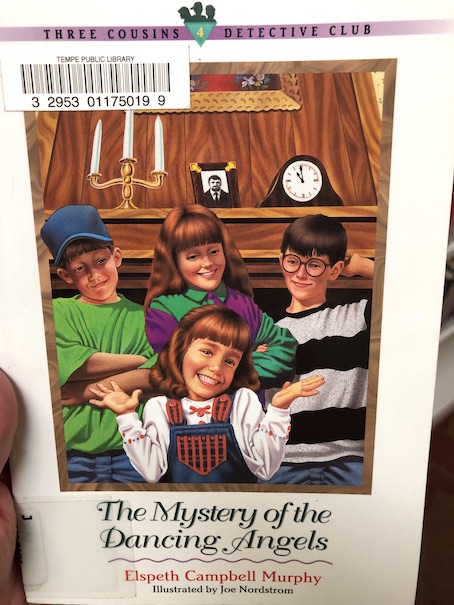
The Mystery of the Dancing Angels

Three Cousins Detective Club

#4 The Mystery of the Dancing Angels by Elspeth Campbell Murphy, 1995.

Sarah-Jane, Timothy, and Titus are visiting their grandparents over the summer when their grandmother’s cousin comes over to discuss some information she has found about their family’s genealogy. The kids’ great-great-great-grandfather was a woodcarver, and he did some work in a large house that is now being restored. There is a story that an expensive ruby necklace that belonged to the former owners of the house may be still hidden somewhere on the property.

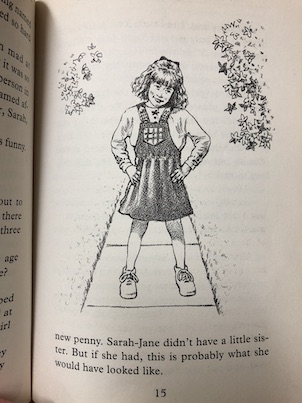
The prospect of exploring the old house and maybe finding the missing necklace sounds exciting, but the kids also must spend their time looking after their distant cousin, Patience, who is only four years old and has a tendency of getting into trouble.

When little Patience disappears inside the house, the kids are worried, but she soon returns with the answer to a riddle that has been passed down in their family for generations. Dealing with little kids requires patience, but Patience herself notices details in the woodwork in the house that the adults and older children haven’t noticed.

The theme of the story is patience.

The book is available to borrow for free online through Internet Archive.

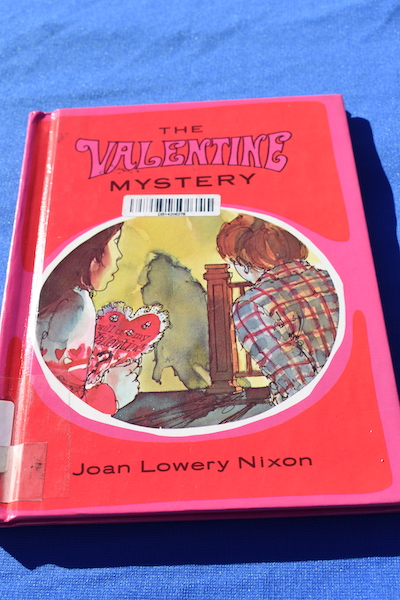
The Valentine Mystery

The Valentine Mystery by Joan Lowery Nixon, 1979.

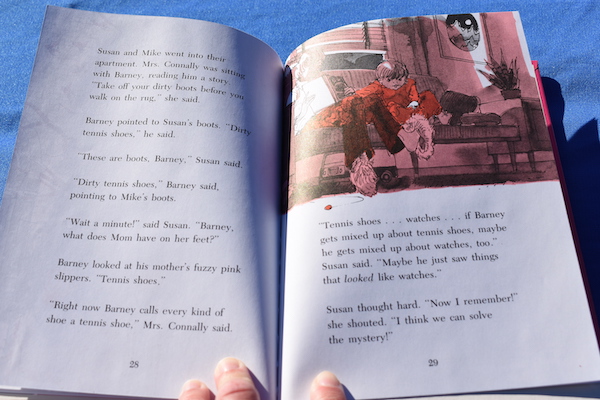
Someone leaves a mysterious, unsigned valentine for Susan Connally at her apartment on Valentine’s Day. Even though everyone was home at the time that the valentine was delivered, the only person who saw the person who brought it was Susan’s little, two-year-old brother, Barney.  All Barney can say about this person is that “He had watches on his tennis shoes.”

Susan and her other brother, Mike, decide to ask some of the other people who live in their apartment building if they know anything about the valentine or a strange person who wears watches on his shoes. 

Nobody knows a person who wears watches on their shoes.  Most people aren’t even wearing tennis shoes.  They’re wearing boots because it’s snowing outside. The questions the kids are asking about people with watches on their tennis shoes sound so strange that one of their neighbors, Mrs. Pickett, thinks that the kids are trying to find the solution to a riddle and keeps guessing things like “a spotted dinosaur who has time on his hands?”  (Mrs. Pickett is one of my favorite characters in this book. All of her solutions involve a spotted dinosaur, for some reason.)

There is a boy named Pete who lives in their apartment building.  His family has only moved there recently, and he’s in Susan’s class at school.  Susan thinks it would be nice if the valentine turned out to be from him, but he’s not wearing tennis shoes or watches.  He’s also wearing boots with round buckles on them.

The breakthrough comes when the kids discover that their little brother is going through a phase where he calls all kinds of shoes “tennis shoes.”

The book is available to borrow and read for free online through Internet Archive.

I read this book when I was a kid and then spent years trying to remember what book involved a kid who thought someone had watches on his tennis shoes before I found it again. It’s a cute, fun Valentine’s Day mystery story, and I love all of Mrs. Pickett’s guesses about who would wear watches on their tennis shoes.

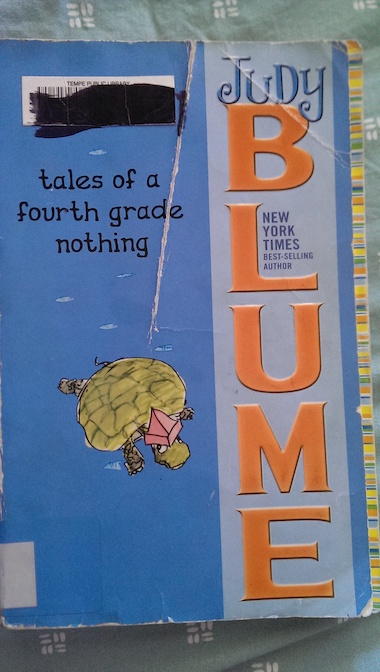
Tales of a Fourth Grade Nothing

FourthGradeNothingTales of a Fourth Grade Nothing by Judy Blume, 1972.

Fourth-grader Peter Hatcher is being driven crazy by his younger brother, Farley, who everyone calls Fudge because he hates his name.  People think that two-year-old Fudge (he turns three during the book) is cute, and his mother sometimes spoils him or gives in to his tantrums.  To Peter, Fudge is a little terror, and he feels like his parents don’t care as much about him as they do about Fudge.

Most of the book is kind of like a series of short stories about Fudge’s antics which take place over the course of several months.

When Fudge goes through a phase of refusing to eat unless he gets to eat on the floor under the table, like a dog, their mother allows Fudge to get away with it, even patting him like a dog.  Peter thinks that his mother would be better to let Fudge not eat until he gets hungry, and Fudge’s doctor gives her the same advice, but his mother lets Fudge’s behavior continue until their father gets tired of it and dumps a bowl of cereal on Fudge’s head, declaring, “Eat it or wear it!”

Fudge sometimes gets Peter into trouble, too.  Peter’s mother takes them to the park along with Peter’s friend Jimmy and Sheila, a girl they know from school who also lives in the same apartment building as Peter.  Their mother has to run back to the apartment for a moment, so Sheila volunteers to baby-sit Fudge.  Mrs. Hatcher only allows it on the condition that Peter help her.  Of course, Sheila, who is a pest, decides to chase Peter and tease him about having cooties, so no one is watching Fudge until he falls off the playground equipment and knocks out a couple of teeth.  Peter can’t help but notice that he gets more of the blame for that from his mother than Sheila does, even though she was supposed to be the main baby-sitter.

Fudge’s third birthday party is a disaster, with other little kids as messy and troublesome as Fudge himself.  He gets into Peter’s room and messes things up, including a project Peter was working on for school.  For many of Fudge’s antics, Peter is able to laugh about them in the end, but there is frequently frustration at his mother’s inability to stop Fudge from doing some of the things he does or her willingness to put up with them and her seeming favoritism at times for the cute younger sibling.

Then, Fudge does the worst thing he could possibly do and eats Peter’s pet turtle, Dribble, the one he won at his friend Jimmy’s birthday party.  Peter loved Dribble, talking to him throughout the book when he didn’t want to talk to his parents, and while everyone else is concerned for Fudge’s health and giving him presents for getting better, Peter is angry that his pet is now dead and no one seems to care about him . . . or about Peter himself.  Or so Peter thinks.

There is one more present from Peter’s parents and grandmother: a pet that Fudge would never be able to eat, and it’s for Peter alone.

Peter’s parents do care about him, even though they can get so caught up in Fudge’s antics and rescuing Fudge from them that it can be difficult to show it.  Most of the time, Peter is able to laugh with his parents at Fudge’s antics, which are pretty funny, but once in awhile, he also needs them to understand how the things that Fudge does affect him, too.

Reading it again as an adult, I sometimes find myself getting a little annoyed with the mother in the story.  Being a mother of a young child isn’t easy, but Mrs. Hatcher does take out her frustrations on Peter (something she even admits to at one point when he confronts her about blaming him for Fudge’s playground accident and she apologizes), and I take issue with some of her priorities and assumptions about Fudge’s behavior.  Sometimes, it seems like she doesn’t know her own child as well as his brother does and she doesn’t take take pragmatic steps in dealing with him and preventing problems before they start.  At times, I found myself thinking, “She’s making a mistake here.  Does she really not see this coming?”  Admittedly, I’ve read the book before, so I have an advantage, but putting a three-year-old into a suit he hates for his birthday party with other three-year-olds?  Seriously?  Suits are things adults are interested in, not three-year-olds, and many adults try to avoid wearing formal wear whenever they can.  She was trying to dress him up like a doll, not a real small child, and it was more for her sake than for his.  Sometimes, Mrs. Hatcher is reluctant to punish Fudge (admittedly, he is pretty young for most punishments), although she does spank him once when he ruins Peter’s school project, showing that she can stand up to him when it’s important.

Possibly, Peter was a different, calmer child when he was young, and Mrs. Hatcher sometimes expects Fudge to be the same way when he isn’t.  That might also explain the episode when Mr. Hatcher invites a business associate to stay with them for awhile, not considering that not everyone is used to putting up with a young child and some of the chaos that goes with it.

The age difference between Peter and Fudge is also important to the story.  Fudge looks up to Peter and wants to do a lot of the things he can do and have things like the stuff Peter has.  Having two kids with very different ages also makes family life a little harder because the children are in different phases of life and have different needs and interests.

Fudge-A-Mania

FudgeAManiaFudge-A-Mania by Judy Blume, 1990.

Peter is horrified when he finds out that his family is going to spend their vacation in the same place as bossy know-it-all Sheila Tubman and her family.  Even worse, the two families are going to be staying to be staying right next to each other.  Really right next to each other.  They’re staying in the same house, which has been split into two halves.  As far as Peter is concerned, the only thing that might save his summer is that his friend Jimmy will be coming up to stay with them part of the time.

The arrangement turns out to be a little better than Peter thought it would be at first.  Sheila finds a way to make some extra money by baby-sitting Peter’s five-year-old brother Fudge.  Fudge says at first that he wants to marry Sheila, although it turns out to be mostly because he’s afraid of monsters in his room at night, and he thinks that if he gets married and shares a room with Sheila, it will keep the monsters away.  Then, he decides that marriage may be unnecessary when he makes friends with a little girl named Mitzi, who is staying with her grandparents nearby.  Mitzi’s grandmother makes a special monster spray for her to keep monsters away, so Fudge decides that he might not have to marry Sheila after all.

Peter is happy when he discovers that Mitzi’s grandfather is Big Apfel, his baseball hero, and that he holds baseball games that are open to the public, so he and Jimmy can also play with him.  He also gets a crush on Isobel (“Izzy”), a girl who works at the local library, although Isobel is a few years older than he is.  The baseball game goes well enough, but the crush, not so much.

Then, comes the most shocking news of the summer: Peter’s grandmother and Sheila’s grandfather decide to get married!  If that happens, Peter and Sheila realize that they’ll be related by marriage!

Big Apfel and his granddaughter Mitzi are fictional characters, but the book that Mitzi claims is about her, Tell Me a Mitzi, is a real book.

This book is part of the Fudge Series.  It is available to borrow and read for free online through Internet Archive.

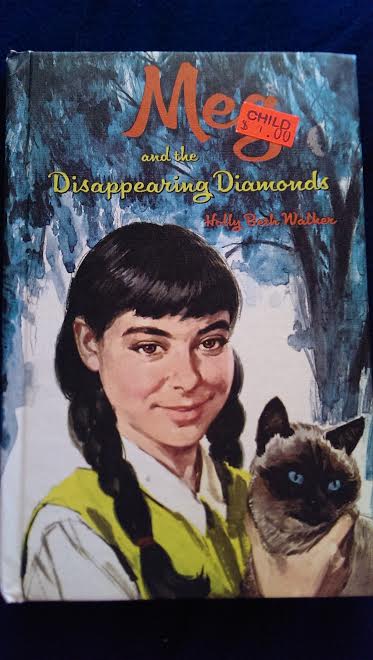
Meg and the Disappearing Diamonds

MegDisappearingDiamondsMeg and the Disappearing Diamonds by Holly Beth Walker, 1967.
Margaret Ashley “Meg” Duncan lives in a small town called Hidden Springs in Virginia, not too far away from Washington, D.C., where her father works.  Her mother is dead, and she has no brothers or sisters. When her father is away in Washington, working, Mr. and Mrs. Wilson, the gardener and housekeeper, take care of her.  For company, Meg has her beloved cat, Thunder (who doesn’t like anyone but Meg), and her best friend, Kerry.

People in Hidden Springs have been talking lately about Mrs. Partlow and her diamond jewelry.  Mrs. Partlow is the wealthiest, most important woman in town.  Usually, she keeps her jewelry in a vault at the bank, but recently, she brought it to her house so that she can wear it at her niece’s wedding.  Then, someone attempts to break into Mrs. Partlow’s house.  Nothing is taken, but everyone can guess what the thief was after.

MegDisappearingDiamondsPicMrs. Partlow invites a few friends to her house for tea to show them her jewelry and thoughtfully invites Meg and Kerry to join the women.  Meg and Kerry are excited at the chance to attend a grown-up tea party and to see Mrs. Partlow’s fabulous jewelry.  However, the party is crashed by Mrs. Glynn, a new woman in town.  Mrs. Glynn has three trained dogs that she dotes on.  She dresses them up in fancy costumes, and she can’t resist the opportunity to show them off when she wanders into the gathering in Mrs. Partlow’s garden.  The dogs cause a disruption, and after it’s over, everyone realizes that Mrs. Partlow’s diamond jewelry is missing!

Could the dogs have been an intentional distraction?  What about the person who tried to break into Mrs. Partlow’s house earlier?

Kerry’s much younger cousin, Cissie, is visiting her family and has a habit of taking things that catch her eye and hiding them in her secret “playhouse” which changes locations from time to time.  So far, the girls know that she’s taken Meg’s ballet slippers. Cissie also slipped into Mrs. Partlow’s party, uninvited and unnoticed by the other guests.  The girls don’t know for sure that Cissie took the jewelry, but the theft is a serious crime, and they don’t want to see little Cissie get into trouble.  They have to either find Cissie’s new “playhouse” and search it for the jewelry or to discover who else might have taken the diamonds before anyone else realizes that Cissie might be the thief.

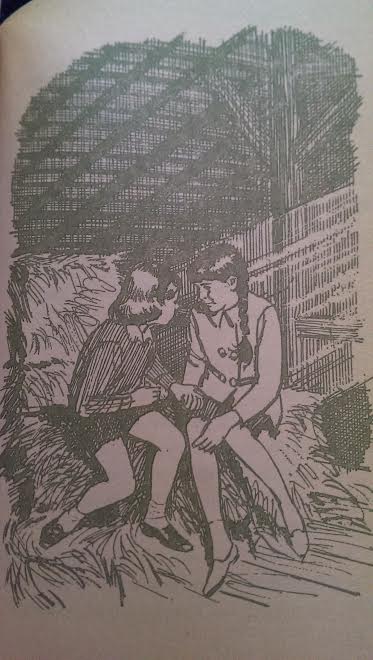
My edition of the book has drawings that are done in kind of a gray green color.

The book part of the Meg Duncan Mysteries.  It is available to borrow and read for free online through Internet Archive.