Sammy Keyes

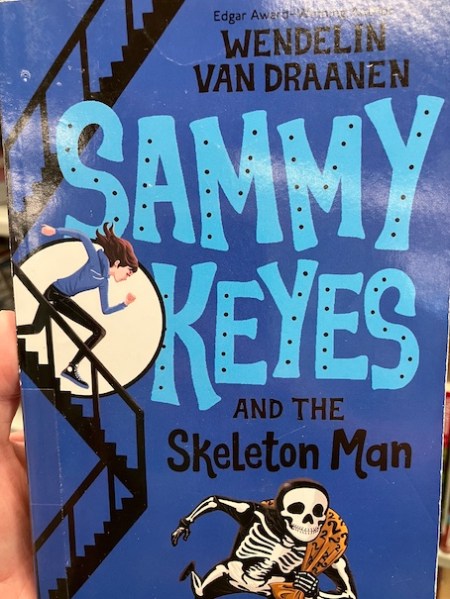
Sammy Keyes and the Skeleton Man by Wendelin Van Draanen, 1998.
Sammy Keyes decides that she wants to go trick-or-treating even though her grandmother thinks that she’s getting too old to do it. She’s still living secretly in her grandmother’s apartment in an apartment building that’s intended only for seniors, so she jumps at the chance to go out with friends on Halloween night. Dot (real name Margaret/Maggie), a new girl at school, invites her and Marissa to come over to her house to get ready before going out trick-or-treating, which works well for Sammy.
As Dot’s house, Dot is painting herself yellow as part of her bee costume. Sammy is going to color herself green so she can be a marsh monster (something she made up, but it sounds like a swamp monster from old movies). When Marissa comes, she brings Sammy a green sweater that she borrowed from her mother that would be good for a marsh monster costume, and the other girls help Marissa wrap herself in toilet paper for her mummy costume. As the girls set off to trick-or-treat, Sammy gets the idea to go by the old Bush House. The Bush House isn’t haunted, but it is a creepy place and there are stories about the crazy Bush Man who supposedly lives there and will jump out of the tangled bushes that surround the house and kill people. Sammy’s grandmother says that the stories are just stories and the old man who lives in the house is just a lonely old man, but Sammy thinks that it would be thrilling to visit the house and see it up close on Halloween.
As the girls approach the house, they almost collide with someone in a skeleton costume who’s running away. He looks bigger than the girls are, and he’s carrying a pillowcase that looks pretty full. The girls are startled, but Sammy is determined to go up to the Bush House and just knock on the door once for the experience of it. What Sammy sees when she knocks on the door is even more startling.
The door of the house just swings open, and there’s a pile of newspapers on the floor inside that are on fire. Sammy calls out to see if there’s anybody in the house. There’s no answer, so Sammy rushes inside and manages to put out the fire by smothering it with her marsh monster sweater. As the girls are about to leave, Sammy sees someone in a Frankenstein costume in a chair, and they scream and run outside. Then, Sammy realizes that the Frankenstein mask was on sideways, and it’s not easy to breathe in a sideways mask, when the nose and mouth holes don’t line up, so she decides that she has to go back and see if the person wearing the costume is really alright. It’s definitely a human in a costume, and not a dummy. When Sammy removes the mask, she at first fears that the person in the costume is dead because he’s so still, but it turns out that the person under the mask is the Bush Man. He’s tied up, has a head injury, and is barely conscious. He begs the girls for help. The Bush Man is having trouble talking, so after the girls untie him, he writes a message down on paper, asking the girls to go next door and call the police. He also wants to know if the girls saw the skeleton man.
The Bush Man’s real name is Chauncy LeBard, and the reason he can’t talk is that he’s had surgery on his throat because of smoking-related throat cancer. He needs a device held up to his throat to really speak in an electronic voice (an electrolarynx, I’ve seen one used before). While Dot and Marissa run next door and call the police, Sammy stays in the house with him. When the police come, Sammy uncomfortably recognizes the police officer who knows her from the previous book in the series, Officer Borsch. Last time, she and Marissa told him that Sammy is Marissa’s foster sister so they wouldn’t have to reveal where Sammy is actually living. Dot is confused when Marissa refers to Sammy as her “sister”, but she doesn’t give them away.
Mr. LeBard explains that the man in the skeleton costume had forced his way into the house and tied him up, but he doesn’t know who the man is or why he did it. The girls can’t fully describe the man because he was wearing a full-body costume, although they agree that he seemed like a full adult, not just a tall teen. It seems like the skeleton man was a thief because Mr. LeBard’s wallet and a pair of candlesticks are missing.
After the night’s adventures are over, Sammy winds up spending the night at the house of an elderly friend, Hudson Graham, because her grandmother’s nosy neighbor is awake, trying to find proof that Sammy is illegally living with her grandmother in their apartment building. Hudson agrees to let Sammy stay with him, and it turns out that he’s also an old friend of Chauncy LeBard. Mr. LeBard used to be a political science professor at the local college, and Hudson was one of his students. The two of them liked to get together and have political debates. Then, Mr. LeBard’s mother died, leaving him her estate. The local rumors say that’s when Mr. LeBard went crazy and became the Bush Man. The reality is that he developed health problems because of his smoking and didn’t want his old friends to know. Chauncy also has a brother, who was disinherited by their mother because she disapproved of his wife, but nobody knows why the mother didn’t like her.
Sammy can’t forget about what happened with Chauncy LeBard, even if she wants to. She at least has to go back to the Bush House to get Marissa’s mother’s sweater, which turns out to be worth a lot more than either of them thought. Marissa tells her that, even though her mother never wears that old green sweater, she did notice that it was gone and was upset because it turns out that it was a designer sweater that she bought for $500. Sammy is horrified because, having put out a fire with that sweater, she’s pretty sure that it’s done for, and if she has to come up with $500 to replace it, so is she! When Sammy goes to see Chauncy about the sweater, she starts learning more about him and how his inheritance from his mother turned out to be more of a curse than a blessing. Sammy also starts to wonder whether theft was really the motive for what happened on Halloween. If Chauncy didn’t have that hole in his throat from his surgery, the sideways mask might have smothered him. Did the skeleton man want Chauncy dead?
The mystery of the skeleton man and the ruined $500 sweater aren’t Sammy only problems, though. At school, there’s a nasty rumor going around that Sammy has been calling a boy name Jared, trying to get him away from his girlfriend, Amber. Amber is angry with Sammy, and Sammy’s school nemesis, Heather, has been gleefully making sure that everyone in school knows about it in order to embarrass her as much as possible. Sammy knows that she has never called or even spoken to Jared in her life and doesn’t care about him, but it’s not easy to convince everyone else of that. So who really has been calling Jared? Sammy is sure that it’s really Heather, pretending to be her and saying embarrassing things to get her in trouble. It would certainly be in character for Heather to do that. The rumors are get so out of hand even in a day that one of Sammy’s teachers even suggests that maybe she should talk to a school counselor about her issues with Jared so it won’t affect her schoolwork.
Because the characters are middle school kids, Sammy decides that the best way to get evidence that Heather is her phone imposter is to crash her Halloween party. With everyone in costume and the whole class from school invited (except for Sammy, of course), Sammy, Marissa, and Dot are pretty sure that Sammy can sneak in with them, posing as Dot’s cousin “Nikki.” What could possibly go wrong?
The book is available to borrow and read for free online through Internet Archive (multiple copies).
My Reaction
There are characters in the Sammy Keyes series who smoke, which was becoming uncommon in children’s books in general when I was young in the 1980s and 1990s because adults didn’t want to set a bad example for children. In the last book, the fortune teller character smoked, and it kind of surprised me, but it seems that the series follows the unspoken rule for children’s books that include smoking, that the only characters who do it are either villains or oddballs, not cool people to be imitated. This book confronts the issue of smoking more directly, with Chauncy LeBard’s throat cancer. Mean girl Heather also turns out to be a secret smoker who bribes one of her friends to spy on Sammy and her friends by giving her cigarettes. Sammy later finds out that Chauncy’s mother was also a smoker who died of lung cancer. Between Chauncy’s throat cancer and his mother’s death, the story helps illustrate the hard realities of long-term smoking. Chauncy seems to be living in reduced circumstances, without heat or electricity in his house. My first thought was that his mother’s medical expenses and subsequent funeral and Chauncy’s surgery drained his funds. Medical expenses have wiped out people’s savings before in the US, and I remember that one of the stories they told us to discourage smoking when I was in school years ago was about a woman who was forced to sell her family’s heirlooms to cover her cancer treatment. When Sammy meets Chauncy’s brother, Douglas, she finds out that Douglas was trying to get his mother and brother to quit smoking, but neither of them would, and that’s part of the reason for the family rift. Douglas says that if Chauncy has suffered health problems and blown through the family’s money, it’s really his own fault. It’s true that Chauncy should have taken the hint and quit smoking a long time ago, and he might have spared himself a lot of pain and misery if he had, but it turns out that he didn’t sell the family heirlooms to pay for his medical expenses. There was something in his house that was worth a great deal of money, something that Chauncy couldn’t bear to part with even to improve his own living situation because of the sentimental value. The thief is one of the few people who understood what Chauncy had and how to take it without him even noticing that it was gone right away. In a way, what the thief really stole is as much of a mystery for most of the book as who the thief was. The skeleton man turned out to be one of the people I suspected, but not my first suspect, so I was actually in suspense for most of the book.
As for the side plot with Heather calling Jared as Sammy: Oh, criminy! This is one of those ridiculous tween problems that seems so impossibly complicated when you’re in middle school but pretty dumb when you’re not. I appreciate that the math teacher is concerned when Sammy seems distracted in class and her work suffers, but I have trouble believing that an adult teacher would really be interested in rumors about who at school is calling who. I can’t remember any of my teachers ever caring about that stuff because adults usually know that rumors are wrong and that this kind of school drama passes faster if you don’t feed it. I don’t recall any massive rumor campaigns getting the attention of teachers when I was a kid, and I can’t imagine any of my old teachers giving rumors much weight or interest. I think my teachers would have just told us to stop being drama queens, focus on our work, and save the gossip for after school. A few of the more outspoken and direct communicators on the faculty would have flat out told us that gossip isn’t worth anything, that most of it is wrong anyway (that was actually the subject of a play I was in at school once), and that everyone will have gotten bored of whatever it is and moved on in a week or two because nothing we were talking about was really that earth-shaking and we all had the attention spans of chihuahuas on a sugar rush.
If I had to say something to these kids about this situation, I might just tell Sammy not to go calling people who don’t want to speak to her (if I were to assume that she was doing that) because it’s just going to annoy everyone. As for Amber, it’s not really her business to control either her boyfriend or the person calling him, whoever it is. Her decision is whether or not she’s satisfied with how Jared is responding to the situation and if she wants to still be his girlfriend when he acts that way. I’d make it a point to tell Jared, as the center of this drama, that if he doesn’t want to talk to somebody on the phone, he should just hang up without saying anything. You don’t need to stay on the line with someone who’s bothering you. With today’s caller IDs and cell phones that identify everyone who calls, it’s even easier because you don’t have to pick up the phone in the first place if you recognize a number you don’t want to answer. I can’t remember if they had those in the late 1990s, or if that was more an early 2000s development, but I know we definitely had answering machines, and I knew people who would just let the machine answer most of the time, only picking up if they recognized the voice leaving a message. Either way, just because someone calls you doesn’t mean that you have to take the call. On the other hand, if Jared likes being called by a girl other than his girlfriend, it might be time for him to rethink his relationship and decide what he really wants. That seems to be where Jared is. The book describes him as not being too bright and going on an ego trip from whoever keeps calling him. Actually, if I were one of the teachers, the people I’d really want to talk to the most would be Jared’s parents because I think they’d have more power to stop the situation than anybody, no matter who the caller was. Jared’s a kid who still lives at home, so his parents could answer the phone first and find out who wants to talk to him or let the machine record a message that could be used as proof against a prankster who’s bothering him if it gets excessive. Most child pranksters would give up if they called a few times and only got the boy’s parents, especially if the parents sound annoyed or angry when they answer. If Jared’s family got the call on a landline (probable for the 1990s), an annoyed parent could also *69 to last-call return the prankster’s number or look it up on their phone bill if they want to confront the prank caller or talk to the prankster’s parents. It’s annoying to deal with a prank calling kid but not really that hard. I didn’t have access to my parents’ phone bill as a kid, but everyone knew how to *69. Of course, if people in the book handled the situation sensibly, the book would probably be less exciting, and we wouldn’t get the payoff of seeing Sammy get the best of Heather.
There are some laughs when Sammy finds a clever way to record Heather making one of her calls and play the recording for the whole school. It was the sort of victory moment that I would have loved when I was about twelve. However, Sammy’s secret life living in her grandmother’s apartment complicates any problems that Sammy has with the authorities and school administration. After she turns Heather into a public spectacle during a school assembly, the vice principal insists that Sammy’s mother attend a parent-teacher conference. Since Sammy’s mother isn’t available, her grandmother has to attend instead, risking the exposure of their secret.
There is a little more insight into Heather when Sammy sees what Heather’s home and mother are like, but understanding doesn’t equal approval. Heather’s life isn’t perfect, and she lets slip at her party that her mother is a 40-year-old who dresses really inappropriately and flirts with much younger men, possibly including some of her daughter’s teenage classmates. She doesn’t appear to know about Heather’s smoking habit or the truth about any of the other things Heather does. Knowing that her mother is odd and may have really inappropriate taste in men/boys doesn’t make Heather any more likeable, though. At the end of the book, Heather’s outbursts in front of the vice principal may lead to the school insisting on counseling for Heather, which is a hopeful sign, but since Heather remains a bully mean girl for the rest of the series, it’s not that hopeful. You can lead a person to professional help, but you can’t make them internalize it and make use of it.
For me, one of the best parts of this book was the further development of the relationship between Sammy and her grandmother and Hudson Graham. There are hints that Hudson is romantically interested in Sammy’s grandmother, and he treats Sammy like his granddaughter. He seems to be in on the secret of Sammy living with her grandmother and is one of Sammy’s best protections against getting caught. He willingly aids and abets Sammy’s investigations, giving her knowledge and guidance whenever she needs it, and at the end of the book, he gives Sammy and her grandmother a ride to the parent teacher conference.
The ending of the story sets up the beginning of the third book in the series with Sammy being given the assignment of completing some volunteer hours to make up for the disruption that she caused at school.

 Jestress's Forgotten Books and Stories