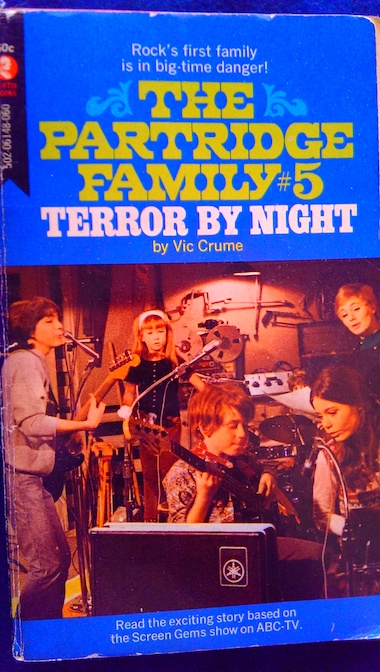
This book is part of the Partridge Family book series, based on the The Partridge Family tv show.
Shirley has been thinking that she and her children could use a vacation, and her family band’s manager, Reuben Kinkaid, suggests a place where they could have a little vacation and do some rehearsing. Reuben arranges for the family to rent a large house with several acres of land attached in a small New England town not far from Salem, Massachusetts. That should have been their first clue. That, and the fact that the town’s name is Haunt Port.
At first, the Partridges are just thinking about how they can rehearse without disturbing anyone on such a big place, and Danny and Chris want to try camping out. However, when they arrive in town, they learn that the name of the house they’ve rented is Witch’s Hollow and that it’s close to a place called Hangman’s Hill. Soon after the family arrives at the house, Keith and Laurie also find a dummy hanging from a tree with a note that says, “Welcome! The Hangman.” It’s pretty disturbing, but Keith and Laurie decide to hide the dummy and not scare the others. They don’t know who is behind this awful joke, but they don’t want to give that person the satisfaction of seeing them react to it.
However, the disturbing things don’t end there. The family’s dog, Simone disappears. Also, people in town seem to have a strange attitude toward the house’s cook/housekeeper, Mrs. Judbury, and her daughter, Prudence. Prudence is sullen and anti-social with a habit of catching toads for fun. Keith has to admit that he can see how Prudence might have gotten a reputation for being a witch, but there’s more behind the strange happenings at Witch’s Hollow than that.
Simone eventually returns, although it’s clear that she’s frightened and hasn’t been fed well, and Mrs. Judbury tells the family the story of her family’s history in Haunt Port. One of Mrs. Judbury’s husband’s ancestors was one of the accusers at the Salem witchcraft trials, but later, when people began to realize that they had executed innocent people, some of the accusers themselves found public opinion turning against them. This ancestor decided to leave Salem and go to Judbury Port (the old name for Haunt Port) because he had family there, but he and his wife were never really accepted there, either. This man later hanged himself in despair (at the place called Hangman’s Hill), and his wife later died alone, also shunned by the town. Although some of the townspeople might feel bad about how things ended up with the Judburys, the old uneasy feelings about the family have remained, and Prudence’s stand-offish attitude, combined with her mother’s apparent psychic premonitions, has fueled some of the old stories.
At one point, Keith tells Prudence that he knows why she acts the way she does, because it’s much easier for her to keep her distance from people and behave strangely than it is for her to try to learn to get along with them and make friends. Prudence isn’t responsible for what the townspeople did in the past, but she isn’t helping things in the present. Jane Parsons, whose family owns the local store, also helps in a way because she and Prudence are cousins, and Prudence joins her in welcoming a cousin of their and his friend when they visit town. As Prudence becomes friendlier, she and her mother become allies in trying to figure out the mysteries of Witch’s Hollow, which turn out to have less to do with past wrongs than current crimes.
The book is available to borrow for free online through Internet Archive.
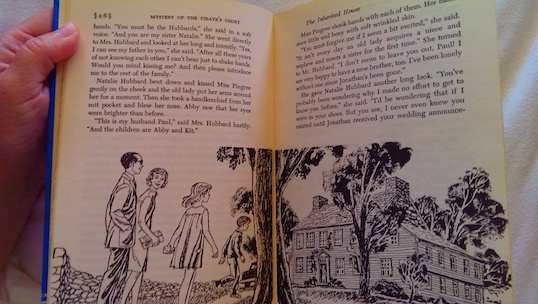
Mystery of the Pirate’s Ghost by Elizabeth Honness, 1966.
Abby
and Kit Hubbard’s mother has just received a letter telling her than her half
brother, Jonathan Pingree, has died and left her the old Pingree mansion. He has left over bequests to other family
members as well, and money to be held in trust for Abby and Kit. It’s exciting news, and the family may move
to live in the mansion they have inherited, although it partly depends on Mrs.
Hubbard’s other relatives.
Mrs. Hubbard, who was born Natalie Pingree, has never met her half-brother or half-sister. They were her father’s children, from his first marriage. She doesn’t know much about her father’s early life because he died when she was very young, and all that she knows about him is what her mother told her. Apparently, her father’s first marriage was not a happy one. He stayed in that marriage long enough for his first two children, Jonathan and Ann, to become teenagers. Then, he made sure that his first wife and children were settled comfortably enough in the family home and left them to move to Philadelphia to start a new life by himself. Sometime later, his first wife died and he married Natalie’s mother, who was much younger. After his death, Natalie and her mother moved in with her mother’s sister, Aunt Sophie. When Natalie got married, Aunt Sophie sent a wedding invitation to Johnathan and Ann, but they never came to the wedding or made any reply. Natalie assumed that they felt uncomfortable about their father’s remarriage and didn’t want to see her, which is why she’s so surprised about Jonathan leaving the family home to her. The only reason she can think of why he would do that is that neither he nor his sister ever married or had children of their own, so there was no one else to leave the house to. Both of them were more than 30 years older than Natalie, and Ann is now an elderly woman, still living in the house. Jonathan’s will has made provision for her as well, and the Hubbards go to see her at the Pingree mansion.
Mrs. Hubbard is pleasantly surprised that Ann is actually happy to see her. Ann Pingree explains that the reason why she and Jonathan never replied to the wedding invitation was that, until that invitation arrived, neither of them had known that their father had another child, and they felt awkward about it. However, Ann has been lonely since Jonathan’s death, being the last of the Pingrees, and she is glad to have Natalie and her husband and children with her and is eager to have them move into the mansion and live there. (Ann doesn’t live in the old mansion itself, but she does live nearby.)
Aunt Ann shows the family around the old mansion and explains more about its history and the history of the Pingree family. It turns out that the house, which has existed since Colonial times, although it has been burned, remodeled, and expanded over time. The house also has a number of secrets. Apparently, there used to be a tunnel running from the basement of the house to the beach that was used to bring in smuggled goods during the Colonial Era. There is also a hidden room behind a fireplace upstairs where the children of the family could hide during Indian attacks. (It doesn’t say how often that happened.) To the family’s surprise, Ann also tells them that the mansion is supposed to be haunted. The kids think it all sounds exciting, although Ann doesn’t explain much about the ghost the first time she mentions it. (Kit uses the phrase, “Honest Injun?” when asking Aunt Ann if she really means it when she says that the house is haunted. This isn’t a term that people use anymore because it isn’t considered appropriate.)
Mr. Hubbard is able to get his job transferred to a different branch of the company he works for, so the Hubbard family decides that they will move into the Pingree mansion. The kids like living by the beach, and their parents tell them that they can use the old ballroom of the house as a kind of rec room. Soon, they meet a couple of other children who live in cottages nearby, Chuck and Patty, and make friends with them. Chuck and Patty have already heard that the Pingree house is supposed to be haunted, although they’ve never seen anything really mysterious, just a light in the house once when they thought that the house was supposed to be empty.
The next time Aunt Ann comes to visit, the four children ask her to tell them about the ghost, and she tells them the story of the first Pingree to live at Pingree Point. This ancestor, also named Jonathan Pingree, built the original house in the late 1600s. He was a shipbuilder who owned several ships of his own, and he wanted to live near the sea. Later, he also became a privateer. When the kids call Jonathan a pirate, Aunt Anne agrees and explains that, unlike a pirate, Jonathan’s position as privateer was all perfectly legal because he had a Letter of Marque. (Yes, privateers operated within the law, but yes, they were also essentially pirates who raided other ships for their goods. In other words, they did the same things, but privateers did it with permission whereas ordinary pirates didn’t get permission. Historically, some privateers continued their pirating even after permission was revoked, so as Aunt Ann says, “the line between that and piracy was finely drawn.”) His son, Robert, was sailing on one of his father’s ships when it was taken by other pirates, and Robert was forced to join their crew. The family never saw Robert again and only found out what had happened from a fellow crew member who was set adrift and managed to make it back home. What happened to Robert is a mystery. His family didn’t know if he had really taken to the life of a pirate and couldn’t return home because he couldn’t face his family, if he had been killed in some fight, if he had been hung for piracy because he had gotten caught and couldn’t prove that he was forced into it. However, members of the family claimed that Robert’s spirit did return to the house and that he knocks at doors and windows, begging to be let back into his old home. Aunt Ann says that she’s never seen the ghost herself, but old houses can make all kinds of noises on windy nights, and that’s what she thinks the “ghost” is. As Chuck and Patty leave, they say, “we hope that old ghost doesn’t show up to frighten you.” Of course, we all know that it will because otherwise this book would have a different title.
One day, Kit is bored and starts playing around in the secret room, pretending that he’s hiding from American Indians. While Kit is in the secret room, he overhears the servants, John and his wife Essie, who have worked for the family for years, talking. Essie seems very upset and wants John not to do something that might risk their home and jobs, but John says that it’s too late and that they’re already “in it” and “can’t get out.” Kit tells Abby what he heard. That night, Abby hears banging and wailing during a storm and fears that it’s the ghost. Soon, other strange things happen, like a desk that mysteriously disappears and a cupboard that also mysteriously appears in its place. The children like John, and they don’t want to think badly of him, but he’s definitely doing something suspicious. One night, the children try to spy on him, and Abby once again hears the wailing and sees a mysterious, cloaked figure in the fog. Is it the ghost?
There are some interesting facets of this story that make it a little different from other children’s books of this type. For one thing, the children confide their concerns to their parents almost immediately, and the parents immediately believe them. In so many children’s mysteries, either the children decide to investigate mysterious events on their own before telling the parents or the parents disbelieve them, forcing the children to investigate on their own. It was kind of refreshing to see the family working together on this mystery. It actually makes the story seem more realistic to me because I can’t imagine that I would have been able to keep worries about mysterious things secret from my parents as a child, and they would have noticed if I was sneaking around, trying to investigate people, anyway. Abby and Kit do something dangerous by themselves before the story is over, but they also confide what they’ve done to their parents at the first opportunity and do not take the same foolish chance again.
The truth of John’s activities comes to light fairly quickly, although it takes a little longer for the family and the authorities to decide how to handle the situation. Investigating John brings to light some of the Pingree family secrets, and Abby and Kit soon discover the fate of Robert the pirate and the truth of his ghost. I’ll spoil the story a little and tell you that the ghost that Abby sees is apparently real, but it isn’t very scary. Once they learn the truth of what happened to Robert and see that his body gets a decent burial, the ghost appears to be at peace.
One thing that bothered me was the way that the characters talk about Native Americans in the book. It’s not the talk about Native American sometimes abducting children because I know that happened. It’s more how they picture that would happen. In the scene where Kit was hiding in the secret room, Kit imagines that the Indians were attracted to the house by the smell of his mother’s cooking and that he went into hiding while his mother fed them to avoid being abducted. As part of his scenario, he imagines that his mother would have wanted to “hold her nose against the Indian smell.” What? Where did that come from? There are all kinds of tropes about Native Americans in popular culture, from the “noble savage” image to that silly “Tonto talk” that actors did in old tv westerns, but since when are they supposed to smell bad? I’ve never seen characters in cheesy westerns hold their noses before, so what’s the deal? I tried Googling it to see if there’s a trope that I missed, but I couldn’t find anything about it. I’m very disappointed in you, Elizabeth Honness.
This book is currently available online through Internet Archive.
Linda Craig and the Clue on the Desert Trail by Ann Sheldon, 1962.
Linda
and her friend, Kathy, are exploring Olvera Street in Los Angeles before a horse
show when Kathy notices a strange man watching them. While the girls were shopping, Linda bought a
small horse statue that reminded her of her own horse. As the girls finish lunch, Linda notices an odd
symbol on the statue that looks like an arrowhead, but before she can study it
more, the man grabs the horse and runs off.
Linda tries to chase him down to get the horse back, but the man drops
it and breaks it. Linda picks up the
horse’s head and decides to go back to the shop where she bought it to see if
she can get another one.
The shop
doesn’t have another horse like the one Linda bought. It was unglazed, and the others are
glazed. Disappointed, Linda goes on to
the horse show, where she is taking part, along with her brother Bob and his
friend Larry. At the show, they see the
mysterious man again, and he apparently steals the broken head of the horse
statue that Linda had kept. Bob thinks
that maybe the man is some kind of smuggler and that there was something hidden
in the head that Linda hadn’t noticed.
Linda goes back to the shop to talk to the owner again, and he tells her that the horse was a special order from Mexico for a man named Rico. Rico said that he was a traveling salesman and that he would collect the horse at the shop, but when he didn’t turn up to get it, the shop owner decided to sell it. Linda asks the shop owner to send her another horse statue like the broken one if one comes into his shop and reports all of this information to the police. Then, when she returns to the horse show, she finds a threatening message, warning her to “Beware. Stay away from C. Sello.” The note is signed with the symbol of an arrowhead, similar to the one on the horse statue. Linda also reports this note to the police, but she can’t resist trying to figure out who C. Sello is and how this person fits into the mystery of the possible smugglers.
Soon after, the shop owner calls Linda to say that another horse statue did come into the shop and that he has sent it to her but now someone has broken into his shop and smashed every horse statue he has. Realizing that what they wanted was not in the shop, the bad guys are soon on Linda’s trail, even kidnapping one of her friends by mistake, thinking that it’s her. They even try to poison Linda’s horse!
At the end of a desert trail, the Mojave Trail, there is a ghost town with sinister characters and old cliff dwellings with Native American petroglyphs that may hold part of the secret to the mystery.
The story contains some anecdotes about California history, which is interesting. I have to admit, though, that I thought that the warning note for Linda was pretty silly. C. Sello turns out to not be a person but a clue about what the smugglers are smuggling, and they didn’t have to tell Linda what it was because she hadn’t heard about it at that point and wouldn’t have any reason to know what they were talking about. If they really wanted to get her to leave them alone, they could have left a more vague warning that didn’t include any clues like “Go home!” or “Go away!”
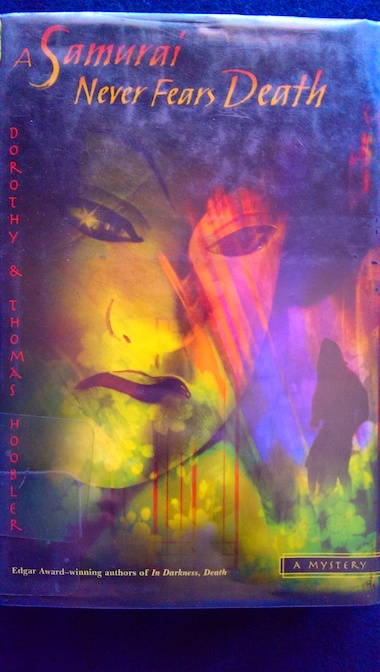
Sixteen-year-old Seikei returns home to visit his birth family in Osaka while Judge Ooka investigates reports of smugglers in the city. Seikei is a little nervous about seeing his birth family because he hasn’t gone to see them since he was adopted by Judge Ooka about two years before. All he knows is that his younger brother, Denzaburo, is helping his father to run the family’s tea business, which is probably a relief to Seikei’s father because Denzaburo was always more interested in the business than Seikei was.
However, things have changed in Seikei’s family since he left Osaka, and his homecoming isn’t quite what he imagined it would be. Seikei had expected that his older sister, Asako, might be married by now, but she says that Denzaburo is keeping her from her dowry because he needs her to help run the family business. Although Denzaburo enjoys business and the life of a merchant, it turns out that Asako has a better mind for it than he has. The two of them have been running the family’s tea shop by themselves because their father is ill. Also, although the family no longer lives above their shop, having bought a new house for themselves, Denzaburo says that he sometimes stays at the shop overnight to receive deliveries of goods. Seikei knows that can’t be true because no one ever delivers goods at night in Osaka. Denzaburo brushes off Seikei’s questions by suggesting that the three of them visit the puppet theater together to celebrate Seikei’s visit.
At the puppet theater, Seikei learns that Asako is in love with a young man who is an apprentice there, Ojoji. Because Ojoji is only an apprentice, the two of them cannot afford to get married, something that Denzaburo laughs about. However, before Seikei can give the matter more thought, they discover that one of the narrators of the plays has been murdered, strangled.
They summon an official from Osaka to investigate the scene, Judge Izumo, but Seikei isn’t satisfied with his investigation because it seems like Judge Izumo is quick to jump to conclusions. Then, suspicion falls on Ojoji. Asako doesn’t believe that the man she loves could commit murder and wants Seikei to ask Judge Ooka to intercede on Ojoji’s behalf, so Seikei begins to search for evidence that will help to prove Ojoji’s innocence.
The mysterious happenings and murders (there is another death before the book is over) at the puppet theater are connected to the smuggling case that Judge Ooka is investigating, and for Seikei, part of the solution hits uncomfortably close to home. However, I’d like to assure readers that Asako and her beloved get a happy ending.
During part of the story, Seikei struggles to understand how the villains, a group of bandits, seem to get so much support and admiration from other people in the community, including his brother. It is Asako who explains it to him. It’s partly about profit because the outlaws’ activities benefit others monetarily, but that’s only part of it. In Japan’s society, birth typically determines people’s roles in life, and each role in society comes with its own expectations about behavior, as Seikei himself well knows. Seikei is fortunate that circumstances allowed him to choose a different path when he didn’t feel comfortable in the role that his birth seemed to choose for him; he never really wanted to be a merchant in spite of being born into a merchant family. Others similarly do not feel completely comfortable with the standards that society has set for them, and their fascination with the outlaws is that the outlaws do not seem to care what society or anyone else thinks of them. The outlaws do exactly what they want, when they want to do it, dressing any way they please, acting any way they please, and taking anything they want to use for their own profit. Denzaburo, who was always willing to cut corners when it profited him, sees nothing wrong with this, and he envies the outlaws for taking this idea to greater lengths that he would ever dare to do himself.
The idea of throwing off all rules and living in complete freedom without having to consider anyone else, their ideas, their wants, their needs, can be appealing. Asako understands because, although she is better at business than either of her younger brothers, she cannot inherit the family’s tea business because she is a girl. She thinks that, because the system of society doesn’t look out for her interests, she has to look out for herself, and what does no harm and makes people happy (in the sense of giving them lots of money) shouldn’t be illegal. At first, Asako sees their activities as victimless crimes. Although she doesn’t use that term to describe it, it seems to be her attitude. However, do victimless crimes really exist? Seikei has a problem with this attitude because what the outlaws are doing has already caused harm in form of two deaths and the risk to Ojoji, who may take the blame for the deaths even though he is innocent. Asako might not care very much about the others at the puppet theater, but she does care about Ojoji.
It’s true that Seikei has defied the usual rules of society by becoming something other than what he was intended to be, and for a time, he struggles with the idea, comparing himself to the outlaws, who were also unhappy with their roles and wanted something different. However, the means that Seikei used to get what he wanted in life are different from the means that the outlaws use, and Seikei also realizes that his aspirations are very different from theirs. While Seikei had always admired the samurai for their ideals and sense of honor and order, the outlaws throw off the ideals of their society in the name of doing whatever they want. Although the outlaws do benefit some of the poorer members of society, paying money for goods that the makers might otherwise have to give to the upper classes as taxes and tribute and trying to stand up for abused children when they can because their leader was also abused as a child, their main focus is still on themselves and what they and their well-paying friends want. Seikei is concerned with justice and truth, which are among his highest ideals. Even though he learns early on that, as a samurai, he could claim responsibility for the deaths at the theater himself because, in their society, a samurai would have the legal authority to kill someone for an insult. Claiming responsibility for the killings would allow Ojoji to go free, and it would be one way to solve the problem quickly and make Asako happy, but Seikei cares too much about finding the truth behind the murders and bringing the real murderer to justice to take the easy way out. It is this difference in ideals and priorities between Seikei and others around him which set them on different paths in life.
One thought that seemed particularly poignant to me in the story is when Seikei reflects that we don’t always understand the importance of the choices we make in life at the time when we have to make them because we don’t fully understand all the ways in which a single choice can affect our lives. He thinks this when the leader of the outlaws offers to let a boy who was abused come with them and join their group after they intervene in a beating that the boy’s father was giving him. They tell him that joining their group would mean that he could do whatever he wants from now on. The boy, not being sure who they are or what joining their group would really mean for him, chooses to stay with his father. Seikei wonders then whether the boy will later regret his decision or not. His father obviously doesn’t treat him well and may not truly appreciate his show of loyalty by remaining, although joining the outlaws comes with its own risks. It’s difficult to say exactly which two fates the boy was really choosing between in the long run and which would be likely to give him a longer, happier life, which is probably why the boy chose to stick with what he already knew.
There is quite a lot in this story that can cause debates about the nature of law and order, society’s expectations, and the effects of crime on society and innocent bystanders. I also found Seikei’s thoughts about what makes different people choose different paths in life fascinating. I’ve often thought that what choices a person makes in life are determined about half and half between a person’s basic nature and the circumstances in which people find themselves, but how much you think that or whether you give more weight to a person’s character vs. a person’s circumstances may also make a difference.
The story also explains what fugu is, and there is kind of a side plot in which Judge Ooka wants to try some. A lot of the characters think that the risk involved in eating the stuff isn’t worth it, but well, a samurai never fears death, right?
There is a section in the back with historical information, explaining more about 18th century Japan and the style of puppet theaters called ningyo joruri, where unlike with marionettes or hand puppets, the puppeteers are on stage with the puppets themselves, wearing black garments with hoods so that the audience will disregard their presence (except for very well-known puppeteers, who might reveal their faces). For another book that also involves this style of puppetry, see The Master Puppeteer.
After leaving Mexico, Basil and his best friend Dr. Dawson journey north into the western territories of the United States. There, some friends of their ask them to investigate a smuggling operation. Mice have been illegally bringing Mexican antiquities across the border.
Basil realizes that the smugglers have been smuggling the antiquities in the open, pretending that they are ordinary replicas, the kind that tourists often buy. Because the border guards aren’t experts in antiquities, they haven’t been able to tell the difference between harmless souvenir replicas and the real thing.
When they catch one of these smugglers, they learn that the mastermind behind the scheme is a mouse called J.J. in a town called Moriarty in New Mexico (the name of the town irritates Basil). They go to the town with the help of some friendly horses and confront J.J.. At first, they think it won’t be too difficult because, although J.J.’s house is well-guarded, he is confined to a wheel chair because of an accident. However, the wheel chair is an act, and J.J. is no ordinary mouse.
Although J.J. escapes, Basil and Dr. Dawson decide that the smuggling ring has been defeated and it’s alright to continue their sight-seeing. However, their adventures are not over!
Basil and Dawson want to see the Grand Canyon, but it turns out that the hotel where they are staying is being terrorized by a weird, glowing Thing. Nobody knows what it is, but guests think it could be some kind of ghost or monster, and many of them are too afraid to stay. The owners of the hotel ask Basil to discover what the Thing is and stop whoever may be behind it before their hotel is ruined!
This book is really two stories in one, and neither has any direct bearing on the other. In that way, it’s kind of disjointed.
The book is currently available online through Internet Archive.



 Basil in the Wild West by Eve Titus, 1990.
 Although J.J. escapes, Basil and Dr. Dawson decide that the smuggling ring has been defeated and it’s alright to continue their sight-seeing. However, their adventures are not over!
 Jestress's Forgotten Books and Stories