Lowly Worm Sniffy Book

Sniffy books or scratch-and-sniff books were a new development during the 1970s, and they remained popular through the mid-1980s, along with scratch-and-sniff stickers. This particular book features characters from Richard Scarry‘s Busytown series, especially Lowly Worm. The first part of the book has Lowly and his friend Huckle Cat looking at a sniffy book and teaching readers how to use the scratch-and-sniff parts of the picture.

The rest of the book takes readers through the four seasons: spring, summer, fall, and winter. In each season, there are different objects and foods associated with the season for readers to scratch and sniff. In the spring, the characters smell violets and bananas that they eat at the circus.

During the summer, there are lemons for making lemonade and chocolate ice cream sticks that they eat at the beach.

During the fall, there are apples and pumpkin pie at Thanksgiving.

The winter parts focus on Christmas, with pine-scented Christmas trees and gingerbread pigs.

Sniffy books and stickers were common features of my early childhood in the 1980s. I think they still exist, although I don’t know if they’re as popular in the 21st century as they were back when they were relatively new developments. This particular sniffy book was a favorite of mine and my brother when we were little kids.

One of the interesting things about finding some of these older sniffy books decades later is seeing which of the scratch-and-sniff patches have held up over the years. They do wear out over the time, especially the ones that have been scratched more than others, meaning that favorite scent patches will wear out faster. Milder scents are also harder to detect years later than the ones that were always strong. In our old copy of this book, I can’t smell the lemon, chocolate ice cream, pumpkin pie, or gingerbread any more, but the violet, banana, apple, and pine are still fine. I think those scents were always the strongest.

Baker Smurf’s Sniffy Book

Baker Smurf’s Sniffy Book by Peyo, 1982.

“Sniffy” books with scent patches for readers to scratch and sniff were a recent innovation in the 1980s and were popular with kids. Many books that included this feature used well-known characters from popular children’s cartoons, like this one featuring the Smurfs.

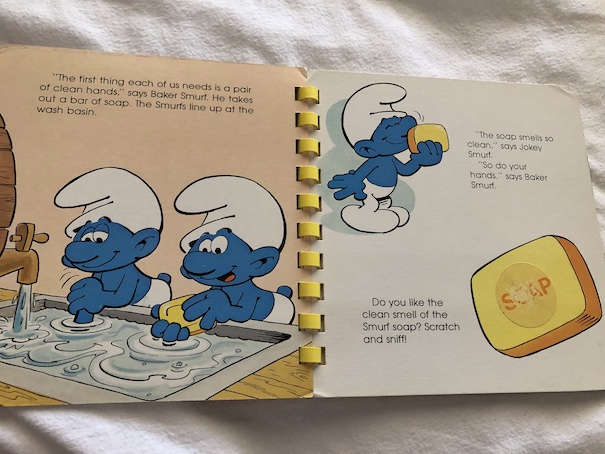
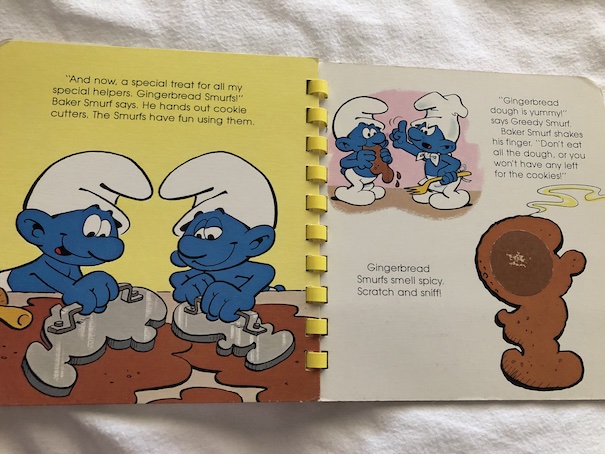
The Smurfs are making special treats as part of a surprise party for Papa Smurf’s birthday! The first scent in the book is the soap the Smurfs use as they wash their hands and prepare to help.

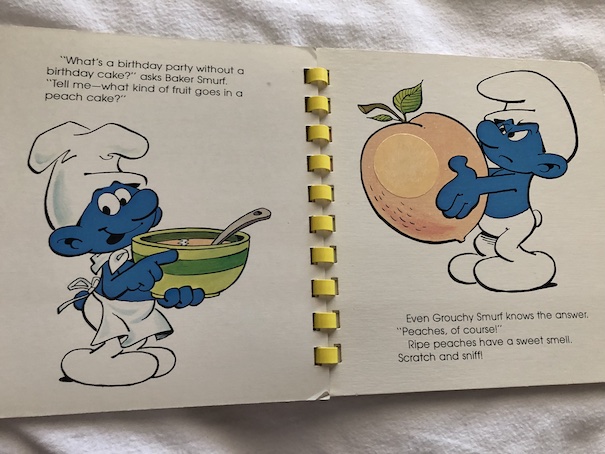
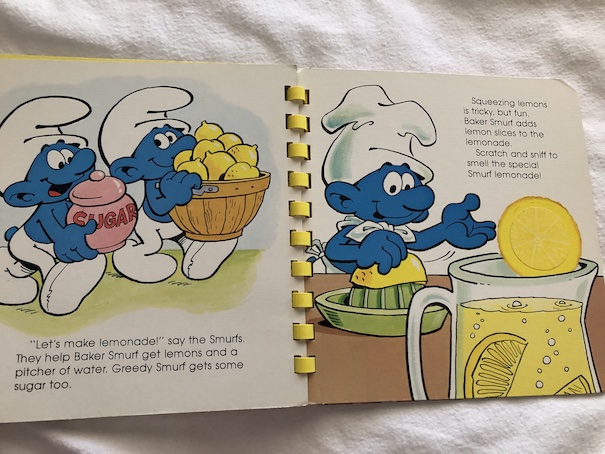
All of the rest of the scents in the book are ingredients they use to make the birthday treats. There is the jam that they put in the jelly rolls, the peach they put into the peach-flavored birthday cake, violets that they make into candied violets (not common in the US, but they can be used as decorations on desserts in real life), gingerbread that they make into gingerbread Smurfs, and lemonade.

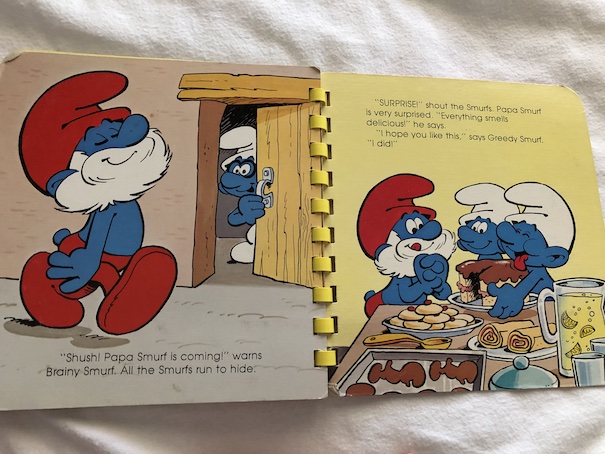
When everything is ready, they surprise Papa Smurf with their fun birthday feast!

My Reaction

We’ve had this book since I was a little kid. Sniffy books gradually lose their scents the more the patches are scratched, but we used this one pretty frequently, and the scents have held up surprisingly well. You can see the scratch marks on the scent patches in the pictures, and the scents aren’t as strong as they used to be, but even more than 30 years later, the scents are still there and recognizable as what they’re supposed to be. The one that held up the least well is the lemonade scent, but the others are pretty good for being as old as they are!

Detective McGruff Sniffs Out a Thief

Detective McGruff Sniffs Out a Thief by Megan Durand, illustrated by John Sullivan, 1983.

Sniffy books, or scratch-and-sniff books, were popular during my early childhood in the 1980s, and they are still being made today. Scratch-and-sniff books are picture books with special patches that release a scent when they’re scratched. Kids like interactive books, so it can be fun for them to scratch a flower or some food in a picture and then smell it. I know from my old books that these scented patches eventually wear out, although I’m amazed that some of them still have a scent more than 30 years after the books were originally made. I had expected that the ones that my brother and I liked and scratched the most would be the ones that would eventually wear out the fasted, but it also depends on the strength of the original scent. The milder, more subtle scents are often more difficult to smell decades later. Scratching a little harder can sometimes help. This picture book is a mystery story, and I thought that it was clever, using the sniffy patches as part of the mystery story.

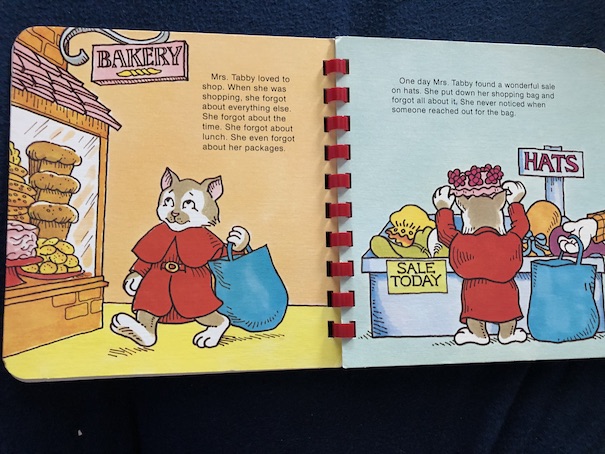
Mrs. Tabby loves shopping, but she often forgets to pay attention to her purchases while she’s looking at other things. One day, someone steals her shopping bag while she’s trying on hats at a sale. It’s terrible because the bag contained the chocolate cake for her son’s birthday.

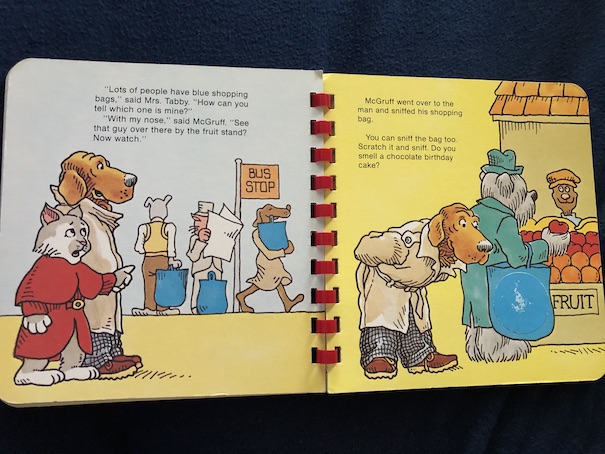
Fortunately, Detective McGruff is nearby when Mrs. Tabby realizes that her bag is missing. Unfortunately, finding it isn’t going to be easy because many people are carrying blue shopping bags that look like hers. Mrs. Tabby isn’t sure what to do, but McGruff decides to use his nose to sniff out the correct bag.

McGruff approaches various shoppers and gives their bags a sniff. All of the bags look alike, but readers can scratch and sniff the special patches on each bag and try to guess what they contain before McGruff reveals the truth.

After sniffing several bags, McGruff eventually locates the one that smells like chocolate and finds the cake. But, curing Mrs. Taffy of being forgetful is another matter.

Detective McGruff, or McGruff the Crime Dog, was created in the early 1980s as a mascot for anti-crime messages from U.S. police and law enforcement agencies through the National Crime Prevention Council, including anti-drug messages and information related to the issue of child abduction. Sometimes, police use McGruff costumes when visiting schoolchildren to talk to them about crime.

Peter Rabbit's Sniffy Adventure

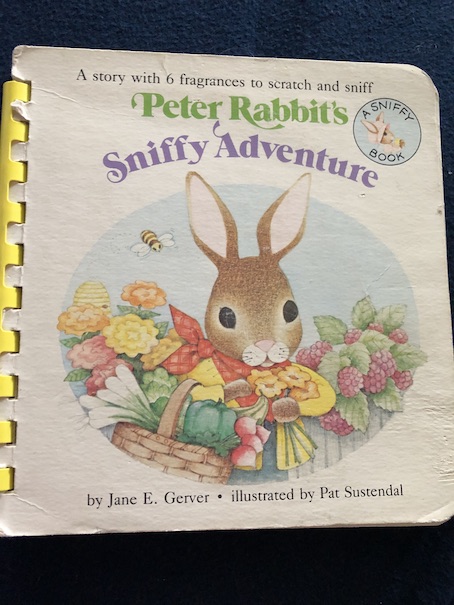
Peter Rabbit’s Sniffy Adventure by Jane E. Gerver, illustrated by Pat Sutendal, 1984.

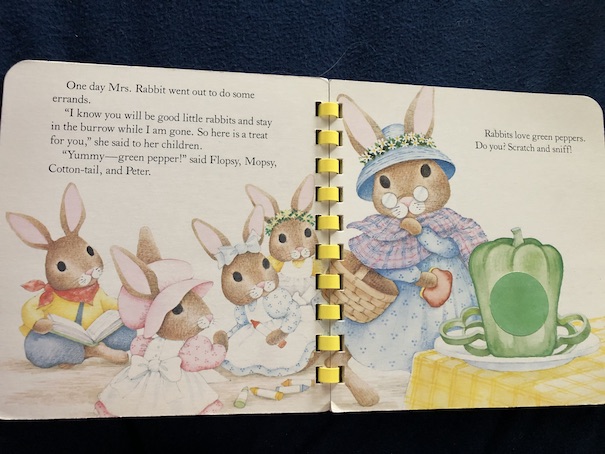
Sniffy books, or scratch-and-sniff books, were popular during my early childhood in the 1980s, and they are still being made today. Scratch-and-sniff books are picture books with special patches that release a scent when they’re scratched. Kids like interactive books, so it can be fun for them to scratch a flower or some food in a picture and then smell it. I know from my old books that these scented patches eventually wear out, although I’m amazed that some of them still have a scent more than 30 years after the books were originally made. I had expected that the ones that my brother and I liked and scratched the most would be the ones that would eventually wear out the fasted, but it also depends on the strength of the original scent. The milder, more subtle scents are often more difficult to smell decades later. Scratching a little harder can sometimes help. If you look carefully at the pictures of our old book, you can see where the round scent patches are on the illustrations.

This book is based on The Tale of Peter Rabbit by Beatrix Potter. It’s meant as a continuation of Peter Rabbit’s adventures.

Peter Rabbit lives with his mother and three sisters. One day, Mrs. Rabbit leaves her children alone while she goes to run some errands, giving them a green pepper to eat while she’s gone.

Then, Peter’s cousin, Benjamin comes by and asks Peter to come with him and visit Mr. McGregor’s garden. Peter is reluctant to go because of the trouble that he got into the last time, but Benjamin finally persuades him to come.

In Mr. McGregor’s garden, the bunnies eat raspberries, get into a sawdust pile, and stop to pick some flowers. Peter’s clothes become more dirty, stained, and torn through their adventures.

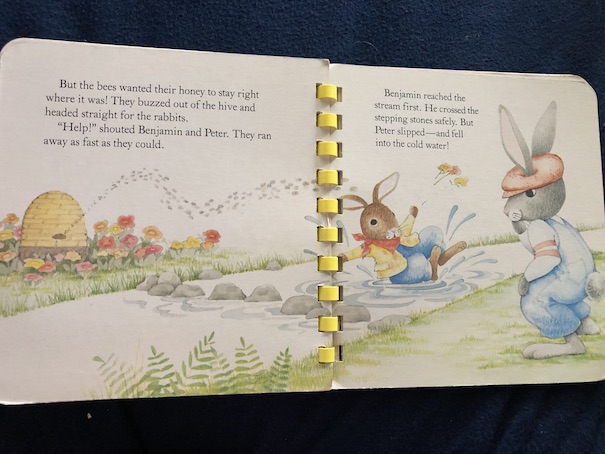
Then, Benjamin spots a beehive and suggests that they get some honeycomb to take home. They end up angering the bees, and Peter falls in a stream as they run away.

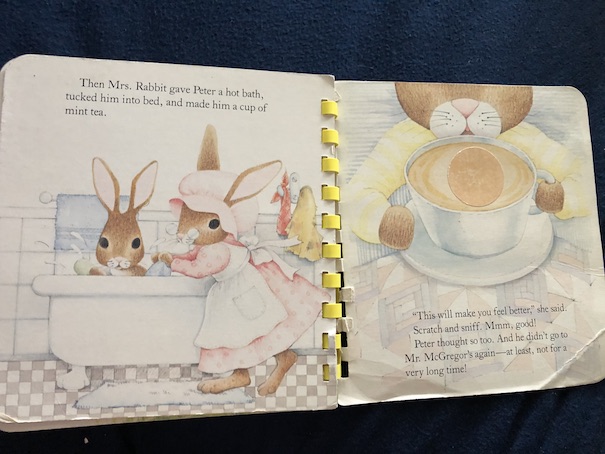
When he returns home, Peter is a mess, and he apologizes to his mother for going to Mr. McGregor’s, promising not to do it again. His mother gives him a bath and puts him to bed with a cup of mint tea.