The Wouldbegoods

The Wouldbegoods by E. Nesbit, 1901.

“We are the Wouldbegoods Society,
We are not good yet, but we mean to try,
And if we try, and if we don’t succeed,
It must mean we are very bad indeed.”

By Noel Bastable

The previous book in the Bastable Children series, The Story of the Treasure Seekers, ended with the children and their father going to live with their “Indian uncle.” The uncle isn’t identified by name, but he is apparently their real uncle, and he had only recently returned from living in India in the previous book, when he invited the Bastables to come live with him at Christmas. Since then, he has been helping the children’s father with his business, and the children are once again going to school, but not boarding school because their father doesn’t believe in boarding schools. However, the six Bastable children are still motherless and not accustomed to being supervised much in their free time.

During the spring, the children of one of their father’s friends come to stay for a visit. The Bastable children don’t like the other children much at first because they seem too timid and too well-behaved. The imaginative Bastable children decide that what these other kids need is a good game of pretend to get them out of their shells. One of the Bastables’ favorite books is The Jungle Books by Rudyard Kipling, so they decide to make their own jungle and act out scenes from the book. They give their guests the book to read, pointing out parts that they want to act out, while they go set up the jungle. They use the garden hose to create a waterfall, and they haul a bunch of their uncle’s taxidermy animals out of the house to set the jungle scene. They also set loose some guinea pigs and a pet tortoise and cover their dog in coal dust so he can be a wolf. Their father’s friend’s son, Dennis (called Denny), starts really getting into the game, but his sister, Daisy, prefers just to read the book. Matters come to a head when the boys frighten Daisy too much with their tiger costumes, and she faints. It is at that moment that their father and uncle arrive with some friends, seeing the children all gathered around Daisy, whom they first fear has died of fright. Some of the boys are nearly naked, their skin covered in brown dye so they’ll look like Mowgli from the book (no modern children should dye their skin for a costume like that, and that should be something adults explain to them, if they read this book), the taxidermy animals are all wet from the hose, the coal-covered dog is on the sofa inside, and the tortoise and one of the guinea pigs are never seen again.

Naturally, the adults are angry at the situation, and the children admit that their game went too far. The uncle swats the boys with his cane (not the girls because it would be ungentlemanly to hit a girl), and all of the children are sent to their rooms and put on a temporary diet of bread and water as punishment. Their father briefly talks of the possibility of boarding school, which shocks the children because they know how he feels about it. What the adults decide to do instead is to send the children to the country for the summer. Their friend from the previous book, Albert’s uncle, is an author, and he has rented a house in the country, where he will be writing. He always appreciates the children’s imagination and playacting, and he agrees to take all eight children, both the six Bastables and Denny and Daisy. (Albert isn’t there, so he’s probably somewhere with his mother.) Of course, since Albert’s uncle (who is never identified by any other name) will be writing much of the time, readers can guess that the children will have little supervision in the country.

The old manor house that Albert’s uncle has rented is a fascinating place. It has a moat around it, and a secret staircase, although it’s not really secret anymore because people already know about it. The eight children immediately begin doing things wrong in the country because they don’t know what they’re supposed to do and what they aren’t supposed to do, and adults usually only tell them what they’re not supposed to do after they’ve already done it. They ring a bell that is only supposed to be rung in emergencies, and they play in some hay that the horses are supposed to eat. Then, the girls in the group bring up an idea they’ve had.

The girls are still feeling guilty over the earlier bad behavior that got them sent to the country in the first place, so they’ve decided that it’s time for them all to reform their characters. Daisy in particular suggests that they form a society to do it because she knows that when people are serious about undertaking a good cause, they form a society for it. The boys aren’t as enthusiastic about the idea of forming a society around just being good, which doesn’t sound very fun or interesting, but the girls talk them into it. Oswald wants to know how it will be organized and who will be in charge, so they begin setting out some rules. Basically, all of the children are in the society, and nobody is allowed to leave it without telling the others. As long as they are in the society, they must always try their best to be good, and every day, they must try to do some good deed, which they will record in special book. After a debate about the name of their society, they decide to call it the Society of the Wouldbegoods. They also decide that this society must be kept secret from the adults, which is a major reason why their efforts turn out the way they do.

The first evening after they form the society, the children are unusually well-behaved but glum because they’re working so hard to be good. Albert’s uncle notices their odd mood, but they can’t explain to him why they feel this way, and he doesn’t press them. They also quickly have trouble finding good deeds to do, especially ones that are fun or interesting.

Dicky’s first good deed effort is to try to fix a window that seems broken to him, but it turns out that he doesn’t understand the reason why the window is the way it is. Because he changes it, a milk pan accidentally falls out the window into the moat. Oswald decides that the only good deed they can do is to retrieve the milk pan and fix Dicky’s mistake. They immediately recruit the other children to help them drag the moat, but none of them really knows how to do that, and by the terms of the society, they can’t ask the adults or tell them what they’re
trying to do. The only thing they can find to use for dragging the moat is a bed sheet, which they ruin by getting it dirty and tearing it, and it still doesn’t help them retrieve the milk pan. Failing that, they decide to make a raft and use it to reach the pan. This works better, but when they reach for the pan, the raft overturns and dumps everyone in the water, and Dora hurts her foot badly on an old tin in the water. Fortunately, the cook sees them fall in the moat, and she hurries to get Albert’s uncle, who gets the boat from the boathouse and rows out to rescue the children. (Apparently, the kids didn’t know there was a boat before they built the raft.)

Their next good deed goes better, although they don’t entirely think of it as a good deed. The children become fascinated with some soldiers who are training nearby. They like to watch the soldiers as they ride by and have their drills and exercises. When they wave to the soldiers, the soldiers blow kisses to the girls, which gives them a thrill. The kids dress up as soldiers and ask Albert’s uncle if they can borrow the old armaments that are decorating the walls of the old manor house as their weapons, and he says yes. (Oh, Good Lord, why? Nothing bad happens to the kids because of those old weapons, and they apparently don’t damage any of the antiques, but given their track record, this was taking a real risk.) The soldiers are amused by the children, and the next time they pass by, they stop and take a rest with the children. The captain of the soldiers takes some time to explain the soldier’s weapons to the children and tells them that they will soon be sent to the front overseas. (This is way too early to be World War I, and they refer to the Southern Hemisphere, so I think they’re talking about the Second Boer War, which was happening while this book was being written and published.) Before the soldiers leave, the children decide that they want to give them a parting gift, so they get some money from their father and give each of the soldiers a pipe and some tobacco, because the soldiers were all smoking during their rest break. Modern children’s books wouldn’t have the kids encouraging their smoking habit, but in this turn-of-the-century book, the gift goes over well. Sadly, the children never see any of the soldiers again after they leave for the front and don’t know what happened to them. Still, they did something nice for the soldiers.

The children’s experiences with the soldiers sets up their next attempt at a good deed, with mixed results. Part of it gets very uncomfortable, but it has a happy ending. The children notice an older woman who also watches the soldiers and seems to get very emotional when she sees them. They find out that her son is also a soldier who is already at the front, and she is very worried about him. The children decide that they should do something nice for her, so they try to weed her garden without permission. The problem is that the children
don’t know how to tell the difference between vegetables and weeds, so they also pull up her turnips and cabbages. The woman is angry with them, but they apologize and say that they’ll talk to their father about making things right with her.

Then, the children have to bring her a postcard addressed to her that was accidentally delivered to them with the mail for the manor house. They don’t even read it ahead of time although they could because they don’t want to do anything else wrong. This is a rare serious moment in this series because the postcard is from the army, and it says that the woman’s son is dead. The woman is very upset, and the children sympathize with her.

Then, the children decide that they can do something else nice for the woman by making a tombstone for her son. They know that he must have been buried at the place where he was killed on the battlefield, so he won’t have a normal tombstone in England, and they think it would be nice to make a memorial for him. The concept of making a memorial for someone who is buried elsewhere is actually a real thing. It’s called a cenotaph (although I don’t think these children know that word because they keep calling it a “tombstone”), and they are commonly done for soldiers who are killed overseas and buried there or whose bodies can’t be retrieved. (The musician Glenn Miller has one because his plane went down in the English Channel during WWII, and his body was never recovered.) Making a memorial of this type for the grieving family of a soldier would be a nice gesture, if it was done well and with the input of the soldier’s family. The kids do the best they can, carving a wooden tombstone and inscribing a beautiful message on it, but they don’t tell the soldier’s mother about it until after they’re finished. At first, the older woman thinks that they’re making fun of her grief, but Alice persuades her that’s not the case and convinces her to take a look. They decorate the tombstone with flowers and offer a lovely message about the soldier’s service to his country. The soldier’s mother is touched, and she appreciates the sentiment, although she has the children move the memorial to a more private spot. She likes it that the children continue to put flowers on the memorial, and she becomes friendly with them.

This episode also has a happy ending because it turns out that the reports of the soldier’s death were wrong. He was actually missing and injured, not killed. His mother and the children learn the truth when he comes home and sees the children decorating his “tombstone.” Fortunately, he is amused by the memorial and the touching sentiment expressed by the children, and his mother is overjoyed at his return. The children celebrate by chopping up the tombstone and using it for a bonfire.

Around this time, the children realize that they don’t have very many good deeds to record in their book, so they decide that they can make notes about any good thing that they notice someone else doing. Nobody is allowed to write about themselves or to persuade someone else to write something about them because bragging about their own good deeds wouldn’t be good or noble. It’s a fortunate decision because many of the children’s other adventures in the country aren’t directly related to the Society of the Wouldbegoods or their good deed efforts, but they count some of the things that certain children do during their adventures as good deeds (and Oswald gripes about things he did which he thought should have been counted but weren’t).

One day, the children are sent out on a long walk because Albert’s uncle has a headache and the children are making too much noise in the house. They decide to check out a tower that has some spooky local legends about it because it contains a tomb about halfway up the tower. The others credit Denny for a good deed because he offers to go first into the spooky tower. (This tower is somewhat based on a real landmark, but the
author took some creative liberties with it. The man who is supposedly entombed there, Richard Ravenal, isn’t a real person. He was created for this book, but he gets a mention in the lore of The League of Extraordinary Gentlemen.) The children have a frightening encounter there with a beggar. They give him a coin as a good deed, but he sees that the children have more money with them, so he locks them in the tower from the outside, telling them that he won’t let them out until they give him the rest. Oswald notices that there are bolts on the inside of the tower door as well as the outside, so he quickly locks them to make sure that the beggar can’t get inside. This turns out to be a good decision because, when the children toss the rest of their money to him, it isn’t as much as he thought they had, and he pounds angrily on the tower door. (Oswald thought that the others should have counted his locking the door as a good deed because it saved them, but they decide not to because it was really more “clever” than “good.” Oswald thinks that’s an unfair technicality.) The children are safe inside the spooky old tower until the beggar leaves, and they are able to signal to someone else to unlock the door from the outside. This incident wasn’t the children’s fault (for a change), but the adults insist that, from this point on, they take the dogs with them when they go very far from the house.

The children make some other attempts at doing good deeds on purpose, but again, they go horribly awry because the children don’t know what they’re doing, and they don’t talk to anybody else about their ideas before they do them. After they cause a disaster that ruins a fishing contest and wrecks a barge full of coal, which costs their father a lot of money to fix, Albert’s uncle explains to them the full consequences of what they did and how much trouble they caused for a lot of people. The children feel terrible about it, and Alice starts to cry. She doesn’t fully reveal the existence of their society to Albert’s uncle, but she does say that they’ve been working so hard at being good and doing good things, but nothing they do works out. She says that they must be the worst children in the world and dramatically says that she wishes they were all dead. Everyone is shocked by this, and Albert’s uncle calmly tells her that they’re not the worst children in the world. He says that he knows they’re all feeling bad about what they’ve done, and he does want them to feel badly because they have seriously caused some real problems, and he doesn’t want them to do these things again. However, he says that he doesn’t want them to give up on the idea of being good because that’s something that they will learn better how to do over time. Also, he notes that, in all the time he’s known then, none of them have ever done anything intentionally mean or wicked, they’ve never lied about what they’ve done, and they’ve always been sorry when things have gone wrong. Being truthful and genuinely regretful for causing harm are worthy qualities.

Oswald feels bad abut that part because he has realized that there’s one thing he’s done that caused a disaster, and he hasn’t admitted it to the others yet. What he did was unintentional, and he didn’t know the incident was his fault at first, but he’s been trying to work up the courage to confess since he realized what he did. Albert’s uncle’s kind words make Oswald confess right away, and Albert’s uncle is appreciative of his honesty for that, too. The others call credit Oswald’s confession as a good deed. He doesn’t think it is, but they say it counts because it was a difficult thing for him to do, and technically, he didn’t have to do it. At that point, nobody had guessed that he was responsible for one of the problems, and if he had kept quiet, it wasn’t likely that anybody would have found out. He had been honest because he simply wanted to be honest and do the right thing, even knowing that people might get mad at him or punish him for what he did.

Albert’s uncle forgives the children, although he still expects them to learn from their misadventures. At this point, the children also begin to consider just how far the Society of the Wouldbegoods will go. So far, it hasn’t been a great success, but they do appreciate what Albert’s uncle says about not giving up on the idea of trying to be good. Still, the children (especially Oswald), decide that it’s time to set an ending point for the society. They decide that each of them will try to do one more good deed of some kind, and when each of them has
one more deed to their name to put in their book, they’ll dissolve the society. From that point on, if any of them want to be good, they’ll do it on their own, when and how they choose do it. (The boys in the group are particularly relieved at this idea, although they’ve all been feeling some strain from the society.)

The children’s escapades still continue, some related to good deed efforts and some just part of summer activities that they do for fun. They try to hold a circus with some farm animals, which get loose. There’s a bonfire that gets out of control and burns a farmer’s bridge (although the children put it out themselves before it gets worse). Dora finds a baby who’s been left alone in his carriage and kidnaps/cares for it. At first, she thinks that maybe he’s the long-lost heir of a noble house who was kidnapped by gypsies, like in books,
and has been abandoned, so she must adopt him and care for him until he can be reunited with his family. Like many of the children’s good deeds, it has mixed results, but this one ends up being more on the side of good. She shouldn’t have just taken the baby from its carriage, and he technically wasn’t kidnapped until she took him. However, it turns out that his nanny was neglecting him, leaving him all alone while she flirted with her boyfriend. When the adults discover that the children have the baby and why they have him, the nanny’s neglect is exposed, and she gets fired.

A couple of the boys later buy a pistol, which they make all the children promise not to tell the adults about. (I thought at first that it was a toy pistol, but it apparently fires real bullets. God only knows why anybody thought it would be a good idea to sell these boys a real gun.) The boys were thinking at first that it would be handy to have if there was a burglar, but one of the boys accidentally shoots a fox with it and kills it. The other children, although they were pretending to be fox hunters, are upset at finding a real dead fox and bury it with a proper funeral before they know that it was one of the other boys who killed it. They get into some trouble over it from the master of fox hounds. The boy who shot the fox explains that, at the time he shot it, it was caught in a metal trap, and it bit him when he tried to let it loose, which is when he accidentally shot it. Albert’s uncle confiscates the pistol because none of this would have happened if the boys hadn’t been playing with a gun, and Oswald thinks that it would serve him right if they really did get a burglar in the house and were unable to fight him off. (I’m pretty sure that they’d be more likely to accidentally shoot one another or one of their own dogs before they shot anybody else.)

Toward the end of the summer, Albert’s uncle agrees to be a host for an antiquities society that wants to see the old manor house and investigate a nearby site for possible Roman ruins. Albert’s uncle is beside himself when he discovers that, rather than being host to a small club, more than 100 people show up to accept his invitation to have tea before touring the grounds. The children, inspired by a book called The Daisy Chain, decide that it would be amusing to bury some pottery that they made themselves, just so the antiquarians will definitely have something to find. That part turns out fine because the antiquarians can easily tell the pottery made by the children from actual antiquities, and they are amused by the children’s “relics.” The problem is that the children also decide to bury some pottery they found in the library along with their own pottery, and those were real relics. The antiquarians get excited when they find those, but Albert’s uncle realizes that those pieces of pottery belonged to the real owner of the rented manor house. The children have to go to the head of the antiquarian society to admit what they’ve done to get the antique pottery back.

From there, the children are inspired by something a tramp says to them to open up a stand offering free drinks (lemonade and tea), but it goes wrong when some people take advantage of their kindness. They also take part in some war games without realizing that it’s all a game or training exercise. Then, while acting out the pilgrimage from The Canterbury Tales, they meet a kind lady, who turns out to have a romantic past with Albert’s uncle! They’re not sure that they like the idea of Albert’s uncle getting married, but they’re willing to try to help him reconnect with his lost love if it will make him happy and for goodness’s sake!

THE EPITAPH

‘The Wouldbegoods are dead and gone
But not the golden deeds they have done
These will remain upon Glory’s page
To be an example to every age,
And by this we have got to know
How to be good upon our ow—N.’

by Noel Bastable

The book is now public domain, so it is available to read online through Project Gutenberg and Internet Archive (multiple copies, including audiobooks). There is also a LibriVox Audiobook on YouTube.

My Reaction

This book reminds me of a couple of more modern books, The Adventures of the Red Tape Gang by Joan Lowery Nixon from the 1970s and Why Did the Underwear Cross the Road? by Gordon Korman from the 1990s, which are both books about kids trying to do good deeds with unintentional and hilarious results.

Just as in the first book in the Bastable Children series, much of what the children do in this story is due to the children’s naivety and imagination and a lack of adult supervision. Oswald makes it a point to say that they were not entirely neglected by the adults while they were in the country. Although Albert’s uncle frequently had to spend time writing, he did spend plenty of time with the children, and their father and Denny’s father came to see them regularly, along with some other adults. The children enjoyed spending time with the adults and doing things with them, but Oswald doesn’t describe much of what they did with the adults because the things they did on their own were the most interesting. (In the sense of dangerous and disastrous, but also exciting.) At various times in the story, they meet up with adults who are happy to talk to the children and explain things about their business or how things work, but the children also like acting on their own initiative, without asking adults for advice or opinion or taking time to really prepare for things they want to do, like when Oswald didn’t want to take the time to actually train an animal to do something when the children decided that they wanted to have a circus with animals. The children’s innocence and ignorance are played for comedy, but child readers would probably appreciate the children’s sense of independence. Few modern children would be given even half of the opportunities the Bastables have to do things on their own and cause as much trouble as the Bastables do.

Racial Issues

In the first book of the series, I talked about some racial issues in the story, and there are also issues with racial language and attitudes in this book. I don’t know whether or not this book has been reprinted with altered language, like the first one. Some of the incidents in this book might take more editing than the first one, like where the kids darken their skin for acting out scenes from The Jungle Books or giving pipes and tobacco to the soldiers.

There is an instance of the use of the n-word in this book, and this time, it’s something Oswald says rather than something the adults say. Basically, he was talking about hard the children were working, and he was trying to imply that they were working like slaves, but instead of saying the word “slaves”, he says the n-word. Children’s word choice is influenced by the books they read reads and the things adults say around them, and we’ve already established that adults around them use the n-word in a casual way.

Again, this brings up the question of whether or not the author herself this that using the n-word is acceptable or if she’s just trying to portray the way some people around her talked. In a way, I think she does address this topic indirectly, although that might be unintentional. There is a point in the story when the children talk about unpleasant things found in poetry, like death and the devil, and they note that a person doesn’t always have to like the things they read or write about. It struck me that, perhaps, the author was trying to explain that she doesn’t always like, advocate, or believe in things that occur in her stories. This conversation isn’t directly related to the use of the n-word, so I’m not sure whether that would be one of the things that the author didn’t really like or not. It might have been a more general notion, like when authors write about sad things that happen or the things the children do that they really shouldn’t. It is a reminder, though, that characters are not exactly the same as their characters, and they may differ in important ways. The nature of the characters suits the story, but may not be a reflection of the author’s life and attitudes.

There is also one instance of an anti-Catholic attitude, but it’s played for humor. The kids are on a tour of Canterbury Cathedral, and their tour guide says, “This is the Dean’s Chapel; it was the Lady Chapel in the wicked days when people used to worship the Virgin Mary.”

(I’ve heard this accusation about Catholics worshiping the Virgin Mary before, all too many times, mostly from my Protestant grandmother. I belong to a family of mixed religions, and I had experiences like this from a very young age. Catholics don’t worship Mary. Catholics honor Mary, which is different. We also have a sense that those who were bound together by faith never lose that spiritual connection to the living members of the church when they die, so living Catholics can still communicate with the departed spiritually through prayer, which is what the whole thing about praying to saints is about. It’s about communication and spiritual support rather than worship. Catholics don’t have to do this if they don’t want to, but it’s always an option, if they feel the need of spiritual support from another soul who might understand their situation, because there is a sense that the spiritual connection is always there. Mary and the other saints are not substitutes for God or Jesus but rather part of an extended spiritual family that supports its other, younger, and more vulnerable living members in a spiritual way as they all, living and dead, serve and worship the same God. I suppose a simpler way of putting it is the concept that those who love us never leave us, or as C. S. Lewis put it in the The Chronicles of Narnia, once a king or queen of Narnia, always a king or queen of Narnia. Some bonds are unbroken by death. The punchline to the tour guide’s comment is in H. O.’s response.)

When the children think about the connotations of changing the name of the chapel from Lady Chapel to Dean’s Chapel because of changing worship styles, H. O. speculates, “I suppose they worship the Dean now?” You can imagine how well that question is received. Yeah, do they worship the Dean, or is the Dean just someone they’ve honored by naming something after him? You tell me if there’s a difference.

War and Soldiers

The scenes with the soldiers and war games remind me of something that the author couldn’t have known when she wrote the book. In the following decade, Britain would be involved with World War I (called the Great War before WWII), and many boys, like the kids in this story, would end up going to war. Oswald thinks that it would be exciting to be a soldier, but real war isn’t a game, and he might have many of his illusions shattered. Knowing what I know about this generation’s future, I have some real concern for the children in this story. There’s a very real risk that they could be killed in battle, just as the young soldier in this book that they built that tombstone for in this story could have died in the war that was being fought during his time. This story doesn’t go that dark because the Bastable Children series is a humor series, but there are moments of real sentimentality in the stories. E. Nesbit couldn’t have known about the war that was coming, but she did know about wars that existed during her lifetime. Introducing the children to the soldiers in this story introduces some serious concepts to the children, who are largely naive about many aspects of life, still thinking of many dangerous things as sources of excitement and adventure. We don’t know what happened to any of the soldiers the children befriended, but the knowledge that the old woman’s son almost died brings it to the children’s awareness that death is a very real possibility in that type of “adventure.” It’s a lesson that will accompany them into their future.

Eyewitness Medieval Life

Eyewitness

Medieval Life by Andrew Langley, photographed by Geoff Brightling and Geoff Dann, 1988, 2004.

I love books that explain the details of daily life in the past, and I especially like Eyewitness books because they include such great photographs to show objects that people would have used in the past.

This book begins by explaining the time period of the “Middle Ages”, which was the period between Ancient Greece and Rome and the Renaissance, when culture and knowledge from Ancient Greece and Rome came back into vogue. The Middle Ages lasted about 1000 years, roughly from 400 to about 1540 AD. (Estimates of the start and end dates vary because this was a period defined by cultural changes, which are gradual and don’t have precise start and end dates.) This long period of time can also be divided into smaller periods and contained many important events that helped to shape society and culture, including The Crusades and The Great Plague.

Medieval society was hierarchical and was based on land ownership. The king and the highest nobles controlled the land and allowed people in lower levels of society to use it or grant farming rights to peasants in exchange for rent in the form of their services and a share of what they produced. The peasants or serfs were tied to the land they farmed, and the land was owned by the lords they served. They were not regarded as “free” people, and they couldn’t leave their lord or the land except by raising enough money to buy some land for themselves or by marrying a free person from a higher level of society.

A lord’s manor included not only his manor house or castle but the nearby village, church, and the farmland where his serfs worked. Often, villages and manors had little contact with the outside world, so the people who lived there had to make most of what they needed themselves. Most people never left their land or were only able to travel a short distance from it, so the only new people they might meet would be traveling peddlers, soldiers, or pilgrims.

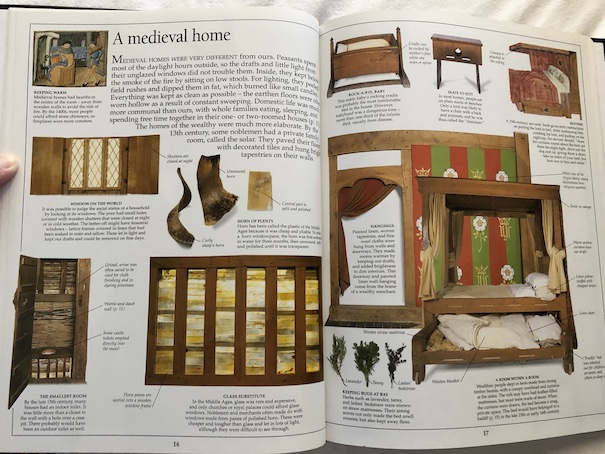
The book explains what would be found in a typical Medieval home. Poor people lived in houses that had only one or two rooms for the entire family. Few people could afford to buy glass windows. Poor people only had wooden shutters to cover their windows. Others might have tallow-coated linen over a lattice frame, which would let in light, and some wealthier people had pieces of polished horn in their windows, which also let in light, although you couldn’t really see through them well. What people ate varied depending on their social status. Wealthier people could afford a wider variety of foods, and poor people mostly ate what they produced themselves.

Women’s lives also varied depending on their social status. Pleasant women farmed and provided for their families alongside their husbands. Women in families of craftsmen and tradesmen often worked alongside the men in the family business. Wealthy women managed their husbands’ households or could rise to rank of influential abbess if they joined religious orders. However, the highest ranks in society were occupied by men.

While peasants served their lords, lords also owed services to higher nobles and, ultimately, to the king, although sometimes the king struggled to control powerful nobles and assert his authority over them. The king generally had to keep his nobles satisfied with his rule if he wanted to retain their loyalty because, while he was the source of their land and authority, they were effectively ruling over their own smaller lands with their own troops. While nobles owed their king military service and support, if they were dissatisfied with the state of their lands or were just unoccupied with other battles to fight and saw an opportunity, they would sometimes use their troops to raid the lands of neighboring nobles. Part of the king’s job involved preventing his nobles from being dangers to him and to each other. The king also made and enforced laws, settled disputes, and oversaw the collection of taxes.

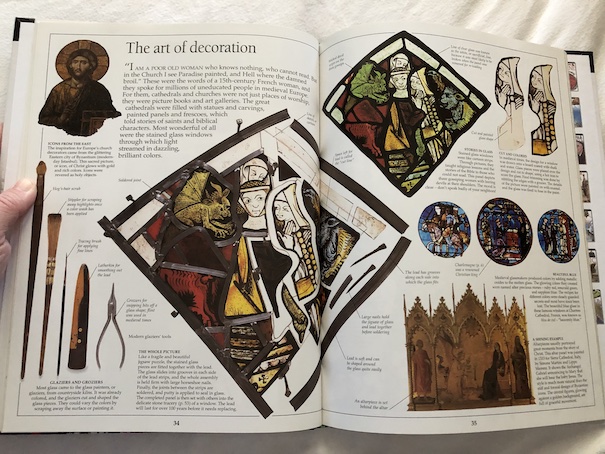
Christianity, specifically in the form of Catholicism, was central to the lives of people in the Middle Ages. During this time, stonemasons and craftsmen developed new techniques for building impressive cathedrals that still stand today. These cathedrals were lavishly decorated with statues, frescoes, and stained glass windows that depicted Biblical stories and the lives of saints. These works of art were important for helping to teach people who did not have the ability to read the Bible themselves about their religion.

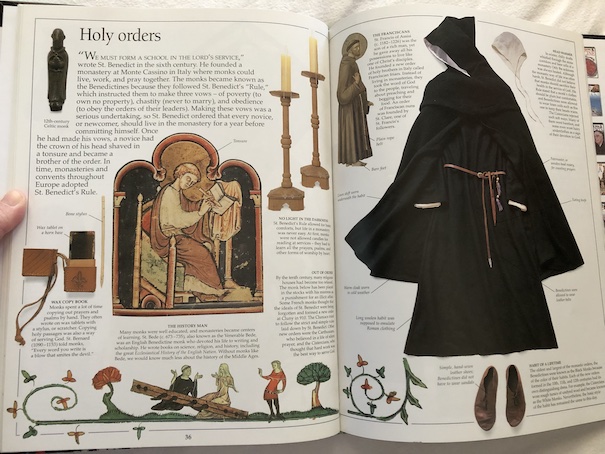
Religious orders of monks and nuns performed important functions for society, such as caring for people who were poor or sick, providing safe places for travelers to stay, and copying written texts by hand. In the centuries before the printing press was invented, there were only handwritten books, and they took time and skill to produce. It could take an entire year for someone to copy an entire Bible. Few people were able to own personal books, and much of the schooling in this period was provided by religious orders.

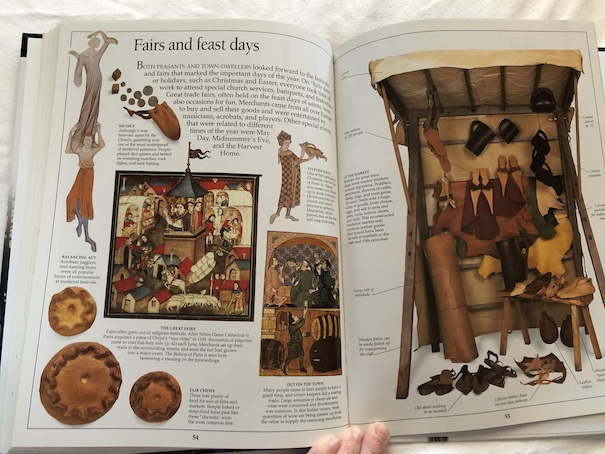
The book describes the rise of Islam during the early Middle Ages, increases in trade and commerce, the growth of towns, and guilds that controlled different professions. It also describes Medieval music and entertainment, such as plays and parades. One of my favorite parts of the book is about fairs and feast days.

The book ends by describing the beginning of the Renaissance and the rediscovery of classical Greek and Roman culture as well as the beginning of the Reformation and the development of new scientific discoveries and artistic styles.

The book is available to borrow and read for free online through Internet Archive (multiple copies).

The Magicians’ Challenge

The Magicians’ Challenge by Tom McGowen, 1989.

This is the third book in The Magician’s Apprentice trilogy. It picks up soon after the second book, with the magician Armindor, his apprentice Tigg, Jilla, and Reepah the grubber on their way to the city of Ingarron, where Armindor and Tigg were originally from. They’ve already told the people of the city of Inbal of the threat posed by the reen, the ratlike creatures that are scheming to take over the world by finding old forms of lost technology and using them to dominate and destroy humanity.

Before they return to Ingarron, they want to stop in Orrello and take care of some business there, letting that city know about their discoveries about the reen and the ancient technology they’ve uncovered. On the ship to Orrello, they begin to get some insight into one of the pieces of old technology they’ve uncovered – the magnetic compass. When they first found it, they didn’t know what purpose it served. All they could tell about it was that the compass’s arrow always points in one direction, no matter how you move it. When they show it to the captain of the ship, he says that he could see a purpose in having such a thing if it pointed to a place that he knew he wanted to go, and Tigg begins to realize that the compass doesn’t point to a specific place but the general direction north. They still have a concept of north and south as directions, but they don’t think in those terms unless they’re comparing one known location to another known location, which is why they didn’t think of it before. Armindor is overjoyed at the revelation. Their people currently depend on known locations or observing the sun and stars in the sky to find their way, but with a compass (which they consider a “spell” of finding your way), people could navigate even in unfamiliar areas where the sky isn’t easily visible. This is the sort of thought and investigation that “magicians” (scientists) have had to do since the old technologies were lost and forgotten following a great nuclear war. After thousands of years, people are starting to rebuild society and redevelop technological knowledge, but because they don’t yet understand most of the principles behind it, they think of it as “magic” and “spells.”

However, as they are about to arrive in Orrello, they discover that the city has already been attacked by the reen, and many people there are dead. The captain of the ship says it’s not safe to go to the city now, so Armindor asks him to drop off his party further down the shore so they can continue to Ingarron and warn them of the danger. Now that they understand how the compass works, they can use it to find their way. (Although, readers will notice that, because language and writing have changed over the centuries, they don’t understand which of the letters on the compass actually represents “north”, and they think it’s the ‘S’ symbol, so ‘E’ represents “west” and so on. Close enough. They have the basic principle, and as long as they’re consistent, it will still work.)

On the way to Ingarron, they find a young man who escaped from the attack on Orrello. The young man, tiLammis, turns out to be the nephew of an important merchant in Ingarron, and he confirms that it was reen who attacked Orrello. The others are grateful that tiLammis witnessed the attack so he can help describe and confirm their accounts of the reen.

When they reach Ingarron, they are relieved to see that it has not yet been attacked. Tigg is promoted from Apprentice to Novice Sage and becomes a member of the Guild of Sages. They warn the other sages and the Lord Director of Ingarron about the reen, and tiLammis’s account of the attack on Orrello helps to convince them of the danger. Because they know that the reen hide among human populations and spy on them, Armindor says that they will have to make their preparations to protect Ingarron in secret. No one outside of the city leaders and sages should be told about what is happening. Rumors are already starting to spread about the destruction of Orrello, but the city leaders decide to pretend that they think some marauding barbarians are responsible. They discuss the armor and weapons they’ll need and the possibility of making a first strike on the reen by going into the sewers and tunnels beneath the city, where they know the reen are hiding, pretending to be normal rats.

Thanks to Tigg’s deprived upbringing in the streets of Ingarron, he knows someone who could be invaluable – the King of the Ratcatchers, Goorm. The Ratcatchers are a guild of intermarried families who, for generations, have made their profession catching and killing rats, thus eliminating a city pest and providing meat to poor families, who can’t afford anything else. When Tigg approaches Goorm and the other Ratcatchers to explain the problem of the reen and why the city needs their help, he discovers that they already know about it. They didn’t know exactly what the reen were or how many of them there were, but they’ve encountered them before while hunting rats, and they’ve even lost some of their members to them. They’re more than ready to help lead an expedition against them with the help of the city’s soldiers.

There is a complex system of underground roads beneath Ingarron, which the Ratcatchers explain were once above-ground roads because Ingarron was built over the ruins on a much-older city. Sometimes, Ratcatchers even find old artifacts from the Age of Magic (our time) there. The reen have poison darts that kill instantly, but the humans have improvised incendiary weapons made of flammable liquid in bottles. (Basically, they’ve figured out how to make Molotov cocktails, although they don’t call them that. They just call them “fire bottles”, which is descriptive.) The ensuing underground battle between the reens and the humans seems to end in victory for the humans with many reen dead. The humans are quick to celebrate their victory, but the story isn’t over yet. Tigg and Armindor determine that, although hundreds of reen were killed in the human attack, it’s not enough to account for the full reen population. Although the Lord Director and soldiers want to believe that the remaining reen have fled, they haven’t, and the battle has really just begun.

However, as Tigg and Jilla seek shelter from the reen’s retaliatory attack underground, they come face-to-face with the reen and realize that there is more than one faction of reen, including one that might be willing to negotiate instead of fight.

The book is available to borrow and read for free online through Internet Archive.

My Reaction

I haven’t talked about religion in this post-apocalyptic future, but they do have a different concept of religion from our time. They are polytheists in the fashion of ancient civilizations, with gods who represent different natural forces, like weather, or different professions, almost like patron saints. However, the names for their gods are completely unfamiliar, not based on any classic mythology. I haven’t explained about this before because they only make passing references to their gods and don’t go too deeply into their lore, so it’s hard to say much about them.

In the last book, they described the origins of one god, Roodemiss, who is the god of sages and “magicians”, and it seems that he might be based on some scientist or astronaut from the past because they describe him as a magician who ascended into the sky in a machine that he built in order to keep watch over the Earth from above during the nuclear holocaust that brought an end to civilization as we know it on Earth. However, they don’t explain any more about him, and he apparently never came back to Earth, which leaves a lot of unanswered questions. Was there supposed to be some kind of space station or maybe a Martian space colony where some humans went? I’m guessing a space colony would make more sense because space stations need to be resupplied from Earth, something that would be impossible for people to continue to do after the nuclear holocaust. On the other hand, because we don’t know who “Roodemiss” is, he might not necessarily be a human being, even though they describe him as being a “magician.” It occurred to me that, just as people in this time don’t really understand the difference between “science” and “magic” or “inventions” and “spells,” they might have gotten the story about “Roodemiss” wrong, and Roodemiss might actually be a satellite that would monitor conditions on Earth from above. Since they really only have legends about Roodemiss and no direct, continuing contact, it’s hard to say. Roodemiss is only represented by an eye because he is supposed to be watching over the world. If Roodemiss was a human in a space ship, space station, or space colony of some kind, we have no information about what happened to him or whatever group he may have been with in the thousands of years that have passed since his time. Sometimes, I wondered if the names of the gods are something that I should recognize, like corruptions of the names of modern people or things that I should know, but I just don’t recognize them and can’t think of what they are or would be, so that might not be the case. If anyone thinks they can recognize what “Roodemiss” or “Badoween” (the weather god) or “Durbis” or “Garmood” are supposed to reference, please comment below.

Part of the reason why I’m talking about religion now is that the Ratcatchers have made their headquarters in what is clearly an abandoned church. Tigg recognizes from the way it looks that it was once a place of worship, but he’s not quite sure what god was worshipped there. He looks at the pictures on the walls and describes seeing winged humans (angels), but he doesn’t know what to call them and doesn’t know what god they are surrounding. It gives him an odd feeling, and he worries about what happens to a god if people forget about him. We don’t know by what process this monotheistic society (we know from the previous book that Tigg’s society is located somewhere in North America) turned polytheistic or whether they will ever uncover their religious and cultural past, but there are remnants of that past still there, waiting to be uncovered, along with lost technology.

In the end, the humans and the reen do negotiate with each other. Although a large faction of the reen have wanted to destroy humans, another faction would really rather just be separate from human society. What they want is to leave human cities and build their own civilization in the uninhabited Wild Lands, where humans normally don’t go. The decision to negotiate isn’t easy for the humans because they don’t trust the reen. They consider possibly attacking the reen as they leave the city because they will be vulnerable, and if they kill them there, they could eliminate an enemy who might return to attack them again later. However, Armindor argues that a sneak attack after a peace agreement would be a dishonorable betrayal. There are also the other communities of reen in other cities to consider. If they hear stories about betrayal and massacre of their kind in Ingarron, it will only fuel their hatred of humans and lead to further war and massacre. Armindor and the other sages have the sense that, even though they don’t really understand what exactly the nuclear weapons that lead to the destruction of the past civilization were, that they were weapons of some kind that were used in a great war, and they don’t want their civilization to go the same way, just when they’re beginning to make some real progress on rebuilding it. The Lord Director is persuaded by their arguments and decides to allow Tigg to carry the message to the reen that they will be allowed to leave the city in peace and go to the Wild Lands.

It seems like a sudden end to the conflict with the reen, but only on the surface. There really are no easy answers. In the last book, the humans made the discovery of a computer with tutorials about ancient knowledge, but although the computer is telling them things they’ve always wanted to know, they first have to understand the language that the computer uses, and that’s going to take time. Even then, they’re going to have to work their way up through simple concepts to more complex ones in order to regain the level of technology that society once had. This agreement with the reen of Ingarron is also only the first step into an unknown future. The reen of Ingarron are only one faction of a much larger reen society that extends to other human cities. The reen have already destroyed and conquered Orrello, and as the book and the trilogy ends, it remains to be seen whether reen in other human cities will favor conquest and destruction or if they will join with the reen from Ingarron in building a new society of their own. They have a shared resentment of humans from generations of being treated like pests that need to be eliminated, but they’ve reached the point where they now have intelligence and abilities that are equal to those of human beings. Whatever happens to them, they now don’t have to live off of the crumbs of human society and can continue to build an independent society of their own. It’s possible that gaining recognition as an intelligent species with a society of their own that must be respected will calm some of their anger and resentment, so their future with the humans may include trading with human society as an independent, sovereign nation, but all of that is left to the imagination. It’s enough to know that all of the societies that now inhabit the Earth, both human and non-human, are beginning to change, and that’s a start.

Out of Their Minds

Out of Their Minds by Carol Matas and Perry Nodelman, 1998.

When the book begins, Princess Lenora and Prince Coren are going to Andilla, where their wedding will finally be held. (That seems to go against earlier books in the series, where they were planning to hold their wedding in Gepeth, but whatever. It turns out the Balance that governs this world has decided that it demands it, and so do the authors and story plot.) However, Lenora has been having strange, disturbing dreams about her vanquished alter ego, Hevak.

Lenora is still preoccupied by the concept of the Balance that governs their world and keeps it from descending into chaos because of the powerful mental abilities that the people in their world have. She still feels like the rules that help maintain the Balance are too restrictive, particularly in her home country of Gepeth, and it bothers her that there doesn’t seem to be a system that makes everyone perfectly happy. Somehow, no matter what system people in different countries have, someone is always unhappy or doesn’t fit in with the way the country lives. Lenora dreams of developing a perfect system of life and Balance, providing every individual person with perfect happiness and justice. Fortunately, since the last book in the series, she has come to realize that before she attempts to create a perfect world, she needs to think it over more and decide what a perfect world really looks like and how it should work.

It’s noble goal, and I don’t consider myself a cranky old cynic who hates youthful enthusiasm, but anyone who’s ever tried to get a roomful of people to agree on pizza toppings only to learn that at least one person in that room is also gluten intolerant and can’t eat the pizza at all unless you specifically take that into account at the beginning of the process knows that finding any system that makes absolutely everyone happy is not an easy process. Even putting together a system in which the majority of people are pretty happy most of the time is a major undertaking and involves taking into account various real world conditions and different peoples’ needs, things which Lenora has previously found boring and completely ignored in her lessons. She usually likes to play with ideas and consider possibilities more than getting into the nitty gritty details of how things actually work. I’m saying that she’s got a long way to go.

However, Lenora and Coren soon encounter other problems which are even more pressing than the preparations for their upcoming wedding. Something is very wrong in Andilla. Usually, the people there prefer using their imaginations to change their perceptions of reality rather than doing anything to actually change reality itself. They let their buildings turn to ruins as they live in the mansions of their imaginations, which is why Prince Coren prefers the way people in Gepeth live, actually creating and maintaining real things. (When Lenora sees what Andilla is like, she decides that she’ll never think of Coren as a coward again, as she has in previous books. He is usually more cautious than she is, but Lenora comes to recognize that it has taken courage for him to acknowledge the way his people really live outside of their imaginations instead of trying to hide from it and live in his own mind. It’s a step forward for Lenora.) People in Andilla also use telepathy to communicate directly with each other, mind to mind, rather than speaking out loud, something even Coren finds invasive at times although he uses that power, too. However, the people of Andilla are suddenly losing their ability to communicate telepathically, and their ability to maintain their imagined realities is fading. They’re having to resort to speaking aloud and seeing things as they really are, and Coren’s mother is beside herself. Coren’s father, the King of Andilla, hardly even seems aware of the problem because he has become deeply absorbed in his new hobby, baking things. People in Andilla usually do very little cooking, just turning very basic foods into whatever they want to imagine that they’re eating, but the King Arno has discovered the joy of baking in the new kitchen that Lenora’s parents actually created for his castle out of sheer desperation.

Kaylor, the Thoughtwatcher, who is the person responsible for maintaining Andilla’s version of the Balance, suspects that the king’s recent cooking might be responsible for shattering Andilla’s illusions, but most people don’t think that’s it. Everyone in the country seems to be affected, although King Arno can’t recall his two closest advisers complaining. Actually, he can’t recall seeing them around at all since the trouble began. Actually, nobody else has ever heard either of their names before. Actually, it looks like King Arno probably invented them as imaginary friends when he was a boy, forgot he invented them, and has been following their imaginary advice ever since because it generally seems to work out.

Lenora suggests that, since there don’t seem to be any answers to the immediate problem in the castle, she and Coren should go out to the countryside, meet the people of Andilla directly, and see if there are any answers there. (Plus they can get away from their annoying doubles, Leni and Cori, who were created in the last book, and the argument they’re having over who really owns Coren’s old room and the stuff in it.) Queen Milda and King Arno admit that, although they’ve spoken to many of their subjects with their minds, they’ve never actually met them face-to-face.

As Lenora questions Coren about the people in the castle and life in Andilla, she is also surprised to learn that, although everyone in the kingdom eats an odd kind of blue mush at every meal (while imagining it to be something far better), even Coren isn’t quite sure what the mush is made of and where it comes from. Of all of the people in his kingdom, Coren is the one who was always more interested in living in reality than fantasy and finding out how things really work, and it seems odd to Lenora that he’s never questioned the food that he’s eaten at every meal for his entire life in Andilla. According to Coren, it just appears in vats every day, and people help themselves to it or have a servant bring them some. No matter how empty the vats are at the end of the day, they’re always full the following day, and he has no idea who fills them, how, or why. To his surprise, Coren realizes that he’s never even thought to question it before, although he’s questioned nearly everything else. Lenora starts to wonder if that could be a key to the puzzle and if Coren actually has some kind of mental block against questioning the food, perhaps something his own people intentionally put there in order to keep their country’s version of the “Balance” in place, reinforcing the version of reality they’ve chosen to live in.

Investigation of the countryside reveals a previously unknown side to Andilla that everyone there has been ignoring, along with the dilapidated condition of their own homes and society. In a place where no community is supposed to be is an entire town of strangely neat, well-kept houses (the only well-kept houses in Andilla) and people all dressed alike whose only goal in life is constant work. The people there, who call themselves Skwoes, seem surprised that Lenora and Coren can even see them. They are the source of the blue mush that the other Andillans eat, although everyone else is unaware of it. The Skwoes are a forgotten part of Andilla’s Balance because everyone is too busy living in their imagination to notice them. Although they feed the rest of the population in exchange for payment from Andilla’s supply of gold, according to an ancient arrangement, they are disdainful of the lazy population they support, who spend their entire time living in their imaginations. (This is when we learn that none of our main characters have any idea what the word “economy” means, not to mention being completely unaware of the fact that Andilla actually has one.)

That explains part of the mystery, but there is still the question of why the Andillans have now lost their powers of imagination or why Lenora’s bad dreams about Hevak are getting increasingly worse.

The book is available to borrow and read for free online through Internet Archive.

My Reaction and Spoilers

Hevak is back … sort of. In the first book of the series, Lenora made her evil alter ego, Hevak disappear. But, we’ve also previously established that everything Lenora creates actually does exist somewhere. Exactly where Hevak went is somewhat nebulous, but he manages to communicate to Lenora that, when she made him disappear before, she accidentally sent him to another world where everything is the opposite of what it is in their world. Hevak says that this world really is the perfect world that Lenora has always dreamed of creating, where everything is happy. He also claims that he has now turned “good” himself and wants to help Lenora make everything in her world “good.” Hevak’s influence has been what has been causing all of this disruption to everyone’s powers, and he begins taking over Lenora.

Lenora does have a genuine desire to make the world a better place. She really always has wanted the world to be better, but what that means changes over the course of the series. At first, Lenora thought that making a better world involved more excitement, more freedom, and fewer rules. In this book, it’s about people loving each other and having all of their needs fulfilled. In the end, the characters aren’t completely sure whether that part was Hevak’s idea or whether Lenora’s desire for a better world was what called Hevak back from wherever he is now, but it does call into question what “good” really is and whether it really is possible to have too much of a “good” thing.

When Lenora, under Hevak’s control, tries to be “good” and help everyone with even their tiniest problems, she does create some fantastic and helpful machines that last even beyond the latest adventure. However, this form of “good” and trying to help everyone goes way too far because it is an extreme form. There is no “Balance” to it. In her “good” form, Lenora unconsciously drains other people of their powers, apparently so she can use them herself to make everyone “happy” and build the perfect world. She uses the Andillan ability to read minds in order to plant the suggestion of love in everyone’s mind, drawing them to her because she is suddenly ultra-appealing to everyone, and to find out what everyone wants and needs. Then, she uses the Gepethian of creation to make everything as everyone wants. Because this is an out-of-balance approach to making people happy, Lenora ends up being ultra-controlling (something she normally hates herself, when she’s in her right mind) of other people, and also because she has this desperate, uncontrollable need to make everyone happy, she struggles to grant their tiniest wishes, whether or not they would actually be good for anyone involved. Some of the wishes people have might make them happy in the moment but would be terrible for them in the long run, like young Sayley’s wish to never stop eating because she’s enjoying the food so much, and Lenora, in her current state, is unable to think beyond this desperate need to just give everyone whatever they want the moment that they want it. Coren, recognizing the problem, tries to free Lenora from the influence of Hevak but ends up under Lenora’s control himself because he loves even without the telepathic influence and the efforts to please everyone and cannot help being drawn to her.

Fortunately, Lenora, being a human girl even with her extended powers, soon begins to find everyone’s constant demands on her overwhelming. Even in the midst of this unbalanced effort to make everyone happy, no one is ever completely happy. Just like in the last book, where Lenora visited the distant past and witnessed a completely out-of-control world where everyone could do absolutely anything they wanted with their minds, it quickly becomes apparent that getting everything a person can think of instantly doesn’t make them happy. No sooner does someone thing of something they want and get it, they think of something else that they also want. Sometimes, people change their minds about what they want because what they got didn’t make them as happy as they expected it would. Human wants and needs and the imagination to think of new possibilities are never-ending. These are the basic reasons why humans never achieve perfect happiness. Eventually, Lenora snaps under the pressure of trying to keep up this impossible system when Coren, who at first only wanted to love Lenora and seemed like he was the only one truly happy with her, suddenly decides that he needs a glass of water and that it must have a straw. Yep, that’s the last straw that finally annoys Lenora enough to break Hevak’s hold on her.

I already mentioned above that creating a perfect system of anything is difficult, especially when you have many people with competing needs and some with needs that are completely unknown. Throughout the series, both Lenora and Coren have been learning more about the way their world and their powers function, which I think is good because it shows character growth. Usually, it’s Lenora who needs to learn something, but in this book, Coren also learns about sides of his own home country that he never knew existed before. There is an entire group of people in Andilla he knew nothing about, and they’re the only reason why there is “Balance” in Andilla and why the system there keeps working (not to mention their “economy”). The Skwoes and the other Andillans are total opposites in the way they live their lives. While most Andillans live in their imaginations to the point where they have completely lost touch with reality and the state they actually live in, the Skwoes have shunned all imagination and creativity in the name of practical work. Both groups are extreme, and up to this point, they have needed to be extreme in order to maintain a Balance with each other. But, maybe they don’t actually have to be that way because Balance can also mean reaching a happy medium. Lenora comes to realize that the difference between the Gepethian Balance and the Andillan Balance is that the Andillan Balance is more communal (although about half of the community was completely unaware of it up to this point), with one group of extremists balancing another group of extremists. In Gepeth, society focuses more on making individual people behave in a more balanced way. In the past, Lenora has found the enforced individual responsibility in Gepeth repressive, but she actually comes to appreciate it as a more balanced approach than the Andillan extremes.

In the end, the different groups in Andilla (now that they really know about each other), begin building a new form of Balance where some of each of their qualities being rubbing off on each other. The formerly purely imaginative Andillans come to see that they do need to face some parts of reality in order to rebuild their crumbling buildings and society, and they work out new contracts with the Skwoes to help them take care of these practical projects. Meanwhile, the Skwoes, freed from the monotony of just producing blue mush (made from some kind of plant material that’s never fully explained), begin enjoying these new work projects and actually not feeling bad about enjoying something for once. This new variety of work has a creative side that reawakens some of the Skwoes’ latent imaginations, and the book leaves the impression that the different Andillan groups will develop and new Balance of creativity and practicality. Also, Coren, who was troubled before about the way his people lived and even resisted using his powers too much because it felt too out-of-balance to him, comes to realize that using his powers sometimes is also part of the Balance and comes to appreciate his own abilities more.

Even though part of this story really reiterated some of the themes of the last book, I thought that it also did a good job of exploring Andillan, delving into how such a world could actually work, and considering new possibilities for it to change. Lenora also becomes more thoughtful as a person in this book. Some of that was partly from her unnaturally increasing need to be “good” and help people, but the characters also consider that it was partly Lenora’s real desire to make the world better that may have accidentally summoned Hevak back. Lenora and Hevak are two sides of the same person (with Hevak being the more unbalanced one in everything he does), so this desire to be helpful is still a part of Lenora’s personality. Lenora also continues to use the lesson that she learned in the last book about the need to think before she acts (although her thoughts are disrupted due to Hevak’s influence), which I also thought was a nice touch of character development. One of Lenora’s before traits was that she was slow to learn and actually resisted learning when it was offered because she was too absorbed in wanting to do whatever she wanted in the moment, so it’s nice to see her growing out of that.

In the Circle of Time

In the Circle of Time by Margaret J. Anderson, 1979.

This is the second book in the In the Keep of Time Trilogy. There are a couple of characters from the first book that appear in this one, but most are new.

Robert lives on his family’s farm outside of a small town in Scotland.  He loves to draw, but his father doesn’t think much of Robert’s art.  He wants Robert to take over the family farm when he’s grown, especially since Robert’s older brother, Duncan, disappeared two years earlier.  Everyone assumes that Duncan just got tired of the farm and ran off to the city to find work, but Robert has trouble believing that.  Duncan always loved Robert and looked after him, and Robert can’t believe that Duncan would just run off without even telling him.

One day, Robert goes to the ancient circle of stones that stands near his town, known as the Stones of Arden, to draw before school.  There, he happens to meet Jennifer, an American girl who has recently moved to the area because her father is working in the nearby city.  Jennifer has an interest in archeology, and she points out to Robert that there are depressions where there used to be stones in the middle of the circle that aren’t standing anymore.  She persuades Robert to help her do a little digging to see if they can find them.  As they dig, a strange fog comes in, and Jennifer sees a vision of dark-haired people also digging.  However, no one is really there because the ground where they were digging is undisturbed.  Robert doesn’t see the people, but he believes Jennifer when she tells him what she saw.  There are a lot of strange stories about the stones, and Robert has heard many of them from his grandfather.

Jennifer, although spooked by what she saw, refuses to believe any superstitious stories.  She persuades Robert to come back to the stones with her so that she can take another look at them.  However, when they do, the strange fog comes, and the kids suddenly find themselves many years in the future.

The kids learn where (or when) they are when they meet a boy named Karten, who was digging in the spot where Jennifer had seen him digging in her earlier vision.  He tells them that the year is 2179 (two hundred years after the book was written).  The kids can suddenly hear the sound of the ocean from the stones when they couldn’t before, and when they ask about it, Karten tells them that the polar ice caps melted in the 21st century, raising the level of the ocean and bringing the water much closer to the stones.

The future is a harsh place, and Karten fears the people he calls “the Barbaric Ones.”  The Barbaric Ones are people from “across the sea” who, as Karten and his people explain, “have retained the ways of people who lived long ago. They are interested in wealth and machines and factories.” The problem is that resources are in short supply, so the Barbaric Ones kidnap people to use as slaves, gathering as much of the scarce resources as they can to sustain their standard of living.  Karten and his people don’t want to fight the Barbaric Ones if they can avoid it because they have lost people who tried to fight them and because they believe in the values of love and trust above all.

Jennifer is quick to insist that she and Robert return to the stones where they entered this strange and disturbing future, but Robert persuades her to stay awhile and meet more of Karten’s people. Karten particularly tells them about an older woman who told him before about other people from the past who came to their time (the kids from the first book in the series), and Robert is hopeful that this woman will not only be able to tell them how to get home but maybe also what happened to his brother, Duncan. Robert has started to suspect that when Duncan suddenly disappeared, he may have come to the this time period the same way he and Jennifer did and may still be there.

The book is available to borrow and read for free online through Internet Archive.

My Reaction:

I don’t generally go in for dystopian novels because I find them depressing. The real world has enough problems without trying to imagine new and worse ones. However, I do find it interesting that this book, which was written a few years before I was born, has a vision of the future that specifically addresses things that are of major concern to people in the early 21st century. It imagines that the polar ice caps have melted and the sea level has risen. Many of the old coastal cities are gone, and there are new cities and communities in areas where there weren’t before.

Because of what’s happened, the world’s population has separated into two parts that have different ways of coping with the situation. The “Barbaric Ones” are much more technology-oriented, but what makes them barbaric is the way they exploit other people to serve their purposes and support the lifestyle that they want to maintain, which is much harder to maintain in this new future. Karten’s people, on the other hand, have developed a more old-fashioned, communal style of living. In fact, it’s unusually communal, to the point where young children are raised collectively by the adults of the community, nobody really knowing or caring about who their birth parents are. When children are nine years old, they select families they want to join, usually because of similar interests they have, and are raised as children of that family. Karten also likes art, and so he joined a family of artists.

These two types of societies are extreme in their views and lifestyles, polar opposites of each other, and neither is really the sort of society that Jennifer or Robert want to be part of. Jennifer is unnerved that people in Karten’s society don’t really know or care who their parents are and just kind of pick families for themselves without attachment to their birth parents. It just seems unnatural to her. Karten explains that their view is that children belong to the community as a whole. If everyone is part of the same big community, what does it matter who they live with? Their concept of marriage or partnership is never fully explained, but there don’t seem to be any rules or even social conventions about who can live with whom. One girl, called Lara Avara, tells Jennifer that her chosen parental figures/mentors are a pair of women, which surprises Jennifer, who thinks of family in terms of mothers and fathers, one of each per family. However, the future people have a different concept of family that seems to be centered more around sharing personal interests, with no particular conventions around how the family should be shaped. The chosen parental figures/mentors raise the younger members who chose to join their family, teaching them skills and professions they have mastered, according to their interests. It is not explained in the story if these older women are or were married or lovers, and it doesn’t seem to be important to any of the characters in the story, either. Lara Avara just tells Jennifer, “There cannot be rules deciding whom you love and from whom you learn.” I see one disadvantage to not knowing who one’s parents and full-blooded siblings are because there would be no way to ensure against incest, which is worrisome because that tends to bring out certain genetic health problems and weakens the genetic pool of the community, especially if it goes on for generations (unless this society has thought of that and just doesn’t mention their solution during the course of the story – maybe the elders of the community who remember who has the same birth parents and who doesn’t will intervene if siblings try to match up with each other). In some ways, Robert is attracted to this style of life because it would make things easier for him. In his own time, his family undervalues his artistic gifts and his unpleasant, temperamental father forces him to do hard physical labor on the family farm. There are times when Robert would love to exchange his problematic family for one that would help him hone his craft and appreciate his personal talents.

For awhile, Jennifer worries that Robert likes these future people so much that he wants to stay there, and she’ll be stuck in the future with him. Unlike Robert, Jennifer is close to her family and happy in their time, and she wants to go home. The two of them are accidentally separated from each other when a character from the previous book in the series (Ollie) brings Robert back to their own time without Jennifer, through the tower that the previous set of characters had used for their time travels. As Robert figures out how to rescue Jennifer from the future, he discovers the truth about Duncan, who has not traveled through time at all (although it looked like that was the way the story was going to go) but really did run away from home, as people thought he did. Like Robert, Duncan was also unhappy about their home life. Although Duncan is better suited to the farm work than Robert, he also found life there stifling, constantly having to work for their father and deal with his angry moods. Their father’s attitude problems are what makes the farm life difficult for both boys, and Duncan also seems to have been feeling overworked and unappreciated. Although life as a teenage runaway has been difficult for Duncan, he has at least managed to find work (paid, unlike the farm work he was doing for his father, and payment is a monetary form of appreciation as well as providing the worker with a living) and the freedom to begin building a life of his own.

Rescuing Jennifer means returning to the stone circle where their time travels began. After Jennifer returns home to their time, she and Robert talk about their experiences. They feel badly that they were not able to help the future people more with their problems and dangers, but Robert says that maybe what’s important is what they’ve learned from the experience themselves and how it’s changed them. Their problems (just like Robert’s brother, Duncan) have always been in their own time, and they have to live their lives in the present. What they do in the present may also change the future and help make it a better place. By the end of the book, Duncan returns to his family’s farm to tell his parents that he’s all right. Duncan will not work on the farm again, as he once did, but he decides to take a new job nearby and help out on the weekends, which will make things easier for Robert. Their family has some healing to do. A talk with Robert’s grandfather also reveals that other members of Robert’s family have traveled through time in the stone circle, and although Robert’s grandfather did his time traveling many years earlier, the vision he got of the future was actually after Robert and Jennifer’s adventures. They can tell that it was further along in time by the people and things he saw, and it reassures them that their future friends will be all right in spite of everything.