Voyage to the Planets

Voyage to the Planets by Jeff Davidson, 1990.

This was my second favorite book about outer space as a kid! It would have been the first favorite, but my first favorite had glow-in-the-dark pictures, and this one doesn’t. I bought them at the same time at a school book fair, but the one with the glow-in-the-dark pictures definitely caught my attention first. This book does, however, have pictures of the planets taken by the Voyager 2 space probe.

The beginning of the book explains a little about the solar system and its place in the galaxy and the Voyager 2 probe.
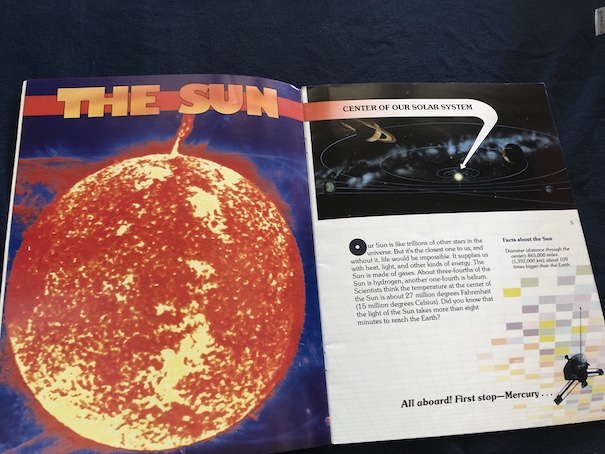
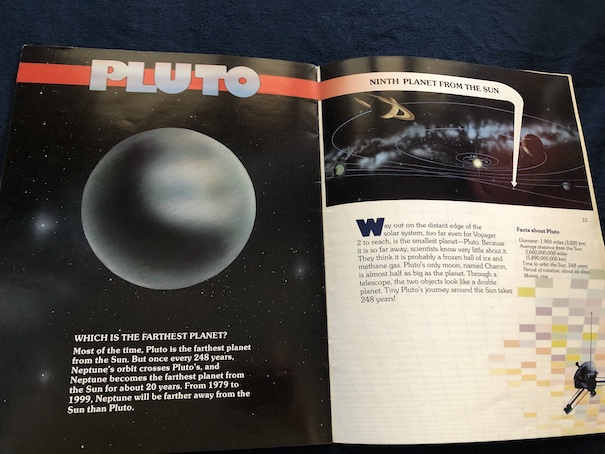
Then, it takes readers on a journey through the solar system, beginning with the sun at the center of the solar system and moving outward, planet by planet. The page about each planet explains the origin of the planet’s name in Roman mythology and gives facts about the planet, such as its size, distance from the sun, and rotation and orbit periods.

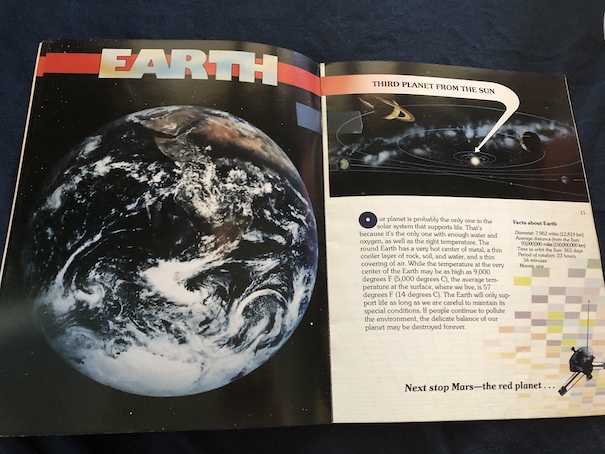
The page about Earth specifically mentions, “The Earth will only support life as long as we are careful to maintain its special conditions. If people continue to pollute the environment, the delicate balance of our planet may be destroyed forever.” Books, movies, tv shows, and teachers in public school gave us environmental messages very early in life when I was young in the 1980s and 1990s.
The book ends with Pluto as the ninth planet, which is what we were taught as kids in the early 1990s. There is no mention of “dwarf planets” or the Kuiper Belt because the book was published in 1990 and scientists didn’t find definite evidence of Kuiper Belt objects until 1992.
Discover the Night Sky

Discover the Night Sky by Chris Madsen and Michele Claiborne, 1989.

I bought this book at a school book fair when I was a kid, and it was my favorite book about the stars and outer space because it has glow-in-the-dark pictures. As a child, I loved anything that was glow-in-the-dark. Actually, I still do.

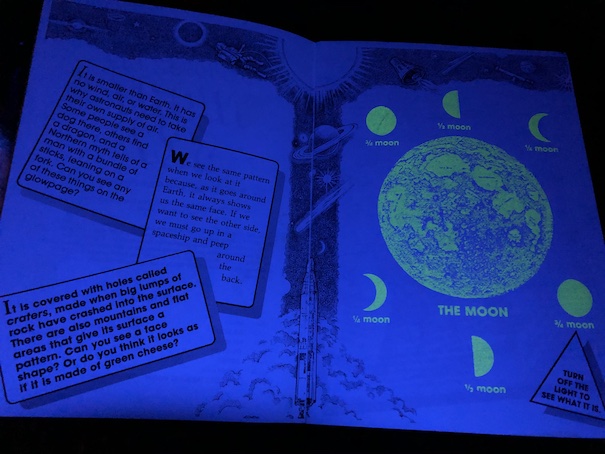
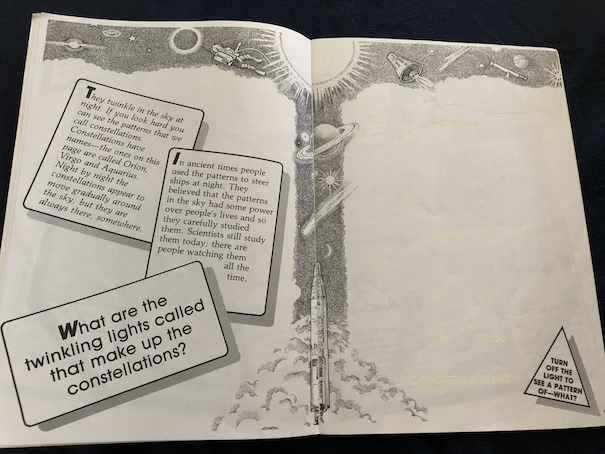
Every page in the book is designed to be interactive. There are pages that talk about different aspects of outer space, but the pages with the glow-in-the-dark pictures want you to guess what’s in the picture based on descriptions of it. Then, you’re supposed to turn off the light and look at the glowing picture to see what it is. You can see the what the glow-in-the-dark picture is without turning off the lights if you tilt the book and look at it at an angle or use a black light (like I did to take the pictures), but it is more fun if you really do look at it while it’s glowing in the dark. (Like other glow-in-the-dark toys, it glows better if the page has been in the light first to charge it.)

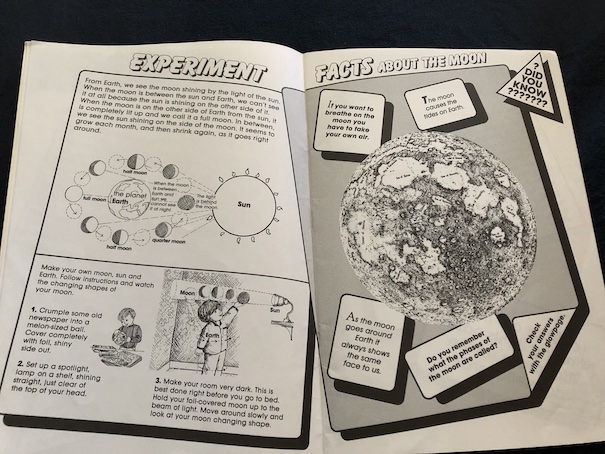
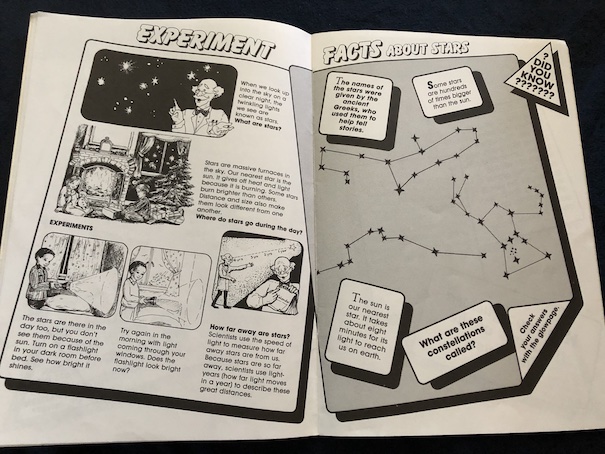
The pages after each glow-in-the-dark page have facts about the object in the glow-in-the-dark picture and an experiment for readers to do. The experiments help demonstrate the nature of the moon, stars, and planets, like what causes the phases of the moon, what causes seasons on Earth, and why you don’t see the stars during the day, even though they’re still there.

The information in the book is still factually correct, although it shows Pluto as being the last planet of the solar system. (Since people still quibble about this, I don’t consider it a big issue.) It isn’t a bad introduction to outer space for young children. The last page in the book is about the Voyager 2 space probe. Its primary mission ended around the time the book was first published, but we have contact with the space probe today (as of early 2021).

The book is available to borrow and read for free online through Internet Archive. The online version of the book doesn’t fully do it justice because you can’t take advantage of the glow-in-the-dark feature, but you can still read the text and see the experiment pages.

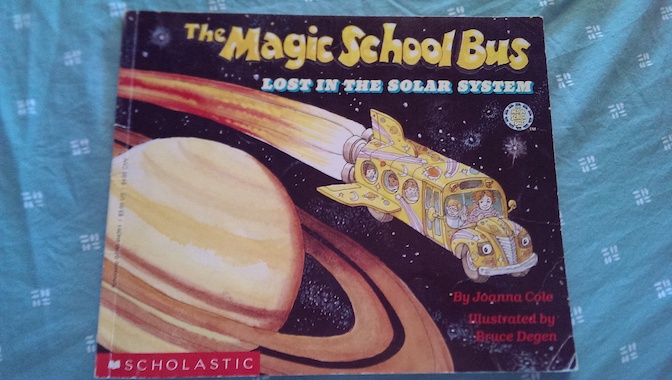
The Magic School Bus Lost in the Solar System

MSBSolarSystem

The Magic School Bus Lost in the Solar System by Joanna Cole, 1990.

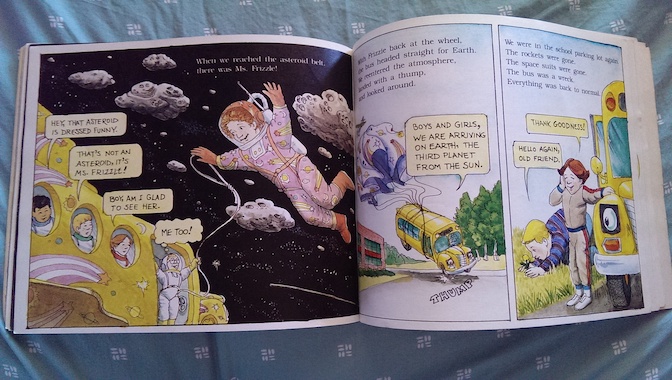
Ms. Frizzle’s class is planning a trip to the planetarium as part of their lesson about the solar system, but of course, their magic school bus has other plans.  When they get to the planetarium and find out that it’s closed for repairs, the bus sprouts rockets and takes them on a real trip through the solar system.

MSBSolarSystemBlastOff

This time, the class is accompanied by Arnold’s visiting cousin, Janet.  Janet is a show-off who brags constantly about everything, making up stories when she has nothing real to brag about.  She gets on the other kids’ nerves, but when they’re separated from Ms. Frizzle because she got out of the bus to fix a taillight broken in the asteroid field, Janet takes charge, using Ms. Frizzle’s lesson plan to continue the field trip, eventually figuring out how to turn the bus around to rescue her and get back to Earth.

MSBSolarSystemMoon

All through the book, there are facts about the sun, the moon, and the planets in the solar system from the students’ reports.  Each time they stop at a planet, a scale shows the difference between Arnold’s weight on Earth and his weight on each planet.  The book considers Pluto to be a planet because it was written before its planet status was reconsidered.

The book is currently available online through Internet Archive.

MSBSolarSystemRescue