
The Silver Nutmeg by Palmer Brown, 1956.
It’s late summer, and it’s very hot. The well is dry, so Anna Lavinia has to go to the spring whenever they need water, and the paw-paws are falling off the trees even though they’re not ripe yet. Anna Lavinia is spending most of her time outside, singing songs from her favorite book Songs from Nowhere, because her mother is making the green paw-paws into preserves, and it’s a smelly process. Nothing seems like it’s going right, and even Anna Lavinia’s animal friends are grumpy because of the heat.
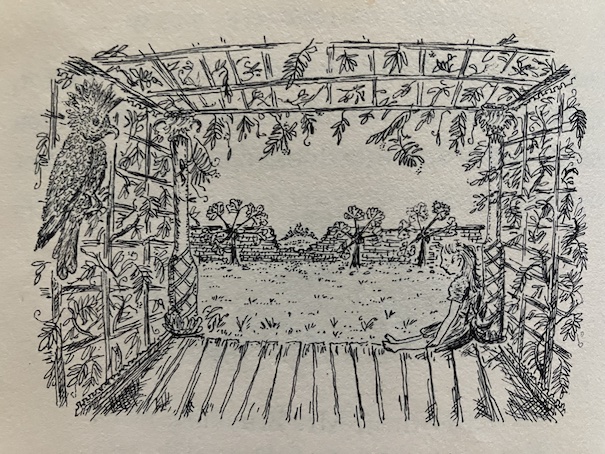
Anna Lavinia looks at Dew Pond Hill through the hole that her father recently made in the garden wall. He made it because he’s been thinking that Anna Lavinia has been too cooped up, and he wants to “broaden the horizon for her” and give her a new “point of view” in a very literal sense. Anna Lavinia thinks that she already has many points of views on many issues, but she does like the new vista that her father has opened up for her.

Things seem to improve on this very hot day when Uncle Jeffrey comes to visit. Uncle Jeffrey deals in spices, and he brings herbs and spices with him to replenish the family’s supply. Uncle Jeffrey also likes to collect samples of flowers and leaves, which he keeps pressed in a book with labels of their names (if he knows them) and the places where he found them. This time, Anna Lavinia notices a special purple flower in his book that she has never noticed before. There are no notes about it in the book, but she is sure that it is something special.
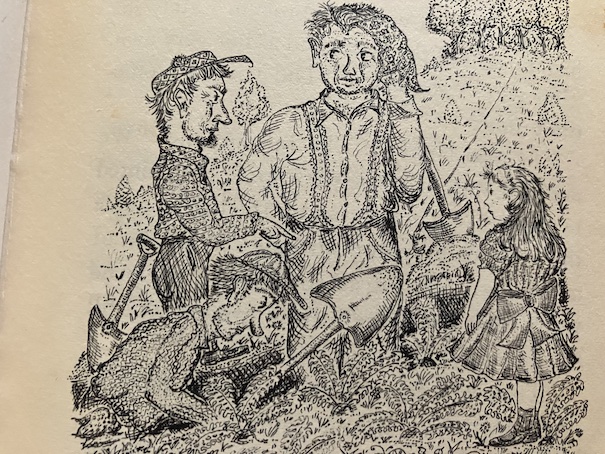
Then, she notices three men digging for something by the dew pond on the hill and decides to go see what they’re doing. Uncle Jeffrey warns her against going to the dew pond because he says that dew ponds are always bewitched. However, her mother thinks that’s nonsense and sees nothing wrong with Anna Lavinia going to look at the dew pond. When Anna Lavinia talks to the diggers, they joke with her at first that they’re digging a hole to go to exotic places on the other side of the world, but then, they admit that it’s just a ditch for water. They want to drain the dew pond! Anna Lavinia is upset about that, and they explain that they need the water to grow their parsnips. They say that this won’t be the end of the dew pond because they plan to fill in the ditch, and the pond will eventually fill up again. However, they really need the water now.

Anna Lavinia goes to look at the dew pond and enjoy it while she can, thinking how awful it is that it’s going to be drained just when her father created a new view of it for her. While she thinks about it, she tosses a few acorns in the water. Then, suddenly, one of them jumps back out of the water at her! Strangely, the acorn also seems completely dry. Curious, Anna Lavinia tosses in another acorn. This time, when it flies back at her, it has a note pinned to it that says, “Please don’t throw acorns at me.” When Anna Lavinia looks into the water, she doesn’t see her own face reflected back at her. Instead, she sees a blond boy in a green sweater. She looks around, but she doesn’t see anyone else by the dew pond but herself. When she calls out to the boy to ask where he is, he says that he’s on the other side of the pond – the underside!
The boy says his name is Tobias, and he’s playing with a boat on the pond. Anna Lavinia asks if he can come up to her through the pond, and he says he could but he promised his mother that he wouldn’t. However, she can come through the pond to him, if she likes. He says that, for her to get through, the water must be completely still, no ripples, and that she must jump in as hard as she can. Anna Lavinia asks what will happen if she doesn’t do it right, and Toby tells her that she’d probably just get all wet and get a scolding from her mother. Anna Lavinia debates about it because Toby is upside down compared to her, and she’s not sure how gravity will work on the underside of the pond. Toby says that the right side up depends on your point of view and there is no gravity where he is. He shows her a net in a tree where she can jump and teases her about being afraid. Deciding that it’s a small risk, Anna Lavinia jumps in along with her pet lizard, which she calls a thobby.

It works just like Toby said it would, and Anna Lavinia lands safely in the net. Once in Toby’s land, she experiences a strange sensation that they call “the tingle.” (It’s not a dirty thing, although I did raise an eyebrow at first.) This sensation is a kind of force that Toby says flows through the ground in his land, and it’s what keeps objects from just floating around all the time in the absence of gravity. If you lift an object off the ground, it will float around in the air because there is no gravity, but once it’s in contact with the ground or in contact with another object that’s in contact with the ground, it will stay where it is, held in place by this force, until someone or something else causes it to move. Toby describes it as being like a kind of magnetism.
With Toby’s help, Anna Lavinia experiments with this lack of gravity. Toby explains that people can’t fly in his land, although birds can fly through the air with their wings. People do lose contact with the ground if they skip or jump, but it’s usually not a big deal because they can sort of maneuver themselves in the air until they can get back down to the ground or grab hold of something that’s grounded. It’s impossible to fall.

All of Toby’s world is the underside of our world, and the ground they’re walking on is the inside of the ball that is the Earth. Because it’s the inside of the Earth, it’s dimmer than the outside world. The light that comes through comes through bodies of quiet water, like the dew pond. Toby says that, while people from this inside world can go to the surface area through any still pond, they typically don’t. For one thing, they find it difficult to deal with the gravity of the outside world, and it will turn them bandy-legged if they stay too long. For another, people who left used to be banished by their own people if they returned, so those who have gone to the outside world have often stayed. Toby’s Aunt Cornelia still misses the man she had planned to marry. After the two of them quarreled about his desire to see the world, he vanished, and Aunt Cornelia thinks that he probably went to the outside world, never to return. Things have changed now so that people who left are now allowed to return, so Aunt Cornelia hopes maybe her sweetheart will come back, but Toby doesn’t think there’s much hope of that.
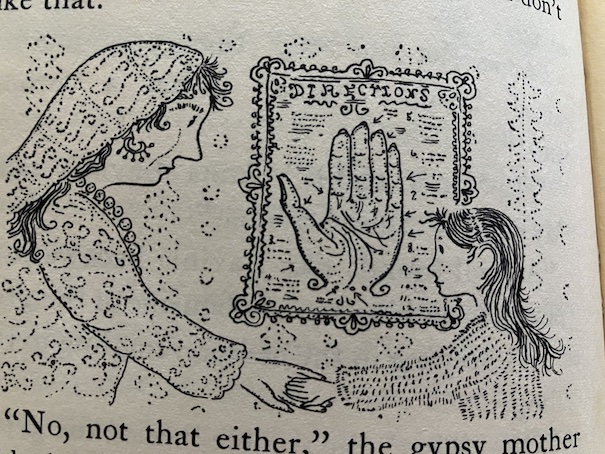
When the children hear a baby crying, Anna Lavinia insists on finding the baby and seeing why nobody seems to be tending to him. It turns out that the donkey pulling a gypsy wagon has pulled the wagon over a cliff, which isn’t as dire as it sounds, since nothing in this land can fall. However, the wagon is now stuck sideways on the side of a cliff, and things from the wagon have been tossed around and are hanging in mid-air, including the baby in his basket. Toby and Anna Lavinia rescue the baby, and his grateful mother offers them a reward for their help. She gives Toby a tambourine, and she tells Anna Lavinia’s fortune. The fortune comes out strangely backward because Anna Lavinia is from the outside world, but from what they gypsy sees, it looks like Anna Lavinia is going to do something to make an old man happy.
Anna Lavinia has a lovely visit with Toby and Aunt Cornelia, but then, she suddenly remembers that the men are going to drain the dew pond today! By the time she and Toby return to the dew pond, it’s dry! With the pond dry on her side, Anna Lavinia can’t get home … unless still waters run deep.
This book is the sequel to an earlier book called Beyond the Pawpaw Trees, which first introduced the character of Anna Lavinia.
My Reaction
The book is sweet and would probably appeal to fans of Cottagecore. The characters sing songs and recite rhymes throughout the story, which might appeal to young children. I was a little divided over whether I liked having the story interrupted by the songs and rhymes, but the songs and rhymes really are a part of the story and add to its charm. It’s a little like Alice’s Adventures in Wonderland, where a girl goes to a magical land, where things don’t work as they do in the ordinary world.
In Alice’s Adventures in Wonderland, there’s a lot of random nonsense, and that’s fun, but I liked that this particular story uses a kind of pseudo-scientific focus on magnetism and gravity. Neither the magnetism nor gravity works the way it does in the real world, and it adds a kind of science-fiction twist to the fantasy world in the story. Even with this almost science-fiction twist, we still have that old-fashioned, cottagecore style fantasy atmosphere that’s charming and whimsical rather than technical. I haven’t read the first book in this series, but I understand that it uses similar concepts. Nothing really stressful happens in the story, and it would make a nice bedtime story.
My one complaint is that there are some stereotypical gypsies and comments about gypsies in the book. They are always referred to as “gypsies” and not Romany or any other name, and for some reason, they make a point at the beginning of the story that gypsies always go barefoot. I’m not sure what the point to that was except to establish that gypsies have eccentric habits. It’s not unusual for children’s books from the mid-20th century to have stereotypical gypsies as characters, although it might rub people from the 21st century the wrong way.


 Jestress's Forgotten Books and Stories