
The Dark-Thirty: Southern Tales of the Supernatural by Patricia C. McKissack, 1992.
There are ten short, scary stories in this book, not thirty. The author explains in the beginning that the name of the book comes from an expression kids used when she was young. The “dark-thirty” was the last half hour of light before it became truly dark outside, when the kids had to hurry home so they wouldn’t be out after dark, when the monsters came out. The author was African American, and the stories in this book have African American themes. They were based on stories that the author heard from her grandmother when she was young.
This is a book that I remember a school librarian introducing to us when I was in elementary school, probably around age 10 or 11. My memories of it are a little vague. I had forgotten most of what the stories were about, although the title stuck with me, and I remembered thinking that I should read it again someday. I have to admit that most of the emotions that I experience while reading this book as an adult were anger and frustration. The sad truth is that those are the emotions that permeate much of African American history, from the harsh conditions of slavery to the injustices of racism, and those are the aspects of the stories that stand out to me most as an adult. As I recall, I did think more about the ghost parts of the stories when I was a kid, but I didn’t have as deep an understanding of the background of the stories then. Maybe part of the lesson here is that human monsters are more terrifying than anything supernatural, partly because it’s the people who are or should be closest to you in a shared humanity are the ones who have the most opportunity to cause harm, if that’s what they’ve decided to do. That’s a rather dark thought, but these are dark stories with dark themes.
On a lighter note, I found the stories that introduced pieces of folklore fascinating. I’ve had an interest in folklore since I was a kid, which is part of why this book stuck in my mind for so many years.
I wouldn’t recommend this book for kids younger than 10 years old because of the dark themes. There is also derogatory racial language in the stories (including the n-word), particularly used by the villains, which helps show why they’re villains. I think, before kids are ready for this book, they need to have some background information on the subjects of racism and slavery to understand what’s going on, and they should also know that there are certain words they shouldn’t use themselves, even if other people do.
The book is a Newbery Honor Book. It’s available to borrow and read for free online through Internet Archive.
Stories in the Book:
The Legend of Pin Oak

The story is set during slave days. Harper McAvoy, a plantation owner, has resented one of his slaves, Henri, since they were both young. Harper was neglected by his father after his mother died giving birth to him, and years later, when his father finally returned to their estate, called Pin Oak, he learned that his other had another son with a free black woman, Henri. Their father had hoped that the two boys might be friends and that Henri would help Harper run the estate one day, but Harper always resented Henri for being more like their father than he was and for receiving the attention that his father never showed him. After their father died, Harper thought that he could sell Henri and be rid of him forever, but Henri has actually been a free person all along because his mother was free.
When the slavers try to take Henri anyway, he and his wife run away with their baby. They apparently die jumping to their deaths at a waterfall, although some say that they actually turned into birds and flew away while Harper is killed pursuing them. Others think that Henri and his family may have survived by jumping into a cave behind the waterfall, although there is evidence that Henri didn’t know there was a cave there. Their fate is left ambiguous.
We Organized
As part of the government’s effort to get people back to work during the Great Depression, the Library of Congress employed writers to record the stories of people who had been slaves. This chapter is a poem based on one of those stories.
Justice
This story is about the Ku Klux Klan. A wealthy and influential man called Riley Holt is murdered. The identity of the murderer is unknown, but local people are so shocked and angry at the crime that they are determined to get “justice” … one way or another. A bitter and suspicious local man called Hoop Granger blames a young black man named Alvin Tinsley. However, Alvin has an alibi, and the chief of police, knowing that Hoop is a bully and a liar and has a history of pushing Alvin to take responsibility for things he’s done himself, asks Hoop if he has an alibi, too. He says that he was working at his service station and his friends will vouch for him, but Chief Brown doesn’t think much of any of them as witnesses.
Hoop is a member of the KKK, and to throw suspicion for the murder from himself, he convinces his fellow KKK members that Alvin is guilty and needs to be punished. They capture Alvin and lynch him, but before Alvin dies, he promises to come back and prove his innocence. Hoop and his friends tell everyone that Alvin hanged himself after confessing to Holt’s murder. Not everyone in town believes the story, but they have no way of proving it’s a lie, and the authorities seem satisfied with the explanation (mainly because the mayor’s son was also part of lynch mob, and the mayor is forcing everyone to cover for him). However, Hoop can’t forget what Alvin said about coming back to prove his innocence. He seems haunted by Alvin’s words. Soon, he starts seeing things and becomes convinced that Alvin is coming back for him. Is it really a restless spirit or Hoop’s own guilty conscience?
The 11:59
This story is about train travel and the Brotherhood of Sleeping Car Porters. The Brotherhood of Sleeping Car Porters had stories that they liked to tell each other, like this story about a phantom train called the Death Train or the 11:59.
A retired porter enjoys telling the younger porters stories about how the Brotherhood was formed and the truly great men among the porters. Many of his stories are tall-tales. One of his stories is about the 11:59. When a porter hears the whistle of this phantom train, he only has 24 hours left to live, and nobody can escape it. Not even old Lester.
The Sight
There’s an old superstition that babies who are born with a caul over their heads will have psychic abilities and could be able to see the future or spirits. A boy named Esau gets “the sight” and is able to tell the future from a young age. However, people with “the sight” have to be careful who knows they have that power because some people will try to use them for unethical purposes, which might cause them to lose their gift, and Esau’s father is a con man. Esau knows that his father can’t be trusted, but when he feels compelled to warn his father of danger, his father learns what Esau can do. His father forces him to help him win at gambling with his gift until the gift finally fades. Then, his father deserts him and his mother. Esau’s mother says maybe it’s just as well to lose the sight, and Esau agrees, not liking it when he sees that bad things are about to happen.
Years go by, Esau grows up, and he eventually becomes a soldier in WWII. He manages to make it home safely, but he is surprised by the sudden return of his gift just in time to save his family.
The Woman in the Snow
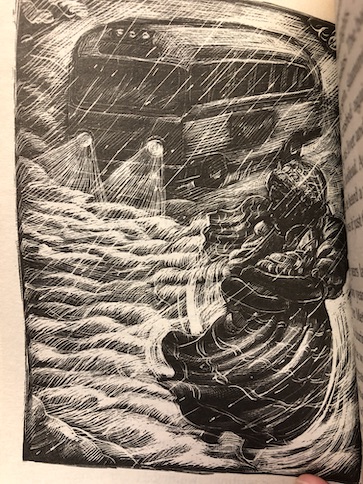
This story involves the bus boycott in Montgomery, Alabama in the 1950s.
Grady Bishop, a white man with a bad history and a chip on his shoulder, has recently started working as a bus driver, although he’s never happy when he has to take the less prestigious route through the city, where a lot of black people catch the bus. Driving makes him feel powerful, but he considers this route beneath him.
One day, during a bad snow storm, a poor woman with a sick baby begs him for a ride although she doesn’t have money to pay. She’s afraid if she can’t get the baby to the hospital, she’ll die. Grady refuses to give her a free ride, convinced that she’s making too much out of nothing and just trying to get a free ride. Later, he hears that the woman and baby froze to death in the storm. A year after that, he sees the same woman again on the same route. Startled, Grady crashes his bus and is killed.
Years later, a black bus driver has that route, and other drivers tell him about the ghost lady with the baby that they see whenever it starts snowing. He becomes the last person to see the ghost lady … because he’s the first to give her a ride.
The Conjure Brother
This story explains that “conjure women” were women who sold herbal cures and practiced folk magic to help people change their luck.
A girl named Josie is tired of being an only child and wants a brother. However, her mother shows no signs of being pregnant, even though Josie keeps asking her for a brother. When she hears a couple of women talking about the local conjure woman, Josie decides to go see her and ask if she can help her get a brother. The conjure woman gives her a set of instructions to follow, but Josie performs the ritual too early at night. Instead of getting a baby brother, Josie gets an older brother, called Adam. Her parents act like Adam has always been their oldest child. Adam is bossy, and some of the things that used to belong to Josie now belong to Adam. Josie starts to think of Adam as a pest and returns to the conjure woman to ask her to do something about Adam, but instead, she learns an important lesson about sharing her life and house with a sibling.
Boo Mama
This chapter talks about the tumultuous times of the late 1960s and the assassinations of Martin Luther King, Jr. and Robert Kennedy. Some people felt so overwhelmed by everything that was going on that they just wanted to “drop out” of society and ignore the chaos around them.
Leddy has been a social activist since she was in her teens, but then, her husband is killed in the war in Vietnam, leaving her with a young child. After the deaths of Martin Luther King, Jr. and Robert Kennedy soon after her husband’s death, Leddy feels completely overwhelmed. She’s been putting forth all of the effort she has for a long time, and the deaths of the man she loved and the people who inspired her feel like too much. She has a breakdown and starts questioning whether everything she and her friends have done has really accomplished anything. Deciding that she needs a change of scene for her and her son, she moves to a rural community in Tennessee.
At first, her young son seems to do better in the countryside, and Leddy finds the change of pace relaxing, but then, her young son disappears. He wanders away while his mother is hanging out the laundry. The locals put together a search party. They search for days, but all they can find is the boy’s teddy bear. Everyone is convinced that he’s dead, but Leddy can’t give up hope that her son is still alive. Her son does turn up, but he is strangely different. Where has he been, and what has happened to him?
The Gingi
There is an old superstition that “Evil needs an invitation.” Among the Yoruba people of West Africa, there is a belief that evil spirits need someone to welcome them into a house before they can enter, so they will try to trick unsuspecting people into giving them an invitation. They use special talismans called gingi to guard against evil.
A woman named Laura is fascinated by a strange statue that she sees in a shop window. However, when she tries to buy it, the shopkeeper says that she’s never seen it before and warns Laura that evil spirits sometimes disguise themselves to trick people into taking them into their homes. Laura thinks this is just superstition and insists that she wants the statue. The shopkeeper charges her a price that’s too high to discourage her from buying the statue, and it almost works, but for some reason, Laura feels compelled to buy it and pays for it anyway. Seeing that she can’t prevent Laura from taking the statue, the shopkeeper insists that she take a small complementary talisman and keep it with her. The talisman is a small doll, and she gives it to her young daughter to play with.
The Chicken-Coop Monster
The final story in the book is semi-autobiographical, inspired by the author’s feelings when her parents got divorced when she was a child.
A young girl named Melissa is upset about her parents’ divorce. Her parents send her to stay with her grandparents in Tennessee while they’re sorting things out, but she becomes convinced that there’s a monster living in the chicken coop on her grandparents’ property. She and her friends are part of a group called the Monster Watchers of America. Melissa’s grandmother doesn’t believe in the monster, but her grandfather teaches her an important lesson about facing up to life’s monsters.
 Jestress's Forgotten Books and Stories