When Clay Sings

This children’s picture book is a salute to the ancient makers of Native American pottery, dedicated to these makers and the museums that preserve their work. It’s written as free form poetry with images of the American Southwest and designs from Native American pottery.

The story sets the scene on a desert hillside, where pieces of ancient pottery are buried. Sometimes, Indian (Native American) children dig up pieces of old pottery, and their parents remind them to be respectful of what they find because they are pieces of the past and of lives that went before. Sometimes, they’re lucky enough to find pieces that fit together or even a bowl that isn’t broken.

They reflect on the time and skill that went into making the pottery and how strong the pottery would have to be to last well beyond the lives of the people who made it. They think about the people who painted the beautiful designs on the pots and what their lives were like. Could their own children have requested favorite pictures painted on their bowls?

Some designs show animals or bugs or hunters, but others show bizarre creatures that might be monsters or spirits. Others show a medicine man trying to cure a child, ceremonies, dancers in masks and costumes, or the traditional flute player. People can reflect on the lives of those long-ago people and how they compare to the lives of people today.

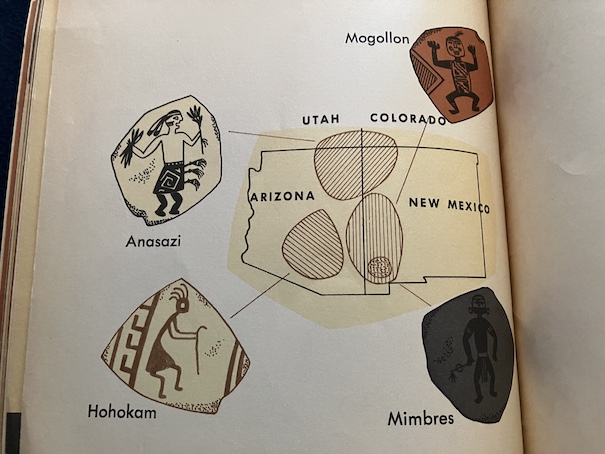
There is a map in the back of the book which shows the areas of the American Southwest (Arizona, New Mexico, Utah, and Colorado) where the pottery designs the book uses originated from and the tribes that used them.

This is a Caldecott Honor Book. It is available to borrow and read for free online through Internet Archive (multiple copies).

I grew up in Arizona, and I remember our school librarian reading books by Byrd Baylor to us in elementary school during the late 1980s or early 1990s. She wanted to introduce us to this author because she wrote about the area of the United States where we lived. In fact, this book about pottery was fitting because, when they were building our school in the 1970s, they found some ancient pottery. They used to have it on display in the school library. Even to this day, it’s common for people creating buildings in this area to have the site surveyed by archaeologists. Finds are fairly common, and the usual procedure is to thoroughly document everything that gets uncovered before burying it again in the same location and constructing the building over it. One of the reason why they usually rebury finds is that, in this dry, desert climate, putting them back into the ground will actually preserve them very well. It’s possible that later generations will find them again (especially with the location documented) when the building is gone or no longer necessary, but they may have better instruments or techniques for analyzing them.

I’m a little divided on how much I like this book, though. On the one hand, I like books about folklore and traditional crafts, and this book focuses on a geographical area that’s very familiar to me. On the other hand, the free verse poetry that reflects on the feelings of people about the pottery doesn’t appeal to me quite as much as books which show the process of making it, like The Little Indian Pottery Maker. I like to see the process and learn more of the known background legends of some of the designs than just try to imagine what things might have been going through the minds of the designers. Toward the end of the book, they show the legendary humpbacked flute player, but they don’t tell you that this figure is called Kokopelli and that there are legends about him. It’s a nice book, but I just felt like there was potential to include more background information.

This book uses the word “Indian” for “Native American” or “America Indian”, which is common in older children’s books.

Kokopelli’s Flute

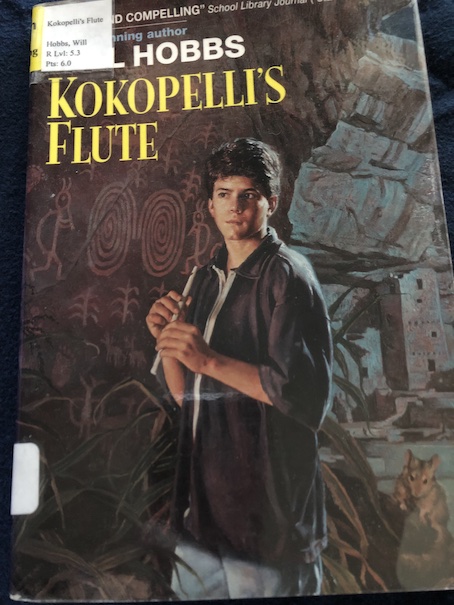
Kokopelli’s Flute by Will Hobbs, 1995.

Tepary Jones, called Tep for short, has always been fascinated by the ancient cliff dwelling known as Picture House. One night, he goes there with his dog, Dusty, because he think it would be a great place to watch a lunar eclipse. However, he and Dusty aren’t there alone. Tep witnesses a couple of looters illegally digging for valuable artifacts. The looters uncover the burial of a medicine man and begin taking some of the things he had buried with him. They damage the site before they leave, but Tep discovers that they have left behind an unusual artifact, a small flute made of polished bone. When Tep picks up the flute, he feels compelled to play it. Not wanting to leave the flute behind in case the looters return, Tep takes it home with him.

That night, Tep has a strange dream that he turned into a packrat, like one of the literal packrats he saw up at Picture House. However, he soon realizes that this was not just a dream. Ever since he played the flute, he finds himself turning into the animal he saw the first time he did so. Tep returns the flute to the body of the medicine man and reports the looting to the authorities, hoping that, once the body is respectfully reburied, whatever magic or curse is afflicting him will end. Unfortunately, it doesn’t.

Tep still finds himself turning to the packrat at night, having uncontrollable urges to go out and explore and find food, and it’s dangerous because animal predators and even his own parents are after him. Rodents in the house are a serious concern because they can carry hantavirus, which causes dangerous respiratory infections in humans. After his mother catches sight of him in packrat form, Tep’s parents start setting out traps. His dog, Dusty, seems to know him even when he’s a rodent and helps to protect him, but Tep knows that he’s going to have to stop this transformation somehow, before either his parents catch him or a predator eats him!

Tep’s parents are academics and researchers who study ancient agriculture and cultivate varieties of seeds on their farm that require little water to grow. To buy himself time from his parents’ efforts to catch the packrat, Tep makes the argument that the packrat is a part of the ecosystem and that it might be performing an important role in the environment, like birds that help propagate seeds by eating them and then depositing them in new places. Tep brings up the fact that there are some seeds that really need to be processed in a bird’s digestive system before they can grow. It’s a thoughtful argument, but the looming threat of hantavirus in their community still means concern about the presence of rodents. Hantavirus is serious, even fatal, and people in their community have already fallen victim to it.

Tep returns to Picture House to try to find the flute again to break whatever spell is affecting him, but he can’t find it. He only hears what he thinks is the sound of someone playing the flute, and he’s not sure if he really hears it or if he’s imagining it. Then, a stranger comes to the farm, a man who appears to be a humpbacked Native American or possibly someone from Mexico or Central America. He calls himself Cricket, and Tep’s family thinks that he’s probably just another migrant worker. Tep shows Cricket around the farm and explains the different types of seeds they cultivate and how they can be used to keep particular varieties of plants alive for their drought-resistant or pest-resistant qualities. Cricket doesn’t say much, but he seems to approve of the idea of cultivating more varieties of seeds. When he helps Tepary to plant seeds, Tep notices that he uses a planting stick, like Native Americans traditionally did.

Of course, Cricket is no ordinary farm worker. Tepary notices his unusual ability with plants and animals, and one night, Cricket speaks with Tepary while he’s in his packrat form. Cricket knows more of what’s been happening than anyone because he is one of the legendary figures from Native American folklore known as Kokopelli. Kokopelli was a legendary humpbacked flute player known for bringing seeds to people, and Cricket says that he still visits people like Tep’s family, who are interested in the past, who cultivate the land, and who keep seeds alive. Tep appeals to him for help with his transformations, and Cricket says he will help, if he can, although he notes that Tep seems to have been managing well. Cricket says that Tep can use the flute to reverse his condition, but only if he knows the right notes to play on it. If he plays the wrong notes, he could change into something else and make his condition worse. The clues to the notes are contained in the pictures on the walls of Picture House.

Tep manages to use his animal form to play a trick on Coyote in the tradition of old trickster tales and to rescue his dog from the looters. Then, Tep’s mother contracts hantavirus. Cricket says that ancient people also suffered from the disease, and they used an herb to cure it. Nobody grows that particular herb anymore, but there should still be some contained in the medicine bundle buried with the old medicine man at Picture House. To save his mother and break the spell on him, Tep must return there to find the medicine man’s bundle and the flute.

The book is available to borrow and read for free online through Internet Archive (multiple copies).

My Reaction

I vaguely remember having read this book when I was a kid, around the time when it was first published in the 1990s. It stuck in my mind because it takes place in the Southwestern United States, where I grew up, and it was also the first time that I had heard about hantavirus, which is a serious concern in real life. I couldn’t remember exactly how the book ended, though.

Reading it as an adult, I understand more about the parents’ work and the commentary about interrelated aspects of the ecosystem than I did as a kid. I understood some aspects of environmentalism and ecosystems as a kid because those were topics that we discussed in science classes at school in the 1990s, but admittedly, science wasn’t my best subject, and I’ve had more time to grasp certain concepts since then.

There are agricultural researchers in real life who do what Tep’s parents are doing, trying to cultivate seeds for drought-resistant crops, which are important in places like the area where I live, that are very dry for much of the year, and are becoming even more important due to climate change. That type of research takes time to cultivate generations of plants and to propagate seeds with desirable qualities. Modern researchers also take information and inspiration from past agricultural practices to enhance modern techniques (paleoethnobotany or archaeobotany). When Tep is talking to Cricket, he explains why it’s important to keep growing a different varieties of crops because some varieties are more resistant to different types of problems that others, like drought-resistant crops or pest-resistant crops. One of the dangers of huge, corporate farms is that they produce too few varieties of particular types of crops, focusing on the most popular ones, leaving them vulnerable to being almost completely wiped out by particular disasters. People need to keep growing older and less popular varieties of crops to keep the plant varieties alive and keep producing seeds for new generations so agriculture as a whole will have those varieties to draw on for the plant qualities they need to cope with changes in the environment and/or particular plant diseases.

One of the reasons why I liked this book is that it references the legend of Kokopelli. Because I grew up in the Southwestern United States, I grew up seeing images of Kokopelli along with other Southwestern Native American symbols. Kokopelli is often used as a decorative image in Southwestern art, although not everyone who has or uses the decoration knows the legends behind it. Kokopelli is described in somewhat different ways in different stories, but he is generally a fertility figure who travels from village to village, bringing changes to the seasons and promoting good harvests. He is also a trickster figure and represents human fertility. In some stories, human women get pregnant everywhere he visits, including by Kokopelli himself, an aspect of the character that does not appear in this particular book because it’s not kid-friendly. There is a theory that the legends might be based on traveling Aztec merchants who arrived seasonally, carrying sacks of seeds and other goods to trade on their backs, giving them that hunched appearance.

The book frequently uses the word “Indian” instead of Native American. It seems to be meant in an informal way rather than a disrespectful one, although I found it irritating because it can be a bit confusing. When Tep uses it in relation to the Native American ruins nearby, context tells readers that he means “Native American”, but when he uses it when he talks about places around the world that use the seeds his family produces, it becomes more confusing. At one point, he uses the word “Indian” and then talks about an order his parents have received from Pakistan, so did Tep mean Native Americans or people from India the country in that context? I heard the word “Indian” used a lot in relation to Native Americans when I was growing up, and sometimes, I even have the urge to use it out of old habits, but I don’t really like using that word anymore. It’s not so bad if you say “American Indian”, but just saying “Indian” by itself is often confusing. I generally agree with the modern convention of saying “Native American” or using the name of a specific tribe, if you know the name to use, both because it sounds more respectful and because it really makes a difference in the clarity of the sentence. It’s just not as effective if someone immediately has to ask, “Wait a minute, do you mean ‘American Indian’ or ‘Indian from India’?”, and when it’s in writing, there isn’t even a live person there to ask.

The Day of the Ogre Kachinas

The Day of the Ogre Kachinas by Peggy D. Spence, 1994.

My Dog, Betty

First, I would like to apologize for the cover picture above. This book was in better condition when I first got it. Then, I accidentally left it where my dog could play with it. Oops. She greatly enjoyed this book, which was printed on high-quality and apparently tasty paper, and thought it was a lot of fun, although she found it very difficult to get through. In fact, she did not get past the cover. (Thank goodness.) I enjoyed it much more.

The story is set in a Hopi town in Arizona (my home state!) and features Hopi traditions about kachinas. The introduction to the book explains a little about kachinas, which are spirits that represent concepts in the natural world. In Hopi ceremonies, men dress up as these spirits and dance or act out certain rituals. The ritual in this book is that of the Ogre Kachinas, which is meant to influence children’s behavior, teaching them what their community views as right and wrong and letting them know when they have overstepped the boundaries of their community. (I don’t know if eating the cover of a book counts as overstepping, but I promise that no doggies were harmed or even frightened as part of this book or the reading of it.)

Judson Honyouti, a young Hopi boy, is not a bad kid, but sometimes, like many other kids, he does things that he shouldn’t do. Sometimes, he forgets things or loses his temper and fights with people. His parents and the other adults in his village try to teach him the right things to do, but sometimes, he needs a little extra help to remember.

Judson is nine years old, and he knows that when he sees kachinas in a ceremony, it is only some of the men in his village, wearing costumes. He hopes that when he is old enough, he may become one of the kachina dancers himself, but for that to happen, he must follow his people’s ways and be a good member of his community. To be a good member of his family, Judson helps his father to take care of their cornfield and helps to look after his little sisters, but he still sometimes gets into trouble.

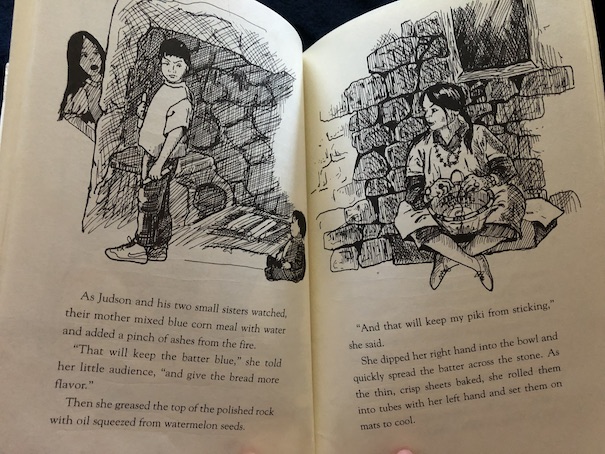
One day, Judson falls asleep while tending his family’s sheep, and most of them wander off. His father has to help him find the sheep again. Then, when his mother asks him to take some stew to his grandfather, Judson drops the bowl because he is playing and not paying attention. To make up for losing the stew, Judson gives his portion to his grandfather. Then, when Judson is supposed to be helping his mother to make piki (or paper bread) so that she can use it to trade in the market, Judson gives into temptation and eats too much. He has to help her make more.

In the market in the plaza, the Ogre Kachinas (really, men dressed up in costume), frighten the children and warn them that they must obey their parents. The Ogre Kachinas like to eat naughty children (but not really), and they say that they will return again soon to see if the children have been good. If they have been bad, the Ogre Kachinas might carry them away!

Even though Judson knows that the Ogre Kachinas are just human beings, their warnings worry him because he knows that he has been doing things wrong and has been getting into trouble. In spite of Judson’s attempts to do better, he still keeps getting into trouble. He fights with his sisters and even hits two other boys when he gets into fights at school. His father warns him that the ogres might come for him if he doesn’t behave, and sure enough, the Ogre Kachinas come one night.

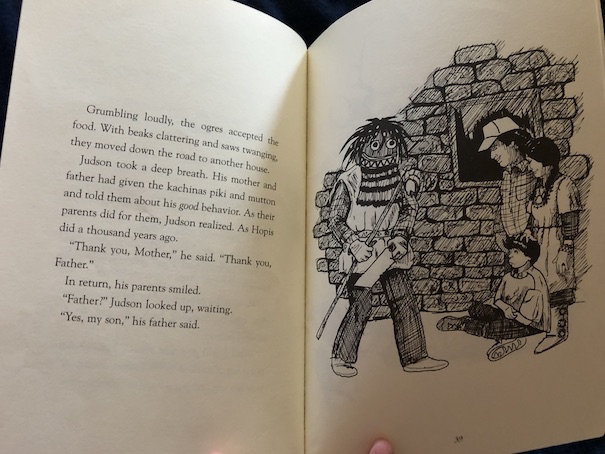
The Ogre Kachinas dance around Judson and his parents and confront Judson with their knowledge of all of the things that Judson has been doing lately. They threaten to take Judson away and eat him because they like to eat bad boys! Even though Judson knows that the kachinas are just ordinary humans in disguise, it’s an alarming performance! However, as part of this tradition, Judson’s parents speak up for him and tell the Ogre Kachinas to leave Judson alone.

It’s true that Judson has done things that he shouldn’t have done, but in many cases, he also did something to try to make up for what he had done wrong, like when he gave his portion of the stew to his grandfather to make up for the portion that he had ruined. He gets into trouble, but he is also polite and helpful in many ways. His parents say that he is actually a good boy and would make the ogres sick if they tried to eat him. Judson is relieved to hear that his parents love him and value the good things he does, even when he isn’t perfect. The Ogre Kachinas not only remind children of what they are not supposed to do but provide an opportunity for the parents to explain that they value their children and what the children do right. As Judson’s parents give the kachinas gifts of food and send them away, Judson realizes that their parents must have done the same for them when they were children and that the same thing has also happened for all Hopi children for generations.

I like books that include a little history and interesting information about cultural practices, but I also like this book for its understanding of human nature. First, I grew up in Arizona (in the American Southwest, for those who live outside of the United States), where this story is set. Although I am not Native American and didn’t grow up on an Indian Reservation, like Judson, I knew about Kachinas and was fascinated by them when I was growing up. I read books about Kachinas, and I loved the display of Barry Goldwater’s Kachina doll collection at the Heard Museum when I was a kid. I used to remember more of the individual names of different kinds of Kachinas and could point out the different ones in the Goldwater collection, but I’ve forgotten some of them as an adult. These things slip away if you don’t reinforce them. The book describes how Kachinas function in Hopi culture. There are different kinds that perform different ceremonial functions, but the main ones in the story are the Ogre Kachinas, which are meant to help frighten children into good behavior.

The need for both positive reinforcement and negative reinforcement is a real part of the human condition. Negative reinforcement has a bad reputation in modern times for making people feel scared or ashamed, and I think that it isn’t enough to have just negative reinforcement (punishment or criticism for things that a person has done wrong) or just positive reinforcement (praise for doing things right) by itself; I think they function best as a pair, the way they do in this story. It isn’t enough to just tell people what not to do (negative reinforcement) because it often leaves them wondering what they should have done instead, and it’s not enough to just give them praise with no criticism because it leaves them with the feeling that they do nothing wrong, and they’re often surprised later when they find out that things they’ve been doing have been seriously getting on everyone’s nerves all along. I think an over-reliance on positive reinforcement alone is part of the modern phenomenon where people don’t realize that they’ve been acting like bullies or saying really inappropriate things for years because, somehow, no one clued them in earlier in life. I’m pretty sure that I know why that is: it’s difficult to be the bearer of bad news or criticism that someone has gone too far with their behavior, to play the role of the disciplinarian, the “rules police” who has to stop the game to tell someone they’re not playing right. In an odd sort of way, the Ogre Kachina costumes probably make it easier for the elders of the community to dish out the criticism and discipline because they’re not quite doing it as themselves; they’re doing it in disguise as the horrible “ogres.”

To help people understand how they’re really supposed to behave in society, they need to know both what they’re not supposed to do and what people really want them to do instead. Judson gets both kinds of feedback in the story during the Ogre Kachina ceremony. First, he is confronted by what he has done wrong, and then he gets to hear his parents explain what he has done right in order to emphasize both what they love about him while helping him to realize what he needs to fix in order to be a better person in their society. Having a child confronted by scary ogres that threaten to eat him for doing things wrong sounds pretty scary, but the book does note that Judson is old enough to know that the Kachinas are just people in costume. Even though he’s kind of scared at being confronted by them, and for a moment, he does feel like they’re really threatening to eat him, he is aware that they are not what they appear to be and realizes that it’s all part of the ceremony. It also means that he is old enough to accept the rebukes as the consequences of their behavior, and he finds his parents’ praise of his good deeds as a motivator to do even better next time, not as an excuse for the things he did wrong.

By the way, Betty the dog was not punished for eating the book cover. I just took the book away from her and gave her a toy she could chew on instead. She is a good doggy, and I should not have left the book where she could get it. Bad Tracy!

The book is available to borrow for free online through Internet Archive.

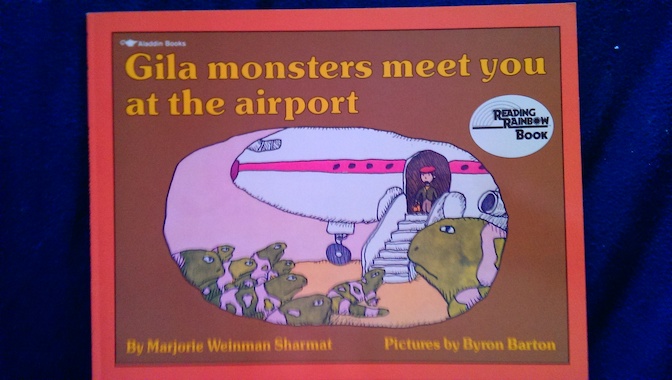
Gila Monsters Meet You at the Airport

GilaMonsters

Gila Monsters Meet You at the Airport by Marjorie Weinman Sharmat, pictures by Byron Barton, 1980.

This is a humorous picture book about a boy moving from one side of the United States to the other and his misconceptions of what he’s going to find when he goes west.

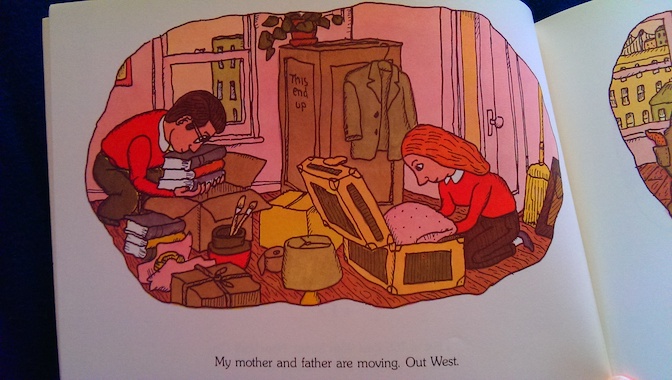
At the beginning of the story, the boy lives in an apartment in  New York City.  As far as he’s concerned, he could live there forever, but his parents decide that they’re going to move “Out West.” (The book never really says what state they’re moving to, but it seems to be somewhere in the Southwestern United States, like Texas, New Mexico, or Arizona.)

GilaMonstersMoving

The boy thinks he’s going to hate his new home.  He thinks of all the things that he’s heard about the West, like there’s cactus everywhere so you hardly know where to sit down, everyone dresses like a cowboy and rides horses everywhere, all he’ll ever get to eat is chili and beans, and he’s bound to die of heat exhaustion in the desert.  His best friend in New York, Seymour, told him that Gila monsters would meet him at the airport.

GilaMonstersCactus

Of course, there aren’t any Gila monsters at the airport when the boy gets there.  Instead, he meets another boy whose family is moving East.  The two boys talk to each other for awhile, and the Western boy starts telling him that he’s not looking forward to heading East because he’s heard that it’s always cold there, the cities are overcrowded and full of gangsters, the buildings are so tall that airplanes fly through the apartments, and there are alligators in the sewers.  He expects to find alligators waiting for him at the airport.

GilaMonstersAirportBoy

Of course, things aren’t as bad as either boy is expecting.  The boy from New York realizes that Seymour and his other friends back East don’t know much about the West, and he starts realizing that things in his new home are actually pretty good, some of them not all that different from home.

GilaMonstersArrival

This book was featured on Reading Rainbow.

The Little Indian Basket Maker

BasketMaker

The Little Indian Basket Maker by Ann Nolan Clark and illustrated by Harrison Begay, 1957.

By “Indian,” the author means Native American.  This book specifically focuses on the  Papago (Tohono O’odam) who live in the Southwestern United States, specifically Arizona.  The story is about a young girl who is starting to learn the traditional art of basket-making, and the book goes into the process involved in making baskets, step by step.   Although the use of “Indian” instead of Native American is somewhat antiquated, and Tohono O’odam is really the proper name for the Papago people, the book has something of an interesting history and the picture it provides of the practice of traditional crafts is fascinating. There is a section at the beginning of the book which explains a little about the history of the Papago (Tohono O’odam) people and where they live.

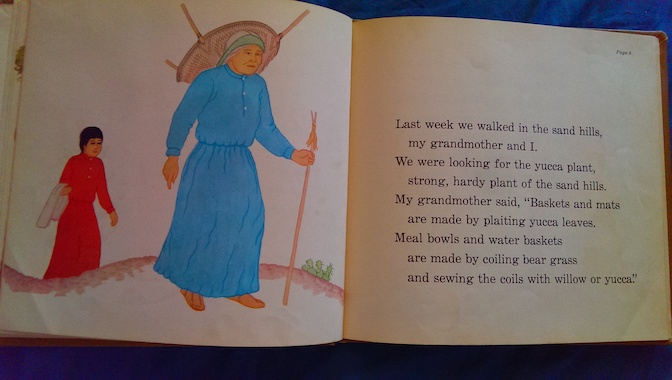
BasketMakerGrandmother

A young girl explains how her grandmother teaches her the traditional craft of making baskets.  They start by gathering the types of plants that they are going to use.

BasketMakerPlants.jpg

They also need special plants for the dye they will need in order to decorate the baskets.  The girl’s grandmother explains about the different types of decorations they traditionally use.

BasketMakerDesigns

Making baskets is a long process that includes cleaning the plants and tearing them into long strips, bleaching them, soaking them to soften them, dyeing strips used in the design, and weaving them together.

BasketMakerSoftening

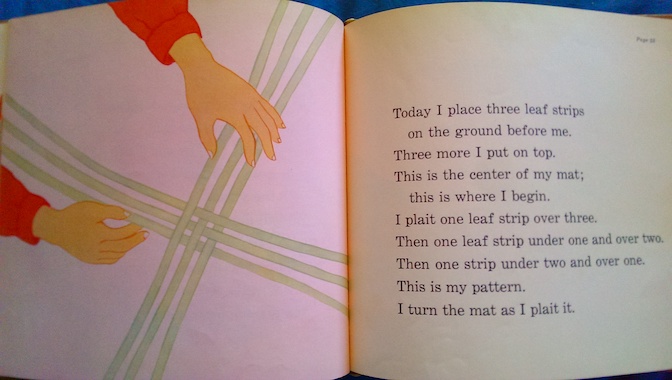
The girl weaves a mat that takes days to finish.  It is the first one that she’s made herself.

BasketMakerWeaving

She is very proud of herself when the mat is finished, and she is pleased with the quality of her work.

BasketMakerFinishing

I’ve owned this book since I was a young child, and it was my introduction to traditional crafts.  Later, I found a related book at a thrift store, The Little Indian Pottery Maker.  Until then, I hadn’t realized then just how old the books were and that there were more of them by the same author.

The book, which was written in the 1950s, was one of a group of stories (not exactly a series because they didn’t have a specific set of characters in common and the themes varied somewhat) written by a woman who was a teacher with the United States Indian Service.  The other books that she wrote, including The Little Indian Pottery Maker, focus on members of different Native American tribes.  She was not Native American herself, and the modern view of Indian schools is not favorable (for good reasons), so one might be a little suspicious of a book written about Native Americans by an Indian school teacher. However, these books interest me because of their explanation of traditional crafts. There are no white people in the stories at all, and they have a timeless quality to them.  Reading them, it’s hard to get a sense of exactly when the stories take place because it’s never mentioned, and there aren’t many clues (no mentions of modern technology, it’s all about the crafts).  I haven’t found any of the other books that the author wrote, but these two are very respectful in their tone, and they begin with explanations of the history of the tribes involved in the stories.  According to Andie Peterson in A Second Look: Native Americans in Children’s Books, the author was deliberately trying to write books that her Native American students could relate to.

The art style of the books vary because they had different illustrators.  The illustrator for this particular book was a Navajo painter.

The book is available to read for free online through Internet Archive.

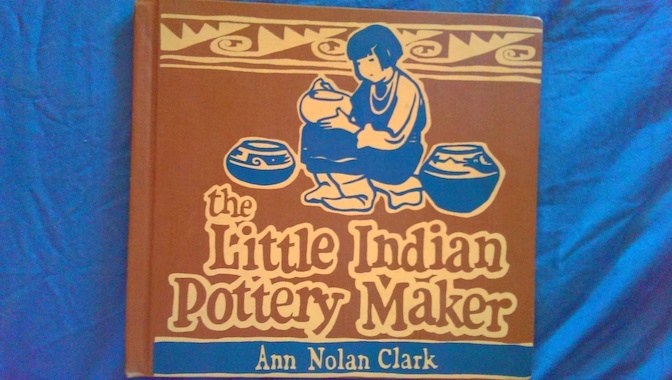
The Little Indian Pottery Maker

PotteryMaker

The Little Indian Pottery Maker by Ann Nolan Clark and illustrated by Don Perceval, 1955.

By “Indian,” the author means Native American.  This book specifically focuses on the Pueblo Indians who live in the Southwestern United States, specifically New Mexico and Arizona.  The story is about a young girl who is starting to learn the traditional art of pottery-making, and the book goes into the process involved in making pottery, step by step.   Although the use of “Indian” instead of Native American is somewhat anitquated, the book has something of an interesting history and the picture it provides of the practice of traditional crafts is fascinating. The beginning of the book explains a little about Pueblo Indians, their history, and where they live.

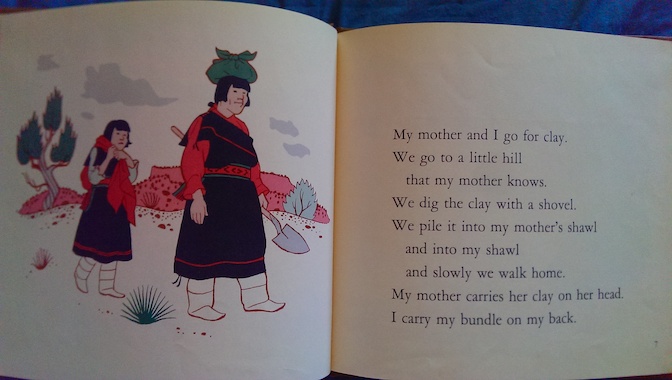
PotteryMakerGettingClay

The young girl tells the story of how her mother introduces her to the traditional craft of making pottery and teaches her how to make her first pot.  She describes every step in the process, from when they collect the clay themselves from a hillside until the pot is finally complete.

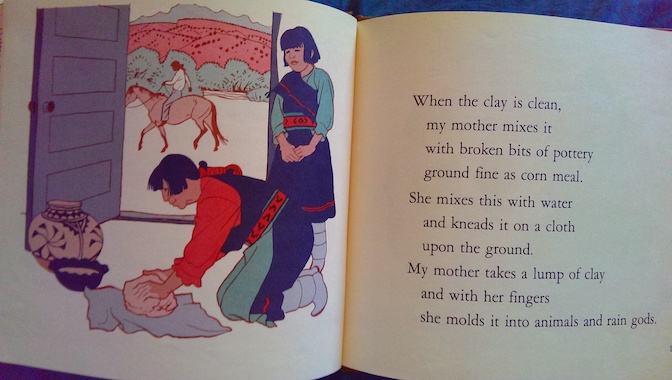
PotteryMakerMixingClay

The girl’s mother explains about the different methods used to make pots, and pictures show how pots are shaped.

PotteryMakerRollingClay
PotteryMakerMakingPots

Making pottery is a long process that takes days to complete, including shaping, scraping and smoothing the sides, drying, decorating, and finally firing the pottery.  The girl is proud of the first pot she has ever made.

PotteryMakerFiringPots

I found this book at a thrift store a number of years ago and recognized it because I already owned a related book, The Little Indian Basket Maker, that I liked when I was a young child.  I hadn’t realized then just how old the books were and that there were more of them by the same author.

The book, which was written in the mid-1950s, was one of a group of stories (not exactly a series because they didn’t have a specific set of characters in common and the themes varied somewhat) written by a woman who was a teacher with the United States Indian Service.  The other books that she wrote, including The Little Indian Basket Maker, focus on members of different Native American tribes.  She was not Native American herself, and the modern view of Indian schools is not favorable (for good reasons), so one might be a little suspicious of a book written about Native Americans by an Indian school teacher. However, these books interest me because of their explanation of traditional crafts. There are no white people in the stories at all, and they have a timeless quality to them.  Reading them, it’s hard to get a sense of exactly when the stories take place because it’s never mentioned, and there aren’t many clues (no mentions of modern technology, it’s all about the crafts).  I haven’t found any of the other books that the author wrote, but these two are very respectful in their tone, and they begin with explanations of the history of the tribes involved in the stories.  According to Andie Peterson in A Second Look: Native Americans in Children’s Books, the author was deliberately trying to write books that her Native American students could relate to.

The art style of the books vary because they had different illustrators.  The illustrator for this particular book was not Native American (unlike some of the illustrators of other books), but he was adopted into a Hopi tribe, apparently as an adult because of his accomplishments in representing Hopi culture in art.

Basil in the Wild West

BasilWestBasil in the Wild West by Eve Titus, 1990.

This book picks up right after the previous book in the Basil of Baker Street Series, Basil in Mexico.

After leaving Mexico, Basil and his best friend Dr. Dawson journey north into the western territories of the United States.  There, some friends of their ask them to investigate a smuggling operation.  Mice have been illegally bringing Mexican antiquities across the border.

Basil realizes that the smugglers have been smuggling the antiquities in the open, pretending that they are ordinary replicas, the kind that tourists often buy.  Because the border guards aren’t experts in antiquities, they haven’t been able to tell the difference between harmless souvenir replicas and the real thing.

When they catch one of these smugglers, they learn that the mastermind behind the scheme is a mouse called J.J. in a town called Moriarty in New Mexico (the name of the town irritates Basil).  They go to the town with the help of some friendly horses and confront J.J..  At first, they think it won’t be too difficult because, although J.J.’s house is well-guarded, he is confined to a wheel chair because of an accident.  However, the wheel chair is an act, and J.J. is no ordinary mouse.

BasilWestPic2Although J.J. escapes, Basil and Dr. Dawson decide that the smuggling ring has been defeated and it’s alright to continue their sight-seeing.  However, their adventures are not over!

Basil and Dawson want to see the Grand Canyon, but it turns out that the hotel where they are staying is being terrorized by a weird, glowing Thing.  Nobody knows what it is, but guests think it could be some kind of ghost or monster, and many of them are too afraid to stay.  The owners of the hotel ask Basil to discover what the Thing is and stop whoever may be behind it before their hotel is ruined!

This book is really two stories in one, and neither has any direct bearing on the other.  In that way, it’s kind of disjointed.

The book is currently available online through Internet Archive.