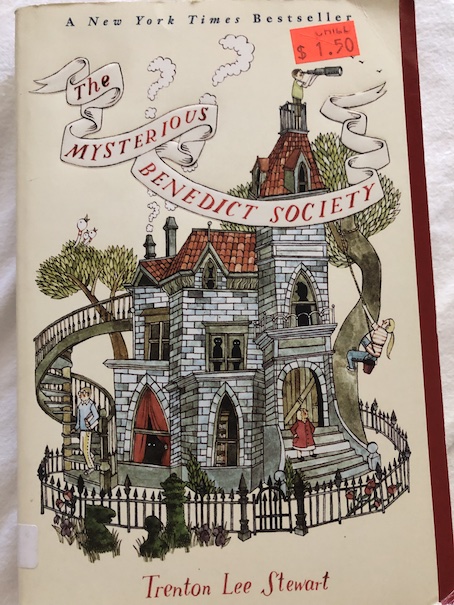
The Mysterious Benedict Society by Trenton Lee Stewart, 2007.

A boy named Reynie (short for Reynard) is taking a series of tests to apply to an unusual school. Reynie lives in an orphanage in Stone Town, and he is highly intelligent. He is often laughed at by the other children for being smart and using big words. He has finished all of the lessons the orphanage has to offer and has been studying with a private tutor, but he is running out of things to do with the tutor. He and his tutor like to read the newspaper together, and they see an advertisement for gifted children looking for new opportunities. His tutor encourages him to look into the advertisement, which is how he comes to take a series of tests to qualify.
The tests have strange instructions. The first part of the tests asks some brain teaser questions and a few personal questions, such as whether Reynie likes to watch tv or listen to the radio (he doesn’t really like either) and whether he thinks of himself as brave. Only a few children qualify to take the next part of the test, which will be given at another building with students only allowed to bring a single pencil and eraser. The instructions say that if they bring anything else with them, they will be disqualified. Reynie would have asked more questions, but the person giving the first test leaves by a window to avoid having to deal with parents who are angry that their child didn’t pass the first test.
When Reynie arrives at the second building, there are two girls there, one of them with green hair. The green-haired girl accidentally drops her only pencil down a storm drain. Since she is only allowed to have one pencil and the others don’t have a spare one to lend her, it looks like she won’t be able to take the test. The other girl seems relieved that there will now be less competition, but Reynie solves the problem of the missing pencil by snapping his own pencil in half and giving the other half to the green-haired girl, who is named Rhonda. She is so grateful that she offers to help him on the test, saying that she already knows the answers. Reynie doesn’t understand how she can know the answers when they’ve only just arrived, but he turns down the offer because he doesn’t want to cheat. It’s just as well because the person administering this test tells them that cheaters will be “executed.” Then, she tells the shocked children that she means “escorted”, as in they will be escorted out of the building. She tells the children that they must follow the test instructions exactly, and although the test looks fiendishly difficult, Reynie does his best.

It turns out that the test is actually a puzzle and that the answers to all the questions are found within the test itself. Following the instructions shows Reynie how to find the answers. Reynie passes the test and is told to go on to the third part. Reynie wants to talk to his tutor, and the woman who administered the test says that she’s already spoken to her. She leaves Reynie to wait with another boy, who has a bald head. The bald boy, called Sticky as a nickname because things he reads stick in his head, says that, like Reynie, he was the only person in his group who passed the second test. When the boys compare their experiences, they realize that Rhonda was a part of the test. Each of them met a girl who lost their pencil and who offered to let them cheat off her.
The boys are soon joined by a girl named Kate, who is carrying a bucket full of random things, which she says are all useful. As an example, she describes how she met a girl earlier who lost her pencil in a storm drain and how she managed to get it back by using things from her bucket. The boys realize that she also met Rhonda and that she also passed the second test, including the Rhonda portion. Actually, Kate tells them that she failed the test, along with the other kids, but she was allowed to stick around for the next test anyway because she helped out the test administrator when she was cornered by angry parents.
The other tests that the children take are similarly puzzles and brain teasers. They all pass by using lateral thinking and unorthodox approaches that highlight their unusual personalities and unique abilities. When they are informed that they’ve passed the tests, they are joined by a fourth test-taker, who has also passed, weirdly by refusing to try to pass the tests. Instead, the fourth test-taker, a girl called Constance Contraire, passed the tests by questioning everything, including the very nature of the tests and trying to go contrary to every rule. The others can’t understand why she passed the tests when the did the opposite of everything she was told to do, but these tests aren’t like the types of tests students usually take.
After they are told that they passed the tests, the test administrators introduce the four children to the man behind the tests, the mysterious and narcoleptic Mr. Benedict. Mr. Benedict says that he has been trying for years to assemble a team of children with unique abilities to undertake a dangerous but important mission. It hasn’t been easy because he’s had a difficult time finding children who can pass his tests, and until now, too few children passed the tests at once to form the team. The test administrators are actually the first children who passed his tests years ago, but they’re too old to really be considered children now. They’re young adults. Now, with four passing children at the same time, Mr. Benedict thinks they finally have the children they need for the team.
Each of the children has demonstrated their thinking skills and unusual approaches to problems. Each of them is also alone, in one way or another, not accountable to any adults, so they can make their own decision to join the team without asking for adult permission. Mr. Benedict says that joining the team will be dangerous, and normally, he would never want to put children at risk, but the situation is serious, and harm may come to them and other people if they don’t solve the problem at hand. Each of the children considers the situation and decides to accept the offer to join the team. (Constance only joins after Mr. Benedict makes it clear to her that she would be joining not because she was told to join, but because she wants to and that her obedience to the group’s rules would also be because she chose it. Constance never does anything just because someone tells her to, which is part of the reason why Mr. Benedict recruited her.)

The kids are given rooms in Mr. Benedict’s book-filled house, which can only be entered through a complicated maze. They are under the guidance and protection of Mr. Benedict’s three assistants:
Rhonda – She was originally from Zambia and was one of the first children to pass Mr. Benedict’s tests several years earlier. Mr. Benedict adopted her.
Number Two – She is also one of Mr. Benedict’s adopted daughters, but she refuses to tell the children what her real name is, preferring to go by her code name. She always wears yellow and rarely ever sleeps.
Milligan – He is an amnesiac who knows nothing about his early life. He’s not even sure that his real name is Milligan, but it’s the only name he could remember. His earliest memory is about escaping from some people who were interrogating him, and he thinks his amnesia is due to a head injury.
When the children are told that they are being protected at Mr. Benedict’s houses, they want to know who or what they’re being protected from. Mr. Benedict explains that he has discovered that someone is sending subliminal messages to the general public through radio, tv, cell phones, and other forms of electronic media. These subliminal messages are being delivered in children’s voices, which Mr. Benedict thinks is part of the sender’s plan. Adults often disregard things that children say, which makes it easier for the messages to go into the adults’ subconscious brains. Some people, like the children and Mr. Benedict and his assistants, are less susceptible to these messages than other people. Mr. Benedict plays the messages for the children so they can hear what they sound like. The things they say are confusing and annoying, but they don’t sound immediately dangerous. Mr. Benedict says that these same messages are being transmitted in different languages all over the world, and he thinks that they’re merely the precursors to something more dangerous. However, Mr. Benedict things that the messages are merely a prelude to something more sinister. Constance asks why Mr. Benedict hasn’t gone to the authorities with what he knows, and he says that he has tried. He used to be a consultant for law and government agencies, but they no longer believe what he has to say. They think that he’s a crackpot. People who would have believed him and been his allies have mysteriously disappeared, and he is sure that’s also part of the sender’s plot, removing anybody who stands in his way.
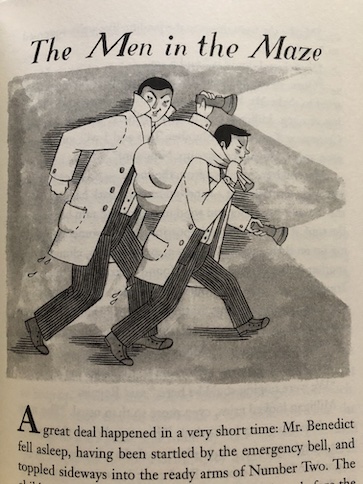
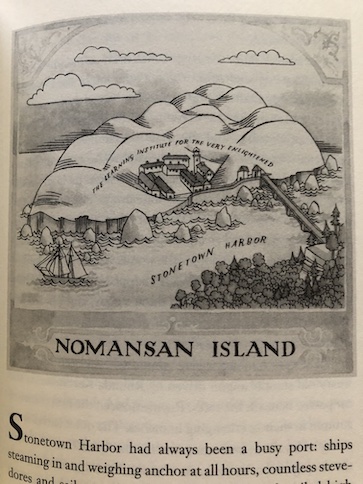
The children become fully aware of the danger when some men try to kidnap them from Mr. Benedict’s house. Mr. Benedict’s assistants subdue the kidnappers with tranquilizer darts and remove them from the house. Mr. Benedict explains that, if they had successfully kidnapped the children, they would have likely taken them to the Learning Institute for the Very Enlightened (the acronym isn’t bad, but the reverse acronym is), which is a mysterious boarding school on an island that teaches orphans and runaways and other children who, like the children in Mr. Benedict’s house, are alone and unsupervised by outside adults. Sometimes, the school also kidnaps vulnerable children to use for its sinister purpose.
Mr. Benedict believes that the mysterious messages are being transmitted from this school by a group of its top students. The dangerous mission that Mr. Benedict has in mind for the team of children is for them to infiltrate the school as students and join this elite group so they can learn the truth about what’s happening and how to stop it.
The children spend some time preparing for their mission at Mr. Benedict’s house while Mr. Benedict and his assistants work on forging papers and getting the children admitted to the school as students. The kids practice learning Morse code and other helpful skills. They also learn a little more about each other and start figuring out how they can work together as a team.

Reynie was orphaned as a baby and has no memory of his parents or his life before coming to the orphanage. Nobody really seems to understand him or care about him except for his tutor, Miss Perumal.
Kate also used to live in an orphanage because her mother died when she was small, and she was apparently abandoned by her father. She can’t remember her mother at all, and she only has one memory of her father from a time when he took her swimming. She remembers him as a nice man, but she thinks maybe she was wrong about that, since he abandoned her. She lived in the orphanage for several years before she ran away to join the circus. Because of her circus life, she’s very strong and athletic, and she’s also surprisingly good at estimating sizes and distances with just her eyes.
Sticky isn’t an orphan but a runaway. He thought that he had a happy life with his parents until they discovered his amazing memory. From then on, they insisted on entering him in contests and quiz shows to earn money. As Sticky won these contests, his parents became more and more money-grubbing, entering him in more and bigger contests. They stopped letting him play with friends and made him constantly study so he would know all the answers to everything. Sticky became stressed out and wanted to quit, but they wouldn’t let him. Eventually, he pretended to run away and hid nearby to see what his parents would do. At first, they were worried and tried to find him, but then, people began donating money to them to help in the search. His parents kept up the search in a nominal way, so people would continue to donate, but they weren’t really interested in finding him. They said to each other that they were getting more money for him not being there, so they were better off with him gone. Sticky was shocked at their lack of love and concern for him, so he left for real. The reason why he’s bald is that he used hair remover to disguise himself from anybody who might still be looking for him.

These three children get along well with each other, but Constance is different. She doesn’t tell the others much about herself or her background. She’s a contrarian who rarely shows any consideration for her teammates. She even refuses to stop calling Sticky “George Washington”, which is Sticky’s real name, but he hates it. Kate wonders why she’s on the team when she’s not a team player and doesn’t seem to have any special abilities. She is much smaller than the other kids and has a generally cranky disposition. Reynie talks to Mr. Benedict about it, and Mr. Benedict assures him and the others that he has a reason for wanting Constance for the team. She has traits that will be of help to them later. Constance is the one who names the team The Mysterious Benedict Society when the others have trouble thinking up a good name for themselves.
When the children arrive at the school, they are told that the top students there become “Messengers” and get special, secret privileges, so they have to try to gain those positions themselves. The school also gives them many weird, mixed messages, which sound a lot like the secret messages being broadcast from the school. The kids are told that there are very few rules at the school, but there are so many exceptions to the “no rules” rule that the school effectively has a lot of rules. The Messenger showing the kids around the school doesn’t understand what they mean when they point it out the inconsistency. The kids are encouraged to always leave their television sets on, and they are always watched by well-dressed people known as the Executives.
The Executives are former students, particularly former Messengers, who now act as teachers at the school. The lessons at the school are as contradictory and annoying as the secret messages being sent over radio and tv. The kids are just made to memorize and repeat these contradictory phrases, like “Work longer hours to have more free time” and “War is necessary to have peace.” None of the other students seem to notice how these phrases don’t make sense. They’re all just memorizing the messages to get good grades and competing to be given Messenger status. Nobody knows what the extra privileges are that Messengers have, but everybody wants them. Messengers also fear new students becoming Messengers because there can only be a set number of Messengers at a time, and the current Messengers can lose their status if other students pass them in their classes.
Most of the chores at the school are done by people called Helpers, who are not allowed to be speak unless someone asks them a question. They’re not even supposed to made eye contact with the students. Students are periodically called to a place called “the waiting room”, which seems to involve some kind of punishment. The other students seem terrified about it.
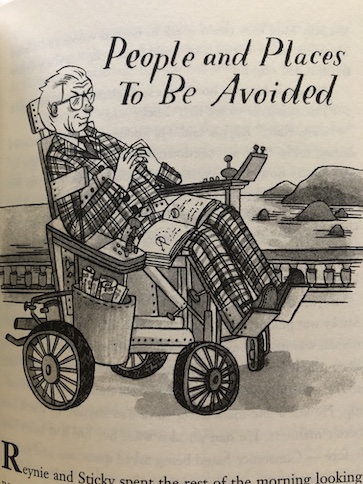
The kids are told that the school was founded by a wealthy man, Mr. Curtain, and that tuition is free for everyone. The messengers say that Mr. Curtain works very hard and never leaves the school. When the kids see Mr. Curtain at the welcoming assembly, they are shocked that he looks exactly like Mr. Benedict! They wonder if he could actually be Mr. Benedict and if they’ve been tricked. However, Mr. Curtain seems to have exactly the opposite character of Mr. Benedict. It seems that Mr. Benedict has an evil twin! The kids of the Mysterious Benedict Society have to figure out who they can really trust and if they’re now trapped at this very weird school with people who are truly dangerous.
I couldn’t find a copy of this book available online, but it’s still in print and easily available. It’s the first book of a series. It’s also been made into a tv series.
My Reaction and Spoilers
Riddles and Brain Teasers
One of the things I loved about this book is that it is full of riddles, brain teasers, and wordplay. The name of the island where the school is located is Nomansan Island, or “No Man’s An Island.” Ha, ha.
Some of the characters’ names are also clues to their characters and identities. I understood the significance of Milligan’s name way before he and Kate did because I was already starting to look for word games and clues.
The messages that the kids and Mr. Benedict and his assistants send to each other take the form of riddles, just in case someone intercepts them. This makes some of Mr. Benedict’s instructions a little difficult for the kids to interpret, but it does add extra challenge for the readers as well.
Emotional Manipulation (Spoilers)
Mental and emotional manipulation are major themes in the book. Mr. Curtain is actually a deeply insecure person who craves control over others. He understands enough about his own personal fears to understand how fear has a strong effect on other people, and he uses that as his weapon. Through his machine called the Whisperer, Mr. Curtain can dispense both fear and reassurance as he tries to steer the entire population in the direction he wants: putting himself in charge.
The strange messages being transmitted are meant to plant fearful and contradictory images in people’s minds, making them feel like everything is out of control. Then, he can present himself as the man with all the answers, soothing the fears that he intentionally created. He wants to be be put in a position of being in control of everyone and everything because that’s what he feels like he needs to feel safe and reassured.
The contradictory lessons and rules at the school are part of the images that he wants to place in people’s minds. The rules that there are no rules except when there are gives people a false sense of freedom when he’s in control. They no just longer notice the control because he’s told them to feel free, and they do. This goes along with the school’s teachings that there is no need for regulation of businesses except when there is. This leads up to government is good, except when it’s bad, and it’s always bad … because Mr. Curtain isn’t in charge. He wants everyone to distrust and disregard the forces that might oppose him and trust only him: the guy who says what everyone is apparently thinking and tells them things that make them feel good. (This all sounds scarily familiar.)
At one point in the story, Mr. Curtain explains to Reynie that the messages he transmits with the Whisper are simple ones with hidden layers of meaning and complexity because people who are scared, which is what Mr. Curtain wants them to be, crave simple answers to complicated questions to soothe their minds. Mr. Benedict says that one of the gifts that the children share is a love of truth, which allows them to resist the messaging, but I would argue the children also have a love for complexity. The puzzles and brain teasers bring out their complex thinking, and the kids like to think about things and examine them from different angles. They’re creative and unconventional, not just doing what other people might tell them is the “smart” thing to do. They’re not looking for just the easy answers and the warm fuzzies or what gets them ahead of other people today but the bigger pictures. Some people are scared to confront complexity and things they don’t understand, but other people thrive on it. They’re not scared by mere ideas or trying to avoid thinking because it’s difficult or unpleasant. In the end, it’s partly the children’s ability to confront some of the things that they’re truly afraid of, whether it’s doubts about themselves or their own cravings for comfort and belonging, that help them overcome Mr. Curtain and his machine. Fear is powerful, but facing up to it with honesty does more in the long run than trying to hide from it.
Memories and Hidden Pasts (Spoilers)
Many people in the story have repressed memories an hidden pasts. When some of these are revealed, t’she story also raises the question of how sorry we should feel for the villains. We learn that Mr. Benedict and Mr. Curtain are identical twins who were separated as babies when their parents will killed in a lab accident. They were raised by different people, but they both had hard childhoods. They are very much alike, but they are different in the ways they were raised and also in the ways that they responded to adversity in their lives. Mr. Benedict coped with his lack of family by surrounding himself with good friends, who became his new family. Mr. Curtain has gone a different route, seeking to control and manipulate other people.
Mr. Curtains evil plan, which he calls the “Improvement” is based on his hard childhood and his need for control over other people as an adult. We can feel badly that his youth was terrible, but he is doing truly evil things that harm people. The kids discover that many of the children at the school were actually kidnapped. When the children first arrive at the school after being kidnapped, they’re terrified, but they later become happy and obedient because Mr. Curtain has developed a method of wiping people’s memories (more accurate, hiding people’s memories from themselves), so he can make the people’s he’s kidnapped forget that they were kidnapped and scared. He targets orphans and runaways for his school because they won’t have parents or anyone else looking for them, and many of the kids cling to the school and try to excel there, becoming Messengers and Executives, because it gives them the feeling of belonging that they’ve always craved. Yes, Mr. Curtain had a bad childhood, but he’s using his adulthood to do horrible things to vulnerable kids who are very much like he was at their age.
When the kids realize that many of the people who are now Executives were once lonely, kidnapped children, they wonder if they should feel sorry for them. They think it over and decide that they don’t really feel sorry for them and that they still hate them. They feel that way because the Executives have become like Mr. Curtain. They have no empathy toward children who are very much like they were once, they knowingly do things to these vulnerable children that once terrified and hurt them, and they do it all for their own personal promotion and the good feelings they get from doing Mr. Curtain’s bidding. The machine Mr. Curtain uses for the children to transmit his messages to the world gives the children good feelings when they use it, feelings of comfort and having their worries wiped away, which is why the Messengers cling so hard to the “privilege” of using it. They all have sad pasts and a craving for belonging and achievement, but there are acceptable and unacceptable ways to deal with those types of feelings. Everything the Executives do, from assisting in the kidnapping other kids and punishing them in horrible ways at Mr. Curtain’s direction, is terrible. The kids know that the Executives have had their minds and emotions manipulated by Mr. Curtain, but even knowing that doesn’t help them relate much to the Executives because the Executives are still their enemies and still doing horrible things. Trying to sympathize with them won’t change that because the Executives only care about pleasing Mr. Curtain and get their comfort from his machine and sense of power and authority he gives them over the kids. They are not open to sympathy or bonding with others. Their only chance at redemption is getting their memories back and seeing Mr. Curtain and his manipulation of them for what it is.
The kids also realize that the missing agents and allies that Mr. Benedict talked about are the Helpers at the school. Mr. Benedict wiped their memories more thoroughly than he did the children’s because they were adults and had established lives, duties, and families outside of the school. He gave them mental reconditioning to turn them into the grunt workers at the school and to keep them from prying into the memories they have of their lives which periodically resurface. Unfortunately, he can do little about the depression that hangs over them constantly because, on some level, they know that they’re missing parts of themselves and their past lives. The kids realize that’s what happened to Milligan. He had his memory wiped by Mr. Curtain, but he escaped before he was reconditioned, which is why he’s more aware than the Helpers are. People whose memories were apparently wiped haven’t actually lost them, but they need reminders of things and people who were important to them in their past lives to bring their memories to the surface again.
I was pretty sure that I knew Milligan’s real identity and the fate of Kate’s father early in the book when Milligan said that “Milligan” was all that he could remember as his name. The entire book makes use of puzzles, and I realized that “Milligan” isn’t really a real name but a dim memory of the last thing that Kate and her father talked about doing. Later in the book, the kids find out that what triggers memories in the Helpers is someone mentioning people who were important to them or unfulfilled obligations. When Kate last saw her father, she wanted to go to the mill pond again, and they never did because her father disappeared, and everyone assumed that he had abandoned her instead of that he’d gone missing. This was partly the fault of Mr. Curtain because one of the secret messages he’s been transmitting is that “the missing are not missing, merely departed”, discouraging anyone from trying too hard to find all of the people he’s kidnapping. Therefore, it never occurred to anyone that Kate’s father was a missing person, only that he’d left. Kate is not only glad to have her father back but relieved to understand that the father she’d loved was abducted instead of abandoning her.
At the end of the book, it’s also revealed that Sticky’s parents were similarly victims of Mr. Curtain’s messaging. When their son disappeared, they knew only that he’d left, and they were stuck in the mode of not trying too hard to look for a missing person. I felt like the matter of Sticky’s parents was a little too easily resolved when Mr. Benedict reveals that they had not been saying that they were better off without Sticky but they felt like Sticky might be better off without them because he was much smarter than they were, and they felt like they’d failed as parents. They were charmed by living the high life for a while, but before the end of the book, they regretted not trying harder to find Sticky and blew all of their money in a real search. Mr. Benedict says that he believes that they’re sincere in wanting Sticky back because they really do love him, enough to throw off the last of the influence Mr. Curtain’s messages had on their minds.
Earlier in the story, Mr. Benedict told Reynie that, as a child, he used to wish for a family, but not anymore. Reynie asks him if he grew out of wanting a family, but Mr. Benedict says no, it’s just that he’s been able to build one of his own as an adult. He has his friends and associates and his adopted daughters. He also adopts Constance. Reynie is adopted by his beloved tutor, so he also gains a family, along with his new friends.













 Guns in the Heather by Lockhart Amerman, 1963.
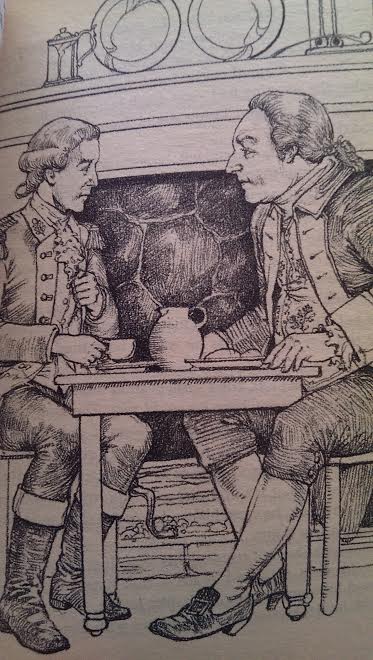 The Gentleman Spy — This is the story of Captain John Andre and General Benedict Arnold during the American Revolution. John Andre was a British officer who was executed for his role in helping Benedict Arnold defect to the British side.
 The Phantom of the Desert — Lawrence of Arabia was actually Thomas Edward Lawrence, a British army Captain. He helped the Arabs to fight against the Turks during WWI.
 Jestress's Forgotten Books and Stories