Meg Mackintosh and The Mystery at the Soccer Match by Lucinda Landon, 1997.
Meg and her brother Peter play on opposing soccer teams, the Hawks and the Panthers. Peter is brags about how good he is at being a goalie, and Meg hopes that, in this game, she can score a few points off him. There are prizes for this soccer team, and the winning team will get to keep a medal that Coach Lee won playing international soccer until next year’s game. Everybody admires the medal, which is displayed on the awards table.
Meg’s teammate, Alex, is less thrilled about the game. He has an injured leg and can’t play, and his mother is busy campaigning against awarding prizes for children’s soccer. She thinks that giving prizes isn’t fair and hurts the feelings of kids who don’t get prizes.
It’s true that there is some pressure from the parents for their children to play harder to win prizes than the kids really want. Peter accidentally collides with one of his teammates, Heather, and they both end up with scrapes and are temporarily removed from the game for first aid. Heather’s father pressures her to get back in the game as soon as possible and win, but Heather privately admits to Peter that she doesn’t really feel like playing anymore. She only does it because she knows her dad would feel bad if her team doesn’t win.
It starts to rain during the game, and the adults and kids cover the awards table with a blanket. When they remove the blanket later, the gold medal is gone! Who could have taken it? Meg invites Alex to join her detective club and help investigate the mystery while she plays soccer!
The book is available to borrow and read for free online through Internet Archive.
My Reaction
Meg inviting Alex to help her investigate the case and consider motives makes this book a little different from other books in the series, where Meg usually does that herself. The mystery is good because there are several suspects to consider, each of whom was seen near the table and left signs of their presence there. Did Heather’s dad take the medal because he once almost won a similar soccer medal and was jealous that Coach Lee won the prize he didn’t? He certainly seems very prize-oriented. Did Alex’s mother take it because she disapproves of sports prizes and wanted to make a statement about it? Could one of the children have taken it, either because they wanted to claim the prize they didn’t think they could win honestly or because they wanted to impress one of their parents?
As with other books in the series, readers are given the chance to review the evidence Meg and her friends have collected and see if they can spot the clues along with them in pictures taken at the scene. There was a clue that I thought was pretty obvious in one of the pictures but which Meg and the other kids didn’t spot at first. They only notice it when another clue makes them take a second look at one of the pictures. I think many young readers might also spot the clue I did, although if they do, it might make them feel clever for noticing something before Meg and her friends do.
When I first noticed that clue, I was inclined to think the solution to this mystery was too obvious, but there is another twist to the story that makes it more interesting. The medal was actually stolen twice. After the original thief put it back, someone else took it again, so there are two thefts to figure out instead of one.
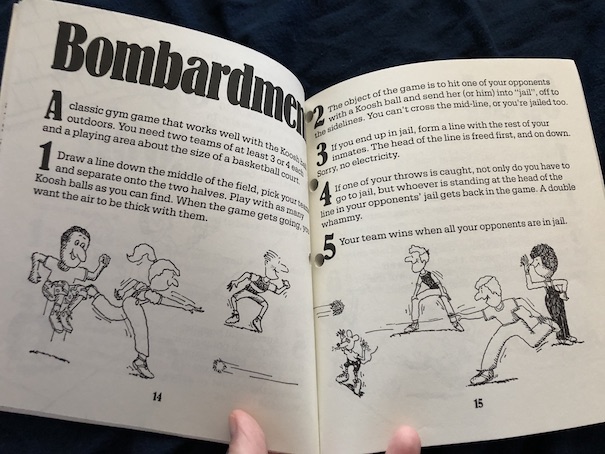
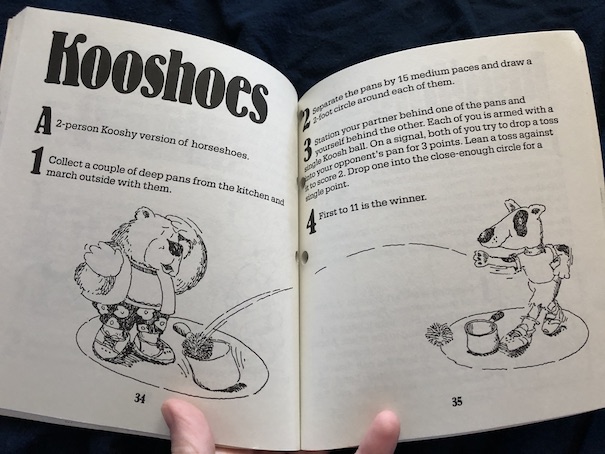
The Official Koosh Book by John Cassidy and Koosh ball inventor Scott Stillinger, 1989.
This book is part of the classic children’s hobby and activity series from Klutz Press. Originally, this book came with three mini Koosh balls, which were attached to the book at the holes on the left side of the book. I can’t remember now whether I actually got my set of mini Koosh balls with this book or if I bought them separately because my book was used. I’ve had this book for a long time, and my favorite activity in the book is juggling, a favorite staple activity of the Klutz series as well as a personal favorite of mine.
My copy of the book isn’t a first edition, and the introduction explains some changes that had taken place since the book was first written. John Cassidy of Klutz Press partnered with the inventor of the Koosh ball, Scott Stillinger, to write the book to explain various ways kids could use Koosh balls and games people could play with them when the toy was a new product. Since the book was first written, Koosh balls had become much more popular, and new varieties of Koosh balls were created, including the Mini Kooshes that came with the book.
Koosh balls are rubber balls covered with rubber filaments that are something like short spaghetti, making them feel soft, even if you get hit in the head with them while learning how to juggle. (I speak from experience.) This soft, painless-when-hit-with-one quality of Koosh balls was completely intentional on the part of the creator. It’s also the reason why they’re still a popular toy and the basis for many of the Koosh games in the book.
Many of the games in this book make use of the fact that it doesn’t hurt to be hit with a Koosh ball to give battle games like Dodge Ball and Bombardment a new twist. As the book says, “Dodge Koosh also fulfills the basic human need to bonk others of our same species.” I get that feeling some days, but when it’s done with Koosh balls, it’s pretty harmless.
Because Kooshes are soft, you can even play games indoors that usually wouldn’t work indoors because of the damage that could be done to things and people.
The book also suggests using Koosh balls for variations on Footbag (or Hacky Sack) or Horseshoes. Koosh balls work for these types of games because they don’t roll like regular balls. Because Koosh balls are made of rubber, they can also be used in a swimming pool.
The book is available to borrow and read for free online through Internet Archive (multiple copies).
Who Ran My Underwear Up the Flagpole? by Jerry Spinelli, 1992.
It’s still just a few weeks into the first new school year at Plumstead Middle School, and Eddie still feels a little out of place. He still feels like he’s a grade school kid at heart and doesn’t fit in with the big kids at middle school. The most grown-up impulse that he has is to frequently stare and smile at Sunny Wyler, and she doesn’t even like him to do that.
Then, something horribly embarrassing happens. Mr. Hollis, the social studies teacher is so late that the entire class gives up on him arriving and decides to go to the locker rooms to change early for gym. Mr. Hollis storms into the boys’ locker room a minute later and barks orders at the boys to return to his class immediately. Eddie, scared to death of his angry teacher, follows this order to the letter – forgetting that he isn’t wearing any pants and is just sitting there in his underwear. Eddie is the only person who doesn’t get any punishment from Mr. Hollis, who is sympathetic to his plight, but that’s not enough to make up for everyone seeing Eddie in his underwear.
Eddie’s underwear has cartoon characters on it, which is just another thing that makes him feel like a baby in middle school. He enlists the help of his best friend, Pickles, to help him burn his old cartoon character underwear, planning to buy some new ones with money he was saving to buy comic books. Then, Pickles suggests to him that he do something else to see how grown-up he is: try out for the school’s football team.
Unbeknownst to the boys, Salem and Sunny are both trying out for the school’s cheerleading squad. Salem isn’t at all the cheerleading type, but that’s the very reason why she wants to join the cheerleading squad. She wants to be an author, and she’s trying to understand different types of people so she can create more realistic characters. Therefore, she sometimes does things that would otherwise be out of character for her just for the experience or to get inside the head of different types of people. However, Salem realizes that she isn’t a very good cheerleader, so she invites Sunny over to consult her on what to do.
In spite of her grumpy, prickly personality, Sunny is actually a very good cheerleader, but she can’t help Salem to improve enough to make the squad. The girls do see Eddie at the football try-outs, though. Eddie’s uniform is really too big for him, his helmet gets turned around, and he ends up with a nosebleed. The coach complains about everything that’s going on with the team and how little time he has to train them and says that what he needs is a manager, so Salem volunteers for the position. Salem is very good at organizing things. With Pickles as part of the school’s small marching band, the entire group of friends is now involved in the school’s football games.
The four kids still have lunch with the school principal once a week, having developed a friendship with him during their rocky first days of school. They tell the principal about their football involvement, and Sunny brings up the subject of Eddie’s Superman underwear that everyone in the class saw him wearing. Eddie denies having any Superman underwear (which is now true), and Pickles backs him up, saying that one pair was just an old pair that he had to wear that day because the others were in the wash. The principal tries to hint to Sunny that she should stop teasing Eddie, but she takes it too far, and Eddie ends up smashing a Devil Dog snack cake (link repaired Nov. 2023) into Sunny’s face. The principal is actually impressed that timid Eddie had to the nerve to do it, and oddly, Sunny doesn’t even seem upset afterward.
Thus begins Eddie’s first steps at learning to be more grown-up. However, it’s not going to be easy for him. His current reputation is going to be hard to live down. The other guys on the football team are all bigger than he is, and he’s been bullied by the big kids since school started. At one practice meet, his pants fall down because his uniform is too loose, and a big kid hoists him in the air to show everyone that he’s not wearing Superman underwear.
But, what Pickles had told Eddie when they were burning Eddie’s old underwear was correct: Eddie might be a kid, but so are all the other sixth graders at their school. Eddie isn’t the only boy on the football team who is new and small. He’s not the only one who is sometimes timid and awkward, either. As team manager, Salem soon begins helping the new football players tie the drawstrings of their pants more tightly because other players are worried about losing their pants like Eddie did. She also begins soothing their various injuries, fears, and ruffled feelings. Around their coach, the boys have to act tough and not cry, even when they’re scared or hurt, but since their team manager is an understanding girl, the boys can sometimes let down their guard and be more human with her. Salem gets a lot of insight into the emotions of football players, and in return, she helps the young players to understand and manage their emotions, too. Eddie resists most of Salem’s help because he’s trying to prove that he’s tough and grown-up, but without her support, many of the other boys would have quit the team.
As the season progresses, Eddie gets the chance to a football hero, the very first player to score a touchdown at their brand-new school, and Sunny realizes that she’d rather be a mascot than a cheerleader because she’s too grouchy to be a cheerleader and nobody tells a Fighting Hamster to keep smiling. However, even Eddie’s football victory doesn’t end the teasing, and somebody runs a pair of Superman underpants up the flagpole to mock him. In a desperate attempt to cheer him up, Salem promises to arrange the thing she knows that Eddie wants the most – a chance to kiss Sunny. Will it work?
The book is available to borrow and read for free online through Internet Archive.
My Reaction
The kids do some growing-up in this book, but not unreasonably so for eleven-year-olds. The party where Salem tries to arrange for Sunny and Eddie to kiss is suitably awkward. As the kids talk about the idea of kissing, they tease each other. I didn’t like the part where Salem called Sunny a baby for not wanting to kiss Eddie. It’s not that I don’t think that’s realistic for some eleven-year-olds, but I believe more in the modern idea of giving consent and respecting someone’s “no” when it comes to anything romantic. That didn’t occur to me when I first read this book as a kid, but that’s what real maturity does for you. The word “sex” does appear in the story when Salem challenges Sunny’s maturity, saying that she probably still giggles when someone says that word, to which Sunny quickly replies, “Don’t you?”
“‘No,’ said Salem, ‘as a matter of fact, I don’t. What’s there to giggle about? It’s nature. It’s as natural as trees and cows. Do you giggle when somebody says trees or cows?’ ‘If the tree tries to kiss the cow,’ said Sunny, ‘sure, absolutely.'”
As part of their maturity talk, Salem points out that women do mature faster than men, and that’s why some young women marry older men. Well, that’s one explanation for that, although, as an adult, I can think of at least two more.
To her credit, Sunny thinks of a way to deliver a kiss to Eddie without exactly kissing him. She does it in a joking way as part of a game of Truth or Dare.
As a side plot, the kids were also trying to decide whether or not they want to go to the Halloween Dance at school. On Halloween, they all meet in their costumes, and Eddie is over his Superman underwear embarrassment enough to wear a Superman costume. At first, the kids think that maybe they’ll go to the dance, but on the way, they can’t resist stopping to trick-or-treat and end up changing their minds. They’re not really ready to be completely grown-up yet, any more than they’re interested in romance in any serious sense. What’s more, they’re all fine with that.
This is the book where Pickles makes himself a new skateboard out of an old surfboard that’s big enough to carry not only him but all of his friends, too. He calls it the Picklebus.
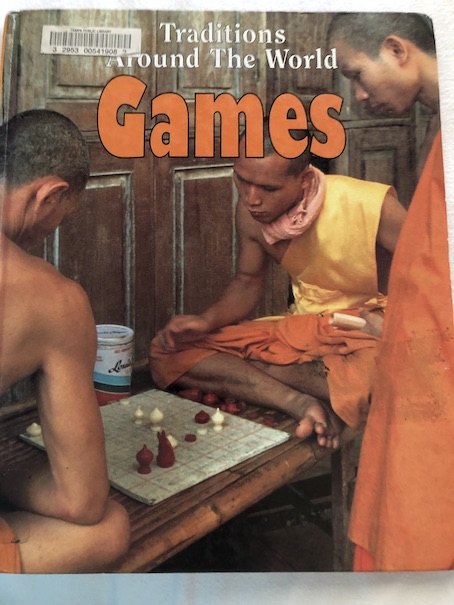
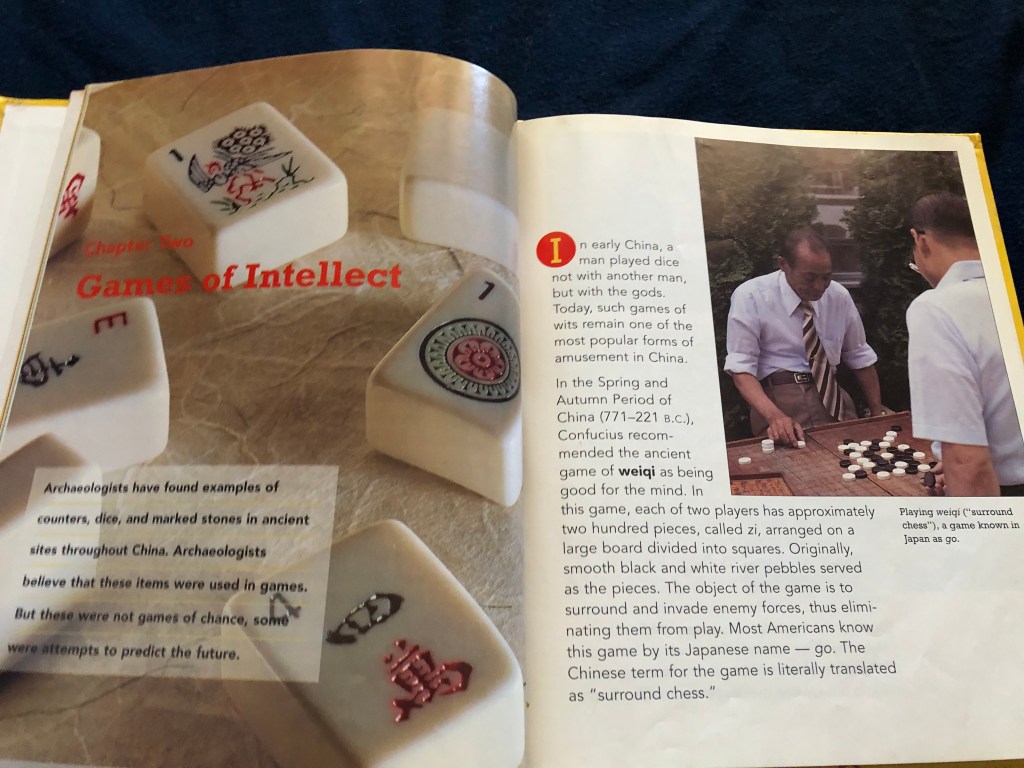
This book is part of the Traditions Around the World series, which explains different aspects of culture around the world. Each book in the series focuses on a different cultural topic and then explains traditions regarding that topic in different countries. This one is all about games of various kinds.
The games are organized into sections by continent, and the book covers a variety of board games, party games, and sports. Not all of the games are explained in detail. Many of them have brief descriptions, explaining what types of games they are and when they are usually played, and there are some with complete instructions.
I was originally interested in the histories of the some of the games, but the book doesn’t always explain the history of games or tell how old they are. There is some of that type of information, but some of it is a little vague, just mentioning that these are games are played or have been played in certain countries. Of course, when dealing with such a broad topic in a short book, it can be difficult to go into detail on everything, and when it comes to cultural topics, like games, their origins aren’t always known or obvious. Many games have their origins in many different countries. Sometimes, it’s because they are based on such universal concepts that many different societies naturally come up with their own variations (like games involving tossing a ball or hiding and seeking). Other times, it’s because the games have been played in many different countries over the centuries, and everywhere they’ve been played, rules have been altered or pieces and boards redesigned to take their modern form, like Checkers and Chess. Sometimes, this has happened so many times, it can be difficult to say exactly how the very oldest forms were played like with Backgammon. This book mention that people in China play Backgammon, but it’s actually a game played all over the world, related to ancient board games from Ancient Rome, Egypt, and the Middle East. The book doesn’t really go into its history.
I think that the two strength of this book are the variety of games it covers and the pictures it shows of real people playing different games. The book discusses ancient board games like Go (China and Japan), unusual sports like hurling (from Ireland), and children’s playground games, like How Deep Is the Water? (from Germany) as well as some common games that are played around the world, like jacks (an ancient game that has been played in many variations, called variously knucklebones, jackstones, etc.). Some games and game concepts are universal, but there are some unique gems that are particular to certain areas. Seeing the pictures makes the games come alive and also makes the descriptions easier to understand. That is one of the things that I really like about children’s books, and I wish more adult books would make better use of pictures. They really are worth a thousand words.
This book is part of a series about games played around the world. The series also covers sports and other, related activities. This book is specifically about the traditional games and sports of China.
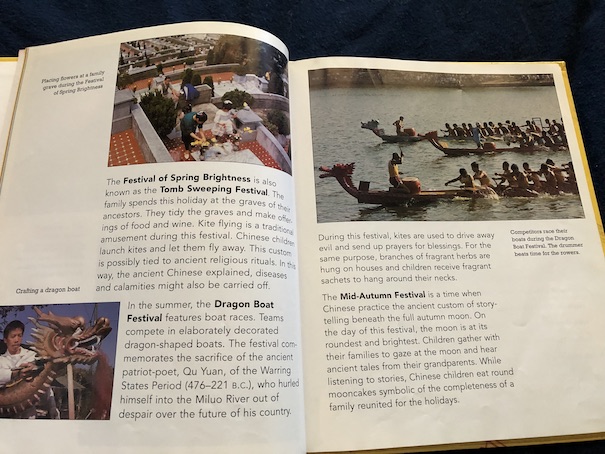
China’s history goes back thousands of years, and so does the history of games and toys enjoyed there by generations of children. The book begins with a brief history of China. This book was written in the 1990s, and it contains a brief description of China’s one-child policy, which controlled the sizes of Chinese families and impacted the way in which children were raised. It also explains some important Chinese festivals, such as the Lunar New Year, Lantern Festival, and Dragon Boat Festival. It explains the origins of these festivals and how people celebrate, including the roles of children in the celebrations.
I most enjoyed the sections about board games. Some of the oldest board games in the world come from China. Some of these games are also played in Japan under different names. For example, the game Weiqi is known as Go in Japan, and this is the name that is also most familiar to Americans. Chinese Chess uses different pieces from the international form of chess. The book mentions Chinese Checkers also, but it doesn’t explain that it was not actually invented in China, even though it is played there today. (The “Chinese” in the title was a marketing gimmick in the United States, to make the game seem more exotic. It’s actually a German variation of the American game Halma, which was based on an older English game called Hoppers.) Majiang (called Mah-Jongg in the United States) is another well-known Chinese game. Sometimes, in the United States, people play it as a solitaire game on their computes, but the real-life board game is a multiplayer game with several variations.
When I was in school, I had a teacher who was fond of tangrams, which is a kind of puzzle game that involves using a set of basic shapes to produce different forms or pictures of objects. The book demonstrates how to make a tangram set and how to use it.
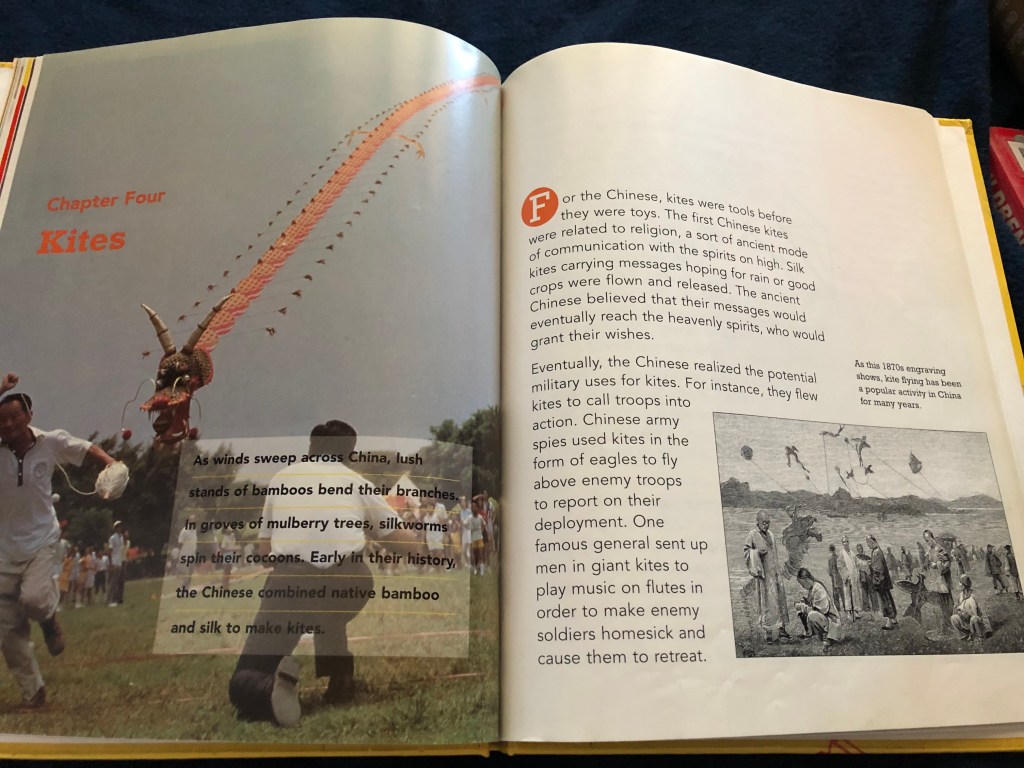
The earliest kites made in China were made for serious, religious purposes, sending prayers, signs, or messages to the heavens. Later, the Chinese also used them to give military signals. Later, paper kites became a popular form of amusement and folk art. They can be made in many different forms. Some of them even make musical sounds, caused by the wind passing over holes placed in the bamboo frame of the kite.
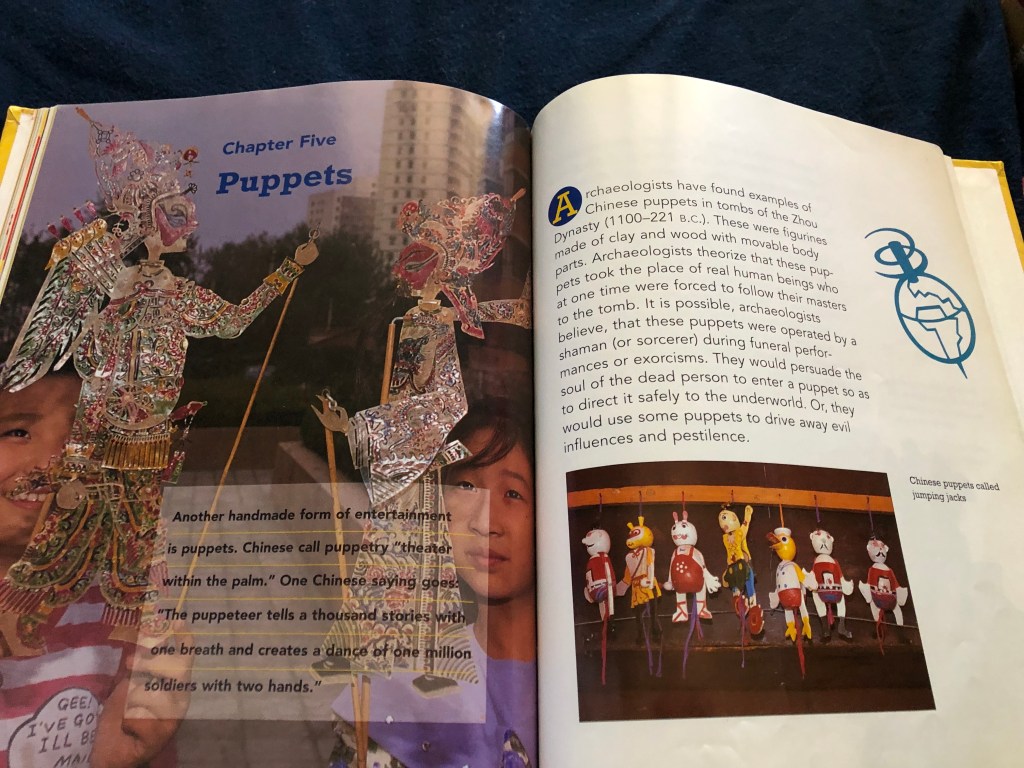
The Chinese also use puppets in different styles. The history of puppet theater also goes back thousands of years, and puppets made for puppet theaters can be very elaborate. Sometimes, plays are performed with shadow puppets controlled by sticks and sometimes with marionettes or hand puppets. The appearance of a puppet and provide clues to the puppet’s character. For example, puppets with red faces represent brave characters while ones with white faces may be cunning and treacherous and ones with black faces are loyal.
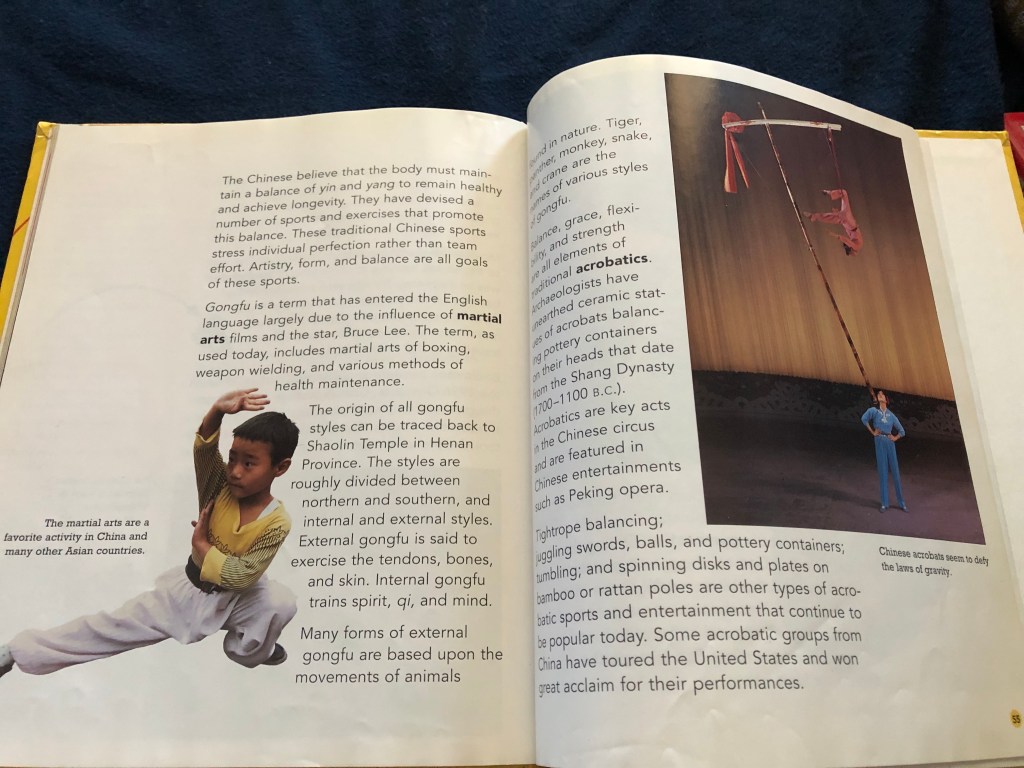
Popular sports in China include soccer (called “football” everywhere but in North America) and badminton. China is also famous for its martial arts and some spectacular forms of acrobatics.
The Dangerous Book for Boys by Conn Iggulden and Hal Iggulden, 2006, 2007.
This is an activity/hobby book for children, especially for boys, but really, full of activities that girls could enjoy, too. It’s often sold in sets with a companion book, The Daring Book for Girls. These books follow in the tradition of earlier activity/hobby books like The American Boy’s Handy Book and The American Girl’s Handy Book by the Beard siblings. Some of the activities in these modern books are similar to ones included in historical children’s activity/hobby books, but there are some notable differences. Although The Dangerous Book for Boys includes sports and outdoor activities, it has more scientific and academic information than The American Boy’s Handy Book.
The differences between these books show changes that have taken place in society, the activities that adults want to promote for children, and the types of activities that children can actually use in the 125 years between the times when the two books were published. The motives of the authors of these books were similar, all of them wanting to produce the type of activity/hobby book that they would have liked to have when they were young and didn’t have, not because other hobby books didn’t exist exist when they were young but because they were looking for something that they hadn’t found in the hobby books of their youth. In the 1880s, Daniel Beard set out to write a hobby book for American boys because many of the hobby books of his youth were poorly written and/or came from England, using words that were not used in American English or recommendations for London shops where boys could buy equipment, which were of no use to an American boy. His book, The American Boy’s Handy Book, promoted do-it-yourself hobbies, particularly ones related to outdoor activities and suitable for children who lived near woods and lakes or rivers where they could do things like go fishing, sail boats that they made themselves, or build log cabin playhouses. However, 21st century society is much more urban/suburban, and it can be difficult or impossible for modern children to do something the things that Daniel Beard recommended. The Dangerous Book for Boys was written for 21st century children, who might need a bit of nudging to get off their computers and video game systems now and then and maybe a little academic help or something to ignite an interest in history or science, but are no less interested in learning something new and interesting or something fun to do with their friends. One thing that I hope readers come to understand from these books is that the world is full of things to do. There is more to do in life than anyone will have time to do in a single lifetime, and far, far more than can be contained in any one book. The Dangerous Book for Boys (published first in the UK and later in the US) contains things that 19th century Daniel Beard might have found very interesting but didn’t exist during his time, so they never even occurred to him as possibilities, and there are bound to be more things coming in the future that people either haven’t thought of yet or are quietly working on right now, planning the books and activities of the future. There’s always something to do. People just need time to do things and the willingness to get started.
I like to explain the contents of books so that people will know whether they would like to read them in more detail. It’s difficult to describe the contents of The Dangerous Book for Boys succinctly because the contents are extensive and they are not grouped into convenient categories. It’s more like reading a very long magazine with isolated articles, although some of the articles are related to each other. It’s just that related topics are not put next to each other. For example, the information about reading star maps comes much later in the book than the introduction to astronomy, and information about the solar system comes even later, with many other sections in between. There are also some sections of trivia/interesting information, history, or academic topics which were purposely split into different numbered sections and distributed throughout the book, like Questions About the World (explaining natural phenomena like the seasons, the tides, and why the sky is blue), Famous Battles (divided into sections starting with ancient battles and then more modern ones), Extraordinary Stories (about the lives and accomplishments of famous men, including the Wright Brothers and Robert the Bruce), and Understanding Grammar (a more academic section).
Because it would be difficult for me to explain everything in this book without basically copying the entire table of contents, which would take quite a lot of space to do, I’ll just hit some of the highlights by describing them in sections that the book doesn’t have but which explain the types of activities covered in this book. All of the types of activities that I describe below are included in the book, but there is also more in the book than I could take the time and space to describe in detail.
Useful Skills and Knowledge
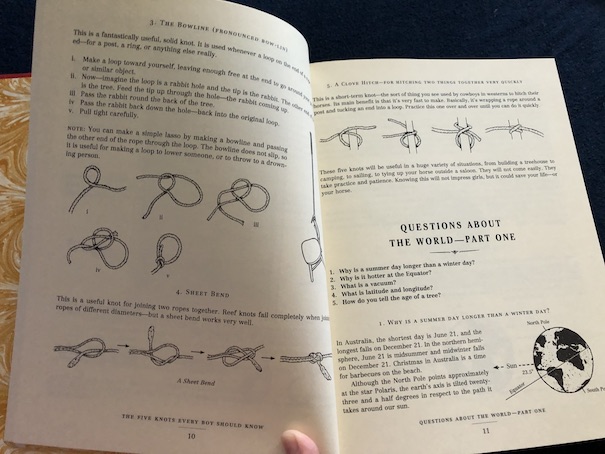
The book has sections explaining how to do first aid, how to tie different types of knots, how to wrap a package with brown paper and string, and how to make cloth fireproof.
I was somewhat amused by the section about how to talk to girls. Most of it is good advice, like maintaining a clean appearance and not being vulgar or overdoing it with jokes. Lesson #1 is “It is important to listen.”, which is always true. The part that I thought was funny was in the introduction: “You may already have noticed that girls are quite different from you. By this, we do not mean the physical differences, more the fact that they remain unimpressed by your mastery of a game involving wizards, or your understanding of Morse Code.” To that, I say, “Are you kidding?!” I used to have Morse Code memorized from playing the Nancy Drew computer games by Her Interactive, and I know from my fascination with activity books like this that the reason why Morse Code looks the way it does is that Morse wisely decided to make the letters of the alphabet used the most often the shortest to form. I used to play World of Warcraft, and I played every one of the available factions, but then I got more interested in physical board games and board game history. My female friends continued much longer, although they ended up switching to Final Fantasy. I’ve played both D&D and Call of Cthulu and liked them both. The more wizards, the better, as far as I’m concerned!
I always think that advice about what girls like often fails to take into account that girls are individuals with different interests and hobbies, no matter what their age. Not all woman like to wear high heels (which are stupid, annoying shoes that are bad for your feet, especially those with the dumb, skinny heels that always make me turn my ankle), and some either never wear makeup or consider it an annoying hassle that they feel obligated to do to because other people expect it. Some girls wear their hair long because they like the feminine look or like to experiment with different types of artistic braids and hairstyles, and some girls chop their hair short because they’d rather just quickly run a comb through it and forget about it. Some women, like me and my friends are geeks, who love books, play video games and role-playing games, know various types of computer programming or maker hobbies, study history, and would gladly do most of the activities in books like this. Some girls are into sports and working out. There are even some girls who are into things like hunting and even taxidermy and wished that they could have joined the Boy Scouts instead of learning to sew and bake cupcakes in Brownies. People in general can have many and varied interests. Even though this book was written for boys of the 21st century, I don’t think that the authors are really in touch with women and girls of the 21st century and understand the range of topics that many of them find interesting. Although, I think that the authors’ attitudes about girls’ interests aren’t just due to them growing up in the 20th century themselves. Guys have often tried to figure out what women like and what women want, and they frequently get it wrong because they approach the question from the wrong angle. Chaucer tackled the problem of what women want way back in the Middle Ages, and he figured it out. What women like most is often what men like most: having things their own way. What that means varies from person to person because of our different interests, but in some form or other, that’s what we all want. So, don’t try to figure out what “girls” like; just ask a particular girl what she likes. Guys don’t need to try to please all the girls in the world at once, just the one they’re with. Most people will tell you who they are and what they’re interested in, given the chance (or maybe a Facebook or Instagram page), and when a boy finds a girl who likes things that he also likes or is willing to do things that he likes to do, he’s found a good one.
Aside from random, useful life skills, there is also academic information in the book that would be useful to school, like standard and metric measurements, the sections about how grammar works, the origins of words, Latin phrases, quotes from Shakespeare, the Ten Commandments, and poems that boys should know and books that boys should read.
Games
I count games differently from sports because sports tend to be outdoor activities and require a certain level of physical skill, and games tend to be more general, require less physical skill, and can be played indoors. This book includes some pen-and-paper games, marbles, chess, role-playing games, poker, and table football.
Sports
The book has the rules for soccer and stickball. It also discusses famous baseball players and rugby.
Outdoor Activities
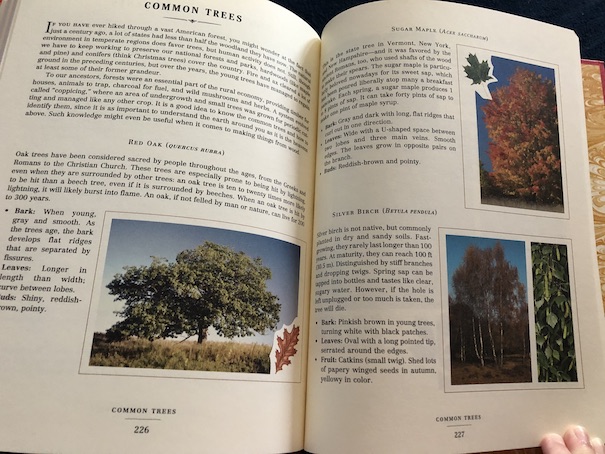
These are activities to do that are related to the outdoors and nature and things to make related that are related to outdoor activities, including fishing, building a treehouse, making a bow and arrow, how to hunt and cook a rabbit, how to tan an animal skin, making a go-cart, and learning various methods of navigation and different types of trees.
Science and Technology
The book describes various topics related to science, like astronomy, insects and spiders, cloud formations, and fossils and dinosaurs. There are also instructions for making projects that would probably make good science fair projects, like a battery, an electromagnet, a periscope, a pinhole projector, and crystals.
History and Geography
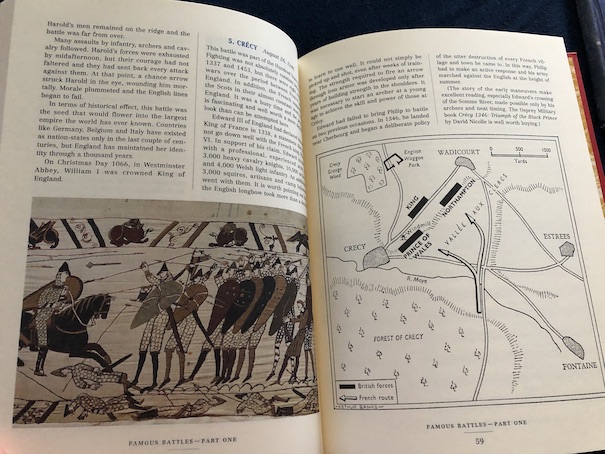
There are sections about US geography (I don’t know if the original UK version had this or if it focused on the geography of the UK), Early American History, the Declaration of Independence, the Golden Age of Piracy, descriptions of the Seven Wonders of the World (both ancient and modern), the sections about Famous Battles from history, and a Brief History of Artillery.
Spies and Secret Codes
There are sections about the codes and ciphers that spies use, the Navajo Code Talkers’ Dictionary from World War II, the US Naval Flag Codes, and how to make secret inks.
Crafts
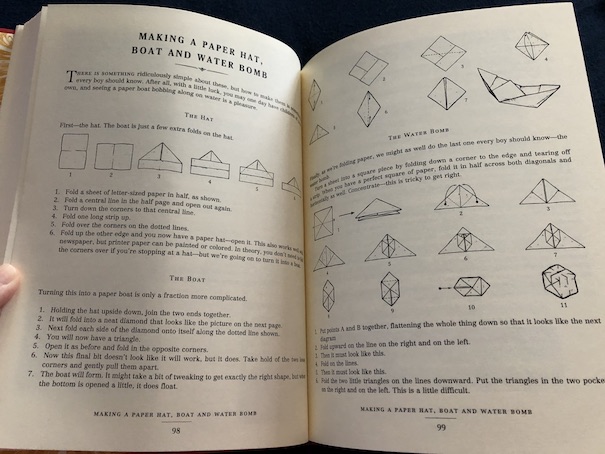
The book explains how to build a workbench, how to grind an italic nib for italic writing, and how to make marbled paper, making paper airplanes and paper hats, boats, and water bombs (these are little origami boxes that you fill with water and splat when you throw them at something – I’ve made them before).
Stunts and Random Skills
These are just random things that are fun to know how to do, like juggling, skipping stones, coin tricks. There is also a section about teaching tricks to dogs.
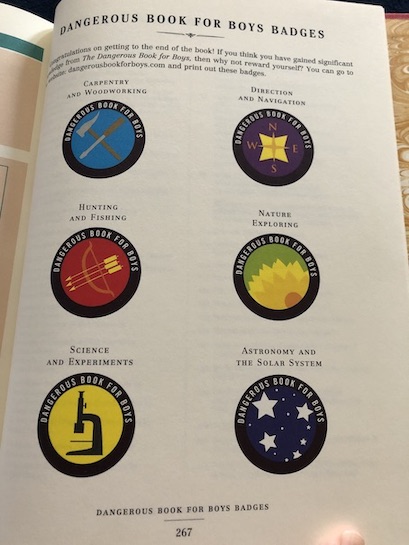
Dangerous Book for Boys Badges
This is the final part of the book. Since many of the activities in the book are the kind done at summer camps or in scout troops, the book overs suggested “badges” you can award yourself and your friends for doing the activities. Even though the activities in the book are not sorted into specific categories, there are six categories of badges offered: Carpentry and Woodworking, Direction and Navigation, Hunting and Fishing, Nature Exploring, Science and Experiments, and Astronomy and the Solar System. The book doesn’t specify what activities you should master to award yourself these badges, leaving that up to the reader. My copy says that if you go to their website, you can print out these badges, but that website no longer exists. I don’t know if later printings say something different.
If you’re looking for something to do with the kids during coronavirus lock-downs and/or over summer vacation, this book has plenty of ideas, and you can even make up your own “badges”, using their ideas, my category suggestions, or anything else you would like to do yourself.
The book is available to borrow and read for free online through Internet Archive. I’ve also learned that the book has inspired a tv series, which is available through Amazon Prime. You can see the trailer on YouTube.
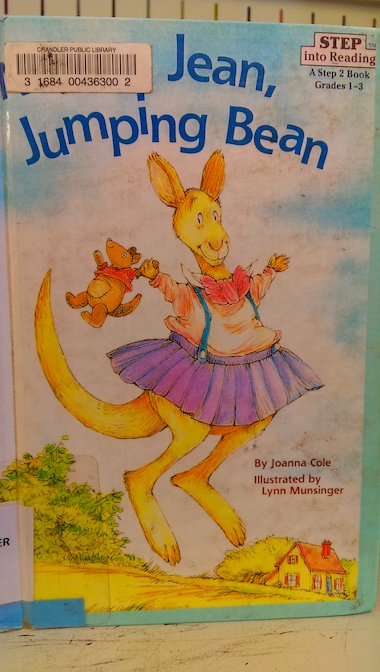
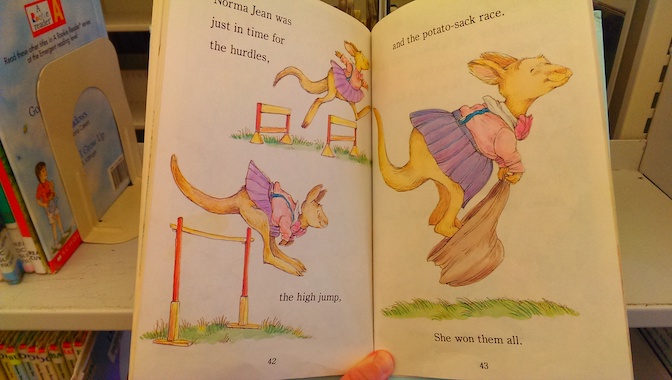
Norma Jean, a kangaroo, loves to jump! She goes hopping and jumping everywhere, all the time.
It’s pretty normal for a young kangaroo, but it sometimes causes problems. She keeps wanting to jump when her teacher wants her to sit still and and listen. Sometimes, accidents happen because she’s jumping around.
Without meaning to, she sometimes plays too rough with her friends because she has so much energy. One day, when her friends stop wanting to play with her after a series of disasters, Norma Jean decides that the only thing to do is to give up jumping. It makes her sad, but she doesn’t want to be thought of as a rough, clumsy klutz, who can’t sit still – a jumping bean.
But, with the school’s field day coming up, Norma Jean realizes that jumping is okay, at certain times and certain places.
Miss Nelson Has a Field Day by Harry Allard and James Marshall, 1985.
Everyone at school is disappointed in the school’s football team. Even the team itself thinks that they’ll never have a chance at winning, so they don’t bother to practice. They refuse to listen to their coach and spend all of their time goofing off. Finally, the coach starts to crack mentally from the strain, and Miss Nelson decides that something needs to be done.
Some of the kids mention that if Viola Swamp, the meanest substitute teacher ever, were there, she’d know how to deal with the team. Not knowing how to contact The Swamp, the principal tries to turn himself into Viola Swamp, but his outfit is just goofy . . . then the “real” Viola Swamp shows up to coach the team. As usual, she takes no nonsense from anyone.
The Swamp undeniably gets results, however, the principal has started to wonder who Miss Swamp is and how she always knows when to show up. Unlike in previous books in the series, Miss Nelson is teaching her class as usual while Coach Swamp is out on the field with the team. Since the previous books pretty well established that Miss Nelson and Miss Swamp are the same person, how is this possible?
The book is currently available online through Internet Archive.
My Reaction and Spoilers
The story doesn’t contradict the other books, and Miss Nelson is still Viola Swamp, but there is one more surprising thing about Miss Nelson that nobody knows which can allow her to appear to be in two places at once . . . she has a twin!
Stories with a secret twin can sometimes feel like a bit of a cop-out, but this one is funny because this is the first and only time Miss Nelson has called on her twin to help her with her double act as Viola Swamp. Miss Nelson’s twin sister is actually the one who’s teaching the class as the nice teacher while Miss Nelson is out on the field coaching as Viola Swamp. There is a moment at the end of the book where the twins are together and Miss Nelson explains to her sister why Viola Swamp is necessary. Sometimes, students need a little tough love and discipline, but by using her alter ego to dish it out when necessary, Miss Nelson gets to keep her reputation as the nice, sweet teacher she really is.
Even though readers know what’s going on with Miss Nelson and Viola Swamp from the previous books, Miss Nelson’s twin adds a nice twist to the plot. The fun of the Miss Nelson books is watching how Miss Nelson carries out her identity swaps. In this book, I also loved the principal’s hilarious attempt to play the part of Viola Swamp in a Halloween witch costume!
The Secret Life of the Underwear Champ by Betty Miles, 1981.
Ten-year-old Larry lives in Connecticut, but one day, while he and his mother are visiting his dentist in New York City, he gets spotted by the Zigmunds. The Zigmunds own a modeling agency, and they think that Larry will be perfect for a series of tv ads. At first, Larry is kind of excited about the idea of being on tv and earning extra money (maybe enough to get a new ten-speed bike!) until he realizes what he’s going to be advertising: underwear.
The Zigmunds like Larry because he’s a clean-cut, athletic kid who likes to play baseball, and the advertisements are supposed to feature a family playing sports together . . . in their underwear. Larry also happens to have red hair, just like the girl already picked to play his sister in the commercials, Suzanne. Suzanne has been in advertisements many times before, and the idea of advertising underwear doesn’t bother her at all. The underwear kind of looks like athletic clothes and isn’t really revealing, but it’s still underwear. Larry goes from feeling proud of his new tv advertising career to hoping that no one at school ever finds out about it. But, how can Larry even hope for that when his underwear-clad form is going to be displayed on everyone’s tv set?
Now, Larry is wondering what he’s gotten himself into. He worries about his filming schedule conflicting with baseball practice and makes up excuses about needing to visit the dentist when he has to film a commercial. Money or no money, Larry just wishes that his life would return to normal!
After the filming is over, Larry starts to feel better about what he’s accomplished. He and Suzanne have become friends (and she may possibly be his first girlfriend), and learning about the world of advertising was kind of fun. But when the commercial actually makes it to tv, and Larry tells his best friend Robert about it, the dreaded teasing starts.
In some ways, Larry’s fears about teasing don’t turn out to be as bad as he fears, although it seems like it at first. Robert laughs at him when he sees the first commercial and realizes why Larry’s been sneaking around and making excuses, but Larry tells him off for being mean and challenges him to think how he feels about it all. Robert feels a little bad about laughing but says that he can’t help it and that other kids at school will react the same way. He’s partly right, but he does help to put a stop to it, and the other kids do calm down. Larry even enjoys some minor fame because he’s the only one of the kids to have been on tv at all.
There’s a lot of humor in the story, but it’s also surprisingly thoughtful as Larry considers why people find the idea of seeing someone in their underwear so funny. After all, everyone wears underwear of some kind, even the President of the United States. It’s a normal part of everyone’s wardrobe and a common part of everyday life. The other people in the ad don’t act self-conscious while they’re being filmed in their underwear because it’s just part of their job, another part of daily life. The book doesn’t mention sex, although the “mother” of the family in the ads gets a few whistles when she’s in her underwear, and Larry acknowledges that he and Robert sometimes giggle over advertisements with girls in their underwear. Larry’s main conclusion is that people laugh about underwear because that’s just not how people normally see each other, so it seems weird. After everyone has seen the commercial with Larry many times, people get used to the idea and it doesn’t seem so weird, so they get over the “funny” part and stop laughing. Eventually, the other kids at school stop thinking so much about the underwear and just think it’s kind of cool that Larry was in a commercial.
The book is currently available online through Internet Archive.
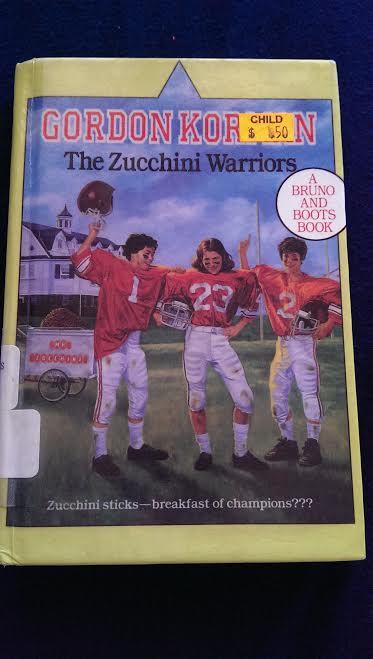
One of MacDonald Hall’s former students, Hank “the Tank” Carson, has made it big with his zucchini stick snack company. As a former football player, he also wants to create a winning football team for his old school, funded by his zucchini fortune.
Mr. Sturgeon isn’t happy to see Hank again. He was in Mr. Sturgeon’s math class, before Mr. Sturgeon became the school’s headmaster. Hank was always a loud, obnoxious student, and against his morals, Mr. Sturgeon gave him a passing grade even though Hank actually failed the class. He only did it because he couldn’t stand another year with Hank as his student, although he’s felt guilty about it ever since.
The boys aren’t thrilled about the new football stadium and team, either. What they really wanted was a new rec hall. But, when Bruno gets up the nerve to tell Hank about it, Hank makes the kids a deal: if they get a football team together and make a decent showing with it, he’ll fund a rec hall for them, too. Bruno, as the one who wanted the rec hall the most, becomes the driving force behind the new football team, talking the other guys into playing and even eating Hank’s zucchini sticks even though everyone at school actually hates them.
The biggest stumbling block that the MacDonald Hall Zucchini Warriors faces is that they know nothing about the game. In fact, the only one around who’s really into football is Cathy, one of the girls across the street at Miss Scrimmage’s Finishing School for Young Ladies. But, football is a man’s game . . . right?


















 The Secret Life of the Underwear Champ by Betty Miles, 1981.
 Now, Larry is wondering what he’s gotten himself into. He worries about his filming schedule conflicting with baseball practice and makes up excuses about needing to visit the dentist when he has to film a commercial. Money or no money, Larry just wishes that his life would return to normal!
 The Zucchini Warriors by Gordon Korman, 1988.
 Jestress's Forgotten Books and Stories