Phoebe the Spy

Phoebe the Spy by Judith Berry Griffin, illustrated by Margot Tomes, 1977.

Phoebe Fraunces is a thirteen-year-old girl living in New York in 1776. The Fraunces family is black, but unlike most black people in the American colonies at the time, they have never been slaves. (There were some free black families who had never been slaves during this period of history, but they were uncommon.) Phoebe’s father, Samuel Fraunces owns a tavern called The Queen’s Head. It’s a popular place for people to meet, and Samuel Fraunces allows some prominent Patriots to meet there in secret and discuss their plans. Being party to such meetings could come with consequences as the colonies are on the brink of war.
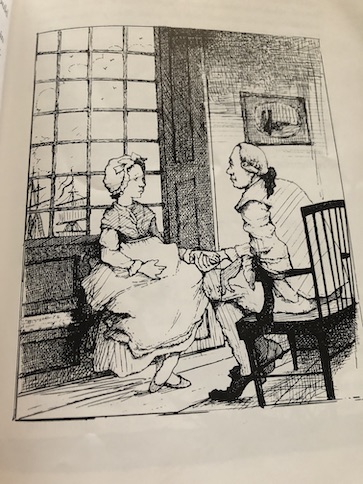
One day, in April 1776, Samuel confides in his daughter that he has overheard something disturbing. He believes that George Washington’s life is in danger, that there are soldiers who are willing to kill their general for money. Samuel is worried about what he heard, but he isn’t sure what the plot against George Washington actually is and has no proof of what he heard. He’s afraid that if he tells Washington about what he heard too soon, without proof, the conspirators will just wait for a safer time to strike, so he asks Phoebe to help him uncover the truth. Samuel knows that George Washington will be coming to New York soon, and he has asked Samuel to help him find a housekeeper for the house where he will be staying. Samuel wants Phoebe to take the housekeeper position and to keep her eyes open for signs of danger.

Phoebe doesn’t know if she can do what her father wants her to do. She isn’t sure what she’s supposed to be watching for, and she doesn’t know how she could stop the plot if there is one. Her father tells her that she should look out for a man who is part of George Washington’s bodyguard and whose name starts with the letter ‘T’. This is all that Samuel was able to tell about the conspirator from the conversation that he overheard. He tells Phoebe to be careful, not to trust anyone, and to meet with him regularly in the market to tell him what she has learned. The two of them also discuss how odd it is that a man like George Washington, who owns slaves, would be at the center of a fight for freedom. Phoebe hopes that he will free his slaves after the war is over, although her father doubts that will happen. Still, the Fraunces family supports the cause of the Patriots, and Phoebe agrees to help her father find the conspirators and save George Washington’s life.

Phoebe is young to be a housekeeper, but she is accepted into Washington’s household. There, she meets Mary the cook and her son Pompey. Pompey also performs chores for the family, like carrying firewood. The work isn’t too hard for Phoebe because much of it is what she is accustomed to doing for her family’s tavern, like making beds, cleaning the silver, and making sure that meals are served on time. George Washington doesn’t say much when he’s around Phoebe, but she carefully observes the people around him. Every day, she goes to the market to buy food and see her father.

At first, Phoebe has nothing to report to her father. Everyone around George Washington seems to be nice or at least behaving normally, and nobody’s last name begins with the letter ‘T’. Mr. Green, a member of George Washington’s bodyguard, seems a bit unfriendly, but a younger man, Mr. Hickey, seems rather nice and sometimes gives Phoebe little presents.

However, there is a traitor among the household, and although it pains Phoebe when she learns who it is, she must do her duty and protect the life of the person she has promised to protect.

Some of the pictures in the book are black-and-white drawings, and some are in muted colors.

The original title of this book was Phoebe and the General. It is available to borrow and read for free online through Internet Archive.

Historical Background

The story is based on the real Fraunces family of New York. Samuel Fraunces really did own a tavern called the Queen’s Head and allowed Patriots to meet there. A note in the back of the book explains that after the war ended, he was given a reward by Congress, and he changed the name of the Queen’s Head to Fraunces Tavern. Fraunces Tavern still exists today, and it is still a restaurant, although part of it has been converted into a museum.

The racial identity of Samuel Fraunces has been in dispute for some time. No one is completely sure what he actually looked like. There is a portrait of a white man that has been reputed to be Samuel Fraunces, but the true identity of that portrait is in dispute. Samuel Fraunces is known to have had the nickname of “Black Sam”, but different sources describe the family differently. All that is known of Samuel Fraunces’s background is that he was born around 1722 and was originally from the West Indies. It’s possible that the Fraunces family may have been mixed race because some sources refer to Samuel Fraunces as “mulatto” (an old term for someone born to a white parent and a black parent, not considered a polite term now), which might explain the other, differing accounts of the family’s race.

The story of Phoebe Fraunces saving George Washington’s life is legend, but the facts regarding that incident are also in dispute. The legend might be based on a misunderstanding, and Samuel Frances’s real daughter, Elizabeth, does not seem to have been old enough at the time to have taken part in this adventure. The story has had a tendency to appear and reappear around patriotic milestones in the United States, first around the centennial in 1876 and then around the bicentennial in 1976, when this book was written.

The Sly Spy

Olivia Sharp, Agent for Secrets

OSSpy

The Sly Spy by Marjorie Weinman Sharmat and Mitchell Sharmat, 1990.

Someone has been trying to steal Olivia’s business by covering up her flyers with ones that say E.J.’s Spy Service. At the same time, Olivia’s friends are trying to keep Desiree’s birthday present a secret even though she has been snooping at their houses to find out what it is.

Olivia’s friends bought her a pet canary because she said that she likes feathers, and they ask Olivia to hide it at her penthouse until the party. However, it looks like Desiree has hired E.J. to spy on her friends and discover what they’re giving her for her birthday.  Olivia has to outwit the spy and prove to him that some cases aren’t worth taking.

In a way, this story is kind of like business ethics for kids.  First, covering up Olivia’s ads to prevent her from getting business was a form of unfair competition.  Then, when Olivia points out to E.J. that he also has a surprise present to give to Desiree, she helps him to understand why the other kids want to keep their present a secret.  It wasn’t really ethical for E.J. to take Desiree’s case in the first place since it would be better for her to be surprised on her birthday.  Olivia makes sure that E.J. only has a vague notion about what Desiree’s present actually is, and he figures out what to tell Desiree so that he can fulfill his duty to her without giving away the surprise.

Guns in the Heather

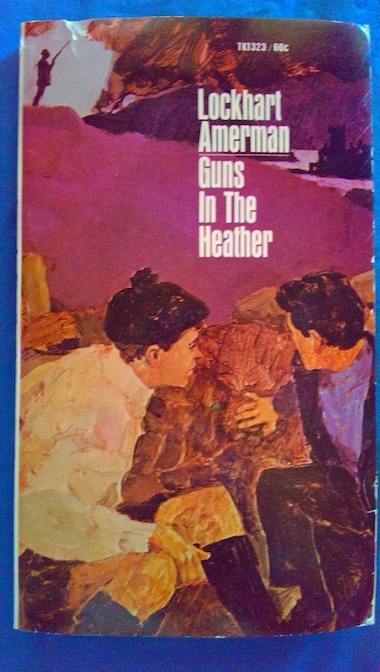
GunsHeatherGuns in the Heather by Lockhart Amerman, 1963.
This book was the basis for the Disney made-for-tv movie The Secret of Boyne Castle. However, the book and the movie are very different.  Although they have a similar premise, many details were changed in the movie version, the first of which is that the location of the story was moved from Scotland, as it was in the original book, to Ireland.

Jonathan Flower, sometimes called “Posy” by his friends, spends most of his time at various boarding schools.  His mother died when he was very young, and his father has a government job that takes him all over the world, so Jonathan has been in boarding schools in various countries, seeing his father whenever he can during school breaks.  For the most part, Jonathan doesn’t really mind it.  He and his father get along pretty well, and he knows that his father’s work is important.

Right now, he’s at a boarding school in Scotland.  He’s made a lot of friends there, spending holidays like Christmas and Easter at various friends’ homes.  He’s also developed an interest in rugby and cricket.  He anticipates that his father will meet him at the end of the school year so that they can go mountain climbing together over the summer break.  However, shortly before his father is expected to arrive, Jonathan receives a telegram from him, saying that he is to go to a certain place and meet a Mr. Finch.  Because the telegram contains certain words that this father uses when a situation is urgent, Jonathan goes to meet Mr. Finch and is kidnapped.

Mr. Finch, who also goes by the alias Dr. Fisher, holds Jonathan captive in a house, pretending that Jonathan is a patient who has volunteered for an experimental treatment.  Fortunately, Jonathan’s father, disguised as a milkman, soon rescues him.

While Jonathan’s father, who is actually a government agent, attends to some of his duties, Jonathan tries to go to the American embassy, only to be misled and almost recaptured. For a time, he is on his own, unsure of who to trust and how to reconnect with his father. When the two of them finally meet again, they both seek shelter with friends, but their enemies aren’t far behind, no matter where they go.  They end up staying with friends who own an old castle, but their enemies are planning a siege.

My Reaction

The style of the writing in this book doesn’t make for a particularly easy read.  It’s not overly difficult, but it starts off slow and is very dense, unlike many more modern books.  The scenes also change quickly throughout the book, and I had trouble keeping track of who some of the characters were.  Overall, I preferred the movie, even though it didn’t follow the book very closely.

In the Disney movie version, a strange man drives onto the grounds of an Irish boarding school, stumbles out of his car, and whispers an urgent message to a teenage American exchange student (played by a young Kurt Russell and renamed Richard Evans) that is meant for his older brother.  Then, the man dies from a bullet wound.  Another man, who is ostensibly from the American embassy in Dublin, abducts Richard after saying that he needs to go to the embassy to make a statement about the stranger’s death.  Richard is also accompanied by an Irish friend, Sean, when he is lured away from the school, and his friend helps him as they escape from the enemy spies holding them captive.  The two of them search for Richard’s older brother (who they have only just learned is a spy, whereas Jonathan was aware that his father worked for the government) to give him the dead man’s message.  In both the book and the movie, there is a final showdown with the bad guys at a castle, but in the movie, they go to the castle to retrieve a secret message that the dead man left there.  I don’t think that the movie is available on dvd, but I have seen it on YouTube and Internet Archive.

Jenny, the Halloween Spy

JennyHalloweenSpy

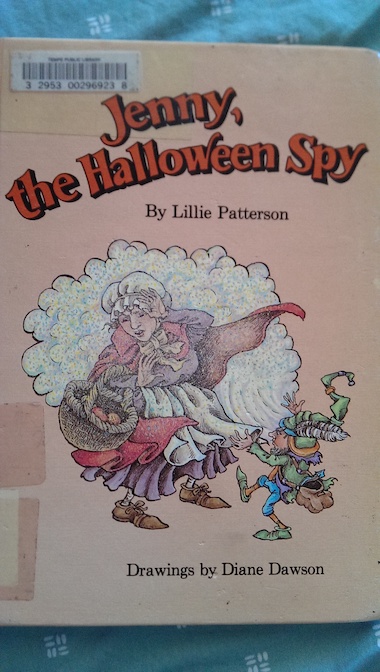
Jenny, the Halloween Spy by Lillie Patterson, 1979.

JennySpyWitchOne Halloween, Jenny goes to visit Nancy, a woman who local people say is a witch.  Jenny is curious about magic and, knowing that there are magical creatures abroad on Halloween, she wonders if she might see something unusual at Nancy’s house.

As she arrives at the house, Jenny peeks inside before announcing herself and sees Nancy putting some kind of oil in her eyes.  After Nancy welcomes her inside and offers her some cider, Jenny sneaks a little of this oil and puts it in one of her eyes to see what it does.  She discovers that the oil allows her to see magical beings that are hidden to most people.  There are fairies in Nancy’s house and rich furnishings that appear very ordinary to Jenny’s unaffected eye.

Using her new ability to see magical creatures, Jenny goes to the town market to see what is going on there.  However, when she catches a pixie stealing some fruit, the fairies and other “wee folk” decide to put an end to Jenny’s spying on their activities.  With some magic dust, the pixie removes her ability to see magical creatures and tricks her into getting onto an enchanted horse that takes her on a wild ride ending with a view of the devil!

The book is available to borrow and read for free online through Internet Archive.

My Reaction

JennySpyFairiesThis is a kind of cautionary story about the dangers of curiosity.  Jenny’s curiosity invites the attention of dangerous creatures and leads her into a frightening situation, something that she never wants to repeat.  For the most part, I think that curiosity is a trait that should be encouraged, but Jenny did deliberately seek out a person with a dangerous reputation and pry into the things she was doing, even trying some herself because she wanted to know more about it, so she could be considered to have gone looking for trouble.

In some ways, this book is very strange, but I can see where it draws on old folklore.  The end part about seeing the devil (accompanied by headless hounds) is a little bizarre and rather frightening for a modern children’s picture book but in keeping with folklore about Halloween and witches.  Although everything that happens to Jenny is supposedly really happening, part of me did wonder about the oil that she put in her eye because plants with hallucinogenic properties are used in folk medicine.  As far as the story is concerned, though, the magic and supernatural creatures are real.

The pictures are colorful and fascinating, but this book may be frightening for very young children.  Some of the fairies remind me a little of the pictures that inspired the Cottingley Fairy hoax.

Kat and the Missing Notebooks

KatMissingNotebooks

Kat and the Missing Notebooks by Emma Bradford, 1999.

KatMissingNotebooksDaVinciThis book is part of the Stardust Classics series.

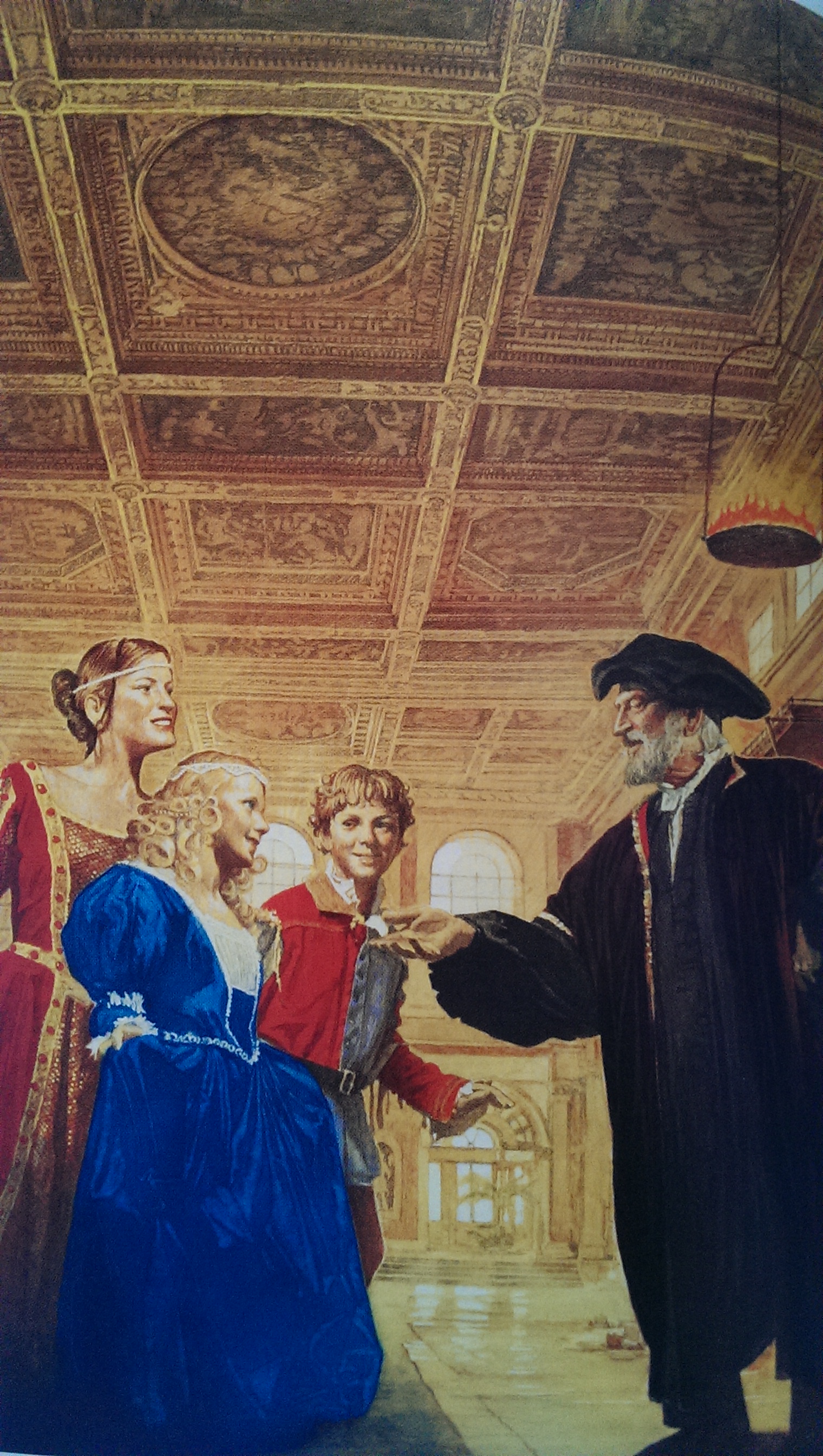
This time, Kat and her aunt, Jessie, find themselves in Florence during the Renaissance. They appear shortly before someone attempts to steal some very important papers belonging to the Florentine City Council from Signor Millori. Kat and Pietro, Signor Millori’s son, both run after the thief, and Kat helps to get the papers back. To thank Kat for her help, Signor Millori invites her and Jessie to stay with him and his family in their palazzo during their stay in Florence.

Signor Millori is a wealthy banker, and the palazzo is a grand place. Kat and Pietro become friends, and he confides in her how much he loves art. Pietro’s father wants him to become a banker, but Pietro’s dream is to study painting with Leonardo da Vinci. In fact, he takes Kat and her aunt to see Leonardo painting a mural at the Palazzo del Vecchio.

Leonardo notices Kat’s aunt and thinks that she has an interesting face. When he asks her to come to his studio to pose for some sketches, she eagerly accepts. Kat hopes that she can use the opportunity to show Leonardo Pietro’s artistic talent and convince him to take Pietro on as a student. However, although Leonardo likes the sketch of Pietro’s that he sees, he says that he has enough apprentices at the moment. Pietro cannot resist the opportunity to study Leonardo’s work, however, and borrows a couple of his notebooks to study.

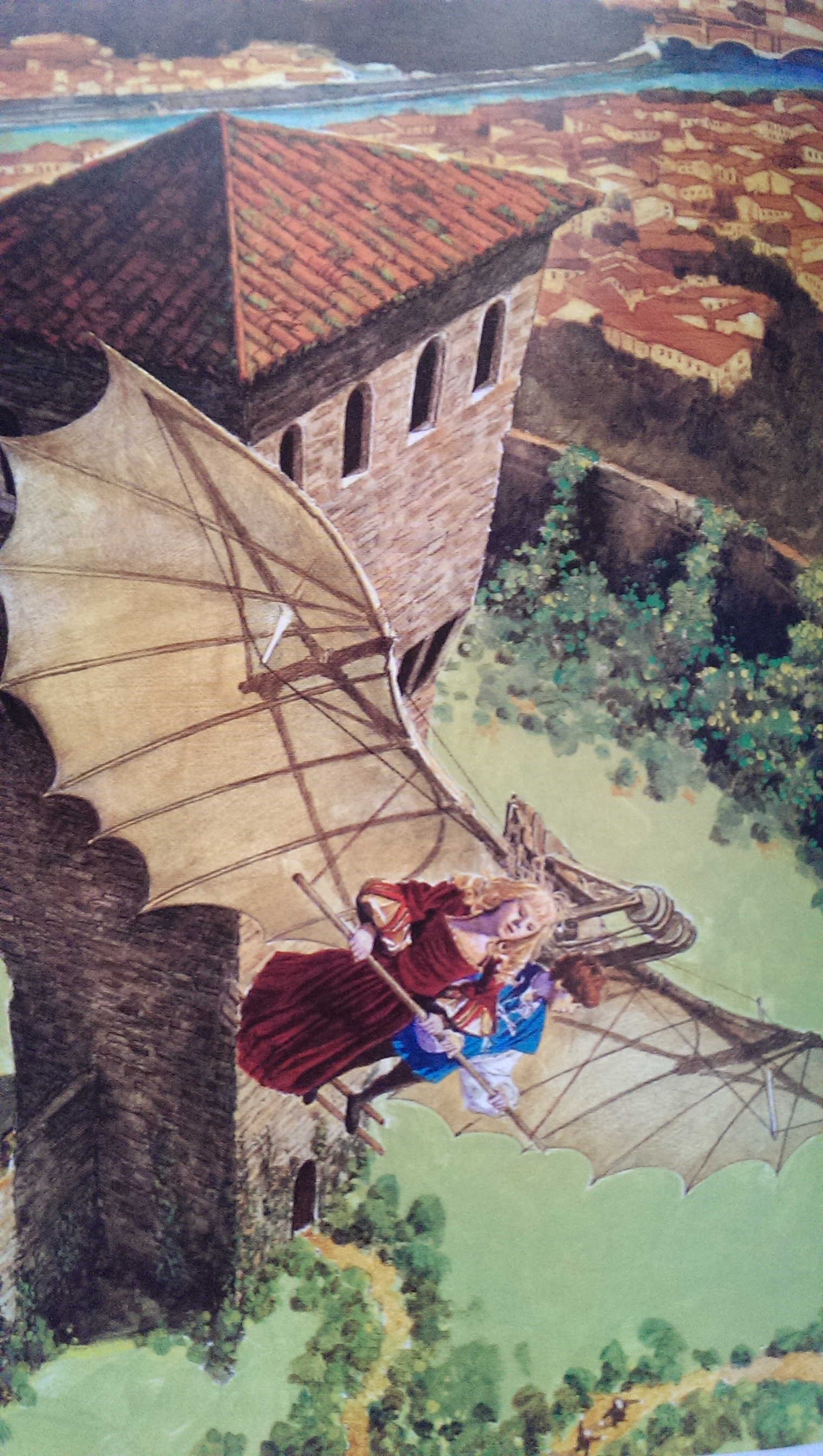
KatMissingNotebooksFlightBesides being a great artist, Leonardo da Vinci is also a scientist, and along with his notes on art, there are sketches and plans for possible inventions in the notebooks. Kat and Pietro go to return the notebooks the next day, but before they can get to Leonardo’s studio, the same thief who tried to steal Signor Millori’s papers steals the notebooks.

Florence has been at war with Pisa for some time, and the Florentine City Council has consulted with Leonardo da Vinci to see if he can come up with some inventions that would give them the upper hand. They know that the thief must be a spy for Pisa who is trying to see what Leonardo has been working on. However, Kat knows that if they do not retrieve the notebooks, history may be changed. Soon, it becomes obvious that the spy has an accomplice who is living in the Millori’s palazzo. Can Kat and Pietro find the notebooks and stop the spies before it is too late?

Although this is a fantasy story that involves time travel, it is based on historical events, and there is a section in the back that explains more about the Italian Renaissance and Leonardo da Vinci.  At the time of the story, Italy was not a united country.  The Italian peninsula was covered with many small city-states which frequently fought each other.  In 1494, Pisa broke away from Florence, and Florence fought for several years to bring it back under their control, until they eventually succeeded in 1509.  This conflict was the basis for the story, and the artist and inventor Leonardo da Vinci was consulted by the Florentine Council during the struggle.

Also in the back of the book is an explanation of mirror writing, which Leonardo da Vinci used in his notebooks.  There are also instructions for making fresco ornaments and a recipe for Nutty Biscotti.