The Mystery on Stage

The Boxcar Children

Boxcar Children Mystery on Stage play announcement

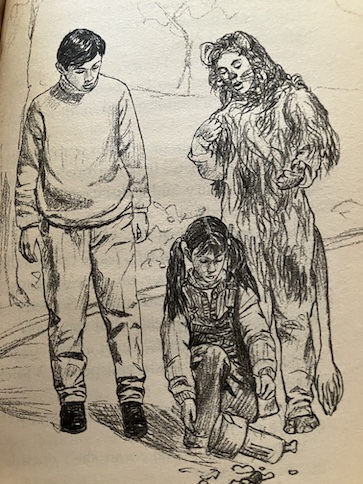
Jessie decides that she wants to try out for a part in a local stage play of The Wizard of Oz. She wants to try for the role of Dorothy, but many other girls also want that part. A spoiled rich girl named Melody is sure that she will get the part because she’s had professional training, and her mother is very pushy. Another girl, Sarah, ends up getting the role by giving an excellent, heart-felt performance. However, Jessie gets the role of the Cowardly Lion, and Melody is offered the role of the Scarecrow. Melody is very upset about not getting the role of Dorothy, but she takes the role of the Scarecrow anyway. The other Alden kids also help out with the play in various ways, like building scenery and making costumes.
Boxcar Children Mystery on Stage threatening message

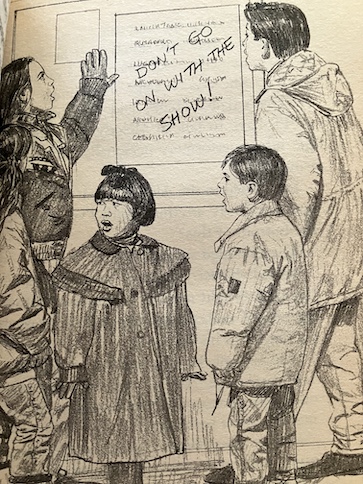
Soon, strange things start happening at the theater. Someone calls the play’s director and threatens that something bad will happen if he directs the play. Then, someone crosses Sarah’s name off a casting list and writes a note saying not to go on with the program. Props are stolen, a costume is destroyed, and lettering on a poster is changed. So many things are going wrong, people are starting to wonder if this play is going to happen after all.

Who could be responsible? Was Melody so upset about not getting the lead that she or her mother have decided to sabotage the whole play? Could the grumpy actor playing the Wizard have a reason to want to shut down the play? What secrets is Sarah hiding? Why does she seem to disappear suddenly at times? Or could more than one person be responsible for what’s happening? And why does the actor playing the Tin Man never want to remove his helmet?

Boxcar Children Mystery on Stage fallen light

I thought the mystery was pretty good, and the author did a good job of making a number of people look guilty. I had the feeling from the beginning that Sarah didn’t have her parents’ permission to be in the play, and that’s why she seems to run off or disappear suddenly, because they wouldn’t approve of what she’s doing. I was partly right, but it’s more complicated than that, and it’s important to the mystery.

I laughed out low at one point when the Aldens were talking about the grumpy and fussy actor who is playing the wizard, saying how he seems good at his part, but “it’s too bad about his personality.” It sounds like a serious slam, and honestly, there are some times when I’ve had similar thoughts about some people. In a way, though, that’s a sort of secondary theme to the story. There are some people involved with the production of the play who are really difficult to work with. They’re very good at what they do, like how Melody has had acting and singing lessons and does well on stage, but at the same time, they’re also disagreeable, self-centered, or pains to work with.
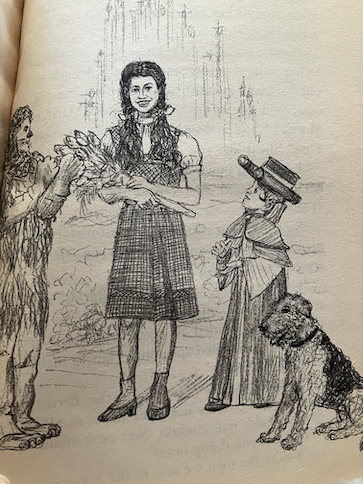
Boxcar Children Mystery on Stage Dorothy holding bouquet

Another theme of the story is the idea that things that seem like a disappointment can work out for the best. Jessie is a little disappointed at first that she didn’t get the role of Dorothy, but she turns out to like being the Cowardly Lion, and she realizes that she’s actually having more fun with that role than she would have with the role of Dorothy. Melody almost refuses to take the part of the Scarecrow because it isn’t the starring role of the play, but she does anyway. She likes it better than she thought she would, although she still wishes that she had a part where she could wear a pretty dress, like Dorothy.
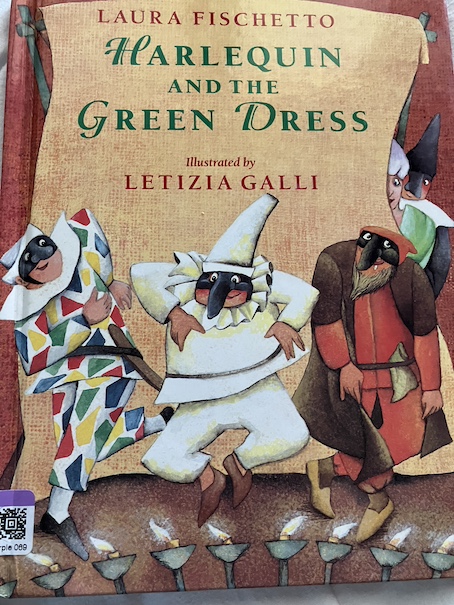
Harlequin and the Green Dress

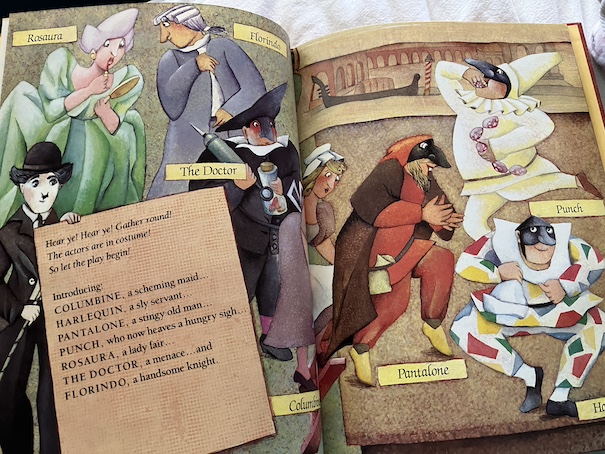
What I love about this book is that it’s a fun introduction to commedia del arte and its stock characters! A figure that looks like Charlie Chaplin holds a card that summons readers like guests to a play and introduces our characters like this:

  • Columbine – “a scheming maid …”
  • Harlequin – “a sly servant …”
  • Pantalone – “a stingy old man …”
  • Punch – “who now heaves a hungry sigh …”
  • Rosaura – “a lady fair …”
  • The Doctor – “a menace … and”
  • Florindo – “a handsome knight.”

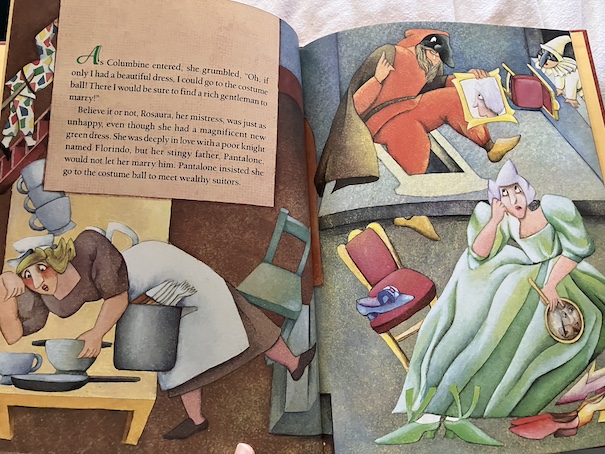
There is going to be a costume ball. Rosaura, a wealthy young lady, has a beautiful green dress to wear, but she is unhappy because her father, Pantalone, refuses to let her marry the man she loves, Florindo. Florindo is a poor knight, and Pantalone hopes that Rosaura will meet a wealthier suitor at the costume ball.

Meanwhile, Rosaura’s maid, Columbine, wishes that she had a beautiful dress so that she could go to the costume ball herself. She thinks that, if she went to the ball, she might also meet a rich man.

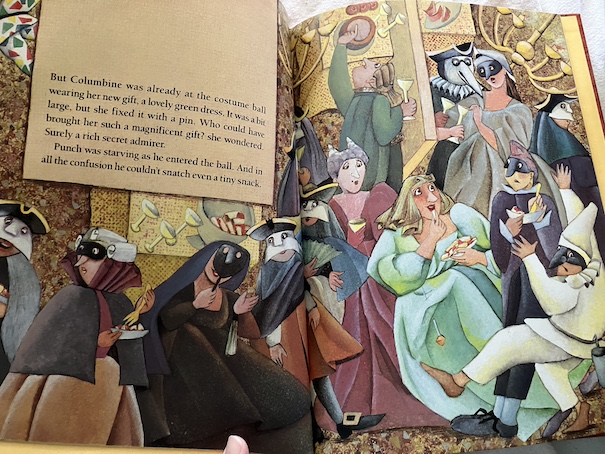
Harlequin is in love with Columbine, and he wants to do something that would impress her. He decides to borrow Rosaura’s dress and give it to Columbine as an anonymous gift so that Columbine can to go to the ball, but unbeknowst to him, Florindo is coming up with a scheme that will allow Rosaura to run away with him and get married. Florindo enlists his servant, Punch, to pretend to kidnap Rosaura, to provide a reason for her sudden disappearance. He tells Punch that he will know Rosaura at the ball because of her magnificent green dress, not knowing that Columbine has already received the dress from Harlequin and is wearing it at the ball.

Chaos ensues when Punch abducts Columbine, thinking that it’s Rosaura and that she’s just playing along with Florindo’s plan. When Punch says that he’s taking her to her suitor, Columbine assumes that he’s taking her to the secret admirer who gave her the dress.

In the meantime, poor Rosaura is having hysterics because she can’t find her dress and can’t go to meet her suitor. When Harlequin discovers what a mess all the scheming has caused, he comes up with another scheme to straighten out everything. Can he reunite Rosaura with Florindo, convince Pantalone to allow their marriage to take place, make her that Punch gets all the snacks he wants, and make things right with Columbine?

I love books that introduce lesser-known topics, and I imagine that few young readers would know anything about commedia del arte. For kids who are old enough to appreciate a little theatrical history and expand their cultural horizons, this is a fun introduction to an art form that they may have never seen before!

My first introduction to the stock characters was in Agatha Christie movies because Agatha Christie was fond of commedia del arte and put references to it into some of her stories, like The Affair of the Victory Ball. There is a section at the back of this book that explains the historical background of this type of theater and more about the characteristics of the stock characters.

I did think that the story in the book jumped around oddly in some places, and the role of The Doctor wasn’t very well explained. I think part of the reason was that the action would be easier to understand if we were watching it on stage rather than reading it in a book. The pictures are also chaotic and a little difficult to follow. I think they’re meant to convey the shifting scenes and the fast and chaotic movements of the characters as they go about their various schemes. The story itself is meant to be chaotic and action-filled because of all the characters’ schemes and counter-schemes. The action and visual jokes would probably make more sense seeing them performed rather than hearing them described.

I did like the part at the end, where we see the actors taking their bows and some of them removing their masks because the story was a play the entire time. The story isn’t meant for readers to see the characters as real people and events that are actually taking place. It’s all been a stage play the entire time. The pictures also indicate that it was always a play, with its flat scenery, objects at strange angles, and characters that seem to be separated from each other by thin walls. It’s all a bit unreal because it is unreal.

To get around some of the chaotic nature of the story and make it more fun for kids, I think this is a good book to read aloud with a lot of enthusiasm and maybe even act out rather than just telling it, encouraging young listeners to get involved in the story and the imaginary world of the theater.