The Christmas Tree Mystery

The Christmas Tree Mystery by Wylly Folk St. John, 1969.

A couple of days before Christmas, twelve-year-old Beth comes running to her 10-year-old sister Maggie, saying that she’s in trouble and needs her help. Beth doesn’t know whether Maggie can help at all, but she thinks she’s done something wrong and needs somebody to listen to her. Someone stole the family’s Christmas tree ornaments the day before, and Beth saw someone running out of their backyard right after the theft. She was sure that the person she saw was Pete Abel, and that’s what she told everyone. However, the girls’ older stepbrother, Trace, says that it couldn’t have been Pete. Beth thinks that it would be awful if she’s leapt to the wrong conclusion and wrongly accused Pete of theft, but then again, she can’t be sure that Trace is right, either. Trace says that Pete was somewhere else at the time, but he doesn’t want to say where because, for some reason, that might also get Pete in trouble. Beth doesn’t know whether to believe him or not.

The kids are part of a blended family that has only been together for less than a year, so the children are still getting used to each other and their new stepparents. Beth likes their new little stepsister, Pip, but teenage Trace is harder to get used to. Trace is frequently angry, and much of his anger comes from his mother’s death. Beth knows sort of how Trace feels because her father died three years ago. She knows what it’s like to miss a parent, and try to keep their memory alive. Even though Beth doesn’t think of her stepfather, Champ, as being her father, she tries to be fair toward him and accept that he’s doing his best to take care of them. Sometimes, she wishes she could talk about it all with Trace, but Trace has made it clear that he doesn’t want to talk. Trace doesn’t like to talk about his mother and gets angry when anyone else even mentions her.

Beth thinks that Pete was the thief because the boy she saw running away was wearing a jacket like the one Pete has and has the same color hair. However, she didn’t actually see his face, and Maggie points out that other kids have similar jackets. Also, they found an old handkerchief of the house with the initial ‘Z’, and that wouldn’t belong to Pete. Beth has to admit that she may have been mistaken about who she saw. However, she can’t think of anybody whose name begins with ‘Z’, either. She worries that if she was wrong to say it was Pete that she saw she may have broken one of the Ten Commandments because she was bearing false witness. All that Beth can think of to make things right is apologize to Pete for being too quick to accuse him and try to find the thief herself, but she needs Maggie’s help to do that.

Why anybody would steal Christmas ornaments right off a tree is also a mystery. Some of the ornaments that belonged to Champ had some value and could possibly be sold for money, but most did not. The thing that Beth misses the most is the little angel that she had made for the top of the tree years ago. Its only value is sentimental, and Beth worries that a thief might just throw it away if he didn’t think it was worth anything. Also, if Trace is so sure that Pete is innocent, why can’t he explain where Pete really was when the theft occurred? Trace is sneaking around and seems to have secrets of his own. Then, after the family gets some new ornaments and decorates the tree again, the ornament thief strikes again! The new set of ornaments disappears, but strangely, the thief brings back Beth’s angel and puts it on top of the tree. If it had just been a poor kid, desperate for some Christmas decorations, they should have been satisfied with the first set. Is anybody so desperate for ornaments that they would take two sets, or is it just someone who doesn’t want this family to have any? And why did the thief return the angel?

The book is available to borrow and read for free online through Internet Archive (multiple copies).

My Reaction and Spoilers

The idea of somebody stealing Christmas ornaments sounds like a whimsical mystery for the holiday, but even though I’ve read books by this author before, I forgot that Wylly Folk St. John can bring in some of the darker sides of life. Much of this story centers around getting ready for Christmas, but there are some truly serious issues in the story. This is a book that would be better for older children. For someone looking for someone for younger children or a lighter mystery for Christmas, something from the Three Cousins Detective Club series would be better. (See my list of Christmas Books for other ideas.) It’s an interesting story, and I enjoyed the book, but I wouldn’t call the mood light.

The ways this new blended family learns to get along with each other and Trace learns to cope with his grief at the loss of his mother are major themes in the book. The parents try to be conscientious of the children’s feelings, making joint decisions and rules for the children as “The Establishment” of the house so none of the children feel like a stepparent is discriminating against them. The reason why the stepfather is called Champ is because he’s a chess champion, and Beth knows that her mother gave him that nickname so the girls wouldn’t feel awkward, wondering whether to call him by his name or refer to him as their dad. Beth is grateful for the nickname because, although she likes and appreciates Champ as a person, she does feel awkward about calling anybody else “dad” while she still remembers her deceased father. Trace calls his stepmother Aunt Mary for similar reasons, and Beth understands that. What she doesn’t understand is why Trace insists on wearing the old clothes that were the last ones his mother bought for him, even though they no longer fit him. Aunt Mary has bought him some nice new clothes that would fit him better, but he won’t wear them, and he even insists on washing his clothes himself, without her help. Beth asks her mother about that, but she says it doesn’t bother her because, if Trace is willing to help with the laundry, that’s less for her to do. Beth says that they ought to just donate all of Trace’s old clothes so someone else who can actually wear them can have them, but her mother doesn’t want to be too quick to do that because she doesn’t want to upset Trace. I can understand that because Trace is still growing, and it won’t be much longer before he won’t be able to wear those old clothes anymore anyway. The day that he can’t pull one of those old shirts over his head or put on old pants without splitting them will be the day he’ll be ready to get rid of them. Time moves on, and eventually, Trace won’t be able to help himself from moving on with it, and I think Aunt Mary understands that.

Part of the secret about Trace and his grief is that his mother isn’t actually dead, although he keeps telling people that she is. The truth is that his parents are divorced and his mother left the state and has gone to live in Oklahoma with her relatives. At first, Beth’s mother doesn’t even know that Trace has been telling the girls that his mother died, but when Beth tells her mother that’s what Trace said, her mother tells her the truth. She doesn’t want to explain the full circumstances behind why Champ divorced Phyllis and why she left, but she says that she can understand why Trace might find it easier to tell himself and others that she’s dead instead of accepting the truth. There is an implication that Phyllis did something that Beth’s mother describes as something Trace would see as “disgraceful” (I had guessed that probably meant that she had an extramarital affair, but that’s not it) that lead to the divorce. So, Trace is actually feeling torn between losing his mother and learning to live without her and his anger at her for what she did. He both loves and hates his mother, and that’s why he finds it easier to think of her as dead and gone and refuse to talk about her any further than deal with these painful, conflicting emotions. Beth’s mother also indicates that Phyllis was emotionally unstable, saying that the atmosphere in the household wasn’t healthy for Trace and his little sister because Phyllis “kept them all stirred up emotionally all the time”, and that’s why she didn’t get custody of the children and isn’t allowed to see them now. It turns out that there was a lot more to it than that, and that figures into the solution to the mystery.

When I was reviewing an earlier book from the 1950s by a different author about children coping with grief and a new blended family, Mystery of the Green Cat, I talked about how books from the 1950s and earlier tended to focus on the deaths of parents when explaining why children lived in households with stepparents and step-siblings and how books from the 1960s and later started to focus more on the issue of divorce. This book kind of combines aspects of both of those types of stories. Beth understands the grief of a parent dying, and Trace has to come to terms with his parents’ divorce, which is a different kind of loss, although it’s still a loss. As I explained in my review of that earlier book, in some ways, divorce can be even more difficult for children to understand than death. Both are traumatic, but divorce involves not just loss but also abandonment (a parents who dies can’t help it that they’re no longer there, but it feels like a parent who is still living somehow could, that it’s their choice to leave their children and live apart from them, which leads to feelings of rejection) and the complicated reasons why people get divorced, including infidelity and emotional abuse. In this case, it also involves drug abuse.

I was partly right about the solution to the mystery. I guessed pretty quickly who the real thief was, but there’s something else I didn’t understand right away because I didn’t know until later in the book that Trace’s mother was still alive. Before the end of the book, Trace and Beth and everyone else has to confront the full reality of Phyllis’s problems. They get some surprising help from Pete, who has been keeping an eye on things and has more knowledge of the dark sides of life than the other children do. (Whether his father ever had a problem similar to Phyllis’s is unknown, but it seems that at least some of the people his father used to work with did, so it might be another explanation for Pete’s family’s situation.) Because Pete has seen people in a similar situation before and knows what to do. I had to agree with what Beth said that much of this trouble could have been avoided if Champ had been more direct with Trace before about his mother’s condition, but Beth’s mother says that sometimes children don’t believe things until they see them themselves. Champ was apparently trying to protect his children from Phyllis before, but because Trace had never seen his mother at her worst, he didn’t understand what was really happening with her. There is frightening part at the end where the children have to deal with a dangerous situation, but it all works out. Trace comes to accept the reality of his mother’s condition and that things will never be the same again, but he comes to appreciate the stepsisters who came to his rescue and brought help when he needed it.
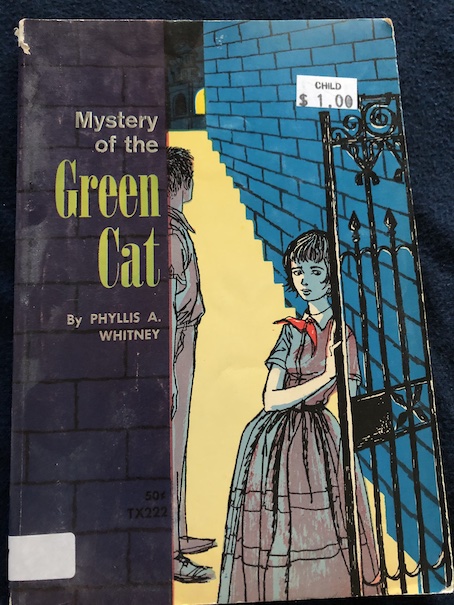
Mystery of the Green Cat

Mystery of the Green Cat by Phyllis Whitney, 1957.

Things just haven’t been the same for twins Andy and Adrian Dallas since their mother died two years ago. Now, their father has remarried to a woman he met through his work, and Adrian has been having an even harder time coping with it than Andy has. The twins have always been different from each other, not identical in appearance or personal interests, but now, Adrian is frequently angry and moody, and he’s getting on Andy’s nerves.

Their new stepmother, Emily, isn’t bad, and Andy can tell that she’s trying hard to be nice to them so that they’ll like her, but it does make the boys uneasy that their father seems to be having an easier time moving on from their mother’s death than they are. Also, Emily has two daughters, Jill and Carol, who have been living with their grandmother. Now that Emily has remarried, Jill and Carol are coming to live with her, her new husband, and the two boys in San Francisco. Emily has been saying that they’ll all be one big family now, but all of the children have misgivings about it. The twin boys have never lived with girls before, and they’re not looking forward to having a bunch of girly stuff around or Carol practicing her dancing in their new house. Meanwhile, the two girls aren’t sure that they’re really looking forward to suddenly having a couple of brothers. Carol is optimistic and thinks it might be fun, but Jill remembers that she hasn’t gotten along with the brothers of some of her friends. This new blended family is a major adjustment for everyone.

Adrian is so angry and upset about the coming of the girls that he refuses to go meet them at the airport with the rest of the family. Andy goes, although he is uneasy about meeting his new stepsisters, and Jill can tell that he’s not really happy to see them. Andy’s father explains Adrian’s absence by saying that he had a summer school art project to work on, although he does warn Jill that Adrian might need some time to get used to being around girls because he doesn’t make friends easily. Jill bluntly asks if that means that Adrian doesn’t want them around, and her stepfather says that it’s more that Adrian is still mourning his mother and having trouble adjusting to his new stepmother. But, he adds that he and his sons have really been lonely since his first wife’s death, and they’ve really needed someone like Emily in their lives, and he’s sure that Adrian will eventually realize that. He asks Jill, as the oldest girl, if she would try to make friends with Adrian. Jill’s not sure how she’s going to do that if Adrian doesn’t want to be friends with her. (This is a recurring theme in other mystery stories by Phyllis Whitney. The solution usually involves shared experiences binding people together, and this is partly the case in this book, too.)

The Dallas family house is situated on Russian Hill, and as they approach it, Jill’s mother points out another house higher on the hill, which she calls a “mystery house,” knowing that Jill loves mystery books. Her stepfather says that there are two women living there, Mrs. Wallenstein and Miss Furness. The two women are somewhat reclusive, and nobody really seems to know much about them. Andy says that Mrs. Wallenstein is a baroness, but his father says he thinks that’s just a rumor. The two elderly ladies also have a Japanese family working for them. The wife is their cook, and the husband is their gardener. Later, Jill spots someone spying on the Dallas house, peeking down from a wall surrounding their property, and Andy says that’s probably the daughter of the cook and gardener. Andy and Adrian have seen her around before, although they haven’t spoken to her much.

While they’re all sitting at the table, eating and talking, someone suddenly throws a rock through one of their windows. The rock came from the baroness’s house, so the father of the family says he’s going to call her and talk to her about it. However, when he calls, Miss Furness answers the phone, denies that anyone at her house would do such a thing, and hangs up. The boys tell Jill that this isn’t the first time someone has thrown rocks, but the last time, the rock just landed on the terrace and didn’t break anything. The boys haven’t wanted to tell the parents about the last time. Jill asks why not, and Andy refers to a “green cat” but doesn’t really explain what that means.

Later, the Japanese girl from the house next door stops by and introduces herself to Jill as Hana Tamura. (Hana’s English is imperfect, and this is one of those books where the author tries to write like the character is speaking to reflect the accent. Hana switches her ‘r’s and ‘l’s when she speaks in that stereotypical way Asians in old movies speak.) Hana admits to breaking the window and says that she did it by accident. She was just climbing the wall to see the new children who moved in next door when she kicked a stone loose from the wall that broke the window. She offers to pay for the damage. Jill’s mother says that won’t be necessary, but Hana insists that she accept some money. Jill’s mother invites her to stay and visit with Jill and Carol, but Hana says she can’t because Miss Furness doesn’t like her visiting with neighbors. Miss Furness doesn’t seem to like people much. Jill is disappointed because she could use a new friend in her new home, and Hana is interesting because she’s the first Japanese person Jill has ever met. (That’s interesting to me because Jill and Carol were originally from New York, and I would think that they’d see all sorts of people there.) Before Hana leaves, Jill asks her if she knows anything about a green cat. Hana refuses to answer, but Jill can tell that she’s a little disturbed at the mention of the cat. Jill’s mother is a little concerned that Hana isn’t being allowed to associate with neighborhood children and says that she’s going to try to talk to Miss Furness about it.

It turns out everyone has completely misunderstood the relationship between Miss Furness and Mrs. Wallenstein (“the baroness”). Rather than Miss Furness being the housekeeper for Mrs. Wallenstein, she’s actually Mrs. Wallenstein’s sister and the head of the household. When Jill spots Mrs. Wallenstein watching her with binoculars, Adrian says that she’s done that before and also finally confides that Mrs. Wallenstein was the one who threw a rock at him and Andy when they were on the terrace, not Hana. The “rock” Mrs. Wallenstein threw was actually just a little pebble, and Andy scooped it up, refusing to even show it to Adrian, although he doesn’t immediately explain why.

After a visit to the house next door to deliver a letter for Mrs. Wallenstein that was accidentally delivered to the Dallas house, Jill comes to realize that Miss Furness doesn’t treat her sister well, reading her mail and keeping people from her, and that Mrs. Wallenstein is in need of help. Andy finally explains to Jill that the rock Mrs. Wallenstein threw had a note tied to it, asking them to help her find her “little green cat.” He didn’t want to tell Adrian before because he didn’t think Adrian would take it seriously. The kids aren’t sure what the “little green cat” is, but both Jill and Andy want to help poor Mrs. Wallenstein.

Miss Furness doesn’t really mean to be mean to her sister, but she is extremely overprotective of her and keeps her isolated from other people because she has been suffering from ill health and memory problems. Mrs. Wallenstein went through hard times in her life after her husband died, and she was badly injured in an earthquake in Japan, which is why she’s now confined to a wheelchair. Sometimes, when Mrs. Wallenstein starts reminiscing about the past, she becomes confused about what’s past and what’s present, and it all begins blending into one. Her sister has been trying to shield her from past traumatic memories, but Mrs. Wallenstein has the feeling that there’s something important that she wants to remember, and she can’t quite figure out what it is. The key to unlocking Mrs. Wallenstein’s memory and learning the truth about the past lies in finding the little green cat.

The book is available to borrow and read for free online through Internet Archive.

Themes and My Reaction

Adjustment to changing family situations is a common theme in Phyllis Whitney’s young adult mystery stories, but this one is a little different from most. Most books by Phyllis Whitney are told only from the point of view of a girl, using third person limited. Even when boys play a major part in stories, the focus is usually on the girl. This book is told mostly from Jill’s perspective, but Andy is the one who begins the story, giving some insight into how he and his brother are feeling before the girls arrive. Although the boys and girls are separate when the book begins, their feelings toward each other are pretty similar. All of the children are trying to adjust to major changes in their lives and having misgivings about suddenly having new siblings of the opposite sex.

I think it’s also important to point out that, although the story focuses on a blended family, there is no divorce in the story. The two parents who are entering into a second marriage were widowed. This book was written in the 1950s, and in the first half of the 20th century, people didn’t talk about parents getting divorced as much. In children’s books of this time period, single parents and remarriages were usually the result of the death of a parent. It’s not that divorce was never mentioned; it’s just that it wasn’t nearly as prevalent in children’s literature, partly due to the social stigma against divorce at the time. I’ve sometimes thought that, in some ways, it was also probably easier for authors to explain the loss that accompanies a parent’s death, which would not have been the parent’s choice and was just a tragedy that couldn’t be helped, than the reasons why parents would willingly choose not to continue living with each other or why one parent would no longer live with the children. This is different from modern children’s books, where it’s usually more common to see divorced parents than dead ones. In fact, quite a lot of modern children’s books include divorced parents. Both death and divorce involve feelings of grief and loss, but if the loss is from a death that just couldn’t be helped, the author can avoid addressing the painful questions of “why” the separation happened. In real life, the reasons for a divorce can involve complex and sensitive issues that many adults would find difficult to discuss with children, including marital infidelity, emotional neglect, financial problems, addiction, and physical or psychological abuse. There’s never a happy reason for a divorce, so saying that the absent parents in the story died allows authors to skip over all of that. Death is sad, but it’s a little more self-explanatory. Andy and Adrian’s mother died from an unspecified long-term illness, and there’s no need for the characters to explain more than that. I could be wrong about some of my theories here, but that’s the impression that I sometimes get from older books. There is less social stigma surrounding divorce in modern times, and the prevalence of divorce in society has made it increasingly important to address children’s feelings about divorce in children’s literature, which is why there are now more books about it. That being said, the loss of a parent because of death is something that children still experience today, and the author of this story makes some important points about the feelings that someone can experience when they lose someone close to them.

As Jill gets to know Adrian, she comes to learn some of the reasons why he’s really unhappy. It’s partly because, when they moved to the new house after his dad remarried, he and Andy had to start sharing a room to make room for the two girls. Adrian and Andy have very different interests, and sharing the space has been particularly hard on Adrian. Adrian is a tidy person, and he’s very serious about art. He needs space to work on his artwork, and Andy is messy and likes to hoard pieces and parts for building things. Jill starts making friends with Adrian when she figures out how to make a better working space for him, but she upsets him again when she accidentally breaks the vase holding his brushes, which reveals the second reason why Adrian is unhappy. When the family moved to the new house, his father got rid of many of the things that used to belong to his first wife. Adrian has been blaming his stepmother for the loss of many of these sentimental reminders. Adrian doesn’t have many reminders of his mother left, and the vase was one of them, so now he blames Jill and her mother for the loss of that. As all the little reminders of his mother seem to be disappearing and Emily and her daughters are moving into the space, Adrian is afraid of losing all of the memories he has of his mother. It’s a situation that’s somewhat similar to Mrs. Wallenstein’s problem, using physical objects as a reminder of the past.

Mrs. Wallenstein has suffered sadness and trauma, which is part of the reason why her memory is so faulty. However she badly wants to remember some of the things she’s forgotten since her injury in the earthquake because they hold the key to the truth about her husband’s death. He died or disappeared under mysterious circumstances, and his business partner was murdered. Some people claimed that her husband might have actually killed his partner, but Mrs. Wallenstein doesn’t believe that. The clues to what really happened are tied up with the mysterious green cat.

However, part of the story also involves selfishness and self-centeredness. Mrs. Wallenstein’s husband’s business partner was a very selfish man, always needing to be the center of attention and taking credit for things that Mrs. Wallenstein’s husband did, and that’s tied in with the story of what happened to the two of them. In his own way, Adrian is selfish, too. It’s true that he’s still grieving for his mother, but the way he shows his grief is selfish, and Jill finally tells him so. Just because his stepmother isn’t his mother is no reason for him to be constantly cold and rude to her. Adrian is also rude and inconsiderate to other people, including Jill, their new friend Hana, and his own brother. Each of them is also dealing with something hard in their lives, but all Adrian cares about are his own feelings. While they all tiptoe around him, trying to make friends with him and be extra careful of his feelings because he’s “sensitive”, he says rude and condescending things to them or suddenly goes into a moody pout if he’s reminded of his mother’s death and/or his father’s remarriage. As Jill says, he’s sensitive, but only about himself; Adrian has no sensitivity for anyone else’s feelings. He’s even careless with Mrs. Wallenstein’s green cat after he learns that it has no monetary value, not considering what it means to her and her past. For someone who’s hyper-aware of belongings that have meaning for him, it’s an incredibly selfish thing to do. He not only doesn’t try to help the others solve the mystery of the cat, but when he finds out some information on his own, he deliberately doesn’t tell them until he can show off how clever he is while taunting the others about how they’re not as clever as they think they are. I honestly thought that he was going to be more help to the others in the story and reconcile his feelings through their shared adventure, but only Andy does that. Adrian resists right up until the very end, when Emily has a very honest talk with him about his feelings and hers.

I was a little annoyed at the way Hana’s speech was shown in the book because it always annoys me a little when authors try to show someone’s accent through spelling. It often seems to detract from what characters are actually saying, and the r/l swapping when Asians speak has a stereotypical feel to it. It’s not that Asians in real life never do the r/l swap, but it’s usually way overdone when it appears in books and movies, so it gets on my nerves. The real life r/l phenomenon is really based on the fact that Asian languages have a tendency to use the same symbol to represent r/l sounds, and the sound those symbols represent is about halfway between the two, depending on the language. In that case, it’s not really so much “swapping” the sounds as making one sound that is more in the middle than English speakers are used to hearing. The speaker may not actually be hearing the difference if they’re not accustomed to thinking of a difference between those two sounds, while listeners who are accustomed to listening for a difference in those sounds are confused about which of the two sounds they’re actually hearing when someone makes a sound that’s kind of in-between.

That being said, the perceptions of Asians, particularly Japanese people, in the book is favorable. This book was published about 12 years after WWII, so I thought it was nice that the characters were looking at the Japanese characters favorably. Jill is genuinely interested in being Hana’s friend, and Jill’s mother wants Jill to be friends with Hana. Later, Hana tells Jill and the boys a little about her own history, how her parents were married before WWII, but because her mother was unsure about coming to the United States, she ended up staying in Japan without her husband for a time. Hana was born shortly before the war started, and her father was unable to come to see her or bring his wife and child to the United States during the war. In fact, Hana and her mother were only reunited with her father a year before the story starts, so she was 13 years old the first time she met her father. Although the other children in the story have had their share of loss and family problems, Hana’s story about her own life helps to highlight that other people have their troubles, too.

The author, Phyllis A. Whitney, spent the first 15 years of her life in Asia because her father worked for an export business. She was actually born in Japan and also lived for a time in China and the Philippines. Because of all of the travel in her early life, Phyllis Whitney’s books often include travel to various countries around the world, people from different cultures, and children getting used to new homes or living among unfamiliar people, for various reasons.

There are some interesting tidbits of information about Asian cultures in the story, particularly about Japanese culture. I thought the part about how Japanese traditionally calculate age was interesting. There are also some interesting pieces of information about San Francisco and its landmarks. I’d heard of Telegraph Hill before, but I didn’t know the origin of the name until the book explained it.

I liked the book, both for the interesting tidbits of information and for the plot itself. This mystery is one of what I think of as the “mysterious circumstances” type of mystery. That’s a name I made up to describe mysteries where no crime (or at least no obvious crime) has been committed but yet there’s evidence of strange happenings and unknown events that must be figured out. I honestly wasn’t sure what direction this story was going to take when it started out, and I changed my mind several times along the way, but it has a very satisfying ending.

The Headless Cupid

HeadlessCupidThe Headless Cupid by Zilpha Keatley Snyder, 1971.

This is the first book in the Stanley Family Mysteries series.  Some people might be put off by the occult themes in this book, but this is a mystery story, and all is not what it seems.  Read to the end or skip to the spoilers section to find out.

Eleven-year-old David Stanley has had to help take care of his younger siblings since his mother’s death.  In some ways, he feels like his mother knew that she was dying before anyone else did, preparing David to help his father by taking care of his younger sister Janie and the young twins, Esther and Blair.  David thinks that his mother might have been psychic because she tended to believe in some odd things and often knew things before other people did.

Now David’s father, a college professor, has remarried, to a divorced woman with a daughter of her own, Amanda, who is twelve years old.  David likes his new stepmother, Molly, who is an artist, and he appreciates having someone else to help take care of the other kids.  Amanda is a different story.  She was an only child before her mother’s remarriage, and she’s not happy to suddenly have step-siblings, some of whom are rather young.  Amanda has been unhappy in general since her parents’ divorce, and she wishes that she could go to live with her father full time. Her father says that he can’t take care of her because he has to work so much, but he spoils her whenever they spend time together.  David has doubts about the things Amanda says about her father, but he and the others try to make her welcome in their new home.

HeadlessCupidNewsWith their family suddenly much larger, David’s father bought a new house for them to live in.  Actually, it’s a very old house just outside of a small town.  People call it the Westerly house after the former owners.  Not long after the family moves in, they find out that people used to say that the Westerly house was haunted.  Mr. and Mrs. Westerly used to travel around the world with their two daughters because Mr. Westerly worked for the government, but after they settled down to a quieter life in this small town in the late 1800s, strange things started happening in their house.  Rocks would fly around the house, seemingly thrown by invisible hands, and someone (or something) cut the head off the carved cupid on the fancy staircase banister.  The head was never found.  These incidents were reported in the local paper, and people believed that the Westerly family was haunted by a poltergeist.  These hauntings seemed to center around the two Westerly girls, particularly the older one, Harriette, which made some people think that the girls were faking the poltergeist.  However, they were never able to catch either of the girls doing anything.  The strange activities finally ended when the girls were sent away to boarding school, but now that the Stanleys have moved into the house, strange things are starting to happen again.
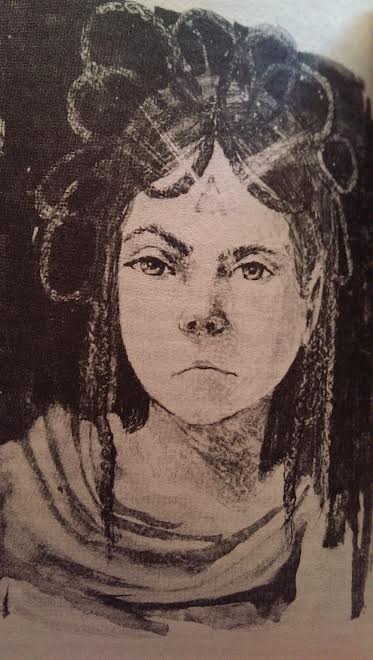
HeadlessCupidAmandaAmanda is fascinated by stories of the poltergeist.  A friend of hers where she used to live (one her mother didn’t approve of) was teaching her about the occult and how to do magic spells.  When David tells Amanda that he thought that his mother was psychic, Amanda is surprised, and she offers to teach David and the other kids about magic over the summer.  David eagerly accepts the offer because he finds the subject fascinating and because it’s the only thing that Amanda really seems interested in.  The other kids are also fascinated at the idea, even the littlest ones, which takes Amanda by surprise.  She had expected them to be scared.
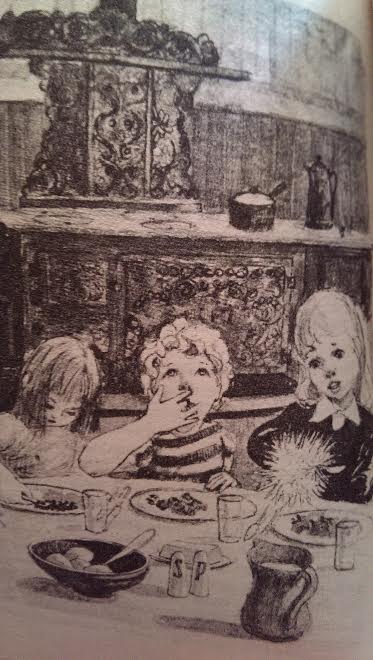
Still, Amanda begins leading the kids through a series of rituals that will supposedly initiate them into the occult world, all of which have to be done in secrecy, without the parents’ knowledge.  They have to do some bizarre things like spend an entire day not talking (they have to take turns so the adults won’t notice, and it’s harder for some kids than others), spend a day where they can’t touch anything metal (mealtimes are awkward), offer “sacrifices” to the spirits (basically giving Amanda things she likes), and find animals to be their “familiars.”  As some of these rituals and the kids’ strange, secretive behavior cause problems, particularly for David’s stepmother, David begins to suspect that Amanda’s “rituals” have an ulterior motive that has nothing to do with magic at all.  Then, the poltergeist activity begins.

HeadlessCupidKidsJust as with the Westerly family years ago, rocks are thrown around the house or found just laying around.  Things are broken in the middle of the night.  Have Amanda’s rituals somehow awoken the poltergeist once more?  David has his doubts, suspecting that it’s part of Amanda’s playacting, but she is accounted for when some of these strange things happen.  The younger kids are still more fascinated than frightened by these strange happenings, but their stepmother finds them particularly unnerving.

Then, just when David thinks that he understands the situation and Amanda seems to be calming down her occult talk and behaving more normally, something happens which is really inexplicable: the missing head of the cupid suddenly reappears.

This is a Newbery Honor Book.  It is available to borrow and read for free online through Internet Archive.

My Reaction, Themes, and Spoilers

The reason why I want to explain some of this is because I think this book has received some unfair criticism because of the “occult” themes in the book, and I want to clarify the situation for the benefit of parents and teachers who have not yet read the book and may be concerned.  I’m putting “occult” in quotes because, as I said before, that’s not really what’s going on.  The book is a mystery story, and the “supernatural” stuff is largely window dressing for the real themes of the story, which have to do with unresolved feelings and revenge.  The story even contains a kind of warning about getting involved with the occult, which is another reason why I think the criticism of this book is unfair.

That Amanda is faking at least part of the haunting is pretty obvious even early on, so I don’t think it’s much of a spoiler to say that.  Amanda is an unhappy girl whose life abruptly changed with her mother’s remarriage, and her occult talk and fake witchcraft are part of her way of dealing with her feelings.  She admits to David at the end of the story that she was purposely trying to frighten her mother, trying to “get even” with her for turning her life upside down, first by divorcing her father and then by getting married again, forcing Amanda to move to a strange town where she has no friends and live with a bunch of kids she hardly knows.  Getting to know her new siblings better and sharing adventures with them helps, but it takes the frightening moment when the cupid’s head suddenly reappears to get Amanda to admit that real occult stuff scares her, too, and to confess the truth of what she did and her real feelings to her mother.

HeadlessCupidDavidAmandaThere are some elements of the happenings, particularly the reappearance of the cupid’s head, that are never fully explained, although David ends up knowing more than Amanda by the end.  Some aspects of the situation are hinted at.  There may be a real supernatural event at the end of the story.  Blair appears to have inherited psychic abilities from his mother, and there is a distinct possibility that the Westerly sisters who once lived in the house were just as unhappy with their parents for the changes in their lives as Amanda was with her mother.  Although the “poltergeist” as it first appears doesn’t exist, it may be that the “poltergeist” of the past remembers what it was like to be young and unhappy and that she wanted to make amends for past wrongs and to help another troubled young girl to make peace with her life and family.  But, if you don’t like that explanation, there is a more conventional, non-supernatural explanation that David considers, which equally possible.  Personally, I think it’s a combination of the two, but it’s not completely clear.  I think the author left it open-ended like that to make readers wonder and to preserve the air of mystery after the other mysteries have been cleared up.

As a kid, I enjoyed the creepy aspects of the story and the sense of wonder the kids experience as they go through their “rituals,” trying to bring some magic to their regular lives, wondering if things like ghosts and magic can really exist.  Now, I more appreciate how Amanda researched tricks used by fake psychics and mediums and used them creatively to her advantage.  When I was a kid, I liked magic tricks, and psychics and mediums make use of those types of stage illusions and psychological tricks in their acts.  I still have some books on the subject myself.  I also like the way David sensed the truth behind Amanda and the strange happenings even though he didn’t really understand how or why it was done at first.  David has some genuine curiosity about magic, but even after he realized that Amanda was faking things and was disappointed by it, he didn’t immediately tell the others.  He could have unmasked her as a fraud, but he knew that would only earn her resentment.  He wanted to understand her motives and help her feel better, giving her the chance to make peace with her mother herself and become part of their family.

This book has been frequently challenged because of the children’s inquiries into the occult, but I would like to point out that their “occult” experiments were all fake, pretty obviously so, and it is acknowledged that Amanda’s interest in the occult was fueled by her emotional distress (part of her urge to “get even” with her mother by causing problems).  By the end of the story, Amanda and her mother have an honest talk with each other about everything.  Amanda admitts her true feelings and makes peace with her mother, and she also says that her mother explained some things that Amanda didn’t know before.  The book doesn’t say exactly what Amanda’s mother told her, but from the context, it’s probably something about the circumstances behind her parents’ divorce, something that they might not have wanted to explain to her earlier.  I have a theory about it, although there’s nothing explicit that I could point to to prove it.  I suspect that Amanda’s father had an affair and that the affair is continuing, which I think is the real reason why he doesn’t want Amanda to live with him full time.  If Amanda were to live at his house, she would be sure to find out the truth.  Maybe his girlfriend is even the housekeeper Amanda referred to, the one who doesn’t help take care of children because she’s “not that kind of housekeeper.”  That possibility didn’t occur to me when I was a kid, but it seems kind of odd for a single man, living without children or other people in his house or other household staff to manage and who spends a large amount of time working away from home, to even have a housekeeper instead of simply hiring a maid or cleaning service to come in from time to time.  Households with fewer people require less maintenance.  There is less laundry to do, and single people who work tend to eat out or order in pretty often or make very simple meals, so I doubt he even needs much help with cooking.  But, that’s just my theory.  No one ever says why Amanda’s parents divorced in the story.  The reasons are less important to the story than Amanda’s feelings concerning the divorce.  Some of Amanda’s earlier resentment toward her mother was fueled by things that her father told her, making it seem like her mother was the one who caused the divorce.  After talking with her mother, Amanda seems to realize that some of the nasty things that her father said about her mother may not have been true and that her resentment toward her mother for causing the divorce was needless.  Much of the story involves unresolved feelings and the need to communicate them honestly.

The difference between reality and perceptions is also important to the story.  Although Amanda at first tries to convince the other kids that she is an expert on all things magic, David soon realizes that she’s not: she acts like ordinary, easily-identifiable wild flowers are rare herbs, she can’t control her “familiar” because she has no idea how to handle animals, and when things happen that Amanda can’t explain, she’s the first to be terrified.  In the end, Amanda gives up on the idea of the occult completely, realizing that the things she did were wrong and that she had gotten involved in something that she really didn’t want to be involved in.  Many kids wonder about the supernatural when they’re young, and I don’t think it’s bad to point out to them that they if they experiment with such things, they may be getting involved in something they could regret and that they should consider their motives for wanting to do so.  Playacting when you know it’s pretend is one thing, but not knowing if the scary stuff is real is another.

For further discussion of the dynamics of the blended family in this story, I recommend the SSR Podcast about this book.  The podcast also points out that there is an incident in this story which might be racially problematic.

Anti-Plagiarism Check

I’ve been thinking about how my reviews could be used for plagiarism ever since I caught a couple of those essay-writing companies trying to follow my blog.  It’s difficult for me to review certain books without giving spoilers, but I’d like to point out that none of my reviews explain everything there is to know about the stories.  That would be completely impossible without reprinting the entire text of the book, which plagiarists are too lazy to read anyway.  There are certain plot points which only a person who has actually read the book would understand and be able to explain.  Teachers who suspect that a student has plagiarized a book review or only pretended to read the book should ask them to verbally explain the points that I have not covered in my review, giving them no chance to try to look up the answers elsewhere or try to find them by quickly skimming the book.  I’m not going to print suggestions for questions to ask here because I don’t want to give the plagiarists a hint, and I doubt that teachers who have read the book recently themselves would really need a hint, but any teacher who contacts me via their official school e-mail address can discuss it with me.  I know these stories well because I’ve loved them for years, and I’ve started a file with suggested plot points to discuss.  I will not send this information to anyone who does not contact me from an official school e-mail address.  Keep in mind that I can easily look up the name of the person who contacts me to determine whether I’ve been contacted by a teacher or a student.

It’s one thing for a student to want to discuss the book with someone to clarify confusing plot points, but it’s another to ask someone to do their homework for them.  I know the difference, and I know homework when I see it.  Let me explain something.  All WordPress blogs have built-in analytics, and I’ve been studying SEO, so I pay attention to who has been visiting my site and how they get there.  I know whether you came here by using a search engine or whether you were referred by another site, and I can also see search terms that you used.  I added this note to this review specifically because I noticed that someone has been trying to Google what are plainly homework questions, and I just got a site referral from an online plagiarism checker.  Yeah, I see what you did there.  This is the Information Age, and when you go looking for information, sometimes, there’s someone else looking back at you, even if you can’t see them.  Not everyone with a blog pays that kind of attention to their traffic, but some of us do, and while some may not say anything about it, some of us are also a little more vocal.  I saw what you did, and I didn’t like it.  I don’t know you, but I know you’re a fool, and your teacher has just discovered it, too.  Now, we’re all aware.  It’s your own fault, and it’s too late to whine about it now.  I do sometimes help people who ask for it.  You should have asked for help when you needed it instead of cheating and stealing my words.  Maybe next time you’ll ask for what you need instead of just taking what you want.