Mystery on Skull Island

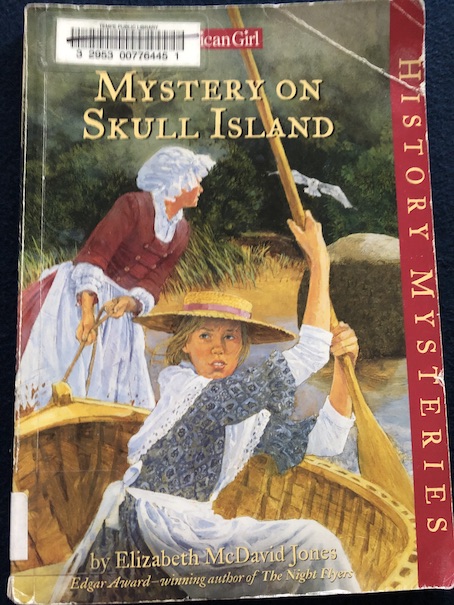
Mystery on Skull Island by Elizabeth McDavid Jones, 2001.

This book is part of the American Girl History Mysteries series.
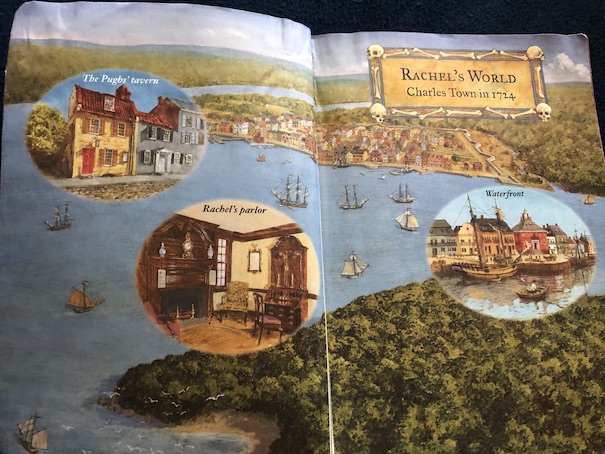
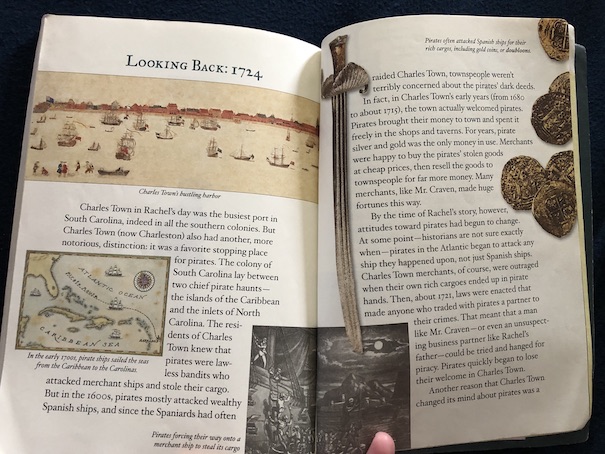
It’s 1724, and twelve-year-old Rachel Howell is traveling to where her father lives in Charles Town, South Carolina. Rachel has been living with her grandparents in New York since her mother died seven years earlier. Her father also used to live in New York, but after his wife’s death, he decided to move to South Carolina, hoping to start a new life. Now, her father has established himself in South Carolina and wants Rachel to come and live with him. Rachel has wanted to live with her father for some time, but she’s nervous because she doesn’t know what life in South Carolina will be like.

Rachel’s new life has a terrifying beginning when the ship that is taking her to Charles Town is attacked by pirates. The pirates force the passengers on board to hand over jewelry and other expensive items. They even take Rachel’s pendant, which belonged to her deceased mother. Fortunately, the pirates don’t hurt or kill anyone and let the ship go once they’ve taken everything of interest to them.

When Rachel arrives in Charles Town, she and her father have difficulty recognizing each other at first, but they are happy to finally be together. Rachel’s father is appalled when he hears about the pirates stealing Rachel’s mother’s necklace, but he is relieved that Rachel is all right. He explains that piracy has been a serious problem to shipping in the area. The local government has tried to combat the problem with harsh punishments, hanging many offenders. However, the pirates have money, and so local businesses still tolerate their presence.

The talk of pirates is shocking, but Rachel is soon in for another shock when her father tells her that he has become engaged and that Rachel will soon have a new mother. Rachel had been looking forward to having some time alone with her father to get to know him again, so she is not pleased at the news, but the engagement is the main reason why her father has sent for her. He wants Rachel to have a mother to care for her and for them to live as a complete family again. He tells Rachel that his fiance, Miranda LeBoyer, is from Philadelphia. She will be arriving in Charles Town soon with her aunt.

Rachel’s father is often busy with his work in the shipping industry, but he grants Rachel more freedom than she had with her grandparents, so she is able to explore her new town and make some new friends. The first friends she makes are the Pugh family, especially the daughter, Sally, who is about Rachel’s age. The Pughs own a local tavern, and Rachel often goes to visit them, sometimes helping with chores and learning to cook. She tells Sally about her worries about her new stepmother, but Sally says that she might not be so bad.

Like her life in South Carolina, Rachel’s first encounter with the woman her father plans to marry takes a disturbing turn. First, Miranda seems to disapprove of Sally and her brother, and Rachel fears that she will interfere with their friendship. Then, her father’s new business partner, Mr. Craven, stops by, and Rachel notices that Miranda seems to both recognize and dislike Mr. Craven. She overhears a conversation between the two of them in which Miranda calls Mr. Craven a “scoundrel” and refers to some kind of illegal dealings in his past. Yet, when Rachel’s father tries to ask Miranda what they’re talking about, Miranda lies and says that they’re discussing the weather and hurricanes that occur in Charles Town. Rachel worries about why Miranda would lie to her father and what kind of dishonest business Mr. Craven might be doing. What are the secrets that people in this town are hiding, and is Miranda really what she seems to be? With the help of her new friends, will Rachel find out the truth before it’s too late?

There is a section in the back of the book with historical information about piracy and life in South Carolina during the 18th century.
The book is available to borrow and read for free online through Internet Archive.

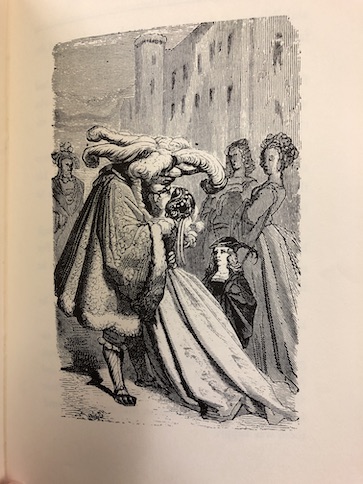
The Enchanted Forest

The Enchanted Forest by La Comtesse de Segur, translated by Beatrice Schenk de Regniers, 1856, 1974.

This is an English translation and retelling of one of La Comtesse’s stories.  I can’t read French, and I’ve never read the original version of the story, but the translator, Beatrice Schenk de Regniers, had a note in the book that she altered the story slightly from its original version.

King Goodheart has a lovely little daughter named Goldenhair, who he loves very much.  Unfortunately, his wife dies, and his people urge him to remarry.  His new wife, Queen Meanette, is as mean as her name sounds, and she does not like Goldenhair at all.  The King, realizing this, does his best to keep her away from his daughter and puts his daughter in the care of some trusted servants. 

Meanette, still jealous of the love and attention the King gives Goldenhair, plots to get rid of her.  One of the princess’s attendants is a boy who takes her out in her little carriage in the garden every day.  The boy is greedy for sweets, and the queen bribes him into tricking the princess into going into the enchanted forest.  People who go into the forest have been known to disappear forever.  When the princess becomes lost in the forest, she is befriended by a cat who takes her to a palace where he lives with a doe.  They are very kind to her, but Goldenhair still longs for a way to return home.

One day, while Goldenhair is living with the cat and the doe in their palace, a parrot comes and claims that he knows a way that the princess can return home.  He insists that she leave the palace, against the doe’s wishes, and pick a single rose that grows in the forest.  What the girl doesn’t know is that the parrot is an evil wizard in disguise.  When the girl picks the rose, the doe’s palace is destroyed, and the evil wizard reveals himself. 

Thinking that she has killed her friends, Goldenhair wanders, lonely and miserable, through the forest.  Then, a large tortoise comes and tells her that her friends are still alive and that she can find out what happened to them if she’s willing to take a long journey on the tortoise’s back without saying a single word the whole time.  Goldenhair does so and arrives at a fine palace where she learns that the doe was really Fairy Kindheart and the cat was really her son, Prince Charming.  They had been turned into animals by the evil wizard, and they had been freed when the princess picked the rose.  However, the princess had then fallen under the spell of the evil wizard, and the other trials were necessary to free her.  Fairy Kindheart takes the princess home to her father, who is overjoyed to see her.  The King marries Fairy Kindheart, and Goldenhair marries Prince Charming, and they all live happily ever after.

The book is currently available online through Internet Archive.
My Reaction and Further Information

The life of La Comtesse de Segur, the original author of this story, is almost like a fairy tale itself. Her first name was Sophie, and she was born in 1799 in Russia.  Her father was a Russian Count, and she grew up with her seven siblings on his vast estate.  However, even though her family was wealthy, her mother believed that children shouldn’t have life easy.  Sophie and her brothers and sisters had to sleep on small, hard beds and were never given much food to eat or any sweets.  When she was 18, Sophie went to live in France, and she married a French Count named Eugene de Segur.  It was not a particularly happy marriage, but she had four daughters and four sons and many grandchildren.  She wrote stories for them and became the most popular children’s writer of her time in France.  She died in 1874, but her stories are still popular with children in France.

I found the story of La Comtess’s life even more interesting than the story in the book, although the story in the book isn’t bad. It seems like a pretty obvious variation on the story of Snow White, but it is a charming story.

Skylark

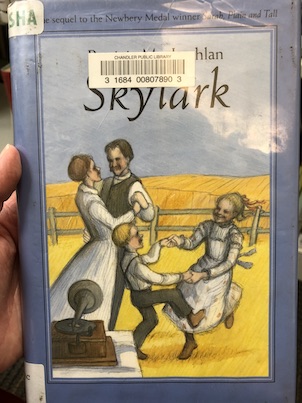
Skylark by Patricia MacLachlan, 1994.

The second book in the Sarah, Plain and Tall Series picks up about two years after the first book, shortly after Sarah marries Jacob, the father of Anna and Caleb.  That summer is very dry, and people worry about when it will rain next.  If there is no rain, their farms will be in danger.  Some people have been known to simply abandon their farms and move on during especially long dry spells.  Jacob says that their family won’t leave, no matter what, because “Our names are written in this land,” meaning that they have a commitment to it because they were born there and make their lives from the land.  However, Sarah was born in Maine, and Caleb worries that, if the dry spell goes on too long, Sarah will want to return to Maine.

The year goes on, and Sarah settles in to life on the farm.  Her cat, Seal, has kittens.  Sarah reflects on the baby animals and seems thoughtful about babies.  However, people are becoming ever more concerned that the water in the wells is lower than usual.  As people keep hoping for rain, Sarah gets a letter from Maine, saying how lovely and green everything there is.  The land around the farm is dry and brown, and the family has had to ration their water carefully, their supplies running increasingly low. 

Eventually, a family from the area has to pack up and leave because their well is dry.  Sarah is upset, trying to think of some way around the problem, but there is nothing to be done.  Everyone’s supplies are running low, and they’re already doing everything that can be done.  Sarah hates feeling helpless against the problem.  When Sarah’s best friend, Maggie, talks about leaving with her family, Sarah says that she hates the land because it takes so much and gives nothing back.  Maggie tells her that she’s like a lark that hasn’t come to land yet and that, if she is hoping to survive in this land and make a home there with Jacob, she will have to write her name in the land, just as he has.

Although the characters become increasingly distressed, in a way, I like the story for that.  Sarah is a strong, capable woman, but even she doesn’t have all the answers to every problem.  It’s upsetting for her to realize that, but it’s very human.  After the family’s barn catches fire and burns down, Jacob persuades Sarah to take the children and visit her family in Maine.  While they are gone, he will take care of the animals and try to keep the farm going, waiting for rain.

In Maine, Sarah and the children stay with Sarah’s aunts.  Aunt Mattie, Aunt Harriet, and Aunt Lou, who have never married, are called “The Unclaimed Treasures.”  They shower the children with affection.  Still, the children miss their father and worry about what is happening on the farm.  Sometimes, the children have bad dreams in which their father is unable to find them.

In the end, the rain comes on the prairie, and Jacob comes to Maine to collect his family.  Then, the family learns that Sarah is expecting a baby.  Anna worries a little because her mother died giving birth to Caleb, but Jacob and Sarah reassure her that everything will be fine.  When they return home, Sarah writes her name in the dirt, signaling her commitment to her new life on the prairie.

There is a movie based on the book that follows the story very well. In fact, some of the dialog is almost word-for-word from the original. The book is available to borrow and read for free online through Internet Archive (multiple copies – including one in Spanish).

Sarah, Plain and Tall

Sarah, Plain and Tall by Patricia MacLachlan, 1985.

This is a popular book to read in schools in the United States, the first in a series.  It’s a Newbery Award winner, and it shows aspects of farm life during the early 20th century and the concept of mail-order brides, a practice from American frontier days where men living in the West or Midwest, where there were not many available women in the population, would write to agencies or advertise for a bride from the East.  The process for arranging these marriages could vary, but it typically started with written correspondence before the man and woman would meet in person.  In this book, the man looking for a bride, Jacob Witting, is a widower with two children who has a farm on the Great Plains.  The story is narrated by his older child, Anna. The book isn’t very long, and it’s a pretty quick read, but it’s filled with colorful imagery and emotion.

Anna has had to help take care of her little brother, Caleb, since he was born.  Their mother died shortly after giving birth to him, and Caleb frequently asks Anna questions about what their mother was like.  Anna’s memories of their mother are fading because she was still very young when she died, but she really misses her.

Then, Jacob tells the children that he has advertised for a bride from the East, the way a neighbor of theirs did.  The children like their neighbor’s new wife and wouldn’t mind having a mother like her.  The father has received a reply to his advertisement from a woman in Maine, Sarah Wheaton.  Sarah has never been married, and now that her brother is getting married, she feels the need for a change in her life.  She loves living by the sea in Maine, but she is willing to move to start a new life.  She says that she would like to know more about Jacob and his children.

Jacob and the children write letters to Sarah, getting to know her better.  They come to like each other, but the children worry about whether Sarah will change her mind about coming to see them or whether she’ll like them or their farm when or if she comes.  When Sarah tells them that she’s coming during the spring, she says that they will know her because she will be wearing a yellow bonnet and describes herself as being plain and tall (the title of the book).

Sarah will stay with the family for a time while they decide if they can be a family together and if she will marry Jacob that summer.  There are adjustments that they will all have to make.  Life on the prairie is very different from what Sarah is used to, and the children still worry that she won’t want to stay.  Sarah brings seashells from Maine to show them, and they teach her about the local wildflowers.  One of my favorite scenes was where Sarah cuts Caleb’s hair, and they put the hair clippings out for birds to use in their nests.  Caleb was particularly concerned about whether Sarah would sing like their mother used to, and Sarah does. 

Through it all, the children can tell that Sarah really misses the sea.  Sarah does say that the land around the farm kind of rolls, a little like the sea, and they play in a haystack, like it was a dune by the sea.  When they visit their neighbors, Sarah talks with Maggie, the mail-order bride who came from Tennessee.  Maggie understands Sarah feels, missing her home in Maine, and it upsets Anna to hear them talk about missing their old homes.  However, Sarah says that things were changing at home, and Maggie comments that, “There are always things to miss, no matter where you are.”  What the women realize is that, although they miss their old homes, they have grown to love the new people in their lives and would miss them if they tried to go back to where they came from.

At one point, Sarah goes to town alone, and the children worry that she won’t come back, but she does.  She just went to town to buy colored pencils in her favorite sea colors.  Sarah does stay and marry Jacob, setting up the rest of the series.

The book is available to borrow and read for free on Internet Archive (multiple copies).

My Reaction

There is a movie version of this book, which follows the story pretty well. The book wasn’t specific about the time period, although it seems to take place during the early 1900s. The movie and its sequels are set during the 1910s, which makes sense for the rest of the series. The book also didn’t say exactly where the farm was, but the movie clarifies that it’s in Kansas. The movie also emphasizes how much the whole family, particularly Jacob and Anna, misses the mother who died.  In the movie, Jacob forbids the children to use any of his dead wife’s things and doesn’t want to talk about her.  However, when Sarah realizes that trying to avoid his wife’s memory is hurting Anna, she brings out some of the dead wife’s belongs to use, helping the family to make peace with the past and prepare for the future. 

In the movie, Jacob’s pain over his wife’s death is partly about guilt as well as grief. The book doesn’t really talk about why Anna’s mother died after childbirth, but in the movie, Jacob has a painful discussion with Sarah about how he blames himself for his wife’s death because the doctor had warned them that they shouldn’t have any more children after Anna.  Apparently, Anna’s birth had been difficult and caused complications because his wife was so young, and the doctor had said that having another child would be dangerous.  However, after a few years went by, they decided to try for a son to help run the farm, thinking that enough time had gone by for it to be safe.  When his wife died giving birth to Caleb, Jacob felt terrible, thinking that he should have taken the doctor’s warning more seriously and not tried to have another child.  Confessing all of this to Sarah helps Jacob to make his own peace with what happened.  However, none of this discussion appears in the book.

In both the book and the movie, Jacob also has to adjust to Sarah’s different personality.  Sarah is more stubborn and independent than his first wife, with her own way of doing things.  Living with her is different from living the mother of his children.  However, Jacob comes to love Sarah for the person that she is.

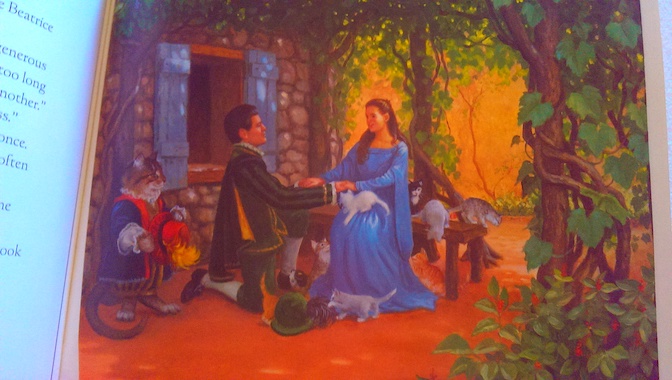
Papa Gatto

PapaGatto

Papa Gatto by Ruth Sanderson, 1995.

This beautiful picture book, set in a fairy-tale Italy, is based on several folk tales, as the author explains on the page with the publishing information.  Among the tales that served as inspiration for this story is The Colony of Cats, which is from Andrew Lang’s The Crimson Fairy Book.  In some ways, this story is similar to Cinderella and Mother Holle, with its wicked stepmother and stepsister.

In the distant past, so the story says, it was common for animals to talk, and one of the wisest cats was Papa Gatto, who served as an adviser to the prince.  Papa Gatto had a lovely wife and a beautiful mansion, but soon after the birth of their eight kittens, his wife died.  Needing someone to help care for the motherless kittens, Papa Gatto decides to advertise for someone to help.

PapaGattoAdvertises

In the town, there is a widow who has a daughter named Sophia and a stepdaughter named Beatrice.  As in many fairy tales, the widow favors her own daughter, who is lazy and spoiled, while giving all of the hard work to her stepdaughter, who is much nicer.  When they hear about Papa Gatto’s advertisement, Beatrice feels sorry for the young kittens and wants to help.  However, the widow, thinking of the generous fee that the wealthy Papa Gatto is offering, decides that she wants it for Sophia.  Sophia doesn’t want the job, but at her mother’s urging, she goes to see Papa Gatto anyway.

PapaGattoSophia

Papa Gatto gives Sophia the job tending his house and family while he’s away on a trip, but Sophia doesn’t know how to work hard and has no real intention of doing a good job.  She simply makes herself at home in Papa Gatto’s lovely mansion, trying on his dead wife’s jeweled collars as bracelets and neglecting the housework and kittens.  When Papa Gatto returns home and sees what she’s done, he sends her away in anger.

When Beatrice hears that Papa Gatto is once again looking for help, she goes to see him without telling her stepmother about it.  Papa Gatto sees how interested she is in the kittens and how gently she treats them, he gives her the job, reassured that she will do it well.

PapaGattoBeatrice

Sure enough, when he returns from his next journey, he sees that Beatrice has taken good care of the house and kittens and rewards her with the jeweled necklace/bracelet that Sophia had admired.  Needless to say, Beatrice’s stepmother and stepsister are angry with Beatrice when she returns home, and Sophia takes the bracelet for herself.

Meanwhile, Papa Gatto has told the prince about Beatrice.  The prince has been thinking about marrying, and he says that he would like to meet Beatrice.  Papa Gatto tells him that she will probably be at the coming fair in town, and the prince should attend and look for the girl with the bracelet.

At first, the prince mistakes Sophia for Beatrice, a deception that she and her mother encourage.  However, when the prince speaks to Papa Gatto again, Papa Gatto realizes the deception and sets things right.

PapaGattoRevelation

The pictures in this book are beautiful!  And, of course, there’s a happy ending.

I liked it that Beatrice didn’t accept the prince’s offer of marriage immediately, saying that she’d like to get to know him first.  It’s more sensible than the fairy tales where they get married right away.

PapaGattoHappyEnding