Seven-Day Magic

SevenDayMagic

Seven-Day Magic by Edward Eager, 1962.

John and Susan are brother and sister, living in a perfectly ordinary town in Connecticut. They are tall, good-looking, and good in school and at sports, so they are generally popular and are often chosen for positions like class president. However, their home life is unusual because they are orphans who live with their grandmother, who sometimes requires them to look after her as much as she looks after them. Their grandmother isn’t very strong, but she is spirited and is sometimes tempted to do things that she probably shouldn’t do at her age, like climbing trees. Because John and Susan feel like they have to look after their grandmother, it’s sometimes difficult for them to get out and do some of the things that other children their age are doing, like going to parties. They’re glad when Barnaby and his sisters move to a house nearby because they make life more exciting.

SevenDayMagicChildren

Barnaby and his sisters, Abigail (called Abbie) and Fredericka, become friends with John and Susan. Their father is a singer in advertisements, and their mother is a realtor. Because their parents work a lot to make ends meet, the children are often left to their own devices.  Barnaby is opinionated, stubborn, and sometimes hot-tempered, which causes him to get into fights at school, but John likes him because he’s imaginative and full of interesting ideas.

Barnaby wants to be a writer. He’s secretly writing a story of his own, and he encourages the others to read more. Before meeting Barnaby, John hardly read anything at all, and Susan was mostly into the Sue Barton books, about a young woman who becomes a nurse (a real series that was popular in the mid-20th century, realistic fiction). Barnaby introduces them to a whole new world of fantasy stories, full of adventure. One day, while visiting the library together, the children talk about the kinds of stories that they like and wish that they could find a really good book full of magic and kids that are like themselves. Their wish comes true in a peculiar way.

On impulse, Susan checks out a rather worn-looking book with a red cover, not really knowing what it’s about but thinking that it just looked kind of interesting. The librarian seems a little uneasy when she takes it and warns her that she can only keep that particular book for seven days, which is surprising because that’s the limit usually imposed on new books, not old ones.

On the way home, the children show each other what they got and read parts of their books aloud to each other. When Susan opens the red book, they are all startled to find out that the book is about them. It starts out just like the real life book and tells about their lives and backgrounds and has their conversation about books they like, word-for-word. The children can tell that this is a magic book, but even while the idea is thrilling, it makes them uneasy. There is nothing written beyond their conversation about books, and the book won’t let them turn pages to see what might come next or how their story will end.

As much as the children like the idea of being the stars of their own magical book, it’s worrying. They don’t know what they’re in store for, and they even worry briefly that maybe their entire lives are fictional, that they might just exist in someone’s imagination, although they don’t really believe that because they can remember their lives before the story began. Barnaby points out that the book specifically mentions that he and his sisters recently moved to the area, but he remembers having lived elsewhere before that.

The children carefully consider everything they had originally wished for in a book: that children, just like themselves, would be walking home from somewhere and a magical adventure would start before they even realized that it was happening and that they would have to figure out the rules of the magic in order to use it for their own purposes. Since the first part of their wish has literally (very literally) come true, they decide that they’re going to have to figure out what the rules of this magic are before they decide what to do next. Since looking ahead in the book seems to be against the rules, they decide that they will have to be very careful about anything they wish for next because their wishes seem to be what writes the story, and they need to discuss it first and come to an agreement about it.

SevenDayMagicDragon

Unfortunately, little Fredericka (the youngest of the children) is too impatient for discussion and immediately wishes for an adventure with wizards, witches, and magic, and she wants it to start right away so that they’ll know that the magic is really working. A minute later, a dragon suddenly appears and scoops up Fredericka, flying away with her!

The others try to figure out where the dragon came from, and it turns out that a stage magician who lives nearby was practicing his act at the time that Fredericka made her wish. When she wished for a magical adventure, the rabbit that the magician was supposed to pull out of his hat turned out to be a dragon. The magician, The Great Oswaldo, is mystified, but he’s destined to play the part of Fredericka’s requested wizard. The children ask him to help them, and he says he’ll try, although he’s not sure how.

As Oswaldo tries various tricks in his magic supplies, they don’t work in the way they usually do. Finally, he is able to make his landlady’s house fly after the dragon, much to the landlady’s horror (she’s cast in the role of the witch in Fredericka’s story). In the magical land where the dragon lives, the peasants inform them that the dragon is always carrying off girls and young women to eat them, and they have to think of something fast before Fredericka becomes his next meal!

This is where the children discover that the contents of the magical book change depending on who reads it. When the magician reads it, it’s full of magic spells. When the landlady, Mrs. Funkhouser, takes it from him, it has household hints. For the dragon, it’s all about dragons. Surprisingly, it’s Mrs. Funkhouser’s household hints that save the day, although it’s Oswaldo who gets most of the credit because one of his pet cats eats the dragon after Mrs. Funkhouser shrinks it.

Oswaldo and Mrs. Funkhouser decide to stay in the magic land (which the children think might actually be Oz, in its early days), where they are hailed as heroes, sending the children home by themselves with the help of Mrs. Funkhouser’s vanishing cream. As expected, this adventure is now written in the magic book when the children have another look at it (although Fredericka argues that the illustrations don’t really do her justice).
SevenDayMagicCoin

Susan, as the borrower of the book, says that she wants their next adventure to be calmer, the kind of everyday magic that just creeps up on you. This is the part of the story where it crosses over with the events in Half Magic (another book in the same series as this one). In these children’s world, Half Magic is a fictional book that they’ve read and liked. Susan’s requested adventure picks up where Half Magic left off, explaining what happened after the other four children (Jane, Mark, Katharine, and Martha) left their magic coin to be discovered by a new owner. Susan and her friends delight in explaining to the young girl who found the coin what it does. The girl says that she had thought that the coin might be magic, but was confused because she didn’t get her wish to go into the future and meet some other children. Because the coin only grants wishes by halves (interpreting that pretty liberally), Susan and her friends (who live in the future), came to meet her instead.

Once again (as is common in this series), it leaves the matter of what is fiction and what is reality open to question. Was it the girl’s wish that brought the other children to her, or their wish that took them into her story? Or Both? Was that fantasy story secretly real, or are Susan and her friends more fictional than they like to think? The author likes posing questions like this, but of course, you never completely know the answers, and in some ways, it hardly matters because the adventure doesn’t require anyone’s understanding for them to take place, which is something that, ironically, it has in common with real life – things frequently happen regardless of whether or not you understand the reasons why. Sometimes, figuring out how things work and to deal with them is about all you can do, never getting the complete “why” behind everything.  That’s pretty much how all the stories in this series go.

After the children explain to the girl what the coin is and how it’s supposed to work, she makes a more careful, doubled wish to go to the future with the other children. Unfortunately, when they get there, she panics when she realizes that she forgot to bring her one-year-old baby brother with her and makes a hurried half-wish for him to be there, too.   Because she didn’t wish right, what she gets is her brother at the age he would be in the other children’s time (about age 37) but still mentally the baby he was back in 1924 (the girl’s time). The “baby” is amazed when he realizes that suddenly he can walk and talk much better than he could before and that he’s suddenly much bigger and stronger than he used to be. He gets hold of the coin and refuses to give it back, telling his little “big” sister that he can do what he wants now, not what she tells him to do. Noting that he can even pick her up and carry her around now, he does that, with the others chasing after him to get the charm and bring him under control. (A somewhat similar incident, where a baby grows up too fast and is dangerously immature, happens in E. Nesbit’s Five Children and It – another instance of Edward Eager playing off her books.)

It’s chaos for awhile because a 37-year-old man who acts like a 1-year-old can’t help but attract attention, especially when he gets it into his head that he wants to drive a train. Eventually, they get the “baby” back under control and to his proper age, allowing his sister to take him back to their own time and plan her future adventures with the coin.

Then, Susan and John’s grandmother gets hold of the book, and it takes her and her grandchildren back in time, to when the grandmother was a young woman working as a prairie schoolteacher. Susan makes a wish for the other children to join them, and they help their grandmother and her students to survive a sudden blizzard. They come to appreciate their grandmother’s youthful personality and formidable spirit even more from the experience. They even get to meet their grandfather, who died before they were born, seeing him rescue their grandmother and her students when he was a young man.

SevenDayMagicPlaywright

Then, Abbie decides that she wants to try to help her father’s singing career. He typically has to work long hours and never makes very much money, just being part of the chorus on advertisements. She thinks things will be so much better if they can help him to be discovered as a great talent. The others are kind of doubtful about her plan because the book seems to send them on rather “bookish” adventures, related to other stories they’ve read or people’s memories, like in their grandmother’s case because her early life actually did somewhat resemble things from the Little House on the Prairie series (a series which the grandmother enjoys reading for that reason). The other children just don’t know what would happen if Abbie tries to use the book for something more modern and everyday, like their father’s career. She tries it anyway, with some unpredictable results.

During a recording at a television studio (which the children are present to witness), the magic makes their father sing wonderfully but he also does his singing part out of sync with the other singers. He’s sure that he is singing his part at the right time, but for some reason, the other members of the chorus are silent when he sings. The director gets mad at him for singing out of sync and messing up the performance, and the singer who was supposed to be the star gets mad about being upstaged, but the reviewers end up loving the performance. So, while at first it looks like the father is going to be fired, he ends up with more singing parts because of the episode. The only problem is that all the singing parts are silly jingles, like the typical advertising jingles he gets. While he’d welcome more money, he always dreamed of being able to get better parts. However, the magic isn’t quite done, yet. When Abbie meets a playwright who is looking for a new talent to sing in his play, it turns out that he has seen Abbie’s father on tv and likes his voice.

SevenDayMagicWings

Abbie’s wish is so great and does so much for their family that the kids start thinking that it might be the end of the magic. The seven days are really up, and the book has to go back to the library the next day. However, John and Barnaby haven’t had their chance to wish yet, and each of them wants to have a turn before the book goes back. Barnaby even suggests that perhaps they can keep the book an extra day, turning it in late. Surely a little late fee isn’t too much to ask for an extra day of magic, is it? Abbie is afraid, though, that keeping the book overdue would be breaking the rules and that the magic might go all wrong. She’s right.

Even with the idea of keeping the book for extra time, John and Barnaby argue over which of them will get to go first. The book’s magic, angry about not being returned to the library, turns sour on them, causing them to fight. John angrily tells Barnaby that just because he’s usually the group’s idea man doesn’t mean that he’s the only one who’s allowed to have ideas. (Which, in a way, is something that Barnaby needs to hear because that’s part of the reason why he often gets into fights – he always thinks he knows best.) John and Barnaby fight over the book, and the book gets torn. John ends up with a few pages, and Barnaby gets most of the book, which he uses to make a wish that he refuses to tell to the others. Barnaby disappears, and the others realize that the pages that Barnaby is holding are the last few pages from the end of the book, still blank. Without them, the book can’t end, and Barnaby could end up stuck in the book forever! Can the others find him and get him (and the book) back before it’s too late?

Before the end of the book, John does prove that, although he might not be as quick to come up with ideas as Barnaby is, he does get good ones. After he and the others find Barnaby, John uses his wish to get them back home and to return the book to the library in a most unusual way.  (Actually two unusual ways because he couldn’t quite make up his mind about which was best.  Both of them are homages to incidents in E. Nesbit’s books.)

The book is currently available online through Internet Archive.
Knight’s Castle

Knight's Castle

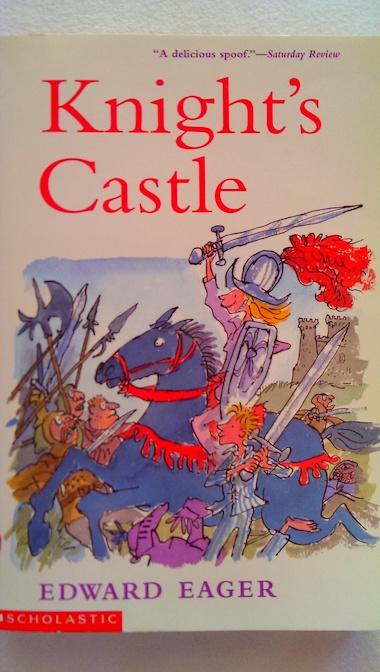
Knight’s Castle by Edward Eager, 1956.

Roger and Ann are the children of Martha from the previous two books in the series. Like their mother’s family when they were growing up, they live in Toledo, Ohio. Their Aunt Katharine (one of Martha’s older sisters) used to live close to them in the Midwest but now lives in Baltimore, Maryland. Roger and Ann don’t particularly get along with Aunt Katharine’s children, Eliza and Jack, because Eliza is bossy and Jack is only interested in photography. However, the four children end up spending the summer together when Roger and Ann’s father needs to have an operation at a hospital in Baltimore.

Like their mother and her siblings when they were young, Roger and Ann also like fantasy stories, which their father likes to read to them. Roger starts to believe in real magic when it seems like one of his toy soldiers comes to life at night. Roger collects toy soldiers, and he has over 200 of them, but this one is special because his father says that its been handed down in their family for generations. Roger calls it the Old One. It’s rather worn, so it isn’t obvious at first, but the Old One is actually a knight. Worried about his father’s illness, Roger takes the Old One to bed with him (which he thinks is more manly than taking a teddy bear to bed), and then feels it wriggling in his hand.

Knight's Castle Roger

Realizing that the Old One is magic and is coming to life when he holds him, Roger asks him if it’s part of his magic to grant wishes. If it is, then he wishes for his father to get well, and if possible, for him and his sister to have an adventure in Baltimore over the summer. The Old One doesn’t answer him immediately, but over time, he makes it clear to Roger that wishes have to be earned, and that will be the source of his summer adventure.

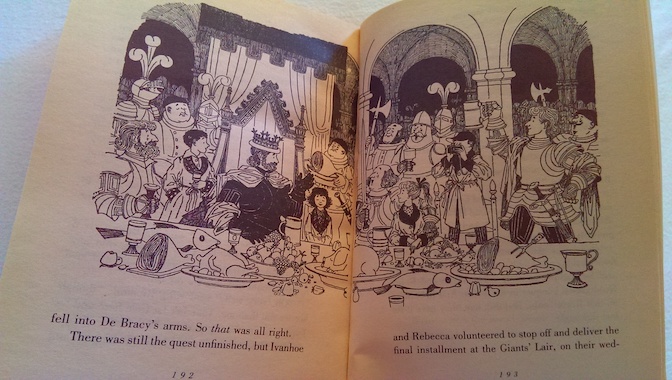
When the children arrive in Baltimore to stay with wealthy Aunt Katharine while their father is in the hospital, Aunt Katharine gives them presents. Ann gets a new dollhouse, and there is a toy castle for Roger. Since Aunt Katharine has also just taken all the children to the movies to see Ivanhoe, all of them become immediately interested in playing with the castle.

That night, Roger has a strange dream that he finds himself within the story of Ivanhoe, which is being acted out in his toy castle. The Old One is there as well, although he is mainly watching the action as Roger begins to take part in the story. When Roger comes face-to-face with the villain, he accidentally lets Ivanhoe’s plans slip to him. Things are looking pretty bleak when Roger suddenly realizes that the castle is still a toy and everyone around him is just a lead soldier. This revelation ends the magical adventure and brings him back to reality. However, Roger is disappointed that he ended the adventure so early when perhaps he could have done something really heroic.

Seeing the toy soldiers scattered around instead of poised for the battle they were planning the night before, Eliza and Ann think that Roger was just playing with the castle without them, but he explains to them what happened. The girls were just reading The Magic City by E. Nesbit, and they start building their own “magic city” out of random things from around the house, surrounding the toy castle. Roger is upset about the city because he says that it doesn’t fit in with the Ivanhoe story, and he’s sure that it will ruin everything, maybe from preventing the magic from working again at all. The Old One tells Roger that magic works by threes, so the next opportunity for magic will be in three days.

Knight's Castle Magic City

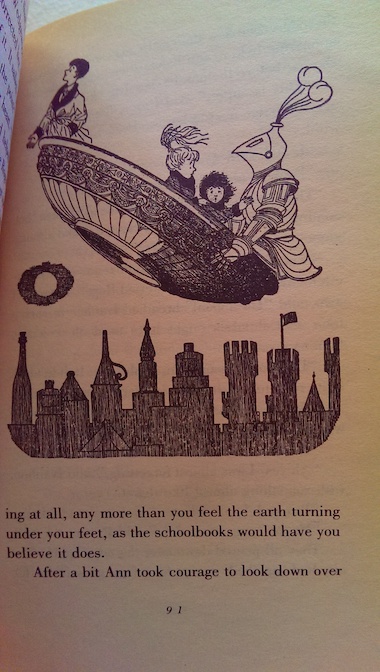
As it turns out, the city does end up becoming part of the story when the magic brings it all to life on the third night. Roger, Ann, and Eliza find themselves in the middle of the city, surrounded by knights attempting to drive modern cars. Ivanhoe has become a fan of science fiction books, via the public library in the city that the girls built. Although Ivanhoe has turned into something of a geek, the children persuade him to come on a mission to rescue the captive Rebecca, and they end up traveling in a flying saucer (made from a real saucer) to the Dolorous Tower, where the adventure ends as soon as Eliza remembers that the villain threatening them is still just a lead soldier.

Knight's Castle Flying Saucer

It was an even weirder adventure than Roger’s first one, but by now, the children are starting to understand the rules that go along with the magic. Jack, who says he doesn’t really believe in magic, accompanies the other children on the next adventure, as they try to prove to him that it’s real. They end up having to rescue some of the others from the “giant’s lair”, which turns out to be Ann’s new dollhouse. The dolls are angry that Ann has been neglecting them, only paying attention to the dollhouse when she and Eliza needed to borrow things for their magic city. They manage to escape again by remembering that the dolls are just dolls.

However, Roger is still worried about their father, who is about to undergo his operation. The Old One had told him that wishes needed to be earned, and he doesn’t think that they’ve managed to accomplish much in their adventures. Roger thinks that they need to do something really heroic so that his wish for his father to get better will come true. The Old One gives Roger a rhyme, hinting at what the children need to do on their next adventure, but Roger doesn’t understand what it means, and he doesn’t know if he can figure it out in time.

Actually, it is Ann who eventually realizes what the rhyme means and provides Roger with the “wisdom” that he needs to earn his wish. All throughout the story, Roger was criticizing his little sister for things she did wrong, saying that she was too little and only a girl. Because Roger thinks of her as being just his little sister, he overlooks what she has to contribute to the adventure. Roger’s acquired wisdom is to value the contributions of others and not underestimate their ability to contribute. Ann, being young and shy, frequently doubts herself, but she also learns confidence when she realizes that she has the answer to the riddle. Jack and Eliza learn lessons as well. Doubting Jack learns to believe in magic, and Eliza learns that she can’t always be the boss, that sometimes it is better to let someone else take the lead when they’re the right person for the job. (Although, she does say at the end of story, “If that wouldn’t be just like that magic’s impudence! Trying to teach me moral lessons!”)

Like other books in this series, there are a lot of references to popular pieces of children’s literature and jokes about things that happen in children’s stories.

The book is currently available online through Internet Archive.

Knight's Castle Feast

The One Hundredth Thing About Caroline

The One Hundredth Thing About Caroline

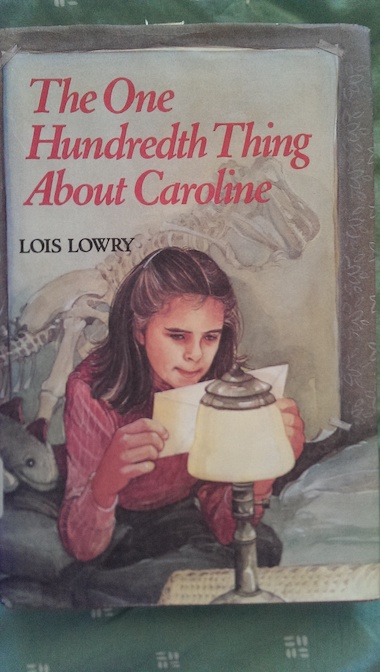
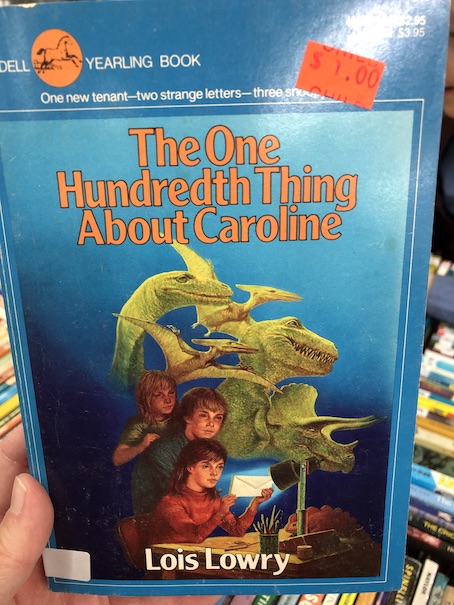
The One Hundredth Thing About Caroline by Lois Lowry, 1983.

Eleven-year-old Caroline Tate knows that she wants to be a paleontologist when she grows up, but she is also fascinated with her friend Stacy’s dream of becoming a great investigative reporter. For fun, the two girls begin investigating the people who live in their respective apartment buildings.

Caroline’s investigation focuses on the mysterious Frederick Fiske, who lives on the fifth floor of her building. In a wastebasket, she finds a letter written to him by a man she’s never heard of telling him to “eliminate the kids.” Also in the wastebasket, there is an overdue notice for Fiske from the library, and the book is about poisons. From this evidence, Caroline comes to believe that the strange Mr. Fiske is planning to murder some children.

The situation becomes worse when Mr. Fiske begins dating her divorced mother, and Caroline fears that the children Mr. Fiske is planning to murder are her and her brother, J.P.. Can Caroline, J.P., and Stacy prove that Mr. Fiske is a cold-blooded murderer before his relationship with the Caroline’s mother can go any further and before he succeeds in poisoning them?

The book is available to borrow and read for free online through Internet Archive.
My Reaction and Spoilers:

It’s a bit of a spoiler, but this is one of those stories where the mystery is largely based on a series of misunderstandings. The book is a comedy mystery.  Mr. Fiske isn’t really a murderer, although he has done some things which make the children suspicious.  It’s a humorous story, and the kids’ antics as they try to further their investigation and collect “evidence” against Mr. Fiske are hilarious.  Along the way, the kids end up helping Mr. Fiske with a problem he’s been having, and the kids realize that they’ve made a mistake about him and his intentions.  Whether Mr. Fiske learns of their suspicions about him or not is left to the imagination, although something at the very end of the story may bring everything out into the open.

The title of the book comes from a joke between Caroline and her mother.  Caroline’s mother is always talking about the things she loves about Caroline, giving them different numbers.

Secret of the Tiger’s Eye

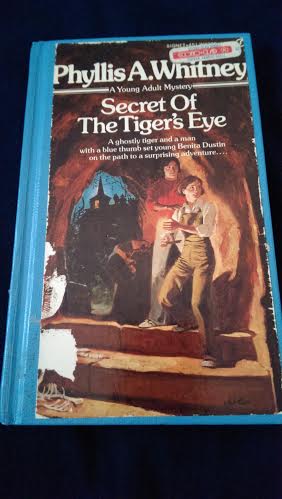
tigerseyeSecret of the Tiger’s Eye by Phyllis A. Whitney, 1961.

Benita Dustin’s father is a writer, just like she hopes to be one day. When her father announces that they will live for a year in South Africa with his Aunt Persis so that he can do research, it sounds like a grand adventure. The trouble is that her father’s editor has given permission for her son, Joel, to accompany them because she thinks the experience would be good for him, too. Benita’s little brother, Lanny, gets along well with Joel, but Benita and Joel fight and tease each other almost constantly. Benita gets annoyed with Joel’s obsession with facts and information, and Joel thinks that Benita’s stories and flights of fancy are silly.

Aunt Persis’s house is wonderful with a beautiful tower room where Benita is allowed to stay. There is even a fantastic story about the ghost of a tiger that Aunt Persis’s husband shot years ago in India haunting the grounds of the house and the little cave in the garden. Although Joel scoffs at the idea of a tiger ghost, Benita is captivated by the story, especially when strange things begin to happen around the house. Benita learns about the tragic death of Aunt Persis’s adopted son, Malcolm, and the strange theft of the emerald diadem that Aunt Persis received from the rajah that her husband saved from the tiger years ago. However, she will need Joel’s help to make sense of the situation, a difficult prospect at the best of times but almost impossible to ask for after Joel plays a cruel joke on Benita and tries to get Lanny to help gang up on her.  Then, Benita’s father tells her something that changes everything, and all the time, someone with sinister intentions is watching and waiting . . .

The book is available to borrow and read for free online through Internet Archive.
My Reaction

Besides the mystery, there is also a subplot about the nature of hate and prejudice. In South Africa, at the time the story was written, apartheid was still in force. Benita makes friends with a girl of mixed race called Charis, and they talk about racial issues in South Africa and the U.S. during the 1960s. Although Benita wouldn’t think of being prejudiced against anyone on the basis of race, she finds it harder to understand people with different personalities, like Joel.  Although the story focuses on Benita and the lessons she learns, I personally found Joel and his mistakes harder to accept.  Both Joel and Benita need to learn to be more understanding of each other, but in a way, I think Joel is worse because of his deliberately cruel pranks and because he already knows a couple of things that Benita doesn’t which should have influenced his behavior. Joel is deliberately trying to pick fights, and the book never really explains what he expected to accomplish by that.  Everyone needs a motivation, and Joel never really explains his, so he comes off seeming like he’s just there to be a mean character for no real reason.

I also wish that the parents in the story had more frank and straight-forward discussions with the kids.  As a professional writer and a professional editor, they should have been able to settle the kids’ arguments about imagination vs. facts or at least put the situation into perspective by explaining what they do in their jobs.  After all, Benita’s father is going to South Africa specifically to do research.  In other words, even fiction writers need to have a nonfiction background and real facts to use as a basis for their fictional stories.  Realistic backgrounds give stories the grounding they need in order to feel real to readers.  (Although that does depend somewhat on the type of story.  Fantasy stories don’t need to be based on real life, although they do have to have a consistent logic within the story so readers feel like they can understand the world in which the stories take place and the rules by which the magic in the story works.  If the story is meant to be surreal, the internal logic can be more loose.)  Editors, like Joel’s mother, fact check stories as well as ensuring that they are compelling for readers, helping to make decisions about where fictional stories need to be factually correct and where the author can depart from the facts for the sake of the story.  I think that Benita and Joel really should have had a better grasp of their parents’ professions and the balance between fact and imagination in fiction.  Of course, if they did, there would be less conflict in the story.

Fortunately, Benita and Joel work out their differences while confronting the mysterious situation and become friends when they learn to allow each other to be themselves and to appreciate each other’s good points.

Jumble Joan

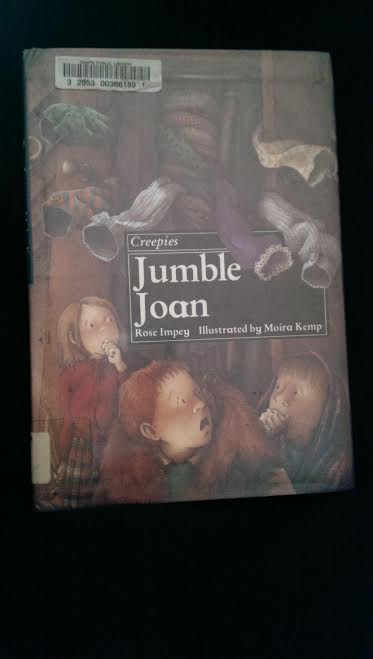
jumblejoanJumble Joan by Rose Impey, 1989.

A boy and his friend, Mick, take his little sister upstairs to explore their grandmother’s attic one evening.  The boys are hoping to scare the girl by telling her all sorts of creepy stories about the stuff they find in the attic, but if they’re scaring anyone, it might just be themselves.

A rocking horse becomes one of the dreaded “Ten O’Clock Horses” that might drag a child off into the night if she isn’t in bed on time.  An old stuffed parrot in a cage becomes “The Deadly Vampire Bat”, waiting to suck their blood.  But, the most sinister creature of all might be “Jumble Joan”, who hides by pretending to be a pile of old clothes, ready to steal away any little girls who might want to play dress up in their grandmother’s attic!

Although the brother narrates the story, the pictures show that his little sister knows exactly what the boys are trying to do, and she does things to turn the situation around.

This is one of the books in the Creepies Series.  Kids under the age of seven might find stories in this series a little scary because they focus on how stories about monsters can build in the imagination, even if you know that you made them up yourself.  Still, all of the books have good endings, and this one is pretty funny.

This book is available to borrow and read for free online through Internet Archive.