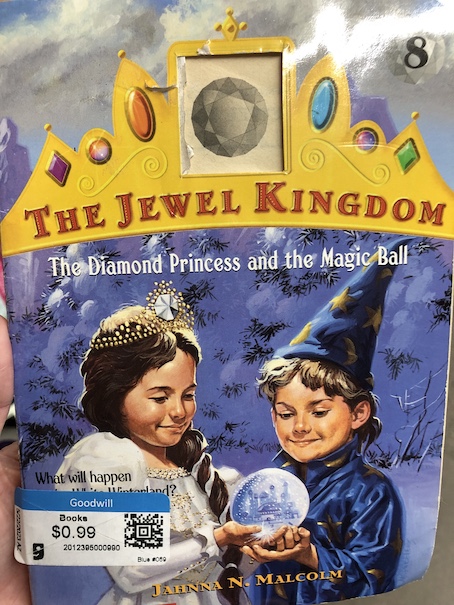
#8 The Diamond Princess and the Magic Ball by Jahnna N. Malcolm, 1998.
Demetra is the Diamond Princess, and she lives in the White Winterland. She and each of her sisters has a different castle and region to rule over in their parents’ kingdom, but they still spend time together. After a visit with her parents, Queen Jemma and King Regal, at the Jewel Palace, Demetra finds herself worrying about how she measures up to her sisters. It seems like each of them has done something special for the people in their region, but Demetra can’t think of anything special she’s done. She talks about it with her friend, Finley the fox, but she can’t think of anything really special to do.
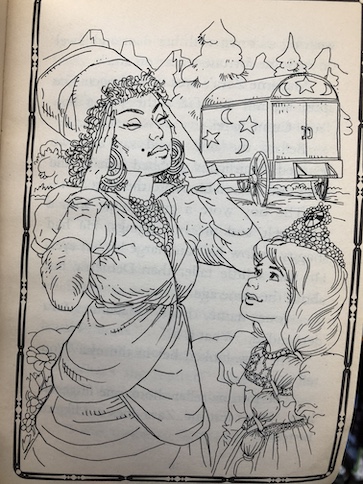
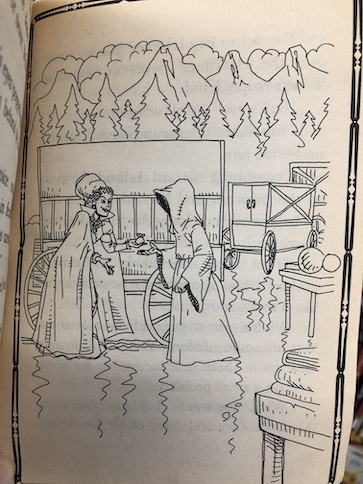
On the way home, they see a wagon with performers giving a show. Princess Demetra wants to stop and watch the show, but Finley warns her that it could be dangerous because they’re near the Mysterious Forest, which is a dangerous region. Demetra insists on stopping anyway, and she meets a fortune teller called Madame Zara. Madame Zara says that she can see that Demetra is a princess, and a boy from the audience says that’s not much for a fortune teller to see because Demetra is obviously wearing her crown.
Madame Zara says that she knows who the boy is, too. His name is Wink, and Madame Zara says that he’s a failed student wizard, rejected by the Wizard Gallivant. Demetra also knows Gallivant because he appointed her as the Diamond Princess. Madame Zara could have figured out Wink’s identity because his wizard robe is peeking out from his pack and has his name on it, but the part that’s harder to figure out is how she knew that the frog hidden in Wink’s shirt is actually his dog. Wink accidentally turned his dog into a frog.
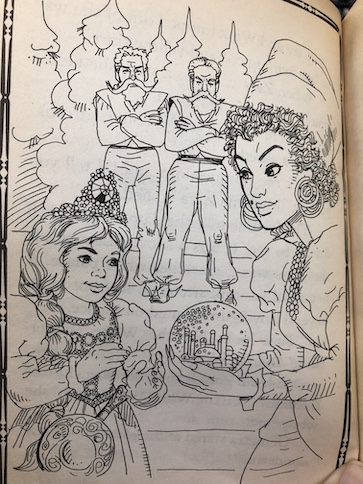
Demetra decides that’s good enough proof that Madame Zara knows things other people don’t, so she asks her to tell her fortune. Madame Zara shows her a beautiful snow globe that looks like it has a scene of the White Winterland inside. Demetra can even hear the voices of people she knows inside it. Madame Zara says that the magic ball tells the future and asks Demetra if she would like to have it. Demetra says she would, although Wink tries to warn her not to trust Madame Zara. However, Demetra lets Madame Zara take a lock of her hair in trade for the magic ball.
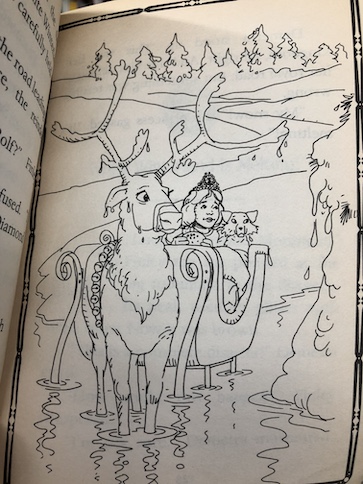
As Demetra continues on her way home, she begins to see that the snow that always covers the White Winterland is melting! Something is terribly wrong, and it may have something to do with the magic ball!
The book is available to borrow and read for free online through Internet Archive.
My Reaction
I never actually read any of the Jewel Kingdom books when I was young, but I remember them being sold in stores along with little jeweled charms. It doesn’t take too long to get into the lore and backstory of the series, even though I’ve read the few books I’ve read out of order.
There are recurring villains in this series, especially Lord Bleak and his minions, called Darklings. When the Darklings appears in this story, the book explains who they are and about Lord Bleak’s backstory. Lord Bleak was an evil tyrant who used to rule the Jewel Kingdom, until he was vanquished by Queen Jemma and King Regal. Since then, he’s been trying a series of evil schemes to regain control. The Darklings used to be beautiful, but they were corrupted by evil, and now they’re hideous creatures in dark robes.
Because this story is meant for young children, Demetra makes the mistake of entering into a suspicious trade with a shady character, apparently not having had the “stranger danger” warnings and not heeding her friends’ concerns. Of course, it turns out that the lock of hair she traded for the magic ball was important because it gives the person who holds it power over her and her kingdom. To save her kingdom, she has to get her lock of hair back.
I enjoyed the story, though. It has a colorful setting, and I liked their trip to the Bizarre Bazaar.
#21 The Deserted Library Mystery by Gertrude Chandler Warner, 1991.
Mr. Alden tells his grandchildren that a friend of his in a nearby small town, Pete, is concerned about their local library. The town is really too small to support a library, and when the last librarian left, they weren’t able to replace her. The library has fallen into disrepair and is in danger of being torn down. However, the building is old and has historical significance. It might be preserved as a historical landmark, but it needs some cleaning and organizing. Mr. Alden asks his grandchildren if they would be interested in the project, and they say they would. Pete spends part of the year living at his restaurant in town, so the Aldens can use his house while they’re working on the library project.
When they get to Pete’s house, they have to do a cleaning job there because Pete hasn’t been there in a while, and the place seems a bit spooky to them. The library seems a little spooky to them, too, when they begin looking around, but they soon begin finding some significant treasures. The children find a sword hilt from the Civil War along with a letter about the sword being awarded to a soldier by General Lee, but for some reason, the blade of the sword is missing! They children know that, if they can find the sword blade, it would be of great historical significance.
Then, strange things start happening in the library. Food that they bring for lunch disappears, and the kids start feeling like they aren’t along in the building. They search the library and find a 10-year-old boy named Miguel Morales. Miguel explains that his mother is dead and that he heard his father’s fishing boat sank. If his father is dead, he has nowhere to go and is afraid of being put in an orphanage or children’s home. The Boxcar Children sympathize with Miguel because they were once in a similar position, but they also tell Miguel that the situation might not be as bad as he thinks. They don’t know for certain whether Miguel’s father is dead or not. He can’t hide in the library forever, so they invite Miguel to stay with them and help with the library project while they check and see for certain what really happened to Miguel’s father. Henry contacts his grandfather to ask for his help and to see if he can learn anything about Miguel’s father. Mr. Alden agrees to help Miguel and is thrilled to hear about the Civil War sword.
Finding Miguel seems to clear up the mystery of who has been in the library, but the children soon begin to realize that there is a second intruder. The kids find a gray work glove in the library that doesn’t belong to any of them, and Jessie hears someone humming when no one is supposed to be there. Then, someone tries to trap them in Pete’s house by putting a big branch in front of the door, and when they get out and return to the library, they find the place trashed! Someone has thrown all the books around and torn them and turned the furniture over. Later, someone sneaks into Pete’s house at night, while the children are there but asleep, to search the place. Henry is pretty sure that the mysterious intruder is searching for the Civil War sword, the most valuable thing they’ve found so far.
My Reaction
I like the location and set-up of the story. An abandoned library makes a nice, spooky place to have mysterious things happening and people lurking around. Although this book was written by a ghost writer after Gertrude Chandler Warner’s death, it has a lot of the flavor of the original books in the series – opportunities for the Alden children to show off their self-sufficiency and community-oriented volunteer work, another child who is on his own and needs some help, and a mystery that is more adventure in some ways than mystery.
I liked the idea that the kids think they’ve solved the mystery of who’s been lurking around the library when they find Miguel, only to realize that there’s someone else snooping around. It was a little disappointing that we seem to know what the mysterious lurker is looking immediately for because there’s only valuable item associated with the library, and there’s no twist to it. We also don’t really get to to know the culprit as a character outside of his lurking. This isn’t the case that there are multiple people to suspect. By the time we learn the culprit’s identity, we already know him as the culprit. I would have preferred more mystery with a choice of known suspects, but something that does complicate the mystery is also that the antique sword is broken, so the kids have to find the other part of it.
The side plot with the question of whether or not Miguel’s father is alive adds some suspense. Although the Boxcar Children are optimistic that Miguel’s father survived his boat sinking, and Mr. Alden says that he will take care of Miguel, Miguel privately thinks to himself that, if it turns out that his father isn’t among the survivors, he will run away again. Readers are left in suspense because we are told that there were survivors from the boat, but we aren’t told whether Miguel’s father is one of them until the end.
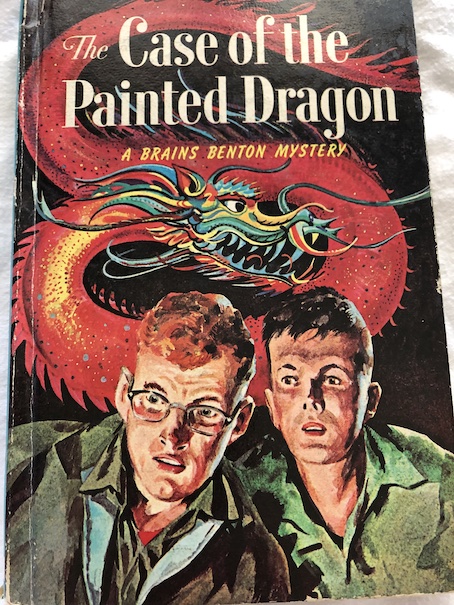
The Case of the Painted Dragon by by George Wyatt (Charles Spain Verral), 1961.
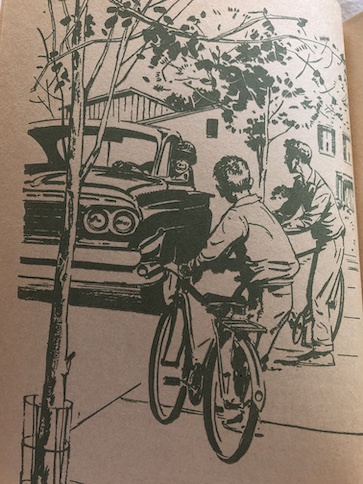
Jimmy and Brains are on their way to school when a strange man in a car stops and asks them if they know where he can find a Japanese kid. (He uses the derogatory terms “Jap” and “Nip”, and Brains disapproves. Also, the man is very unspecific about which kid he’s looking for. He offers no names, just that he’s looking for a Japanese boy about their age The town where the boys live is a fairly small college town, so I guess it’s supposed to be reasonable that there would only be one boy matching that description. I grew up in a larger university town, so the idea of there being only one person who could match any description and just expecting random people to know who it is seems really odd to me.) Brains just says that they don’t know anybody with Japanese ancestry, and the man drives away.
After the man leaves, the boy talk about how suspicious he was. They really don’t know who he could be looking for. The last Japanese family to live in their town was the Yamadas, but Mrs. and Mrs. Yamada were killed in a car accident the year before. (It was a point in the book’s favor that Brains doesn’t like derogatory racial terms, but the point is lost quickly when Jimmy is describing Mr. Yamada, who taught art at the boys’ school, and he says that Mr. Yamada “wasn’t one of those ‘inscrutable orientals’ you’re always reading about.” He says that Mr. Yamada was friendly and also coached the school’s swimming team. It’s nice that Jimmy liked Mr. Yamada, but the way he says it sounds a little back-handed. I suppose it’s a sign of the times when this book was written that the author thought it was reasonable for people, even kids, to “always” be reading about “inscrutable orientals”, but on the other hand, I’ve read other books from this time period and earlier that weren’t like that, so I’m inclined to think that it’s not really “always” and everyone.) However, the boys don’t remember the Yamadas having a son their age, so they doubt there’s a connection. They’re concerned because they think that the suspicious stranger might have bad intentions toward the kid he’s looking for.
After the boys get to school, Jimmy sees that stranger driving by the school, and he gets worried. Either the stranger is still looking for the Japanese boy, or he’s looking for Brains and Jimmy. Brains thinks that the best thing to do is try to find the Japanese boy before the man does. However, Brains doesn’t want to tell their principal or teacher about the stranger or the boy. Jimmy worries that maybe the stranger made up the Japanese boy as an excuse to get to him and Brain, and he decides to tell the principal about the stranger in the car, and the principal goes outside and demands that the stranger tell him who he is and what he’s doing, hanging around the school and scaring the students. Unfortunately, he confronts the wrong person in the wrong car, which is an embarrassing situation. (He did the right thing even if he confronted the wrong person. I give him credit for that, but they need to have a reason why the school authorities don’t do anything about the weirdo scouting the students.)
In the boys’ next class, they meet a new student, Mikko, who may be the Japanese boy that the stranger was looking for. The boys make friends with Mikko, inviting him to come to baseball practice with them. They want to warn him about the stranger, but before they talk to him about thr man who seems to be looking for him, they spot the car following them again. Mikko spots the car, too, and the boys ask him if he knows the driver. Mikko says, no, the man is a stranger. Aside from the people at school, the only people Mikko knows in town are Mr. and Mrs. Bevans, the people he’s staying with. Brains makes up a story about why the man might be following them because he doesn’t want to alarm Mikko too much and also because he doesn’t want anybody calling the police until he and Jimmy have had a chance to investigate the situation themselves. (This is a selfish move – Brains just wants a case to investigate, and he doesn’t want to share the case with the proper authorities. But, again, the story needs to provide a reason for Brains and Jimmy to handle the investigation without adult help.)
Jimmy’s mother knows about Mikko’s background and tells him about it when he gets home. It turns out that Mikko is the Yamadas’ son, but until recently, he had been living with relatives in Japan. Mr. Yamada was born in the US, but he worked in Army Intelligence during WWII, which is when he went to Japan and met his wife. Mikko had been born in Japan and was going to school there, but the Yamadas planned to move to the US permanently. Mr. and Mrs. Yamada had come first to get established, but they died in the car accident before they could bring Mikko to join them in the US. However, Mr. Yamada had wanted his son to become an American citizen, like him, and get an American education. The Yamadas had boarded with Mr. and Mrs. Bevans and became friends with them. The Bevanses’ have no children of their own, and they are considering adopting Mikko and giving him the American life that his father wanted him to have.
There is one adult who knows about the mysterious car following Mikko: Yama, an old family servant who accompanied Mikko from Japan to the US to make sure that he gets settled in his new home. Yama is a former sumo wrestler and a formidable man, and when Mikko tells him about the mysterious stranger in the black car, Yama says that he will protect him. However, when the Bevanses’ house is ransacked while the boys are playing baseball and they return and find Yama looking around Mikko’s room, they boys start to suspect that Yama may be involved with the mysterious stranger in some way. At least, he seems to know more than he wants to say about the situation because he refuses to call the police to report the ransacking.
After some further research, Brains and Jimmy learn that the Yamadas’ car accident might not have entirely been an accident, and Brains suspects that everything that has happened may relate somehow to Mr. Yamada’s former work in Army Intelligence.
My Reaction
This is the last book in the Brain Benton series, but it’s also more of a mystery than the previous books. In most of the books, it doesn’t take the boys long to realize who the villains are, and the mystery is more about how they’re going to prove it and stop the bad guys. However, in this book, Brains and Jimmy really do start off completely in the dark. First, they have to learn who the Japanese boy is that the strange man is looking for, and then, they have to learn the history of Mikko and his family. Brains and Jimmy do genuine investigative work, starting with old newspaper stories about the accident that killed Mikko’s parents. Little by little, they begin to reconstruct the past and learn why someone is looking for Mikko and what Mikko has that they want. Even when the boys know who the bad guys are and what they’re after, there is still the puzzle of where Mikko’s father hid it before he died.
I enjoyed the mystery in the book, but I didn’t like some of the ways Jimmy talked about Japanese people. I think it was good that he noted that derogatory terms are inappropriate, and I appreciated that he liked Mikko pretty quickly and pointed out good things about him. Those are good points. It’s just that, sometimes, even when Jimmy speaks favorable about some of the Japanese people in the story, it comes off sounding a little back-handed, like when he says that Mr. Yamada was actually a really nice and friendly guy and not “inscrutable” like characters Jimmy has heard about. I can see that it’s a positive point that someone who has been given a negative impression about certain types of people can consciously notice that the reality is both different and better than what he’s heard before. I think Jimmy is moving in a good direction in his attitudes. It’s just that compliments sound flat when they’re accompanied by a negative or implied negative. It’s like the difference between saying “He’s a really nice guy” vs. “He’s a really nice guy for being the kind of person I’ve always heard was really sinister.” It just adds an uncomfortable twist on the sentiment. I know that the reason Jimmy talks like this is because this book was written during the 1960s, when racial attitudes were changing, and the author probably felt like it was necessary to acknowledge old stereotypes, but I still don’t like it.
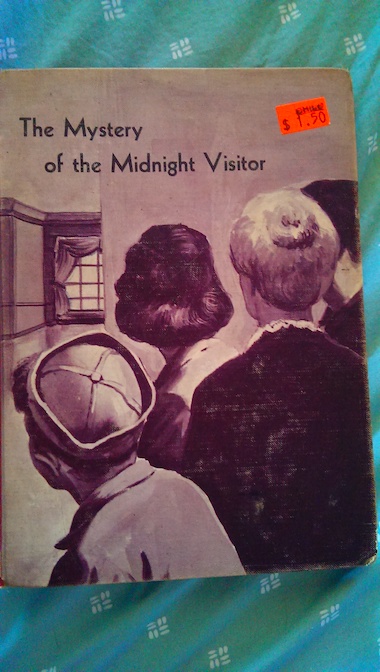
The Mystery of the Midnight Visitor by John and Nancy Rambeau, 1962.
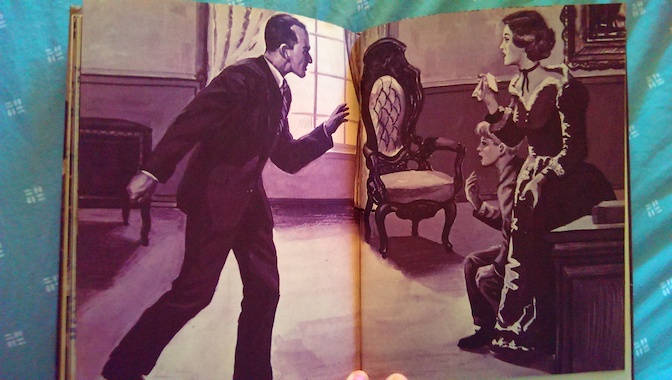
One day, Gabby is going fishing on the beach at Morgan’s Landing. Miss Wellington, a family friend, owns the property along with the old mansion known locally as Morgan Castle. She has given permission to Gabby to fish there, but Gabby is surprised to meet a stranger on the beach as well. This stranger is an old man who says that his name is Admiral Lavendar. When Gabby tells him that he’s on private property, the old man moves on. Then, Gabby spots smoke coming from Morgan Castle!
When Gabby goes to investigate, he finds that someone has shut Miss Wellington in a closet and that there is a fire in the bedroom that had once belonged to Mrs. Morgan, the former lady of the house. He gets Miss Wellington out of the closet, and they call the fire department. The firemen put out the fire and tell Miss Wellington that it was apparently caused by a dropped candle.
Morgan Castle was once owned by the wealthy Morgan family that gave Morgan Bay its name. However, the house has become shabby over the years. Miss Wellington inherited the house after Mrs. Morgan died because there were no other Morgans left. However, she doesn’t actually live in Morgan Castle because she has a house of her own. People have been saying that perhaps the house should be torn down because of its poor condition. Miss Wellington doesn’t have much money and says that she would find it difficult to manage the upkeep of the house.
Gabby and his brother Bill and sister Vinny don’t want to see the old beautiful old mansion destroyed, and there is still the mystery of who dropped the candle and why to consider. A small silver box that Gabby found on the beach turns out to be a jewelry box that once belonged to Mrs. Morgan. Mrs. Morgan wasn’t particularly interested in jewelry, but she did own one particularly fine emerald necklace that was never found after her death. Perhaps the person who dropped the candle was looking for it!
To give Morgan Castle a new purpose and prevent it from being torn down, the kids convince Miss Wellington to let them turn it into a Historical, Boat, and Tennis Club, dedicate to celebrating local history and providing entertainment for local people.
At first, the mysterious Admiral Lavendar looks like a likely suspect for the person sneaking around Morgan Castle, but he turns out to be very helpful to the children and their plans. There is another stranger in town who has the knowledge to seek out Mrs. Morgan’s lost necklace.
This book is part of a series that were once used as classroom readers.
Lucille Pierce has been feeling lonely because her other friends joined a club with some other girls that meets over the weekend, and Lucille hasn’t been invited to join. The only people who are available to hang out with now are her brother Brent and his friend Kevin, and they don’t always want a girl hanging out with them.
When Brent and Kevin have an argument because Kevin laughed at Brent’s horrible spelling during a spelling bee (Brent is horrible at spelling because he never stops to think about what he’s doing, and he gets into fights fast because he also has a quick temper), Kevin invites Lucille to join him as he goes out to have a look at the old house on Moody Island before the new owners take over. The old farmhouse stands on an island in the marsh. Sometimes, people hear odd sounds coming from the house, and some people believe that it’s haunted by the ghost of John Moody, who was lost at sea years ago. Old Mrs. Moody, John’s widow, was a hermit in her final years, and now, the only living member of the Moody family is Clyde Moody, John’s nephew. Everyone had expected that Clyde would inherit the old Moody house, but instead, Mrs. Moody left it to a man named Arnold Lindsay, an apparent stranger. Miss Rand, who owns the diner not far from the Moody house thinks that Mrs. Moody should have left it to Clyde. Clyde has had problems with alcohol and hasn’t been able to hold any job for very long, and Miss Rand thinks that having the house to care for might have been good for him, providing him with some stability. No one even has a clue who Arnold Lindsay is.
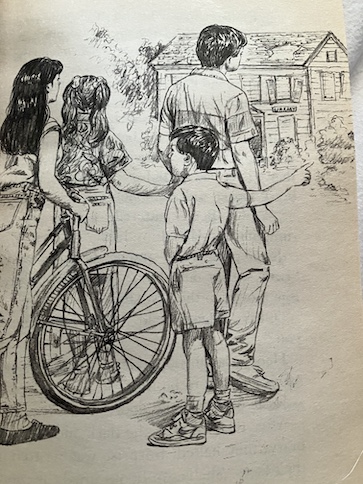
Lucille and Brent take a bike ride out to the island, but a noise in the barn frightens them away. It isn’t that they really think there’s a ghost, but they’re concerned that someone may be trespassing on the property. They decide to keep an eye on the house to see if they can see anyone sneaking around, but they don’t.
A short time later, Lucille, Brent, and Kevin meet Arnold Lindsay, who turns out to be a nice man. Like the children, he becomes concerned about the condition of Pedro, the donkey that the Turner family owns and leaves neglected in one of their fields. To give the donkey a better life, Mr. Lindsay buys Pedro, telling the kids that they can come out to the Moody house and visit him.
Mr. Lindsay doesn’t have any idea why Mrs. Moody left him the house, either. He’s a writer, but not a famous one. He just writes newspaper columns. All he or the children can think of is that Mrs. Moody must have been a fan of his columns. She didn’t get out, but she did read newspapers.
Mr. Linsday has also heard strange noises around the Moody house, and he asks the children what they know about it. They tell him the ghost stories about the Moody place, but they say that they don’t really believe that there’s a ghost. Mr. Lindsay is fascinated by the stories. He says that his impression was that the noises he heard came from the cellar, but he didn’t see anything when he investigated. He invites the children to help him investigate further sometime.
Meanwhile, Lucille tries to make friends with a new girl at school, Barbara Rosen. At first, Barbara doesn’t want to be friends because she thinks that Lucille is part of the Saturday Club with the other stuck-up girls, but she becomes friendlier when Lucille tells her that she’s not with them. Barbara had worried that the snobby girls didn’t like her because they thought something was wrong with her, but she really likes Lucille and thought for sure that she would have been asked to join the club, too, having been involved in a lot of other activities at school. Both girls find it reassuring that the fact that they weren’t asked to join the club doesn’t mean that that there’s anything wrong with them, but maybe with the girls running the club and their priorities in choosing friends. Having each other for friends makes them both feel less lonely, so they can stop worrying about the club and its members so much.
Barbara’s father owns a clothing store in town, and she says that some of his customers have been saying bad things about Mr. Lindsay. Some of them have even said that he might be a spy. Lucille thinks that’s ridiculous and that they’re only saying things because they wanted to buy the property or see it go to Clyde. Lucille has to admit that she doesn’t know much about Mr. Lindsay, so she can’t swear that the rumors aren’t true, but she still thinks that he’s probably just a nice guy, and she wants to see him keep the house so that Pedro will have a safe place to live.
With Clyde Moody and others sneaking around the property, seeming to look for something, and Clyde’s new accusations that Mrs. Moody was never legally married to his uncle and therefore had no right to will the property to anyone, Lucille, her brother, and their friends try to help prove that Mrs. Moody was really Mrs. Moody and that the house does rightfully belong to Mr. Lindsay.
Part of the theme of this story is about loyalty. Lucille feels hurt that the girls she had previously thought were her friends abandoned her to join the Saturday Club. She thinks that people who are real friends should stand by each other, no matter what other friends come into their lives. However, looking back on her friendship with these other girls, she comes to realize that she was mostly friends with them because they were the girls who lived nearby, and neither of them really had other options. In the end, they didn’t really have much in common, and she realizes that she doesn’t think very highly of them, so she is as free to move on and make new friends as they are.
Similarly, that is how some of the people in town feel about Clyde Moody. It isn’t so much that they like him as he’s always been there. He’s familiar to them, and it would have made sense for Mrs. Moody to will the Moody house to him. It doesn’t make sense to them that she would leave her house to someone she’s never met, so they get upset about it and assume that there must be something wrong with the situation or with Mr. Lindsay himself. However, nothing is wrong with Mr. Lindsay, and Clyde isn’t really worth their loyalty. He’s a known troublemaker who associates with other troublemakers, like the Turners. Mr. Lindsay really is a better person.
In part of the story, the children catch Miss Rand sneaking around the property. At first, they think that she was there to help Clyde or get Mr. Lindsay in trouble, but she tells Mr. Lindsay that she was actually there for very different reasons. There was something on the property that she wanted to protect. She wasn’t sure that she could trust Mr. Lindsay, and she knew that she couldn’t trust Clyde, so she was taking it on herself to look after it.
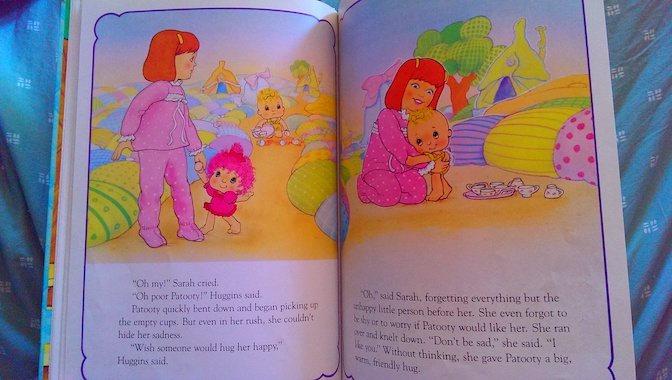
A Hug for a New Friend by Janet Anderson, illustrated by Ron C. Lipking, 1985.
Sarah is worried because her usual babysitter, Kim, is sick, and her mother says that she will have to have a new one until Kim is better. Her temporary new babysitter is named Laura, and Sarah will meet her the next morning. Sarah really likes Kim, and she worries that her new babysitter will be mean or not like her.
When Sarah wakes up the next morning, before she goes to meet Laura, she sees an odd little person in her bedroom mirror. This odd little person is Tickles, one of the Hugga Bunch. She says that she likes making new friends, but Sarah isn’t sure that she feels the same way.
Tickles says that she came to see Sarah because she saw her looking sad and invites her to come to Huggaland with her to meet the other Hugga Bunch. Sarah worries at first about what the other Hugga Bunch will be like and whether they’ll like her, but she is amazed at what she sees. Huggaland is soft and colorful, and everyone is very friendly.
She asks Tickles how they can all like her when they don’t know her, and they explain that being friendly to other people encourages them to be friendly in return. That’s really how friends are made. When Sarah comforts one of the Hugga Bunch after she drops a tray of lemonade, she sees what they mean. Her kind gesture has earned her a new friend.
When Sarah returns home and goes to meet her new babysitter, she discovers that Laura is actually rather sweet and shy, not mean, as Sarah feared. Sarah greets Laura with a friendly hug, and the two of them become friends.
The Hugga Bunch’s advice to immediately start a new friendship with a hug may be somewhat awkward in real life, but the idea that kindness and friendly gestures inspire others to respond with kindness and friendship is a good one.
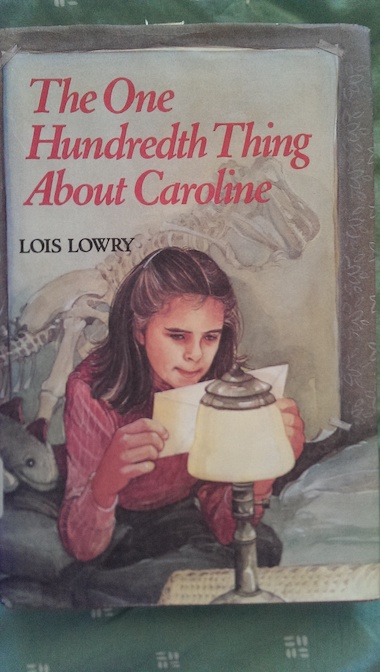
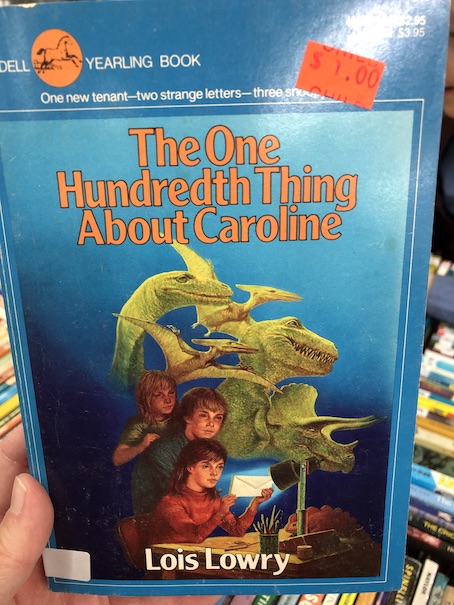
The One Hundredth Thing About Caroline by Lois Lowry, 1983.
Eleven-year-old Caroline Tate knows that she wants to be a paleontologist when she grows up, but she is also fascinated with her friend Stacy’s dream of becoming a great investigative reporter. For fun, the two girls begin investigating the people who live in their respective apartment buildings.
Caroline’s investigation focuses on the mysterious Frederick Fiske, who lives on the fifth floor of her building. In a wastebasket, she finds a letter written to him by a man she’s never heard of telling him to “eliminate the kids.” Also in the wastebasket, there is an overdue notice for Fiske from the library, and the book is about poisons. From this evidence, Caroline comes to believe that the strange Mr. Fiske is planning to murder some children.
The situation becomes worse when Mr. Fiske begins dating her divorced mother, and Caroline fears that the children Mr. Fiske is planning to murder are her and her brother, J.P.. Can Caroline, J.P., and Stacy prove that Mr. Fiske is a cold-blooded murderer before his relationship with the Caroline’s mother can go any further and before he succeeds in poisoning them?
The book is available to borrow and read for free online through Internet Archive.
My Reaction and Spoilers:
It’s a bit of a spoiler, but this is one of those stories where the mystery is largely based on a series of misunderstandings. The book is a comedy mystery. Mr. Fiske isn’t really a murderer, although he has done some things which make the children suspicious. It’s a humorous story, and the kids’ antics as they try to further their investigation and collect “evidence” against Mr. Fiske are hilarious. Along the way, the kids end up helping Mr. Fiske with a problem he’s been having, and the kids realize that they’ve made a mistake about him and his intentions. Whether Mr. Fiske learns of their suspicions about him or not is left to the imagination, although something at the very end of the story may bring everything out into the open.
The title of the book comes from a joke between Caroline and her mother. Caroline’s mother is always talking about the things she loves about Caroline, giving them different numbers.
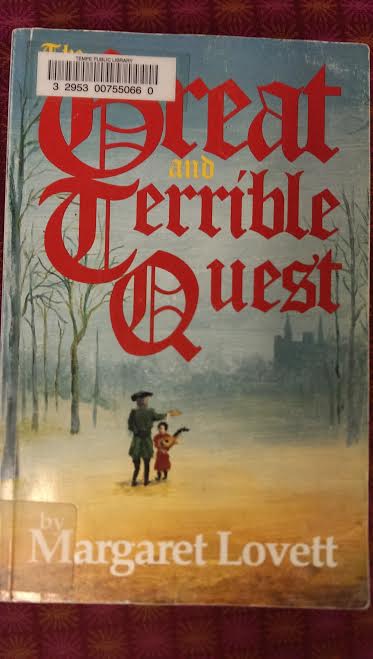
The Great and Terrible Quest by Margaret Lovett, 1970.
This story takes place in a fictional kingdom during the Middle Ages. Trad is a ten-year-old boy who has lived most of his life with his abusive grandfather. He barely remembers his parents, who died in a plague when he was only four. This grandfather consorts with robbers and evil men. Trad often pretends to be stupid to avoid their notice and warns travelers away from their territory.
One day, he rescues a man who has been badly wounded and cares for him in a secret cave. This man, whose white hair makes him seem elderly, insists that he is on a mission, a great and terrible quest . . . but because of a head wound, he can’t remember what his quest is. All that he knows is that time is short, and he does not have long to complete his quest to find something very important.
Trad soon learns that his grandfather’s wicked friends are the ones who attacked this mysterious stranger. Taking Trad’s father’s old lute, a couple of coins, and a mysterious ring dropped by one of the robbers which seems to have once belonged to the stranger, Trad and the stranger embark on a journey across the land, making friends and pursued by enemies as they go. While the stranger struggles to remember his identity and the nature of his mission, Trad begins to learn a few things about his own forgotten past and the nature of his family. Nothing is what it seems. Their country is in trouble because of the evil men who have been controlling it. Everything depends on the success of the stranger’s mission, and Trad has a much larger role to play than he had ever dreamed.
It’s a beautiful and fascinating story about good and evil, loyalty, friendship, and determination to do the right thing, even against the odds. There are parts that might frighten younger readers. The fights are violent and bloody, and there are a couple instances of cruelty to animals (partly, it seems, to show how truly evil Trad’s enemies are). Still, it’s a great story for tweens and teens, and readers will want to cheer Trad on as he struggles to help those around him and find his own destiny.
Although the kingdom is fictional and the themes are similar to fantasy stories, there is no actual magic in the story.
The book is currently available online through Internet Archive.
The Mystery on October Road by Alison Cragin Herzig and Jane Lawrence Mali, 1991.
A strange man has moved next door to Casey. He always wears a bandana tied across the lower part of his face, like a bandit. His pets are the strangest dogs Casey has ever seen, huge Irish Wolfhounds. He’s started fixing up his new house, but for some reason, he only likes to work at night.
One day Casey and her friend Cats (really, they’re both named Catherine, but they each have nicknames) go to take the man some bread that Casey’s mother baked, and they’re frightened away by one of the dogs. Casey goes back to get the bread they left behind, and the man tells her to go away and leave him alone.
Casey and her friends (Cats and Benny, a boy Cats likes) are curious about this strange man. They even wonder if he could be some kind of gangster, hiding out. At her friends’ urging, they sneak into his house one day to look around. When the man comes back unexpectedly, her friends get away in time, but Casey falls and hurts her ankle. The man finds her in his house, and she learns the truth about him.
The man isn’t a bad guy, and Casey even becomes a friend for him. The story ends on Halloween, when the man creates a special Halloween display for Casey of beautifully carved pumpkins. The part that always fascinated me was the way he carved them, by peeling the skin off the pumpkin and only leaving it in places where he wanted dark lines.
Part of the story is about how appearances can be deceptive. The stranger is actually a good person, but he is physically disfigured, which is why he doesn’t like people to see him. For part of the story, Cats isn’t really a very good friend for Casey, neglecting her feelings and the feelings of the mysterious stranger in order to impress Benny. But later, when she realizes that Casey was right about the stranger and that she was really hurt in their little escapade, she shows that she can be a better friend, too.
The book is currently available online through Internet Archive.






 Mystery on Nine-Mile Marsh by Mary C. Jane, 1967.
 Lucille and Brent take a bike ride out to the island, but a noise in the barn frightens them away. It isn’t that they really think there’s a ghost, but they’re concerned that someone may be trespassing on the property. They decide to keep an eye on the house to see if they can see anyone sneaking around, but they don’t.
 Mr. Linsday has also heard strange noises around the Moody house, and he asks the children what they know about it. They tell him the ghost stories about the Moody place, but they say that they don’t really believe that there’s a ghost. Mr. Lindsay is fascinated by the stories. He says that his impression was that the noises he heard came from the cellar, but he didn’t see anything when he investigated. He invites the children to help him investigate further sometime.
 Barbara’s father owns a clothing store in town, and she says that some of his customers have been saying bad things about Mr. Lindsay. Some of them have even said that he might be a spy. Lucille thinks that’s ridiculous and that they’re only saying things because they wanted to buy the property or see it go to Clyde. Lucille has to admit that she doesn’t know much about Mr. Lindsay, so she can’t swear that the rumors aren’t true, but she still thinks that he’s probably just a nice guy, and she wants to see him keep the house so that Pedro will have a safe place to live.



 The Great and Terrible Quest by Margaret Lovett, 1970.
 The Mystery on October Road by Alison Cragin Herzig and Jane Lawrence Mali, 1991.
 Jestress's Forgotten Books and Stories