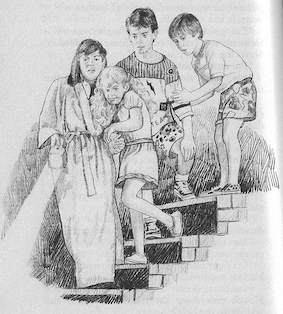
The Case of the Tricky Trickster

The Bobbsey Twins

Before I begin, I’d like to acknowledge Sean Hagins, for supplying me with photos of this book! Usually, I take pictures of books myself, but I just couldn’t find a physical copy of this one. Sean is a big fan of the Bobbsey Twins, particularly the New Bobbsey Twins mysteries, and you can see some of his video reviews as well as videos about his photography work on his YouTube channel, SJHFoto. Thanks, Sean!

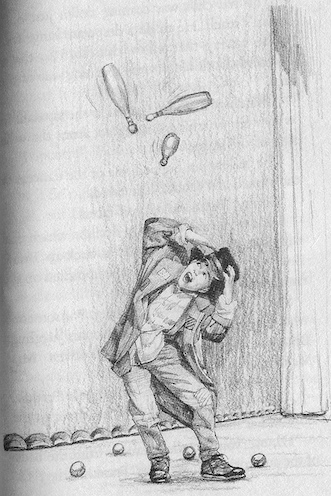
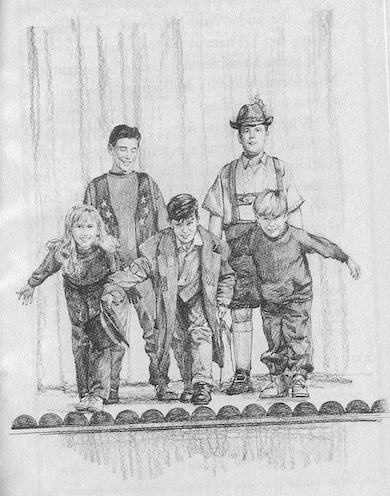
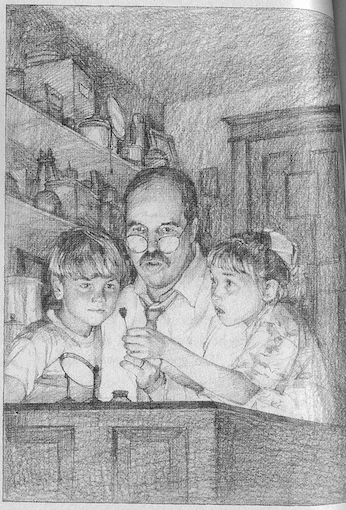
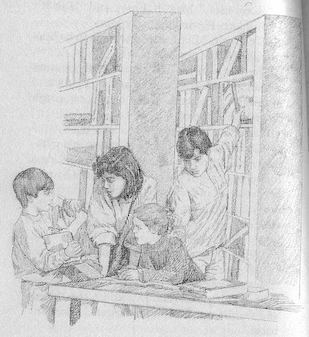
The PTAs at the schools the Bobbsey Twins attend, elementary and middle school, are holding a variety show to raise money, with students showing off their talents. A boy in Freddie and Flossie’s class, Brian, is going to put on a juggling act, but Freddie and Flossie are going to help another friend, Teddy, with his magic act. Nan and Bert have a rock band with some friends called the Aliens, and they’re going to be performing, too. Danny Rugg, the school bully, even has an act where he’s going to play the accordion.

However, things soon start going wrong with the show. During the rehearsal, someone turns on the Aliens’ amplifier, making a loud sound that startles everyone. Then, a pole falls and almost hits a student while she’s singing. Then, Brian slips on some floor wax. Freddie and Flossie suspect Danny of playing pranks on everyone because he was near the places where the pranks occurred, and it seems like the kind of thing he might do, but there are other suspects.

Some of the other students seem nervous about performing their acts or think that the show won’t really be that good. Could someone be trying to sabotage the show to get out of performing? Then again, there seems to be some kind of rivalry between the music teacher who is directing the show and Mr. Horton, the fifth grade teacher. Mr. Horton seems resentful that he wasn’t given the chance to direct the show, and he keeps trying to prove that the music teacher is doing things wrong and that he could do them better. Just how far would he go to prove that he would be the better director?

The book is available to borrow and read for free online through Internet Archive.

I thought that the mystery was good, although I also thought that the culprit was obvious about halfway through the story. It might take kids longer to figure out who it is, but there is one person who gets more than their share of the sabotage, and some of the tricks are ones that a person could only play on themselves. There is a student who is trying to get out of having to perform, but once the Bobbsey Twins figure out why, they manage to work things out so that the student is able to go ahead with their act.

The story reminded me a little of The Tap Dance Mystery in the Eagle-Eye Ernie series, although the mysteries aren’t the same. What reminds me of the other book is that both stories involve family expectations. Performing in front of classmates is enough to make anyone nervous, but having family with high expectations present puts a great deal of pressure on a child performer. There is a bit more than that because there are reasons why the student doesn’t think they can live up to everyone’s expectations, but fortunately, a little help from a friend can go a long way!

The Case of the Crazy Collections

The Bobbsey Twins

Before I begin, I’d like to acknowledge Sean Hagins, for supplying me with photos of this book! Usually, I take pictures of books myself, but I just couldn’t find a physical copy of this one. Sean is a big fan of the Bobbsey Twins, particularly the New Bobbsey Twins mysteries, and you can see some of his video reviews as well as videos about his photography work on his YouTube channel, SJHFoto. Thanks, Sean!

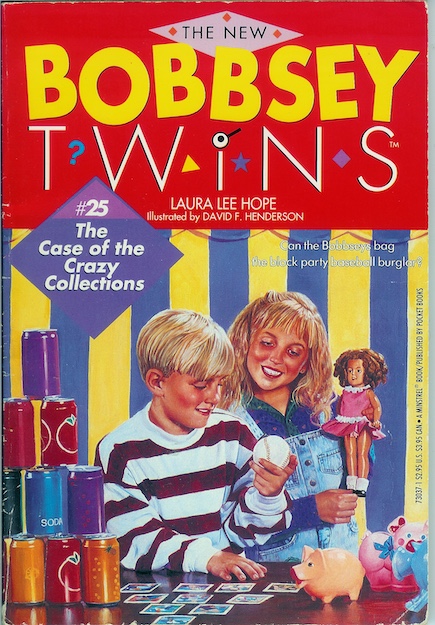
The Bobbsey twins’ neighborhood is having their annual block party, and the Bobbsey twins and their parents are helping to set up for it. As part of the party, the neighborhood has rented a tent, where kids from the neighborhood are displaying their collections. The neighborhood kids collect all kinds of things, like baseball cards, comic books, soda cans, autographs, and coins. One boy, Kevin, has an autographed baseball that his grandfather gave to him. The neighbors are charging people money to see the exhibit of collections, and the money will be used for a pizza party later.

Later, Kevin’s autographed baseball disappears. Could the baseball thief be Mr. Sher, a visitor staying with their neighbor, Mr. Andersen? Mr. Sher tried to buy the baseball from Kevin earlier, but Kevin turned him down. Then again, Kevin’s cousin, Steve, was jealous that Kevin has the baseball. Steve turned down the offer of some of his grandfather’s old collectible items in favor of a savings bond, which he has already cashed in and spend on video games. Steve tried to borrow more money from Kevin earlier, but Kevin turned him down because Steve hasn’t yet repaid him for money Kevin loaned to him before. Danny, the neighborhood bully, was also mad at Kevin earlier. He’s a friend of Steve’s and didn’t want to have to pay to see the collections. Then again, another local girl, Jennifer, collects autographs, and they see her at a collectors’ shop. Would she know the value of an autographed baseball, and was she trying to sell it? With so many people coming and going from the tent where the collections were on display, it’s hard to say who might have taken something. The thief may have even been the Bobbseys’ own dog, Chief, who has developed a habit of collecting and hoarding baseballs.

Then, another boy realizes that his prized hologram sticker is missing. Could the thief have taken that, too? Their clues are an unexplained slit in the back of the tent, some footprints, and a pin with Greek letters on it. Can the Bobbsey Twins find the valuable baseball and return it to Kevin?

The book is available to borrow and read for free online through Internet Archive.

Something I thought was interesting about this story was that it brings up the concept of collecting things for fun or sentimental value vs. collecting things because of their monetary value. Most of the kids in the neighborhood collect things just for fun. At first, Kevin doesn’t seem to fully realize the value of the autographed baseball. His attachment to the baseball is because he got it from his grandfather. When he had the offer to sell it to Mr. Sher, he refused because the baseball reminds him of his grandfather.

I had a strong suspicion about the identity of the baseball thief early in the story, and my guess turned out to be right, but I liked it that there were plenty of other suspects to consider. There are child suspects, adult suspects, and even the Bobbseys’ own dog. Any of these could be plausible. When they realize that the hologram sticker is missing, it raises the question of whether the person who took the baseball also took the sticker, if the sticker was taken by someone else, or if the missing sticker is just a red herring. Overall, I enjoyed the mystery, and I liked the abundance of suspects.

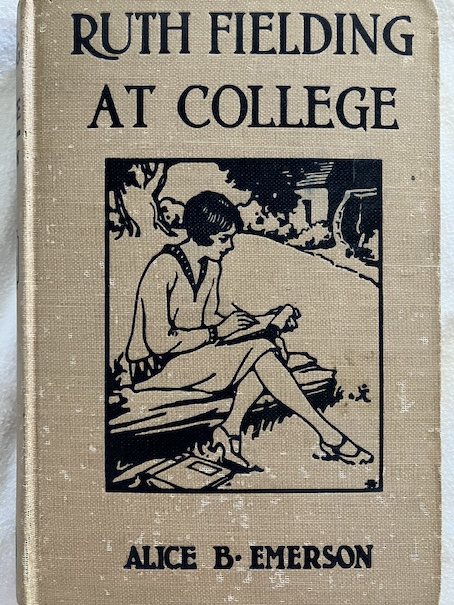
Ruth Fielding at College

Ruth Fielding

Ruth Fielding and her friends have graduated from their boarding schools, and now, they’re headed off to college! Ruth and her best friend, Helen, will be attending Ardmore, a college for young women only. Helen’s twin brother, Tom, will be going to Harvard. When they were at boarding school, they also attended girls’ only and boys’ only schools, but their schools were located near each other, and they were able to visit each other on weekends and attend joint social events held between the schools. Helen and Tom are close as twins, and Helen worries that she won’t be able to see her brother as often while they’re in college. Tom and Ruth are also fond of each other, and although they’re excited about college, they’re also a little sad at the idea of being apart.

While they’re having tea with Aunt Alvirah (the housekeeper), the hired hand working for Ruth’s Uncle Jabez, Ben, comes in and says that there is a boat adrift on the river that runs by the mill where they live. Everyone goes outside to have a look at the boat. At first, they think no one is in it, and Uncle Jabez says, if it’s abandoned, then he will go after it as salvage. Then, they see that someone is in it after all, just lying down in the bottom of the boat, but the boat is drifting toward the dangerous rapids below the mill! Whoever is in the boat seems incapacitated or unaware of their dangerous situation.

Uncle Jabez is less eager to go after the boat when he knows there’s somebody in it than he was when he thought he could get a free boat, but Ruth persuades him that they have to rescue whoever is in the boat. They manage to reach the boat, and they find an unconscious girl in it. They bring the girl back to the house with them, and Tom says that he will get a doctor. However, Aunt Alvirah doesn’t think that a doctor will be necessary because it looks like she has only fainted, and she thinks that the girl will be all right.

When the girl wakes up, she explains that her name is Maggie and that she was working at Mr. Bender’s camp for summer vacationers up the river. After the season ended, the vacationers left, and Mr. Bender paid her for her time at the camp, someone was supposed to give her a ride across the river with her luggage, but Maggie fell asleep while she was waiting in the boat. When she woke up, she was drifting down the river alone. She got scared, and she fainted. Ruth says, if her job is over, then she has no reason to return to Mr. Bender’s camp, and Maggie says that’s true and that she needs to find another job. Ruth says they can use their telephone to call Mr. Bender’s camp to explain the situation and reassure Mr. Bender that Maggie is all right.

Ruth likes Maggie, and she notices, from the way she talks, that she seems more refined than most poor working girls. Aunt Alvirah is getting older, and she often has trouble with her rheumatism. Ruth suggests to Uncle Jabez that they hire Maggie to help Aunt Alvirah at the mill this winter while Ruth is away at college. Uncle Jabez is still a miser and he grumps about Ruth spending his money. Ruth has money of her own now, and she is willing to pay Maggie’s wages, although she says that Uncle Jabez must make sure that Maggie has good food because she looks undernourished. Ruth and Uncle Jabez often butt heads over the issues of money and Ruth’s education because Uncle Jabez never had much education and is both proud of the money he has now and is tight-fisted with what he has. At this point, the story explains some of the history of the characters. Since Ruth retrieved a stolen necklace for the aunt of one of her school friends and received a reward for it (in Ruth Fielding and the Gypsies), Ruth has had enough money to be financially independent of her uncle and to fund her education. She is also correct about Aunt Alvirah’s age and health, and she is concerned for the older woman’s future.

Aunt Alvirah welcomes the idea of help at the mill, and Maggie accepts the position. Ruth notices that Maggie studies an Ardmore yearbook, and she is surprised that Maggie is interested in the school. She has the feeling that there is more to Maggie’s past than she knows.

When Ruth and Helen go to Ardmore, some of the girls have already heard about Ruth’s reputation as a writer of movie scenarios from the movie that Ruth wrote and her classmates helped make to raise funds to replace a dormitory that burned at their school. Some of them are prepared to despise Ruth as being stuck up about her writing, although some who saw the moving picture liked it.

A girl named Edith thinks that they’ll have to “take her down a peg or two” as soon as she arrives. One of the other girls, Dora, reminds the others about the rules against hazing at the school. The rules have been strictly enforced since a hazing incident went too far last year and traumatized a student, Margaret Rolff, who was trying to join the Kappa Alpha sorority. Since that incident, the college has forbidden sororities to initiate freshmen or sophomore students as members and cracked down on hazing rituals. Edith, a sophomore, thinks that’s a shame because the sororities are fun, while May sarcastically remarks about how fun “half-murdering innocents” is. The students aren’t really supposed to talk about what happened to Margaret, although the sophomores don’t see why not because everybody who was at the school when it happened knows about the incident.

Margaret’s nerves were apparently shattered by the incident, and a valuable silver vase, an ancient Egyptian artifact, disappeared from the college library the same night. It isn’t entirely clear what the Kappa Alpha sorority told Margaret to do, specifically, but it seems that Margaret’s initiation task involved both taking the vase from the library and going to nearby Bliss Island alone at night. She was found there the next day in a terrible state. Nobody is sure what happened to the vase, and Margaret was apparently unable to explain it. She left the school soon after, and nobody knows where she is now. The vase might have been stolen by somebody else that night, or it might have somehow been lost in the confusion of the initiation stunt that went wrong. Because the Kappa Alpha sorority was responsible for telling Margaret to commit a theft from the school (or, at least, borrow a rare and valuable object without permission), they are raising money to replace the vase. The students’ opinions about the incident waver back and forth between thinking that Margaret was a naturally nervous and delicate person to be so dramatically affected by the incident to thinking that maybe she faked her trauma as an excuse to get away with the theft herself.

When the other girls start discussing Ruth Fielding again and how grand she must think herself, being involved with the movie industry, a plump girl who is listening to them starts laughing, but she refuses to tell the other girls why. Then, a wealthy-looking girl with a lot of fancy luggage arrives at the school, brought by a chauffeur. Her luggage is stamped with European labels and has the initials “R. F.” on it, so the other girls assume that this must be the overly-grand Ruth Fielding. The plump girl struggles not to laugh as she watches their reactions because she knows Ruth and knows that this girl is someone else.

Meanwhile, Ruth and Helen have traveled to the school by train and are coming from the train station by bus. They arrive at their college dormitory, Dare Hall, just in time to see the other girls giving “R. F.” a hard time because of her fancy luggage. When Edith addresses “R. F.” as “Miss Fielding”, “R. F.” corrects her in front of the other girls, telling her that her real name is Rebecca Frayne. The plump girl, Jennie Stone, laughs at Edith’s presumptuous mistake and greets the real Ruth Fielding and Helen.

Jennie Stone was one of their fellow students at their boarding school, Briarwood Hall, in upstate New York. She was affectionately known as “Heavy” because she’s always been “plump” (or, as the book sometimes calls her, “fleshy”). Ruth and Helen are surprised to see Jennie at Ardmore because they thought that she was lacking some credits to go to college, but Jennie says that she made up those credits, and she wanted to go to college because she really had nothing to do after graduating from Briarwood but eat and sleep and put on more weight. There is some joking about Jennie’s weight, and Helen gives her a teasing pinch, but Jennie reminds her that she has feelings, too. People in Jennie’s family are naturally big, but she is determined that, as part of her college experience, she will lose weight. She wants to keep busy and reform her diet. The mathematics instructor at Ardmore has been advising her about her eating habits, urging her to eat more vegetables. The teacher seems to be hard on Jennie on the point of her weight, but the teacher openly tells her that’s only because she cares about Jennie. She knows that Jennie will want to make friends in college, and she won’t want to get a reputation as the heaviest girl in her class. It’s hard on Jennie, but she appreciates the teacher’s advice and the fact that she cares.

The mathematics teacher, Miss Cullam, also privately confides in the girls that she’s worried about the incident that happened on campus last year. She has some suspicions about the older classes of girls, although she can’t really prove anything against them. Few other people know this, but Miss Cullam admits that she had hidden some papers for last year’s mathematics exam inside the vase that disappeared from the library. It was an impulsive move and only meant to be temporary hiding place for them, but when she tried to get the papers out of the vase, she couldn’t because they were stuck. She went to get some tongs to retrieve them, but by the time she returned to the library, the vase was gone. At exam time, several students that she had not expected to pass her class did unexpectedly well on their final exam. She can’t prove that they got hold of the papers from the vase, and she hates to think that any of her students would cheat, but she still suspects they did. It bothers her that she doesn’t know for sure that they didn’t. Although the vase had value itself, the mathematics teacher’s story raises the possibility that someone knew that the exam papers were in the vase and that was the motive for the theft.

Ruth, Helen, and Jennie talk about the politics between the freshmen, sophomores, and upperclassmen in college. Edith seems undeterred by her earlier mistake and still gives Ruth a hard time about her writing and budding movie career. It doesn’t entirely surprise Ruth that people would give her a hard time because she is a noticeable figure among the freshmen, and having been to boarding school, she knows how things typically work among cliques and class levels at school. Although some of what Edith says embarrasses her and hurts her feelings, she knows that it’s best not to make too much fuss about the things people say, and just wait for it to blow over. It helps that Helen and Jennie stand by her and stand up to the other girls on her behalf. Ruth is somewhat reassured that hazing is forbidden at Ardmore, so she expects that little will happen other than occasional mean comments.

Although hazing is forbidden on campus, the college does allow the upperclassmen some privileges over the underclassmen. They do it with a purpose in mind, using it as a tool to get the freshmen to bond with each other and solidify their class leadership. Few freshmen pay attention to the elections for class president until the seniors put up notices to tell the freshmen that they must all wear baby blue tams (hats), that no other colors will be allowed, and that the freshmen only have three days to comply. The freshmen aren’t sure what the upperclassmen will do if they don’t comply, and some of them are resentful about the upperclassmen commanding them to buy new hats. Helen, like some of the others, initially thinks they should just ignore the command and not bother, showing the upperclassmen that they won’t be bossed around, but Ruth decides that she would rather buy and wear one of the tams because she doesn’t want to draw unnecessary attention to herself and maybe more resentment from the older girls on campus. When they go shopping in town, they see that every shop is selling baby blue tams, and one shop keeper (described as a “Hebrew” for no real apparent reason and having an accent that seems to indicate that he’s an immigrant) comments that blue is their class color, which gives the girls a clue that this is an organized campus tradition or stunt with the support of the local businesses. Because those tams are everywhere in town and other freshmen are buying them, even most of the reluctant freshmen end up with one of those hats. After that, the freshmen realize that they need to get serious about organizing their class leadership so the upperclassmen won’t be dictating everything to them.

There is one hold-out among the freshmen who doesn’t buy one of the tams, and that’s Rebecca Frayne. She just keeps wearing the same tam she was wearing when she arrived at school. When the three days are up, and Rebecca still doesn’t have a baby blue tam, the upperclassmen start boycotting her. If she comes to class in her usual tam, they all get up and walk out. They even walk out on meals when they see her. This seems like more of a punishment for the upperclassmen, who have to leave without finishing their meal, than it is a punishment for Rebecca, and someone does point that out.

(I see what the students say about these traditions being bonding experiences, but I really don’t have any respect for these catty and manipulative tactics because it looks dumb, and I think it just disrupts class for everyone to have so many students walking out. I think my college professors would have counted them as absent if they walked out of class over a dumb hat because student social activities need cannot impact the education they are supposedly here to receive and have no place in the classroom. Whatever they do needs to be done on their own time, not on the teacher’s or the class’s time. Actually, I did have a professor who used to award extra points to students who showed up on days when class attendance was low due to bad weather or people ditching class for sporting events. He would have us take notes or a short quiz and write a special phrase at the top of the paper as a sign that we were there that day when others weren’t, like “Rainy Day Faithful” or “Sports Day Faithful.” I kind of wanted to see the instructors in the story do something similar. On the other hand, if they self-punish themselves by sending themselves away from the dinner table, I’m inclined to think it’s deserved. I’d be inclined to let them do that until they get hungry enough to stop. It’s a rare example of a problem that will eventually solve itself.)

However, Rebecca’s apparent defiance of the social order even gets on the nerves of her fellow freshmen. The others have come to appreciate the bonding experience of buying the matching hats and solidifying their support of their own class leadership. It was a ridiculous and high-handed order from the upperclassmen, but ultimately, a fun and harmless one, a reason for a short shopping trip, and only a minor expense that supports local businesses. The other freshmen don’t understand why Rebecca isn’t joining in with them in class solidarity. Rebecca doesn’t mix much with the other students, and the others think that she doesn’t want to be friends, although Ruth can see that the boycotting she’s suffering is hurtful to her.

However, there may be another explanation for Rebecca’s behavior besides defiance or stand-offishness. Ruth begins to realize that Rebecca not only always wears the same hat but that she’s only ever seen Rebecca wear the same three outfits, over and over. They’re good quality clothes, but it’s odd that she never seems to wear anything else. Although they all saw Rebecca arrive at college with a lot of luggage, more than the other students had, she either doesn’t seem to have many clothes or never wears the other clothes she brought. From the way she arrived and the amount of luggage she had, everyone expected that Rebecca would be the wealthy fashionista of their class, but that hasn’t been the case. Is Rebecca not as wealthy as they thought, and could her choice to not buy a blue hat be because she can’t afford one? But, if her luggage wasn’t full of fashionable clothing, what was really in her large trunk? Ruth becomes concerned about her and tries to figure out what’s really going on with Rebecca.

Meanwhile, Ruth, Helen, and Jennie have been exploring the area around the college. One day, the three of them go to Bliss Island to have a look around. Jennie is hoping that hiking around the island will help her in her quest to lose weight. While they’re exploring, Ruth thinks that she sees someone else on the island. She doesn’t get a good look at this other person, but she thinks it looks a lot like Maggie. Helen thinks that she must be wrong because Maggie is supposed to be helping Aunt Alvirah back at the mill. Later, Ruth sees a light on the island at night and realizes that someone must be camping there.

When Helen and Ruth go to investigate who is camping on the island, Ruth expects to find Maggie. Instead, they find a strange girl who seems to bear a resemblance to Maggie. This other girl seems suspicious and doesn’t want to explain much about herself. What is she doing on the island, and does it have anything to do with what happened on Bliss Island during the hazing incident?

The book is in the public domain and is available to read for free online through Project Gutenberg.

In a way, this story is what I had hoped that Ruth’s first adventures at boarding school in Ruth Fielding at Briarwood Hall would be like. It doesn’t have any spooky stories, but there is an unresolved mystery involving the initiation rituals of a campus sorority, the theft of a valuable object, and a possible cheating scandal. There also also mysteries about the behavior of other students and girls Ruth knows. At first, I thought there might be a connection between all of these things, but the mysteries aren’t call connected.

Ruth is correct that Rebecca isn’t as rich as she looked at first. When Ruth speaks to Rebecca privately, Rebecca explains that her family was once wealthy, and they still live in the biggest house in their small town, but the family’s fortunes have diminished over the years. Her aunt, who takes care of her, thinks it’s important to keep up appearances, which is why she has a few nice clothes but not many. The family has to make real sacrifices to keep up the pretense that they have more money than they really have, and Rebecca arrived at college thinking that she would have to make an impression on the others at the beginning that she came from money so they wouldn’t think that she didn’t belong.

Ruth explains to her that college isn’t really like that. Not everyone at college has much money, and many other girls get part time jobs, like waitress, to pay for their education. Belonging at college comes from participating in activities with everyone else, and Rebecca is pushing other students and potential friends away by not joining in the traditions of the college. Personally, I thought the other students were being too militant about this silly hat thing. I get how people can bond over shared traditions and how school traditions and spirit events are meant to be bonding experiences, but I just think that they went overboard, making too much of a big deal about this one student, with only Ruth thinking to actually talk to her and find out what’s going on with her. It does beg the question of whether the students are really focusing on this as some kind of school initiation/bonding ritual for the fun of it or because the older students are on a power trip and trying to exert control and be exclusive. In a lot of ways, I share Olivia Sharp’s feelings about exclusive clubs and initiation rituals from The Green Toenails Gang. It’s one thing if a club has a particular purpose, but being pointlessly exclusive is something else. This is something that Ruth actually addresses with the upperclassmen later, which was a relief.

However, even though Ruth is sympathetic to Rebecca, Ruth points out to Rebecca that her resistance to participation with the other students is causing problems in her relationships with others. When she doesn’t do what everyone else is doing, she isn’t sharing in their experiences and doesn’t bond with them. That’s when Rebecca says she really can’t afford to buy one of the blue tams, and her aunt would never allow her to take a part time job because that would ruin the pretenses the family tries to maintain about their actual money troubles. Ruth thinks the Frayne family pretenses are as silly as I thought the students’ militant hat ritual was, but she can see that a more creative approach is necessary to solve Ruth’s problem. Rebecca knows how to crochet, so Ruth suggests that she crochet a tam for herself in the baby blue color of their class because that would be cheaper than buying a tam. This will allow Rebecca to participate in this campus ritual and tradition but on her own terms and within her budget.

Then, Ruth quietly has a word with some of the senior students and freshman students about Rebecca’s situation to keep them from harassing Rebecca further while she’s working on her new tam and so they won’t give her a hard time about anything related to money. She even stands up to the seniors and tells them that, if their enforcement of the tam rules was for the sake of campus tradition and creating a memorable bonding experience among the students, they should have compassion for Rebecca and her situation, but if it was only to bully and exert power over the younger students, she will tell the other freshmen that’s the case, the freshmen will completely rebel, and everyone will stop wearing the hats or doing anything else the seniors say to do. If the upperclassmen continue to insist on leaving the dining hall in the face of their disobedience, the freshmen will make sure that the upperclassmen don’t eat on campus for the rest of the year. The seniors understand the situation, appreciate Ruth standing up for her classmate, and like her spirit, so they finally lay off their boycott of Rebecca.

Ruth also helps Rebecca solve her money problems when she realizes that Rebecca has brought something with her to college that is worth real money. Rebecca’s trunks were from the attic of her house, and she brought them just to create the illusion that she had more money and belongings than she really does, but she hasn’t appreciated the value of what they contain. Rebecca has many lessons to learn about the real value of many things. The contents of the trunk seemed a little anti-climactic at first because I had initially thought the story was building up the idea that she might be carrying something more suspicious, maybe something illegal or a smuggled person, but I liked the theme that Rebecca and her family know more about the superficial look of things rather than their true value.

The mystery of Rebecca and her behavior is an interesting side plot that adds dimension to the main plot and mystery, which concerns campus politics and initiation rituals and what happens when they go too far. Most of the rest of the plot and mysterious happenings centers around what happened to Margaret and the vase. In some ways, the solution to that problem turns out to be disappointingly simple. Margaret was a very nervous person who, although academically bright, was too easily influenced by other people and unable to stand up for herself. When Margaret got nervous and messed up the initiation ritual, she didn’t know how to explain herself and fix things. The situation does get resolved, and Margaret is fine. (You might have even guessed where she is through most of the story.)

However, I thought the story did a good job of demonstrating how social initiation rituals and school stunts can get out of hand when closed societies don’t consider how the things they do or ask others to do affect other people. The sorority didn’t really know Margaret as a person before they set her a task that was more difficult for her to do than it might have been for someone else, and Margaret was too timid, nervous, and anxious to be accepted by others to explain how she really felt about it or refuse to do it. This is part of the reason why the school later forbids the sororities from initiating freshmen and sophomores, so the younger students have time to get to know the campus and its groups, develop some confidence, and understand what’s acceptable for a group to ask and what isn’t. Having the sororities only recruit upperclassmen also gives them time to get to know prospective members and set appropriate tasks for people who know their own limits and when the groups are asking too much. The task should also not have involved taking a valuable object that didn’t belong to the sorority and putting it in a position where it could be lost. That is the Kappa Alpha sorority’s fault for setting a task that really wasn’t appropriate under any circumstances.

I liked the multiple mysteries of the story, the ones that connected to each other and the ones that were more stand-alone. There’s also a brief subplot where some of Ruth’s friends fake a haunting to get a relative of a faculty member to move out of her room in their dormitory so they can use the space. Before she came, that room was being used as a public sitting-room for the students, and they resent her taking it. The students involved in the plot don’t tell Ruth what they’re doing or ask her to join them, but they explain it to her when they’ve accomplished their goal. I appreciated that the plot was subtle, just making subtle noises at night using a rocking chair.

Up to this point in the series, Ruth Fielding and her friends were teenagers at boarding school. Now, they’re becoming young women and young men in college. I liked how aspects of their college life resemble their experiences at boarding school, but the characters show that they are now more experienced. The things that happen with the social politics on campus build on the girls’ earlier boarding school experiences, but they are now more aware of the dynamics of these situations and how to deal with them. There are some times when it’s better to go along with the group for the sake of building friendships, but there are also sometimes when they have to stand up for themselves and others and tell the groups on campus that they’ve gone too far. There are times when it’s better to take some teasing and let it go, and there are times when teasing and enforcement of group conformity goes too far, and someone needs to be told to stop and go easier on someone. They still have things to learn, but it was nice to see their development and the use of things they have already learned. Students like Rebecca and Margaret suffer more at college at first because they are more new to the large school environment, and they don’t understand what others expect from them or when and how to stand up for themselves. They need some help from compassionate, experienced students to find their way.

Readers also see main characters are continuing to build their future lives and develop as people. Ruth has already started her writing career, and through the story, we are told that she is still working on a play she’s writing, and she and her friends also take part in the filming of another movie during a school break. Ruth is planning to go further in her writing and movie career, and she is serious about using her education to develop her career.

We don’t know as much about what Helen and Jennie are planning for their futures. Helen’s family is wealthy, so she technically doesn’t need a career, but she is a serious student. Jennie’s trait of being overweight, something which has helped to define her character through the series is interesting in this story both because Jennie stands up for herself and emphasizes that she has feelings and so more than just a fat person to be made fun of, and she’s also decided that she wants to change her image. While her teacher urges her to eat healthier, Jennie also starts joining in the sports on campus. At first, it’s difficult for her, but she gradually becomes stronger and more athletic, and she enjoys it. College is a time for people to experiment with their lives, habits, and self-image, and Jennie specifically wanted to go to college for that reason as part of her personal development.

I didn’t like the repeated references to Jennie as “plump” or “fleshy.” I did like seeing her try new activities to change her appearance and develop different sides of her personality, but the older Stratemeyer Syndicate books do have this odd focus on describing characters’ weight. Heroines are usually described as “slim” or “slender”, pleasant sidekicks are “plump”, and villains and unpleasant characters are actually fat. These designations appear repeatedly in various Stratemeyer Syndicate series, although I think they finally stopped doing it after people raised public awareness about fat shaming. In Jennie’s case, I minded it less than I’ve minded the weight references less than I’ve minded it in other books because she does remind people of her feelings and because her decision to try to improve her weight situation was her own decision rather than one she was bullied into making and is an extension of her trying new activities, experimenting with her self-image, and the college experience of personal development. Jennie was at a point in her life where she felt the need for a change, so she’s just going for it.

At this point, I want to remind readers that characters who develop and change are rare in Stratemeyer Syndicate books, at least the ones that most people remember from their childhoods, because in the series that are still in print, the characters’ ages are frozen.

I’ve pointed this out before, but one of the hallmarks of most of the classic Stratemeyer Syndicate books that most people remember reading when they were growing up is that the characters never age. In series like Nancy Drew and the Hardy Boys, they’re always in their late teens or early twenties, and their exact age often isn’t specified. Readers just know that they’re old enough to be traveling around and doing things without adult supervision, sort of like the characters in the Scooby-Doo cartoons. Also, like Scooby-Doo cartoons, the series get redone about every decade or so to update technology, slang, and world circumstances so that the books take place roughly around the time when they were written. (For example, you won’t find any Cold War references in books written after the 1990s, and existing books for series that were still in print were rewritten and reissued in the mid-20th century, around the time of the Civil Rights Movement, to remove unacceptable racial terms and stereotypes.)

However, it’s worth reminding readers that this wasn’t always true of Stratemeyer Syndicate books. The oldest series produced by the Stratemeyer Syndicate are often unknown or forgotten by modern readers because the characters did age. As the series ran their course, characters grew up, graduated from school, married, and became parents themselves. When Stratemeyer Syndicate characters got too old to be teen detectives or young adventurers, the Stratemeyer Syndicate would simply stop producing their series and start a new one, often with characters who were somewhat similar to characters in previous series but not exactly the same, so they could continue writing series with similar themes and a similar feel, but also a little different. Ruth Fielding is one of those forgotten characters because she did age, and her series ended around the time that the first Nancy Drew books were published. Nancy Drew was meant to be the next generation series to Ruth Fielding, a similar character who has investigates mysteries and has adventures with her friends, but by that point, the Stratemeyer Syndicate realized that, if they never let Nancy age, they would never have to end her series or replace her with anyone else. This is the reason why 21st century readers know who Nancy Drew is, but not many people know Ruth Fielding.

Also, because Ruth Fielding books weren’t being produced during the mid-20th century, when existing Stratemeyer Syndicate books were being revamped and modernized, the Ruth Fielding books were not modernized. The movie industry, which becomes increasingly prominent in the books, makes silent movies because the stories are set in the 1910s. There are some racial terms in books, while not being deliberately insulting, also don’t sound right because they’re not polite by modern standards. It did throw me a bit when the book referred to a shopkeeper as being “Hebrew.” I think I might have heard this before in relation to Jewish people (I can’t remember where right now, although I think it might have been an older book as well), but not often. Using the word “Hebrew” in this way is acceptable in some languages, but not in modern English, and it is considered a derogatory reference by modern standards. It took me out of the story temporarily when I got to that part because I had to stop and think it over. I came to the conclusion that the kind of person who would use “Hebrew” instead of “Jewish” to describe a Jewish person sounds like someone whose primary knowledge of Jewish people comes from reading the Old Testament rather than talking to them in life. Then, after I considered that, I had to stop and consider how Ruth Fielding could know that the shopkeeper was Jewish without even knowing his name or him saying anything about it. I suppose it might have been his general look, but that’s not always reliable. More importantly, it’s a case of the author telling us something as if it makes a difference to the character or the scene when it doesn’t. This goes absolutely nowhere. Ruth has never seen this shopkeeper before because she’s new in town, and we never see him again. This is why writers are discouraged from bringing up people’s racial or ethnic backgrounds unnecessarily because it sounds like they’re trying to make a point about something when there’s no point. This is also why I don’t mind rewrites of books that include outdated or unacceptable racial terms because I read them as a distraction that actually takes away from the story. I suppose, from a scholarly viewpoint, it’s kind of informative about the way people spoke in the past, but from the point of view of someone just trying to enjoy the story, it acts like a speed bump that shakes the reader out of it.

I don’t think the Nancy Drew or Hardy Boys books ever connect the characters with any world events with known dates because that would also mark the characters’ ages relative to events and make it obvious that they don’t age over time, but the Ruth Fielding books do connect to world events, and we’re almost to the point in the series when the characters become directly in World War I. I’ll have more to say about that when we reach that point in the series.

The Case of the Close Encounter

The Bobbsey Twins

#5 The Case of the Close Encounter by Laura Lee Hope (Stratemeyer Syndicate), 1988.

Before I begin, I’d like to acknowledge Sean Hagins, for supplying me with photos of this book! Usually, I take pictures of books myself, but I just couldn’t find a physical copy of this one. Sean is a big fan of the Bobbsey Twins, particularly the New Bobbsey Twins mysteries, and you can see some of his video reviews as well as videos about his photography work on his YouTube channel, SJHFoto. Thanks, Sean!

When Nan gets sick, her twin brother Bert, agrees to take over her babysitting job, looking after a 5-year-old boy named Artie. Artie has a reputation for being a troublemaker, but since he’s had experience looking after the younger set of twins in the Bobbsey family, Bert figures that he can handle Artie. Of course, Artie turns out to be a handful. Artie tries to paint his cat’s whiskers and juggle eggs, and he generally makes a mess. Then, he suddenly declares that they’re playing hide-and-seek and runs outside. When Bert goes out to look for him, he sees a bright light from the sky, and when he looks up, he sees what looks like a flying saucer!

Artie doesn’t see the flying saucer and thinks that Bert is making it up. Everyone is in bed when Bert gets home, so he phones the police and reports the UFO. He tells the rest of his family about it the next morning. He speaks to the police and a reporter from the newspaper where his mother works, but they all say the same thing: without more witnesses to the event or more information, there’s not much they can do. Since nobody seems to believe him, Bert decides that they only thing to do is to investigate the phenomenon himself.

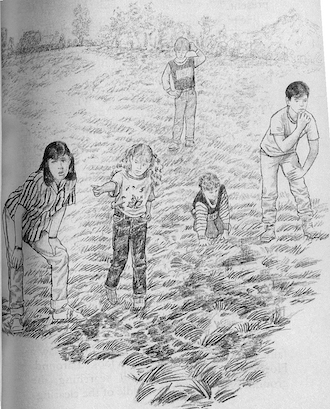
Bert and his siblings go to the area where Bert saw the UFO to look for clues about what it could have been. Artie tags along, although he’s more of a distraction than a help to them. In a clearing, they find large patches of grass that have been flattened and burnt. They look almost like footprints made by some kind of fiery dinosaur. The kids aren’t sure what to think of them. Then, while walking along the road, they’re almost hit by an angry man on a motor scooter. When they get back to Artie’s house, Artie’s father identifies the man as Felix Usher, who is renting a cottage nearby. There are stories that the house he’s renting used to be used by smugglers and gangsters and that they might have left some kind of treasure behind, but Artie’s father doesn’t really believe that.

On the way home, the Bobbsey twins stop off at a diner called the Flying Saucer Diner. While they’re talking with the owner, they learn that he bought the place from Mr. Stockton, the same man who used to own the house that Felix Usher is renting. When Mr. Stockton owned it, he called it the Cup ‘n’ Saucer Diner, which is the name on an old coffee cup that Artie found in the field with the burn marks. The kids wonder if there could be some kind of connection between the diner and the UFO Bert saw. Then, they find a tape cassette on Bert’s bike seat with a threatening voice on it, telling him that he saw nothing and he should say nothing, or else!

It seems like someone wants Bert to forget what he saw and stop trying to figure out what it was, but that’s just more confirmation that Bert really saw something and that what he saw was significant. What did Bert really see in the sky? Was it really a flying saucer, and were the burn marks really caused by aliens? Or is something else happening in their town?

The book is available to borrow and read for free online through Internet Archive.

My Reaction

I liked the premise of this mystery immediately! Unlike many mysteries, it isn’t immediately obvious that a crime has been committed. It falls more under the category of what I call Strange Happenings, where the characters know that something weird is going on, but they’re not entirely sure what it is or why it’s happening.

If I read this one as a kid, I didn’t remember the story, but I had a theory from the beginning about what Bert could have seen because I’ve seen the episode from the old Hardy Boys/Nancy Drew tv series The Creatures that Came on Sunday (older than this book) and an episode of Psych (newer than this book) with a similar premise, that someone had seen an alien spaceship or UFO. I guessed right on the type of flying object Bert saw, but I wasn’t sure what made the burn marks on the ground or how the situation could be related to the old house that might have treasure in it. There is also a woman who comes to see Bert and interview him about what he saw for a book she’s writing, but Bert has the feeling that she isn’t really an author, and she dodges questions that he asks her about her other research into UFOs and the encounters other people have had. There is some doubt from the beginning whether or not Bert’s UFO was an alien spaceship, but the book provides enough doubt and suspects to keep the story interesting as readers speculate about who is playing what roles in the mystery.

This book is from the late 1980s, and there are a couple of dated references to technology and pop culture, although it’s not too bad. It’s enough nostalgia that people who were kids in the 1980s would identify with it, but not too distracting for modern kids to enjoy the story. The kids use a very basic modem to connect to their local newspaper’s archives to do some research. It’s not how the modern World Wide Web works, but Internet use wasn’t popular yet at this time. This is still the early days of civilians having remote access to archives and databases through their computers. There wasn’t much to see, and there weren’t as many people who had the ability to see it yet. There is one instance of someone who seems to be talking to themselves in the story, and then, the kids realize that this person is actually using a radio. The modern equivalent is realizing that someone is actually talking on their cell phone, but cell phones were a relatively new invention around this time. They were expensive, brick-like, and heavy, and very few people had them. A radio or walkie-talkie would have been a more practical choice for this time period. There is also a point where the neighborhood bully and his friend tease Bert about seeing a UFO, and they make some references to popular sci-fi movies, like ET and Planet of the Apes.

The Mystery of the Missing Mummy

The Bobbsey Twins

Bobbsey Twins The Mystery of the Missing Mummy cover

Before I begin, I’d like to acknowledge Sean Hagins, for supplying me with photos of this book! Usually, I take pictures of books myself, but I just couldn’t find a physical copy of this one. Sean is a big fan of the Bobbsey Twins, particularly the New Bobbsey Twins mysteries, and you can see some of his video reviews as well as videos about his photography work on his YouTube channel, SJHFoto. Thanks, Sean!

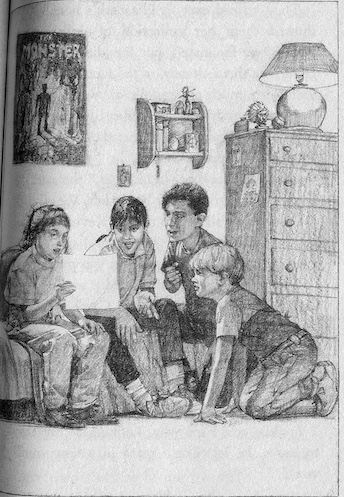
It’s only two days before Halloween, and the Bobbsey Twins are getting their costumes ready. Flossie is going to be a black cat, Bert is dressing as Frankenstein (the monster, not the scientist, for purists), and Nan is a traditional witch in a pointed hat. Only Freddie isn’t sure what he’s going to be yet. He could just put a sheet over his head and go trick-or-treating as a ghost, but that doesn’t seem exciting enough. He wants to be something really scary, but he doesn’t have much time left to decide.

The children’s mother offers Freddie some inspiration when she tells them that she will be writing a story about a new museum exhibit for the local newspaper. The new exhibit is an ancient Egyptian mummy. She asks the kids if they want to go to the museum with her to see the mummy, and they eagerly accept. Freddie thinks that a mummy would make a great costume idea, so he will be a mummy for Halloween.

The museum curator, Mr. Foxworth, gives the Bobbseys a special tour of the exhibit after hours, when there are no other visitors. The Bobbsey Twins are fascinated with the exhibit, and they talk about Egyptian hieroglyphics and the reasons why ancient Egyptians wanted their bodies preserved as mummies for the afterlife. Mr. Foxworth says that the mummy belongs to a wealthy woman named Mrs. Truesdale, who is also there to see the exhibit with her fifteen-year-old nephew, Lex.

The kids notice that Lex seems nervous, and he tells them that there’s a legend about the mummy coming to life. He even says that he’s heard strange noises coming from the mummy case. Mrs. Truesdale thinks that’s nonsense. The mummy has belonged to their family for 60 years. However, when the case is opened, Flossie is certain that she hears the mummy sigh. Then, when Freddie takes a closer look after the others leave the room, he sees the mummy breathing, and it tries to grab him!

Freddie and Flossie try to tell everyone what they saw, but everyone assumes that it was just their imagination. The kids go to the library to do some research about mummies, and they learn that Lex was telling them the truth about the legends surrounding this particular mummy. Nan doesn’t believe that the legends are real, but when the kids walk home from the library, they see the mummy walking in the park!

The kids run home and tell their parents what they saw. Their parents remind them that it’s almost Halloween, and it could have been somebody in costume, on their way home from a Halloween party. It sounds like a reasonable explanation, but the next morning, they hear a news report on the radio that someone broke into the museum and stole the mummy from the exhibit! The kids wonder if the mummy could have really come to life and broke out of the museum itself rather than being stolen.

The Bobbsey Twins decide to report their mummy sighting in the park to the police. At they police station, they see the security guard from the museum. The security guard tells them that the mummy did come to life and that it knocked him unconscious before leaving the museum, but nobody believes him because it sounds too crazy. The kids believe the security guard, but it also occurs to them that their parents might be right, that it could have been someone dressed as the mummy rather than the mummy itself. But, why would someone want to dress up like the mummy to pull a stunt like that, and if that’s what happened, where is the real mummy now?

The book is available to borrow and read for free online through Internet Archive.

I was pretty sure I knew right away who one or two of the culprits was because I figured that a theft and stunt like this would have to involve more than one person. However, I figured that there had to be another confederate involved because my favorite suspects were accounted for the first time the mummy moved. It turned out that I was way off base because there were suspects I hadn’t considered. The motive behind everything was different from the one that even the kids believed. I was pleasantly surprised by the twists in the story. There is a clue later in the book that more than one person dresses up as the mummy at different times when the kids realize that the mummy looked thin one time and fat the next time they saw him.

I liked the pieces of historical information about mummies included in the story, although the part about tanna leaves bringing mummies to life and attracting them is fictional, a concept created for a movie called The Mummy’s Hand from 1940. That’s why it’s important that one of the books Freddie finds at the library is about mummies in movies. At one point, Freddie and Flossie use what they’ve learned to build their own trap for the mummy.

I also noticed that the mummy’s legend comes with curse that rhymes when it’s translated into English, sort of like how the clues on the old Spanish map rhyme in English in The Goonies. In real life, things translated from one language to another don’t maintain their rhyme scheme. That went over my head when I was a kid, but I hadn’t studied other languages at that point, so the idea didn’t occur to me.

At one point in the story, the kids receive a message from the “mummy” that is clearly written on modern paper that someone tried to make look old, and the kids notice right away. They realize that it’s modern computer paper that someone yellowed with a candle, and they see where the holes at the sides were torn off. Modern kids might not understand what they mean about holes being torn off at the sides of the paper, but this was a familiar feature of computer paper at the time the book was written in the 1980s. Modern computer paper doesn’t have holes at the sides, but when I was a kid in the 1980s, there were perforated sections on both sides of the dot matrix printer computer paper with a series of little holes in them. The holes were where the printer would grab the paper and feed it through the machine. They later became unnecessary when printer designs changed, which is why you don’t see paper like that any more. When I was a kid, we would tear off those perforated sections with the little holes after printing. We would also have to break the individual sheets apart at perforated points because the sheets of paper were all joined together to feed continuously through the printer. That’s the type of printer paper that the kids in the story have. I don’t know if everyone did this, but I’d sometimes use those edging strips with the holes for little craft projects, or make them into little chains or bracelets.

The Clue in the Classroom

The Bobbsey Twins

#9 The Clue in the Classroom by Laura Lee Hope (Stratemeyer Syndicate), 1988.

Before I begin, I’d like to acknowledge Sean Hagins, for supplying me with photos of this book! Usually, I take pictures of books myself, but I just couldn’t find a physical copy of this one. Sean is a big fan of the Bobbsey Twins, particularly the New Bobbsey Twins mysteries, and you can see some of his video reviews as well as videos about his photography work on his YouTube channel, SJHFoto. Thanks, Sean!

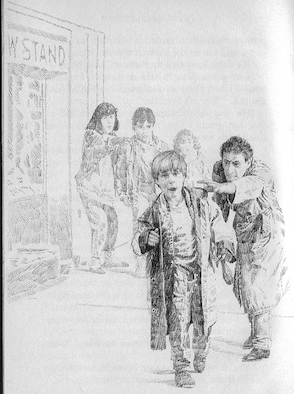
Nan and Bert are walking to school when Bert starts trying to follow Nan, practicing shadowing someone, like his favorite comic book detective, Rex Sleuther. Nan thinks that Bert’s attempts at following her are ridiculous, especially since she already knows he’s there. Then, she spots a tall man who is really being shadowed.

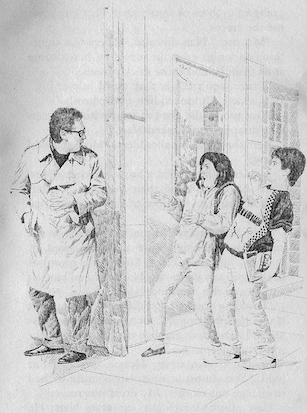
The tall man keeps looking over his shoulder and ducking into doorways, like someone is after them. It doesn’t take the kids long to realize who is following him because a man in a trenchcoat, who is walking behind the tall man, keeps pausing and pretending to tie his shoe or look in store windows every time the tall man glances back. It’s not very subtle. When the man in the trenchcoat sees Nan and Bert watching him, he gives them a menacing look and seems like he’s about to confront them, but then, he leaves. They lose sight of the tall man. It’s a bizarre experience, and it ends when the kids’ mother drives up with their younger siblings and gives them a ride.

At school, Nan meets her new science teacher, and she realizes that he is the tall man who was being followed by the man in the trenchcoat. He introduces himself as Mr. Newman (ha, ha), and he seems much more relaxed than he was before. That is, until they all see the message written on the blackboard in the classroom: “Newman, give up your plans. We’re watching you.” Mr. Newman exclaims, “Oh, no! They’ve found out! They know!” (I seriously wish that at least one of my old teachers had started their first day in class by saying that exact thing.) Mr. Newman doesn’t explain what it’s about. He just quickly erases the message on the board and begins talking about the science project he’s assigning.

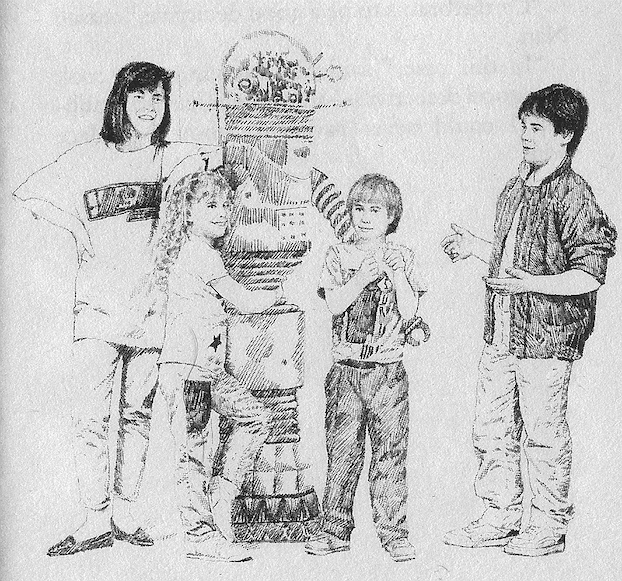
When Nan tells her siblings about Mr. Newman and what happened in class, Freddie says that Mr. Newman will also be teaching the afternoon science club that he joined. Mr. Newman will be teaching them about robots, and they’re going to have a meeting at his house, where Mr. Newman will show the club his inventions. Bert says that Freddie can help them figure out what Mr. Newman is doing and what and who he’s afraid of after he’s seen the projects that Mr. Newman is working on.

Bert decides to take a walk past Mr. Newman’s house to get a look at it before Freddie goes there. While he’s doing his reconnaissance, Bert sees what looks like people fighting in one of the windows. When he knocks on the door to see if Mr. Newman is all right, Mr. Newman says that he is and insists that there’s no one else there. Then, a strange woman shows up and starts asking Bert questions about Mr. Newman. She says that she’s his former boss at a computer company and wants to know if Bert saw anything in his house. She seems very interested in what he might be working on, but Bert just says that Mr. Newman was too busy for visitors.

Is this woman really Mr. Newman’s former boss, and does she have anything to do with the mysterious man in the trenchcoat? Someone breaks into the school and trashes Mr. Newman’s classroom. What is this secret invention of Mr. Newman’s that everyone seems so interested in, and why would someone threaten him over it or try to put a stop to his work?

The book is available to borrow and read for free online through Internet Archive.

My Reaction

The kids’ first thoughts about the mysterious people who are after Mr. Newman is that they might be spies, and they’re partly right. This is a matter of industrial espionage. People are after Mr. Newman’s invention because they can make a lot of money from it.

The robot Mr. Newman is building is really impressive, even by modern 21st century standards. Back in the 1980s, when this was written, a robot that large and sophisticated would have seemed almost like science fiction, although increasing developments in robotics technology would have made it seem more possible. Companies were working on developing robots during the 1980s, and Honda was working on a humanoid robot that could walk on two feet. Kids had toy robots. (I wanted one but never got one.) I don’t remember any classes for building robots for kids, but there may have been some that I didn’t know about at the time because I was still pretty young in the 1980s. In the 21st century, there are modern robotics classes for kids, and they sometimes show off their robots at competitions.

The Super-Duper Cookie Caper

The Bobbsey Twins

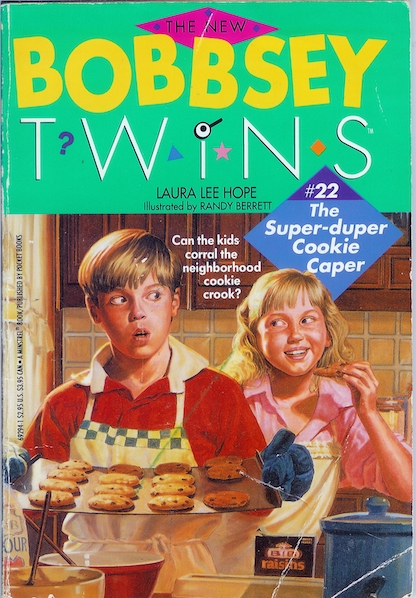
Bobbsey Twins Super-Duper Cookie Caper coverr

#22 The Super-Duper Cookie Caper by Laura Lee Hope (Stratemeyer Syndicate), 1991.

Before I begin, I’d like to acknowledge Sean Hagins, for supplying me with photos of this book! Usually, I take pictures of books myself, but I just couldn’t find a physical copy of this one. Sean is a big fan of the Bobbsey Twins, particularly the New Bobbsey Twins mysteries, and you can see some of his video reviews as well as videos about his photography work on his YouTube channel, SJHFoto. Thanks, Sean!

Freddie decides that he wants to get a new bike, and inspired by the school bake sale, he decides that he’ll make and sell cookies to raise the money. His grandmother makes really delicious oatmeal chocolate chip cookies that everybody loves, so he plans to make and sell them. He persuades his twin, Flossie, to help him by promising her part of the money from the cookie sales. Their parents approve of the plan, and their mother offers to help them because neither of them has much experience with cooking.

When Freddie and Flossie go to sell the cookies in the park, they’re pretty popular. Everyone loves the cookies, and Freddie boasts about his grandmother’s secret recipe. Their last customer is a man who gives them a dollar with some kind of white powder on it, and he doesn’t seem to think much of the cookies. Freddie doesn’t care because everyone else likes them, and they’re making money.

There are some complications to selling cookies. First, Flossie has a sweet tooth, and Freddie has to keep stopping her from eating their stock herself. Then, a boy at school, Brian, announces that he’s going to set up a rival business in the park, selling brownies. Freddie gets the idea of offering broken cookies as free samples and selling orders of cookies door-to-door.

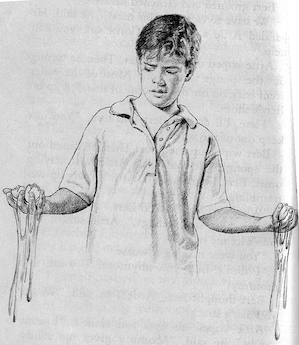
Nan and Bert start helping with the cookie-baking, but things don’t always go well in the kitchen. There are times when they forget ingredients or let the cookies burn. Then, the children realize that the card with the recipe on it is missing! They search the kitchen and realize that there is a chocolate smudge on the kitchen window. It looks like someone reached through the window and stole the recipe!

There are a few logical suspects. It could be Brian, hoping to cash in on the success of the cookie-selling. It could be their old nemesis, local bully Danny Rugg, who stole their free samples earlier and generally likes to mess things up for the Bobbseys. Then again, there is the mysterious man who keeps showing up at the park. The Bobbsey Twins find out that he owns his own bakery. To find out who the recipe thief is, Freddie decides to invent a trap. He tells everyone that his grandmother has given him her other secret recipe for super-duper cookies that’s even better than the first one. Who will take the bait?

The book is available to borrow and read for free online through Internet Archive.

My Reaction

Sean and I were discussing earlier how later books in the New Bobbsey Twins series tended to focus more on the younger set of twins than the older Bobbsey twins and seem to involve lower-stakes mysteries. Earlier books in the series involved definite crimes, police matters, and strange phenomena. A stolen cookie recipe feels like much lower stakes. However, I thought this one was well-done for what it was. There are some definite suspects, enough to sow some doubt about who the recipe thief is. The actual thief is someone I suspected but not necessarily the most obvious suspect, and the thief’s motives do make logical sense, although I’m not sure (spoiler) any real adult would seriously consider that kind of business model. It sounds more like something a kid might do, and that’s partly what allows readers to doubt whether it’s a child or adult who took the recipe.

There is also a punchline to the story. There was one thing that I had guessed early on about the grandmother’s “secret recipe.” It’s not as “secret” as the kids think it is. I guessed that because, when I was a kid, one of my grandmothers always baked chocolate chip cookies. Those cookies were one of the highlights of going to her house. When we were little, my brother and I liked them so much that we guessed that she must have been a baker before she retired. When we were older, we found out that she’d actually been a bookkeeper and that her cookie recipe was just the Toll House recipe from the chocolate chip package. She made two versions, with and without nuts from the pecan tree in her backyard, but it was still the Toll House recipe. It’s a similar situation with the Bobbsey Twins’ grandmother’s secret recipe. The only thing the grandmother changed was the cooking time. Everyone just thought that the cookies were special because her grandchildren thought they were, and they convinced other people. Few things are as special as homemade cookies from your grandmother!
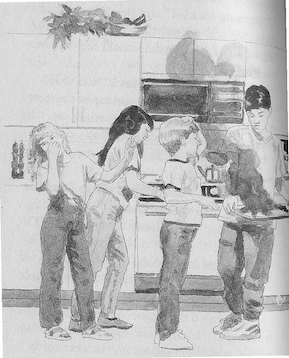
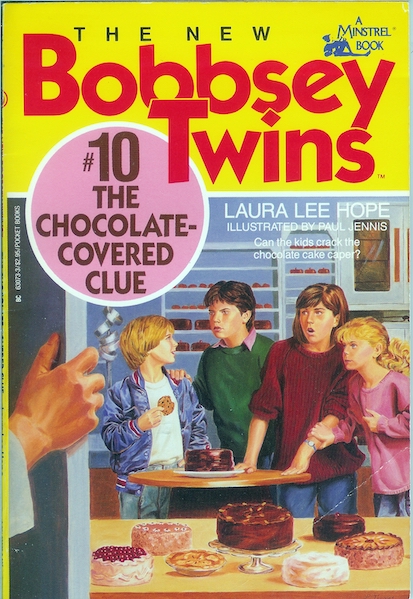
The Chocolate-Covered Clue

The Bobbsey Twins

#10 The Chocolate-Covered Clue by Laura Lee Hope (Stratemeyer Syndicate), 1989.

Before I begin, I’d like to acknowledge Sean Hagins, for supplying me with photos of this book! Usually, I take pictures of books myself, but I just couldn’t find a physical copy of this one. Sean is a big fan of the Bobbsey Twins, particularly the New Bobbsey Twins mysteries, and you can see some of his video reviews as well as videos about his photography work on his YouTube channel, SJHFoto. Thanks, Sean!

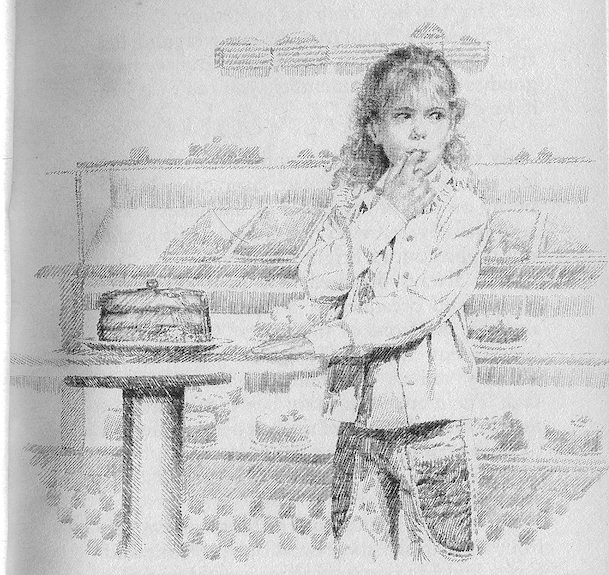
Flossie has made a new friend, Casey Baker, whose parents own Baker’s Bakery. They invite her to come for a tour of the bakery to see how they make everything. It means getting up very early on a school morning because the baking has to start very early. They need to have everything freshly baked by the time the bakery opens for customers. Although it’s difficult to get up that early, Flossie enjoys the tour, seeing the large electric mixers where they make the cake batter and the enormous oven where they can bake over 100 cookies at once.

While the Bakers are showing her everything, they all realize that they feel cold. Someone has left the door to the alley open. Nobody is around, so they assume that it must have just been left open by a deliveryman making an early delivery.

Later, while Flossie and Cassie are admiring a beautiful chocolate cake, something really strange happens. A masked man suddenly runs into the shop, grabs the cake, and runs away with it! Who could be so desperate for chocolate cake that they have to resort to theft? The Bobbsey Twins’ mother is covering a series of recent burglaries for the local newspaper, but this is the weirdest theft the kids have ever heard of.

It gets weirder as the day goes on. While Freddie and his mother are running errands, they stop at a diner, and the same masked man runs in and smashes the chocolate cake on the counter with his bare hands! Freddie tries to chase him, and the man throws cake at him. The cake that was smashed was also from Baker’s Bakery.

The Bobbsey Twins talk to Casey, and she tells them that someone stole their delivery list. From then on, this crazy cakenapper starts tracking down and stealing and smashing every chocolate cake Baker’s Bakery made that day – including the one that the Bobbseys had delivered to their house.

What’s behind all of this cake carnage and chocolate destruction? Does someone have a grudge against the Bakers or against chocolate-based desserts?

The book is available to borrow and read for free online through Internet Archive.

My Reaction and Spoilers

I really liked the premise of this mystery! It’s such a fun, crazy concept of someone going all over town, smashing cakes, apparently for no reason. It’s the sort of mystery that I sometimes call a “Bizarre Happenings” mystery. That’s a mystery where strange things happen that encourage the characters to investigate, but it’s not obvious what’s behind it all or what sort of crime is really being committed. An example from adult literature would be the Sherlock Holmes story, The Red-Headed League, where the characters know that someone has been deceived into joining a special club for red-headed men that doesn’t actually exist and paid to copy entries from the encyclopedia, but they’re not sure why at first. In the case of the Bobbsey Twins mystery, the characters know that someone is stealing and destroying chocolate cakes, which is a very bizarre form of theft, but they’re not sure why. Readers can guess from the beginning that this rash of cake thefts is related to a different crime.

Actually, the solution to the story is very similar to that of another Sherlock Holmes story, The Adventure of the Six Napoleons, where someone is stealing and smashing busts of Napoleon. It has nothing to do with Napoleon or the busts themselves. There is something hidden inside one of the busts that someone is desperate to find, but because the busts all look alike, they have to track down and smash them all to find the one they really want. It’s like that with the cakes. The destruction of the cakes has nothing to do with the Baker family, their business, or the cakes themselves. Someone came into the bakery, looking for a place to hide, and dropped something in the cake batter while it was being mixed. Because the batter in the massive mixer was made into multiple cakes, they can’t be sure which cake now contains what they want. They need to track down the right cake in a hurry, before someone else finds what they hid. What seems to be an oddball crime puts the Bobbsey Twins up against a dangerous criminal!
The Secret of the Sunken Treasure

The Bobbsey Twins

Bobbsey Twins The Secret of the Sunken Treasure cover

The Secret of the Sunken Treasure by Laura Lee Hope (Stratemeyer Syndicate), 1989.

Before I begin, I’d like to acknowledge Sean Hagins, for supplying me with photos of this book! Usually, I take pictures of books myself, but I just couldn’t find a physical copy of this one. Sean is a big fan of the Bobbsey Twins, particularly the New Bobbsey Twins mysteries, and you can see some of his video reviews as well as videos about his photography work on his YouTube channel, SJHFoto. Thanks, Sean!

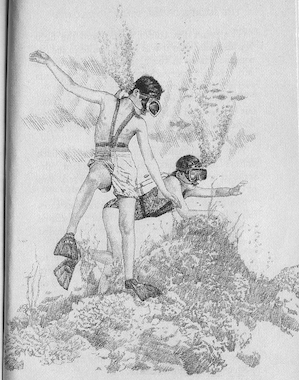
The two sets of Bobbsey Twins and their parents are on vacation in Florida for a week. It’s just a fun family vacation, although Mrs. Bobbsey is hoping to write an article about a sunken treasure ship called the Granada. The Bobbsey Twins are intrigued at the idea of searching for sunken treasure, although nobody has detected a sign of the treasure since the ship sank in 1801. Dan Chester, he brother of a family friend, lives in the town where the Bobbseys are staying along with his 15-year-old daughter, Meg. Dan and Meg are divers, and they have been searching for the wreckage of the Granada, and they think they have a lead. The Bobbsey Twins are excited to think that they might be able to participate in the search for the treasure or be there when the Chesters find it!

However, when Dan and Meg pick them up at the airport, they have bad news. Although they were able to locate the wreckage of the Granada, they were delayed reaching shore to claim their find because their boat propeller broke, and someone else claimed the Granada before they could. Joe Lenox, the man who claimed the wreckage, runs an underwater salvaging company, and he’s tough competition for the Chesters because he can afford all the latest sonar equipment. It’s a heavy blow to Dan and Meg, losing such an important find when they were so close to claiming it. The only consolation is that everyone will be able to watch the old safe from the wreckage being hauled to the surface. The safe is supposed to contain the treasure the ship was carrying.

When Joe Lenox learns that Mrs. Bobbsey is an out-of-town reporter, he invites the entire Bobbsey family to come with him on his boat to see the treasure being recovered. They accept the invitation, although the kids feel a little funny about it because Joe is Dan and Meg’s competitor.

On the boat, Joe shows the Bobbseys his equipment and explains how everything works. (I grew up in Arizona and have never been diving, so I have very little context for understanding diving equipment. This part looks informative, but since this book was published decades ago, there may have been some changes in equipment since then. I wouldn’t know.) Flossie is hoping that, when the treasure is brought up, she will get the chance to try on the famous tiara that is supposed to be in the safe. However, everyone is in for a shock. When the divers go to recover the safe, they discover that someone has already managed to open it and remove the strongbox containing the treasure!

Now, Joe feels cheated out of a treasure he thought he had safely claimed, and he wants to know who’s responsible. The logical suspects would be Dan and Meg, who felt cheated out of their opportunity to claim the treasure first and who have the diving skills needed to reach the safe. A charm belonging to Meg is found in the safe, making Joe and the police believe that the Chesters are guilty. Although, there are also the other members of Joe’s crew to consider. They were the only other people who knew where the wreck was. Could any of them gone out to raid the wreck before the official salvage operation? Can the Bobbsey Twins find the real thieves?

The book is available to borrow and read for free online through Internet Archive.

My Reaction

I had a couple of favorite suspects early on in the story. The book establishes that it would have taken at least two people to deal with the safe, so I was looking for a pair of people. I was only partly right, though, because there’s another suspect who isn’t introduced until later in the book. The first person I suspected is guilty, but there were more people involved than I thought.

The book explains a little about how a person can lay claim to a sunken ship. The characters say that they have to fill out paperwork at the courthouse. There are laws regarding claiming a sunken ship and official procedures to follow. It’s not as simple as finders keepers. It does matter who found it, where they found it, and who the ship belonged to originally. There were also some changes to the laws around the time this book was written and published with the Abandoned Shipwreck Act of 1987. I’m not completely sure whether each Joe or Dan and Meg could have legally claimed the ship. It partly depends on whether or not it was within US territorial waters or outside the official three-mile limit, and it also depends on whether or not the ship was property of a foreign government which could lay claim to it. For the purposes of the story, we have to assume that Joe Lenox was able to successfully lay a claim to the ship and that Dan and Meg could have done so if they had reached the authorities first. What makes me doubt this is how it would have worked in real life is that the treasure on the ship belonged to a Spanish countess, which makes me think that it could be regarded as property of the Spanish government, but it would be difficult to determine that without additional information.

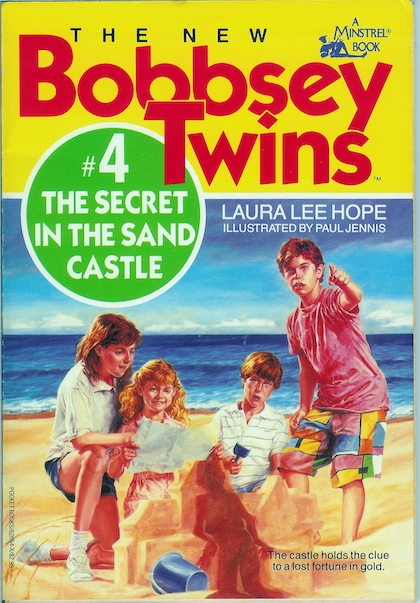
The Secret in the Sand Castle

The Bobbsey Twins

#4 The Secret in the Sand Castle by Laura Lee Hope (Stratemeyer Syndicate), 1988.

Before I begin, I’d like to acknowledge Sean Hagins, for supplying me with photos of this book! Usually, I take pictures of books myself, but I just couldn’t find a physical copy of this one. Sean is a big fan of the Bobbsey Twins, particularly the New Bobbsey Twins mysteries, and you can see some of his video reviews as well as videos about his photography work on his YouTube channel, SJHFoto. Thanks, Sean!

The two sets of Bobbsey Twins and their parents are spending a few weeks in an old house at Beachcliff Bay. It’s sort of a working vacation for their parents. Mr. Bobbsey owns a lumber yard, and he’s helping a local builder, Jim Reade, to either find some antique Victorian wooden gingerbread house trim or make new ones to match a home restoration project. Meanwhile, Mrs. Bobbsey is planning to write a travel article about the area for their local newspaper.

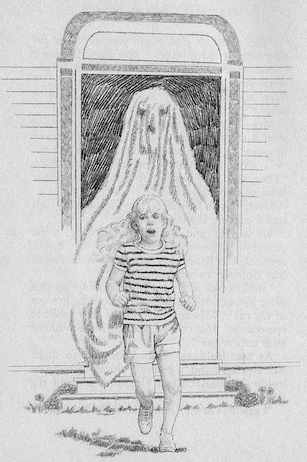
The house where the family will be staying is called the Wilson house, and it’s one of Mr Reade’s recent renovation projects. Flossie is the first in the family to go inside, and she is startled by what she thinks is a ghost. It turns out that it’s only the caretaker, Pete Smedley, taking the old dust sheets off the furniture. It’s not entirely reassuring because Pete says that there are stories about the old Wilson house being haunted by the ghosts of its former owners, who drowned in the nearby bay. He says that he knows when the ghosts have been there because they move things around and leave trails of water, seaweed, and seashells. Mr. Reade thinks that Pete’s stories are nonsense and that the strange things he’s observed are due to windows in the house being left open or something like that.

The inside of the Wilson house is as elaborate as the outside. The Bobbsey twins unpack their things and claim rooms for themselves upstairs. Flossie is quick to claim the biggest room with the best view for herself, and she asks Bert to help her move a mirror she likes into her room. They don’t have anything to hang the mirror, so they set it on Flossie’s bed. Strangely, they later find the mirror still on the bed but broken, and they don’t know how that happened.

Nan is curious about the Wilson family and the history of the house, so she and Freddie take a trip to the local library. There, Nan learns that the last two members of the Wilson family were a brother and sister, called Clay and Jennie. They were both artists, but they never made much money. Badly in need of money, they apparently robbed an armored car and stole gold bars. They tried to escape in a boat, but it was lost in a storm. The Wilsons apparently drowned, although their bodies were never found. The police thought they might have hidden the gold somewhere before getting on the boat, but nobody ever found the gold they stole.

Mr. Reade tells the children that his son, Jimmy, is entering a local sand castle contest, and the Bobbsey twins decide that they would like to enter the contest, too. Nan thinks they should try to build a replica of the Wilson house in sand. Unfortunately, Jimmy turns out to be a troublemaker, and it doesn’t look like he wants to be friends with the Bobbsey twins.

While the girls go to the store, Bert and Freddie decide to check out the old root cellar at the house, and someone traps them inside. The girls let them out when they get back. Then Flossie finds a secret passage and hidden stairs. Mr. Bobbsey says that it was once a servants’ entrance that had been sealed off. Later that night, a ghostly figure tries to enter Nan’s room! Could it have been Jimmy. playing a nasty prank, or is it someone looking for the lost gold? Could it even be a real ghost?

The book is available to borrow and read for free online through Internet Archive.

My Reaction

From the beginning of the book, I had a favorite suspect. However, this is one of those mysteries where there is more than one person involved, and they’re not working together. In the end, I was right about my main suspect, but having a second person doing suspicious things made the mystery more interesting. The title is a little misleading because the story is really about the search for the hidden gold from the robbery, not about the sand castle contest. The sand castle contest is more of a side issue, although studying the design of the house to build the sand castle version leads the kids to the solution of the mystery.

Because this book is from the late 1980s, there are things in the story that were more a part of my childhood than the lives of 21st century children, like renting videotapes. I was about the age of Freddie and Flossie when this book was first published, so it’s a bit of a fun nostalgia trip for me, both because I read books in this series when I was young and because some of the things the kids do in these stories are similar to things I did at their age.