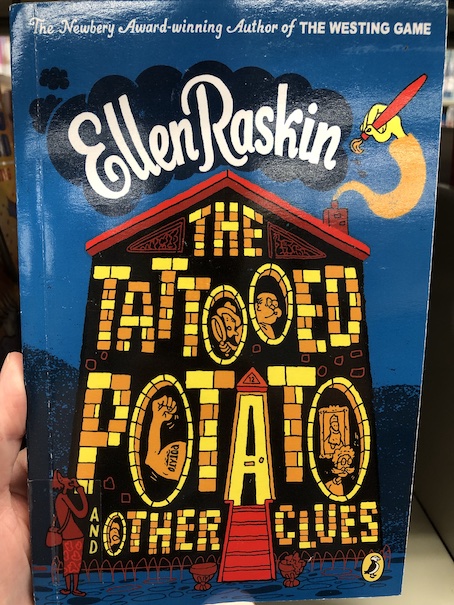
The Tattooed Potato and Other Clues by Ellen Raskin, 1975.
Dickory Dock (yes, that’s her name) is a 17-year-old art student in New York. She takes a part time job as an assistant to a mysterious artist who only calls himself Garson. She really needs the job because she’s very poor and often only has markers to use in making drawings for her art classes. She lives with her brother and his wife because their parents are dead, but her brother and his wife struggle financially and sometimes can’t even pay their bills. However, Garson is a strange person who seems determined to keep the details of his past secret.
Garson requires Dickory to be quiet, well-organized, and observant as his assistant, and she tries her best to be these things. He periodically tests her powers of observation and perception, pointing out that these are valuable skills for artists to have to see beyond the outward appearances of things and into their very essence. Garson lives in a house with a deaf-mute man called Isaac. Isaac frightens Dickory at first because he is a large man who appears scarred and is brain-damaged. Garson says this is just his outward appearance and tells her that Isaac is a gentle soul. On the other hand, Manny Mallomar, the fat, greasy man who rents the lower apartment in the house, is rough and rude. Because he dresses all in white, Dickory describes him as looking “like the ghost of a greasy hamburger.” Manny Mallowmar’s associate, Shrimps Marinara comes to visit him, and Garson praises Dickory for guessing his name because he’s a shrimpy little man. (This pair sounds like the criminals in The Maltese Falcon.) Garson stresses the importance of seeing behind the outward appearance of people and objects to their inner natures, what they hide behind the disguises they wear. Garson himself, however, remains a mystery, purposely covering himself up with bland manners.
Garson is good at reading people, and he accurately realizes that Dickory is a haunted person. Dickory admits that the reason why she lives with her brother is that their parents were murdered. Their parents ran a pawn shop, and they were killed in a robbery. Dickory’s brother (his name is Donald Dock, and he’ll hit anybody who makes quacking sounds at him) is terrible at managing money, which is why they can’t always pay their bills, and they no longer own their parents’ pawn shop as a source of income because he lost it to a bookie.
Strangely, Dickory realizes that, even though Garson is perceptive to people’s hidden deaths, this isn’t always reflected in his work, which does focus on showing people the way they want to be seen, not how they actually are. It’s just the sort of thing Garson tells her not to do, so why does he do it himself?
Then, the Chief of Detectives Quinn comes to see Garson. Garson was talking about the need to see behind people’s disguises with an artist’s eye at a party, and Quinn has come to take him up on the offer. Quinn has been struggling with a case of fraud where widows have been duped out of their savings by a mysterious hair dresser who got them to invest in a new kind of hair treatment. At first, the hair treatment made them look really good … and then, their hair fell out, and the hair dresser was gone with their money. Garson interviews the three fraud victims, and they all describe the hair dresser, who called himself Francis, slightly differently, although there are certain details of their accounts which are the same. In the end, Garson’s conclusion is that “Francis” is actually a woman named Frances, and that she probably had the extremely short hair they described because she was the first victim of her own hair tonic that doesn’t work, and her own hair has only just started to grow back. Garson tells Quinn that she has probably used these ladies’ money to set herself up with her own hair salon.
Garson’s theory of the case turns out to be accurate, so Quinn asks his opinion on another case. This next case involves a counterfeiter whose bills are almost perfect, except he puts his own self-portrait on them where the presidents’ picture is supposed to be. Garson seems to like playing detective in these cases, but Dickory realizes that he is still a mystery himself. He seems to love using disguises, and he tries to trick Dickory with them. Dickory can tell that these disguises aren’t just tests of her observation skills but also seem to be ways for Garson to try out different disguises for his own sake. She also begins to realize that Manny Mallomar isn’t just a disagreeable character but actually a criminal. He’s blackmailing the people who come to visit him, and also Garson, which is the reason why he’s allowed to live in Garson’s house. What is there in Garson’s past that Manny knows and Garson doesn’t want to reveal?
The book is available to borrow and read for free online through Internet Archive (multiple copies).
My Reaction
Ellen Raskin is also the author of The Westing Game. The Westing Game is better-known than this book, and I read The Westing Game first as a kid, which is what led me to this one when I was in middle school. It’s interesting to note that The Tattooed Potato and Other Clues was actually written and published a few years before The Westing Game, and it has some similar themes in the story. Both books involve people with mysterious, hidden pasts, and they delve into the psychology of a cast of characters whose pasts are linked, even though the characters themselves don’t know all the connections between them initially.
Dickory knows from the beginning that Garson is being secretive about his past, but everyone involved in the situation has secrets. Manny Mallowmar and Shrimps are blackmailers, but they also have guilty secrets from their other crimes. Quinn is also not just consulting Garson for help on cases but using those cases as excuses to investigate Garson and the other people in his house. Quinn is aware of Mallowmar’s shady history, and he thinks that he knows what Garson’s guilty secret is. Dickory inadvertently learns the truth behind the murder of her own parents, and she becomes the only person to figure out the full story behind Garson’s past crime.
Garson teaches Dickory how to see behind people’s facades, which is how she is able to learn his true identity and the secrets of his past. Garson didn’t intentionally do anything evil, but he recognizes that, while he is considered a gifted artist for being able to see the truth about people, he has caused great harm to someone he really cared about by revealing painful truths in a heartless way. Garson harbors guilt for the harm he has caused, and in a way, he actually seems to fear his gift for the harm it can do. However, not every kind of truth is hurtful. Dickory shows Garson that some truths can heal, and that he can expose the good and lovable sides of people as well as their dark sides.






 Jestress's Forgotten Books and Stories