 Wayside School is Falling Down by Louis Sachar, 1989.
The books in the Wayside School Series are collections of short, funny stories about a school that was accidentally built sideways. Instead of being a one-story school with thirty classrooms all in a row, Wayside School is a thirty-story school with only one classroom on each floor. Strange things are always happening there. The stories mostly focus on the kids in Mrs. Jewls’s class on the top floor of the school. Like the first book in the series, there are 30 short stories in this book.
It would take too long to describe all the stories in the book individually, but they’re just as funny as in the first one. Mrs. Jewls has a new student, Mark Miller, except that Mark Miller is really Benjamin Nushmutt. Benjamin would correct Mrs. Jewls except that he seems to be a much better and more popular student as Mark Miller. But, as he soon learns, answering to a name that isn’t yours is about the least strange thing at his new school.
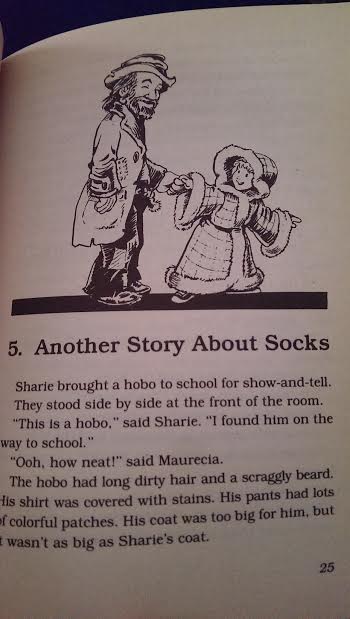 Socks figure into many of the stories, with a special jingle invented by Mac, who used to be named Nancy until he traded names with a girl. It’s fortunate that Mac invented the jingle because Allison uses it to free herself from the non-existent 19th story. Myron chooses freedom over safety, emancipating himself from the school’s rules. Bebe invents a younger brother, and things turn around for Leslie when her pigtails pull Paul. Rondi fears that she’s no longer cute now that her front teeth have grown in. Joy learns the best thing about the toy dog that Todd brought to school, and Ron actually tries the school lunch.
There are plenty of lessons to learn. Watch as Mrs. Jewls teaches her class about gravity using her brand new computer! Dana thinks that she hates stories until she learns that she actually loves them. Mrs. Jewls teaches Jason not to chew pencils using masking tape. Dameon learns about love via a dead rat. Stephen explains how uncomfortable clothes and strangling ties make people look important, and Mrs. Jewls says that it’s what’s underneath that counts, so it’s best to wear expensive undies. Then, everyone learns to tango in dance class (except Myron).
But, one windy day, the children are faced with an alarming possibility: Can their overly-tall school actually fall down? (Lyrics courtesy of Kathy, who still hates everyone.)
This book is currently available online through Internet Archive.

 Each of the books contains thirty stories, like the school (ha, ha!). It would take awhile to describe them all, but there are stories about each of the kids in Mrs. Jewls’s class. Mrs. Jewls took over the class on the 30th floor after Mrs. Gorf accidentally turned herself into an apple. She used to turn her students into apples when they made her mad, but most forms of revenge backfire eventually. Mrs. Gorf ends up turning herself into an apple when one of her students holds up a mirror, and then, Louis the yard teacher eats her.
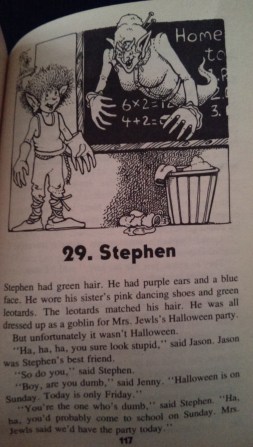 Mrs. Gorf does make one more reappearance on the Friday before Halloween. Mrs. Jewls and the children argue that she can’t haunt the school if it’s not Halloween, but when Halloween falls on a weekend, schools have to have their Halloween party on the Friday before. Stephen’s just happy that the ghost of Mrs. Gorf justifies his costume.
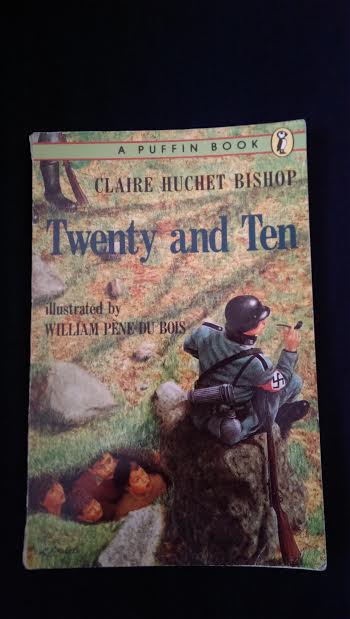 Twenty and Ten by Claire Bishop, 1952.
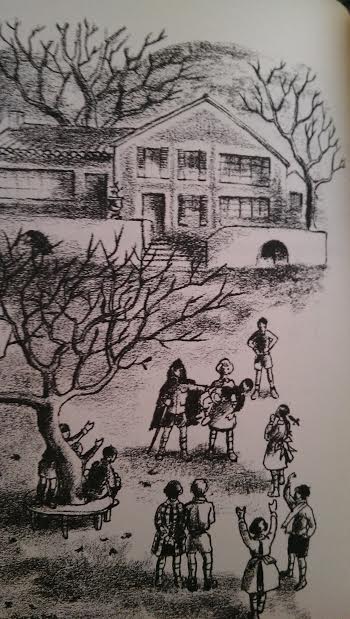 The two groups of children soon make friends, and one of the Jewish children, Arthur, shares something special with his new friend, Henry: a small piece of chocolate. With the rationing, none of them have seen chocolate in a long time. Henry decides to share a little with Janet because he likes her, and they decide to hide the rest and save it for later. When Denise spies them with the chocolate and wants to have a little herself, she steals the piece of chocolate from where Henry has hidden it. The others chase after her to get the chocolate back, and they end up accidentally discovering a cave that none of them knew was there.
 Jestress's Forgotten Books and Stories