Frindle

Frindle by Andrew Clements, 1996.

Nick is a creative boy in elementary school who is known for pulling elaborate stunts, like turning his classroom into a tropical paradise with fake trees and real sand. When he gets to fifth grade, he has Mrs. Granger as his language arts teacher. Mrs. Granger has a sense of humor about some things, but she also has some strict rules and is all business when it comes to her specialist subject. Her vocabulary lists for her students are extensive, and her favorite thing is the unabridged dictionary. Nick likes words and enjoys reading, but he finds the dictionary to be boring. When he sees a word he doesn’t know, he would rather ask someone else what it means than look it up in the dictionary.

In most classes, Nick is good at asking teachers questions to sidetrack them from assigning homework. The other kids know he does this, so they aren’t surprised when he asks Mrs. Granger about her big unabridged dictionary and where all the words in it come from. Unfortunately, for Nick, Mrs. Granger is also onto his trick, and rather than answering the question herself, she assigns Nick to look up the answer and tell the rest of the class what he’s learned the next day in addition to his usual homework assignment. Nick is upset because he usually doesn’t have much homework at all, and now, he has to do more.

When Nick gets home, he reads about dictionaries in his encyclopedia, but he’s not sure that he understand everything he’s read, and it all sounds terribly dull. Then, Nick gets one of his creative ideas that he thinks will make this boring assignment more fun. When it’s time for Nick to give his report, even he is surprised at how much he has to say about the dictionary. Mrs. Granger loves his report, although even she tries to cut Nick short when he goes on for too long. Although the other kids were initially bored, they begin to enjoy Nick’s report when they realize that he is actually using it to waste an entire class period. Eventually, Mrs. Granger tells Nick that he’s at a good stopping place in his report, and she praises him for all of his work. Nick, annoyed that she’s making him look like a teacher’s pet, decides to ask one more question. He says that he still doesn’t understands who decides what the meanings of words are, like who decided that the word “dog” refers to a dog. Mrs. Granger tells him that everyone who speaks English does. Words mean whatever the people who use them agree that they mean. People who speak other languages use different words to refer to the same animal, but those words are valid to them because they all agree on the meaning of the words.

Then, Mrs. Granger says something that really starts Nick thinking. She says that if everyone in their classroom decided that they wanted to call a dog by some other word, and they got other English-speaking people to agree on it, that word would come to mean “dog.” If enough people agreed to use their new word and agreed on its definition, the new word would be put into the dictionary. To answer Nick’s original question, people who speak a language determine the words of that language and whether they are included in the dictionary. Mrs. Granger adds that the dictionary is the work of many experts over many years, and there are good reasons why each of the words included in the dictionary are there. The dictionary contains the laws of the English language, and while those laws can change, it takes time.

Later, when Nick is walking home with his friend Janet, Janet finds a fancy pen. Nick thinks about what Mrs. Granger said about how people like him, who use a language everyday, decide what words mean. It reminds him how, when he was little, he used to use a baby word that his family understood meant “music.” He had to give up using that word when he went to preschool because nobody outside of his family understood that word, but Nick understands how the word had meaning in his family because they all understood what Nick meant when he used it. While he’s thinking about it, he bumps into Janet, who drops the pen. On impulse, when Nick gives the pen back to her, he decides to give the pen a new name. He calls it a “frindle.”

At first, Janet is confused about what Nick means by “frindle.” It’s the beginning of a new experiment for Nick. Out of curiosity, Nick tries to see if he can teach a saleslady at a local store that the word “frindle” means “pen.” He goes to the store and asks for a frindle, pointing to the pens. Then, he gets some of his friends to do the same thing. After several kids all ask the same lady for a “frindle”, she begins to respond to it by automatically reaching for a pen. Nick is excited because he has just created a new word. “Frindle” now means pen because he decided that it did, and he got other people to agree on the meaning. Nick is making language history!

To make sure his word becomes part of language, Nick gets his friends to use the word “frindle” instead of “pen” at school … in Mrs. Granger’s class. Mrs. Granger isn’t amused by the class’s excessive use of the word “frindle” for pen because she knows that this is another of Nick’s stunts, and it’s a distraction from school lessons. She tries to discourage Nick from promoting it at school, and Nick points out that he’s only doing what she said about how words are made. Mrs. Granger explains how words in language evolved from other words that also have meaning, but “frindle” doesn’t have that kind of evolution because Nick just made it up, based on nothing. Nick insists that “frindle” means something to him and his friends, and they’ve already sworn an oath to each other to keep using it.

To Nick’s surprise, Mrs. Granger responds by showing him a sealed envelope. She tells him that it’s a letter for him, but she doesn’t want him to read it now. The letter is for him after the question of “frindle” is resolved. For now, she just wants Nick to sign the envelope and date it so that he’ll know what she hasn’t switched envelopes or tampered with the letter in any way. Nick is confused, but he does sign the envelope, and Mrs. Granger mysteriously says, “And may the best word win.” It seems like Mrs. Granger is declaring a war of words, pen vs frindle, but are Nick and Mrs. Granger really on opposite sides?

The book is available to borrow and read for free online through Internet Archive (multiple copies).

My Reaction and Spoilers

This is a fun and humorous story that does a great job of showing how languages evolve and the purpose and meaning of language. Nick and his friends unwittingly give themselves an education during the course of their stunt. The reason why Nick had to sign and date the envelope is that Mrs. Granger is also enjoying their experiment, and she has made a prediction about how it will all turn out. Anyone who has ever had to deal with a small child who has learned a bad word can guess what Mrs. Granger has realized and how her own actions are calculated to make sure she gets the result she really wants.

Something that not even Nick fully reckons with until his experiment is well underway is that, now that all of the kids at school know about “frindle”, he can’t stop them all from using the word, even if he wants to. Although Nick originally created the word, words in a language belong to everyone who uses them. This is both a thought-provoking book about the nature of words and language and a good story for stopping periodically and having kids make their own predictions about what will happen next.

Even kids have power because they are also language-users, and they have the ability to influence the language and understanding of everyone around them by the words they choose! Nick is very much an idea person, but after “frindle” starts getting so much national media attention, he starts to get intimidated by the level of power he has. He has become more conscious of the consequences of his ideas and how they can affect large numbers of people. For a time, he becomes more shy because of that realization, but Mrs. Granger gives him some encouragement. She tells him that he has many good ideas and that she’s sure he will go on to do great things with them. Nick regains his confidence and realizes that he can use his powers for good, supporting good causes.

Ruth Fielding at Briarwood Hall

Ruth Fielding

Ruth Fielding at Briarwood Hall by Alice B. Emerson, 1913.

Since Ruth and her friends have helped her Uncle Jabez to recover his stolen cash box in the previous book, Uncle Jabez has decided to send Ruth to Briarwood Hall, the boarding school that her best friend, Helen Cameron will attend, so the two of them can stay together. Briarwood Hall is an exclusive school, where the primary entrance requirements are academic records and teacher recommendations. Ruth has already graduated from the local school in her uncle’s town although she is a little younger than Helen, and she is ready for the high school level. Helen’s twin brother, Tom, will be attending a military academy close to the girls’ boarding school.

The three of them travel alone to their schools, without adult chaperones. They amuse themselves by seeing if there are other students bound for their schools traveling on the same train and steamboat they take to their boarding schools, but they can’t find any. However, they do see an interesting older lady with a veiled hat who attracts their attention because she looks doll-like and speaks French. For some reason, this lady seems greatly upset by a strange man with a harp who is part of a musical group entertaining passengers on the steamboat.

The mysterious French woman turns out to be the girls’ new French teacher at Briarwood Hall. She seems very nice to the girls when they are introduced to her as they’re riding in a coach to the school after they get off the boat. Mary Cox, a fellow student who is older than Ruth and Helen, rides to the school with the girls and the French teacher. On the way to the school, Ruth notices that Mary seems to oddly ignore the French teacher, speaking only to her and Helen.

Mary is a Junior at the school, and tells the girls about the school clubs. The two main clubs at Briarwood are the “Upedes” and the “Fussy Curls.” I was glad that Ruth and Helen thought that these sounded by strange names for clubs, too. Mary explains that they’re just nicknames for the official club names. The Upedes are members of the Up and Doing Club, a group of girls who like lively activities. There are other groups at school, like the basketball players, but the Upedes and Fussy Curls have a particular rivalry for members. Mary is a member of the Upedes, although, in spite of the groups’ rivalry for gaining new members, Mary strangely doesn’t invite Ruth and Helen to join her group and doesn’t seem to want to explain what the rival group does.

When the girls leave the coach, Mary says that she doesn’t like the French teacher because she’s a poor foreigner, and Mary doesn’t know why she’s at the school. (Mary sounds like she’s rather a snob.) Mary says that she thinks it’s strange that the French teacher never wears any nice clothes and doesn’t seem to have any personal friends or relations. (Yeah, definitely a snob toward someone who just seems a bit unfortunate, like it’s some kind of moral failing, not having nice clothes or personal connections to show off.) Helen says that the French teacher does have personal acquaintances because she seemed to know the harp player on the boat, something that seems to interest Mary. Ruth has the uneasy feeling that they shouldn’t have mentioned it, not knowing exactly what the teacher’s connection to the harp player is. Helen likes Mary, but Ruth has reservations about her friendship.

Mary Cox shows the girls where their dorm room is. Helen and Ruth are sharing a room by themselves. Another girl, a senior named Madge Steel, comes by to talk to the girls and invites them to a meeting of the Forward Club (known as the “Fussy Curls” because of its initials) that evening. Ruth wants to go to that meeting because Madge seems very nice, and the Forward Club includes members of the school faculty. However, Helen says that she’d rather attend the meeting of the Upedes that evening that Mary told her about. Helen thinks that they owe Mary their loyalty because she was the first to meet them and was helpful in finding their room. Besides, the Upedes have no teachers in their club, and Helen thinks that it sounds more exciting and free from supervision than the Forward Club. Ruth thinks that she would prefer to get closer to her new teachers and some well-behaved girls instead, and it’s the first major disagreement that the friends have. Mary talks Ruth into going to the meeting of the Upedes that evening because that was the invitation that they received first, but Ruth says that she won’t join any club officially until she’s had a chance to see the other girls involved and learn what the clubs are really like. Ruth’s stance seems to be the wise one as the school’s headmistress tells the girls that joining clubs on campus are fun but that they should beware of getting involved too much with girls who don’t take their studies seriously and waste their time, and they learn that Mary Cox’s nickname at school is “the Fox”, suggesting that she’s as sly as Ruth has sensed. Although Mary didn’t mention it to the girls before, she’s actually the leader of the Upedes.

That evening, the girls are introduced to other students, and at the meeting of the Upedes, the school’s very own ghost story. Briarwood wasn’t always a school. It used to be a private mansion, and a wealthy man lived there with his beautiful daughter. The wealthy man was the one who commissioned the creation of the fountain with the marble statue that still stands on the school’s grounds. Although people on campus say that nobody really knows what the statue of the woman playing a harp in the fountain is supposed to represent, the ghost story claims that the figure was modeled after the beautiful daughter of the mansion’s former owner. However, according to the story, the girl fell in love with the man who sculpted the statue of her, and the two of them eloped, leaving her father alone and sad. Rumor had it, though, that the girl and her new husband must have died somewhere after they ran away because people started hearing mysterious harp music at night on the grounds of the mansion. Eventually, Briarwood was sold, and the school’s founders, the Tellinghams, bought it, and sometimes, people still hear harp music on the school grounds. Every time something strange or momentous happens at the school, people hear the twang of the harp.

That night, Ruth and Helen become the targets of a frightening hazing stunt by the Upedes that seems to bring the ghost story to life, but when something happens that frightens even the hazers, it brings into question how much of the ghost story is really true.

The book is now public domain and available to read for free online in several formats through Project Gutenberg. There is also an audio book version on Internet Archive.

Spoilers and My Reaction:

I liked this story much better than the first book in the series because it is more directly a mystery story than the first book, and Ruth makes a deliberate effort to untangle some of the puzzling things happening at her new school.

It’s pretty obvious that there is a connection between the ghost story of the girl with the harp and the French teacher’s apparent discomfort at the suspicious harpist. Ruth finds out pretty quickly that the harpist from the boat is lurking around the school. That revelation explains the frightening happenings at the hazing incident, although it still leaves the question of the connection between the harpist and the French teacher. At first, I thought that it was going to turn out that there is some truth to the ghost story the Upedes told, but that actually has nothing to do with the real situation. In some ways, I felt like the real situation was a little to straight-forward and resolved a bit too quickly at the end, considering the build-up they’d had about it. It is interesting that, of the students at the school, only Ruth comes to learn the full truth of the French teacher’s secret. Even Helen doesn’t know what Ruth eventually discovers, partly to save the French teacher’s reputation and partly because Ruth and Helen’s friendship is suffering for part of the book.

Unlike newer series produced by the Stratemeyer Syndicate, characters in the older Stratemeyer series, including the Ruth Fielding series, grow, age, and develop their lives and personalities. In this book, when the girls go away to boarding school, the differences in Helen and Ruth’s backgrounds and personalities become more obvious. It leads them to clash in some ways, and they both worry about endangering their friendship with each other, but by the end of the book, each of the girls develop a greater sense of who they are and what they really stand for.

Helen is more familiar and comfortable than Ruth is with the traditional rituals of boarding school, even taking some glee in the mean hazing ritual of the Upedes, and she badly wants to fit in with the cooler older girls at school, willing to put up with their mean bossing to take part in their schemes for the fun and excitement. However, Ruth, is naturally more serious and shy and less accustomed to having things her way or telling others what to do anywhere she’s lived than the wealthy Helen. Ruth overcomes some of her shyness and learns to be more assertive as she stands up for herself and the other new girls at school, called “Infants” by the older girls. Ruth decides to refuse to join either the Forward Club, which has a reputation of being made up of girls who toady up to the school faculty, or the Upedes (which was initially founded as a protest group to the Forward Club, which is why most of the activities of their club involve breaking various school rules and instigating pranks), after experiencing their mean pranks and bossiness. Instead, she takes a joke of Helen’s seriously and decides to form a secret society of her own. She talks to some of the other new girls at school, and they feel the same way they do, that they don’t want to choose between either the Upedes or the Fussy Curls and would rather have a club of their own, where they won’t be dominated or hazed by the older girls. Helen gets upset at Ruth starting this new group because she thinks that they won’t gain any new friends or have any real fun or really be a part of this school if they don’t join an already-established group. Helen thinks that a group of new girls would look ridiculous because they wouldn’t know what to do with their club and will look like a group of babies. However, Ruth realizes that this is nonsense. There are enough interested girls among the newcomers to give them a good group of friends and they can think of their own things to do where they can be the leaders. Ruth turns out to be more of a leader and Helen more of a follower, and Ruth is also more creative, thinking of new possibilities in life instead of stuck with someone else’s creation. I wish that the book had gone into more details about what Ruth’s club actually does. She and some of the other girls periodically go to meetings of their club, but they don’t say much about what they do at the meetings.

Helen and Ruth temporarily go separate ways at school. Helen joins the Upedes, and Ruth and some of the other new girls carry out the plan to form a new club that they call The Sweetbriars. The other girls who help form The Sweetbriars are as independently-minded and creative as Ruth and like the idea of forming their own school traditions. Helen criticizes Ruth for being a stickler from the rules because she doesn’t want to take part in school stunts that might get her in trouble, but although Helen is more inclined to break rules in the name of fun, she is still less independent in her mind than Ruth because her rule-breaking is done following the dictates of the Upedes and the traditional school stunts of having midnight feasts with other girls in their dorm rooms. They are not stunts of her own creation or particularly imaginative, and while she is brave about school demerits, she is not very brave about what other people think about her. After the Upedes have treated Ruth very badly and spread rumors about her, Ruth finds the courage to tell Helen how hurt she is that she continues to be friends with people who have treated her so badly when she wouldn’t have put up with people mistreating a friend of hers. She doesn’t ask for an apology and says that she’s not sure that one is even warranted, but she wants Helen to know how she feels. Helen has felt like hanging around Mary Cox has made her act like a meaner person, and she feels like she can’t help herself in Mary’s company. Understanding how Ruth really feels reminds Helen that she risks damaging her relationship with her best friend if she doesn’t do something about her behavior, and when Mary is ungrateful and lies to Helen after Ruth and Helen’s brother help save her life during a skating accident, Helen begins to see Mary for what she really is.

In the second half of the book, the Mercy Curtis from the first book in the series reappears. In the first book, she spent most of the time being bitter because she had a physical disability that prevented her from walking, and she was overly sensitive about how people looked her. However, at the end of the first book, Mercy received some treatment from a surgical specialist that has enabled her to regain her ability to walk. She still walks with crutches, but her spirits have improved now that she is able to move more easily on her own, without relying on her wheelchair. Because she had previously spent much of her time alone, studying, she qualifies for admittance to Briarwood and decides that she would like to join her friends, Ruth and Helen. When Mercy comes to the school, she is still sharp-tongued, although less bitter about herself. She rooms with Ruth and Helen and joins the Sweetbriars. She adds a nice balance to Ruth and Helen’s friendship. Ruth gets to spend some time with Mercy and the other Sweetbriars when Helen is with the Upedes, and Mercy is very serious about her studies, so she insists that her friends not neglect theirs, keeping then on task in the middle of their social dramas.

As a historical note, there is a place in the story in, Ch. 22, where the book describes Ruth as wearing a sweater, defining it as if readers might not know exactly what a sweater was, calling it “one of those stretching, clinging coats.” The reason for that is that sweaters were actually a relatively new fashion development for women in 1910s, although men had worn sweaters before. Women often wore shawls in cold weather before sweaters became popular, but sweaters left a woman’s arms more able to move freely than a shawl would allow, as this video about women’s clothing during World War I from CrowsEyeProductions explains.

The Rover Boys at School

The Rover Boys

The Rover Boys at School by Arthur M. Winfield (aka Edward Stratemeyer), 1899.

The three Rover boys, Richard, Thomas, and Samuel (called Dick, Tom, and Sam), live with their aunt and uncle in the country, but they learn that they are going to be sent to boarding school. The boys have been restless on the farm because they used to live in the city.

The boys’ father, Anderson Rover, is a mineral expert and made his fortune in mining. The family had lived in New York, so the boys are accustomed to city life. The boys’ mother died of a fever when they were young. After his wife’s death, the boys’ father traveled restlessly because of his grief, leaving the boys at boarding school in New York. Then, he had the notion to go to Africa and left the boys with their Uncle Randolph. The boys and their uncle haven’t heard from him since, and they worry that something has happened to him.

When the boys first arrived at the farm, they enjoyed the outdoor life of the country, but there isn’t much variety to the activities, and the boys start getting to trouble when they get bored. Their Uncle Randolph spends all of his time in studying scientific farming, and he can’t understand why the boys can’t take an interest in the subject or at least give him some peace and quiet for his work. The boys aren’t too impressed because, so far, their uncle doesn’t seem too successful at it. Richard (Dick) is the oldest of the three boys and is often quiet and studious, so he gets along better with Uncle Randolph than the others. He is 16 at the beginning of the series. Thomas (Tom) is fun-loving, likes to play pranks, and is 15 years old. His pranks are part of the reason why the boys are driving their uncle and aunt and their cook crazy. Samuel (Sam) is 14 years old and athletic.

Uncle Randolph doesn’t know much about kids or young people, so boarding school seems like the ideal solution. The boys’ aunt and uncle think that the boys need some discipline. They do, but the boys are also looking forward to seeing something of the world and having some adventures, so the prospect of going to boarding school sounds exciting to them. They’ve been to boarding school before, but they think it would be exciting to go to a military academy.

Before the boys leave the farm, Dick is attacked by a tramp, who steals his watch and pocketbook (wallet). The boys chase him and get the wallet back, but Tom almost drowns and Sam is almost swept over a waterfall while they try to pursue the tramp, who escapes in a boat with the watch. The boys are sad about the loss of the watch, which belonged to their father.

Tom gets a letter from his friend, Larry Colby, to say that he’s going to be attending the Putnam Hall Military Academy soon, and Larry’s father has recommended the school to the boys’ uncle. Uncle Randolph says that he’s decided to take the suggestion. The boys think it sounds exciting, and they’re glad that they’ll be going to school with someone they know. Uncle Randolph says that the headmaster of the school, Captain Victor Putnam, is a former military man who has a reputation for being kind to his students but strict on discipline, so it sounds like what the boys need.

Later in the story, they explain that Captain Putnam is a graduate of West Point and that he used to serve under Major General Custer, helping to put down Indian uprisings (Native American) until he was injured in a fall from his horse. For this book’s original audience of boys living in the late 19th century, this probably would have sounded exciting and noble, but not to people from the early 21st century. However Captain Putnam would have looked at it, quelling Native American uprisings would be essentially admitting to being part of their oppression because they weren’t uprising for nothing, and that fall from his horse is probably the only reason why he would even still be alive at the time of this story, given what eventually happened to Major General Custer. Because Custer had been a Civil War hero, people were shocked and saddened by his sudden and violent death. As with many people who die young, they romanticized his past and exaggerated his story, turning him into a legend for young people to live up to. Eventually, the romanticism wore off, and the reality stayed (he was the bottom of his class at West Point, not a student parents would really want their kids to emulate, and there were darker sides to his life and personality than most people in the 1800s would have known and which wouldn’t be appropriate talk for children), which is why his modern legacy isn’t as great as people a hundred years or more ago would have thought. Captain Putnam doesn’t look as exciting and heroic as advertised by association, but it’s enough to know that the Rover boys would have thought that it sounded impressive because of what their elders would have told them and so would their earliest readers, for similar reasons.

Before the boys leave for school on the train, Tom plays one last trick on the unpleasant station master by throwing a firecracker into some trash that the station master was burning, setting the mood for the boys’ eventual arrival at school.

After the train ride, the boy have to continue part way by boat. On the boat, they meet three pretty girls (how fortuitous) and a bully who also goes to their new school, Dan Baxter. The bully is harassing the girls by continuing to try to talk to them when they want him to leave them alone. Dan doesn’t say anything shocking to the girls, it’s more that he’s off-putting because he’s rather pushy and full of himself and can’t read a room to see that he’s making the girls uncomfortable because of the way he talks. It’s awkward. The Rover boys step in and try to get Dan to leave the girls alone, making an enemy of Dan. The girls (Dora Stanhope and her two cousins, Grace and Nellie Laning, who belong to prosperous farming families in the area) are grateful for the intervention and think that the Rover boys are better behaved than Dan is. The boys talk to the girls about their new school and learn that they don’t live far from the school, although they don’t mix with the students there much because the students at Putnam Hall don’t leave the campus very often. The boys hope that they’ll have the chance to see the girls again while they’re at Putnam Hall. (You know they will.)

Tom’s Putnam Hall experience starts off with a bang … literally. As the boys arrive at the school, Tom decides to give the other students a “salute” by scaring them with another of his firecrackers. That’s when Tom gets his first taste of military discipline from the Head Assistant Josiah Crabtree, the second in command at the school and the strictest disciplinarian in the place. Most of the school would have given the prank a pass, especially from a new boy, but Josiah Crabtree takes exception to Tom’s attitude and doesn’t accept his excuse that he doesn’t need to answer to Crabtree because he has only just arrived at the school, isn’t an official student yet, and shouldn’t be subject to the school’s rules. (Tom may have thought that military school would be exciting, but it’s pretty clear that he doesn’t have the first clue what military discipline is about.) Crabtree marches Tom off and locks him in the guard room to wait for Captain Putnam to return to the school and administer his discipline. This is actually in Tom’s favor because Captain Putnam understands that his students are still boys, and therefore, he isn’t as strict with them as he would be full adult soldiers.

Josiah Crabtree’s ultra-strictness has caused him to be not well-liked by other students at the school. When he and Tom discuss Tom’s prank while waiting for Captain Putnam, Tom continues to argue the point that he is not yet a student at the school and that Crabtree has no right to lock him up like he has. Tom tells him that he wants to be released to stay at the hotel in town so he can contact his guardian because he may not wish to join this school after all, threatening to tell his uncle of his mistreatment. Crabtree is correct that setting off a fire cracker to scare people isn’t the best way to start off on the right foot with the faculty (I wouldn’t have liked it if someone did it to me, and this is a school where people learn to fire real guns, so you can’t have people who treat firearms and explosives like toys), but Tom’s point that immediate imprisonment before he’s even really joined the school and been notified of the school’s rules is a valid criticism, and he is not so committed to the school at this point that he can’t leave if he wants to. If Tom makes false imprisonment a public issue, it would damage the reputation of the school. That threat is worrying to Crabtree, who knows that he has already rubbed others the wrong way and made a few enemies of his own.

Tom runs away from Crabtree and hides in the forest outside the school. He plans to walk into town, but along the way, he spots a campfire. He listens in on the conversation of the men sitting by the campfire. He discovers that one of them is the tramp who stole their father’s watch before, and he listens to the men discussing some clandestine “mining deal.” When they catch Tom spying on them, Tom confronts the man called Buddy about stealing his father’s watch. Buddy and his friend deny it, and Tom fights with them before running away and getting help at the Laning farm, where he meets Grace and Nellie again and the family gives him a room for the night. When he explains his story to the family, he learns that Josiah Crabtree has been courting Dora Stanhope’s widowed mother because she owns a sizeable farm and has money from her first marriage.

In the morning, Tom returns to the school and makes his case to Captain Putnam, arguing as he did the night before that he had not yet officially joined the school before Josiah Crabtree imprisoned him and confiscated and searched his luggage. Captain Putnam makes it clear to Tom that certain things, like fire crackers, are forbidden at the school, and he will have to accept that if he’s serious about being a student there. Tom asks what the point is of him joining the school if he’s going to have marks against him before he’s even had a chance to properly start, and Captain Putnam says that if Tom still wants to join, he’s willing to let bygones be bygones and let him start school with a clean slate. Captain Putnam sees Tom as intelligent and spirited even though he’s undisciplined, and is willing to give him a chance. Tom accepts and joins the school, although Crabtree is still annoyed at Tom getting away with his prank and running away the previous night. When Tom rejoins his brothers, he tells them about seeing the thief who stole the watch, and they discuss how awful it would be for Dora if the martinet Crabtree became her stepfather.

Because The Rover Boys is an early Stratemeyer Syndicate series, there is more adventure and the general friendships and rivalries of life at a boarding school than there is mystery. The boys and their friends get used to the routines, rules, and drills of military school, getting into fights with the bullies, playing sports, and pulling stunts with their friends. However, there are villains in the story with secrets for the boys to learn. Josiah Crabtree hasn’t been honest with Dora Stanhope’s mother, trying to use pressure to get her to marry him so he can use her money and property for his purposes … including money and property entailed for Dora under her late father’s will. Crabtree claims to have money of his own, bur shows no evidence of it. Although, who has been giving the bully, Dan Baxter, large sums of money and for what purpose? What about the watch thief and his friend? Why do they keep hanging around?

By the end of the book … not too much is resolved, compelling readers to continue on to the next book in the series to find out what happens.

This book and others in the series are now public domain and are easily available online in various formats through Project Gutenberg and Internet Archive (including audiobook).

My Reaction

I never read any of this series of books when I was a kid, but having grown up with other Stratemeyer Syndicate books, like Nancy Drew, Hardy Boys, and the Bobbsey Twins, I was curious about this first series produced by the Syndicate. I picked several of the books to get a feel for the series, and I had several reactions. First, the Rover Boys, like other early Stratemeyer Syndicate series, is almost but not quite a mystery series. It has some elements of suspense, but the little mysteries and secrets of the villains in the story come secondary to physical adventures and the drama of boarding school life for much of the book. In fact, the action kind of breaks for stories about football and baseball games the boys play at school, which don’t really have anything to do with the villains’ plots and are just part of school life. Although, the bully Dan Baxter loses favor with other boys at school when they discover that he actually placed a bet against the school’s own football team before a game, which seems pretty disloyal. I also suspected at first that at least some of the villains’ threads would be connected, but really, they have very little to do with each other, which was disappointing.

Stratemeyer Syndicate books have a pattern of ending chapters on cliffhangers in order to keep kids reading to find out what happens, which begins to show in this book, and often, the mystery/suspense elements in early stories help to set up these cliffhangers while the plot is more about the characters’ lives. Personally, I prefer stories that are more definitely mysteries, where the characters are making active efforts to solve problems and discover the villains’ secrets instead of just randomly stumbling on information. This particular story kind of annoyed me because the entire book ends on a cliffhanger. In fact, the only problem/mystery that gets resolved in the story is that Dick eventually gets his watch back. The other villains are still hanging around. At the end of the book, Crabtree is still hanging around, in spite of multiple interventions, trying to get Dora’ mother to marry him and turn over Dora’s inheritance from her father. The bully, Dan Baxter, left the school, but is apparently hanging around with Crabtree. It also turns out that Baxter’s father is secretly an old enemy of the Rover boys’ father and thinks that Anderson Rover cheated him out a mine years ago and still has the paperwork to prove it, possibly carrying it with him to Africa, for some reason. The Rover boys’ father is also still presumably lost somewhere in Africa, doing who-knows-what there. All of these problems are left hanging, apparently to be resolved in later books with other problems probably being added along the way. The only thing that I felt really certain about at the end of the book is that Dick is probably going to marry Dora in the future because he is already trying to be her protector, and his brothers will probably marry her convenient cousins, Grace and Nellie, in some order.

Second, I was bracing myself throughout the story to watch for its use of racial language. One thing to watch with old Stratemeyer Syndicate books is racist language and attitudes. In the 1950s and 1960s, with the beginning of the Civil Rights Movement, the Syndicate revised and updated its different series. They changed and removed outdated language, including racial terms, and also updated references to culture and technology. The version of this particular book that I used for my review is the old public domain version. I already talked about Captain Putnam’s service with Major General Custer and how people at the time would have felt about that compared to modern people, but there is also a black man called Alexander who works at Putnam Hall. He doesn’t have a very big role in the story, but I wanted to talk about him because of the way the book describes him. The book describes him using the words “colored” and “Negro”, which are outdated now although acceptable for the time period (that’s why they’re part of the names of the National Association for the Advancement of Colored People (NAACP), which was founded in 1909, and the United Negro College Fund, founded in 1944). However, during the Civil Rights Movement, people wanted to distance themselves from terms that were used during periods of high discrimination, so they began shifting to the use of “African American” as the specific term and “black” as the generic. This is the sort of language update that the Stratemeyer Syndicate books received in later reprintings.

Later in the book, one of the boys’ friends jokingly imitates a “Negro minstrel” in an old minstrel show (an entertainment people of this time would have been familiar with which included caricatured characters of black people), saying “That’s the conundrum, Brudder Bones. I’se gib it up, sah!” (“Brudder Bones” was a stock character in one of those shows, although I don’t know much about it because I’ve never seen a real minstrel show. I think there was a similar reference to the name “Bones” as a minstrel show character in the book Cheaper by the Dozen as well.) This is another cultural element that would be removed from later Stratemeyer Syndicate books and that also appeared in other older children’s books that were written prior to the Civil Rights Movement, including at least one of the Little House on the Prairie books. These references get a bad reaction in modern times because this type of caricature is a mean style of humor that probably wouldn’t have lasted very long against anybody who had the authority to complain about it at the height of its popularity. To put it another way, it’s the kind of humor where someone is definitely being laughed “at”, not “with,” and some even included songs with descriptions of horrifically violent things happening to black people masked as comedy. If you’ve never seen this kind of reference to minstrel shows before, you are not missing anything for having grown up without it. There’s nothing inherently funny in the friend’s little joke, and it wouldn’t mean anything to anybody who didn’t know what the reference referred to. It seems to be one of those things that only becomes amusing when someone recognizes the source of the reference, and as I said, I’m not even sure exactly who “Bones” was supposed to be, other than some kind of stock character. I vaguely know what the reference is from, but not enough to connect with it in the way the original audience might have, and anyone younger than I am probably wouldn’t recognize even that much. I don’t want to put undue emphasis on this line in the book because it was only one line, and the Rover boys weren’t really into it either because they were worried about a problem they had at the time that wasn’t really funny, but I thought that I should explain the background of this comment and point it out as another reason why the Stratemeyer Syndicate books needed revising.

When referring to their father, who is still missing in Africa, the boys also worry that maybe he was killed or taken prisoner by “savage” tribes. “Tribes” in many children’s books of this period are described as “savage.” The exact location their father was trying to reach is not specified, just somewhere in Africa where there is a jungle, although a later book in the series has more about it.

Some general old slang in this book really dates it, like the use of the word “fellows” instead of “guys” and the word “peach” for “tattle” or “tell on” someone. Even later Stratemeyer Syndicate series, like the Hardy Boys, use language that would sound dated to modern people, like the word “chums” for “friends.” These old slang terms were also changed and removed from later reprintings.

There were also some features of this story that took me by surprise. Pranks and stunts are regular features of boarding school stories, but I was surprised at some of the roughness of the boys at the school as well as some of the punishments. At one point, the boys realize that Crabtree has pushed Dora’s mother to marry him, and they’re on their way to town to get married immediately. The Rover boys tell their friends and get them to swarm the carriage, pretending that it’s part of a game they’re playing, trying to delay or disrupt their trip to town and their wedding plans. The boys cause an accident with the carriage that causes Mrs. Stanhope to get a broken arm and a cracked rib. They’re lucky nobody broke their neck. It’s a pretty violent way to interfere, even though they’re trying to save Mrs. Stanhope and Dora from Crabtree’s machinations.

One thing I did enjoy was the description of the game of Hare and Hounds (also called Paper Chase) that came right before the carriage scene. I’d never heard of the game before, but apparently, it’s been a popular game in British schools for centuries. Probably, the reason I’ve never seen it played is because the playgrounds and yards of the schools I attended wouldn’t have been large enough to make a really good game. One person plays the role of the “hare” and is given a head start, leaving a trail of bits of paper behind him as he goes. The other players are the “hounds”, and they try to find the hare by following the trail of paper bits, like they were hounds following a scent. The object of the game is for them to catch the hare before he reaches a designated finishing point. At a school where you can see pretty much the entire playground and everyone on it at once, there wouldn’t be any point in following a trail or any real challenge to the game, but it sounds like an interesting game to play if you can find a large enough space for it.

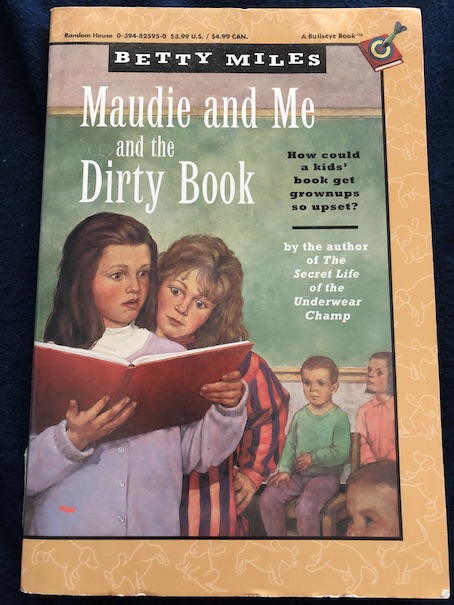
Maudie and Me and the Dirty Book

There’s a lot to discuss here, so I’m going to break up this whole entire review into themed sections and because this is going to be pretty long, I’m giving the link to the copies of the book on Internet Archive here.

Kate thinks of herself as a perfectly ordinary middle school girl. She’s certainly trying her hardest to be normal and cool and hang out with the “right” people. (In that compulsive way some people have when they’re just really trying way too hard because they feel like they’re supposed to. I’ll be honest, I found Kate to be a very trying character for about the first half of the book, and I have things to say about that in my reaction.) She’s very deliberately “normal” and her biggest worry is figuring out who the “right” people are to be friends with that it takes her completely by surprise that volunteering to take part in an English class project lands her right in the middle of a community scandal.

It’s Kate’s first year of middle school, and so far, Kate likes English class and her teacher, Ms. Plotkin. English was always her favorite subject, and Ms. Plotkin is one of those people who can make any subject or project sound exciting. Ms. Plotkin has a friend who is a first grade teacher at a local elementary school called Concord, and the two teachers think it would be a good interschool project to have middle school kids volunteer to read to the younger students to get them excited about reading and books. Kate volunteers right away because she loves reading and little kids. She’s been thinking that she’d like to earn some money by babysitting, so this reading project would be good experience that she might be able to use to get babysitting jobs.

Kate hopes that her best friends from elementary school, Jackie and Rosemary, will also volunteer for the project so they can do it together, but they don’t. The only other kid in class who volunteers is Maudie. Maudie has already been unofficially labeled as one of the uncool kids that all the cool kids avoid because they’re just not like the other, cool kids. There’s nothing seriously wrong with Maudie, but she’s a bit fat and Kate thinks of her as a kind of “dope” because she isn’t trying to act cool or normal like Kate and her friends do and generally isn’t trying to be like them. Kate even actively participates in all of the jokes and mean comments about Maudie that the other kids make behind her back because these shared “jokes” and slurs about Maudie are part of their bonding process with each other and define their in-group as being not-Maudie type people. (Oh, yes, I definitely have issues with Kate that I will rant about later.) That’s why Kate is horrified at first that she might have to actually work with and talk to Maudie if they’re the only ones doing this project together. Maudie is kind of fat, doesn’t quite dress like the other kids in small ways, and just kind of gives off an uncool vibe that’s sure to get Kate labeled as “uncool” if she has to hang out with her for this project. If that happens, she might become (gasp!) a not-popular person because the “right” people will avoid her. (Oh, noes! However will you manage?)

Maudie tells Kate that she volunteered for the project partly because she really likes working with kids, like Kate does, and she was hoping that she and Kate might be friends since they like the same sort of things. Maudie comments that she doesn’t like the atmosphere of this middle school because of people’s attitudes and obsessions with hanging out with the “right” people and being part of cliques. These are mature, sincere comments that shows insight into someone else’s character, and Maudie is correct that Kate is part of an exclusionary clique with Jackie and Rosemary. Maudie’s comments are actually a rather unsubtle hint at Kate that she’s being a bit of a snob and that she could be a nicer person if she could think outside of her snobby clique. Maudie is fully aware of what Kate and her friends are saying about her, and this is an invitation to Kate to change and be a friend, but Kate doesn’t get it at first. She’s too worried about seeming too friendly with uncool Maudie and what other kids will think of it, particularly Jackie and Rosemary.

Kate even thinks that she feels sorry for Maudie, wondering what it’s like to be her and mistaking her sincere offer of friendship for a desperate need to make a friend. Maudie’s actually just being a normal level of friendly in this conversation, but Kate’s assumptions about uncool people have given her a false view of reality. When Kate tries to imagine what it’s like to be Maudie, she’s not actually imagining herself as the real Maudie because she doesn’t really know Maudie at all and wasn’t really listening to Maudie when she was talking because she spent that time thinking about how not to say too much to her or be too friendly. Even though Kate kind of acknowledges that there’s nothing really wrong with Maudie, she still thinks of Maudie as a problem because of the social implications of seeming to like a person the “right” people don’t like, not realizing that the meanness she’s helping to enable is the real problem. (There’s nothing really wrong with Maudie, and I see a lot wrong with Kate and her friends because of their attitudes and the way they think about things. I’d also like to point out that Kate is not filled with sympathy at this point; she’s been nothing but self-pitying because of what she thinks is going to happen to her popularity at school for being seen with the wrong person. She’s projecting that self-pity onto Maudie who is, by herself, just expressing honest sincerity.)

At first, Kate tries to think if there’s a way that she can back out of the project, but in the first glint of honesty about her, she admits that she actually wants to do the project for the sake of the project itself. I always like people who have a particular hobby, cause, or interest that they like for its own sake because that’s a sign of a real personality or character. Standing up for a special interest and doing it anyway, even if nobody else is, also shows a strength of that character that’s worthy of respect. This is the one trait that made me willing to stick out the book with Kate, even though I seriously didn’t like her, because it showed the promise of character development.

Kate also finds additional willingness to continue with the project when Jackie passes her a note telling her to get out of the project so she won’t be “stuck with fat Maudie.” Even though Kate realizes that she was thinking the exact same thing and might have even said so out loud among her friends, it actually looks really bad and mean written out on paper in black-and-white. Kate thinks that writing it down makes it worse, not realizing that there’s really no difference at all, and it’s the thinking behind it that needs to change. Also, she finds it irritating that Jackie seems to think that she can tell her what to do. (I think that’s a legitimate complaint.) After they get out of class, Jackie even snubs Kate to hang out with other kids, and Kate knows that she’s lying to her about the reasons why.

Kate’s mother is actually glad when she hears that Kate will be doing the project with Maudie. Kate’s mother says that she doesn’t like it that Kate is so clingy with her old elementary school friends and that she’d like to see her branch out and meet some new people. (She doesn’t say why she wants Kate to do that, but at this point in the story, I’d already figured out why.)

When it’s time for Kate and Maudie to go to their volunteer project, a girl in class whispers a mean joke about Maudie to Kate, and Kate giggles. Then, Kate sees Jackie whisper something to the other girl and the two of them giggle. Kate suddenly wonders if Jackie is making mean jokes about her, and suddenly, it doesn’t seem as funny anymore.

(Oh, good grief! Is this the first time in her life she ever thought of this? You know, people who gossip and make fun of others (surprise!) spend their time gossiping and making fun of others. It’s what they do, and yes, they do it to different people, depending on who they’re talking to at the moment and who isn’t around to know. If someone gossips meanly about someone else to you, then yes, you can be confident that they’re gossiping meanly about you and making fun of you with someone else when they think you’re not listening. It’s their mode of communication and how they bond with people, and they have no idea why you’d have a problem with them doing to you that because you laughed with them before about someone else, so you must be okay with it and have no reason to get mad. I get impatient with people who don’t think about these things, and if Kate had the imagination to really put herself in someone else real shoes before, she should have thought of this long ago. She should know the kind of person Jackie is from years of experience with her, and she should have figured out that she wouldn’t like other people to say things about her that she’s been saying about Maudie. I feel like Anne Shirley from Anne of Green Gables, saying that if she had any real imagination, Kate could have put herself in someone else’s place and figured out what other people might be feeling, but she doesn’t do that because she’s too self-absorbed and doesn’t get it until someone does it directly to her within her hearing. Kate has plenty of self-pity but no sympathy, at least not at this point.)

The first chapters of this book were pretty painful for me because I had to put up with the kind of people I really hate, including the one telling the story, but fortunately, it does get more interesting from this point on. As they walk over to the elementary school, Kate and Maudie have a fun moment where they throw snowballs at a stop sign, and Kate forgets to be “cool” and snobby. At the elementary school, Kate has fun meeting the cute little first graders, and the first grade teacher reads Make Way for Ducklings to the class. Maudie also introduces Kate to the elementary school librarian because this is Maudie’s old elementary school, and she knows the faculty. The girls talk about Maudie’s time at Concord, and Maudie admits that she kind of misses it because it just seemed so much more friendly than Revere Middle School. Kate feels a little sorry for Maudie because she mentions that her best friend has moved away, and she asks if she’d like to go to the library together to pick out some books. Maudie accepts and says that she can hang out at her house afterward, if she wants, and Kate gets worried again that Maudie is starting to think that they’re actually friends or something. (Once again, oh, noes. However will you manage, Kate? You might accidentally give off vibes that you might be a likeable person or something, and how ever will you be popular if too many people in that vast sea of “wrong” people outside of your tiny clique like you?)

Kate and her friend Rosemary talk about the project a little, and Rosemary asks her what it’s like working with Maudie. Kate says that Maudie isn’t bad when you get to know her, and she is pretty good with the younger kids. Rosemary says that she’s been thinking that the comments people keep making about Maudie are really mean and she doesn’t deserve them because there’s nothing really wrong with her. Kate agrees.

Kate feels a bit bad about going to the library with Maudie because Jackie and the others are going skating, and Jackie is acting like she doesn’t even care that she isn’t going to be there. (It occurred to me that Jackie might actually care that Kate’s doing something with someone else and is trying to play it cool, but it’s dumb because that attitude just drives people away anyway. Either that, or she’s realized that Kate is somebody else to make fun of or gossip about with other girls, and that’s easier to do when she’s not there to defend herself.) Kate not only feels a little bad that she’s missing out on something with her friends, but she comes to realize that she’d rather go to Maudie’s house after the library after all because Maudie at least acts like she wants her around and Jackie doesn’t. Jackie seems to dodging her and trying to get rid of her to hang out with others. Also, it seems like all the other girls are obsessed with the new boy at school, Steve. Kate knows Steve slightly because his parents bought their house through her parents, who are realtors. (Ah, perhaps that’s why Jackie is acting weird! Instead of seeing Kate as her old friend, she’s starting to suspect her of being a rival for a cool guy at school.) However, Kate doesn’t really know Steve very well, and she finds the other girls’ fawning attitudes toward him embarrassing.

At the library, Kate and Maudie talk about their favorite kids’ books and try to pick out some books that will really please the first graders. Kate remembers that one of the first graders had told her that he was excited about getting a puppy, so she decides that she’d like to get a book about puppies. The librarian, who is actually a distant cousin of Kate’s, suggests a book called The Birthday Dog. It’s about a boy who wants a puppy for his birthday. The dog who lives next door is going to have puppies, but the puppies won’t be born in time for his birthday, and he’s disappointed at not getting a puppy for his birthday. Then, he gets a birthday card that says that he can have one of the dog’s puppies after they’re born. The boy and his father even get to see the first puppy being born and how the puppy grows until he’s big enough to leave his mother. The librarian says it’s a good book because the pictures are clear and realistic. The girls decide that they’ll use this book because of the puppy theme and because the boy in the story is about the same age as the first graders. This is where the censorship issue comes into the story. (More on this below, much more.)

Note: The Birthday Dog is not a real book, at least not as far as I can tell. Some of the children’s books mentioned in this book are real books, but some of them aren’t. I think it’s better for the purposes of the story if this picture book is not real because real books often have emotional baggage attached to them, possibly because of feelings of fond nostalgia because people liked them when they were young, resentment because of something the books said or the manner in which teachers or parents forced the books on them, or things people have heard other people say about books, even if the listeners haven’t actually seen the books themselves. For the purposes of this story, which is about examining people’s reactions to controversy, it’s better to approach this particular book with a clean slate, seeing it for what it’s described as being in the story and people’s reactions to it for what they are, removed from any personal emotional baggage. Assume from this point on that the book is exactly as the characters who read it describe it as being, nothing more and nothing less and that all reactions to the situation are exactly as described, nothing more and nothing less.

Kate does go to Maudie’s house, and she starts to learn that she and Maudie have some things in common and that even their mothers act very much the same way. Maudie’s mother has also been pressing her to make some new friends. Kate discovers that Maudie also enjoys old Marx Brothers movies and Maudie has a talent for impersonation. (Finally! A thing that you like, Kate! Early in the story, she was mainly about what she didn’t like and her preoccupation with being liked by the right people. Cool people in stories (and frequently in real life) never seem to genuinely, unironically like anything, especially things that are honest, goofy fun. It’s especially heartening to me that she likes something that not all of her friends like, so Kate is actually showing more signs of independent thoughts and feelings and interests beyond generic coolness and popularity-building. I’m emphasizing this because this was the point in the story to me that Kate started seeming like she might be a real person with an actual personality. Up to this point, she seemed like a two-dimensional wanna-be popular mean kid snob with no self-awareness.) By the end of the day, Kate actually begins looking at Maudie like a real friend and doesn’t seem to mind the idea. (Which means that Kate will finally stop getting on my nerves with her snobby, unaware mean girl act, and I can stop belaboring that point.)

Note: This is the part of the story where we get into issues of censorship and controversy in children’s literature. I think the earlier social machinations, cliques, and using negativity and putting other people down for the sake of personal promotion also ties in with this theme, which is why I went into detail about that before getting into this part of the book, but I’m going to discuss why it’s important later. One thing to keep in mind is that it isn’t unpopular Maudie who selects and reads the controversial book; it’s Kate, the one who’s been trying desperately hard to fit in with the “right” people and be popular and “normal.” Kate is about to be the one who will be ferociously judged by both other kids and adults for doing something controversial. For now, let’s get into the book controversy.

The next time the girls go to the elementary school, they show their books to Ms. Plotkin before they leave, and she approves of their choices. (This is key for the censorship issue. Keep in mind that the girls didn’t choose their books by themselves. They had recommendations from a librarian and the approval of their teacher for their specific selections.) Maudie reads her book, Little Bear, to the class first, and then Kate reads The Birthday Dog. The part where the puppy is born describes the mother dog’s stomach rippling, how she pushed the puppy out, and how she bit at the thin sac that covered the puppy when it was first born. Kate is reassured that the kids seem to like the story, but then the first grade teacher allows the students to ask Kate questions about the book, and Kate isn’t prepared for what the kids ask.

When one of kids ask how the puppy got inside its mommy, Kate looks at Ms. Dwyer, the first grade teacher, and Ms. Dwyer just nods at Kate to answer, not giving her any help or advice about what to say to a first grader about this.

(I just have to step in again at this point and say, if it were me as the adult present for this scene, I’d have noticed Kate’s discomfort, recognized this as a sensitive topic, and stepped in and said, “I’ll take this one, Kate,” and then said something that answers the question in the simplest, most literal terms without getting too deep or detailed. In this case, I might have said something about how that’s simply the way that babies begin to grow. It’s normal for babies to grow inside their mothers before their born because they are very small and weak at first and need some time for their bodies to develop before they can do even simple things like move around, eat, and breathe air on their own. Some animals lay eggs, like chickens, and the babies grow inside them and hatch out of them when they’re ready, and some animals have the babies grow inside their own bodies, like dogs, until they’re ready to come out. The mother’s body helps to protect them and give them what they need so they can grow. People are like that, too, and that’s why pregnant women look big around the middle before their babies are born, because the baby is growing inside them. But, it’s not a good idea to make a big deal about the way people look because you don’t want to make them feel bad or too self-conscious about their appearance (and I hope you know that I mean you too, Kate). Just be extra nice to pregnant people because it’s hard work carrying a growing baby around. If you want extra details, I recommend that you ask your parents because they’ve had kids before, and I haven’t, so they could describe how that feels better than I could.)

Kate stumbles about a bit, searching for a way of describing it, saying something about the father dog, but stopping because she isn’t sure what she should say or if she’s saying too much. But, some of the first graders begin blurting out bits and pieces of what they know, and some of them know more than Kate expected. One of the kids says that the father dog puts a seed into the mom. Kate says that’s correct and that’s called “mating.” Soon, little first graders are using words like “vagina” and “penis.” It’s important that the first graders are the ones who introduce these words into the conversation themselves, not Kate or the teacher or the book. Little kids like to receive recognition for things they know or things they have, so some of the kids are more than happy to show off what they know and to publicly declare which of those two they have. The first grade teacher just says that what they’re saying about the mother and father dog mating are correct and that’s how puppies start. Kate has a moment of panic when she’s afraid that the kids will start thinking about human babies and how she doesn’t want to go into detail on this subject, and she’s relieved when the kids return to the subject of dogs and start talking about their pet dogs’ names. Again, kids like to receive recognition for things they have and to compare things they have with others. When it’s pet dogs, it’s not as embarrassing.

When it’s time for Kate and Maudie to leave, Ms. Dwyer says that Kate handled the situation well, saying, “Kids this age can be embarrassingly frank! But I don’t want them to think there’s anything wrong with their natural curiosity. I’m glad you could answer them so matter-of-factly.” The girls bond over this odd, embarrassing incident, and they think that Kate seems to have handled it okay. Kate even reads the book to her elderly Aunt Lucy at her nursing home and some of the other elderly people there, and they like it, too. Then, the girls and their teacher start getting parental complaints.

The complaining parents in the story don’t handle the situation with grace and understanding, and they make things worse. Rather than defusing the situation and diverting focus from an issue that they didn’t want to discuss in the first place, they blow it up to the point where nobody in the community can ignore it. They phone the principal of the elementary school and the principal of the middle school. They go down to the library and demand to see copies of The Birthday Dog. Soon, everybody in the area hears some version of what happened in the first grade classroom, and just like in a game of Telephone, the events become mangled and confused. This is what I mean about misconception and misrepresentation and how people use these to further an agenda. Be prepared for more of this.

When the girls return to school after the weekend, Ms. Plotkin tells the girls that they need to have a talk with their principal. In the principal’s office, they tell the girls that some parents have complained about The Birthday Dog and the discussion that took place afterward. Ms. Plotkin and Ms. Dwyer take responsibility for allowing Kate to read the book and discuss it with the younger kids, and Ms. Dwyer says that she thinks Kate handled the discussion well. The girls feel like this situation is unfair. They didn’t really do anything wrong, and there are other people involved who also didn’t really do anything wrong. They don’t want the principal to blame their teacher for what happened. Kate feels responsible for having chosen the book in the first place, and Maudie even defends her, saying it was a good book and Kate didn’t do or say anything wrong. Kate appreciates her support because nobody had a problem with the book that Maudie read, and she didn’t have to stick up for her. The librarian helped Kate to choose it. Kate picked it based on her recommendation, so she’s involved, too.

The principal tells Kate that he wants to see the book in question, and he asks Kate to recount the entire discussion in the first grade class. It’s an uncomfortable conversation because Kate is a young girl and the principal is a grown man who is not related to her in any way, and Kate doesn’t like the idea of being forced to discuss anything related to sex with him, even if it’s an innocent recounting of a mildly embarrassing conversation. (If some parents don’t like being put on the spot discussing the issue with their own children, just have a little imagination and understand that this is even more uncomfortable for Kate, who is not related to the principal or anyone else involved with the exception of the librarian, and she is also subject to their authority because she’s a student and a minor. This is what their reactionary complaints have led to, and there’s worse to come.) Kate is accurate in her description, and the principal warns Ms. Plotkin about the importance of choosing appropriate materials for students because of parental anxiety about sensitive issues. Even though the principal acknowledges that the book seems pretty innocent from their description, the anxious, complaining parents can cause a lot of trouble for the schools, so they’re going to suspend the interschool reading program for the present.

This is where Kate begins to experience the varying reactions that people have to the incident, and the ways in which people approach the situation and Kate herself say things about their characters and their relationship with Kate. Kate begins to discover who her real friends are and has to face the wrath of people who are more concerned with their own agendas than they are with her or even the little first graders.

Of course, word spreads around the middle school that Kate and Maudie were called to the principal’s office, and rumors spread about the reasons why. Some of the students have heard bits and pieces of the story, and they’ve become exaggerated, just like the mean girl comments that people were making about Maudie in the beginning. Josh, Kate’s older brother, seeks her out at lunch and demands to know what people are talking about when they say that she was reading a dirty book to first graders and got called to the principal’s office about it.

Kate defends herself, saying that the book wasn’t dirty. She hates it that people are calling the book dirty because they’re making her seem like she’s a dirty person for reading it. Kate is afraid that people are looking at her like she’s a monster, even though she didn’t do anything wrong, and that they’re all going to hate and avoid her now because people are saying things about her behind her back and everyone will think that there’s something wrong with her when there isn’t. (Oh, gee, why does that sound familiar? This is where the story about censorship starts to tie back into the social maneuvering and nasty gossip from before. Kate started out being one of the active participants in this type of behavior, along with what she considered the “right” people, and now, she’s seeing what it’s like being on the receiving end of that same behavior from the same “right” people.) After hearing Kate’s description of what happened, Josh advises Kate not to panic and not to let anybody get to her or to try to explain the situation to anyone because it’s nobody else’s business. Their parents will support Kate and defend her to the complaining parents.

Rosemary also gives Kate a kind response, asking if she’s okay and telling her that not to feel bad if people are trying to make her feel bad for no reason. Kate does confide in her about the situation, and Kate, Rosemary, and Maudie also share a laugh at the ridiculousness of the situation because it was kind of funny to see the little first graders saying all of that stuff, completely unaware that it was potentially embarrassing, and even the principal looked embarrassed when Kate honestly recounted what the first graders said. Rosemary invites Maudie to join her and Kate in having lunch with Jackie and Christine. Jackie pesters Kate for details about what happened, but Kate decides that she doesn’t want to discuss it with them, and Jackie acts jealous when Steve says hi to Kate. Jackie and Christine leave the other three girls, confirming that an imagined rivalry over Steve is part of the reason why they’re acting like jerks.

Kate even thinks, “I didn’t know why Maudie would want to sit with us, if Jackie and Chris were going to act so snotty. I suddenly wondered why I should always sit at the same table. At least every time. I realized that no one was making me. I could sit anywhere I wanted. Maudie and Rosemary would probably go with me.” This is exactly what I was thinking and glad that Kate had this realization. Rosemary is a real friend who is worth retaining, but Jackie is drifting away, and it’s just as well for the other girls to let her go and develop a budding friendship with Maudie.

Kate’s parents are supportive of her, but they also worry that a fight over censorship could tear their community apart. Kate’s mom said that the elementary school principal would be required to take any complaint by parents seriously, but Kate points out that, by choosing to take this complaint seriously to spare the feelings of the adults seems to legitimize the complaint, like a tacit acknowledgement that something inappropriate happened even when it didn’t and that Kate did something wrong, even when she didn’t. In trying to spare the feelings of the uninformed and panicky parents, Kate feels like the adults seem prepared to throw her under the bus and slander her all over town. The middle school principal’s obvious lack of support for Ms. Plotkin also seems to be throwing her under the bus. It’s also already too late to worry about a fight starting, because it’s already begun and battle lines are being drawn.

I’d also like to point out that, to an extent, the battle lines were already drawn before Kate ever joined the reading program and read the book. The way that people react to issues stems from the issues in their own lives, their emotional baggage (you can’t live to adulthood without having at least some because real life experiences do that), and the goals that people want to accomplish. Kate was just unaware that these adults cliques and issue-based factions already existed, which is why she didn’t see this situation coming and accidentally put herself into the middle of it as their latest, hot-button target issue. It seriously bothered me because some of the adults in the story are bonding with their respective factions over the negative things they’re saying about young Kate, not unlike how Kate and her friends were originally bonding over saying nasty and derogatory things about Maudie.

The Millers, a difficult family who have been routinely complaining to Kate’s parents about a house they bought from them, frequently demanding that they solve problems that the Millers caused themselves, phone yet again to complain to them about Kate because the child of a neighbor of theirs was in the class where Kate read the book. (Note: It was not their child in the class, it was a neighbor’s, and we are not told how the neighbor feels about it. The neighbor likely does not know that Mr. Miller is even making this telephone call.) Mr. Miller thinks that Kate’s dad owes him an explanation for something he didn’t witness and no member of his family was involved in and that he just kind of vaguely heard about. This issue has nothing to do with the Millers and is none of their business, but from the descriptions of their behavior, the Millers have personal issues and a desire to make others accountable for things while not being accountable for things they do themselves. This is part of how people’s personal issues dictate where they stand on public ones and how they demonstrate what they’re thinking and feeling. It wouldn’t matter to the Millers what Kate said or did because they’re just the type to want to stick something to someone, anyone, for any reason they can find. It doesn’t have to make sense because the Millers are unreasonable people, so they do unreasonable things. That’s what makes them unreasonable people. Maybe it does make a kind of sense when you think about it.

Right after that, a parent of one of the students in Ms. Dwyer’s class calls to express her support for Kate and offer her a babysitting job, like Kate originally she wanted. In every conflict, there are going to be supporters as well as haters, and it’s not all bad to be part of a controversy when you’ve got the right supporters. The same choice or set of circumstances will get different reactions from different people, and Kate is learning that there’s no such thing as being popular with everyone. No matter what she does in her life, she will draw some people to her who understand and accept her while others will be pushed away, and it’s just a question of who she wants to bond with and how. In this parent who understands the situation and approves of how Kate has been handling it, Kate has finally found a “right” person to be friendly with who is using helpfulness and positivity instead of meanness and negativity and someone to bond with over shared values.

Ms. Plotkin comes to Kate’s house after a meeting of the teachers and principals involved and the librarian, and she says that they’ve come up with some ideas for defusing community complaints. However, word of the controversy has already spread, and Kate’s entire family is feeling the impact. People are writing angry letters to the editor of the local paper, and one of those people happens to be the father of Josh’s girlfriend, Denise, prompting her to break up with Josh. Kate reads these letters and feels horrible. They imply that she’s immoral or that she’s a dope. Kate thinks, “I wished I could just laugh at them, but I couldn’t. Those dumb letters hurt my feelings. Whoever made up the poem about ‘sticks and stones’ was wrong. Words do hurt you.” I’m glad that she realizes that, but I still would have liked it better if she hadn’t been a snob at the beginning of the book and said the things she said about Maudie before she got to know her. Kate has improved as a character, but I have less sympathy for someone when they’re on the receiving end of something that they carelessly dished out to others.

Denise’s father’s letter actually isn’t too bad, but Kate feels bad that he points out that it’s not right for someone who doesn’t know a child personally to bring up the topic of reproduction before a child is ready to hear about it, and “it is impossible for even the most well-meaning teacher to know when the moment is right for every child in class.” Kate doesn’t want to think that she accidentally pushed a little kid into learning something difficult before they were really ready and shocked them. Still, Kate remembers that Denise’s father wasn’t there and didn’t see the book or hear the discussion and might not understand what really happened. Kate finds out that Denise actually isn’t upset with her family; she’s upset with her parents for being closed-minded and making a fuss. She didn’t break up with Josh because she’s upset with him or with Kate or the rest of their family. It was because she’s worried about what they all might be thinking of her because of her father’s public reaction and criticism of them. She’s embarrassed by the way her father wrote that letter and added to the controversy, although Kate appreciates it for being one of the more thoughtful and less hateful letters.

(It occurs to me at this point that Denise’s father himself might be one of those “well-meaning” adults who maybe don’t know “when the moment is right” to say something because they don’t fully understand the situation or how his decision to say something affects other people. After all, he has directly affected his own daughter, the kid he should know the best, because he hasn’t considered her feelings or her position or talked her about the situation before he made his public reaction. Maybe just being someone’s parent alone isn’t enough to fully understand the child or the child’s life without that necessary communication.)

Steve tells Kate that some parent told his mother that “young children had been exposed to explicit sex materials” and was up in arms about the general reading materials in schools. This woman and some other parents had a private meeting about campaigning for “decent books.” Steve’s mom wasn’t impressed by that because she’d read some of her kids’ books from school and thought they were fine. The woman, Mrs. Bergen, accused Steve and his sister of reading smut behind their mother’s back and said that their mother should make them show her the books they didn’t show her before. Steve says that, when he used to live in California, there was a big controversy because an eighth grade teacher wanted kids to read Anne Frank’s diary, and the parents said all of the same things about that. (In the unabridged diary, there are parts where Anne Frank reflects on the concept of sex, getting her period, and her body parts, which she looked at on herself using a mirror. If a kid makes it to eighth grade (about 13 or 14 years old) without knowing what these things are or being afraid of them, they’ve got bigger problems than their reading material. That’s my opinion. Kids normally talk among themselves about these things, and for a person not to know any this stuff, they would have to be restricted from forming close friendships with other teenagers, denied the opportunities to discuss it honestly with family, and in modern times, restricted internet access where various sexual references abound and information is a mere Google search away. None of that would be healthy for a person who is only 4 or 5 years away from legal adulthood in our society.)

Kate is actually glad that Steve understands the issue and has opinions about it. She thinks that she wouldn’t like a boy who had no opinions. That was actually a major part of my original complaint about Kate. In the beginning, she didn’t seem to have any kind of individual personality or opinions of her own beyond her desire to fit in with the popular mean kids. By this point in the story, I felt that Kate was becoming a much deeper, more thoughtful character than the shallow, thoughtless little snob she seemed to be at first, so I was happy to see her coming to this realization and to agree with her about something.

Kate’s feelings finally overwhelm her in English class, after she’s been confronted by many people about the “dirty” book. Mrs. Bergen, a character who has not actually appeared anywhere in the story until this point, has been busily calling other parents and generally stirring things up with an exaggerated story that bears little resemblance to the real incident. Mrs. Bergen is clearly a woman with her own agenda and is taking advantage of the situation to manipulate others into doing what she wants. Kate goes on a rant in class about how unfair the situation is and how she doesn’t want everyone to look at her like she’s a monster or a sex maniac.

The class has a real discussion about the issues of censorship and freedom of speech and what teachers have to consider when they’re choosing “appropriate” material for the kids in their classes. Ms. Plotkin says that there are even some books that she’d rather her students not read until they’re older and have more life experience. (I have a story about that from when I was ten, when a friend “borrowed” a romance novel of her mother’s and told me the most shocking bits, much of which I didn’t really understand at the time. Oddly, that’s not what I ultimately took away from that incident, but since we’re on the topic, I will tell you what I took away from that below.) One boy in class talks about how his parents say that there are things that kids should only learn from their parents, and another boy says what if parents don’t tell the their kids things they really need to know because kids have to learn it somewhere. Jackie comments that she thinks some parents are just too embarrassed about things themselves and so they don’t want their kids to know about them, not because the kids can’t handle it but because the parents can’t. (I thought this was actually a surprisingly perceptive comment from her. Actually, I don’t think that Jackie isn’t perceptive. I just think that she doesn’t always use her social perceptions for good.) Mrs. Plotkin says that’s part of it, but also parents are genuinely concerned for their kids. They worry about a lot of terrible things that kids get exposed to through TV and life in general, and most of it is beyond their control, so they focus on the parts that they can control, like the kids’ reading material.

The kids in the English class say that this whole situation is unfair because none of the complainers were there during the original reading and discussion. Not all of these people even had kids who were involved, most of the complainers haven’t even seen the book in question, and a number of them have only gotten upset because they talked to someone like Mrs. Bergen, who wasn’t there and stirred them up with her exaggerated story. They’re reacting in some over-the-top ways when they don’t really know the real situation and don’t even stop to consider that they don’t know the real situation. Their reaction is having a negative effect on innocent people’s lives, by needlessly damaging innocent reputations, and that’s irresponsible. How people approach a situation and try to control their lives impacts others. While we’re discussing the issue of control, it’s also questionable how much some of these adults are controlling themselves, which is the one thing that everybody truly can control in life, even if they have no control over anything else. While these adults are yelling at people at the supermarket and writing angry letters to the editor, there’s something else that they’re not doing that’s even more important and would be much more responsible: sitting down with their kids to have an honest talk about life and their feelings and getting real feedback from their kids about it all to see how they’re really affected.

Mrs. Bergen finally makes an appearance when she confronts Kate’s mother at the supermarket, trying to get her to join her new group, Parents United for Decency. Kate’s mother tells her off before revealing that her daughter is the one who read the book at the school. Mrs. Bergen and her followers are shocked, and some of the mothers seem suddenly uncomfortable to have to deal with the people they’ve been maligning face-to-face, in a setting where they seem perfectly normal and can see that there is nothing really wrong with them. Mrs. Bergen calls Kate’s mother prejudiced because it’s her daughter who read the book, and Kate’s mother tells her that she’s the prejudiced one. She says that the librarian who recommended the book is her cousin and graduated at the top of her class, and she trusts her professional opinion of the book over their “misinformed ranting” when they haven’t even read it.

The local paper also prints some sympathetic letters about Kate and the book, including one written by her great aunt in the nursing home, saying that Kate read the book to her and her friends, and none of the senior citizens were shocked by it.

The issue ends up being discussed at a special public meeting of the school board, where the board votes about whether or not to allow the interschool reading project to continue. Kate feels awkward when her family sits with Denise’s family at the meeting, after the letter that Denise’s father wrote. However, Josh and Denise have made up, and their fathers are actually old friends who worked together, so the families don’t want to sacrifice that relationship for just this one issue. Personally, I agree with Kate’s awkwardness and feel like, if they were real friends, the two fathers could have just talked to each other privately and directly about what happened before Denise’s father sent one of the public letters that stirred the pot. Not only didn’t Denise’s father talk to his daughter, he didn’t even talk to his old friend about the issue before writing an impersonal public letter, read by the whole community! I don’t know why people don’t think of these things. Kate thinks that people around them at the meeting are looking oddly pleasant and civilized, considering how angry and ranting they were in the letters they wrote and realizes that you can’t always tell who’s a mean person because people don’t always look mean when they act it. “It would be more convenient if mean people looked mean so you could tell.”

When the middle school principal gets up to speak, he describes the reading project in a way that makes it sound dull but harmless. When Mrs. Bergen gets up to speak, she spins a story about how the whole thing was a dastardly, premeditated plot on the part of the teachers, who were scheming to tell impressionable children about sex and undermine their morals. (This book was published in 1980, 40 years ago and two years before I was born, so here, I paused for a moment to consider what Mrs. Bergen would have thought about things that “impressionable” children routinely type into Google, completely unprompted. When inquiring minds want to know something, they seek out sources of information, and kids today know way more about some of that stuff than I had the opportunity to learn, not counting that incident when I was ten. Actually, kids write things on the internet that aren’t exactly clean, either. Who needs books and teachers to corrupt innocent children when they can innocently corrupt each other and themselves? I’ve read fan fiction online.)

Mrs. Bergen’s speech doesn’t go over well, to Kate’s relief, and several other people talk. Then, one of the parents of a girl who was actually in the first grade class gets up and is dreadfully upset that they actually named male and female bodily organs in the class. The woman can’t even bring herself to say these words in mixed company because it’s so embarrassing, something that some of the other adults laugh at in the meeting. Kate senses that her mother is about to get up and speak, but she decides that she’d rather speak for herself. Kate says that she’s not embarrassed or ashamed by these words or by the book she read and that the words in question weren’t even in the book at all, the little kids supplied them themselves in a completely innocent way. Also, Kate thinks that it’s good for kids to learn the real, proper names of their body parts and not get embarrassed or ashamed like some adults, and if anyone wants to criticize the book, they really should read it all the way through, not just the one page with the birth. Kate’s impromptu speech is well-received and even Denise’s parents congratulate her.

The school board votes to allow the interschool project to continue with only one dissenting vote. It’s a victory for Kate, but there is something still bothering her. She knows that, while the dissenters are in the minority, her haters still hate her and are against her, and they’re still around, unpersuaded. They might be back to make trouble later, if they find the opportunity. Also, Kate has developed more of an ability to really see things from other people’s point of view with real depth (something she was unable to do even with Maudie at first). Now, she can think about how it would feel to be on the losing side of this conflict, and even to have a little empathy for Mrs. Bergen. She knows that she wouldn’t like to be in her position. Kate even starts to realize that there are limits to things like a person’s individual rights because, sometimes, those rights can encroach on another person’s rights. Where is the dividing line between having the freedom to say something and the freedom not to hear something? (Where is the dividing line to say what you want about another person and the freedom not to be bullied or have your name slandered? Where is the dividing line between freedom of association and the freedom to walk away from harmful relationships? What do you have a right to control or not control?) There is depth to these issues, and because Kate has matured through her experiences, there is depth to Kate’s thoughts about it. The world and other people are more complex than Kate has ever realized before.

Kate’s father says that all of these issues are complex, and there isn’t always a perfect solution. People just have to do the best they can to work things out as they go. Democracy is just like that.

I edited my review of this book from the way I originally wrote it because I wrote the first review more as stream-of-consciousness, and I decided that it was too awkward and difficult to follow. I left some of my reactions in the middle of the story summary because there were things that made more sense to discuss in the moment rather than trying to do a call-back to them later, but I decided to explain more of my reactions at the end of the summary.

I remember censorship and book banning were topics in children’s literature and tv shows when I was a kid. Generally, the opinion of those books and shows was that too much censorship was a problem, and there was a recurring theme in such stories that the people who were most vehement about banning books were the ones who had never read them and didn’t know much about what the books were really about. This particular book also has that element, but it goes deeper into the various motivations of people who are concerned about the content of children’s books and the varying degrees of concern they have. I thought that it also had some thoughtful insights into social maneuvering and the nature and behavior of cliques (much of which irritated me, even though I think it’s largely accurate, because cliques always irritate me), and some of it also ties into the nature of the public controversy about the book in the story.

Right up front, I have to explain that this book is about two major issues, but there’s a connection between them. The major issue of the story is censorship, particularly about sensitive topics presented to children. It’s an issue that still resonates today. In the early 21st century, there has been a revival of concern about certain issues in children’s literature, with an intensity and both legal and social consequences for people who tread too close to the edge that have children’s educators and librarians genuinely concerned for both their livelihoods, their own physical safety, and even that they may be sent to prison. However, this story closely examines the social consequences of being a controversial person or one who has been labeled as as someone outside the “right” kind of people. Beginning with the behavior of the girls in the story toward each other, the story examines how groups of people use their reactions to other people to bond with each other or solidify their own public image and promote themselves. What bothers me is that we see that type of social maneuvering echoed in the way the adults behave when the controversy over the book Kate read in class begins. It’s not just kid stuff; it’s people stuff, regardless of age.

This type of using other people for social maneuvering is a big pet peeve of mine. I’m very much against one-upmanship in all of its forms (and I complain about it constantly), so the way the girls in the story were trying to increase their own social cred and bonding with each other by putting down Maudie got on my nerves immediately and stayed on my nerves through the entire story. I personally consider it immature, but as someone who now qualifies as being considered middle-aged, I’m well aware that some adults don’t behave that much different from the way they did when they were young teens. Bowling for Soup made fun of that phenomenon in their song High School Never Ends (song and lyrics on YouTube – it also mentions sex – some adults are still as obsessed with finding out who’s having it with whom and what other people are saying about it as teenagers are):

“And you still don’t have the right look
And you don’t have the right friends
Nothing changes but the faces, the names, and the trends
High school never ends”

I talked about my annoyance with that throughout the story summary as incidents happened. I didn’t like Kate as a character from the beginning because she was an active participant in this without any self-awareness. Kate does improve as a character throughout the story, but it’s only after she’s on the receiving end of something similar to what she and her clique were dishing out. I was glad for the improvement, but it was hard to feel too much sympathy for someone who had previously been on the bandwagon with that.

The major issue hinted at in the title of the book is censorship, but that doesn’t actually come into the story until several chapters in (although the chapters aren’t very long). Before that, from the very beginning of the book, there is another issue about popularity and being part of the in-crowd, particularly that catty form of bullying so often found in schools and all too often afterward in workplaces because some people just never mature emotionally and socially. In particular, I noticed the misconceptions that develop around people because of this type of behavior. The concept of being friends with the “right people” especially bothers me. “Right” for what, specifically? In the beginning, Kate is worried about being popular, but she hasn’t stopped to think about popular with whom. As I pointed out in some of my reactions to the story during the summary, nobody on Earth is popular with absolutely everyone. Life is about making choices, and being in agreement or popular with some people very often means passing up connections with others at the same time.

Kate understands from the beginning that any friendship with Maudie means compromising friendship with her existing friends, who are against Maudie, particularly Jackie. What it takes her a long time to understand is that the same is true of being friends with Jackie. Jackie is mean, manipulative, and controlling, and being friends with her means shutting herself off from relationships with anyone who can’t stand the way that Jackie behaves and the way that Kate behaves in Jackie’s presence. Maudie indicates that’s the case when she has that honest conversation with Kate about how unfriendly people seem at their school, although Kate doesn’t get it at first.

Admittedly, I would never have had this conversation with Kate as a kid in middle school because I was the quiet, introverted type who more often watched others rather than speaking up, and I frequently made decisions without consulting other people about them, especially people I didn’t like. Maudie was trying to talk to Kate to give her a chance to be friends, but in all honesty, I would not have wanted to give Kate a chance as a kid. I wouldn’t have liked what I saw of Kate and her friends, and I would have seen that Kate’s behavior is completely intentional, so I would never have talked to her about anything if I could avoid it. It would have taken a great deal of effort to get along with people like that and, in real life, where there are no guarantees of a redemption arc, like in books and movies, the odds of all that effort paying off would be extremely low. People like that are the way they are because they like being that way, and more importantly, they get some kind of social payoff for it, so I wouldn’t expect them to change that and sacrifice whatever payoff they’re getting or think they’re getting just because someone who wasn’t part of the already-established “right” crowd was nice to them or honest with them. I would have completely written Kate off, and she would probably be too busy snubbing me to even notice that I was avoiding her, so it would probably never matter. She would think that she won by driving uncool me away, and I would be rid of her, so I’d win in the long run. Unless she changed and started being different, but I’d still rather skip associating with her until after that change happened because otherwise, I’d just burn out on her in a hurry.

In dealing with such a person in real life, I know that my existence wasn’t be the reason why she started acting the way she did in the first place, so having her in my life could never be the reason why she’d ever stop being like that, in the absence of another, more negative influence. In a way, the story illustrates my logic in this type of situation. Although she does change during the course of this book, it’s not really because of Maudie’s friendliness by itself. Maudie does present her with an alternate friend and a more positive influence, but what really turns Kate’s character is being treated in the way she has treated Maudie and seeing how awful it is, being gossiped about and treated as abnormal and “wrong” when she didn’t really deserve it. Kate just doesn’t get it in the beginning because nobody has ever treated her like she’s treated Maudie before and doesn’t have the imagination or empathy to figure it out without experience that type of hurt directly herself. What I’m saying is that, in a way, a person like her has to be hurt in that way to understand how it feels because they lack the ability to figure it out all by themselves. Maudie was offering friendship and positivity, but it wasn’t until she started experiencing the pain of the same type of negativity that she was dishing out herself that Kate had the incentive to accept those offers of friendship and more positive influences. If she hadn’t had that type of negative experience, I think it would have taken Kate much longer to make that type of change, or it might never have happened for her at all.

Really, when you begin to think about it, much of this story is about control, both the social aspects and the censorship ones. Kate comes to realize that she has the ability to choose her friends, that she has control over who she spends time with, and that she really would prefer to be with people who are kinder and less controlling of her than Jackie is. It’s Jackie’s attempts to control what Kate does and who Kate sees that begin to turn her away from Jackie, and as I said, I think that’s a valid complaint. The “right” people that Kate wants to be popular with in the beginning seem to be the ones who are in control of who is “in” and who is “out” and who associates with who, until she realizes that she doesn’t like that kind of manipulation and control, and she starts to see that there are other options outside of that negative, manipulative, and controlling group.

This talk about control and manipulation seems a bit dark, darker than the book actually reads, but there are some threads that run all the way through life, and the issues of the classroom do carry on to adulthood and into adult behavior. What kids learn in and out of the classroom shapes what they do and the kind of people they become because kids are all about learning how the world works and how to behave in the world to get what they want. The back of the book specifically talks about popularity and how the main character, for whom popularity is extremely important, has to learn to stand up for what she really believes in even if it’s not popular with everyone. Kate has to accept that she can’t always control how other people see her and how they talk about her, but she still has to learn to control what she stands for, how she expresses herself, what she is willing to do for the sake climbing the social ladder, and where her limits are.

The censorship issues in the book are also about control. Some of it is about social control, from the way the adults start forming little groups and cliques around the issue of the controversial book, using their badmouthing of Kate and “dirty” books as a bonding issue among themselves, not unlike the way Kate and her friends initially used their badmouthing of Maudie for bonding purposes among themselves. Some adults appear to be using the issue as a way of controlling others and promoting themselves for attention. However, as the teacher and Jackie point out during the discussion in English class, some parents who are worried about the “dirty” book are coming from a place of fear, and it’s specifically a fear regarding their lack of control. The teacher points out that parents try to control their children’s reading material and media consumption because they’re trying to protect them from serious issues and the related consequences, while Jackie’s emphasis is on parents protecting themselves from uncomfortable thoughts and topics by trying to avoid confronting them with their children. I think all of these aspects of control are present in the situation in the book and in real life, to varying degrees in different people, but I also think that both real people and the characters are trying to control things that they don’t actually have the power to control, at least not completely. I think a better response than trying to control the uncontrollable is to develop an attitude of confidence in handling the unexpected and imperfect. Readers can disagree with this interpretation, if they wish, but that’s the way I read this situation.

There are many things in life that are beyond people’s control, from scary world events discussed on the news to unexpected health problems to the awkward things that six-year-olds blurt out in public about their body parts. Human beings do like to have a measure of control because that’s what helps them minimize disaster in their lives, from minor embarrassments to actual harm. I understand the desire for control and certainty. However, I also believe in limits.

I believe that there are limits on what people can control in their lives, whether it’s controlling circumstances or other people, and I think there should be limits on what people can do to assert control over their lives by controlling other people. Human beings are naturally limited creatures. We never have full knowledge of anything, and there some things in life that you just can’t change, like the fact that human beings have certain body parts, and some girls do look at their private parts with a mirror like Anne Frank did because they’re curious about what’s part of their own bodies, and it’s really the only way to do that. Hey, they’re stuck with those parts, and people with female body parts get periods, whether they like it or not. Simply having a physical human body with all the related bodily functions is just one of the many things that nobody can control. Nobody asks anybody ahead of time if they want their bodies to be the way they are. They just are, and as people grow up, they have to learn about what things are and how to deal with them because that’s how the world is. Their bodies will still have the same parts that work the same way, whether they know the names of them or understand their function or not, and everyone reaches a point where they simply can’t avoid knowing.

Denise’s father said that “it is impossible for even the most well-meaning teacher to know when the moment is right for every child in class,” but his assertion, although “well-meaning” itself, also contains a couple of assumptions that may or may not be true. First, is there really such a thing as one, single “right” moment to confront some of life’s realities? Maybe there’s a “right” time for that, and maybe there isn’t. Maybe there isn’t any such thing as a perfect moment, and maybe life is more of a series of moments and gradual learning opportunities. Some realizations don’t come all at once but in stages and steps, some planned and some not. The discussion in that took place in the class of first grade students could be considered one such step in the lives of the students, although the way it reads sounds like it was more of a revealing of the level of understanding that some of the young students currently had rather than a presentation of new information because much of the talk was volunteered by the students themselves.

Second, Denise’s father seems to be assuming that parents are able to tell when when the “right” moment arrives for their children and will act accordingly when it does, and as an adult with over 40 years of life experience, I know that isn’t true. I’ve known and known of girls who were surprised and terrified by their first period because their parents didn’t think that the “right” moment had arrived until after their little girl started bleeding and absolutely had to be told that they weren’t dying and didn’t need to go to the hospital. (See some of the recountings of first periods on the CVS website for examples. I know a couple of others from friends.) It’s hardly a magical, heart-warming “right” moment when it plays out like that. Not everything has to be done immediately, today, but that doesn’t mean that parents always make things better by waiting as long as they want to talk to kids about situations that are simply going to arise at some point, without prior warning. Time waits for no one. Maybe when the “right” time comes in children’s life, the adults around them will recognize it and act accordingly, with the right amount of preparation, and maybe they won’t recognize it or have difficulty accepting that the time has come, so they’ll lose the moment and the kid will panic or turn to someone else for the answers they need instead. That type of situation is what some of the kids in Kate’s English class discuss. They seem to be aware that they need to have some understanding of certain things eventually, even if their parents never reach the point of being emotionally comfortable with the concept of them having that knowledge or sharing that knowledge with them. What I’m suggesting is that we can’t always choose the “right” moment to deal with uncomfortable or difficult things. Sometimes, moments just come, and we just have to react as gracefully as we can, prepared or not. The reading of the puppy book and the kids’ questions about it are just those kinds of circumstances.

Even if the puppy book hadn’t sparked this particularly discussion among the first graders, it could have arisen just from seeing a pregnant woman somewhere or one of the kids talking about a pregnant relative or pet in class. Not everything in life can be controlled, and I had the feeling like some of the adults were trying too hard to control the uncontrollable. Adults talk about controlling the books kids read because books are relatively easy to try to control because they’re physical objects, neatly contained between two covers and can remain closed and unread, but the life moments that books portray are nowhere near that controllable. Seeing pregnant people or animals, getting a period earlier in life than expected, or hearing someone talk about something are just things that can happen with no prior warning, regardless of what anybody is reading at the time. In a way, I think that having a brief introduction to certain concepts from a book might take some of the shock value out of something that the kids later see, hear, or experience than if those same circumstances arise when they are completely unprepared.

I don’t think that facing the unexpected is the end of the world. Life happens, and when it does, it might not matter precisely how it happened or whether the timing was inconvenient as long as adults are willing to deal with whatever happens when it does, even if it’s awkward and uncomfortable and comes sooner than we think it should. Kate’s father says that all of these issues are complex, and there isn’t always a perfect solution. People just have to do the best they can to work things out as they go. Democracy is just like that, and so is just plain life. Life can be complex and unpredictable, but we still have to live it as best we can as we go.

Although I strongly believe that life isn’t something easily controlled and that the ability to respond gracefully to the unexpected is important, I do also agree that there are some limits on what children should be shown intentionally and that adults should give it some thought ahead of time. I don’t think it’s entirely a matter of maintaining full control over what children see or making it everyone’s responsibility to just accept whatever people give them and just deal with it, but rather a combination of both. It’s a delicate balance, and it’s rarely perfect, but I maintain that it doesn’t necessarily need to be perfect because dealing with imperfection is a valuable life lesson by itself. Rather than worry about those imperfections and being fully prepared for them, I think it’s more positive and productive to show children that the unexpected, awkward, and uncomfortable are manageable. Things can take us by surprise, and we don’t always get to pick our ideal moments, but we can still manage things, even if it’s a bit awkward, so there’s no need to worry about exactly how life is going to go.

Earlier, I mentioned that, when I was 10 years old, a friend took a racy romance book that belonged to her mother, read it, and told me all the most shocking parts. At the time, I knew what sex was, and I understood the nature of what my friend described, although I’ll admit that I didn’t actually know all the words used in the descriptions. That is, I had some knowledge, but the book was definitely not suitable for girls our age or at my level of understanding.

So, what was the effect on me from this incident? Probably not the one that most people would expected. I knew my friend was intentionally trying to be shocking and scandalous, so I said “Ew!” at all the expected places for what she was describing, but the issue that ultimately stuck with me from this experience was more about relationships rather than sex.

It’s a little hard to describe without telling you what the book was about. Let’s just say that the woman wasn’t satisfied with her husband because she was craving something more dangerous. (This is putting it mildly, but that’s the general gist of it. I can’t remember what the title of this book was, so I can’t tell you now or even look it up myself.) So, after being delightfully shocked and scandalized by this forbidden book, I started feeling sorry for the husband in the story.

From the pieces of the story my friend told me, he actually seemed like he was a pretty nice guy, and he was trying to do things he though would please his wife. He didn’t know how she really felt or what she actually wanted, and that struck me as unfair. Although the book was from the point of view of the woman, I found myself, even at age ten, really not liking her because I thought she was self-absorbed and unappreciative of the relationship she had. She seemed to be all about what she wanted and didn’t think she was getting, and I didn’t think she was looking at her husband as a person who also had feelings and was trying to make her happy. After the initial thrill of the shocking bits wore off, my impression of the characters and their relationship stayed with me. They didn’t have a good relationship.

It’s true that you don’t always know how things will affect other people, especially young children, and for that reason, I do think information should be presented gradually and with some caution. The reason why I’m telling this story is to point out that unexpected reactions aren’t always negative ones. My experience with this book was similar to the one I had with the book on witchcraft that I saw when I was around the same age. I learned about something I didn’t want (even though the characters in the book were married and having sex, their relationship didn’t look good, and I thought the woman’s priorities were messed up), and I learned that I can reject ideas that are unhealthy. A person who already does consider other people’s feelings and puts high priority on people’s welfare will continue to have those concerns. If you already have certain priorities or behavioral standards that fit with your personality, they don’t just disappear. Even if something new and shocking temporarily shakes them, they’ll come back. I’ve realized before that I have the ability to reject things I see that I don’t like, whether it’s a book or a relationship with another person that just wouldn’t be healthy.

My friend really shouldn’t have taken that book of her mother’s without permission. Maybe my friend’s mother shouldn’t have been reading that kind of stuff, or maybe the book has a better ending that redeems the characters. (My friend never told me how it ended. She just wanted to shock me with the scandalous parts.) Over 30 years later, I still have reservations about those characters and their relationship.

I wouldn’t recommend kids read books like this. Not all of them are going to have the revelations I had when I considered the characters’ relationship. However, I do think that a couple of positive ways to prime kids for moments like this, when something is unexpected sprung on them (no matter why or by whom) are to make sure that they prioritize people’s welfare and consider the feelings of everyone involved (including but not limited to their own) and that they understand that not everything people tell them is going to be a good idea and that they have the right to reject things that wouldn’t be healthy or helpful for themselves. If you understand that you have both the right and the ability to walk away from anything, you needn’t fear much about what others might unexpectedly offer. I’d also still recommend that parents make it a point to talk to kids about what’s going on in their lives and how they feel about things, so if anything unexpected arises, you can respond to it quickly. I do also highly recommend that parents read some of the books their children are reading and/or ask them about what they’re reading and how they feel about it. If you regularly discuss what the people in your life are doing and how they’re feeling, you don’t have to wonder and worry about it.

I think a dose of honesty is also a good idea. I don’t see anything wrong with parents admitting to their kids that something has come up unexpectedly and that they’re not sure that they’re explaining things in a way the kids will understand, but that they’re making an effort to help them understand what just happened or what people are talking about. (“This isn’t quite the way I was hoping you would start learning about these things, and I’m not sure if you’ll completely understand what I’m about to say, but since the subject has come up, there are a couple of things that I think are important for you to know about this … Now, I’d like you to think a little about what we’ve just talked about, and we’ll talk a little more about it later, after you’ve had time to consider what I’ve just said, and I’ve had time to consider what else I should tell you about that.”) There are some things you can do to prepare for life’s difficult issues and conversations ahead of time, and that helps, but I think it’s also important to acknowledge that no one is every 100% prepared for everything. That might feel a little scary at times, but at the same time, nobody has to be completely prepared for everything for everything in life. We can still manage if we’re willing to be open and honest and accept life as it comes, dealing with things in the moment as best we know how. Knowing that it’s possible to do that makes it a little less scary.

Who Ran My Underwear Up the Flagpole

School Daze

It’s still just a few weeks into the first new school year at Plumstead Middle School, and Eddie still feels a little out of place. He still feels like he’s a grade school kid at heart and doesn’t fit in with the big kids at middle school. The most grown-up impulse that he has is to frequently stare and smile at Sunny Wyler, and she doesn’t even like him to do that.

Then, something horribly embarrassing happens. Mr. Hollis, the social studies teacher is so late that the entire class gives up on him arriving and decides to go to the locker rooms to change early for gym. Mr. Hollis storms into the boys’ locker room a minute later and barks orders at the boys to return to his class immediately. Eddie, scared to death of his angry teacher, follows this order to the letter – forgetting that he isn’t wearing any pants and is just sitting there in his underwear. Eddie is the only person who doesn’t get any punishment from Mr. Hollis, who is sympathetic to his plight, but that’s not enough to make up for everyone seeing Eddie in his underwear.

Eddie’s underwear has cartoon characters on it, which is just another thing that makes him feel like a baby in middle school. He enlists the help of his best friend, Pickles, to help him burn his old cartoon character underwear, planning to buy some new ones with money he was saving to buy comic books. Then, Pickles suggests to him that he do something else to see how grown-up he is: try out for the school’s football team.

Unbeknownst to the boys, Salem and Sunny are both trying out for the school’s cheerleading squad. Salem isn’t at all the cheerleading type, but that’s the very reason why she wants to join the cheerleading squad. She wants to be an author, and she’s trying to understand different types of people so she can create more realistic characters. Therefore, she sometimes does things that would otherwise be out of character for her just for the experience or to get inside the head of different types of people. However, Salem realizes that she isn’t a very good cheerleader, so she invites Sunny over to consult her on what to do.

In spite of her grumpy, prickly personality, Sunny is actually a very good cheerleader, but she can’t help Salem to improve enough to make the squad. The girls do see Eddie at the football try-outs, though. Eddie’s uniform is really too big for him, his helmet gets turned around, and he ends up with a nosebleed. The coach complains about everything that’s going on with the team and how little time he has to train them and says that what he needs is a manager, so Salem volunteers for the position. Salem is very good at organizing things. With Pickles as part of the school’s small marching band, the entire group of friends is now involved in the school’s football games.

The four kids still have lunch with the school principal once a week, having developed a friendship with him during their rocky first days of school. They tell the principal about their football involvement, and Sunny brings up the subject of Eddie’s Superman underwear that everyone in the class saw him wearing. Eddie denies having any Superman underwear (which is now true), and Pickles backs him up, saying that one pair was just an old pair that he had to wear that day because the others were in the wash. The principal tries to hint to Sunny that she should stop teasing Eddie, but she takes it too far, and Eddie ends up smashing a Devil Dog snack cake (link repaired Nov. 2023) into Sunny’s face. The principal is actually impressed that timid Eddie had to the nerve to do it, and oddly, Sunny doesn’t even seem upset afterward.

Thus begins Eddie’s first steps at learning to be more grown-up. However, it’s not going to be easy for him. His current reputation is going to be hard to live down. The other guys on the football team are all bigger than he is, and he’s been bullied by the big kids since school started. At one practice meet, his pants fall down because his uniform is too loose, and a big kid hoists him in the air to show everyone that he’s not wearing Superman underwear.

But, what Pickles had told Eddie when they were burning Eddie’s old underwear was correct: Eddie might be a kid, but so are all the other sixth graders at their school. Eddie isn’t the only boy on the football team who is new and small. He’s not the only one who is sometimes timid and awkward, either. As team manager, Salem soon begins helping the new football players tie the drawstrings of their pants more tightly because other players are worried about losing their pants like Eddie did. She also begins soothing their various injuries, fears, and ruffled feelings. Around their coach, the boys have to act tough and not cry, even when they’re scared or hurt, but since their team manager is an understanding girl, the boys can sometimes let down their guard and be more human with her. Salem gets a lot of insight into the emotions of football players, and in return, she helps the young players to understand and manage their emotions, too. Eddie resists most of Salem’s help because he’s trying to prove that he’s tough and grown-up, but without her support, many of the other boys would have quit the team.

As the season progresses, Eddie gets the chance to a football hero, the very first player to score a touchdown at their brand-new school, and Sunny realizes that she’d rather be a mascot than a cheerleader because she’s too grouchy to be a cheerleader and nobody tells a Fighting Hamster to keep smiling. However, even Eddie’s football victory doesn’t end the teasing, and somebody runs a pair of Superman underpants up the flagpole to mock him. In a desperate attempt to cheer him up, Salem promises to arrange the thing she knows that Eddie wants the most – a chance to kiss Sunny. Will it work?

The book is available to borrow and read for free online through Internet Archive.

The kids do some growing-up in this book, but not unreasonably so for eleven-year-olds. The party where Salem tries to arrange for Sunny and Eddie to kiss is suitably awkward. As the kids talk about the idea of kissing, they tease each other. I didn’t like the part where Salem called Sunny a baby for not wanting to kiss Eddie. It’s not that I don’t think that’s realistic for some eleven-year-olds, but I believe more in the modern idea of giving consent and respecting someone’s “no” when it comes to anything romantic. That didn’t occur to me when I first read this book as a kid, but that’s what real maturity does for you. The word “sex” does appear in the story when Salem challenges Sunny’s maturity, saying that she probably still giggles when someone says that word, to which Sunny quickly replies, “Don’t you?”

“‘No,’ said Salem, ‘as a matter of fact, I don’t. What’s there to giggle about? It’s nature. It’s as natural as trees and cows. Do you giggle when somebody says trees or cows?’
‘If the tree tries to kiss the cow,’ said Sunny, ‘sure, absolutely.'”

As part of their maturity talk, Salem points out that women do mature faster than men, and that’s why some young women marry older men. Well, that’s one explanation for that, although, as an adult, I can think of at least two more.

To her credit, Sunny thinks of a way to deliver a kiss to Eddie without exactly kissing him. She does it in a joking way as part of a game of Truth or Dare.

As a side plot, the kids were also trying to decide whether or not they want to go to the Halloween Dance at school. On Halloween, they all meet in their costumes, and Eddie is over his Superman underwear embarrassment enough to wear a Superman costume. At first, the kids think that maybe they’ll go to the dance, but on the way, they can’t resist stopping to trick-or-treat and end up changing their minds. They’re not really ready to be completely grown-up yet, any more than they’re interested in romance in any serious sense. What’s more, they’re all fine with that.

This is the book where Pickles makes himself a new skateboard out of an old surfboard that’s big enough to carry not only him but all of his friends, too. He calls it the Picklebus.

Report to the Principal’s Office

School Daze

This is the first book in a series about a group of unlikely friends in middle school.

The start of the new school year is a disaster for Sunny Wyler. Her best friend, Hillary, lives directly across the street from her house, and they’ve been close for their entire lives, always attending the same school. However, because of the construction of a new middle school in their town and changing school zone lines, which happen to be drawn directly down the middle of their street, Sunny and Hillary will now be sent to different schools for middle school. (During my childhood, parents could sometimes ask for a boundary exception for kids from the local school district so they could attend a different school with their friends, but that doesn’t appear to be an option here.) Hillary tries to be optimistic, pointing out that the new middle school that Sunny will be attending is much nicer than the old middle school that she will have to attend, but Sunny doesn’t care about that. She just wants to go to school with her best friend.

Sunny thinks that she’s come up with a plan to reunite with Hillary. She’s decided to make herself so obnoxious at her new school that they will kick her out, and her parents will have no choice but to send her to Hillary’s school. She’s decided to wear an old t-shirt that says “Death to Mushrooms” every day, never washing it, so she’ll smell bad. She’ll refuse to wash her hair, so it will be dirty and greasy. Above all, she’ll have the worst attitude, never smile, and never talk, never even answering if her teacher asks her questions in class.

Eddie Mott first encounters Sunny Wyler on the bus to school. She sits next to him, and he can tell right away that she has problems and a bad attitude, and that’s the last thing he wants for the beginning of his new school year. Eddie is trying to adopt a more grown-up image in his middle school years, and he desperately wants to fit in with the other kids. He’s trying to wear the right clothes, be friendly with other kids, and above all, avoid problems. None of that has prepared him for Sunny.

There is one person, though, who has done his best to prepare for all the kids who will be coming to the new middle school, the school’s principal, Mr. Brimlow. Over the summer, he studied the details of the incoming students, and he can recognize them on sight as soon as they arrive. When the school bus driver tells him that there’s a kid on the bus who refuses to get off, he recognizes the kid immediately as Eddie. Between dealing with Sunny’s aggressive unfriendliness and being roughed up by older kids on the bus, Eddie can’t bring himself to come to the school. The bus driver, impatient to get to his other job, actually drives off with the principal, Eddie, and Salem, a girl with literary ambitions who wanted to study the situation for story fodder, still on board.

Things are generally going wrong all over Plumstead Middle School as everyone, including the teachers, try to figure out their way around, but Mr. Brimlow is calm and good-natured, and getting back to school with Eddie and Salem after their bus adventure breaks the ice between them. When Mr. Brimlow gets back to his office, he finds Dennis “Pickles” Johnson waiting for him. Dennis, who gained his nickname from the time he decorated his family’s Christmas tree with actual pickles and the incident made the local paper, is an amateur inventor who made his own oversized skateboard that looks like a pickle. The reason why he was sent to the principal’s office is that his skateboard won’t fit in his locker, and he can’t have it in class. When Pickles asks the principal what could happen if he were allowed to ride his skateboard around the school, the principal asks to try the skateboard himself. He’s unable to stop himself and ends up rolling into a nearby classroom and crashing into the geography teacher’s desk, proving to Pickles (and everybody else) what could happen if Pickles is allowed to use his skateboard in the school hallways. Mr. Brimlow forbids Pickles to bring the skateboard to school again but also thanks him for the fun ride and invites him to lunch.

Far from being upset by the strange beginning to the school year, Mr. Brimlow is actually grateful for the eccentric students and their shenanigans because he really likes to get to know his students, and he particularly learns a lot about Eddie, Salem, Pickles, and Sunny on their first day. It hasn’t escaped his notice that Sunny is being purposely sour to other people, and it isn’t really a surprise when one of her teachers sends her to the principal’s office after she deliberately answers all of her math problems wrong, misspells everything in a writing assignment, writes all of her assignments in extra tiny writing to make them difficult to read, and then pretends to flick boogers at Eddie.

When she’s sent to the principal’s office, Sunny thinks that her plan of being obnoxious has already worked and that she’ll soon be sent home or to Hillary’s school, but the principal ends up inviting her to lunch along with Pickles, Eddie, and Salem. The principal actually enjoys the experience, and rather than punishing any of the students for their various shenanigans from the morning, he decides to give each of them special jobs to help them settle into life at their new school. Since Eddie was a flag raiser at his old school, Mr. Brimlow gives him that job at Plumstead Middle School, assigning Pickles to help him. He puts Sunny in charge of taking care of an escaped hamster that the kids found, and noting Salem’s interest in people’s personalities and organizational skills, puts Salem in charge of all of the other students as they are given the collective job of coming up with a mascot for the school.

Through these activities, the four kids become friends with each other and also start to become a real part of their new school. Instead of being kicked out, Sunny is the one who comes up with the winning idea for the school’s new mascot, the Hamsters, becoming attached to the hamster that she has to care for and upset during a time when she thinks that he’s dead. (Fortunately, the hamster is fine in the end.) Eddie thinks of himself as a wimp for being pushed around by the older kids, but Pickles becomes his friend and sticks up for him, and Salem writes a story about him to show him why he’s actually a hero in his own small way.

It’s a good story about a group of unlikely friends with likable, eccentric characters. In the end, the principal’s tactic of helping the students to adjust to middle school by getting them more involved works well, and even Sunny realizes that she can be happy in her new school with her new friends while still being friends with Hillary from across the street.

The book is available to borrow and read for free online through Internet Archive.

Trouble at School

The Berenstain Bears

Trouble at School by Stan and Jan Berenstain, 1986.

“When a problem at school
Is kept secret too long,
It can grow ’til a cub
Thinks that everything’s wrong!”

Brother Bear runs into problems at school after he catches a bad cold. While he’s recovering from his cold, he is allowed to watch tv and read comic books. His teacher sends home a packet of schoolwork for him to do, but he ignores it and forgets about it.

He doesn’t remember the packet of work until he’s better and going back to school. However, he soon becomes preoccupied with the news that Cousin Freddie has taken over his position on the soccer team during his absence.

When his teacher gives a quiz on the new lesson in division, Brother fails it. Brother is supposed to show the quiz to his parents and have them sign it, but his parents become preoccupied with Sister, who is now sick, and Brother doesn’t show them the quiz.

The next day, Brother is so upset about his bad grade and what’s happening on the soccer team that he doesn’t go to school. He makes his quiz into a paper airplane and throws it away.

Then, Brother gets the idea of going to see his grandparents for help. He explains the entire situation to them. His grandfather tells him a story that helps put the situation in perspective.

There was a time when Gramps did something wrong, and instead of admitting his mistake, he just kept going and made the problem worse, like Brother did by ignoring his schoolwork and not telling his parents about his problems at school. Gramps says that it’s best to admit when you’ve made a mistake so you can do what you need to do in order to turn the situation around.

They find the quiz that Brother threw away and go home to tell Brother’s parents about his school problems. They’re not happy about the situation, but they tell Brother that “It’s never too late to correct a mistake,” and Gramps proves to Brother that he can do division by having him divide a bag of cookies among the family members.

When Mama takes Brother back to school, he learns that nobody else in class did very well on the quiz, so the teacher is letting them do a retake. Now that Brother realizes what division is really about, he does much better. At the soccer game that afternoon, Brother also gets a chance to retake his old position on the team. If he hadn’t gone to school that day, he would have missed these chances to make things right, but because he did go and took the second chances that he was offered, things were much better by the end of the day.

Adults reading the story will recognize that the reason why Brother’s parents are supposed to sign his failed quiz is because that is how the teacher draws parents’ attention to problem areas that their children have so they can make sure that they can pay extra attention to the child’s homework and help him with his problem areas. It’s not about shaming or punishing the child but getting the child the help he needs to understand the subject. By hiding the bad quiz from his parents, Brother was avoiding the help that his parents were supposed to provide and making the situation worse. Parents can be disappointed when their children bring home bad grades, but this is a situation where parents would rather know than not know if their children are struggling with something because they generally want to help their children when they need it.

The lesson of the story is a good one. Anyone can occasionally make mistakes, have problems, or just plain fail at something, but the people who succeed in the end are the ones who face up to their problems and do what’s necessary to make them right. Some people feel overwhelmed when confronted by problems, but the best thing they can do is admit that there is a problem and that they’re feeling overwhelmed and get help from someone else. Brother could have just told his parents and gotten help with division immediately, as soon as he realized that neglecting his make-up work had left him behind in class. At first, he was too embarrassed and worried to do that, but he did manage to turn things around by talking to his grandfather about his problems and taking the help and advice that he offered. Making mistakes or even failing something doesn’t have to be scary or overwhelming because there are always things you can do to make the situation better and people who are able to help.

The book is available to borrow and read for free online through Internet Archive.

Cupid Doesn’t Flip Hamburgers

The Adventures of the Bailey School Kids

#12 Cupid Doesn’t Flip Hamburgers by Debbie Dadey and Marcia Thornton Jones, 1995.

Valentine’s Day is approaching, and Eddie is annoyed by all of the hearts and girly decorations around the school.  However, that’s nothing compared to Mrs. Rosenbloom, the new cook in the cafeteria at school.  The first time the kids meet her, she gushes about how much she loves Valentine’s Day.  Everything she serves them has a Valentine theme – lots of red foods and heart-shaped foods.  Most of the other kids don’t mind the Valentine theme because the food is better than it used to be, but Eddie resolves to do something about it.

Before Eddie can do anything, Carey, a girl Eddie normally doesn’t like, suddenly develops a crush on him after eating one of Mrs. Rosenbloom’s Valentine cookies.  The next day, Ben, the fourth-grade bully, gets a sudden crush on Issy after eating a Valentine cookie.  Even Mrs. Jeepers and Principal Davis are falling in love!  (Mrs. Jeepers is a widow.)  Eddie becomes convinced that Mrs. Rosenbloom has doctored the Valentine cookies with a love potion!  He thinks that she’s going to use it to take over the school!

At first, the others don’t believe Eddie, and in any case, what’s wrong with spreading a little love around?  The problems start when both Melody and Liza eat Valentine cookies at the same time and both of them fall in love with Howie.  The two girls, normally best friends, start fighting over Howie.  Howie is embarrassed and worried that this weird love fight will break up their friendship.  The two boys find themselves trying to dodge the girls while starting to worry that, if the romance between Mrs. Jeepers and the principal flourishes, Mrs. Jeepers will turn Principal Davis into a vampire. (One of the things I appreciate about this series is how it draws on real folklore and mythology. The boys are right that, assuming that Mrs. Jeepers actually is a vampire, she can’t be in love with the principal without revealing it to him and probably changing him into a vampire, too.)

The boys come up with a plan to change Mrs. Rosenbloom’s cookie recipe for the worst, but before this escapade is over, even Eddie gets a taste of love.  As with other books in this series, Mrs. Rosenbloom eventually leaves the school, and things return to normal (or what passes for normal in Mrs. Jeepers’ class).

The book is available online to borrow for free through Internet Archive.

Aliens Don’t Wear Braces

The Adventures of the Bailey School Kids

#7 Aliens Don’t Wear Braces by Debbie Dadey and Marcia Thornton Jones, 1993.

One day, while Mrs. Jeepers’ class is getting ready to take a science test, they hear a strange sound, and the lights mysteriously flicker.  Eddie tries to ask Howie what’s going on, but Mrs. Jeepers sends him to the principal’s office for talking during a test. 

In the office, things are chaotic because the art teacher, Mr. Gibson, is missing, and the second grade teacher is there with her students, asking where the art teacher is.  Eddie meets a strange, pale woman with long, white hair and braces on her teeth.  She says that her name is Mrs. Zork and that she is there to apply for a teaching job.  The principal asks her if she can teach art, and she says that art is her specialty, so the principal hires her as an emergency replacement for the art teacher.  The principal is relieved that a substitute was so handy, but Eddie thinks that it’s a creepy coincidence.

When Mrs. Jeepers takes her class to the art teacher, she is also surprised that Mr. Gibson is gone and questions Mrs. Zork about it.  Mrs. Jeepers says that she saw Mr. Gibson only that morning, and Mrs. Zork tells her that he “had to leave . . . unexpectedly.”  Mrs. Jeepers tells her class to behave for the substitute, but she also seems somewhat suspicious of Mrs. Zork.

Mrs. Zork ignores Mr. Gibson’s previous lesson about totem poles and starts teaching the children pottery.  She seems confused by ordinary expressions, like “you’re all thumbs” and “This place is a zoo.”  When Mrs. Zork escorts Liza to the nurse for a nose bleed, the kids make other discoveries.  A jar of green paint has suddenly turned white, and Mrs. Zork has an old newspaper clipping about a UFO and a star map with a course plotted on it.  Howie, whose father works for the Federal Aeronautics Technology Station, suspects that Mrs. Zork might be an alien.

The kids spy on Mrs. Zork while they’re at recess.  They see her watching a cartoon show on tv, and suddenly, all of the color drains out of it.  It could have been because there was something wrong with the tv, but the kids notice that Mrs. Zork’s braces flash pink afterward, and her hair starts to look more blonde and her cheeks more pink.  Worse still, after Mrs. Zork admires Mrs. Jeepers’ green brooch, suddenly the brooch (as well as Mrs. Jeepers’ hair and eyes) loses some of its color and no longer works in its usual magical way.  Eddie sees it as an opportunity to goof off, and Mrs. Jeepers seems alarmed and leaves the room abruptly.

The children are worried about Mrs. Jeepers, and they can’t help but notice how the art room is looking increasingly drained of color while their new art teacher is getting more and more colorful.  It becomes more and more obvious to Howie that Mrs. Zork is stealing colors from Earth!

This is one of the books where the kids get the most proof of their suspicions, actually seeing Mrs. Zork’s spaceship in her garage.  Even so, Howie’s father doesn’t believe him when he tries to explain the situation to him.  Mrs. Zork tries to convince the children that the spaceship is actually her pottery kiln.  The kids know that somehow, they have to get their colors back to help Mrs. Jeepers and get rid of Mrs. Zork!  Mrs. Jeepers may be creepy, but at least she doesn’t steal colors or give them eternal math problems, like Principal Davis.

The book is available online to borrow for free through Internet Archive.

Charlotte Sometimes

Charlotte Mary Makepeace is a new student at a boarding school in England.  The school is big and confusing, and there are so many new people to meet that she immediately feels overwhelmed.  Starting life at a new school can be intimidating for anyone, but things are about to get particularly strange for Charlotte.

An older girl, Sarah, helps Charlotte to find her room and choose a bed, recommending a bed by the window.  Charlotte is a little puzzled at why Sarah singled her out and helped her, and the other girls are jealous that she got to the room first and got first choice of the beds.  Still, Charlotte is grateful.  She is exhausted, and she feels like she isn’t herself.  When she wakes up in the morning, she really isn’t herself.

The room where Charlotte sleeps is called the “Cedar” room, and when she first enters the room, the name puzzles her because there are no cedars nearby.  However, when Charlotte wakes up in the morning, there is suddenly a large cedar outside the window.  The tree did not grow during the night.  In Charlotte’s time, the cedar is gone, but Charlotte is now back in the past, when the cedar was still there.  Things in the room are arranged differently, although Charlotte’s bed is still in the same place, and instead of seeing her roommates, Charlotte finds herself alone with a girl she has never seen before, who calls her “Clare.” 

Charlotte is very confused.  Earlier, she was feeling like she wasn’t herself, and now she has the sense that maybe she has really become someone else.  Charlotte doesn’t notice any differences about herself in the mirror, but the other girl doesn’t seem to notice that she’s not Clare, whoever Clare is. The girl just keeps talking to Charlotte as if they already know each other.  The other girl’s name is Emily, and it turns out that she is Clare’s younger sister.  Charlotte finds herself feeling toward Emily the way that she feels toward her own sister, Emma.

Charlotte is forced to go through the rest of the day, her first at boarding school, as Clare.  People keep talking about “the war,” and Charlotte doesn’t know what war they mean at first.  When she went to bed, it was the 1960s.  At the end of a very confusing day, she returns to bed in the Cedar room, where she finds a diary with the name “Clare Mary Moby” written on it and the date, September 14, 1918.  The diary really makes Charlotte realize that she has spent the entire day in the past, and she further realizes that the war everyone was talking about is World War I. However, there is nothing else for Charlotte to do but go to bed.  When she wakes up in the morning, she is once again Charlotte.  Emily is gone, and Charlotte is back in her own time with her regular roommates.  However, it quickly becomes clear that this was not just a dream, and this strange incident repeats itself each day, after Charlotte sleeps in the same bed.

Whenever Charlotte shifts to take Clare’s place in the past, she loses a day in her own time, which helps to convince her that she is not dreaming when she is Clare. Every other day, Charlotte switches places and times with Clare, and she sees the school as it was in the past, toward the end of World War I.  Apparently, Clare is living Charlotte’s life whenever Charlotte is living hers, and nobody around them seems to have noticed the switch.  Charlotte has no idea why this is happening, other than the fact that she and Clare happen to be sleeping in the same bed, in the same room.

Charlotte is fascinated by her trips to the past, but they are disorienting.  She now has two sets of names to learn, the people in the past and the people in the present.  There are different school rules in the past, too, and she was still getting used to the rules in her own time.  Charlotte and Clare also need to do some of each other’s homework for classes, and there are some things they can’t do.  Charlotte can’t write an essay about Clare’s holidays because she has no idea what Clare did on her school holidays, and Clare is very bad at arithmetic, giving Charlotte bad grades.

The next time she makes the switch, Charlotte learns that Clare and Emily do not usually sleep in the Cedar room.  Because of the Influenza Epidemic of 1918, girls have been shifted around as the sick ones are quarantined.  Meanwhile, in the 1960s, Clare has created a new diary in an exercise book with Charlotte’s name on it.  In the book, Clare has written a letter to Charlotte about their situation.  She asks Charlotte to look after Emily when they’re together and to write messages back to her.  Clare doesn’t think they should tell Emily about what’s happening. Clare worries that Emily will be confused and frightened.

However, Emily soon discovers the truth, and Charlotte comes to rely on her as the only person in the past who knows who she really is. Emily notices differences between the way Charlotte behaves and the way that Clare behaves, but they are uncanny in their resemblance and behavior in other ways. In many ways, Emily is bolder than both Charlotte and Clare, although her boldness is often to the point of being brash or callous. She is sometimes impatient with Charlotte and Clare’s softer natures, but their apparent softness is due to their greater sense of life’s consequences and their sense of responsibility for Emily. Emily finds talk of the war and bombings exciting, but Charlotte and Clare are both aware of the dangerous reality. As Emily gets to know Charlotte, she points out the ways that she and Clare are similar yet different, and she says that the more time Charlotte spends in 1918, the more like Clare she is becoming. Charlotte worries about the resemblance between her and Clare and how natural it is becoming for her to act like Clare.

In the present, Charlotte is initiated into the usual pranks of a British boarding school by her new roommates, and in the past, she sees soldiers in World War I uniforms. In 1918, students whisper about whether a classmate with a German father could actually be a German spy, and Charlotte is introduced to air-raid alarms. In the 1960s, Charlotte’s roommates wonder about her funny moods, her odd need to be alone, and her reluctance to be friends and join them in activities. In both time periods, Charlotte is constantly afraid of giving everything away by saying something that would be out of character for the person she’s supposed to be or asking questions that she should already be able to answer if she were living every day in one time period. The one element that seems constant throughout these shifts is the bed that she and Clare share in the Cedar room. However, Clare and Emily will soon be sent to board with a family in town, only returning to the school as day pupils. When the Cedar room is turned into another quarantine room for the sick, Charlotte is trapped in the past as Clare, and she worries that she may never return home again. What will happen to her, and will she lose her identity as Charlotte, becoming Clare forever?

This book is a modern classic in children’s literature!  I decided that I had to read it because so many people have nostalgic memories of this book and have written positive reviews about it.  The Cure even did a song and music video inspired by the book. The song even contains words from the book in the lyrics. This is the original music video that goes with the song. (It’s also on YouTube.)

The book is the third book in the The Aviary Hall trilogy. It is available to borrow for free online through Internet Archive (multiple copies). The other two books in the trilogy are also available on Internet Archive, but Charlotte Sometimes is often regarded as the best of the three and is the best known.

Note: Strangely, this book has three different ending, depending on the edition of the book. Older editions (the original and printings from the 1970s) contain the full text, and newer editions are cropped in two different places. The copies on Internet Archive are different editions and have different endings. This one contains the full text of the original. This one and this one have the endings that include Emily’s letter but not the final scene with Charlotte going home from school. The others don’t have the part with Emily’s letter at all. In order to learn the difference between these endings and the significance of Emily’s letter, you’ll have to read the part of my review that includes spoilers.

I was amused by the part where Emily laughs at the name Charlotte because she thinks that it’s kind of old-fashioned in 1918, yet Charlotte is from the future. Names often go in cycles of popularity, and certain classic names have comebacks at regular periods. Right now, in the early 21st century, the names Charlotte, Emma, Emily, and Clare (or Claire) are all pretty popular. In fact, Charlotte has seen a recent resurgence in popularity in the United States. Modern children reading this would actually find many of the names very familiar, thanks to a trend of reviving vintage and classic names. In fact, some of the 1918 names are more popular these days than some of the 1960s names, like Janet and Susannah. Don’t worry, they’ll have their turn again.

I also liked the part where Charlotte tries to consider whether she and Clare really look alike. Emily is a little vague about whether Charlotte and Clare really resemble each other, saying that she might have just seen “Clare” in her because Clare was who she expected to see and that she never really looked at her properly until she realized that she was actually Charlotte. Charlotte thinks about a time where she tried to draw herself by studying her own features in a mirror, but the longer she stared at herself, the more disconnected that she felt from the features she was seeing. This is actually a real phenomenon, and I’ve read other books where people have mentioned it. You can get some odd feelings by staring at yourself in a mirror for too long. I’ve tried it myself, and it can get a little eerie, especially if you look yourself right in the eyes and try not to blink. The longer you look, the more eerie it gets. That’s how that old sleepover trick, Bloody Mary, works. This is sometimes called the “strange-face illusion.” Although Charlotte is having a kind of identity crisis from switching places with Clare, this mirror phenomenon is something that anyone can experience.

Further Note: At the time that I first published this review, January 1, 2020, I hadn’t yet heard of the coronavirus, and I had no way of knowing that there was going to be an outbreak that would eventually turn into a pandemic. Now, in February 2020, I’d like to point out some things to anybody who is as creeped out as I am about this disease. (I had the images of the influenza in this story in my mind when I first started hearing about the coronavirus outbreak, and it didn’t do a lot for my peace of mind.)

Coronavirus and the 1918 influenza have some similarities and differences. Normal seasonal influenza has a death rate of approximately 0.1%. The influenza epidemic of 1918, colloquially called “Spanish Flu“, had a death rate of approximately 2.5%, and it was frightening because many of its victims had been young and apparently healthy before infection, and they died fairly quickly after becoming ill, in a matter of days. (I have more information about that down below.) It spread remarkably fast because of the mass movements of people between countries due to World War I and soldiers returning home toward the end of the war, to the point where it’s never been firmly established exactly where the virus originated.

The coronavirus (as of February 2020, estimates may change later) has a death rate of approximately 2.3%, and most of those deaths have been people who are very old and/or had underlying health problems. It’s bad, but oddly, also somewhat hopeful because, unlike the 1918 influenza, where it wasn’t always obvious who was the most as risk, we can tell ahead of time with the coronavirus who is most at risk, which is helpful for protecting people who are the most vulnerable. We know where the coronavirus started, and although it has spread to countries around the world, public health officials have been taking steps to quarantine people who have contracted the disease or who have been to regions with known infections. It has spread, but perhaps not as rapidly as the Spanish Flu because the 1918 public health officials didn’t understand what they were dealing with at first and didn’t take the steps that we are taking now. If there was any good side to the 1918 influenza epidemic, it was probably that it taught us a few things about how to handle pandemics, including what not to do when one is occurring. The two viruses aren’t precisely the same, but being aware of what we have learned from past experience may help us to stop the situation from becoming worse than it might be otherwise. I know that what is happening and what is probably about to happen is not going to be good because this is just not a good situation, and that can’t be helped, but what can be helped is how we respond to it and make use of what we already know. This current situation is not going to last, but what we do while the situation still exists is going to determine how well we come out of it.

This is not a good time for international travel, and if you can avoid traveling until this crisis is over, I would recommend doing that. If you are in a safe place, I recommend staying there until the crisis passes, and wherever you are, follow the instructions you are given by your public health officials. Before this is over, you may actually get the coronavirus. (I might, too, and I know that as I type this. I live in Arizona, and we’ve only had a few cases so far, but that’s so far.) Health officials are working on a vaccine, but that takes time, and it may not be widely available until next year. However, if you are not in one of the at-risk groups, you will likely survive the experience if you get it, and if you do what your health officials tell you to do, you can help yourself to recover from the disease and avoid spreading it to others. If you think you may be in one of the at-risk groups, follow the instructions that your doctor gives you and seek help (by telephone first) if you think that you may be ill. Try not to be too afraid because, although I know this all sounds scary, one of the first steps to handling difficult situations is believing that it is possible to handle them and taking the steps you know how to take. Take care of yourselves, and consider others as much as possible, too.

Further update: I am now fully vaccinated as of May 2021! I got the reaction that a lot of people got from the Pfizer vaccine; I felt like I had the flu for about a day after getting the second shot. But, after that, I was fine, and I recommend it to other people (provided that you aren’t allergic to anything in the shots – that seems to be the one real caveat to getting them). If you’re a conspiracy theorist, I have not experienced any weird mind control, and I don’t feel any different than I did before. I’m still reading and reviewing children’s books, making various random craft projects, listening to the same YouTube videos, and getting irritated with people I think are jerks, so my version of normal is still basically what it was before. I wouldn’t say that the pandemic is completely over yet because many people are still getting sick and haven’t had their shots, but having more people vaccinated is a good sign. My home state ended up being hit pretty hard during the worst of it, and we have seen some improvement since then because more people are being vaccinated. With vaccinations now open to people age 12 and over, I’m hopeful that there will be more improvement by the end of summer.

There is a lot more that I’d like to discuss about this book, but I wanted to save this discussion for the end because discussing this story and my opinion of it in depth reveals some major spoilers.

First, I love stories with historical background! When I was in school, my teachers didn’t cover World War I and the 1918 Influenza Pandemic in detail. My high school history teacher, for example, was a major Civil War buff, and she spent so much time going over the major battles of the American Civil War and making us watch Gone with the Wind (which I had already seen and didn’t like because I never liked the character of Scarlett O’Hara) that she kind of rushed through the early 20th century with us, charging onward to World War II. If she said anything about the Influenza Pandemic, it wasn’t much, and it didn’t make much of an impression. In fact, I think that the first time I ever heard about the 1918 Influenza Pandemic (although I can’t remember exactly when I first became aware of it) was through fiction, even though one of my own family members died in that pandemic. However, this was an important, worldwide event that came right at the end of the First World War, and it was shocking because the people who were frequently hit the hardest by the disease were people who were normally young and strong, the people who would usually have been the ones most likely to survive under normal circumstances.

No one knows precisely where and how the pandemic began, although people have attempted to go back through the records and isolate the first cases. This is more difficult than it sounds because the earliest cases of the influenza were lighter, not fatal, and people didn’t think that much about them at first. Also, because of World War I, the mass movement of people across countries due to the war, and the masses of troops returning from the front, the disease was spread farther and faster than it might have been otherwise. Charlotte Sometimes shows some of that real-life pattern. Early in the story, when Charlotte first begins switching places with Clare, a member of the school’s faculty in the past talks about how Clare and Emily were shifted from their old room to the Cedar room because they needed a room for the sick children at the school. At this point in the story, people don’t seem to be panicking about the illness because this was the first phase of the epidemic, when people were getting the earlier, less serious form of the disease, but it’s foreshadowing later events. At one point, Charlotte in the past is blocked from entering the Cedar room and returning to her own time because the disease has spread further through the school and the Cedar Room is also turned into a sick room.

This is a major spoiler, but after Charlotte finally returns home to her own time to stay, she learns that Clare is not alive in her time because she also became ill with influenza, the more deadly form, and she died not long after the end of the war and the end of their time-traveling adventures. At the time of her death, Clare was about thirteen years old and apparently healthy otherwise, which is in keeping with the way this particular illness affected many of its victims. There were a couple of factors which made younger people more vulnerable:

  • Unprepared immune systems and the body’s overreaction – Young people may have had less exposure to less serious forms of the same disease from earlier years that would have primed their immune systems to respond appropriately when they encountered this influenza. The human body has certain natural defenses against diseases, like the way it can raise a fever to kill off invading germs with higher temperatures, but sometimes, a disease can strike so hard that the body overreacts to fight it (the technical name for this reaction is “cytokine storm“), causing more damage to itself. Sometimes, this can even happen to the point where the body’s own defenses damage the body itself so much that the person dies or develops a secondary problem, such as pneumonia, that could potentially lead to their death. This is an important factor to consider when evaluating why this form of influenza tended to kill otherwise healthy young people – their immune systems were the strongest and also less primed than older adults, so they were the most likely to overreact. This is where modern vaccines can help, providing the priming the body’s immunity system needs to properly cope with serious diseases it has never seen before.
  • Secondary infections – The people who died of the influenza tended to die of the pneumonia that set in as a secondary infection in their damaged lungs, possibly partly as a result of the body’s overreaction. This was before the development of antibiotics like penicillin, which we use to treat such infections now. This is also where vaccines come in handy because people who can avoid getting sick also avoid developing secondary problems from the illness. Unfortunately, there was no vaccine available in 1918. It wasn’t even obvious to the medical professionals of the time what they were really dealing with, and they lacked medicines that could have helped because they were developed later.

This is basically what happened to Clare, an otherwise healthy teenager, when she caught the influenza. Clare, of course, is a fictional character, but her life and fate were based on real people of the time. This was part of what made the pandemic so scary. People of the time noticed that even people who otherwise seemed young, strong, and healthy were dying of this disease, and it was happening fast. If you read grown-up Emily’s letter to Charlotte in the longer endings to the book, Clare died in a matter of a few days after becoming ill. (This still sometimes happens, but in this particular epidemic, it was happening on a massive scale.) It was happening all over the world, in small towns as well as big cities, and there was nowhere anyone could go to escape it.

Because of the shocking spread of the disease and the tragic youth of many of its victims, the event has found its way into fiction, even children’s literature. Before it was depicted on the television show, Downton Abbey, it was named as Edward Cullen‘s impending cause of death if he hadn’t been turned into a vampire in the Twilight young adult series (he was also a teenager, although older), and it was also described in one of the books of the Sarah, Plain and Tall series, set in the American Midwest. (None of the main characters die in that story, although Anna becomes a nurse and the others fear for her safety, and they witness the burial of a baby who died from the disease, as one of my grandmother’s younger brothers did in real life.)

I added a note above, discussing some of the ways the coronavirus and the 1918 influenza were similar and different. What I’ve described regarding the 1918 influenza’s effects on younger people does not seem to be the case with the current coronavirus (as of February 2020). There may be exceptions, just like more typical seasonal forms of influenza occasionally become serious even in cases of normally healthy young people (I’m not an expert, so I can’t say what the chances of that are, it seems that an overreaction of the immune system is still a primary concern with the coronavirus), but the pattern for the coronavirus so far is that it is most dangerous to the very old and those with underlying health problems. In this situation, we can do a lot to help them by protecting those we already know are most vulnerable.

There are many other historical nuggets in this book besides the influenza epidemic. As I mentioned before, Charlotte learns about life in British boarding schools in the past, finding the discipline harder and the food not as good (possibly due to war rationing).

Some of her 1918 classmates are suspicious of another classmate, Elsie, whose father is German, and they talk about how their parents think that Germans living in England should be interned in camps to isolate them from the rest of the population because some of them might be spies. Emily asks what kind of information a schoolgirl like Elsie could possibly find to pass on to harm the war effort, and one of the other girls says that if one of them comments about a letter they’ve received from their father, saying that he is with the troops in France, Elsie could pass that to her parents, and they could pass it along to Germany. Emily says that’s silly because everyone knows that there are British troops in various places in France, and even Charlotte knows that all British mail is read and censored during this time. In other words, nobody could say anything specific enough in a letter to their children that would be a risk if little Elsie happened to hear about it. Elsie is also plainly uncomfortable with the other girls’ suspicions. Modern adults would see Elsie for what she is: a little girl, very much like the others, born and raised in England, with little personal connection to the country where her father was born. She’s been caught up in the circumstances of the wider world against her will, suddenly finding herself labeled as an outsider in the only home she’s ever known. As a child, there’s not a lot that Elsie can do about this situation, and one wonders if the adults would do anything to help if they knew about it. This was the level of wartime paranoia, and the children were getting it from their parents. It’s difficult for children to learn to behave calmly and reasonably when the adults in their lives are not doing so themselves.

The war is always present in the lives of the 1918 children. Charlotte is also forced to take part in an air-raid alarm at school. When she and Emily board with the Chisel Brown family, they talk about Arthur, their son who was killed in the war, and at one point, they hold a seance to try to contact him. This is also based on real life. There was a rise in spiritualism and spiritualist practices because of the war, just like there was after the American Civil War. When society has been through something traumatic and lost loved ones, they sometimes turn to practices like this for comfort and the hope of reaching out to the people they’ve lost. When Charlotte and Emily witness the seance, they hear Clare’s voice calling to Emily. The girls are not able to communicate with Clare further than that, and there’s no real explanation for why this happened. It’s before Clare dies in her time, and we never hear from Clare’s perspective at any point in the book.

The family, especially Mr. Chisel Brown, have bitter feelings about the war because of Arthur’s death. The bitter feelings are reflected in the way they speak. At one point in the story, Mr. Chisel Brown says, “Damned peace-talk, damned conchies (conscientious objectors – people who refused to fight for moral reasons), hun-lovers (German sympathizers). Should all be hanged, I say.” This is about the strongest language in the book. The girls’ bedroom at the Chisel Brown house has a rather horrifying anti-German poster in it called “Mark of the German Beast,” and when Mr. Chisel Brown thinks that the girls aren’t behaving themselves, he says that they have “hunnish manners,” using references to Germans as derogatory terms.

Charlotte Sometimes, 1970s Cover
This edition of the book has the full ending.

Another reason to explain about the fate of the characters is so I can explain how different editions of this book are different from each other. There are three possible endings to the book, depending on which edition you have. In all versions, the reader learns that Emily is Sarah’s mother, and that is the reason why Sarah singled out Charlotte and guided her to that particular bed at the beginning of the book, because her mother asked her to be nice to Charlotte and to help her, knowing what was going to happen with Charlotte and Clare.

Some of the more modern printings of the story omit sections at the end of the book that were part of the original story in which Charlotte hears from the adult Emily in modern times and where Charlotte heads home for Christmas at the end of the term. Even books that say they are unabridged (including the one that I have from Vintage Classics) sometimes include the letter and package from Emily but omit the part where Charlotte goes home on the bus with the other children, for some reason. I’ve seen all three ending formats, and each time one of these sections is cropped off the end of the book, it changes the tone of the ending and some of the subtle meaning of the story.

In books without the letter from Emily or the bus ride home, the ones with the shortest ending, the story ends with Charlotte finding Clare’s old diary hidden in the bedpost of their bed with her last message to Clare and no reply, and the book simply ends. It’s just kind of a sad reflection that Clare is now gone, and the adventures are over. Charlotte is just left with the memory of what happened with no further reflection on what’s it’s going to mean for her life in the future. I find this ending rather stark and unfulfilling, and I don’t know why this was done to the book.

In the first section of the book that is sometimes omitted, Emily writes a letter to Charlotte and sends her some toys that they were given as children in 1918: a bag of marbles, a solitaire board (the board game played with marbles as pieces), and some toy soldiers. Charlotte puts the marbles in a glass of water on her dresser (like Emily once did in the past because the marbles look bigger and shinier in water), the first personal touch that she’s given to her place in the dorm because she’s really only spent about half her time there, and she reflects on how her experiences as Clare have become part of her personal identity. She compares her experiences as Clare and the impact that it has had on her to the country’s experiences of the war and how it has changed life for all of them, far after the events were over. World War I changed the world and will remain part of history, just as Clare is now a part of Charlotte’s personal history. I thought it nicely summed up Charlotte’s feelings about how aspects of Clare have become part of her own personality, although there is one further point to be made about Charlotte’s future.

In the final section of the book, which is omitted the most often and is apparently only found in the oldest editions of the book, pre-1980s, Charlotte takes the bus home from school at the end of term after getting the letter and package from Emily. Charlotte is looking forward to Christmas, and she and other children chant a variation of the “No more pencils, no more books” rhyme. (Their variant doesn’t actually use that phrase, although it has the same format.) Charlotte reflects that the countryside doesn’t really look any different in modern times than it did in 1918 and remembers that this is Sarah’s last term at school, so she may never see her (and, consequently, may never hear from Emily) again. The ending that ends just after Charlotte receives the letter from Emily and displays the marbles leaves Charlotte considering how Clare and her experiences in 1918 will always be a part of her, but the bus ride ends with her feeling more comfortable that she is truly Charlotte again, even after these experiences, and will be heading back to her family and her life in the present day. She is changed, but she is now sure of who she is, without her earlier quandaries about her own identity.

Each time a little piece is left off the end of the story, it changes the tone of the ending, but I like the full ending that includes the bus ride the best because, while Clare and the past will always be a part of Charlotte, Charlotte has regained her sense of identity as herself. She is a changed person because of her experiences, but she is still her own person, and her life is going to continue in the present, not stuck in the past. I also think that the part with Emily’s letter is important for settling unanswered questions for both Charlotte and the reader about what happened after the time travel ended and Clare died. In older Emily’s letter to Charlotte, she says that she knows that Charlotte is the worrying type, like Clare was, and she wants her to know that there is no reason to worry about her or her younger self because of Clare’s death. Emily reassures Charlotte that, although she was upset at Clare’s death, her life has turned out well. After Clare died, Emily continued attending the school, staying with her aunt on school holidays. Her father rejoined her and her aunt later when he was finally discharged from the army. When she grew up, Emily got married and had four children, even though she had said as a child that she didn’t want children at all. Emily also tells Charlotte that she has decided to keep the doll among the toys they were given for herself because it reminds her of another that her family used to own, which is another change in her attitude. When she was a child, she pointedly preferred the toy soldiers to the doll.

I like the versions that included the letter from Emily because, otherwise, her story seems incomplete. I also liked the idea that Emily got married and had children even after saying that she wouldn’t. When she was young, Emily didn’t like the idea of having children because of the way she and Clare were bounced around to different homes and schools after the death of their mother. Young Emily didn’t think it was fair to have children and then die, leaving them alone and at the mercy of other people, but as adult, we can suppose that Emily came to realize that dying isn’t the expectation of most parents. Her mother’s death wasn’t something that her mother could have anticipated any more than Clare’s was, and people can’t live their lives based solely on what might happen. Presumably, Emily eventually met and fell in love with a nice, stable man who helped to convince her that they could manage to raise a family together. Emily doesn’t describe her husband to Charlotte in her letter or go into detail about what he’s like, but she says that attitudes change as people grow up and her life has been generally happy. Life often takes people in directions that they never predicted when they were young. Some people who want to get married and have children never do, for one reason or another (there is a teacher at the school whose fiance was killed in WWI in 1918, and she is still unmarried in the 1960s, having devoted her life to teaching), and some who never thought that they would do anyway. As long as a person can be satisfied with their life, even if it’s not the one they originally imagined when they were young, they’re doing pretty well. Knowing that Emily is satisfied with her life as it turned out gives the readers as well as Charlotte a sense of completion at the end of the story.

The Vintage Classics copy that I have also had an extra section in the back with a list of the characters in the book (helpful for the time jumps) and additional information about the author and World War I.

This brings us to the reason why Charlotte and Clare were switching places, another factor that is impossible to discuss without considering Clare’s ultimate fate. The book never gives an exact reason why it all happened in any version of the story, although the characters speculate about and draw a few conclusions. Their speculations appear in all of the books , even the ones with the shorter endings. Charlotte and Clare have some similarities in their names (they share the same initials and the same middle name) and lives (they are of similar age, their mothers are both dead, they each have a younger sister with similar-sounding names, and they just recently started going to the same boarding school in their respective times). They might possibly look alike since most people don’t seem to notice many differences between them. It’s possible that the physical resemblance might be a product of whatever magic or psychic phenomenon is causing them to switch places, but I don’t think so or at least not entirely because they are definitely physically switching places and not just transferring into each other’s bodies. We know that they are physically switching places with each other instead of moving into each other’s bodies because, in the final switch at the end, Charlotte accidentally goes to bed while wearing Clare’s bathrobe, and when she wakes up in her own time, she’s still wearing it, causing her to wonder what people will think in 1918 because Clare’s bathrobe has inexplicably disappeared. (This is not Freaky Friday, which was about a body swap.)

However, Clare and Charlotte never meet face-to-face and apparently never see pictures of each other, so Charlotte is entirely dependent on other people’s descriptions of how much she and Clare look alike. It seems that they look enough alike to fool people who aren’t really paying attention, but the people who know them the best and are the most observant can spot which of them is which, even if they can’t exactly articulate how. In real life, the author of this book was one of a set of twins, so some of this seems to be based on her own experiences with her twin and how one person’s identity can be tied to another. According to a blog the author kept, the school in the story is based on the boarding school that she and her twin sister attended in Kent. She does not identify this school by name, but she provides pictures, including one of the cedar tree on the campus that provided the inspiration for the cedar tree in the book, and the pictures are of The New School at West Heath, the school that Princess Diana also attended as a child but at a later date than the author. The school used to be called West Heath Girls’ School and is now called simply West Heath School (this page contains a virtual tour of the school that also shows the cedar tree by the playground – link repaired May 13, 2022). It now accepts both girls and boys and provides special help for children suffering from emotional disorders, learning difficulties, and other personal problems.

What I suspect is the final key to the switch, aside from their odd similarity, is that Charlotte and Clare also may have been in a similar state of mind at the time the switches began taking place that made them more vulnerable to losing their identities. This is speculation, but in the beginning, Charlotte was feeling out-of-place and not quite herself in her new school, and it’s possible that Clare was in a similar emotional state, putting them even more in sympathy with each other.

One of Charlotte’s 1960s roommates, Elizabeth, learns the truth of the girls switching places and comes to be friends with Clare, helping Clare in the present as Emily was helping Charlotte in the past. At the end of the book, Charlotte and Elizabeth become better friends and discuss what made the time switch possible. They discuss the similarities in Clare and Charlotte’s lives and the common dates when the switching began taking place, drawing a few conclusions about the switching and how it was able to happen. Part of what they conclude has to do with the similarities between Charlotte and Clare, but they also take into account the fact that Clare is dead in their time. Although they don’t use these exact words to describe it, it all seems to revolve around two souls that are kindred spirits, but also the idea that human souls cannot be duplicated or divided.

Personal identity is an important theme in the story. Charlotte often finds herself worrying about losing her identity as she is forced to pretend to be Clare and to keep up the pretense of being something like Clare even when she’s in her own time so that her personality won’t seem to shift too abruptly. She and Clare seem to have some similarities in their personalities, but Emily and Elizabeth, the only two people who ever know about the switching, both say that Charlotte and Clare aren’t exactly alike. When Charlotte worries that she’s losing her own identity, she tries hard to look for ways that she and Clare are different, which is difficult for her because, again, while Charlotte is living Clare’s life, she never actually meets Clare and has to rely on others’ descriptions of her personality. Even Emily and Elizabeth never see Charlotte and Clare side-by-side to compare. Charlotte is pleased whenever Emily comments that something she says or does isn’t exactly what Clare would have said or done in the same situation. Toward the end of the book, Charlotte tries to press Elizabeth more about the differences between herself and Clare, trying to clarify her own personality by what makes her different from Clare. Elizabeth tries to explain it by comparing the two of them to another pair of girls in their dorm at school. Those two girls are best friends and often like the same things and do similar things, but they are still very distinct people, like Charlotte and Clare are. It’s not an explicit answer, but it does show that Elizabeth can recognize Charlotte and Clare as different people, independent of each other, in spite of what happened and even though others didn’t notice the differences between them. Yet, the similarities between Charlotte and Clare, and perhaps their similar states of mind, seem to be central factors that allowed them to switch places with each other. Two very similar girls in sympathetic states of mind, happened to be occupying the same physical space (the bed at school) at the same time of year (the beginning of the school year), just years apart.

There is also the matter of Clare’s early death. Both Charlotte and Elizabeth are sad when they learn that Clare died back in 1918, but Elizabeth reasons it out, saying that it makes sense that Clare died and that Emily was Sarah’s mother all along. As Elizabeth explains, Charlotte couldn’t have remained in 1918 and grown up there to become Sarah’s mother (as Charlotte feared might be the truth) because, by the time she was an adult, she would also have been born into their time as Charlotte, and there would have been two Charlottes alive at the same time. If Clare had lived to adulthood and become a mother, there would also be two Clares alive at the same time when the girls started switching places. Both of those situations would have been a logical impossibility because no single person can be two different ages, child and adult, in the same period of time. Even if they were in two different bodies, it would be the same soul because it would be the same person, and there could not be duplicates of a unique, individual soul or personality.

I like it that the book takes the fascinating premise that, even if human souls can swap places with each other or be accidentally confused for one another, they are still unique, individual, and whole, separate from each other, indivisible, and impossible to duplicate. As Elizabeth puts it, Clare was the only one who even could have made the journey through time to swap with Charlotte (or anyone else occupying that bed) because there was no living Clare in the 1960s to create a paradox, just as there was no Charlotte in past because she hadn’t been born yet. If Clare was not already fated to die young, the time journey would have been completely impossible. This is also the reason why nobody else switched places while sleeping in that particular bed. Not only did they not happen to have a similar counterpart occupying the same space at a different point in time, as Clare and Charlotte did, but everyone else who slept in that bed survived and was present in both the past and the future. Elizabeth says that it’s like Clare was a kind of ghost, although she was very solid and alive throughout the switching and her death from influenza took place after it was over. The idea bothers Charlotte because that would have made her a kind of ghost when she traveled back in time, too. Is it possible for someone to be a ghost before they’ve died?

There is no complete answer to that. Part of what makes the book fascinating is the possibilities it raises and allows the reader to consider. There are no magic spells in the book. There is a seance scene, as I mentioned in the section about WWI information, during which Emily and Charlotte hear Clare’s voice instead of the young soldier killed in the war that the family was attempting to contact. However, the main phenomenon of the story doesn’t seem to rely on magic so much as some kind of psychic phenomena – kindred spirits who happened to be sharing a particular space and ended up sharing each other’s lives across time.