Angels Don’t Know Karate

The Adventures of the Bailey School Kids

Angels Don't Know Karate Cover

#23 Angels Don’t Know Karate by Debbie Dadey and Marcia Thornton Jones, 1996.

Before Christmas, the kids at Bailey School are making snow angels, and they start talking about whether or not real angels exist. Melody and Liza say that they do and that everyone has a guardian angel. Eddie jokes that the new school crossing guard should have one as she repaints the crosswalk lines in the road. The kids say that she should also be careful not to get paint on the sidewalk in front of Mr. Mason’s house Mr. Mason is the meanest man in the neighborhood.

As the kids stand around talking, Ben, the school bully, hits Eddie in the mouth with a snowball. Eddie wishes that he knew karate so that he could take care of Ben, and Ben tells him that he’s a just a chicken, daring him to climb a tree on the playground. The other kids tell Eddie not to do it because the tree branches are snowy and icy and he’d probably fall, but Eddie feels like he has to do it to prove that he isn’t chicken. (Yeah, kid, the best way to prove you’re not scared of things is to do a stupidly dangerous thing because you don’t mind demonstrating that you’re desperately scared of what someone you don’t even like thinks about you.) Of course, Eddie does fall, but the others have the impression that the tree branches seem to be helping to hand him down to the ground, where the new crossing guard catches him. Melody thinks that, for a moment, it looked like the crossing guard had angel wings, but no one else saw it because they were all looking at Eddie.

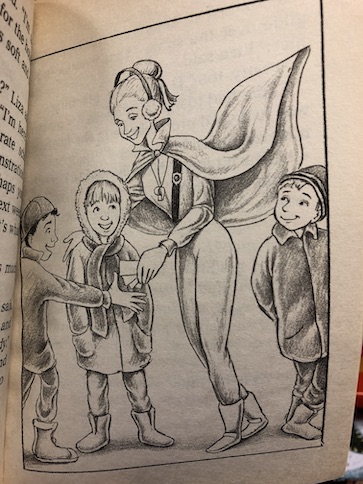
The crossing guard says that her name is Angela Michaels and that she has just come to town for the opening of a new karate school. She invites the children to come to a karate demonstration at the mall. Eddie thinks that the karate demonstration would be great, and Howie says that karate isn’t about attacking people so much as protecting. More and more, Melody becomes convinced that Angela’s rescue of Eddie was a miracle, that she’s Eddie’s guardian angel, and that she’s come to Bailey City on a mission.

Angela turns out to be a karate expert, and the kids are impressed. Mr. Mason yells at the kids as they walk by his house on the way home, and they wish that Angela would teach him a lesson. Eddie says that if they want to spy on Angela and find out if she’s a real angel, Mr. Mason’s yard is the best place to do it because it’s near the crosswalk and no one would expect kids to be hiding in his yard. The others say that he’s crazy to want to go in mean Mr. Mason’s yard, but Eddie says that if Angela is a real guardian angel, they should be safe.

Mr. Mason catches the children in his yard, and Angela does intervene when Mr. Mason yells at them. She convinces Mr. Mason to let her make him a cup of Heavenly Tea. Melody decides that Angela’s mission is probably to help Mr. Mason be nicer and make some friends. Melody says that they should help Angela by being friends with Mr. Mason and doing nice things for him. The others think that she’s crazy, but she’s convinced that it’s safe to do nice things for Mr. Mason because Angela will make sure that they’ll be safe and that Mr. Mason won’t get mad.

Mr. Mason yells at the kids when they come to help him, but Melody convinces him to accept the cookies they’ve brought him and let them shovel some snow for him and decorate his yard for Christmas. He doesn’t seem particularly grateful at first, but he does accept their kindness. Then, to the children’s surprise, Mr. Mason becomes their new school crossing guard, replacing Angela. He says that Angela had to leave on some important business and that she convinced him that he would like the job, and he admits that he does like it. Melody remains convinced that Angela was an angel. Eddie says that she never proved it, but she says that some things don’t need proof, just belief.

Eddie never does use karate on Ben, but Angela deals with Ben for him. Angela catches Ben bullying another younger boy and teaches him that strong people are supposed to protect weaker people, not bully them. The children take karate lessons from Angela, and she’s tough. Eddie compares her to a drill sergeant. But, being tough isn’t the same as being mean. Angela is serious when she says that strong people have a duty to protect others, and that’s what she teaches other people to do. She uses her strength and toughness to help people, not hurt them. It’s a good philosophy!

The book is available to borrow for free online through Internet Archive.

Elves Don’t Wear Hard Hats

The Adventures of the Bailey School Kids

#17 Elves Don’t Wear Hard Hats by Debbie Dadey and Marcia Thornton Jones, 1995.

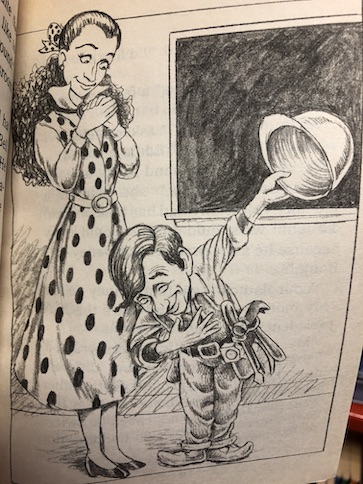
The playground equipment at Bailey School is old and breaking, so the PTA has decided to fund a new playground for the children. The playground is going to be built by the Bell Construction Company, and when the children meet the owner, Hollis Bell, he is an odd little man with curly-toed work boots. In fact, all of his men are unusually short. However, Mr. Bell promises to build the children the best playground they can imagine.

However, the parents at the school are arguing about the playground, how much it’s going to cost, and whether it really needed to be replaced at all. There’s not a lot of Christmas cheer going around, but Mr. Bell puts up Christmas trees and tells the children that they have their own kind of magic that can help fix their parents’ arguing.

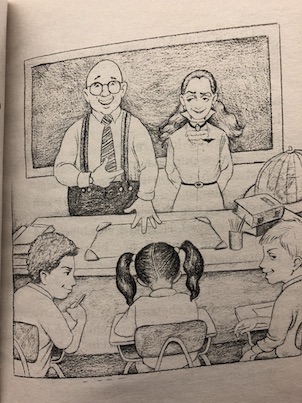
One day, Mr. Bell comes to the third grade class to interview them about what they would like to have on their playground. All of the kids have different ideas, and they end up arguing about the things they’ve heard their parents say about what the playground should be like. However, Mr. Bell urges them to calm down and work together. He tells the children that they should make a list of what they all want and “check it twice.” One of the kids in the class says that it’s impossible to give everyone what they want, but Mr. Bell says that he’s in the business of making wishes come true. Liza asks what happens if someone puts down a really bad idea, and Mr. Bell says that he’ll know if an idea is a bad idea. Because Mr. Bell is short, his tools jingle like jingle bells, and he acts like he can grant their Christmas wishes, the kids start thinking that he might be an elf.

The kids are allowed to watch the workmen work, but Mr. Bell makes it clear that they’re not allowed in the trailer that’s attached to his truck. Naturally, the kids get curious about the trailer. They can’t help but sneak a look inside, and when they do, they find out that it’s a workshop full of toys!

As the children try to figure out if the construction crew might really be elves, they decide to ask the department store Santa more about elves. The kids debate about the department store Santa really being Santa, and the Santa makes a comment about how he’s been meaning to pay a visit to their school, seemingly ignoring a previous book in the series, when Santa apparently became their school’s janitor. However, later in the book, Howie refers to the “new janitor who keeps turning down the heat,” referring to what happened in the previous book, which is confusing. The department store Santa explains that his elves like to fix things, and they are particularly concerned with fixing people who can’t get along, hinting that the arguments over the school’s playground are what brought the elves to the school. Santa’s advice is for the children not to worry because the elves will disappear on their own “when the time is right.”

The deadline for submitting the plan for the new playground is approaching, and the kids realize that if the adults can’t agree on something, they might end up with no playground at all! When the “elves” leave to take care of a job “up north,” and the playground issue still isn’t resolved, the kids think that they probably weren’t magical elves and that they didn’t fix anything, but the kids aren’t ready to give up yet.

When Eddie suggests that they all just build their own playground out of wood and begins drawing his vision of it, it attracts the attention of the adults. At first, the kids think that they’ll have to do all the work on their playground themselves, but the more the adults hear them talk and study the picture Eddie drew, the more involved they become. When the adults were in charge, they each wanted to be considered the leader and authority on the project, with their ideas overshadowing everyone else’s, but with Eddie in charge, the project moves forward. Even though Eddie is a child, he’s the one with the vision to carry the project through, and he neutralizes the adults’ competing egos. The project ends up being finished unexpectedly fast, and in the end, no one knows who actually completed it, hinting that the Mr. Bell might really have been an elf and that he and the other elves secretly returned once everyone came to an agreement about what they really wanted. As always with this series of books, readers are left to draw their own conclusions.

The book is available to borrow for free online through Internet Archive.

Vampires Don’t Wear Polka Dots

The Adventures of the Bailey School Kids

#1 Vampires Don’t Wear Polka Dots by Debbie Dadey and Marcia Thornton Jones, 1990.

The kids in the third grade class at Bailey Elementary School have been pretty hard on their teachers. Their last teacher resigned when she suffered a nervous breakdown due to their misbehavior and pranks. Now, the kids have a new teacher, Mrs. Jeepers.

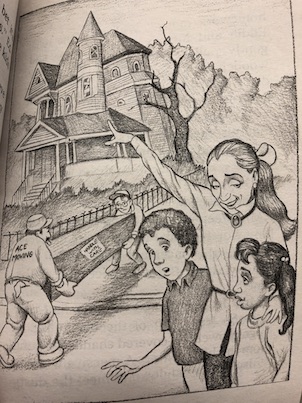
Mrs. Jeepers has just moved to their city from Transylvania, and everyone in class agrees that she’s not a normal teacher. She seems to have a hypnotic power over people, and her mysterious green brooch seems to glow and have magic powers. Not only that, but she has moved into a creepy old house in the neighborhood with a long box that could contain a coffin. Could Mrs. Jeepers be a vampire? No one knows, but none of the kids want to risk making her angry, except maybe Eddie, the class trouble-maker.

Mrs. Jeepers lays down the class rules on the first day. The rules are basically that the students should treat her and each other nicely, talk only when appropriate, and walk instead of run. Eddie asks her what happens if they break the rules, and Mrs. Jeepers only replies, “I hope you never have to find out.” Most of the other students are nervous about creepy Mrs. Jeepers and do their best not to make her angry, but Eddie is annoyed by how good the others are being and tries to various antics to get Mrs. Jeepers angry and make the other kids goof off, like normal. Sometimes, Mrs. Jeepers stops these antics, apparently with the power of her mysterious brooch.

Mrs. Jeepers is strangely evasive about her past, although she mentions that her husband is dead. He is the one who gave her the bat charm bracelet that she wears. Eddie and Melody try sneaking into Mrs. Jeepers’ house one night to see if they can get a look at the long box that might be a coffin, but they are unable to actually open the box, which seems to be locked from the inside.

The question of whether Mrs. Jeepers is really a vampire is never settled. Unlike most mythological vampires, she seems to have no problem going outside during the daytime. When the kids test garlic on her, it makes her sneeze. She does seem to have a strange power to make the children behave themselves, but that is partly because they are afraid of making her angry. At the end, Eddie finally causes Mrs. Jeepers to lose her temper. She takes him out of the classroom for a moment to talk to him, and when they return, Eddie seems to have been badly frightened by something. He never tells the others exactly what Mrs. Jeepers said or did, but he says that she is not normal and that he’ll never do anything to make her angry again.

When the book ends, it says that the children got through the rest of the school year with Mrs. Jeepers without getting her angry or seeing her brooch glow again, making me think that the book wasn’t always intended to be part of a series. However, for the rest of the series, the kids are still in the third grade with Mrs. Jeepers as their teacher.

The fact that the kids can never really prove that Mrs. Jeepers is a vampire, although they continue to believe it throughout the series, sets up the pattern for the books that follow it. Throughout the series, the kids encounter other people (including some relatives of Mrs. Jeepers) who seem strange and may be creatures from mythology or folklore or other supernatural beings, but the books always leave some room for debate. Mrs. Jeepers is the only one of these strange people to remain with the kids throughout the entire series. Other characters come and go, although there are a few recurring characters.

I always like it when children’s books reference other children’s books. In the beginning of the book, after their first teacher leaves, the kids worry about who their new teacher will be, and they make a reference to Miss Viola Swamp from the Miss Nelson books.

The book is available to borrow for free online through Internet Archive.

Chrysanthemum

Chrysanthemum by Kevin Henkes, 1991.

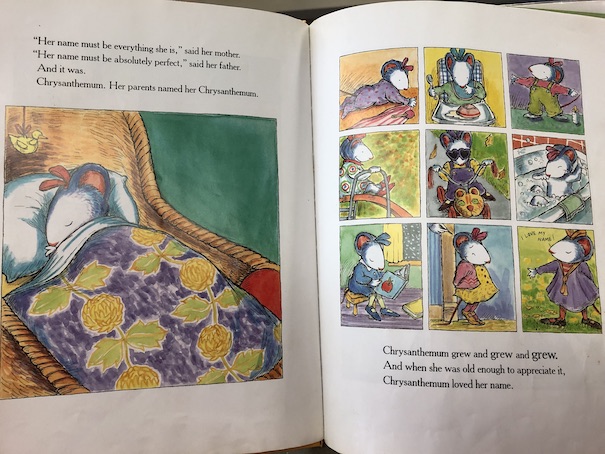
When little Chrysanthemum was born, her parents chose Chrysanthemum as her name because it just seemed perfect, as perfect as their little girl. As Chrysanthemum grew up, she loved her name, and she thought that it was perfect, too.

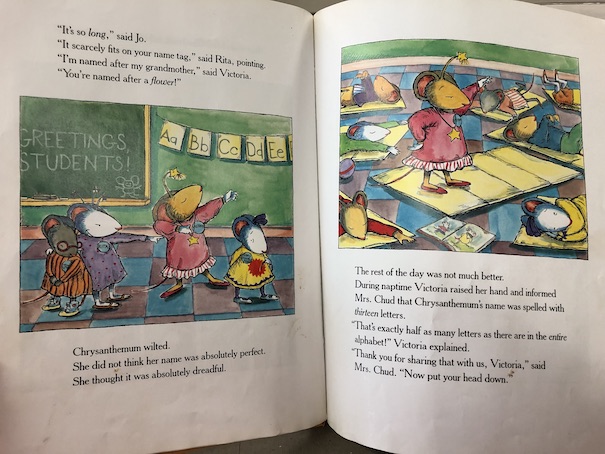
However, when Chrysanthemum starts school, the other kids point out how unusual her name is. Most of them have much shorter names. Chrysanthemum’s name is so long that it doesn’t really fit on her name tag. One girl, Victoria, is particularly mean about Chrysanthemum’s name, making fun of her whenever she can and encouraging other children to make fun of her.

For the first time in her life, Chrysanthemum starts hating her name. She wishes that she had a much shorter name, like Jane. Her parents comfort her and tell her that the other kids are probably just jealous, but their repeated teasing really bothers her.

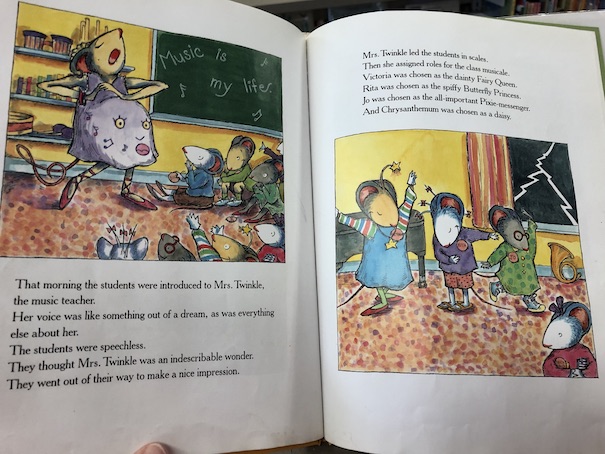
Then, the children have music lessons at school with Mrs. Twinkle. Mrs. Twinkle is a fun teacher, and the kids are excited about her class. She gives the children roles to play in a class musicale, and Chrysanthemum is cast as a daisy. When the other kids laugh about her playing a different type of flower, Mrs. Twinkle asks them what’s so funny.

The other kids explain about Chrysanthemum’s name and that they think it’s funny because it’s so long and weird. That’s when Mrs. Twinkle tells them that her first name is Delphinium – another long, unusual flower name! She says that she really likes the name Chrysanthemum, and since she’s expecting a baby, she might name the baby Chrysanthemum if it turns out to be a girl. Suddenly, the other girls in class envy Chrysanthemum and wish they had flower names, too!

In the short epilogue at the back of the book, the baby does turn out to be a girl, and Mrs. Twinkle names her Chrysanthemum. Chrysanthemum also gets a laugh at Victoria’s expense when the class puts on their musicale, and Victoria completely forgets her lines.

It’s a nice book, and I appreciate some of the messages now even more than when I first read it when I was a kid. Now that I’m an adult, I know that Chrysanthemum’s name isn’t the real reason why Victoria picks on Chrysanthemum. Victoria is mean basically because Victoria is a mean person. Kids who want to bully others make the decision to bully first and then pick something to bully about second. From what I’ve seen, they’re usually out to make fun of someone or make someone mad just to do it, and they don’t really care how or why. Chrysanthemum’s unusual name was just a convenient thing for Victoria to single out and use for her bullying. If she hadn’t had that name, Victoria would have picked on her (or maybe some other, more convenient target) for something else. Maybe it would have been someone’s clothes. Maybe it would have been the way someone walks or the way someone talks or their hair or their eyes or the fact that they have fingernails or breathe air or take up physical space … you get the idea. Victoria is the way she is because that’s what she is and what she wants to be, and she doesn’t see any need to change until the end of the story. (Even then, she may be back to bully again over something different because she hasn’t yet learned not to bully in general, just not over that particular thing.)

My point is that the way Victoria is has nothing to do with Chrysanthemum and her name. I’ve heard parents who are considering names for their children working hard to pick names that can’t be used for teasing, and sometimes, it can help. However, at the same time, bullies are basically going to bully because that’s who they are and what they do, and most importantly, it’s what they want to do. They’ll find something to bully about anyway because they’re always intentionally looking for something to bully about.

For a time, because of Victoria’s meanness and bullying, Chrysanthemum’s enjoyment of her name is ruined. She even feels like Victoria is destroying her sense of identity. At one point, she has a nightmare that she is actually a Chrysanthemum flower and that Victoria plucks her petals, picking at her and picking at her and picking at her until there’s nothing left. That’s the kind of effect that bullies have on people, which is why I have such contempt for them. They ruin things, even really fun and cool things like a colorful name, and make people unhappy just by being the kind of people they are. (If you’ve read my other reviews of books with bullies, you’ve already heard that I have very strong feelings about this subject and absolutely no patience or sympathy for bullies.)

But, fortunately, the book takes a very positive tone and points out that Chrysanthemum’s name is not really ruined by Victoria’s meanness. Chrysanthemum’s music teacher also has a really unusual flower name, and naming her baby Chrysanthemum as well gives Chrysanthemum new status among the kids at school, to the point where some of them, including Victoria, wish that they also had flower names of the kind that might inspire someone to name their baby after them. Mrs. Twinkle is a fun and different kind of teacher, and her fun and different name fits her personality. Although it hasn’t occurred to the other kids yet, the world would be a pretty drab place without colorful and unusual people. The Victorias and Janes of the world may have very proper names and are reassuringly ordinary, but the Delphiniums and Chrysanthemums are the ones who bring color and excitement to life. So, although I wouldn’t deliberately give a child a name that might leave them open to teasing, I don’t see a need to go overboard and reject some of the fun names that are just a bit unusual. Different is good, and it should be appreciated for what it is, not for what a bully may or may not be able to say about it when they’re trying to be mean. (They’ll find something else to bully and complain about two seconds later anyway, so why bother considering them for longer than that?)

The book is currently available online through Internet Archive. It is part of Mouse Books series.

Lilly’s Purple Plastic Purse

Lilly’s Purple Plastic Purse by Kevin Henkes, 1996.

Lilly loves going to school, and she especially loves her teacher, Mr. Slinger. Everyone in class thinks that he’s great, and he inspires a lot of them, including Lilly, to want to be teachers themselves.

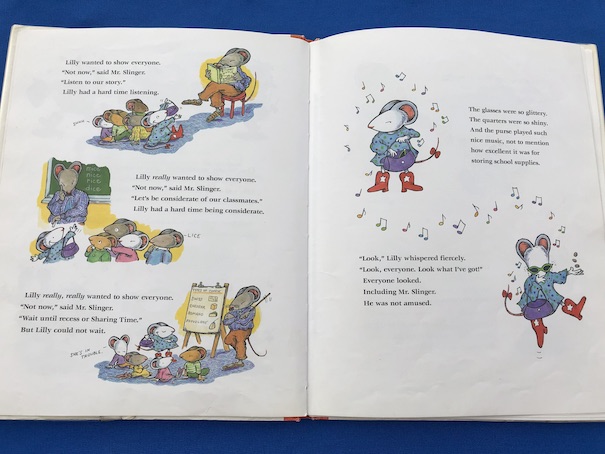
One day, after a special shopping trip with her grandmother, Lilly gains a some special new treasures: movie star sunglasses, some quarters, and a purple plastic purse that plays a tune when she opens it. Eager to show off her new things to her friends, Lilly brings them to school. However, she just can’t wait until recess or Sharing Time to show everyone. She keeps trying to draw attention to these things while the teacher is talking and opening the purse so it keeps playing its tune.

Finally, after repeated warnings, Mr. Slinger is forced to confiscate Lilly’s purse with its other treasures. Lilly is hurt and feels betrayed by her favorite teacher. Sad and angry at having her treasures taken from her, she draws a mean picture of her teacher as a purse thief, leaving the picture where she knows he will find it.

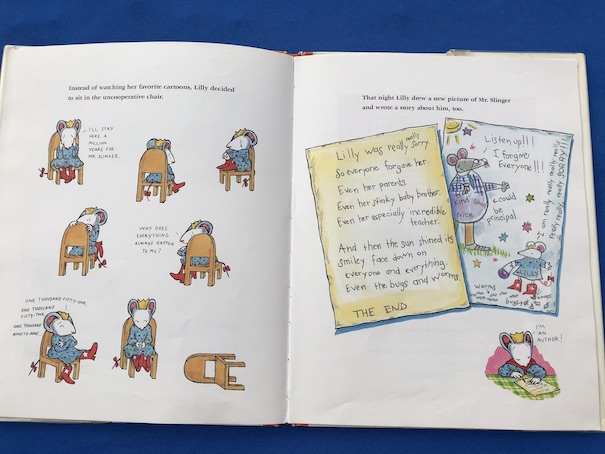
However, Mr. Slinger isn’t as mean as Lilly thinks that he is when he takes her purse. After he gives the purse back to her, she discovers a nice note from him inside, telling her that tomorrow will be a better day, and there’s even a little bag of snacks. Now, Lilly feels guilty about her mean picture. It’s too late to get it back, and she worries that her teacher will never forgive her.

The story is really good at showing how Lilly’s emotions change through the course of the day and how her sadness and anger grow more urgent the more she thinks and worries about them. It’s a good story to use when talking about feelings with young children (through the course of the story, Lilly is happy, excited, sad, betrayed, angry, guilty, worried, and embarrassed – some of these are stated explicitly and some are more implied) and how to deal with emotions. Adults can talk to children how one kind of emotion can lead to another (like how Lilly’s sadness turns to anger at her teacher for making her feel sad by confiscating her purse) and how some ways of dealing with emotions are better than others. It is both creative and appropriate that Lilly used her drawing ability to both insult her teacher and, later, apologize to him.

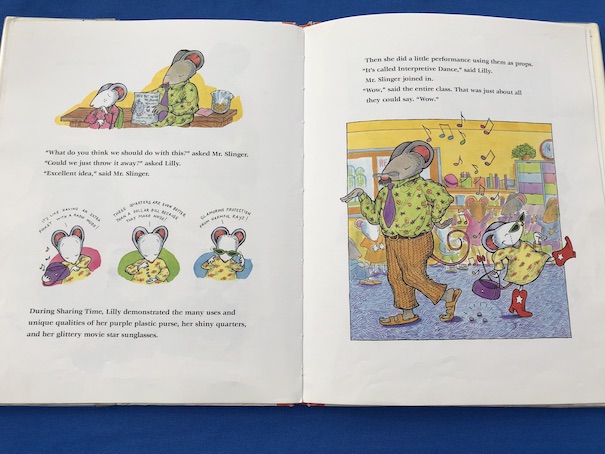
Fortunately, both Lilly’s parents and her teacher are very understanding. Her parents reassure her that her teacher will forgive her. Lilly draws a new, nicer picture of her teacher to go with her apology to him, and her parents give her some snacks to give to him as well. He does forgive her, and she finally gets to show everyone her amazing purple plastic purse at Sharing Time (being careful not to disturb anyone with them at other times.

The book is currently available online through Internet Archive. It is part of Mouse Books series.

The School at the Chalet

The School at the Chalet by Elinor M. Brent-Dyer, 1925.

This is the first book in the Chalet School Series.  This series is uncommon in the United States.  People from Britain or countries with heavy British influence would be more familiar with this series.  It’s considered classic!

When the story begins, Madge and Dick Bettany, who are brother and sister, a set of twins, are discussing their family’s situation.  Their parents are dead, and they have very little money and no family members they can rely on.  Madge and Dick are grown and are ready to begin making their own way in the world, but their younger sister, called Joey, is still a child, and her heath has been poor.  Dick has a job, but he really can’t afford to support his sisters.  However, Madge has had an idea: she wants to start a school.  Dick worries that they don’t have the capital necessary to start a school, but Madge says that she could start one in continental Europe instead of England, where they are from, because the costs would be lower.  She even has a specific place in mind, a chalet near a lake, close to a town called Innsbruck in the Tiernsee (Austria).  Joey could live with her at the school and continue her education in the company of the other students, and Madge thinks that the climate there might even be better for her than England.  She has already written a letter to find out if the chalet is available, and it is.  If they sell most of what they own in England, Madge thinks that they’ll have enough to buy what they need in Europe.  Madge says that she thinks she could handle about a dozen girls, between the ages of twelve and fourteen or fifteen.  She knows someone who could help her teach, Mademoiselle Lepattre, and between them, they are qualified to teach French, German, sewing, and music.  Dick is still a little concerned about whether or not Madge can pull off the school, but he agrees that she should go ahead with her plans (since she likely will anyway) and says that if she runs into trouble, she should contact him for help.

Madge even knows who her first pupil at the boarding school will be: Grizel Cochrane.  Madge has already had her as a student, and she is friends with her family.  She knows that Grizel has been unhappy at home since her father remarried because she and her stepmother do not get along.  Grizel’s stepmother has already been pressuring her father to send her away to boarding school, but he loves her and has been reluctant to part with her.  However, Grizel has been miserable, and her father decides would be more willing to send her away with someone he already knows.  Grizel is pleased at the idea of joining Madge and Joey at a school in Europe, and the Madge gains her first student.

Dick and Mademoiselle Lepattre go to the chalet first to take the larger trunks and belongings and begin getting settled, while Madge, Joey, and Grizel follow them.  Along the way, they see some of the sights of Paris.  By the time they arrive at the chalet, Mademoiselle Lepattre’s young cousin, Simone Lecoutier, has arrived at the school to be a pupil, and Madge has arranged to accept an American girl named Evadne Lannis, who will arrive later.  These four girls, Joey, Grizel, Simone, and Evadne, are the school’s first boarders.  The school soon acquires a few day pupils who live nearby: Gisela and Maria Marani (a pair of sisters), Gertrud Steinbrucke, Bette Rincini, Bernhilda and Frieda Mensch (also sisters).  Maria is much younger than the other girls, only nine, but her mother asked that she be admitted along with her older sister. There are public schools for children in Innsbruck, but the father of one of the new local pupils thinks that the Chalet School might be healthier for his daughter because, while he doesn’t think much of English educational standards (Grizel takes exception to that comment), they shorten the school day (compared to the average school day of Austria or Germany of the time) and encourage participation in sports and games. The local girls are curious to see what things are going to be like at an English style school, and if it will be like other English schools they’ve heard about.  The school also soon gains more students and boarders:

  • Margia and Amy Stevens – ages 8 and 11, their father is a foreign correspondent from London who needs to travel for his work, and the girls’ parents wanted to find a stable place for the girls to stay.
  • Bette Rincini’s cousins, who have come to stay with her family
  • A pair of sisters from another town across the lake
  • Two more children from a nearby hotel
  • Friends of Gisela from Vienna
  • Rosalie and Mary, two girls Joey and Grizel know from England

As the school grows and the girls settle into life at the school, they make friends with each other, although it’s awkward in some cases.  Madge notices that Simone is often by herself and she asks Joey if she and the other girls are being nice to her.  Joey says that they try, but Simone often sneaks off alone, and she doesn’t know where Simone goes.  Joey tries to ask Simone if she’s unhappy, and Simone tries to deny it.  The truth is that Simone is really homesick.  Joey finds her crying by herself later and comforts her, and Simone finally admits how much she misses her mother.  Simone also says that she feels left out because everyone else at the school has someone to be close to.  Other girls at the school share nationalities with at least some of the other students.  Simone is the only French girl at the school.  The Austrian girls are close to home, and Joey and Grizel already knew each other before they left England.  Seeing the other girls being such close friends makes her feel more left out.  Joey apologizes for making Simone feel left out and assures her that she will be her friend.  Simone asks her to be her best friend because she really needs someone to confide in, and Joey agrees, although she finds Simone rather needy and clingy. 

It turns out to be a difficult promise because Simone gets very jealous when Joey makes friends with other girls, and she tries to convince Joey to only be friends with her.  Simone is very dramatic, and she even ends up cutting off her long braid in an effort to impress Joey and get her attention when she learns about the other girls who will be coming from England.  Simone is so desperately lonely and finds it so difficult to make new friends that she is terrified that Joey will abandon her completely when she has other friends.  Joey gets fed up with her behavior and tells her that she’s being selfish. Joey knows that Simone would find it easier to make more friends herself if she would stop moping and being sad and gloomy.

After Juliet Carrick, another English girl, joins the school, Gisela is made head girl, and other girls are made prefects.  Bette is a sub-prefect, and one day, when she tells Grizel to put her shoes away, Grizel is rude to her, and Juliet laughs.  Gisela and the prefects discuss the situation and agree that Grizel, who wasn’t causing problems before, is now acting up because Juliet thinks that it’s funny.  When Gisela sends someone to bring Grizel to the prefects’ room to talk about it, Grizel refuses to come and see them, and she realizes that something needs to be done.  If the head girl and prefects let a girl get away with disrespecting them or not following the rules, the prefect system and student government would fall apart.  Grizel feels a kinship for Juliet because neither of them has a happy home life. Juliet has been raised to believe that the English are superior to everyone else, and she has no shame in showing it.  Juliet encourages Grizel to adopt her prejudices, but at a school in Austria with students of varying nationalities, that can’t be allowed.  Madge supports the prefects, and Grizel is punished for her behavior.

Juliet is still a bad influence, sometimes encouraging other girls to act up with her. When Madge refuses to allow the girls to pose by the lake for some film makers, Juliet convinces some of other girls to sneak away with her and volunteer to be filmed without Madge’s knowledge.  However, the father of one of the local girls catches them. He explains to the film makers that it would be inappropriate to film the girls because they don’t have permission from either the girls’ parents or teachers, and he takes the girls back to the school.  Grizel’s temper and excessive patriotism also get the girls into trouble when they encounter a German tourist who makes it plain that she is disgusted at the presence of the English girls. (This is after The Great War, World War I, so that may be the reason.)  While the German woman was being deliberately rude and insulting to the girls, Joey points out that Grizel’s hot-headed reply to her has now caused them more trouble.  Grizel does apologize for not using more restraint.

Juliet’s home life turns out to be even worse than the other girls know, but they learn the truth when Juliet’s father sends a letter to Madge saying that he and his wife relinquish their custody of Juliet to the school.  The letter says that Madge can do whatever she likes with Juliet.  If she wants to keep Juliet at the school and have her work for her future tuition, that will be fine, and she is also free to send Juliet to an orphanage.  The point is that her parents have left the country, they consider Juliet a burden that they would rather not bring with them, and while they might one day feel able to reclaim her, chances of that are not looking good.  When Juliet learns about the letter, she cries and says that she had been afraid that they would do something like this.  Her parents tried to abandon her at a different school once before, but the school had insisted that they take her back.  Madge now has no idea where Juliet’s parents are.  However, she can’t bear to turn Juliet over to an orphanage, so she promises Juliet that she will keep her and that she can help to pay for her tuition by working with the younger children at the school.  Although Juliet’s behavior hasn’t been very good up to this point, Juliet is grateful to Madge and does earnestly try to please her and to maintain her place at the school. Before the end of the book, Juliet’s parents die in an automobile accident, giving Madge and the school permanent custody of her. Most of the other students (except for Joey) do not know that Juliet’s parents tried to abandon her before they died.

Through the rest of the book, the girls have adventures together and forge the new traditions of their school.  They celebrate Madge’s birthday, get stranded in a storm and have to spend the night in a cowshed, start a magazine for the school, and play pranks on each other. When Grizel’s pranks and disobedience go too far and she is punished harshly for it, she gets angry and runs away from the school, becoming stranded on a nearby mountain. Joey goes after her to save her, and both girls are ill after their experience.

The book ends with Madge and a few of the girls caught in a train accident. Fortunately, they escape the accident without serious injury, and they also manage to help the German woman who had insulted the girls earlier. A man named James Russell helps them. The book ends at this point, and the story continues in the next book in the series. James Russell is a significant continuing character.

The book is currently available to borrow for free online through Internet Archive.

Samantha Learns a Lesson

American Girls

Samantha Learns a Lesson by Susan S. Adler, 1986.

This is part of the Samantha, An American Girl series.

Samantha attends Miss Crampton’s Academy for Girls in Mount Bedford. She is doing well and has some friends at school, but she misses her friend Nellie. She knows how poor Nellie’s family is and worries about how they are doing.

One day, Samantha comes home from school to a surprise: Nellie has returned to town with her family. Samantha’s grandmother recommended Nellie’s family to a friend, Mrs. Van Sicklen, who has hired Nellie’s father as a driver and Nellie’s mother as a maid. Nellie and her sisters will also be helping with household chores. They will also get the chance to go to school, although they will be attending public school and not the private school that Samantha attends.

When they begin attending school, Nellie’s younger sisters do fine in the first grade, where they are expected to be beginners, but Nellie herself has trouble in the second grade. Nellie is a little old for second grade, so the other children make fun of her for being there, and she is so nervous that she makes embarrassing mistakes in front of her teacher and the other students. Nellie thinks that perhaps she’s too old to start going to school, but Samantha realizes that what she needs is a little extra help.

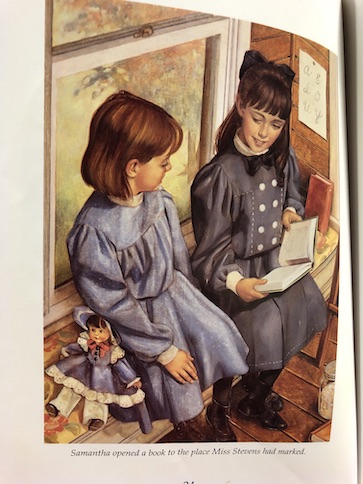
Samantha talks to her own teacher and explains the situation. She says that she would like to help teach Nellie what she needs to know, but she is not sure what Nellie needs to know in order to pass the second grade. Samantha’s teacher, Miss Stevens, thinks that it is nice that Samantha wants to help Nellie and gives her a set of second grade readers to study with pages marked for assignments. Samantha tells her grandmother what she is planning to do, and she says that it is fine, as long as the extra tutoring doesn’t interfere with Nellie’s house work too much.

Nellie accepts Samantha’s help at their secret, private “school” that Samantha calls “Mount Better School.” During their lessons, Samantha discovers that Nellie is very good at math because she used to have to help her mother with shopping and had to keep track of her money. Nellie cannot always come for lessons because of her work, but Samantha’s tutoring helps her to improve.

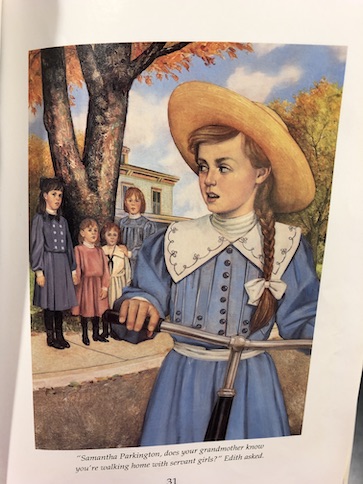
One day, when Samantha is walking home from school with Nellie and her sisters, a mean girl from Samantha’s school, Edith, sees them and criticizes Samantha for spending time with servants. She says that her mother would never allow her to play with servants. Samantha asks her grandmother what Edith means, and her grandmother says that Edith is a young lady. When Samantha asks why she is allowed to play with Nellie, her grandmother says that they are not really playing, that Samantha is helping Nellie, which makes it different. That explanation doesn’t entirely satisfy Samantha.

However, her grandmother is both understanding of the help that Samantha has been giving to Nellie and serious about the need to help others. When Edith’s mother and other ladies of the neighborhood come to visit and complain about Nellie’s family and how Samantha is spending time with them, Samantha’s grandmother defends them and says that Samantha is doing good.

Meanwhile, Samantha’s school is preparing for a public speaking contest with the theme “Progress in America.” To prepare for her speech, Samantha asks her grandmother, her Uncle Gard, and other people what they think about progress and what the best inventions are. They mention inventions like the telephone, electric lights, automobiles, and factories. Samantha is fascinated by the idea of factories and the variety of products that they can make. However, when Samantha reads her speech to Nellie, Nellie is not nearly so enthusiastic about factories as a sign of progress. Nellie used to work in a factory herself, and she knows that they are not pleasant places. She tells Samantha how factories are noisy and how dangerous the machines are for the workers. The factory workers are also very poorly paid, which is why the products they make are so cheap.

Nellie’s stories about factories bother Samantha. When it is time for the public speaking contest, Samantha delivers a changed version of her speech in which she discusses the dangers of child labor and how some form of progress, particularly ones that endanger children, are not good forms of progress. Samantha’s thoughtful speech wins the contest, and her grandmother understands that Samantha has been learning things from Nellie even while teaching her.

In the back of the book, there is a section with historical information about education and child labor during the early 1900s.

The book is currently available to borrow for free online through Internet Archive.
The Secret School

The Secret School by Avi, 2001.

The year is 1925, and what 14-year-old Ida Bidson wants most is to graduate from her community’s small, one-room schoolhouse so that she can go to high school in a nearby city.  She dreams of becoming a teacher when she grows up, and she knows that she can’t do that without more education.  The problem is that, in her rural community in Colorado, not everyone thinks that higher education is important, especially for girls.

When their teacher’s mother becomes ill toward the end of the school year and the teacher has to leave, the man in charge of the local school board, Mr. Jordan, doesn’t want to bother to hire a new teacher to finish off the year.  In fact, it seems a little dubious about whether they’ll even get a new teacher in the fall.  Ida is crushed because, without a teacher, she can’t graduate this year as planned, and she had just about persuaded her parents to let her attend high school in the fall.  Her friend, Tom, is in a similar position.  More than anything, he wants to work with radio, the latest technological development of their time, and he also needs to attend high school.  (So far, he’s just been teaching himself by reading Popular Mechanics – the magazine started in 1902 and is still in circulation today.)  However, Tom comes up with a plan that could help everyone: What if Ida becomes their teacher?

Ida knows that there’s no way that Mr. Jordan would actually hire her as the new teacher.  Everyone knows that he’s a miser and that a large part of the reason they’re not getting a new teacher is that he doesn’t want to have to pay for one.  Besides, what school board would hire a 14-year-old girl who hasn’t yet graduated?  After discussing it with the other children, they make the decision to keep their school open secretly with Ida as their secret teacher.  Although Ida confesses the truth about what they’re doing to her parents, most of the others don’t, figuring that they’ll wait to tell them when the school year officially ends in another month.

Although it’s a daunting challenge, going from student to teacher while still continuing her own studies, Ida sees it as the only way to get what she wants.  She does her best to act out the part of teacher, telling her friends to call her “Miss Bidson” when she’s teaching instead of “Ida”, giving them their assignments to study, and checking their work. 

Most of the other children agree to her terms as their new, secret teacher, although one boy, Herbert, deliberately gives her a hard time.  Herbert’s future ambitions don’t include higher education, and he was originally looking forward to having an early summer break.  At first, he delights in trying to push Ida, to see how she’ll deal with him as a discipline problem.  Ida partly earns his cooperation by pointing out with him that their secret school is voluntary, that no one is making him come, that they had all voted to make her the teacher, and that if he makes problems for the other students, they can also vote him out of the school.  The thought of being rejected by his friends for making problems keeps him more or less in line.

Then, a woman from the County Education Office, Miss Sedgewick, comes to the school and finds Ida teaching there.  She is the one who administers tests to graduating students, and she has come to ask how many students will be tested this year.  Ida is forced to admit her circumstances to Miss Sedgewick.  Miss Sedgewick is surprised to discover that Ida is both teacher and student and says that she isn’t quite sure if she can give the exams if the local school board has officially closed the school.  She leaves, promising to look into the matter.  What she eventually tells them is that they can keep the school open with Ida as the teacher, but in order for the children to get credit for their work, they will all have to take exams at the end of the year, not just Tom and Ida.

As the end of the school year approaches, Ida does her best to prepare the other children for the exams and thinks about how her relationships with them have changed.  Tom, her best friend, has become more her student and less her friend, which feels uncomfortable to her.  She also has her own studying to do if she hopes to pass the exams herself, which is difficult both with her teaching work and the work that she must do on her family’s sheep farm.

Then, Herbert’s father, who doesn’t value education at all and just wants Herbert home to work their farm, finds out what they’re doing and gets Mr. Jordan to shut the school down for good.  Ida feels like all her dreams and hard work have been for nothing.  However, a talk with Herbert changes her mind.  Herbert knows that his father fears his education.  Herbert’s father is afraid that Herbert will look down on him for not having as much education or that Herbert will want to leave him.  Herbert admits that he’s been very unhappy at home because his father is a bitter, angry man who doesn’t treat him much better than he does other people.  Herbert has actually learned more than he pretends at school and really does have plans to leave home.  Herbert also tells Ida that his father and Mr. Jordan are planning a secret meeting to close the local school permanently, purposely telling only people they know will agree about it, not local people who value education. 

Knowing about the secret meeting gives Ida’s parents, as well as other parents in the community who support their children’s education, to show their support for their children’s hard work.  Faced with their opposition, Mr. Jordan agrees to let the school remain open while the children take their final exams.  Ida not only does better on the final exam than she had feared, but she finds an ally in Miss Sedgewick, who will help her fulfill her wish to attend high school and become a real teacher.

The book is available to borrow for free online through Internet Archive (multiple copies).

River Quest

Dinotopia

#2 River Quest by John Vornholt, 1995.

Thirteen-year-old Magnolia and Paddlefoot, a Lambeosaurus, are apprenticed to the Habit Partners of Freshwater. Habitat Partners keep an eye on different aspects of the environment on Dinotopia and make sure that the environment is maintained and cared for. The Habitat Partners of Freshwater are specifically concerned with the bodies and sources of freshwater all over Dinotopia.

When Magnolia’s master, Edwick, is injured badly during the eruption of a geyser, he and his partner, a Saltasaurus named Calico, retire and leave the post to Magnolia and Paddlefoot. Magnolia thinks that she is still too young for the position, and she and Paddlefoot worry about whether they are ready to handle the job. However, they have no choice because a crisis has arisen, and Edwick is in no shape to handle it.

The Polongo River, which supplies the water for the waterfalls that power virtually everything in Waterfall City, is drying up. Magnolia and Paddlefoot must journey up the river to find out what is happening and restore the river to its proper course.  Along the way, they find friends who can help them, but completing their mission means coming perilously close to the Rainy Basin where the meat-eating dinosaurs live.

The book is currently available online through Internet Archive.
The Lottery Rose

LotteryRoseThe Lottery Rose by Irene Hunt, 1976.

Young Georgie Burgess has been abused his entire life by his mother, Rennie, and her boyfriend, Steve (who is not Georgie’s father, whose identity is unknown, Rennie says that she is a widow).  Rennie is an alcoholic, and she and Steve (who is the source of most of the violence in Georgie’s life) once deliberately burned the side of Georgie’s face when he was a baby because he wouldn’t stop crying and they were angry that they had run out of whisky.  Sometimes, they tie him up in a closet for days at a time with no food.  Other times, they beat him, even leaving scars.  When Rennie is confronted by the school nurse about Georgie’s injuries, she claims that Georgie is a problem child who gets into fights.  Georgie’s teacher believes that because Georgie is always acting up and doesn’t appear to learn anything, although he is actually smarter than he pretends to be.  Because the other adults in Georgie’s life either do not see his condition for what it is or do not want to acknowledge the truth of it, it is a long time before he gets the help he really needs.

Georgie’s early life is bleak, and at first, his future seems equally bleak.  The only people who seem to care about him at all are the school librarian and Mrs. Sims, who works at the grocery store.  Georgie’s real love in life is flowers.   He likes to borrow a book from the school library about flowers, and one day, he enters a drawing at the store and wins a rose bush of his very own!

It’s the best thing that ever happened to Georgie, but shortly afterward, Steve beats him so badly that the police are finally called.  Georgie is taken away from his mother, and for the first time, his life becomes different.  Georgie insists on bringing his precious rose bush with him when the police take him away, and it becomes instrumental in helping him reshape his life.

For a time, Georgie has to stay in the hospital to recover from his injuries, and then he stays with Mrs. Sims.  Unfortunately, as much as Mrs. Sims and her husband care for Georgie, they can’t afford to take care of him.  Instead, Georgie is sent to a Catholic boarding school with his new teacher and guardian, Sister Mary Angela.  Sister Mary Angela assures Georgie that he will be taken care of at the school and so will his rose bush.

Georgie thinks the school is ugly, but there is a beautiful house nearby with a beautiful garden.  It belongs to Mrs. Harper, who lost her husband and one of her sons in a tragic car accident.  Although Georgie isn’t supposed to go there, he can’t help himself.  It seems like the the perfect place for his rose bush . . . and maybe even for himself.

The tragedies and descriptions of child abuse in this story make it inappropriate for young children.  This would be a good book for kids at the middle school level, probably age twelve and up.

Georgie, who has never really known kindness in his life, blossoms like a rose at the school, making new friends for the first time and coming to terms with his past.  At the same time, Mrs. Harper, who is still suffering from the loss of her husband and son and also loses her other son (a child with developmental disabilities) during the course of the book, finds her heart warmed by Georgie.  Georgie has desperately needed a mother who acts like a real mother and really loves him, and Mrs. Harper comes to realize that she also needs a boy like Georgie to love.  While he is not a replacement for the sons she has lost, he does help to fill an empty place in her life, and the two of them become the family that each of them needs.

The book is currently available online through Internet Archive.