The Lancelot Closes at Five

The Lancelot Closes at Five by Marjorie Weinman Sharmat, 1976.

“Camelot” is the name of a new housing development being built in Shady Landing, New York. In the beginning of the story, Camelot has only three model homes, demonstrating what the houses in this new neighborhood are going to look like. In keeping with the Arthurian theme, the three model homes are called “the Excalibur”, “the Lancelot”, and “the Guinevere.” Abby’s family decides that they will buy a house there on the Excalibur model because they are tired of their crowded apartment in Brooklyn and Abby’s parents think that buying a house sounds like a good investment for future.

The move isn’t easy for Abby and her family. Abby doesn’t like leaving her old friends behind. There are several things wrong with the new house, including windows that are nailed shut, doorknobs that fall off, and a flooded basement. Also, the people who live in the village of Shady Landing don’t like the newcomers because trees were cut down to build Camelot.

However, Abby soon finds a friend, Heather Hutchins, who likes to be called “Hutch.” Hutch also lives in the new Camelot neighborhood. Hutch’s family is very health-conscious, believing in all-natural foods, which is why Abby doesn’t usually like to eat at their house, and Hutch’s mother is a very competitive person.

Then, Hutch springs a surprise on Abby. Hutch tells Abby that she wants to run away from home. She doesn’t want to be gone for long, just about day during the Memorial Day weekend. She doesn’t want to go far, planning to spend a night in the Lancelot model home. But, she wants Abby to come with her so she won’t be alone.

At first, Abby is a little reluctant, but Hutch is very persuasive, the idea does seem like a fun adventure, and hiding out secretly so close to home doesn’t seem too dangerous. In fact, since the public is invited to come and walk through the model homes, it doesn’t even seem like trespassing. Abby agrees to do it. The girls’ plan is to tell their families that they’re spending the night with each other but conveniently not mention where so they’ll assume that they’re just having a normal sleepover at each other’s house. Then, they plan to visit the Lancelot and hide there until it closes and all the other people leave.

When she proposes her plan, Hutch doesn’t explain her motives for wanting to run away for a day, and Abby decides not to question her, thinking that Hutch will tell her when she’s ready. She does note that Hutch doesn’t seem to get along well with her mother. Hutch’s mother doesn’t seem to connect well with other people in general, being more focused on what she wants them to do than on just acknowledging them or building relationships with them. Worse still, Hutch’s mother is what Abby calls a “scorecard mother,” always comparing her child to everyone else’s child, constantly keeping track of where Hutch is ahead and where she’s behind. Hutch’s mother has overly high expectations of Hutch and pushes for perfection. Hutch’s mother sometimes quizzes Abby about what she does to help out at home and how each of the girls are doing in school so she can compare them. Abby sometimes feels like she’s in the uncomfortable position of defending Hutch to her own mother.

The Lancelot model home is decorated in a fakey pseudo-Medieval style, in keeping with the Camelot theme. When Abby and Hutch sneak in, they pretend to be part of a family group touring the house and then hide under a bed until everyone else leaves. Their plan works, but staying in the house isn’t quite what Abby imagined it would be. The furniture is uncomfortable because it’s made to be looked at and not actually used. Not all of the appliances even work, like the tv, because they’re just for show and not for using. For their “supper”, Hutch has brought candy bars and pastries, things which her mother normally forbids her to have because they aren’t natural and will rot her teeth. Abby still can’t have some of them because she has food allergies and braces, but Hutch brings pound cake for her.

Hutch finally admits to Abby that her main reason for wanting to have this adventure is just to have the chance to do something for no other reason than she just wants to do it. Abby is right about Hutch’s mother. Everything that she wants Hutch to do is centered around gaining something – recognition, awards, physical health benefits, learning things and getting a mental edge. Hutch just wanted the chance to do something without a particular motive other than just wanting to do it and the fun of planning it out and pulling it off by herself, with the help of her friend.

Unfortunately, Hutch gets carried away with the success of her plan and turns on the lights, which attracts the attention of a passing police car, although the police just try the doors, decide that the lights were left on by accident, and leave without finding the girls. Then, Hutch doesn’t want to go to sleep and stays up, eating candy bars in bed, just because she’s normally not allowed to do that. Abby is uncomfortable in the big, fancy bed that isn’t meant to be slept in and can’t sleep, so she leaves and goes home, making Hutch mad. Abby spends the rest of the night sleeping in her sleeping bag in her family’s basement (which is no longer flooded) so she won’t give away Hutch’s secret.

Later, Abby feels guilty about abandoning Hutch, so she sneaks out early in the morning to check on her. Hutch got out of the Lancelot without being noticed, but she’s still mad at Abby for leaving her when she was trying to do something that was important to her. However, there is worse to come. The police hadn’t forgotten about something strange happening at the model home that night, and now, there’s a rumor in the neighborhood that the house was “vandalized” during the night (meaning the mess that the girls left in the house from the food they ate, trying to sleep in the bed, and using the bathroom). Abby is naturally a more timid person than Hutch, and while she has started to appreciate Hutch’s attempts to help her be more bold and take more chances, it makes her nervous that she and Hutch are the “vandals” whose escapades have now made the local paper. Abby’s father, an author, is even attempting his own investigation into the matter.

Abby is not only worried about repairing her friendship with Hutch but not getting found out for what they did. Then, one of the boys at school starts bragging, claiming that he and his friend were the ones who snuck into the Lancelot to hang out that night. He’s not the only one trying to claim credit for the stunt, either. Abby hopes that the whole thing will just die down and be forgotten, but Hutch doesn’t feel the same way. Even though she originally set out to do something just on a whim without looking for recognition, the idea that someone else might claim recognition for what she did galls her. What will happen when Hutch tries to reveal her role in masterminding the night in the Lancelot?

I purposely sought this book out online because I never owned a copy and I remembered it from when I was in elementary school, but the funny thing is that I don’t remember ever hearing the entire story when I was a kid. I think that my class might have just read a selection from the book, maybe as part of one of those story collections that has excerpts from books to demonstrate certain concepts and give samples of stories. I can’t quite remember now. All I remembered was that the main escapade was just a part of the story that took place at the beginning of the book, and the rest was about what happened because of the girls’ secret nighttime excursion. It makes the book a bit different from other children’s books about kids running away and hiding in usual locations, like From the Mixed-Up Files of Mrs. Basil E. Frankweiler, where most of the book takes place during the kids’ adventure and the kids’ parents are barely seen. In this book, the girls are mostly at their own homes, and the parents have prominent roles.

Runaways generally have two motives – getting away from something or going in search of something, and when you really think about it, they frequently have both. Hutch’s adventure is both about escaping from her mother’s oppressive rules and emphasis on perfection as well as undertaking something unusual and pulling it off for the sense of personal achievement. However, even though Hutch at first insists that she wanted to do it just for the sake of doing something that she wants, with no expectation of recognition or reward, it turns out that isn’t completely true. Part of the reason why she wanted Abby along was to get a sense of recognition from her for the accomplishment as well as her company. Her bad feelings toward Abby for abandoning their adventure and going home were partly because Abby didn’t value that type of uncomfortable adventure as much as she did and didn’t fully acknowledge the cleverness of her plan. Even if it started out as just a fun escapade, undertaken as a brief chance to break a few rules in secret, Hutch badly craves acknowledgement, just not in the form of the constant comparisons he mother makes between her and other people. What Hutch really needs is just to be acknowledged for being herself and to feel valued, no matter how she compares to others. In her attempt to make things right with Hutch again, Abby does something that she never thought that she would ever be bold enough to do: give Hutch’s mother a piece of her mind.

The book is available to borrow and read for free online through Internet Archive.
The Encyclopedia of Immaturity

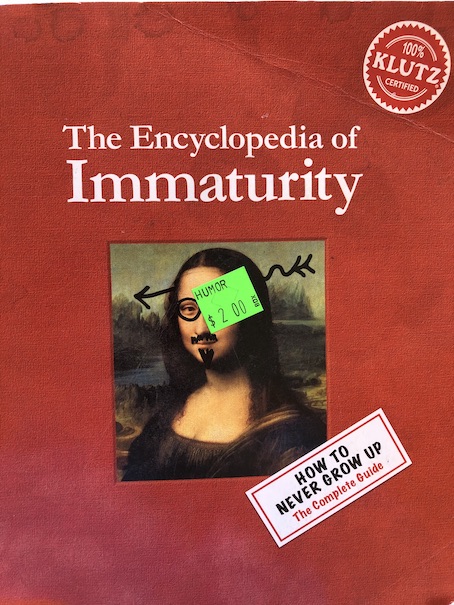
The Encyclopedia of Immaturity by the Editors of Klutz Press, 2007.

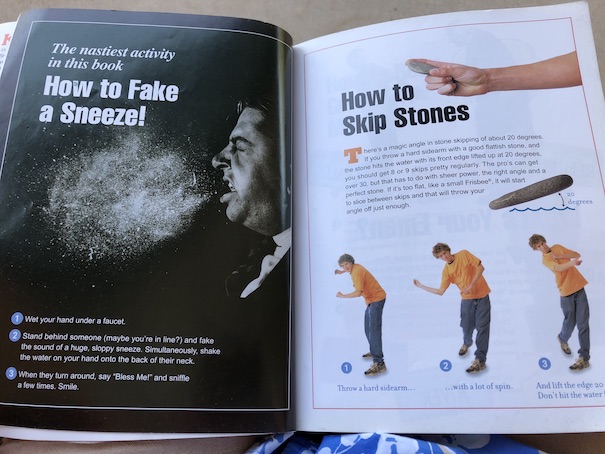
This book is part of the classic children’s hobby and activity series from Klutz Press. It’s a collection of pranks, stunts, and fun things to do. There is too much in this book to describe everything in detail, so I’ll just explain some general themes and highlights.

The stunts and activities are in no particular order, and the book isn’t divided into any special sections. Most of activity or stunts just takes up a page or two of explanation, but some are longer, about three or four pages. None of them are very long.

Some of the activities are classic kids’ activities or pranks, like skipping stones, hanging a spoon from your nose, and Peep jousting (a more modern classic – the book points out that you can do it with regular marshmallows, too, but I like Peeps for the imagery). I remember the one about how to blow a bubble gum bubble from your nose instead of your mouth (found on p. 271) being mentioned in Amber Brown Goes Fourth, when Amber’s new friend, Brandi, teaches her how to do it.

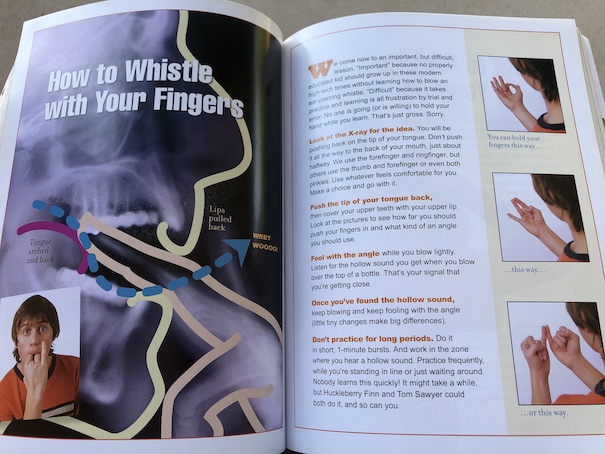
There are also some more difficult tricks to master, like how to do an ollie on a skateboard and how to do a wheelie on a bike. (At least, I consider things like that difficult because I’ve never been able to master them.) I also don’t know how to whistle with my fingers, although the book shows multiple ways to do it.

Some of the pages are designed to be cut out and made into things, like the page that provides a pattern for a paper fortune teller and the page where you cut a square of paper so that it’s possible for a person to go through it.

Some of the activities in the book were also in previous Klutz books, like juggling and how to use trick photography to take pictures that make people look like they’re small enough to pick up. I also remember the backseat rituals for long car trips being part of the Klutz Kids Travel book.

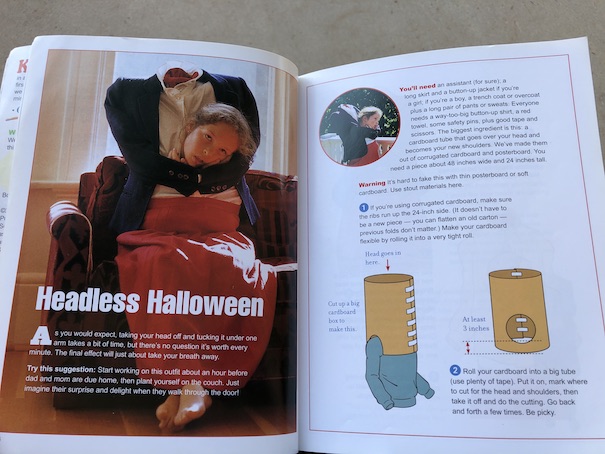
My two favorite sections in the book are the part about how to be a headless person for Halloween and how to sneak around. I never dressed as a headless person as a kid, but I like the idea, and might still do it. I did a lot of sneaking around as a kid because I always loved hide and seek.

There’s quite a variety of activities in this book, including some indoor activities and outdoor activities, and things that can be done on car trips. Some of these activities look kind of gross to me (and still would have when I was a kid because I wasn’t one of the kids who was into gross outs), like how to make fake dog barf, but there’s such a wide selection of activities, I’d say that there’s plenty here for anybody to find fun things to do!

The book is available to borrow and read for free online through Internet Archive (multiple copies), along with the sequel to the book, The Encyclopedia of Immaturity, Volume 2.

Stop the Watch

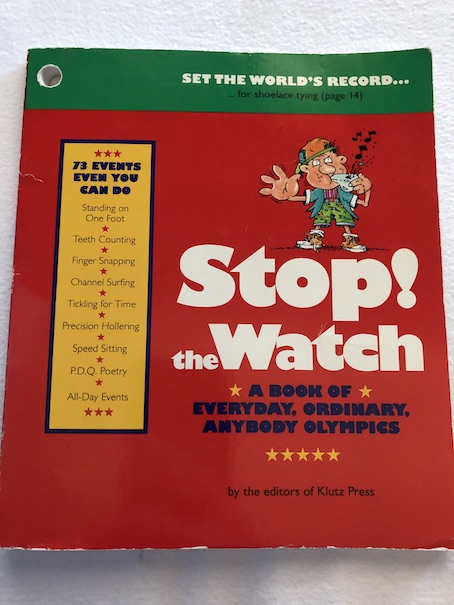
Stop! the Watch by the Editors of Klutz Press, 1993.

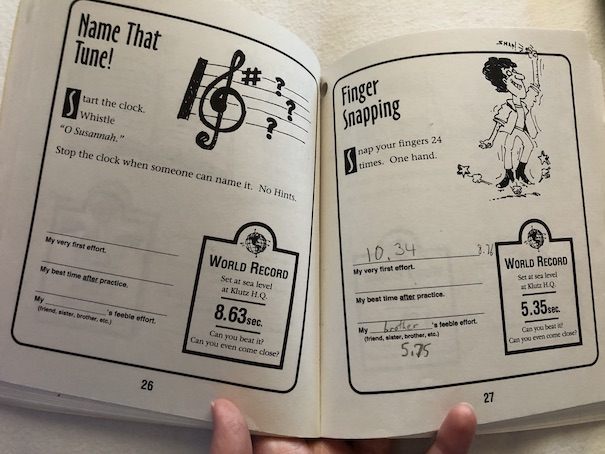
This book is part of the classic children’s hobby and activity series from Klutz Press. Originally, this book came with a working stopwatch in bright colors, which was attached to the book at the hole in the upper left corner. Unfortunately, I broke my stopwatch years ago, but I liked the book, and I got a new stopwatch to use with it.

The book begins with instructions for using the stopwatch and then offers various timed activities and goals for kids to reach while using the stopwatch. Most of the activities involved kids performing various simple stunts and trying to do them as fast as possible, like counting to 126 by 7s, writing a verse from The Song of Hiawatha, tying shoelaces, singing “Happy Birthday” to Rumpelstiltskin, walking up a flight of stairs with a book balanced on the head, and drawing a picture of a gorilla. There are places in the book to record your efforts and your own time records and the records of your friends. (You can see in my copy where I made notes.)

There are also activities that participants are supposed to perform for a very specific amount of time, trying to keep as close to the allotted time as possible without actually watching the watch. For example, one of the events is hollering the word “Eeeeellllllskin” for exactly 17 seconds.

There are also some events that are meant to be completed by two people acting as a team, like leapfrogging, carrying your partner ten steps, singing “Jingle Bells” while alternating words between partners, and throwing something weird back and forth.

The original edition of this book included time records set by the author and others at Klutz HQ. Readers could compete against these records and try to beat them, and later editions of the book were printed with new records set by readers who reported their results.

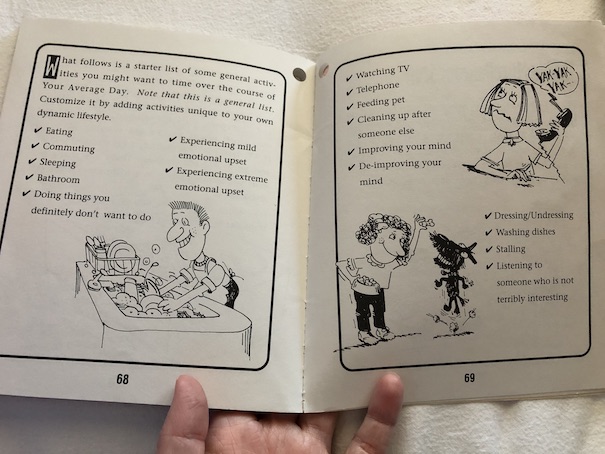
In the back of the book, there is a section explaining how to time daily events and predict about how much time you will spend doing those things throughout your life, like how much time you spend in the bathroom. Some of these things can be enlightening, like how much time you spend watching tv (Is it too much?), being emotionally upset (Have you been stressing too much?), or stalling when you’re supposed to be doing something else. There are also some educational ways of using time. The book explains how to tell how fast the car you’re traveling in is driving without looking at the spedometer by timing the distance between mile markers. It also explains how to tell how high you’ve tossed a ball by timing how long it takes to hit the ground.

The book is available to borrow and read online through Internet Archive.

Juggling for the Complete Klutz

Juggling for the Complete Klutz by John Cassidy, 1977.

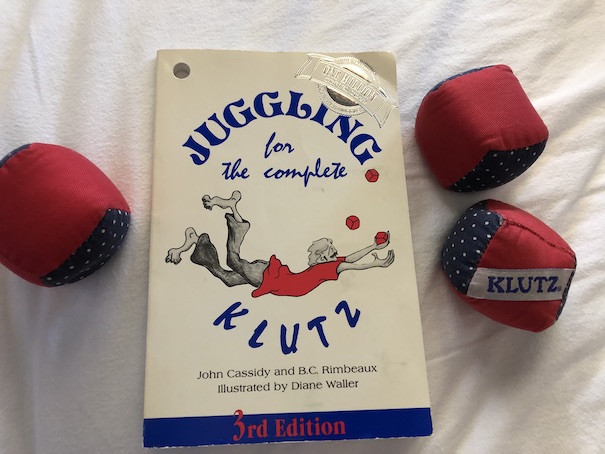
This is the book that started the Klutz Press publishing company as well as the book that inspired the name that I often use online, Jestress. The term “jestress” (which even I have never been sure is proper English) refers to a female jester. Back when I was in high school, I learned how to juggle from this book. In fact, I became obsessed with juggling and jesters (I often become obsessed about odd and random topics), and I started giving myself that nickname. (I’m not the only one who uses that handle, so not every “Jestress” on the Internet is another incarnation of me, but I have used it in several other settings.) However, the Klutz books in general were a regular feature of my youth, as they have been for many people from about the 1980s onward.

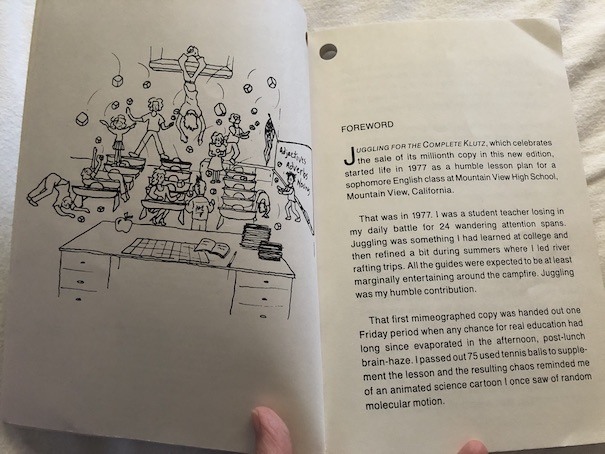
Klutz Press began as a small outfit, and the very first book they offered was this guide for learning how to juggle. The author of the book used to teach English, and as the intro to the book explains, he started teaching his students how to juggle as a fun exercise in class. John Cassidy learned how to juggle in college and used it to entertain guests on rafting trips. The author and his friends printed up more copies of his guide to juggling and began selling them. Their company branched out from there.

By the time I bought my copy of the book in the 1990’s, it came with 3 cube-shaped bean bags to use for juggling. The hole in the upper left corner of the book is where the bag holding the bean bags was originally attached. The bean bags are one of the best features of the book. They are weighed well for juggling, which makes them easier to control than other small juggling balls I’ve tried. A friend of mine got a later edition of the food from the 2000s, and the bean bags are a little different – the cloth is more velvety, and they have a different feel to them, like they’re slightly lighter. I prefer the ones I own.

The very first step for learning to juggle in the book is to master “The Drop” – throw all of the bean bags in the air and just let them fall to the ground without trying to catch them. The goal of mastering this is to get used to the idea of dropping things because it’s going to happen a lot while you’re learning. The cube shape of the provided bean bags helps to keep them from rolling too far when you drop them, which happens a lot when you’re learning to juggle. When I was in high school, I started teaching a friend to juggle, and we both agreed that the learning process actually gave our leg muscles a good workout; you really feel them when you have to bend over that many times to pick up dropped bean bags. (The book mentions this later in the section called “Special Problems”, but we considered this a bonus. It’s like doing a bunch of toe touches with more exciting moments in between when you’re throwing stuff in the air.)

From there, the book guides you through mastering the scooping motion of juggling tosses and how not to panic when you realize that the hand that is going to catch a tossed bean bag is already holding one. Successful juggling is largely a matter of timing, maintaining even motions, and eventually, letting muscle memory take over. You toss one ball (or bean bag), and then you toss the next one with the other hand when the first one reaches the top of its arc, freeing that hand for catching. Then, you keep doing that, over and over, to keep all of the juggling balls in motion.

It might feel impossible at first, when you’re still dropping everything, but speaking as someone who learned how to do this about 20 years ago, muscle memory is very strong, and if you build the right habits and keep at it consistently, you will not only eventually master it, but it will feel as natural as riding a bicycle. I don’t even have to look at my juggling balls or my hands while I’m juggling, and I can comfortably carry on a conversation with someone else while juggling, because my hands know what to do with minimal instruction from my brain.

The book has tips for getting around difficulties in learning to juggle, and when you’re feeling more confident, instructions for going even beyond basic juggling. The book explains different types of juggling cycles, how to juggle four or five balls, how to juggle other items besides balls and bean bags, and how to juggle with a partner. The section about clubs is particularly interesting because it not only describes the techniques of club juggling but how to make your own set of juggling clubs from plastic bottles and wooden sticks or dowels.

The book is available online through Internet Archive (multiple copies).

Clifford's Tricks

Clifford

Clifford’s Tricks by Norman Bridwell, 1969.

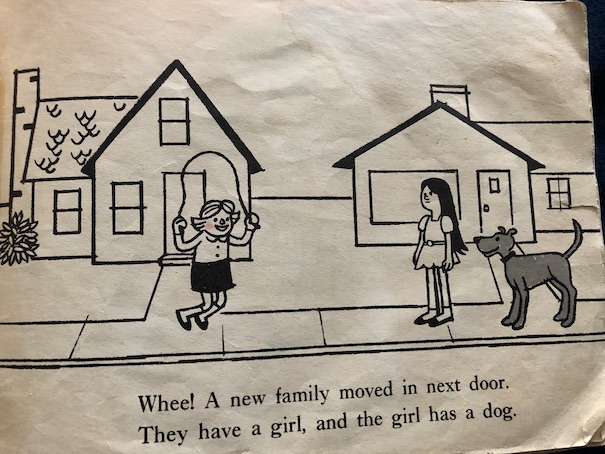
A new girl moves next door to Emily Elizabeth. The new girl, Martha, also has a dog, although her dog, Bruno, is a normal-sized dog, unlike Emily Elizabeth’s dog, Clifford.

Martha is competitive and brags that her dog is probably smarter than Clifford. Martha and Emily Elizabeth compare the tricks that their dogs can do, although Clifford’s tricks are different from those of normal dogs. His tricks tend to go wrong or cause problems because of his large size. For example, Bruno can retrieve a newspaper for Martha, but when Clifford tries to do the same thing, he comes back with the whole news stand.

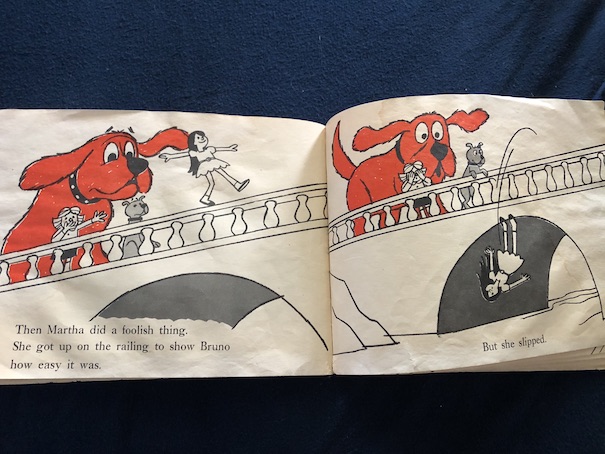
Martha tries to show off Bruno’s bravery by getting him to walk the railing of a bridge, but Bruno doesn’t want to do it because it’s too dangerous. When Martha tries to show Bruno how easy it is, she falls off the bridge into the river. Bruno jumps in to save her and also gets into trouble.

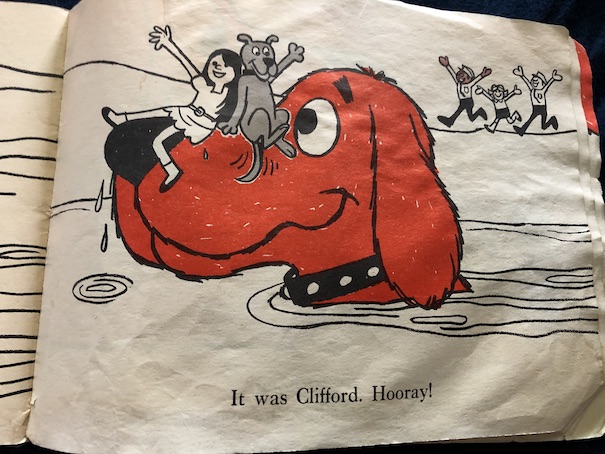
Fortunately, Clifford is big enough to save them both.

Martha is grateful that Clifford saved her and her dog, but each girl still loves her own dog the best.

The book is available to borrow for free online through Internet Archive. The edition that I have is the older edition of the book with pictures that are mostly black-and-white, except for Clifford, who is red. However, there is also a newer edition with full color pictures.

Totally Useless Skills

uselessskills

Totally Useless Skills by Rick Davis, 1994.

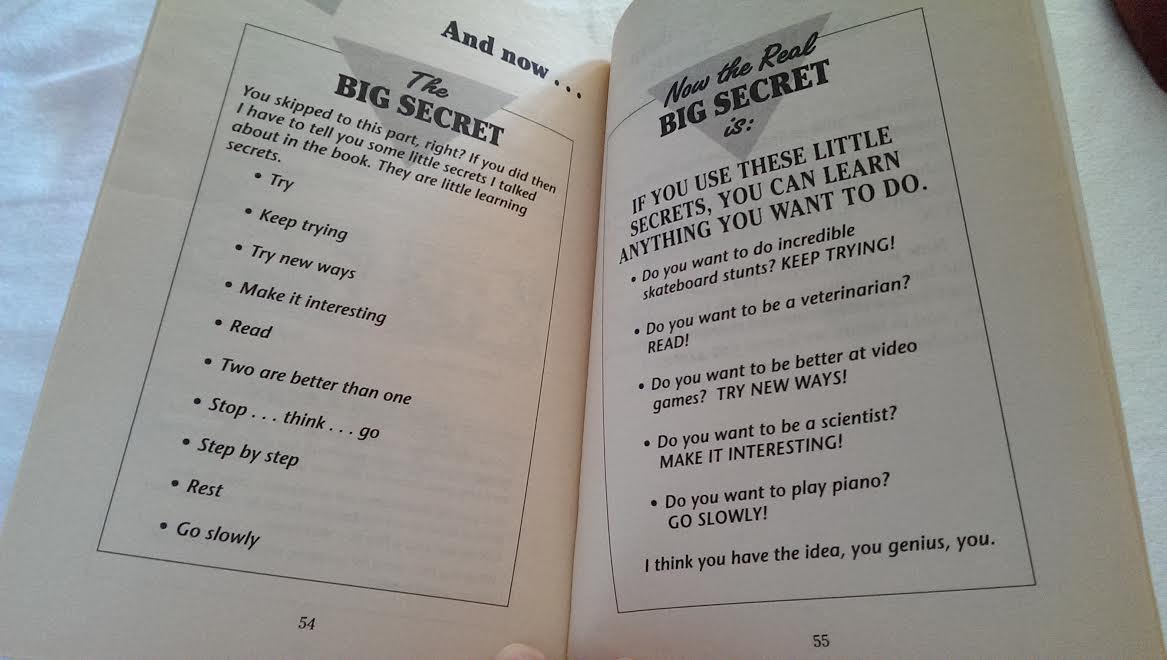
The name of this book is intentionally deceptive, but only partly.  What I mean by that is that the little tricks and stunts in the book may not have much of a practical application except for just having fun and amusing your friends, but the techniques for learning them can be applied to learning just about anything.

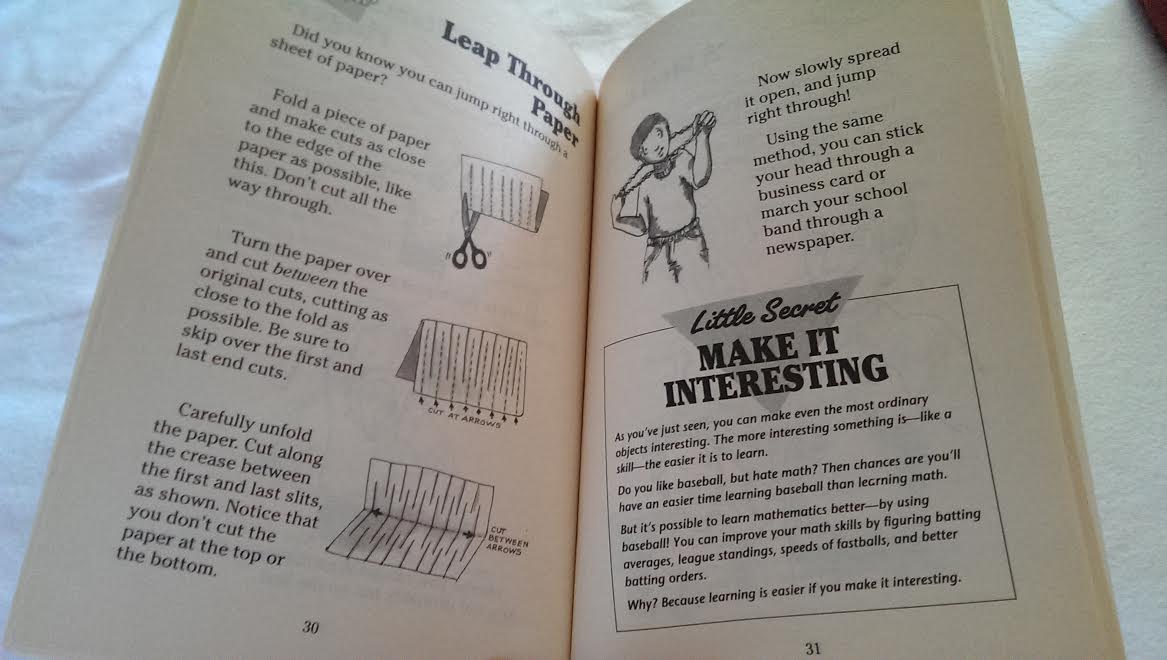
This book describes how to do fun tricks that don’t require any special equipment and are mostly based upon knowing things work, like the blind spot in the human eye (such as using the blind spot in your eye to make it look like your teacher’s head has vanished) and where your center of balance is (used in the trick showing how a girl can pick up a chair when a boy can’t). The tricks include making it look like your arms are lengthening or shrinking, making it look like you’ve broken your nose, how to hang a spoon from your nose, how to jump through a single sheet of paper, how to make a pencil float, how to make your leg disappear, and how to pronounce the longest word in the English language.

uselessskillspic1

Kids will enjoy learning these little tricks to entertain their friends. However, the book also contains useful tips for learning these skills that can be used to learn anything you want to learn. The author emphasizes the importance of trying new things, practicing what you’ve learned, going slowly and dividing big tasks into smaller ones when trying to master something difficult, and making tasks interesting so they will be easier to learn. Aside from the fun of learning these little tricks, the book’s main purpose seems to be helping kids to develop self-confidence and new learning skills.

The book is currently available online through Internet Archive.

uselessskillspic2