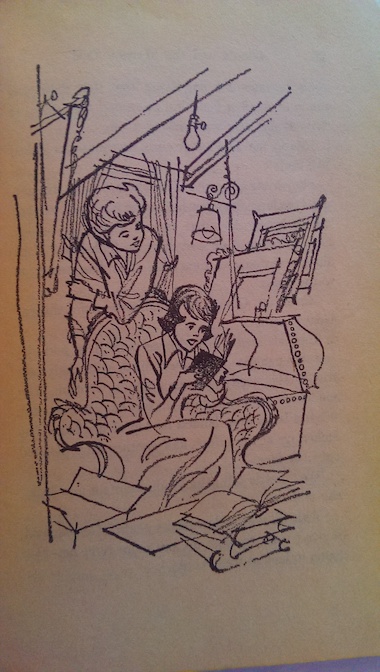
Gone-Away Lake

Gone-Away Lake by Elizabeth Enright, 1957.

Eleven-year-old Portia and her six-year-old brother Foster are traveling alone by train to visit their aunt and uncle and twelve-year-old cousin Julian in the country for the summer while their parents are on a trip. Portia likes spending time with Julian because Julian is an amateur naturalist and tells her things about animals and birds. When Portia and Foster arrive, their aunt, uncle, and cousin tell them that their dog has had puppies. Portia is allowed to name them, and if her parents agree, she and Foster will even be able to keep one!
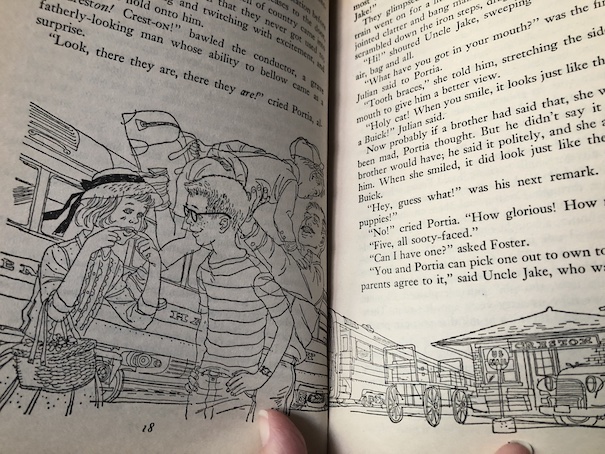
While Portia is out exploring the countryside with Julian one day, they find some garnets in a rock. They start chipping some out to take to Julian’s mother, and they find a carved inscription in Latin on the rock with the date July 15, 1891. They’re not sure what the Latin words mean. They figure out that part of the inscription refers to the Philosopher’s Stone, which was supposed to turn different substances to gold. Portia asks if this stone could be the real Philosopher’s Stone, but Julian says that’s impossible because they’ve been using knives to pry out the garnets, and they haven’t turned to gold. They continue to wonder what the inscription really means and why someone put it there.
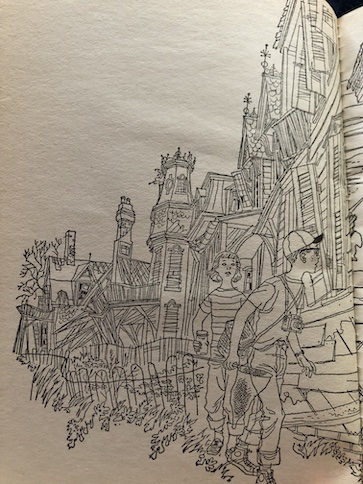
They explore the countryside further, getting lost. They aren’t too worried because they don’t need to be back soon. They follow a brook and find themselves in a swampy area. Strangely, they stumble over an old rowboat. Then, they spot a row of old, abandoned houses. The houses are in bad condition, but the kids can see that they were built in elaborate Victorian styles. The children wonder why those houses are there on the edge of swamp. Portia finds it a little creepy, but Julian wants to get a better look.

Then, the children hear a voice. Strangely, the voice is repeating an advertisement for medicine for indigestion. The children think it’s funny because no ghost would say something like that. Taking a closer look at the houses, they notice that one seems to be in better condition than the others that it has animals and a garden, so someone must be living there. Thinking about it more, Julian says that the swamp was probably once a pond or a lake, and that’s why it had houses and a rowboat. He hasn’t heard of a lake in the area, but he and his parents haven’t lived in the area for long. The children wonder who lives in the house and decide to find out.

They find an old woman in old-fashioned clothing, listening to a radio. The old lady is surprised to see them but welcomes them, saying that it’s been a long time since she has seen children. She invites them to come inside her house, and the children find themselves in a cluttered and chaotic parlor with each wall covered in a different kind of wall paper. The woman introduces herself as Minehaha Cheever.

The children explain how they ended up there by coming through the swamp, and Mrs. Cheever says that they shouldn’t go through the swamp because there is a dangerous sinkhole there that they call the Gulper. She says that when it’s time for the children to go home, she’ll have her brother show them a better and safer way. Mrs. Cheever says that there used to be a lake there, and that her family and about a dozen others had summer houses there, but the lake largely dried up when a new dam was built. After that, the summer houses were abandoned, and many of them were vandalized. However, her father and another woman locked up their houses with the furniture inside, thinking that they would come back and move them, but they never did. The large and fancy old Villa Caprice is still untouched, but Mrs. Cheever says that she supposes that much of the contents is probably deteriorated. She says that the Villa Caprice gives her the creeps.

The children ask Mrs. Cheever why she’s there, and she says that she used to live somewhere else. After her husband died, she didn’t have much money, and she remembered that the house at the former lake was still there. Her brother, Pindar, also wanted to retire somewhere quiet, so they decided to go live in their family’s old summer house. There was enough furniture and old clothes left there for the two of them, and it suits them. They keep animals. Pindar still has their old car, so he can sometimes go into town for things they need. “Pindar” was one of the words in the inscription on the rock.

Pindar explains that he and his best friend when he was a kid, Tarquin (another of the words on the rock), were the ones responsible for the inscription on the rock. Tarquin was three years older than Pindar, but they were still close friends. However, they had a temporary falling out when Tarquin was 13 years old. Tarquin had gone away to boarding school for the first time, and the next time they met at their summer homes, Tarquin had brought a friend from his new school with him, Edward. Tarquin and Edward were putting on airs and showing off how sophisticated they were because they were 13 years old and knew so much more now that they had been to boarding school. Pindar felt bad about his old friend shunning him and treating him like a little kid, so he started hanging out with his other best friend, Barney. Then, Pindar had the idea of showing Barney the big rock with garnets stuck in it where he and Tarquin used to meet and hang out together.
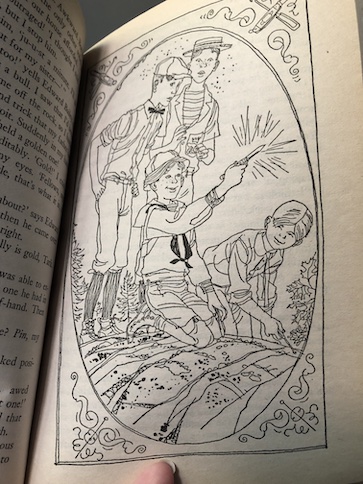
When Pindar and Barney got to the rock, they discovered that Tarquin and Edward were already there, and the older boys said that they had claimed the rock for themselves. They called the rock the philosopher’s stone and wrote the inscription labeling it as the philosopher’s stone in Latin, which they had learned at their boarding school. The older boys said that the younger ones were too little to be philosophers, like the two of them. Pindar’s feelings were hurt all over again, and he told his father about the situation. Pindar’s father was amused by the older boys and their sophisticated philosopher talk. He said that there was no age limit on who could be a philosopher and explained to Pindar what a philosopher’s stone was supposed to be and how it was supposed to turn things to gold. Then, he suggested a prank that Pindar and Barney could play on the older boys, convincing them that the stone really did have the power to turn things to gold. The older boys were temporarily fooled by the trick. At first, Tarquin was angry about being tricked, but then, he had to acknowledge that he had provoked Pindar and that the trick was a clever one. Tarquin made up with both Pindar and Barney, and he added Pindar’s name and his own to the inscription on the rock. Pindar still considers Tarquin and Barney to be his best friends, and they still write letters to each other in their old age.

Julian and Portia are fascinated by the stories that Pindar tells about the childhood summers he and his siblings and friends spent at this now-vanished lake. Mrs. Cheever said that she loves having children around the place again, and she suggests that Julian and Portia could use one of the old houses that is still in reasonably good condition as a kind of clubhouse. Julian and Portia love the idea, and Pindar and Mrs. Cheever suggest that they use the old house where Tarquin and his family used to stay. It’s in disrepair, but it’s much better than some of the other houses. There is plenty of furniture in the attic that the children can use, too. The children decide to invite some other kids to join them, and they call their club the Philosopher’s Club, after Pindar and Tarquin’s old group of friends.
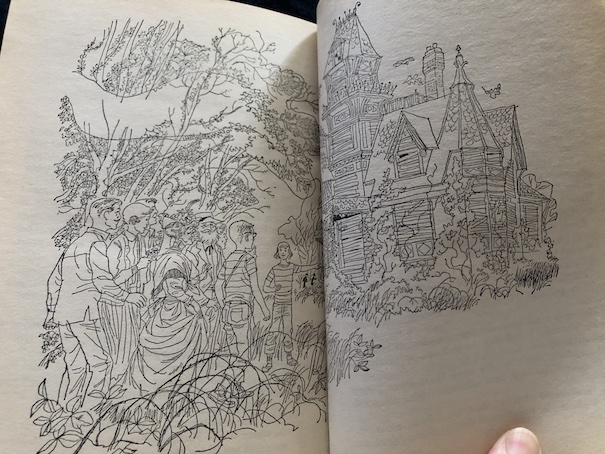
Julian and Portia invite some other local children to join the Philosopher’s Club and spent a magical summer exploring this abandoned community, picking blackberries, learning about local plants and their uses, and scavenging things from old houses and trying on the clothes from Pindar and Mrs. Cheever’s youth. The boys help Pindar build a bridge over the large sinkhole they call “the Gulper” after Foster falls into it and has to be rescued. When Julian and Portia’s parents meet Uncle Pin and Aunt Min (as they come to call Pindar and Mrs. Cheever) and come to see Gone-Away Lake, the adults also experience the magical, dream-like qualities of this place, and Portia’s parents consider plans that may make the children’s future summers magical.

The book is available to borrow and read for free online through Internet Archive (multiple copies – including a couple of copies of the sequel, Return to Gone-Away).

My Reaction
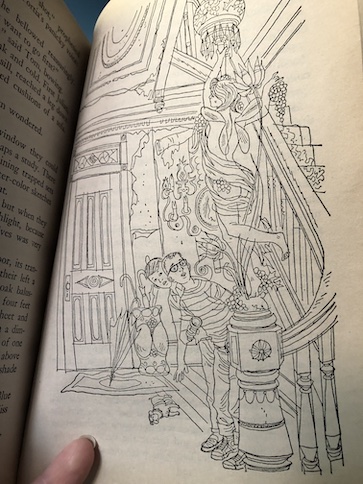
I remember a teacher reading this book or part of it to us when I was in elementary school, but I couldn’t remember much about the story except for the lake that had gone away and caused the town to be largely deserted. For some reason, I had thought this story was a mystery story, but it’s not.

In many ways, I think this is the perfect nostalgia book because a large part this story is about the nostalgia that the elderly brother and sister in the story have for the place where they used to have their childhood summer adventures, even though the place isn’t what it used to be. Through the stories that they tell the children and the children’s own adventures and explorations of this largely abandoned summer community, they begin building their own attachments to the place and their own nostalgic summer memories.

Because the story takes place in such a unique location, I think it would make a fun kids’ movie with a vibe of nostalgic summer adventure. Although, because the story is largely low-key slice-of-life and the flashbacks of Uncle Pin and Aunt Min to incidents in their youth, I can see that the story might have to be changed a bit to fit the usual movie format, focusing on one definite problem or a particular adventure to give the story its climax. I picture the kids and their Philosopher’s Club making it their mission to preserve this vanishing community, which fits with the way the original story goes, although the kids in the book enjoy the old community for the magic of its dilapidated state rather than wanting to fix it up and restore it to its former glory. I think they could lean into promoting the preservation of nature and the ecosystem of the area, with Julian in particular pointing out what makes this environment unique and how it has become home to animals and insects since the lake changed to a swamp and most of the people left. The Philosopher’s Club might connect with a local naturalist society, and they could build the bridge in the story together to make the swamp safer to traverse for nature lovers and bird watchers. Uncle Pin and Aunt Min could remain on the site as its caretakers. Perhaps, the kids might even find some old notes and drawings in one of the old houses that show some interesting aspects of how the environment has changed and some of the unique animals that make their home there. That didn’t happen in the book, but it would be a sort of environmentally-connected treasure the children could find.

Spot Goes to the Beach

Spot

Spot Goes to the Beach by Eric Hill, 1985.

Spot’s parents take him to the beach to spend the day there. When they get to the beach, Spot wants to get a sailor hat from a stand selling beach equipment, and his father also buys him some beach toys.

Spot plays with a beach ball, builds sand castles, and buries his father in the sand.

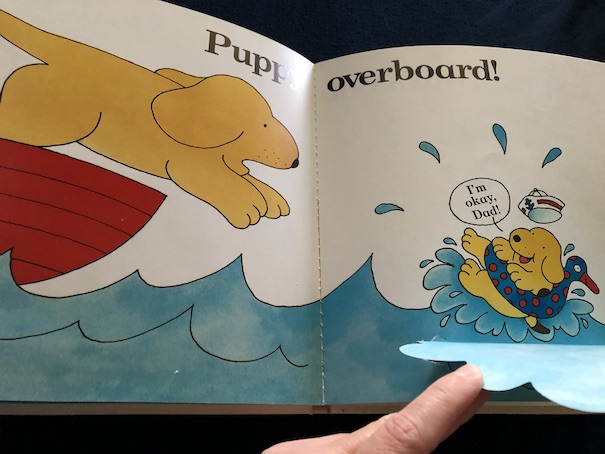
Spot and his father later go fishing, and Spot falls in the water, but Spot is fine because he’s wearing a pool float.

Before they leave the beach, Spot also makes a new friend, another puppy!

This is just a cute book for children about the fun things that they can do at the beach.

Like other Spot books, this book is a lift-the-flap picture book. The British version of the title is Spot Goes on Holiday. It’s available to borrow and read for free online through Internet Archive (multiple copies).

Aqua Volume 2

Aqua Volume 2 by Kozue Amano, 2003, English Translation 2008.

The is the second volume a fascinating manga series that combines sci-fi, fantasy, and slice of life. The series takes place about 300 years in the future, when Mars has been terraformed and renamed Aqua (because of all the water on its surface). The human colonies on Aqua are designed to resemble old-fashioned cities on Earth (called Manhome here). The people of Aqua prefer a much slower pace of life than people on Manhome, and aspects of life on Aqua more closely resemble Earth’s past.

In the previous volume, a young girl, Akari Mizunashi, came to Aqua to learn to become a gondolier in the city of Neo Venezia (which resembles Venice). Female gondoliers, called Undines, give tours of the city, giving Akari plenty of time to admire the beauty of her new home and meet interesting people.

The two Aqua books are the prequel to the main series, Aria. Aqua covers Akari’s arrival on the planet, her introduction to life on Aqua, and the beginning of her training. The series has received some criticism for being slow and lacking danger and adventure, but that is not really the point of the series. The main purpose is to show people how to appreciate the small pleasures of life. The sci-fi and fantasy elements (the spaceships, advanced environmental controls, intelligent Martian cats, and even the occasional appearances of the legendary Cait Sith) are mainly background to the stories about the magic of friendship and simple pleasures. Each volume contains a few short stories about Akari and her friends and the little adventures they have on a daily basis and the life lessons they learn. It’s a great series for relaxing when you’re stressed out.

The stories included in this volume are:

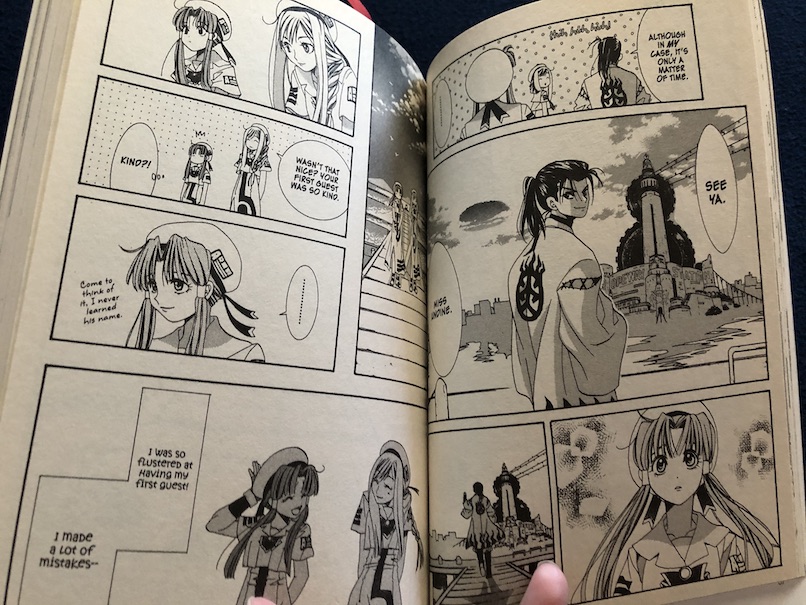
My First Customer

Akari gives her first customer a ride in her gondola. Although she makes mistakes, it is still a memorable experience, and she makes a new friend. Her ability to row a boat very fast backward even comes in handy!

It’s good to read the books and stories in this series in order because characters reappear. Akari’s first customer is Akatsuki, who is a trainee “Salamander” who lives on the floating island of Ukijima above Neo Venezia, which is reached by cable cars. Because Akatsuki spends most of his time on Ukijima, he tends to get lost when he comes into town. He becomes an important character who makes regular appearances through the books. There’s a story later in this book that explains more about his job.

It’s Hard Being President

President Aria feels useless because he can’t help with the spring cleaning. He decides that he isn’t a good president to Aria Company and tries to run away from home but learns that there is nowhere else where he is happy and that his friends still love him.


Night-light Bells

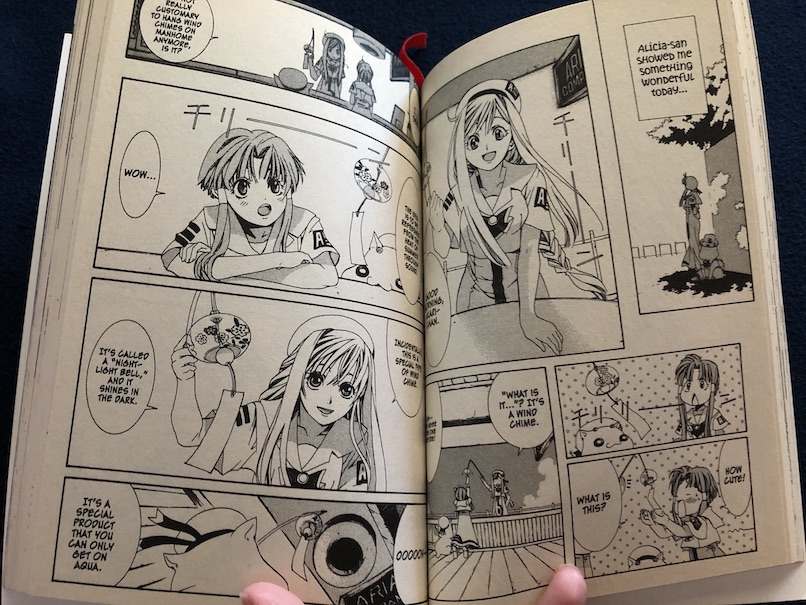
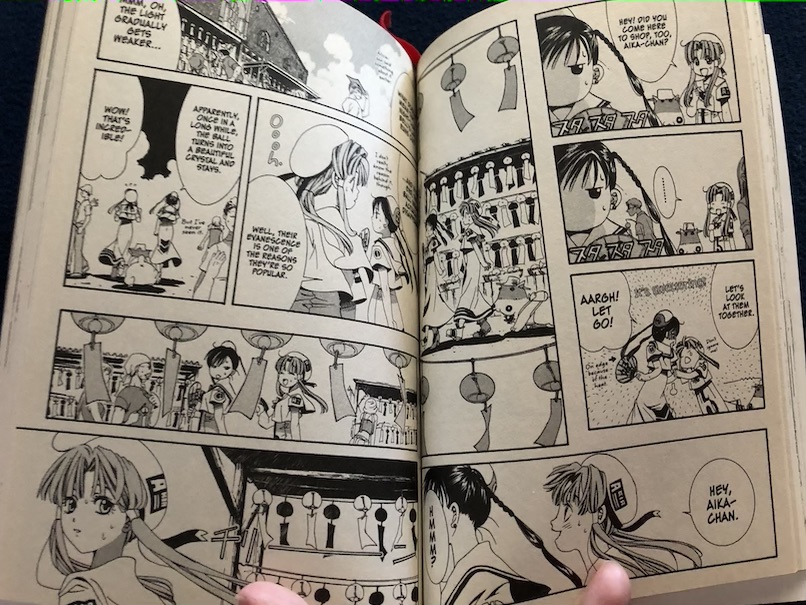
In the summer, people in Neo Venezia buy special night-light bells, chimes that glow in the dark.

These bells do not last forever because the glowing center eventually falls out, but sometimes they leave something special behind besides happy summer memories, a tiny crystal.

Akari goes to a night light bell festival and gets a night light bell of her own. The night light bells are a cheery part of summer, and when it’s time for them to expire, the people of Neo Venezia have a special ritual to return the glowing centers to the water when they fall out. However, Akari is lucky and gets one of the bells that has a tiny crystal when the center falls out.

I like this story because I think that the idea of having glow-in-the-dark wind chimes is really charming.

Enter the Hero!

President Aria dreams of being a super hero, like the hero of his favorite television show.

His attempts to be an ally of justice aren’t very successful until he discovers that even doing something small can make a big difference, returning a lost toy to a grateful child.


Fireworks

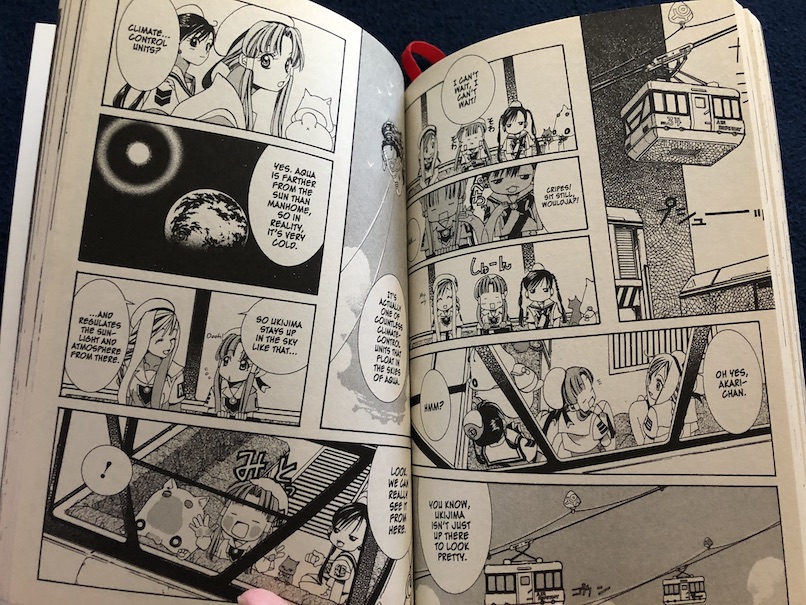
Akari and her friends visit the floating island of Ukijima where her friend, Akatsuki, is learning to be a Salamander. Salamanders help control Aqua’s climate. Because Ukijima is anchored above Neo Venezia, they have to use a cable car to get there, and Akari thinks that the view is amazing, like she’s flying when she’s there.

Akari and her friends have dinner wtih Akatsuki, and he shows them around and explains more about how Ukijima works and what his job as a Salamander involves. Neo Venezia experiences different seasons and different types of weather, but the Salamanders help to regulate it and keep it safe for the residents by controlling the amount of heat released into the atmosphere. The processes behind some of the technology on Aqua sound almost magical.

There are many amazing things on Ukijima, but Akari is most entranced by her first fireworks show. Even though Akari has never seen fireworks before, she finds herself connecting with the nostalgia surrounding them, which she realizes is a feeling that surrounds everything on Aqua and in Neo Venezia because the style of living is more old-fashioned than on Earth/Manhome.


Colds and Pudding

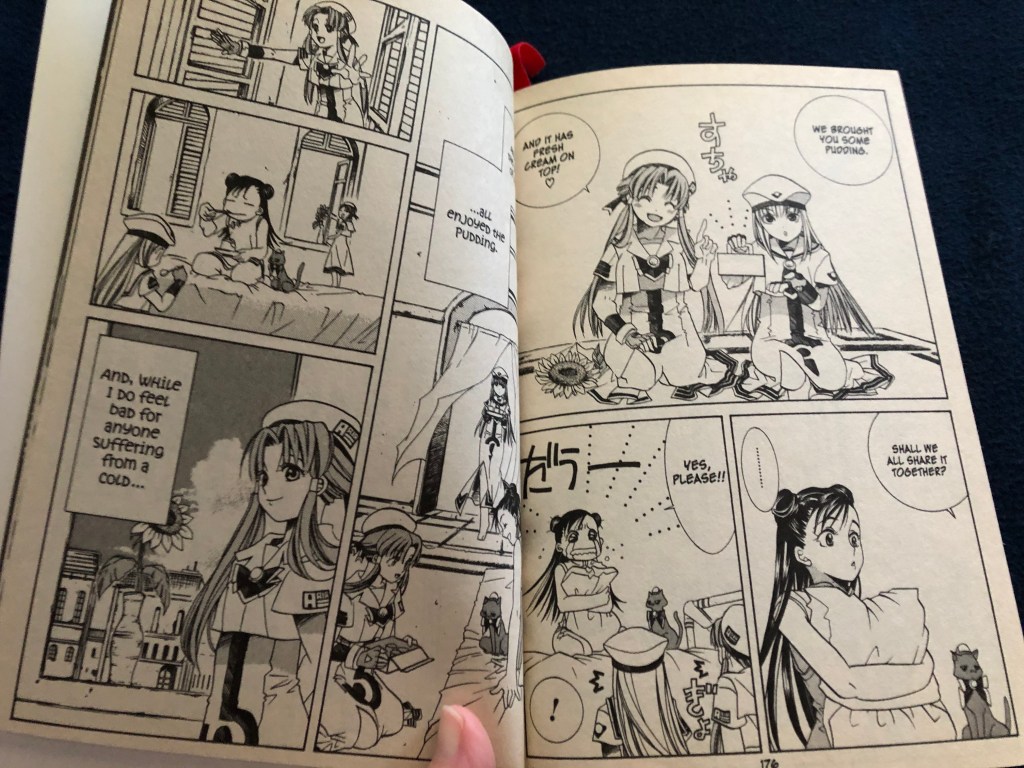
Akari and another friend, Alice (who you don’t really get to meet until the Aria series begins – she’s another trainee Undine), go to visit Aika, who is sick with a cold. They find her upset and learn how a simple trip to get some pudding led to a disturbing epiphany for her.

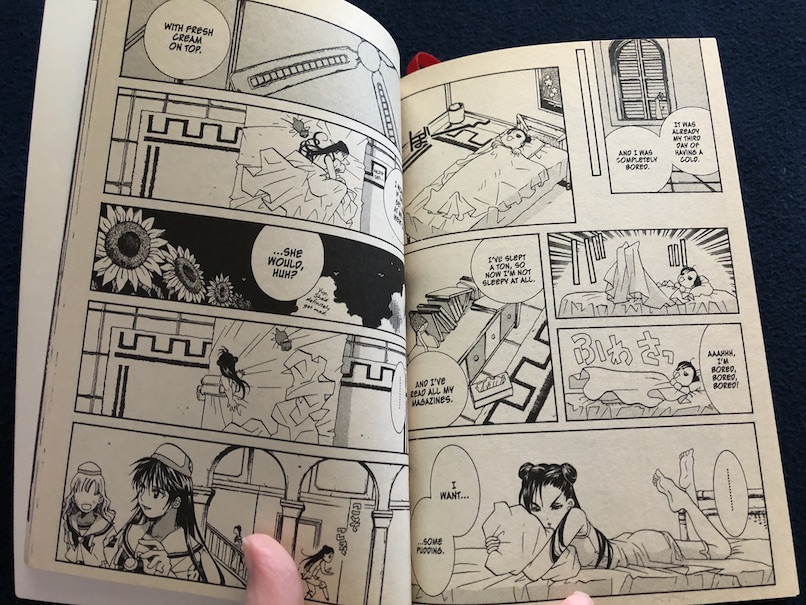
Aika was bored, hungry, and tired of staying in her room, so she decided to sneak out to get some pudding.

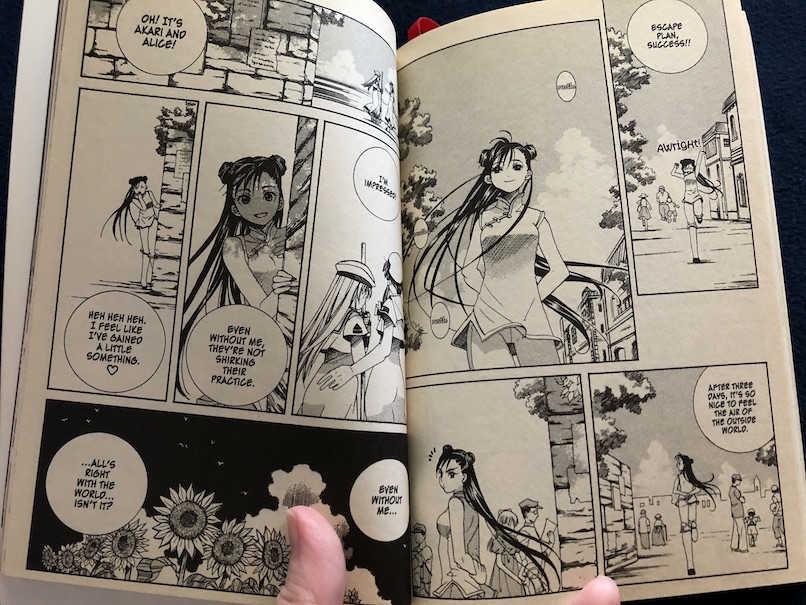
While she was walking through the streets, enjoying her freedom without anyone knowing she that she was gone, she caught sight of Akari and Alice practicing their rowing. At first, Aika is amused that she can spy on them without them noticing her, but then, she gets a strange feeling, realizing that, under normal circumstances, she would be practicing with them, but she can’t be with them now.

It feels eerie to her to see people going on with their day without her, as if she didn’t exist or that her absence doesn’t matter. Aika gets so spooked by the feeling that she runs home and goes back to bed, crying.

However, Aika’s friends do miss her and are thinking about her while she’s sick, and they know exactly what she needs. Trust your friends to help you feel better (and bring you pudding) when you need it!

This is the story that convinced me to learn how to make pudding from scratch one day when I was sick at home. You don’t have to go out and get creepy feelings when you know how to make pudding yourself! Pudding is an easy dessert to make; it just takes awhile to thicken on the stove.

Samantha Saves the Day

American Girls

Samantha Saves the Day by Valerie Tripp, 1988.

This is part of the Samantha, An American Girl series.

Samantha and her family are spending the summer at their summer home at Piney Point. Besides Grandmary, Uncle Gard and Aunt Cornelia will be there. Cornelia has also brought her younger sisters, a set of twins named Agnes and Agatha. They are close in age to Samantha. Grandmary’s friend, Admiral Archibald Beemis, is also visiting from England.

The family’s summer home isn’t just a single house. They have a lodge in the style of a log cabin and separate guest cottages. This summer, Samantha and the twins will get a cottage to themselves with no adults. The girls have fun exploring the area around the lake together. However, there is one place that Samantha is afraid to go, the island in the lake called Teardrop Island. The only way to get to the island is by boat, and there are sharp, treacherous rocks in that part of the lake. That was where Samantha’s parents had their boating accident and drowned during a storm. To Samantha, Teardrop Island is a place of sadness and danger.

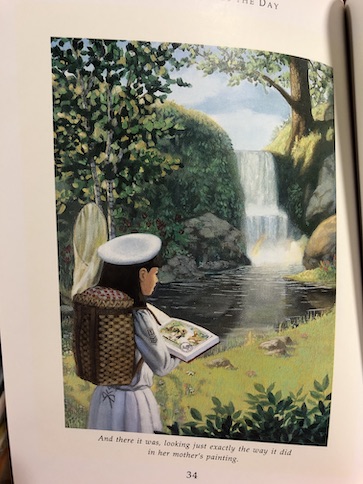
One rainy day, the three girls go up to the attic of the lodge to look for more paintbrushes so they can paint pictures. In the attic, they find old clothes and pictures of Samantha’s family. They also find Samantha’s mother’s old sketch book, labeled “Happy Memories of Teardrop Island.” In the sketch book, she drew pictures of Samantha and her father as they had picnics and played by a waterfall. Samantha was a very young child at the time, and she has no memories of having been on the island with her parents. From the pictures, it looks like it used to be her family’s favorite place.

Seeing the pictures makes Samantha want to visit the island once more, hoping to bring back memories of her earlier visits and her parents. The next day, the three girls go out to the island and try to find the places that Samantha’s mother drew in her book. Teardrop Island turns out to be a beautiful place, and Samantha loves it. The more time she spends there, the more she feels like she has been there before, although her memories are vague and dream-like.

However, the girls forgot to tie up their boat, and they find themselves stranded on the island! A storm comes, and the girls are afraid. When the Admiral tries to come out to the island to help them, he is injured, and the girls realize that they are going to have to find a way to save him! Can they make it home through the storm, or will they meet the same fate as Samantha’s parents?

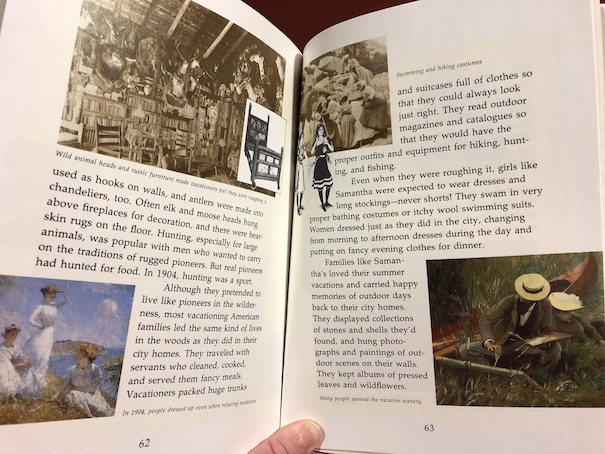
In the back of the book, there is a section with historical information about how people would spend their summers during the early 1900s. Wealthy families like Samantha’s would go to summer homes in the countryside to escape the heat of the cities.

The book is currently available to borrow for free online through Internet Archive.

Surprise Island

The Boxcar Children

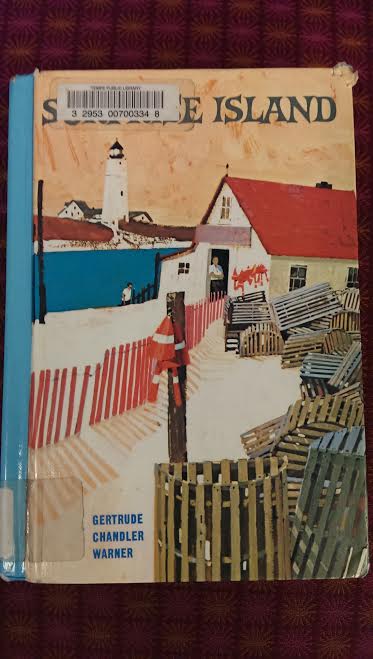
Surprise Island by Gertrude Chandler Warner, 1949.

Mr. Alden has promised his grandchildren a special surprise for their summer vacation. He tells them that, years ago, his father bought a small island because he kept horses and wanted a quiet place for them.  The island has only one little yellow house, a barn, and a fisherman’s hut where Captain Daniel lives.  Captain Daniel operates the motorboat that can take people to the island.  Mr. Alden plans to take his grandchildren to the island to look over the house, and if they like, they can spend the summer there.  The children think that it sounds like fun.

When they get to the island, the children decide that they want to stay in the barn instead of the house.  Captain Daniel also tells them that he has a young man staying with him, a friend who hasn’t been feeling well.  The Aldens’ old friend, Dr. Moore, has come to see the island with them, so he looks in on the young man.  It turns out that the young man was in an accident and had lost his memory for a time, although he has been gaining it back.  He says that he used to live with an uncle but that he didn’t want to go home again until he was sure that he was completely well.  He is going by the name of “Joe”, which is short for his middle name, Joseph.  Captain Daniel says that he’s known the young man all his life, and Dr. Moore also seems to know him, but Joe doesn’t seem to want to talk about himself to Mr. Alden.

The kids enjoy setting up housekeeping in the barn.  It reminds them of when they used to live in an old boxcar.  They use old boxes for furniture, dig for clams, and eat vegetables from the garden that Joe and Captain Daniel have tended for them.  Their grandfather allows the children to stay on the island in Captain Daniel’s charge, but they are mostly allowed to take care of themselves.  Joe sometimes brings them supplies that they ask for from the mainland.  (One of the themes of the Boxcar Children Series is self-sufficiency.  At one point, Jessie comments about how much better things seem “when we have to work to get it.”)  For fun, they go swimming, and Joe spends time with them, telling them about different types of seaweed.  They are surprised at how knowledgeable Joe is.

Henry gets the idea that they can set up a kind of museum of interesting things that they find on the island, like samples of different types of seaweed, shells, flowers, pictures of birds that they’ve seen, etc.  The other children think that it sounds like fun, and they begin thinking about the different types of things that they can collect.While they’re searching for things to collect and add to their museum, the children find a cave and an old arrowhead and ax-head.  They are authentic Indian (Native American) relics!  When they show Joe what they’ve found, he gets very excited, especially when they tell him that they saw a pile of clam shells, too.  Joe explains to the children how Native Americans used to use shells as money called wampum.  He thinks that what they saw was wampum, which the people who used to live there might have made after drying the clams to eat later.  Joe explains to the kids some of the process they would have used to turn the shells into wampum.  He’s eager to go to the cave and look for more Native American artifacts with them, but he urges them not to say anything to anyone else about it because other treasure hunters will probably show up if they do.  The children agree to keep their find a secret until their grandfather returns.

When they return to the cave with Joe, they make an even more incredible find: a human skeleton with an arrowhead inside.  It looks like they’ve found the bones of someone killed by an arrow!

The book is available to borrow and read for free online through Internet Archive.

My Reaction

As with some other vintage children’s mystery series, the early books in the series were more adventure than mystery.  The most mysterious part of this book concerns the real identity of the young man they call “Joe.”  The truth begins to come out when a strange man who calls himself Browning comes to the island in search of a young man who disappeared the year before while doing some exploring for him.  The young man he’s looking for worked for a museum.

This is the book where Violet first learns to play the violin.  This is a character trait that stays with her for the rest of the series.

Annie’s Promise

AnniesPromise

Annie’s Promise by Sonia Levitin, 1993.

This is the final book in the Journey to America Saga.  Annie, the youngest of the Platt girls, is more of a tomboy than her older sisters.  Her father thinks that she’s been growing up too wild in America, running around and climbing like a boy.  This summer, in 1945, while her best friend goes to visit their family’s farm in Wisconsin, Annie’s father wants her to stay home and help him with sewing for his coat business, and Annie’s mother has a list of chores for her to do.  It all sounds so boring and dreary.  Twelve-year-old Annie longs for excitement, but because of her recent appendix operation and her migraine headaches, her parents worry about her health.

Then, Annie gets the opportunity to attend summer camp.  She wants to go and do all the fun summer camp activities that other girls do, but her parents worry at first.  They worry about Annie’s health, and they don’t know who is running the camp or what they do there.  Annie’s older sisters, Ruth and Lisa, tell their parents that it’s normal for girls in America to go to summer camp and that the experience might do Annie some good.  When the family doctor says that Annie is healthy enough to go, her parents finally agree.

At first, camp is hard.  Annie faints soon after her arrival, and she worries that maybe her parents were right about her being delicate.  However, one of the counselors tells her that these things happen and that she was probably just overtired, overheated, and still suffering from the rough bus ride to the camp and that she will be fine after she rests.  Annie is physically fine, although one of the other campers, Nancy Rae, makes a big deal about the incident, calling Annie a “sickie” and other names.  Nancy Rae is a terrible bully, and Annie nearly drowns in the lake after accepting a dare from Nancy Rae to swim across it, in spite of not being a good swimmer.  Annie overhears the counselors saying that Nancy Rae should probably be sent home for goading Annie into a dangerous stunt, but they know that Nancy Rae comes from a bad home and that her father abuses her.  For her own sake, they decide to give her another chance.

However, even knowing Nancy Rae’s troubled history doesn’t help Annie when Nancy Rae keeps picking on her and a black girl named Tallahassee (Tally, for short).  Nancy Rae calls Tally and her younger brother (who is also at the camp) “nigger” and says that Annie is a “nigger-lover” when she tries to protect the younger brother from one of Nancy Rae’s tricks that could have really hurt him.  (Note: I’m not using the n-word here because I like it. I’m just quoting because I want you to see exactly how bad this gets.  Nancy Rae uses this word multiple times, and so do others when quoting her. This book is not for young children.  Readers should be old enough to understand this word and beyond the “monkey see, monkey do” kind of imitation some kids do when they learn about bad words.  The management assumes no responsibility if they aren’t.)  Nancy Rae is a thrill-seeker, who frequently does wild stunts to get attention and tries to make other girls hate Annie as much as she does.  At one point, she snoops through Annie’s things and tries to take her diary.  Eventually, she figures out that Annie is Jewish and makes fun of her for that, painfully reminding Annie of what it was like living in Nazi Germany and of her relatives, who died in the concentration camps.

Finally, Annie reaches the breaking point with Nancy Rae.  At a camp talent show, she arranges with other kids to dump horse manure on Nancy Rae’s head after she finishes singing a song.  Nancy Rae is so humiliated by the experience that she ends up leaving camp.  Annie is relieved that she is gone, but one of the camp counselors, Mary, makes her feel guilty about her revenge because she sees Annie as being stronger and more talented than Nancy Rae and wishes that she could have made Nancy Rae her friend instead, giving the bully a chance to improve herself.  (I disagree with what the counselor says, but I’ll explain more later why.)  Annie feels badly about how things turned out, but the incident blows over, and the rest of camp is a great adventure for her.

At camp, Annie mixes with different kinds of children from the ones she usually sees in her neighborhood and at school, and everything is a learning experience.  She becomes friends with Tally and gets a crush on a boy named John.  There is an ugly incident in which an assistant in the camp kitchen tries to molest Annie when he finds her alone (this really isn’t a book for kids), but the camp counselors dismiss him for what he did.  Annie and Tally talk about many things together, and Tally is very understanding.  The incidents with Nancy Rae and the kitchen assistant bring up the subjects of people who try to victimize others and how to deal with them.  Annie resents that people like that force others to be on their guard, limiting them in ways that they can behave in order to avoid being victimized, but Tally says that there’s no help for that.  As long as people like that exist, she says, protecting yourself is a necessity.  They also compare the way Annie feels when John gives her a little kiss to the repulsed and frightened way that she felt when the kitchen assistant tried to force himself on her.  Both incidents involved a kiss, but the way it was delivered and the person delivering it made each experience feel very different.  In the end, Annie’s crush on John turns into friendship rather than love as she realizes that the kiss was just a friendly gesture.  It is a little disappointing to her at first, but it is still a learning experience for her.

Annie learns that everyone at this camp has been through something bad in their lives.  Annie’s family are war refugees, but Tally’s father has been married three times, and she’s often the one to take care of the house and her younger brother, while her current stepmother cleans other people’s houses for money.  Other kids are poor or orphans or have fathers in jail.  The camp gives them a chance to get away from their problems for awhile, to make new friends, and to develop talents that they can be proud of.  Annie really blossoms at camp, learning to ride horses and work on the camp newspaper.  As Annie’s session at camp comes to an end, Mary offers Annie a position as a junior counselor for the final session of camp, helping the young children.  Annie is enthusiastic about the prospect, but family dramas at home threaten to derail her plans.  Ruth’s fiancé is shell-shocked from the war and has broken off their engagement.  Lisa is tired of arguing with their parents about every small piece of independence in her own life and has decided to move to a place of her own.  With all of this going on, and their parents upset about everything, what chance is there that they will sign the permission slip that Annie needs to become a junior counselor?

This book shows how much the lives of the girls in the Platt family have changed since they first left Germany for America.  It’s partly because they are living in a different country, partly because times and habits are changing everywhere, and partly because all of the girls are growing up and making decisions about what they really want to do with their lives.  The older girls in the family, Ruth and Lisa, are women now and thinking about careers and marriage.  As the girls suffer disappointments and changes of heart, their parents suffer along with them, and Annie realizes that she has to make up her own mind about what she really wants.  As Annie tries to decide what she really does want, her parents struggle to cope with all of the changes in their daughters’ lives and in the changing world around them.  They fight against it in a number of ways, and when things go wrong, whether it’s Annie’s illnesses or the older girls’ romantic problems, they tend to get angry or panic.  As the book goes on, it becomes more clear that what the parents really feel is helplessness.  More than anything, they’ve wanted life to be better for their daughters in their new country, and it upsets them when things don’t work out.  They want to help guide their daughters and make their futures work out for the best, but in the process, they often come across as too controlling or making the wrong decisions because they don’t fully understand the girls’ feelings or situations.

Ruth and Lisa each suffer romantic disappointment before they settle down.  Ruth had a fiancé, Peter, who went away to fight in World War II, but having seen the prisoners in the concentration camps, he has returned disillusioned and dispirited.  He was Jewish, but now comes to associate his religion and heritage with pain and suffering and wants to give it up, breaking off his engagement to Ruth in the process.  At first, Ruth is angry with him, saving that it’s like he wants to give up on his whole life, on the whole world.  The girls’ father says that he wants to kill Peter for leading his daughter on, but part of his feelings turn out to be his own feelings for somehow failing his daughter, that he is somehow to blame for allowing this disappointment.  When Lisa is upset because the young man that she’s been seeing says that he doesn’t want to get married, she argues with her parents about the course of her life and leaves home to live on her own.  Her parents see that as turning her back on their love and protection, but Lisa says that she just wants the independence that other girls have.  Even Annie feels abandoned by Lisa because Lisa was always there to comfort her as a sister and help her persuade their parents to listen to her, but Lisa says that she has to deal with problems on her own and that Annie will understand someday, when she’s in the same position.  Annie realizes that, in a way, she already is in the same position.

The one time that Tally comes to visit Annie at her house and the girls go to the beach together, Annie’s parents make a scene when she gets home because she’s left sewing all over the house and eaten more food than she should have.  Tally was going to apply for a sewing job with Annie’s father, which would have helped both of them, but Annie’s parents send her away, thinking that she’s a bad influence who encouraged Annie to goof off.  Then, Annie hears her own parents use the n-word.  It’s the final straw for Annie, and she runs away to camp.

The people at camp are glad to have her because they need her help, but being there, helping them, and thinking about her own life and future help Annie to realize what’s really important to her.  She’s been feeling bad about the hate she got from Nancy Rae and the hate that she felt from her parents with their insults to her friend.  However, her parents don’t really hate her, and in spite of what they’ve done, she doesn’t really hate them.  She realizes that, before she does anything more with the camp, she needs to go back and see them.

Annie rethinks what Nancy Rae was really about, how she was filled with hate for everyone, dealing out hatred because of all that she’d received from everyone else.  The counselors realized that she needed love more than anything, but Nancy Rae’s own hateful behavior pushed away the people who would have given her more positive attention and Annie’s revenge (although provoked) ended her camp experience.  Annie realizes that she doesn’t want to go down the same path and that she must mend her relationship with her family.

I said before that I disagreed with the counselor’s approach to the problem of Nancy Rae and what she said to Annie about her revenge.  I see what they were trying to do with giving Nancy Rae another chance, but what bothers me about it is that they act like Annie was in a much less vulnerable position to Nancy Rae and that she should have been strong enough to take what Nancy Rae dished out without hitting back, and I don’t think that’s true.  All of the kids at the camp were there because they had something troubling in their lives, some vulnerability, including Annie.  To say that Annie was more fortunate and more talented and that it should have been enough was to discount the harm that Nancy Rae was doing.  I know that the counselors were trying to make the camp experience positive for Nancy Rae, but she was making the camp experience more negative for everyone else around her and needed to be stopped.  Everyone suffers from something in life (as this book also demonstrates), but not everyone chooses to become a bully because of it.  Nancy Rae made that decision herself, within herself, and for herself alone.

Part of the problem, I think, was that there were no obvious consequences for Nancy Rae’s bad behavior, and therefore, she had no reason to stop doing what she was doing.  The lack of punishment and the inequity of the situation was what finally sent Annie over the edge with her.  Since the counselors didn’t make it obvious that Nancy Rae was in the wrong, Annie felt that she had to, and that says to me that there was a lack of responsibility and accountability.  I think that life is a balance and that both positive reinforcement (giving rewards to people who do good) and negative reinforcement (punishment for bad behavior) are necessary.  I believe in plain speaking, and if I were in the counselors’ position, I would make it plainly and specifically clear that no campers were to use the n-word, to mess with others’ belongings, or to do the other things that Nancy Rae was doing and that there would be consequences for doing so, telling them exactly what those consequences were so that no one could say that they were surprised.  I would also make it clear to Nancy Rae that I knew exactly what she was doing and why she was doing it and that it was unacceptable.  When we choose what we do and say in life, we all consider (or should consider) what we want to happen in life, and I would put it plainly to Nancy Rae how she really expects others to react to her and how their reactions would change if she did things differently.  Clearly, no one has ever told her that in her life before, and it was about time that she heard it from someone.  I suppose we could guess that the counselors may have said something of the sort to her out of hearing of the others, but I would also say the same thing to Nancy Rae’s victims.  Letting them know that I’d dealt with her adequately might head off their attempts to deal with her themselves and talking about what our behavior might lead others to do might also discourage revenge.

Also, the counselors were counting too much on the idea of friendship with Annie to get Nancy Rae to stop treating her badly, but that’s not at all the way that bullies work.  One of the primary reasons why people bully is that they know that there are a lot of people who like mean humor, and they use their bullying to bond with those people, not their victims.  Their friendships are formed on mutual contempt for the victim and the fun of humiliating that person.  They’re getting everything they want through their bullying, so there’s no reason for them to stop until someone else gives them consequences and puts an end to their bully support network.  I think that the counselors should have also talked to the people Nancy Rae was trying to bond with, explaining that they know what Nancy Rae is attempting to do and telling them that they would also be punished if they tried to help her, further cutting off one of Nancy Rae’s incentives to keep doing what she’s doing.

I’m not saying that it’s a perfect solution or that it would be guaranteed to work, just that I believe in being direct rather than letting things slide and just hoping that people will someday see the light.  Sometimes, people just need to have things spelled out for them in no uncertain terms.  If they chose to ignore what you say, then it’s on their own head, and they can’t say otherwise because you were clear and backed up your words exactly how you said you would.  I do think that the counselors were right that, in the long term, revenge never turns out well.  It often turns into a vicious cycle, as Annie later considers.  However, in this case, some proper handling in the first place, with consequences as well as words, might have headed off the situation before it got that far.

We don’t know what eventually happened to Nancy Rae by the end of the story, but I’m not sure that Annie is right to think that she wronged her.  In fact, she might have actually done her some good.  Sometimes, seeing others react badly to bad treatment can make a difference to someone’s future.  In my experience, people sometimes don’t realize that they’ve pushed another person too far until that other person finally reacts and says or does something.  Realizing that they’ve pushed someone too far can give them a reason to change because they realize that people won’t put up with their behavior forever.  Part of me thinks that maybe, at some point in the future, Nancy Rae might look back on this experience and quietly admit to herself that she had provoked it, being more careful the next time not to pick fights because she can be humiliated or excluded when people get fed up.  It might even help Nancy Rae to realize that she doesn’t have to put up with her father’s ill treatment forever because she also has the right to lose patience with bad treatment, too.  At least, I hope that this was a learning experience for her.

Annie realizes that both her parents and Nancy Rae are angry and hateful because of what they’ve suffered in their lives, but the problem is that both of them are taking it out on the wrong people.  Annie’s parents, at least, seem to realize that what they did was going too far and taking out their feelings on someone who didn’t deserve it.  By the time that Annie arrives home, they are also ready to make their peace with her and even support her return to the camp as a junior counselor, if that’s what she really wants to do.

The final days of World War II frame this story, beginning with the reports of Hitler’s death in the late spring of 1945 and ending with the bombings of Hiroshima and Nagasaki and the Japanese surrender in August.  With the end of the war comes a new chapter in the lives of the Platt family.  They’ve been through a lot together, but in spite of the girls growing up, moving out, and arguing with their parents, they still are a family.  There are no more books in the series, but Annie explains that Lisa gives up the dream she once had of being a dancer because she doesn’t think that she’s star material and because she decides that what she really wants is to get married and have children of her own.  In the end, she and her boyfriend get married, and she is happy with her life.  Similarly, Ruth, who is now a nurse, meets a new love when she visits Annie at camp and later marries him.  Annie realizes that she has found what she loves most in teaching young children, taking care of animals, and writing, and these things will form the basis of what she does with her future life.

Molly Saves the Day

MollySummer

Molly Saves the Day by Valerie Tripp, 1988.

MollySummerCampMolly and her friends, Linda and Susan, are attending Camp Gowonagin over the summer.  They love summer camp because there are so many fun things to do, like nature hikes, archery, arts and crafts, and campfire sing alongs.  The only thing Molly doesn’t like is swimming underwater, although she’s embarrassed to admit it.  Susan has trouble with canoeing because she doesn’t know how to keep her canoe moving straight.  Other than that, all three girls have fun at camp and as their time at camp is coming to an end, they think about how much they’ll miss it.
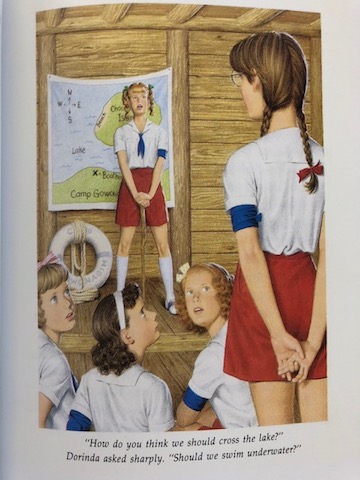
Then, the counselors announce a special event for the end of camp: The Color War.  At Camp Gowonagin, the Color War is like a giant game of Capture the Flag.  The girls are randomly assigned to two teams, Red and Blue.  The Red Team will be guarding their flag on a small island in the lake near camp.  The Blue Team’s job will be to try to steal the flag from the Red Team.  The contest will take place over the course of an entire day.

MollySummerPlanMolly and Susan end up on the Blue Team, while Linda is assigned to the Red Team.  Molly and Susan aren’t really looking forward to the Color War because their team captain will be Dorinda, a bossy, competitive girl who likes to act like she’s the general of an army and this camp game is a real war.  Molly is uneasy about what Dorinda will order them to do, afraid that it might involve the thing she dreads most, swimming underwater.  The only comfort Molly takes is what her father told her before he went away to war, that being scared is okay because it gives a person a chance to be brave.

As it turns out, Dorinda’s strategy is very simplistic.  She wants the entire Blue Team to row out to the island, landing directly on the beach.  Then, while her army takes the Red Team prisoner, she will triumphantly capture the flag.  Molly says that she thinks that the Red Team will spot them easily if land on the beach and asks if there is a less obvious place where they could land.  However, Dorinda simply says that there is no less obvious place and taunts Molly about whether she would rather swim there underwater.  Molly and Susan have no choice but to follow Dorinda’s orders.

MollySummerRetreatOf course, Dorinda’s plan doesn’t work out as she thought.  The Red Team’s scout spots them right away and takes most of the Blue Team prisoner.  Only Molly and Susan are left free because Susan accidentally overturned their canoe on the way to the island.  After they manage to get back into their canoe and bail it out, they try to approach the beach, but Linda spots them and signals to the rest of the Red Team.  Molly and Susan have no choice but to return to camp to avoid capture.

Back at camp, the two of them have to decide what to do.  They are vastly outnumbered by the Red Team, and they feel betrayed by Susan treating them as her enemies.  Molly does think up a plan for freeing the rest of the Blue Team, but to carry it out, she must face what she fears the most . . . and force Linda to face something that frightens her.

MollySummerEscapeMolly and Susan (and the rest of the Blue Team, once they’re free) manage to snatch victory from the jaws of defeat, but they worry that perhaps their friendship with Linda is ruined because of the trick they play on her.  Fortunately, Linda decides to take it in the spirit of the game and shows sympathy for the girls when it turns out that their victory plan ends with the entire Blue Team getting poison ivy.
I’m with Molly and Susan in not liking overly competitive games and people, but I thought that the book handled this situation well, focusing on how the girls each had to face something that was difficult for them in order to do their jobs for their respective teams.  It was a learning experience for all of them, and part of what they learned was that facing what worried them the most wasn’t as bad as they thought it would be.

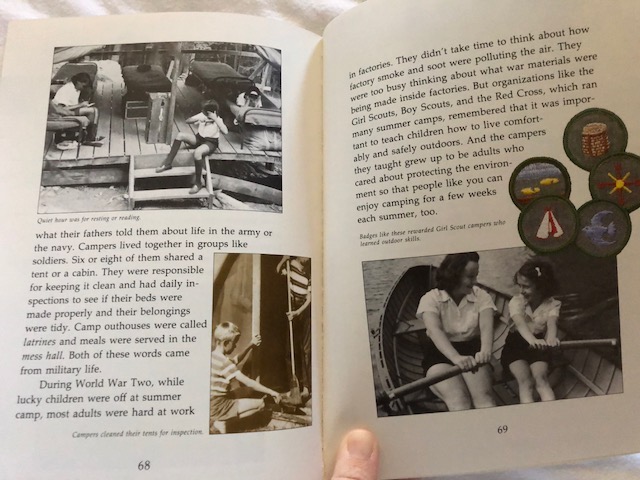
In the back of the book, there is a section of historical information about summer camps during World War II.  Because many families were separated by the war and people were discouraged from traveling much in order to save fuel and space on trains, children were often sent away to summer camps by themselves instead of going on family vacations.  The camps could be run by different organizations, such as the Girls Scouts, the Boy Scouts, or the Red Cross.  There, they would learn wilderness skills, like how to identify different plants, how to swim, and how to build a campfire.  They also had lots of fun activities, like horseback riding and arts and crafts.

The book is currently available online through Internet Archive.

MollySummerHistory

Bed-Knob and Broomstick

BedKnobBroomstickBed-Knob and Broomstick by Mary Norton, 1943, 1947.
This book is actually two books in one.  The title Bed-Knob and Broomstick is the one used for editions that include both the first book, The Magic Bed-Knob, and the sequel, Bonfires and Broomsticks.  Together, these two books were the basis for the Disney movie Bedknobs and Broomsticks, although the plot of the movie is considerably different from the two books. Because the movie is based on both of the books at once and because I read the combined edition, I’ll explain the plots of both of the books in one post.

There are two major differences between the movie and books that change many other things about the plot. The first one is that there is no mention of World War II in the books, even though the books were written during that time.  Miss Price was not studying magic to help the war effort, and the children were only in the countryside for vacation, not because they were evacuated there. Also, in the books, Emelius Jones (Emelius Brown in the movie) was a man they met when they traveled through time, not a man living in London during their own time.  He was not involved in Miss Price learning magic, although the two of them do end up together in the end.

The Magic Bed-Knob

At the beginning of the first book, the three Wilson children – Carey (who is described as being “about your age”), Charles (“a little younger”), and Paul (six years old) – are spending the summer with their Aunt Beatrice in Bedfordshire. There is never any mention of the children’s father in the books. Probably, their father is dead, although he might have left the family and went to live elsewhere or may be fighting overseas, although there is no mention of that in the book, making me think that it is probably not the case. The children apparently live with only their mother in London, and because she works, she always needs to find somewhere for them to stay during the summer, when they’re out of school. (This is a major plot point in both of the books.  In the Disney movie, the three children are orphans who have no memory of their birth parents, and their guardian was killed in a bombing shortly before they were evacuated to the countryside.  You only get their full backstory if you see the anniversary edition of the movie that includes the deleted scenes.)  While the children stay with Aunt Beatrice, they enjoy playing in the countryside, and one day, they happen to meet Miss Price, who they find with an injured ankle.

Miss Price is a respectable spinster from the village who gives piano lessons and is often seen riding around on her bicycle.  When they find her hurt, Carey says that they should get a doctor for her, but Miss Price insists that she doesn’t want one. Instead, she just asks the children to help her get home. As she starts to lean on Carey and Charles, Paul picks up a broom nearby. The older children thought it was just an old garden broom, but Paul calmly says that it belongs to Miss Price because it’s what she rides around on. The others are shocked, but Paul simply says that that he’s seen her improve in her flying, so Miss Price knows that he’s seen her riding her broom more than once. Miss Price is worried that everyone in the village will know now that she’s a witch, but Paul hadn’t even told his brother and sister what he’d seen.

The children help Miss Price get home, and they allow their aunt to think that Miss Price simply fell off of her bicycle. When the children are able to speak to Miss Price privately, they ask her directly if she’s a witch, and she admits that she’s studying to be one. She says that she’s had some talent for magic since she was young, but she never really had the time to develop it. The children are convinced that, while Miss Price might be a witch, she’s not a wicked one, and she says that’s true, that she started too late in life to be that way and that wickedness doesn’t come naturally to her. However, she’s still worried that the children might tell people about her magic.

Carey is the one who suggests that Miss Price give them a magical object as part of their pledge of secrecy (unlike in the movie, where it was Charlie’s idea), with the idea that, if they ever told anyone that she’s a witch, the magic would stop. Charles suggests that Miss Price could give them a magic ring that would summon a slave to do their bidding, but she says that she couldn’t manage that and that she has a better idea. Miss Price asks the children if they have anything on them they can twist, like a ring or a bracelet. The only thing they have is a bed-knob that Paul twisted off the end of his bed (basically, because he discovered that he could).

Miss Price says that the bed-knob will do nicely, and she casts a spell on it that will allow the children to travel to the destination of their choice when they put it back on the bed and give it a twist. If they turn it in one direction, they can travel in the present time, but turning it the other way can send them to the past. Also, because Paul was the one who had the bed-knob, he’s the only one who can make it work. Miss Price isn’t troubled by Paul’s young age because she thinks that it’s best to learn magic young, although she warns the children to be careful.

Because it’s Paul’s bed-knob, Carey and Charles give him first choice of where to go, but they think the places he wants to go sound mundane. He wants to either see a museum exhibit that the others saw without him once or to go home and see their mother in London. Carey and Charles try to persuade him to go someplace more exciting, but Paul insists that he wants to go home.

The bed whisks the children home to London, but when they get there, their mother isn’t home. Apparently, their mother has gone away for the weekend herself, and the children find themselves alone on their bed, in front of their house, on a foggy night. A policeman bumps into them, and when he demands to know who they are and where the bed came from, he doesn’t think it’s funny when they say, “Bedfordshire.” He takes them to the police station to spend the rest of the night. Fortunately, they find a way to get back to the bed and use the spell to return to their aunt’s house before they’re missed in the morning. It’s not quite the adventure that the children had been hoping for when they started out, but it’s just the beginning of their amazing summer!

However, magic turns out to be more dangerous than they thought. Their next adventure takes them to an island with cannibals (yeah, one of those scenes, sigh – I think that the island of talking animals in the movie was more fun), and they narrowly escape after Miss Price has a duel of magic with a witch doctor. Their magical adventures create problems that the children can’t explain to their aunt without giving away Miss Price’s secret. Eventually, their messes and wild stories cause their aunt to send them home to their mother. Miss Price considers that magic might cause more problems than it solves and tells the children that she’s thinking of giving it up for awhile. However, Paul keeps the bed-knob in the hopes that their adventures aren’t done yet.

BedKnobBroomstickChildren

Bonfires and Broomsticks

In Bonfires and Broomsticks, two years have passed since the children’s first adventures, and Aunt Beatrice has died. Carey and Charles, worried that Paul would talk too much about their magical adventures, tried to convince Paul that it was all just a dream, although they weren’t very successful.

Then, the children see an advertisement in the newspaper that Miss Price is offering to board a couple of schoolchildren in her house for the summer for a fee. The children’s mother works, and she always has to find somewhere for the children to spend the summer, when they’re not in school. They still have the bed-knob, so they tell their mother that they want to visit Miss Price, hoping they can have more adventures with her. At first, their mother doesn’t understand why they would want to visit Miss Price so badly, but since she seems like a nice, respectable woman and an old friend of Aunt Beatrice’s, she agrees.

Miss Price is happy to have the children stay for the summer, but they are disappointed when they learn that she was really serious about giving up magic. The children discover that Miss Price bought the old bed that they had used for their previous adventures at the estate sale after their aunt’s death. She’s been sleeping on it in her own room. They want to try the bed-knob on the bed, but Miss Price takes it from them. She tries to make their summer vacation a normal vacation with normal activities, like picnics and croquet.

But, even Miss Price can’t resist the opportunity to try the bed-knob one last time. One morning, Carey and Charles discover that Paul and Miss Price have traveled somewhere on the bed without them. When the two of them confront Paul about it, he says that they only went to a nearby town, just to see if the spell on the knob still worked. Carey and Charles understand, but Carey thinks that if they got to use the bed once more, she and Charles should have one more turn. She especially wants to try going into the past, which was something they hadn’t had a chance to try last time. Miss Price is reluctant, but finally agrees after Carey pressures her about it.

The children travel to London of 1666 (ending up there accidentally, when they were aiming for the Elizabethan era), where a man named Emelius Jones has been living as a necromancer. When he was young, he studied magic under a mentor who, as he was dying, finally told him that everything he learned was fakery. It was all an act that he used to get money from gullible people, although it paid very well. The old man leaves Emelius his business, but Emelius is always nervous, worrying both because someone might discover that it’s all a fake and because others might believe that it’s real and that he should be hung as a witch. The only reason why he stays with it is because he has no other business to follow.

The children meet Emelius after ending up lost and stopping at his house for directions. The children can see how nervous and unhappy Emelius is, and they ask him about himself, discovering that his home town is actually close to where they’re staying with Miss Price. They reveal to him that they are from the future and invite him to come home with them for a visit.

Miss Price isn’t happy to see that they’ve brought someone back from the past with them, but she ends up liking Emelius. Before sending him home, they learn that Emelius’s aunt, who lived near to where Miss Price now lives, died the same day that Emelius left London in the past, which is coincidentally shortly before the great fire that destroyed a good part of the city. They know that Emelius’s London lodgings will likely be destroyed in the fire as well, but at least he can move into the house that he will inherit from his aunt.

However, after they send him back to his own time, the children and Miss Price learn that Emelius never made it to his aunt’s house because he was executed for practicing witchcraft. Unable to leave poor Emelius to such a terrible fate, they come up with a plan to rescue him.

The combined book edition is available online through Internet Archive.

My Reaction and Spoilers

Changing Emelius’s past also changes Miss Price’s future. Neither of them has ever married, and both of them have been lonely, and they come to the conclusion that the two of them were meant to be together. In deciding that they will live their lives together on Emelius’s aunt’s farm in the past, they put an end to the magical traveling bed. Only Paul can make the magic bed-knob work, and once he sends them into the past (not going with them), they can never return. But, Carey has one final vision of the two of them, being happy together, so she knows that they will be alright.

Overall, I preferred the Disney movie to the original books.  I think the war-based plot was better than the children’s random travels to cannibal-filled islands (I never liked those tropes in children’s stories anyway) and other places.  At one point in the books, Carey did speculate about the use of magic in war, but she rejected the idea because the notion of someone with the ability to conjure a dragon that could breathe mustard gas or who could turn whole armies into mice was just too horrible.  The spell that Miss Price used against the Nazis in the movie was part of their plan to rescue Emelius in the second book, but I think the movie’s ending was much more exciting.

Color War

Camp Sunnyside Friends

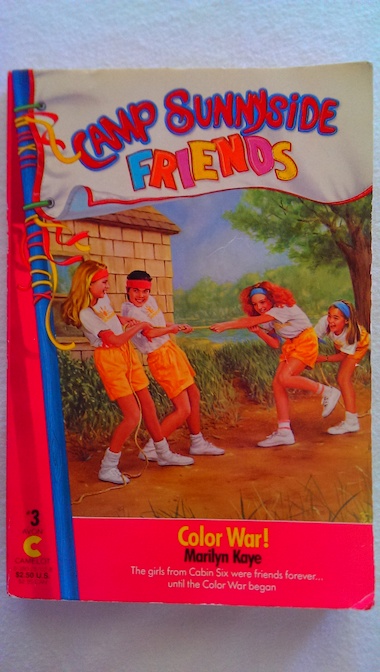
ColorWar#3 Color War! by Marilyn Kaye, 1989.

Usually, the girls of Cabin 6 at Camp Sunnyside have fun during the camp’s annual competition.  Every year, the girls at camp are divided up into two teams, red and blue, and they compete against each other in a series of contests.  Ms. Winkle, the camp director, cautions the girls at the beginning of the Color War not to let themselves be carried away by the competition, to remember that they’re all still friends and members of the same camp, and to keep the contests friendly.  Usually, that isn’t a problem for the girls of Cabin 6.  They each have their favorite activities, and every year, they’re always on the same team, working together against other cabins.  However, this year is different.

When the girls of Cabin Six are split up and put on different teams, the competition between them threatens to ruin their friendship.  Some of the girls of Cabin 6 are more competitive than others, especially Katie, who likes to be a leader and hates to lose at anything.  Trina, on the other hand, values loyalty and friendship more than competition.  She looks on the other girls in her cabin as being almost family because they’ve spent so much time together and considers Katie to be her best friend at camp.  There is an unexpected clash between the two girls when Katie turns out to be the captain of the blue team, and Trina ends up on the red team.

Both Trina and Katie are disappointed about the team assignments.  Trina had helped to campaign for Katie during the elections that were held for the team captains, before the teams were even assigned, and Katie had told her that she wanted her to be her assistant.  But, teams are assigned randomly after the entire camp elects two captains to lead them, and none of the girls had any say in it when Trina and Erin were both placed on the red team, under the leadership of Maura, a snobby older girl who is even more competitive than Katie and not above stooping to some mean tricks to get ahead.  Switching teams is against the rules, so there’s nothing to be done about it.

Trina feels badly that she can’t be on Katie’s team and still thinks of her as her friend.  But, she notices that, from the moment when the teams are assigned (the girls each have a dot of a different color paint on their foreheads when they wake up one morning, indicating what their team will be), Katie starts behaving awkwardly around Trina, treating her almost as a suspicious stranger, or worse, an enemy.  When Katie tries to play on Trina’s sympathies, getting her to let her have an edge at certain contests or even bow out so Katie’s team can win, Trina is willing to go along with it at first because she likes Katie and wants to see her win, if it’s important to her.  But, gradually, Katie’s pushy competitiveness begins to wear on Trina, especially when she sees her taking advantage of her and other friends without regard for their feelings.  When someone tries to deliberately sabotage an activity that Trina is taking part in, it seems like Katie is willing to stoop to some dirty tricks and even cheating against her “best friend” in order to win, and it doubly hurts.

With Katie expecting Trina to give her advantages and inside information on demand and then shutting her out immediately afterward and acting suspicious of her, even accusing her of doing some of the things Katie herself is doing, Trina is fed up!  Katie’s seeming sabotage is the last straw, and Trina decides from that point on, she’s going to treat the Color War as the serious competition Katie acts like it is.  The girls’ unfriendly attitudes toward what are supposed to be fun games turns the Color War into a real war with friend against friend.  When people as well as friendships seem to be getting hurt, the girls have to decide what’s really important to them and what the cost of winning is going to be.

The book is currently available online through Internet Archive.

My Reaction and Spoilers

Although I liked this book when I was a kid, it frustrates and even angers me now.  I have a long-standing contempt for one-upmanship in all of its forms, and I lose respect for anyone I see using one-upmanship tactics.  (I didn’t write this, but I agree with it, especially the part that says, “You really do not need to be the winner every single time.” Seriously.)  As a character, Katie is my least favorite of the girls because of her overly-competitive attitude and lack of consideration for others.  It’s all the more aggravating because, as much as Katie likes to be the leader and the other characters follow her, she isn’t actually good at leading.  She’s mainly good at being bossy and manipulative.  As soon as Katie gets put into a leadership role in a competitive atmosphere, her usual standards of behavior go straight out the window, and she uses even close friends as mere tools to her glorious victory.  Note that she isn’t focusing on leading her troops to victory.  The victory is all about her and the trophy she wnats, regardless of what it does to people around her, and that’s why she’s not good at leading.  In this story, she’s mainly just selfish.  Some people can enjoy some harmless competition without losing their scruples, but sadly, Katie is not one of them.  Now that I’m an adult with more experience with this personality type, I have less patience for it than I ever did.

It’s true that Katie isn’t as bad as Maura, who we learn later actually did some of the worst things that Katie and Trina suspect each other of doing.  Neither Katie nor Trina actually sabotaged each other’s activities.  Maura did that both to give her team an edge and also to stir up Trina’s anger against Katie.  Maura saw that Trina wasn’t a competitive person and was willing to let Katie win just for the sake of friendship, and she realized that the only way to get Trina to even try to win would be to make her fighting mad.

Maura’s lying and acts of sabotage were worse than what Katie did because it was direct cheating, but Katie’s tactics were also a kind of cheating.  Katie persuades Trina to let her have the better horse for the riding contest, even though Trina was supposed to ride that horse, and she tries to convince her to fake an injury so that she can bow out of a gymnastics contest, which she knows Trina loves, just because she knows that Trina is likely to win that activity.

Supposedly, Katie’s a nice person most of the time, but you wouldn’t know it to see her in this contest.  Almost from the word go, Katie turns into a rabid little win-monster, ready to shove even her closest friends under a bus to win . . . at summer camp games.  At one point, she tries to make Sarah compete in a pie-eating contest because she knows Sarah is normally a big eater, but Sarah gets upset because she’s been dieting, and it was just starting to pay off, and she doesn’t want to ruin what she’s done just for the sake of some dumb contest.  When Trina sees how upset Sarah is, she tells her to be honest with Katie about how she feels, and Katie flies off the handle irrationally, as if she had never heard of Sarah’s diet before (she had, a lot, because Sarah had been talking a lot about how hard it was to fight temptation) and accuses Trina of trying to make her lose.  Katie can’t stand the idea of not winning, in case you couldn’t tell, and she doesn’t care about what her friends stand to lose in the pursuit of her personal victory or what the lasting consequences might be after the contest ends.

You might be wondering why winning is so important to Katie.  What’s really at stake for her in this summer camp contest?  I was wondering this a lot, all through the book.  It turns out that winning is important because the alternative, not winning, will make Katie feel like a loser, and people might think she was lame.  And . . . nothing.  That’s it.  Whoopty doo.  Katie fears getting jeered as the loser at the end of the contest, which is silly because no one does jeer the loser at the end, and most of the younger girls they talk to while campaigning for Katie to be one of the team captains in the beginning were kind of unenthusiastic about the games, not because they feared losing, but because they figured that the older girls wouldn’t let them try any of the more fun stuff, saving all the best parts for themselves.  In other words, very few people beyond Katie and Maura were at all concerned about who won or lost, they just wanted to take part.  Mostly, it seems that what Katie is really afraid of is coming up against an opponent, or even other teammates, who are just like her.  Katie is the manipulator who uses her friends; her friends are not trying to manipulate her or make her lose.  Katie is the rude one who jeers at losers.  Ultimately, she’s afraid of what she does to other people coming back on her.

Part of the reason Katie was hoping that Trina would be her assistant on her team was because Katie remembered that the year before some of the girls had ganged up on their team’s captain over a part of the competition that had gone badly.  Trina remembers that Katie had been the main instigator of the rebellion.  Katie’s scared of getting a taste of what she dished out to someone else before.  She fears getting jeered because that’s what she does to others when they lose.  She fears teammates getting down on her for not winning because she does that herself, to them.  And as the reader, we’re supposed to like her and hope she wins against awful Maura?  I have pity for her former team captain, getting stuck with this bratty little girl who ruins fun and makes people miserable because she can’t win at everything.  It must have been like babysitting, unpaid, while she’s supposed to be on vacation.  Have I mentioned how much I hate one-upmanship?

It’s funny, but by the end of the book, I had more contempt for Katie than I did for Maura.  It’s not that I liked Maura at all.  Maura’s tactics were definitely worse.  If I were in charge of the kids, she would be punished worse for what she did.  My anger at Katie is because of her sense of entitlement and because she’s still considered one of the “good guys” at the end, and I don’t think she deserves either.  She saw nothing wrong with manipulating her friends and forcing them to do what she wanted for her own personal glory, even when some of what she asked them to do would have been actually harmful to some of them, like interfering with Sarah’s diet. She plays on their feelings of friendship but with no feelings of friendship returned.  If she feels real friendship for them, it all evaporates the moment the possibility of being a “winner” is on the horizon.  Even if it’s just a dinky summer camp contest.  Worst of all, Katie routinely does things to others that she fears and resents having done to her. She does them more frequently to others than anyone does them to her, and often, she’s the first to do them, so she can’t even say that it was retaliation.  Part of Maura’s justification for her bad behavior is that Katie would do the same things she’s doing.  While Katie might not stoop quite as low as Maura does, the sad part is, Maura’s not that far off in her assessment of Katie.  Even though Trina doesn’t like Maura and sees her behavior as worse than Katie’s, she admits that Maura is pretty good at reading people and understanding their motivations.

In the end, Katie does acknowledge to Trina that the situation was really all of her fault and that she intentionally tried to make Trina feel bad about being on the opposite team because she genuine feared that Trina would win against her.  I don’t have any sympathy for Katie at all, and her apology falls flat for me.  Trina genuinely cared about about Katie.  She let her win when she didn’t have to and was actually happy when she did well.  All the time, Katie just cared about Katie and winning and that was about it.  Even after her apology to Trina, Katie says that she still wants to win.  Dang it, girl, don’t you have any other priorities in your life or any other dimensions to your character?  I would have found Katie more interesting as a character if she liked winning but had exceptions where the price of winning was just too high.  I wish she had limits.

The one part of the book that makes me feel better is when Trina is taking part in the gymnastics competition, and she realizes that if she made a mistake on a very difficult part, she could hand victory to Katie and no one would know that it was intentional.  At that moment, Trina realizes that she can’t do that because it wouldn’t be honest.  She says to herself, “You don’t have to prove your friendship this way . . .  If Katie expects you to, then she’s not a true friend.  And if you intentionally give this away, you’re not being a friend either – you’re trying to buy a friend. And that’s not what it’s all about.”  Bravo, Trina, for growing a backbone and some self-respect!  Katie also shows that she’s happy when Trina does well, and that’s something, a kind of progress for her, learning to care about someone else and be happy when they succeed at something that isn’t also a personal win for her . . . but dang it, that silly, shallow, win-monster still annoys me.  I didn’t really want Maura to win, but I have to admit that I wasn’t entirely happy that Katie’s team won, either.  I didn’t feel like either one of them really deserved it.

Since I disliked both Maura and Katie, I suppose it’s a given that I was going to be disappointed no matter which of them won.  But, I keep thinking of ways that the story could have ended which would have been better.  What if . . . no one won?  Suppose it was a tie?  Trina would have been happy since she doesn’t like to see people lose and doesn’t really care who wins.  In a tie, no one wins, but no one loses, either.  Also, it might bring it home to both of the team captains that the real goal of the contest, which they both somewhat failed, was to make the contest fun for their teammates.  Instead, people on both teams repeatedly remark that the contest is so much nastier this year with both Maura and Katie in charge and everyone feels awkward about it.  Nobody really enjoyed this contest except maybe Katie, because she won the trophy she was hungering for.  Then, when Katie has her pretty trophy at the end, she doesn’t even acknowledge her teammates’ hard work or how they helped her to win.  Many people would be thanking their teammates and talking about this trophy belongs to everyone because everyone won it together, but not Katie.  She was just happy that she had her trophy.  It’s her trophy, hers.  Whee.

I understand that we’re supposed to learn from both Katie and Maura what not to do in competitions, but watching them do what they do is painful and frustrating, a slow train wreck on Katie’s way to victory, and I hated seeing her friends just letting her obsessive meanness slide in the beginning.  In the end, the only person I felt was a real winner was Trina.  She never cared that much about winning the contest because her self-esteem doesn’t depend on it.  Trina is a valuable person and a true friend whether she wins a contest or not.  She knows what’s really important to her, and nothing important changes if she wins a game or not.  I think the world needs more people like Trina, who aren’t in it for the winning but are willing to work cooperatively with others to make good things happen for everyone.  By contrast, Katie needs to win because she is . . . just a winner.  At summer camp.  She’s got a trophy now.  Winner, winner, chicken dinner.

In spite of the fact that a large part of this review is me venting about the frustration, I actually did like this series when I was a kid.  This is the only book in it that I’ve been able to get my hands on recently, and it happens to be the one I find most frustrating.

Ginnie and the Mystery Doll

GinnieMysteryDoll

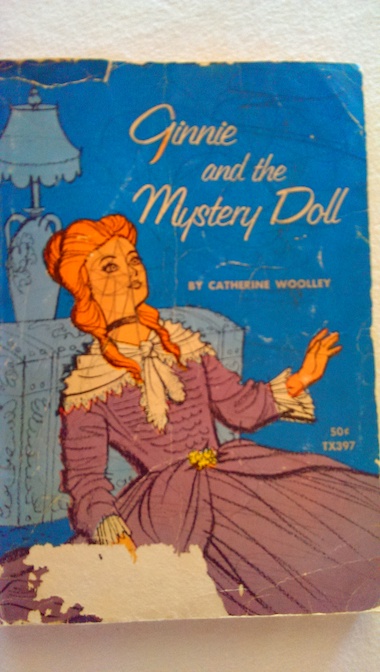
Ginnie and the Mystery Doll by Catherine Woolley, 1960.

Ginnie and Geneva’s families have rented a house on Cape Cod for the summer, so they’ll be sharing their vacation at the beach. Their next door neighbor at Cape Cod is Miss Wade, a nice older lady. Miss Wade’s house is very old-fashioned, and when the girls make friends with her, she shows it to them, allowing them to see some of the neat old things in her attic on a rainy day. The girls have fun trying on the old clothes in the attic, and then they find an old diary belonging to Miss Wade’s mother when she was a girl. In the diary, the girl talks about the special doll that her uncle gave her, which has a “precious jewel.”

GinnieMysteryDollDiaryAtticThe girls ask Miss Wade about the doll, and she says that she knows the one they mean, but she no longer has it. Her mother’s uncle was the captain of a ship and used to bring her presents from around the world. The doll, called Lady Vanderbilt, was very fancy, and Miss Wade describers her costume to the girls. However, she says that the doll disappeared after she rented her house out to a family one summer while she was traveling. She never found out what happened to the doll, but she assumed that the children of the family probably found her and either took her or broke her. Miss Wade said that she didn’t think that the doll was worth making a fuss about, so she never asked the family about it. The girls note that Miss Wade doesn’t seem to know anything about a precious jewel in the doll, but they decide not to say anything about it since Miss Wade doesn’t have the doll anymore.
The girls decide to concentrate on enjoying their summer vacation, picking beach plums and digging clams with Miss Wade on the beach. Then, when they go to see a local auction, they spot a doll that looks exactly like the Lady Vanderbilt that Miss Wade described! The girls try to bid on the doll at the auction, but someone else buys her instead, and that lady leaves the auction before the girls can talk to her.

GinnieMysteryDollJewelThe girls tell Miss Wade and their mothers about the doll, but when they try to ask the people in charge of the auction where the doll came from and who bought her, they learn that the woman who was in charge of organizing the toys has already left on vacation. The only clue that the girls have is that the woman who bought the doll left the auction in a red Jaguar.

The girls make it their mission to track down the doll and its buyer, asking questions all over town about who might own a red Jaguar. Then, at an art exhibit at the Historical Society, they make a surprising discovery: a painting of the very doll that they’re looking for!

But, just when they figure out who has the doll and where she is, she disappears again when the red Jaguar is stolen with Lady Vanderbilt inside! Was it just an accident that the doll was stolen along with the car, or does someone else know that Lady Vanderbilt might be hiding a valuable secret?

The book is currently available online through Internet Archive.