Chimney Sweeps

ChimneySweeps

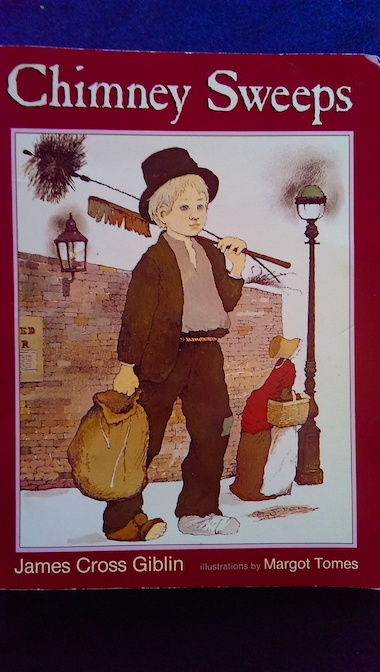
Chimney Sweeps by James Cross Giblin, 1982.

This book explains about the history and traditions of chimney sweeps. I love books that cover odd topics from history like this!

It starts by explaining the origins of chimneys in the Middle Ages. Before they were invented, people would have to have simple holes in the roofs of their houses to let out smoke from heating and cooking fires, or they would have had to rely on windows or doors to perform the function of venting smoke. Chimneys vent smoke more efficiently, but the more they are used, the more soot collects inside them, and they need to be cleaned out from time to time. If they aren’t cleaned, the build-up inside could either block air from getting to the fire in the fireplace, causing the fire to go out sooner, or it could pose a fire risk because the build-up inside the chimney is still flammable. Sometimes, home owners could clean their own chimneys, if they weren’t very tall, but the taller the chimney is, the more professionals are needed to clean it.

ChimneySweepsAdult

Modern chimney cleaners have vacuums that they can use to clean soot out of a chimney, but originally, people were basically relying on brushes. The book explains the evolution of the profession and variations in the profession between England, Germany, and the United States. Germany is significant to the profession because it was one of the first places where chimney sweep became a recognized profession and there were laws even in the 1400s that all chimneys had to be cleaned twice year. (Remember that chimneys that haven’t been cleaned can be a real fire risk, posing a danger not only to you but your neighbors, especially during a time when most buildings are made of wood and other highly flammable materials.) When chimney sweep became a recognized profession during the Middle Ages, members of the profession formed a guild (as was traditional for different professions in general during the Middle Ages) and established rules and standards for the profession. One of the responsibilities of a guild was to decide on the training and qualifications that the profession requires, and in the case of chimney sweeps, the only way to learn was by serving an apprenticeship. The apprentice would live with a master sweep for three years, learning the trade, and at the end of his training, he would have to prove that he could clean a difficult chimney all by himself with thoroughness and reasonable speed.

There are many traditions and superstitions that came to surround the profession of chimney sweep. One of them that you can still sometimes see even in modern times is the image of the chimney sweep in a top hat. The exact reasons for adopting a top hat and tailcoat as part of their uniform are uncertain, but it began back in the 1500s in Europe. The sweeps often got their top hats and tailcoats as secondhand clothing from undertakers (yes, really). Part of the reason for wearing them might have been as an effort to look professional, but the color black was also suitable for a person who was going to end up covered in soot. According to superstition, the top hat would help to protect the chimney sweep from falling when he was on the roof of a house. Chimney sweeps were often thought to be lucky because their jobs were dangerous, yet they survived.
ChimneySweepsChild

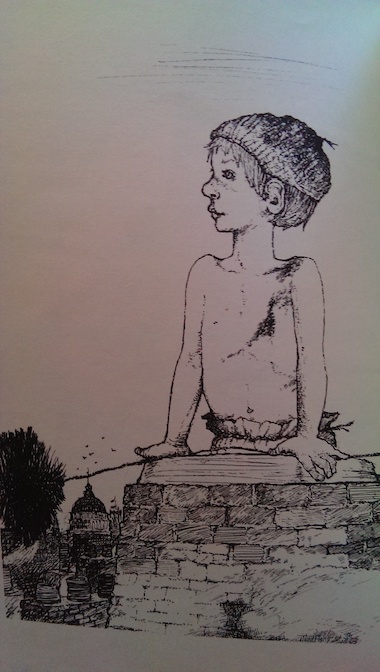
However, chimney sweeps’ lives and work were often hard. In 18th century England, their jobs became more difficult because chimneys were purposely being built in narrow, crooked zigzags. The idea behind the crooked chimneys was that they would keep more heat in, but that made them much harder to clean. Because brushes couldn’t make it around the bends of these chimneys and adults couldn’t get into the narrow flues, sweeps became reliant on young boys to climb up into them and clean them by hand. Although the law required boy apprentices to be no younger than eight years old, many sweeps used boys as young as four or five. Sometimes these boys were official apprentices with the permission of their parents (typically from poor families with many children) or even the sweep’s own children (sometimes, they used their daughters because girls were often smaller than boys). If they couldn’t get children any other way, sometimes sweeps would get children from orphanages or might even resort to kidnapping.  The author of this book includes a short story about what a day in the life of a child chimney sweep was like.

The plight of child chimney sweeps came to light during the early 19th century, when people were starting to become concerned about child labor of all kinds. At first, there was strong opposition to banning child chimney sweeps and using new cleaning devices because the adult chimney sweeps saw it as a threat to their livelihoods and home owners were worried that new methods would be more expensive for them (of the two, I think I’m more offended at the home owners’ attitudes because of the implication that they were more upset about a possible slight increase in expense than the risk to the lives of the children they knowingly endangered).  Many of the child chimney sweeps suffered severe and permanent health problems because they were forced to do this kind of work at an early age, while they were still growing, and because they inhaled and were covered with soot for such long periods.

In the back of the book, there is a poem by William Blake called “The Chimney Sweeper,” which was published in Songs of Innocence in 1789. Knowing the risks to young children, like the little boys in the poem, makes the poem seem pretty disturbing, which may actually be the author’s intention.  Eventually, after long years of struggles in which children were still exploited in chimney sweeping spite of regulations against it, in 1875, Parliament tightened regulations against child labor even further, forcing chimney sweeps to apply for licenses in order to practice their trade, listing each of their apprentices and their ages.

Chimney sweeping in American history was a little different from the way things were done in Europe. The American colonists sometimes tried some strange tactics for cleaning their chimneys. One of the oddest methods was to tie a rope to a goose’s feet and lower it down the chimney. The goose would become frightened and flap its wings, thus knocking the soot loose. When the job was done, the home owner would pull the goose out of the chimney and wash it off. Another tactic was to actually burn the excess soot out of the chimney, although there was a risk of simply setting the house on fire. Later, American cities had official chimney sweeps who were licensed and regulated. On Southern plantations, slaves were used as chimney sweeps, and some of them continued to work as chimney sweeps after they gained their freedom.

Later, when homes began to be heated by other sources than fireplaces, chimney sweeps were in less demand, although there was increased demand in the 1970s, during the energy crisis, because people started using their fireplaces more instead of relying on other heating methods that involved scarce or expensive fuel. Chimney sweeps can also perform other duties beyond simply cleaning chimneys, depending on where they live. For example, in Germany, sweeps perform inspections of factories and homes to make sure that they are using fuels efficiently, looking for sources of needless pollution, which can lead to fines for the owners of the buildings if the problems are not corrected. Some people might also become chimney sweeps as a seasonal part-time job, while they also have another career.

The book is available to borrow and read for free online through Internet Archive.
Midnight Magic

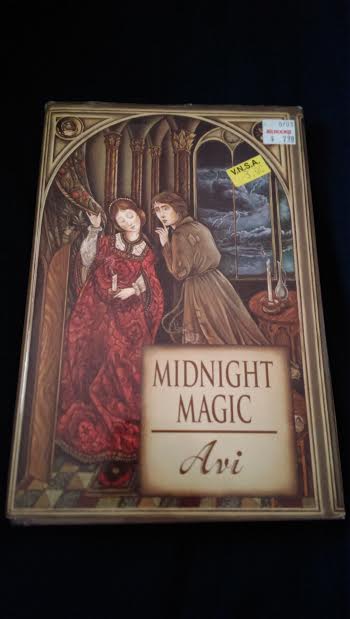
midnightmagicMidnight Magic by Avi, 1999.

The story takes place in Italy, toward the end of the Middle Ages.  Mangus, a formerly wealthy scholar and philosopher, is living under house arrest because the king believes that he has practiced black magic. Mangus was merely performing magic tricks to earn extra money, and in fact, does not believe in real magic.  However, the king is very superstitious and easily influenced by his scheming advisor, Count Scarazoni, who needed a scapegoat to distract everyone from his schemes.  Unfortunately, many people in the kingdom of Pergamontio believe that Mangus is a real magician with frightful powers.  Even Fabrizio, an orphan who is Mangus’s only remaining servant, believes that magic really exists.

When a messenger arrives, summoning Mangus to the castle to see the king, they are afraid that the king has reconsidered his decision to spare Mangus’s life. However, it turns out that the king is in need of Mangus’s help. He believes that his young daughter, Princess Teresina, is being tormented by a ghost, and he wants Mangus to use his magic to get rid of it.

Mangus again protests that he does not do real magic, but both the king and Count Scarazoni promise dire consequences if he fails to help them deal with the problem.  Mangus isn’t sure why Count Scarazoni has asked for his help because he knows that the count doesn’t really believe in magic, except perhaps as a way of appeasing the king.  The king promises that if Mangus can free the princess from the influence of the ghost, he will not only end Mangus’s house arrest but reward him with a generous pension.  Mangus has little choice but to agree to do his best, and the promise of the pension for his master convinces Fabrizio to do everything he can to make sure that Mangus succeeds, not only to save his master’s life but to restore his family’s fortunes.

But, what is the secret of the ghost?  Fabrizio believes in ghosts, even though Mangus doesn’t.  Princess Teresina insists that the ghost is real, appealing directly to Fabrizio to convince Mangus that it is. Adding to the mystery is the disappearance of the princess’s brother, Prince Lorenzo, and the murder of the princess’s tutor. Danger lurks in the castle, and conspiracies are around every corner. Could the troubled spirit really belong to the murdered prince?

The book is available to borrow and read for free online through Internet Archive.

My Reaction

I love historical books and spooky mysteries, and this is both! The Italian kingdom where the story takes place is fictional, but it takes its inspiration from real kingdoms of the later Middle Ages and early Renaissance, with Machiavellian intrigue, power struggles, and arranged marriages, even for children, that could influence the balance of power and successions. (There is talk of a potential arranged marriage in the story, but no child marriages actually take place.  If a child is old enough for ghost stories and murder mysteries and isn’t too frightened by them, there is really nothing more concerning than that to prevent them from reading this book.)

Princess Teresina is one of the most intriguing characters in the book.  Although young, she isn’t a shrinking violet or anyone’s fool, and she’s definitely not a tea party and ball gown kind of princess.  Like real life Medieval princesses, she is the product of a family who came to power by the sword and maintains it by the iron fist in the velvet glove and some clever political maneuvering, although some members of the family are more clever about it than others.  Princess Teresina well knows the family she was born into and what’s expected of her as royalty, and she knows to be careful about who she trusts and what the consequences of trusting the wrong people can be.  Although apparently terrified by the ghost, the princess has a kind of toughness and shrewd determination to do what she thinks is necessary.  She seems to be smarter and knows more than most people give her credit, and Fabrizio often wonders just how much she really knows.

One of the best things about the story is that, as soon as you think you know what’s going on, you learn that there is more to the story. There are conspiracies within conspiracies!

Hint: If you like pseudo-ghost stories, spooky stories of the Scooby-Doo variety, where there are logical explanations for the supernatural phenomena … you won’t be disappointed.

The Mystery of the Haunted Trail

MysteryHauntedTrailThe Mystery of the Haunted Trail by Janet Lorimer, 1989.
Brian Kelly wasn’t too excited at first when his teacher assigned his class to write letters to students at a school in Hawaii.  He doesn’t really like to write, and the whole thing sounded boring, but it turned out to be pretty fun when his new pen pal, Alani, wrote back.  Brian discovered that he and Alani had a lot in common, and he even got to meet Alani when his family came to California on a trip.  Then, best of all, Alani’s family invited Brian to spend part of the summer with them in Hawaii!

Brian loves Hawaii from the moment he arrives.  Alani’s family lives in a rural area near Kalawa.  All of the families in the area raise their own vegetables and keep animals.  They depend on what they earn from selling food although some of them, like Alani’s mother, who is a nurse, have other jobs as well.  Alani’s father, like Alani’s grandfather, is primarily a farmer.  Alani’s grandfather lives with him on land that the family has owned for generations.

Alani and his family enjoy showing Brian around their island and talking about the history of the place.  Brian particularly likes the stories that Alani’s grandfather, who they call Kupuna, tells them, although some of them are frightening.  At the luau that the family and their friends have to welcome Brian to Hawaii, Brian overhears people talking about the Night Marchers.  They say that the Night Marchers have been seen recently and that bad things have been happening in the area, like crops dying and the nearby stream starting to dry up.  Some people seem to think that it’s a sign of bad luck and that maybe they should move away from the area.

According to Kupuna, the Night Marchers are a ghostly parade of the ancestors of the people who have lived there for generations.  Sometimes, it’s just ordinary people and sometimes it’s the souls of warriors.  Sometimes, Hawaiian gods may even walk among them.  But, when they march, any living person must either flee from them or, if that is impossible, they must lie down and hide their eyes.  At the head of the Marchers is a ghostly spearman who will strike down any living person who sees them, unless that person is related to one of the Marchers themselves.  They spare members of their own families.  People who are struck by the spear of the Marchers appear to have died of a heart attack.

The place where the Marchers supposedly walk is an old trail that leads to a sacred place where Alani’s ancestors are buried.  Brian is curious to see the place, but Alani warns him away, saying that they are not allowed to go there because it’s too dangerous.  However, Brian soon sees the Marchers himself one night in Alani’s family’s fields, and the next day, their crops are dead.  When Brian notices strange footprints in the fields as well, he realizes that some living people may be responsible for the awful things that have been happening in the area, but the only way he can prove it would be to explore the haunted trail himself and track the “ghosts” to their lair.

Janet Lorimer’s books are interesting because they are often a combination of mystery and ghost story.  There are logical explanations and living villains who are responsible for the things that are happening to Alani’s family and their neighbors, but there is also a definite supernatural element to the story as well.  Telling you where one ends and the other begins may be saying too much.  It may be more fun to let you find out yourself.

The book is currently available online through Internet Archive.

Patti’s Luck

Sleepover Friends

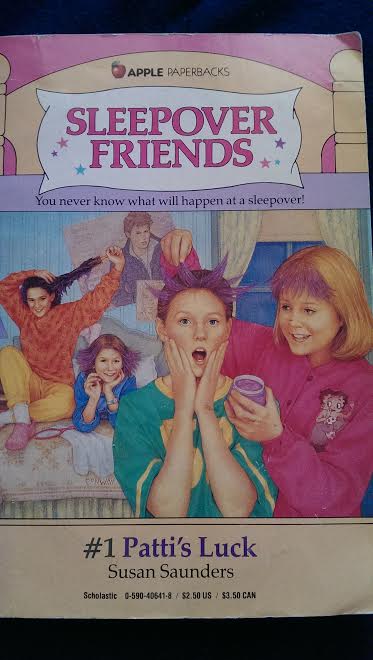
SFPattisLuck#1 Patti’s Luck by Susan Saunders, 1987.

Patti Jenkins has just moved from the big city to the smaller town of Riverhurst.  Recognizing her as a former classmate, Stephanie invites her to join the group of friends she has sleepovers with, Kate and Lauren.  The other girls like her, but almost immediately, bad things start happening.

At their first sleepover with Patti, the girls start watching a creepy old movie that spooks both Patti and Lauren. Patti accidentally knocks over a tray of snacks, and Kate jokes that it’s part of the curse, like in the movie.  Then, the water main breaks at Stephanie’s house, so the girls are unable to wash out the purple styling gel they just put in their hair.

From there, it just seems to get worse and worse.  Patti accidentally sets Lauren’s backpack on the back of a car that drives away, and the girls have to chase after it on their bikes.  Lauren eventually catches up with the car and gets her schoolwork back, but Patti gets lost and caught in a rain storm before she can find her way back to school.  Then, on a school field trip, she helps her classmates to find an elevator at the museum.  After Patti presses the button, the elevator doors close before their teacher gets on, and the elevator gets stuck for awhile with the lights off.

Is Patti bad luck?  She seems to think so, and Lauren, being the superstitious type, is pretty creeped out, thinking that Patti might really be under a curse.  Kate, of course, says that’s all nonsense.  When Stephanie is hurt after Patti accidentally lets Lauren’s brother’s huge dog out of the room whee he was supposed to stay, Patti starts avoiding the other girls because she’s worried about her bad luck curse. The others decide that they need to do something to help Patti out of her bad luck streak.

The book acknowledges that most of Patti’s “bad luck” is just a series of unfortunate accidents and coincidences and that it’s only Patti’s nervousness and superstitious attitude toward them that makes it seem like something more.  Kate devises a way to remove Patti’s bad luck that works partly because Patti feels the need for some kind of ceremony to help her get back to normal.  In the end, all of the girls realize that there’s nothing really supernatural or superstitious going on.

The book is currently available online through Internet Archive.