American Girls

Molly’s Surprise by Valerie Tripp, 1986.

Christmas hasn’t been the same in the McIntire house since Molly’s father went overseas as a doctor during World War II. As Molly writes her father a letter before Christmas, she and her mother and siblings talk about whether or not he might send them presents. Molly is sure that he’ll send something and adds a “thank you” to the letter she’s writing, but her older sister, Jill, is less sure and worries that he’ll feel bad if Molly thanks him for presents that he was unable to send. The boys talk about whether or not any presents that he might send could be shot down before reaching them, and Brad, the youngest child in the family worries about whether Santa might get shot down, too. The children’s mother reassures them, but it’s just another sign of how the war has changed the feeling of Christmas.

Jill tries to be realistic and tells Molly that she should be, too. Jill thinks that there probably won’t be many presents this year, and what they get will be mostly practical things, handmade gifts, or hand-me-downs because of war rationing and the family’s need to be frugal. Everyone is determined to be practical and patriotic, but Molly finds all this “realistic” talk depressing. When her father was home, Christmas was always a time of surprises, and she likes to believe that, somehow, he will still find a way to surprise them.
When the children’s grandparents call and say that they won’t be able to come after all because of car trouble, and they won’t be able to bring them a Christmas tree as promised. The kids are depressed, but Molly says that they’ll just have to do as their mother told her earlier and rely on themselves to make their own Christmas surprises this year. Jill, Ricky, and Molly pool their money and go out to buy a tree. As in the Charlie Brown Christmas special, the only tree they can afford is small and scrawny, but it’s better than no tree at all.
Once they get the tree decorated, it looks much better. As they decorate the tree, Jill admits that some of her attitudes about how this Christmas should be different and more simple from others is because she really misses their father, and when everything looks the same as it did before he left, it just reminds her of how much she misses him. Molly also admits that she doesn’t really care what presents their father sends; she’s only worried that, if a package doesn’t arrive, it might mean that something bad had happened to him. All of the kids want the reassurance that their father is still okay.
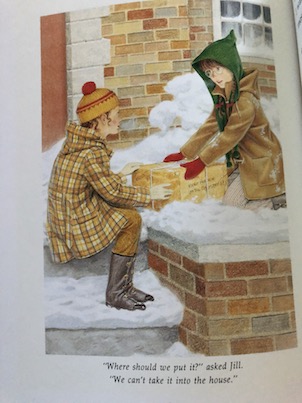
The next day, when the children go out to play in the snow, they find the package from their father that they’ve been waiting for! However, there is a note on the package that says, “KEEP HIDDEN UNTIL CHRISTMAS DAY!” Probably, their father wanted their mother to hide the package from the children, but since Molly and Jill are the first to find it, they decide to do the hiding themselves, putting the box in the storage room above the garage. Jill thinks they should tell their mother about it, but Molly persuades her to wait because she doesn’t want to ruin their father’s surprise.
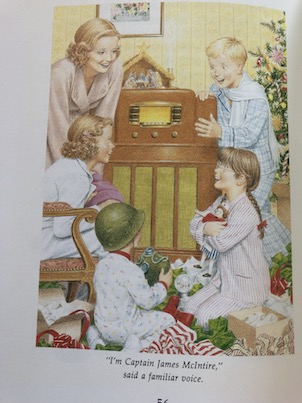
On Christmas Eve, the girls retrieve the box and put it under the tree after everyone else is asleep. However, that’s not the end of the Christmas surprises. Their father has one more special surprise for them . . .
There is a section in the back of the book with historical information about Christmas during World War II. Many families couldn’t be together during the war because families members were overseas and because many civilians limited their traveling during the war in order to save gasoline. In fact, speed limits were greatly reduced in order to save gas – the “Victory Speed Limit” restricted people to driving no faster than 35 mph. Public transit, like trains and buses, was often needed to transport soldiers, so civilians avoided traveling as much as possible.
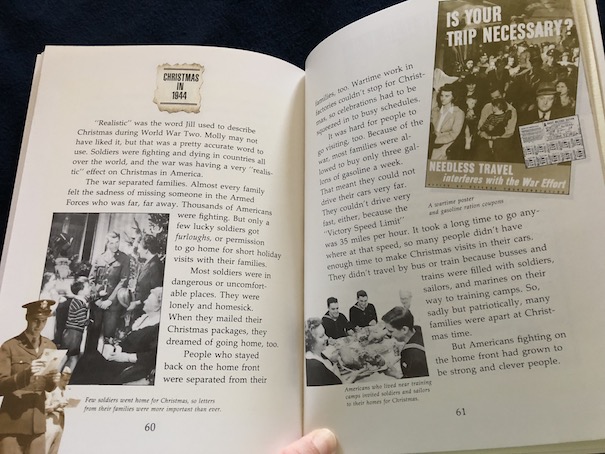
People also had to get creative about Christmas treats because some essential ingredients, like butter and sugar, were rationed. People also made their own decorations. The selection of toys was somewhat limited because factories had been converted to making war materials, and many families gave their children practical gifts. However, there were still toys available, and people managed to give their children a few special surprises.
The book is currently available online through Internet Archive.


 Jestress's Forgotten Books and Stories