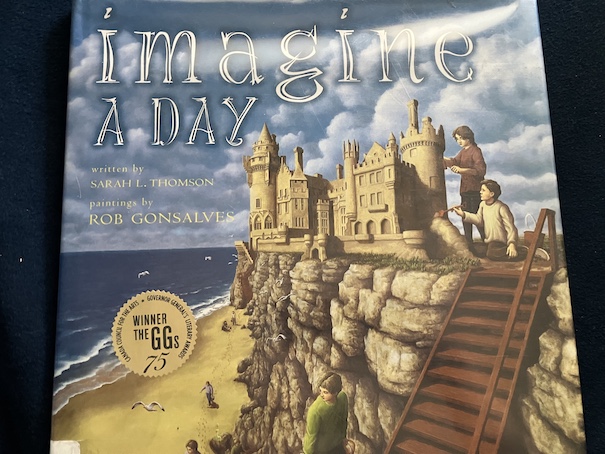
Imagine a Day

This book celebrates the power of imagination and invites readers to use their imaginations, envisioning things that are impossible but amazing!
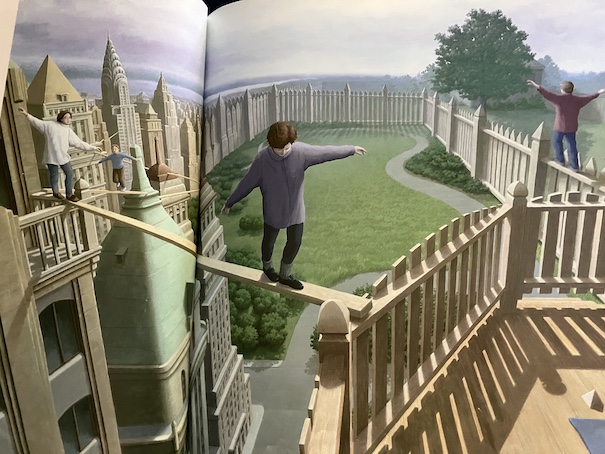
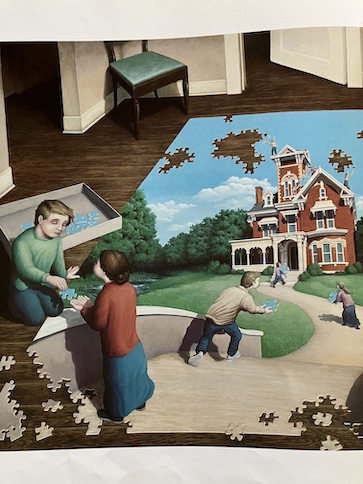
There isn’t exactly a story to the book. Each page poses something for readers to imagine with an accompanying picture where the shifts from the real world to the imaginary or impossible one are shown.

Each of the illustrations is surreal, with perspective changes from the real to the unreal.
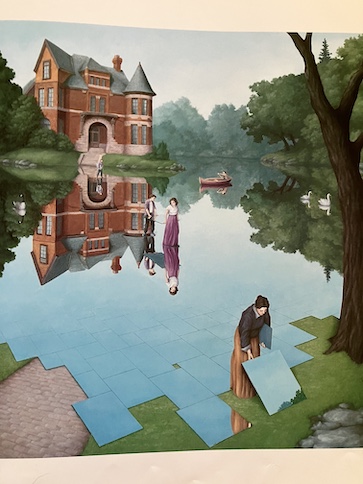
The book invites readers to imagine powerful and amazing things, like “when grace and daring are all we need to build a bridge”, “when you forget how to fall”, “when we build a moat not to keep strangers out, but to welcome them in”, “when everything you build touches the sky”, “when you build the world around you piece by piece”, or “when the edge of the map is only the beginning of what we can explore.” All of this amazing things are things that could happen on a wonderful day! Just imagine a day like that!
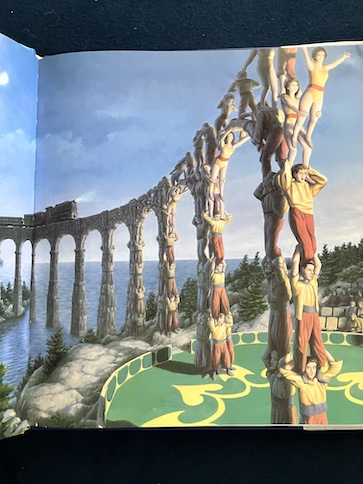
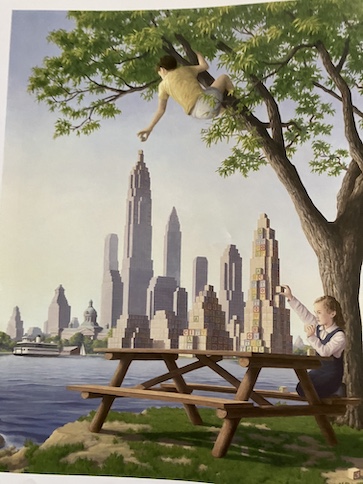
The best part of the book is the end when we “Imagine a day … when a book swings open on silent hinges, and a play you’ve never seen before welcomes you home. Imagine … today.” Books are a key that unlocks a person’s imagination!

The pictures are amazing, and they really make the book! The pictures use perspective to shift the characters and their actions from the ordinary world to the extraordinary! Fence posts or toy blocks gradually morph into buildings. Streets become rivers, and rivers become trees. People on swings or bikes start off on the ground and end up above the trees! I’ve shown a number of pictures from this book to show you what they’re like, but there are many more to enjoy!
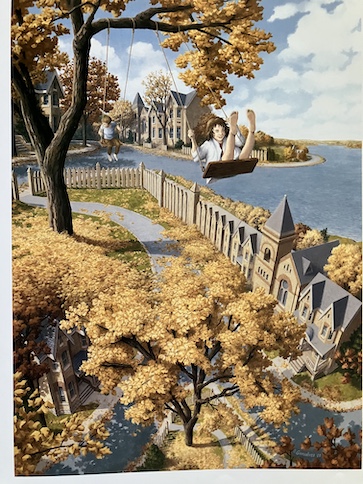
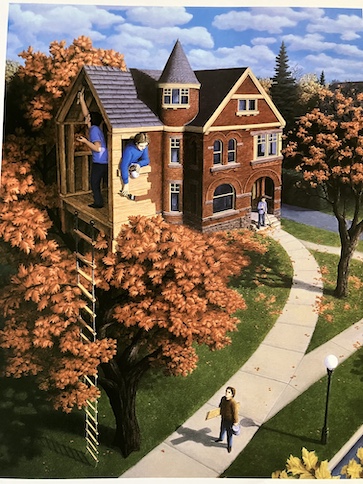
The pictures are fascinating to look at, and each of them seems like it could represent the beginning of a story. In that way, the book reminds me a little of The Mysteries of Harris Burdick. The things the book invites readers to imagine are positive, inspiring, and uplifting, and I think this book would be good to use for a story-writing prompts. Even adults can find this enchanting book inspirational for their creative powers!
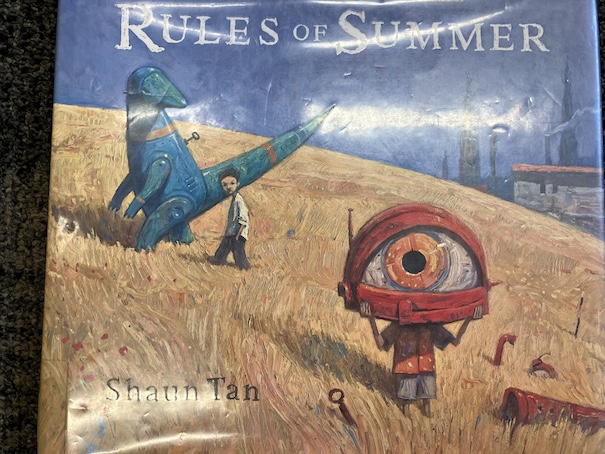
Rules of Summer

The book starts with the phrase, “This is what I learned last summer:” On every page, there’s a different “rule of summer”, something that the kid and his brother learned from their summer adventures.

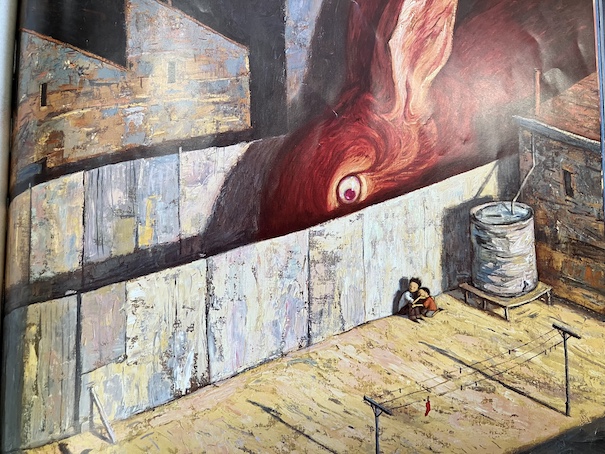
However, they’re not having the ordinary kind of summer adventures. He apparently learned not to leave a red sock on the clothesline when a giant red rabbit appeared, and he learned not to drop his jar when he and his brother were catching falling stars.

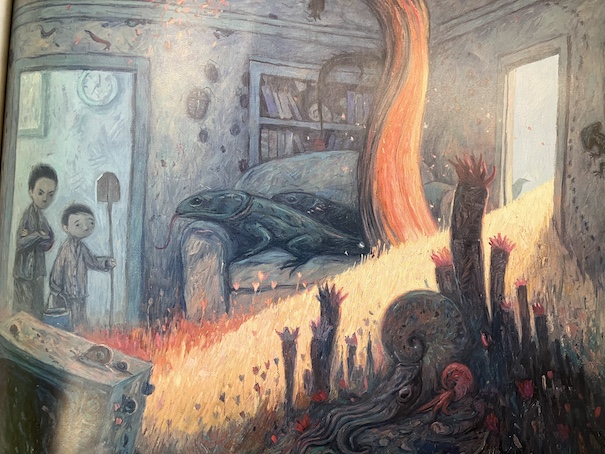
The pictures show all kinds of strange things happening, like a giant lizard and weird plants spilling into the living room, which apparently taught the boy not to leave the back door open overnight and a tornado that came after the boy stepped on a snail.

At the end of the book, the two boys sit in front of their tv with pictures of all the strange creatures they’ve seen pinned to the wall. Are they pictures from the boys’ imagination or memories of a fantastic summer?

The book is available to borrow and read for free online through Internet Archive.

The book is set in a gritty, urban environment where some surreal things happen. Either that, or the surreal adventures all take place in the boys’ imaginations. They could be turning regular adventures in the city where they live into sci-fi, dystopian epics. There is no backstory to anything in the book, so it’s all up to the readers’ imaginations whether anything in the book actually happened or not.

Their world may be post-apocalyptic (at least in their imaginations), peopled by all kinds of strange creatures and robots. There are no other humans in the book other than the boys. I don’t really like gritty or dystopian style books or art, but this book appealed to me because it leaves so much up to the imagination, including whether or not the boys just imagined everything. To me, the last picture, where the boys are just sitting in front of their tv with pictures they’ve drawn all over the walls suggest that they imagined their fantastic summer adventures, but that’s never clarified. In fact, there are a couple of additional pictures after the story ends that suggest maybe it wasn’t all imagination, but you can make up your own mind.

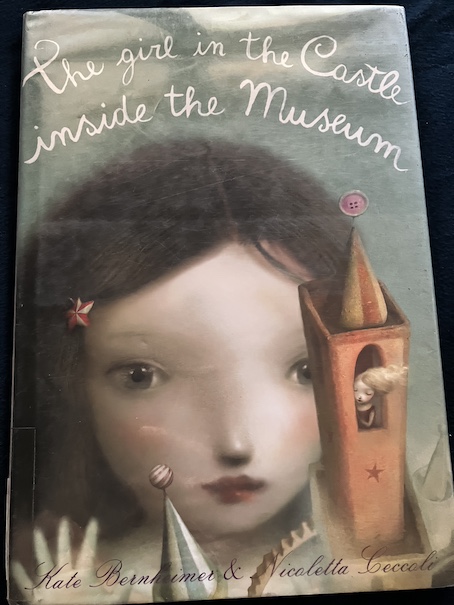
The Girl in the Castle Inside the Museum

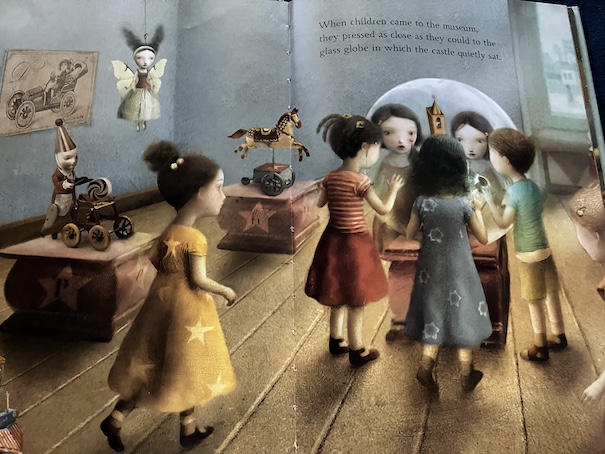
In this story, there is a little girl who lives in a castle in a museum, inside a big, glass globe.

Children love to come to the museum and look at her in her castle. The girl also likes it when the children come to see her.

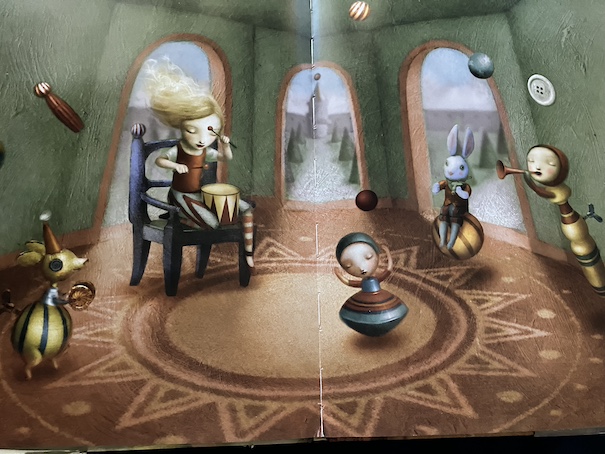
Although the girl in the castle has other creatures to play with and things she likes to do, like making music, she sometimes gets lonely when the museum closes, and all the children go home.

When the girl in the castle dreams, she dreams of the children who come to visit her at the museum, imagining their journeys to come see her.

When the children are visiting or when she’s dreaming about them, the girl isn’t lonely, but when she wakes up from a dream and there aren’t any children, she gets lonely again.

However, the girl gets an idea. If you, the reader, want to be her friend, you can give her your picture. When she looks at your picture, she won’t be lonely anymore!

I love the surreal, fantasy pictures in this book! We don’t know exactly what the girl is or why this tiny girl lives in a miniature castle in a museum. The book says that people claim “she’s lived there forever.” She is alive and has feelings, but she seems to be surrounded by fantasy creatures as companions in her castle rather than other people. She doesn’t seem to have parents or family. My theory is that she is a magical, living toy because the museum seems to be filled with other toys, the fantasy creatures in her castle seem to be toys with little wind-up keys in their backs, and the castle itself incorporates little toys and odd-and-ends, like buttons and marbles. However, the girl’s backstory is left up to the imagination of the readers.

This book breaks the fourth wall of the book, with the girl inviting readers to put their own pictures into the book and saying that the girl can see them through the book when they read it. Readers looking at the book keep the tiny girl company when she doesn’t have visitors to her museum. It’s not the first book that I’ve seen that uses the concept of readers keeping a book character company through their books. There is a book from the 1930s called The Tale of Corally Crothers, where a lonely girl with no brothers and sisters goes in search of a friend and finds you, the reader. (I haven’t found a copy of it myself, but you can see some pictures of this book on this site.) Books that involve the reader and invite the reader into their world are charming, and I found the fantasy elements of this particular book delightful!