Rasmus and the Vagabond

Rasmus and the Vagabond by Astrid Lindgren, 1956.

Disclosure: I am using the 2015 edition of the book, published by Plough Publishing House.  Plough sent a copy to me for review purposes, but the opinions in the review are my own.

The Swedish author Astrid Lindgren is best known for her Pippi Longstocking series, but she also wrote other excellent books for children. This particular book is about a nine-year-old orphan boy and his adventures with a traveling vagabond (tramp) after he runs away from an orphanage.  There is an element of mystery, which pleased me, as a life-long mystery fan.

The dullness and unfairness of life at the orphanage gets to nine-year-old Rasmus. While the other children in the village get to play and go swimming, he and the other orphans are expected to work, doing chores like digging up potatoes in the garden or pulling nettles.  Mrs. Hawk, who is in charge of the children, doesn’t like them goofing off when they could be doing chores.  The work is necessary because orphanage sells produce and eggs to help support the children, and the children know that when they’re thirteen years old, they will have to start taking regular jobs to support themselves.  Mrs. Hawk doesn’t see much benefit in letting the orphans play, like other children do.

One day, while Rasmus is pulling nettles by the chicken coop, he finds what, to him, amounts to wonderful treasures: a single five-cent coin and a seashell!  He has no idea how they got there, but he has never found anything so wonderful before.  He rushes to tell his friend, Gunnar, about them. Gunnar tells him that someone is going to visit the orphanage and pick out a child to adopt. All of the children hope to be the one chosen for adoption, and Rasmus wonders if his lucky finds might be an omen that he will be the one chosen.

Unfortunately, he isn’t the one chosen. As Gunnar predicted, the couple who visit the orphanage pick a girl with curly hair, Greta, and Rasmus embarrasses himself by accidentally breaking the lady’s parasol.  Rasmus thinks that he’ll never get adopted, and he suggests to Gunnar that maybe they should try to strike out on their own and find parents. His reasoning is that, if they didn’t have to compete against the other children at the orphanage (especially the cute, curly-haired girls), they might have better luck at finding families.  Gunnar thinks that Rasmus’s plan is crazy, but Rasmus also knows that he has punishments ahead for his earlier escapades, and he’s decided that tonight is the best time to get away.

That night, Rasmus sneaks out alone, taking his five-cent coin with him and leaving the seashell for Gunnar to remember him by.  At first, Rasmus is terrified on his own, and when he gets hungry, he actually starts to miss the orphanage.  Fortunately, he soon meets a tramp who goes by the name of Paradise Oscar.  Oscar actually turns out to be pretty nice, sharing his food with Rasmus.  Rasmus asks if he can be a tramp like Oscar, and Oscar says that boys should really be at home with their parents.  When he learns that Rasmus doesn’t have parents, he takes the boy under his wing.  Rasmus starts to like the free life of a tramp.  They work when they want to and don’t when they don’t.  Sometimes, they make money by singing in the street.  They can sleep anytime they want, and they spend Rasmus’s coin on butterscotch candies.

However, trouble looms when Oscar is taken in for questioning by the police about a robbery.  Two masked men robbed the Sandhoe factory before Rasmus ran away from the orphanage, and the police think that Oscar may have been one of them.  Rasmus believes in Oscar’s innocence.  The police aren’t so certain, but they release him for lack of evidence.

Shortly after that, Rasmus witnesses another robbery.  At first, they’re afraid to go to the police, but they leave an anonymous note so that the robbery victim gets help.  One of the miscreants involved actually accuses Oscar of being one of the robbers, but some of what Rasmus witnessed points to the real villains.
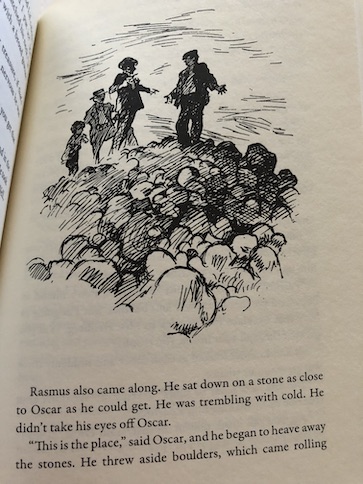
Rasmus and Oscar are colorful characters, and their journey through the Swedish countryside is full of adventure, with Oscar running from the law and Rasmus still searching for the home and family he desperately wants.  There are some moments of suspense in the story, but it all ends happily, and Rasmus does find a home that’s just right for him, although it’s not quite what he had originally pictured. Rasmus’s experiences on the road change him and his ideas of what he wants in life and a family. When he started his journey, he wanted to be chosen by someone else, but in the end, it’s the choice that he makes that determines his future.

One part of the story that particularly fascinated me was when Rasmus and Oscar hide in an abandoned village, and Oscar tells Rasmus that the reason that the village is abandoned is because, years before, the people in the village all decided to emigrate to America together, specifically Minnesota (a popular destination for Scandinavian immigrants).  I remember from my first degree in history that mass emigrations of that sort also took place in other countries.  The Library of Congress has more information about Swedish immigrants and the major periods of immigration.  I think that the event that Oscar referred to was during one of the periods of high population and famine in Swedish history. I love books with interesting historical details!

As a fun fact, this book is also one of those books that appears in Swedish on Ikea shelves, just to help demonstrate bookcases or dress up one of their mock rooms. I spotted it there once. If you look for the name “Rasmus,” you’ll recognize it. The next time you see it, you’ll know what it’s all about!

This book is available to borrow for free online through Internet Archive, but it’s also back in print and available for purchase through Plough. If you borrow the book and like it, consider buying a copy of your own. This one’s a keeper!

Pippi Longstocking

PippiLongstocking

Pippi Longstocking by Astrid Lindgren, 1950.

Pippi Longstocking is an iconic figure in children’s literature, a little red-haired girl with amazing strength (she can lift a horse all by herself) and a quick wit, who can “always come out on top” in any situation and is frequently doing exciting and hilarious things without adult supervision. The books in her series were originally from Sweden, with the first one written in 1945, but I’m reading a later English translation.

In the first book, she comes to live by herself in a house, which she calls Villa Villekulla, in a small town in Sweden when her father, a ship’s captain, is washed overboard at sea.  Although others fear that he is dead, Pippi thinks it more likely that he was washed up on an island of cannibals, where he will soon be making himself their king.  (Of course, Pippi turns out to be right, but that’s getting ahead of the story.) Her mother died when she was a baby, so Pippi now lives all by herself, except for her pet monkey and horse. She pays for the things she needs with money from the suitcase of gold coins that her father left for her and spends her time doing just as she pleases.

Tommy and Annika, the children who live next door to Ville Villekulla, are perfectly ordinary, basically obedient children, who live normal lives with their parents. When Pippi moves in next door, their lives get a lot more exciting. The first time they meet her, she’s walking backward down the street. When they ask her why she’s doing that, she says that everyone walks that way in Egypt. Tommy and Annika quickly realize that she’s making that up, and Pippi admits it, but she’s such an interesting person that they accept her invitation to join her for breakfast. They’re amazed when they find out that Pippi has no parents, only a monkey and a horse living with her, and are entertained by the tall tales that she tells.

When they go back to see her the next day, Pippi tells them that she’s a “thing-finder” and invites them to come and look for things with her. Basically, Pippi is a kind of scavenger, looking for valuable things, things that might be useful, or (which is more likely) just any old random junk that she might happen across. Pippi does find some random junk, although she makes sure that Tommy and Annika find better things (probably by hiding them herself).

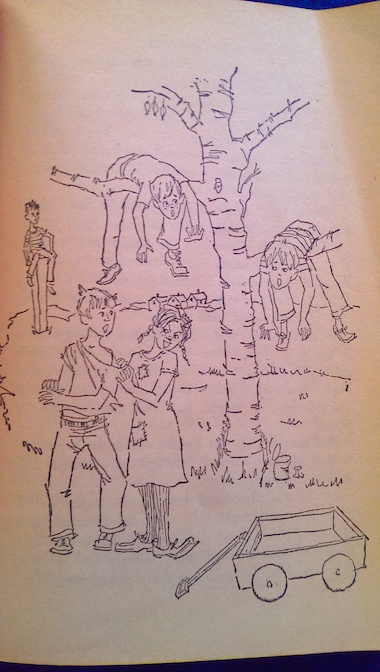
Then, the children see a group of bullies beating up another boy and decide to intervene. The meanest of the bullies, Bengt, starts picking on Pippi, but picking on a girl with super strength isn’t the wisest move. She picks him up easily and drapes him over a tree branch. Then, she takes care of his friends, too.

Word quickly spreads through town about this strange girl. Some of the adults become concerned that such a young girl seems to be living on her own. A couple of policemen come to the Ville Villekulla one day to take Pippi to a children’s home, but she saucily tells them that she already has a children’s home because she’s a child and she’s at home. Then, she tricks them into playing a bizarre game of tag that ends with them being stuck on the roof of the house. The policemen decide that perhaps Pippi can take care of herself after all and give up.

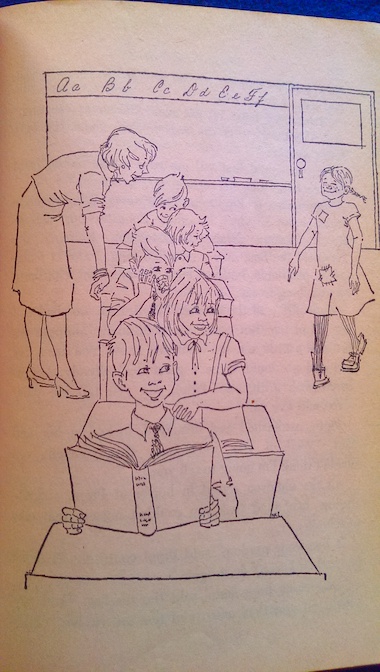
Tommy and Annika try to persuade Pippi to come to school with them, but that doesn’t work out, either. Pippi, completely unfamiliar with the routine of school, thinks that the teacher is weirdly obsessed with numbers because she keeps demanding that her students give her the answers to math problems that Pippi thinks she should be able to solve on her own. The teacher concludes that school may not be for Pippi, at least not at this point in her life.

Tommy and Annika delight in the wild things that Pippi does, like facing off with a bull while they’re on a picnic, accepting a challenge to fight a strongman at the circus, and throwing a party with a couple of burglars.  When they invite Pippi to their mother’s coffee party, and their mother’s friends begin talking about their servants and how hard it is to find good help, Pippi (having already devastated the buffet of desserts and made a mess in general) jumps in with a series of tall tales about a servant that her grandparents had, interrupting everyone else.  Tommy and Annika’s mother finally decides that she’s had enough and sends Pippi away.  Pippi does leave, but still continuing the story about the servant on the way out, yelling out the punchline from down the street.

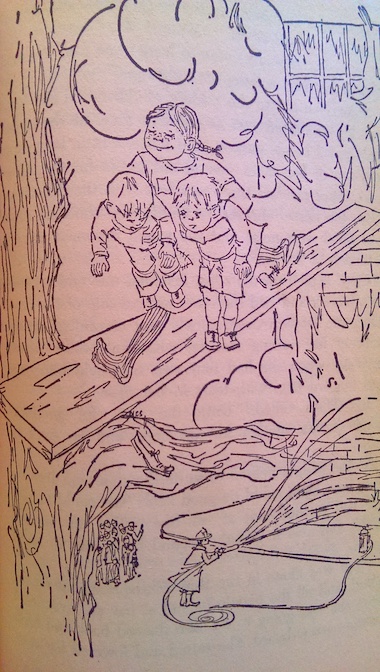
However, Pippi becomes a local hero when she saves some children from a fire after the fireman decide that they can’t reach them themselves.

The book is available to borrow and read for free online through Internet Archive.

My Reaction

I have to admit that, as a character, Pippi sometimes annoys me with her obvious lies and some of the stuff she does. She openly admits that she lies after telling some of her tall tales, but it’s the parts where she admonishes her listeners not to be so gullible that get to me. You can tell that her listeners aren’t really fooled at all; they’re just trying to be polite by not calling her a liar directly, and then she insults them for it. Maybe it’s Pippi who’s really the gullible one, thinking that she’s fooling people when she isn’t really. 

Admittedly, Pippi’s wild stories are sometimes amusing.  I liked the one where she claimed that the reason why other people don’t believe in ghosts is that all of the ghosts in the world live in her attic and play nine-pins with their heads.  When Tommy and Annika go up there to see them, there aren’t any, of course, and Pippi says that they must be away at a conference for ghosts and goblins.

I just don’t like it that Pippi seems to be deliberately trying to make people look dumb when she’s the one saying all the stupid stuff and it’s really obvious that people know it. I also don’t like the part where she makes such a mess at the coffee party because she seems to be trying to be a messy pain on purpose.  She insists that it’s just because she doesn’t know how to behave, but I get the sense that it’s just an excuse and that Pippi just likes to pretend to be more ignorant than she is, pushing limits just because she likes to and because she usually gets away with it.  I didn’t think it was very funny.  But, Tommy and Annika seem to just appreciate Pippi’s imagination, enjoying Pippi’s antics, which bring excitement and chaos to a world controlled by sensible adults, which can be boring to kids, and accepting Pippi’s stories for the tall tales they are, playing along with her.

Pippi herself is really a tall tale, with her super strength, her father the cannibal king, and her ability to turn pretty much any situation her to advantage.  Part of her ability to “come out on top” is due to her super strength and part of it is that Pippi approaches situations from the attitude that she’s already won and isn’t answerable to anyone but herself.  This approach doesn’t always work in real life (I can’t recommend trying it on any of your teachers, or worse still, your boss – not everyone is easily impressed, especially the people who pay your salary), and nobody in real life has Pippi’s super strength to back it up. The adults in the story frequently let Pippi win because they decide that fighting with her just isn’t worth it. (Admittedly, that does happen in real life, too. I’ve seen teachers and other people give in to people who are just too much of a pain to argue with because they’re too impatient or find the argument too exhausting.)  Kids delight in Pippi’s ability to get the better of the adults, who usually have all the control, and in Pippi’s freedom to do what she wants in all situations.

One thing that might surprise American children reading this story is that the children in the story drink coffee. Tommy and Annika say that they are usually only allowed to drink it at parties, although Pippi has it more often. It isn’t very common for American children to drink coffee in general because it’s usually considered more of an adult’s drink and because of concerns about the effects of too much caffeine on young children. Children in Scandinavia tend to drink coffee at a younger age than kids in the United States.

Christmas Around the World

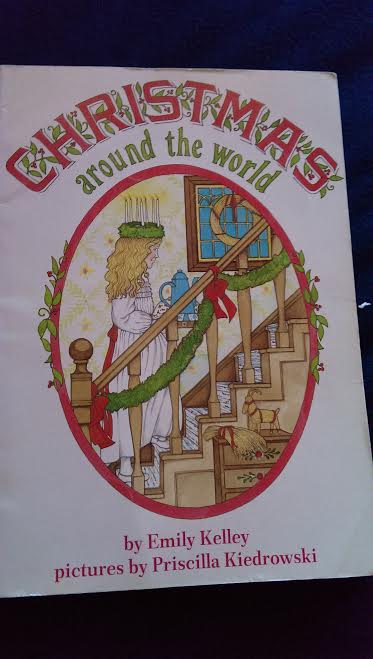
christmasworldChristmas Around the World by Emily Kelley, 1986.
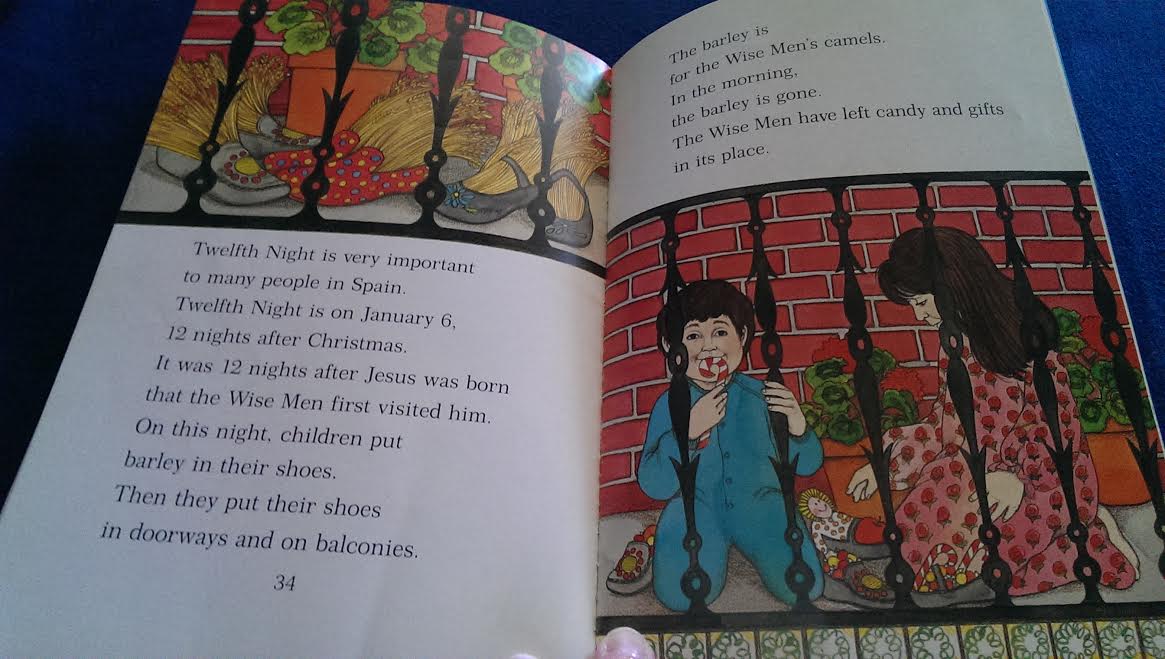
This is a non-fiction book that describes Christmas customs from various countries around the world.  There is some history and folklore associated with different Christmas traditions in every country.  The main countries described are Mexico, Iran, China, Sweden, Iraq, Spain, and Norway, although there is a section in the back that briefly mentions a few other countries.

In some countries, children leave out their shoes instead of their stockings in the hopes of receiving small presents in them.  Sometimes, the gifts are from Santa, and sometimes, they’re from someone else, like the Wise Men.  In other countries, people do not give gifts on Christmas, except maybe new clothes for the children.

Some of the traditions described are older ones, based on folklore, like the one about hiding brooms and tools from witches and bad spirits in Norway.  In countries in the Southern Hemisphere, Christmas is associated with summer instead of winter, changing the way people celebrate the holiday.  Each country has their own special foods associated with the holiday, too.

christmasnorway

The book also describes traditions that are associated with other special days related to Christmas, such as St. Lucia Day in Sweden (December 13) and Twelfth Night, when the Wise Men came to visit Jesus (January 6).  These special days are kind of an extension of the Christmas season in different countries.

christmasspain

christmasspain2

The pictures in the book are beautiful.  Some of them are in color and some are in black and white.

christmasmexico

In the back of the book, there are jokes, a craft project, and a recipe for Christmas cookies.

The book is available to borrow and read for free online through Internet Archive.