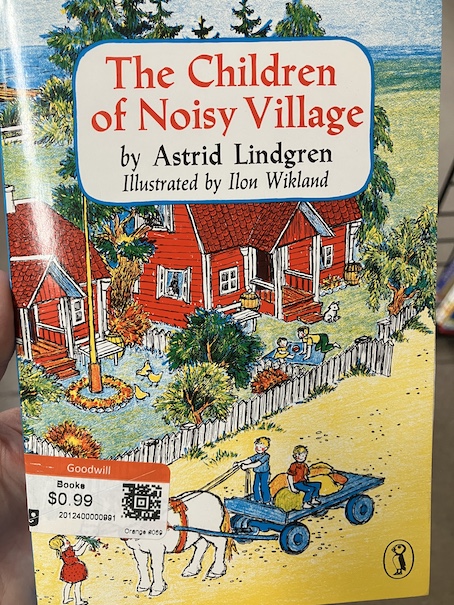
The Children of Noisy Village by Astrid Lindgren, 1947.
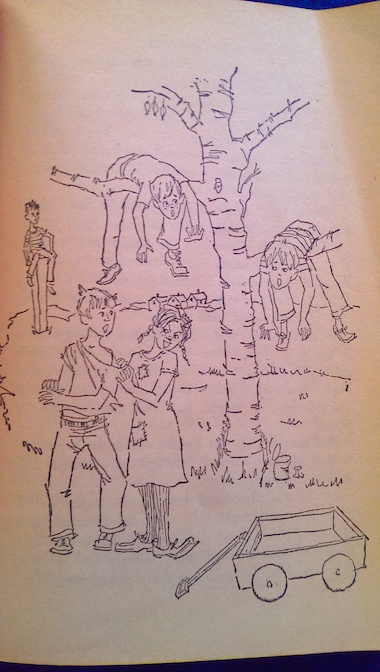
The story is told from the point-of-view of nine-year-old Lisa, a Swedish girl who has two older brothers, Karl and Bill. She and her family live on a farm that people call Middle Farm because it’s between two other farms, North Farm and South Farm. The three farms together are called “Noisy Village” because there are so many children around. The children who live on South Farm are Ulaf and his little sister Kirsten, who is only a year-and-a-half old, and North Farm has two girls, Britta and Anna, who are Lisa’s friends. Ulaf is friends with Karl and Bill. Sometimes, Lisa tries to play with her brothers, but they often tell her that she’s too little, and she sometimes thinks of the boys as a nuisance. Ulaf will sometimes play with girls, although Karl and Bill sometimes tease him about it, but there are also a limited number of children in the area to play with, so being willing to play with whoever is around is a good thing. Through the story, Lisa tells little stories and talks about the things that all of the children of Noisy Village do together.
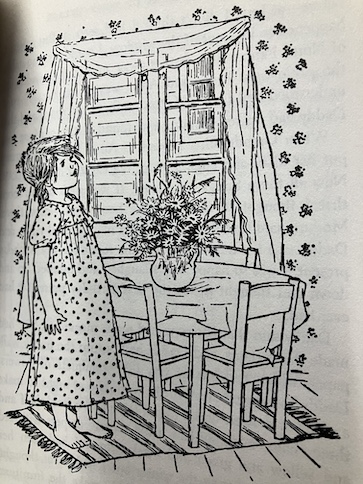
When Lisa was younger, she used to share a room with her brothers before getting a room of her own. At night, Karl used to tell ghost stories, while Bill likes to talk about adventures. Lisa tells a story about how her brothers scared her one night with a ghost story and how they rigged up a trick to make it look like their room was haunted. Although Lisa sometimes misses the stories that her brothers used to tell her at night, she’s also relieved that she has a space of her own so she doesn’t have to put up with their pranks or them bossing her around all the time. Bill and Karl like their room because their window is close to Ulaf’s window, and the boys like to use the tree between their houses to go back and forth between the two rooms. The room that Lisa has now used to belong to her grandmother, before her grandmother moved in with an aunt. Lisa’s family remade the room for her as a present for her seventh birthday. Lisa’s room faces North Farm and Britta and Anna’s room, so the girls can send each other notes or signal to each other through their windows.
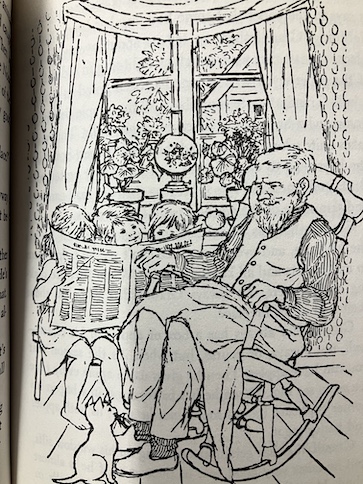
Some of the children at Noisy Village have pets, and Lisa explains how Ulaf got his dog, Skip, from the mean shoemaker, who was mistreating him. Britta and Anna don’t have any pets, but their grandfather lives with them, and the other children at Noisy Village like to visit him. Britta and Anna’s grandfather tells the children stories. One of his stories is about how he ran away from home as a boy. Inspired by the story, Lisa and Anna decide that they should have their own adventure, running away from home temporarily. However, they think that they have to run away during the night, and they both miss their opportunity because they fall asleep.
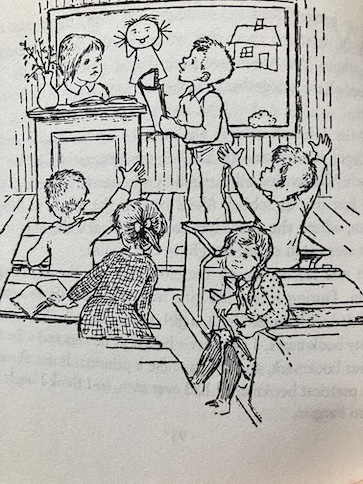
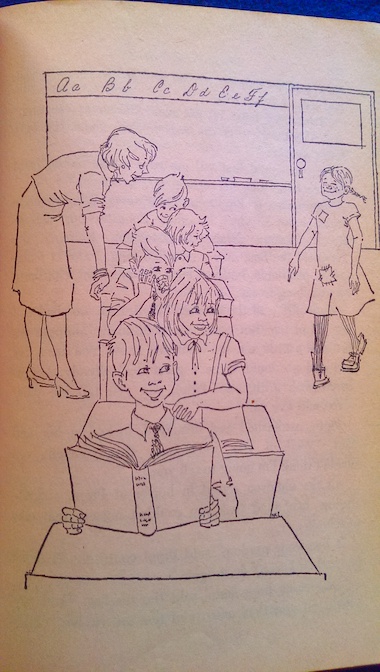
The children like to play games of pretend on their way home from school, which makes their mothers wonder what they’re doing and sometimes get them into trouble. Anna and Lisa accidentally get on people’s nerves one time, when they try too hard to follow their teacher’s advice about doing things to make people happy. They often end up doing the wrong things because they don’t know what other people really want or what people say they want doesn’t seem like enough. They finally succeed in making someone happy when they share some of their things with a girl from school who is sick.
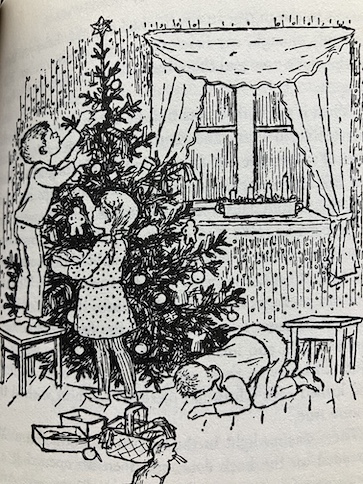
The children’s adventures continue through the year. The people of Noisy Village have a charming, old-fashioned Christmas. At a Christmas party at a relative’s house, they play old-fashioned party games and tell stories. Lisa also describes a Swedish tradition of finding an almond in porridge, which is supposed to be a sign of marriage in the coming year. The children are allowed to stay up late on New Year’s Eve. The boys scare the girls with some firecrackers, and Britta and Anna’s grandfather teaches the children the tradition of pouring melted lead into water to see what shapes it will form to predict what will happen in the new year. On Easter, the children paint eggs and make egg nog.
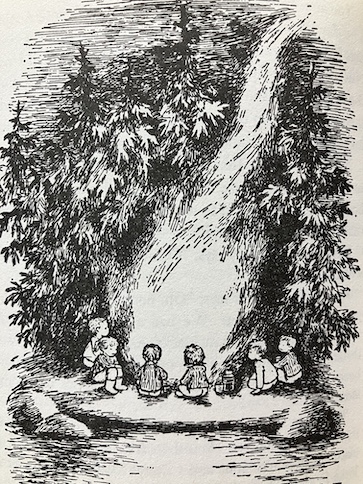
Eventually, school lets out for summer vacation. The children go swimming and catch crayfish during the summer. When they go fishing for crayfish, they camp out in the forest, near the lake, with Lisa’s father and the other men. The children make little huts to camp in. The boys try to scare the girls with stories about goblins. The children appreciate their idyllic lives in Noisy Village!
My Reaction
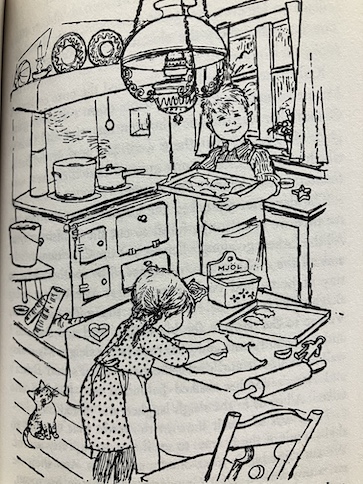
This book is a series of pleasant, gentle, slice-of-life stories about the children who live on a collection of small farms outside of a Swedish town, probably some time in the mid-20th century. Because there is little mention of any form of technology in countryside, it could set almost be any time in history from the 19th century to the time when it was written in the 1940s. The one thing that identified it as the 20th century for me is when they mentioned “turning on lights” in the house rather than lighting lamps. Even into the mid-20th century, not all farm houses had electricity, but it seems that these do. Other than that, these children seem to be living an idyllic, “unplugged” life in the countryside that people who are into cottagecore would aspire to! I think it would be a nice book to read children at bedtime because it’s very gentle.
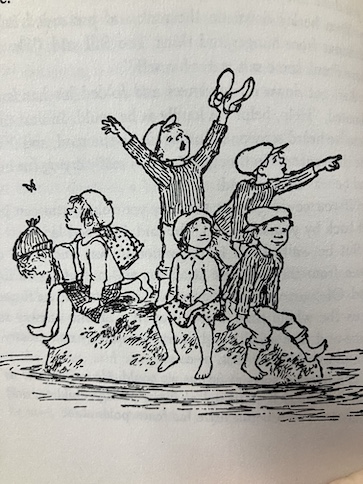
I enjoyed reading about the games that the children play with each other and with their families. The children like playing games of pretend that seem to be inspired by books they’ve read. The girls play at being princesses, while the boys play at being Indians, probably American Indians (Native Americans) because one of young Bill’s ambitions is to be an Indian Chief when he grows up. We don’t really encourage playing at being “Indians” today in 21st century America because that can devolve into caricatures of someone else’s racial group (cowboys are still fair game because that’s a profession, not an ethnicity), but that sort of thing was pretty common in the mid-20th century, even outside of the United States. I’ve read British books from around the same time period that also refer to children playing at being American Indians, so it was something that seems to have captured children’s imaginations, even internationally. The children also pretend that they’re marooned or shipwrecked on a rock at one point, something else that often appears in children’s literature and is based on older books.
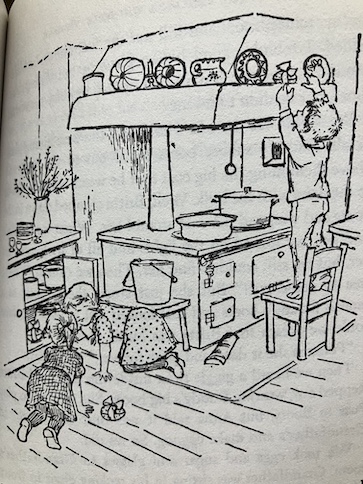
I particularly enjoyed some of the descriptions of Swedish holiday traditions through the year. Some of them are very similar to traditions in the United States and Britain around this time and even earlier, like in the 19th century. They have a charming Christmas with friends and family and a party with old-fashioned parlor games. I’ve heard of the tradition of finding an almond in porridge or pudding before, but I think that’s more common in Scandinavian countries than in the United States. In Britain, there are traditions associated with finding things (like a coin or a bean) in porridge or pudding, but it’s not really common in the US. Another thing that stood out to me was that Lisa said they made egg nog at Easter. In the US, people typically have egg nog at Christmas, but when I thought about it, it does make sense for Easter because of the association with eggs.
One other thing that stood out to me in the book was the little huts that the children make when they’re camping out by the lake. It reminded me of the huts that children in The Secret Summer (Baked Beans for Breakfast) made.




 Christmas Around the World by Emily Kelley, 1986.