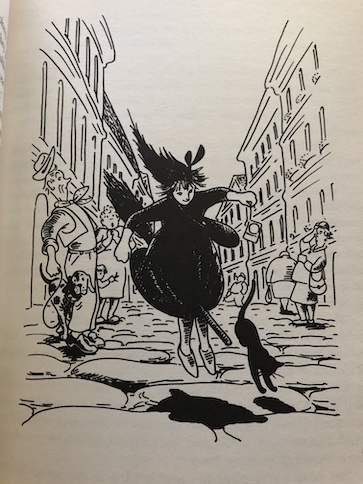
Kiki’s Delivery Service by Eiko Kadono, English translation by Lynne E. Riggs, 1985, 2003.
More Americans would probably recognize the title as the title of a Studio Ghibli animated film for children than as a book title, but the book came before the movie, and it is actually the first in a series, which continues the story about Kiki’s life and adventures, although I don’t think the later books in the series have been translated into English (at least, I haven’t found them in English). The original Japanese version of this book was written in 1985, and I read the English translation from 2003.
Kiki is a young witch, and in keeping with the traditions of young witches, she is expected to leave home at age 13 and live for a year in a city with no other witches. It will be a test of her developing skills and a coming-of-age experience, helping her to recognize her talents and find her place in the world.
When Kiki sets out for her journey with her cat, Jiji, she doesn’t know exactly where she is going to go or what she will find when she gets there. Some young witches know early on what their talents are and how they plan to support themselves during their year away from home, but Kiki is less sure (like so many of us who “don’t know what we want to be when we grow up”). The term “witch” just refers to a person’s ability to do magic. It’s not a job title by itself, and witches are expected to develop a specialization, such as brewing potions or telling the future. Kiki’s mother has tried to teach Kiki her trade, growing herbs and making medicines from them, but Kiki hasn’t had much patience with it. The only major ability Kiki has is flying, which is something that witches are expected to do anyway. Still, she has an adventurous spirit and is eager to set out and see what life has to offer.
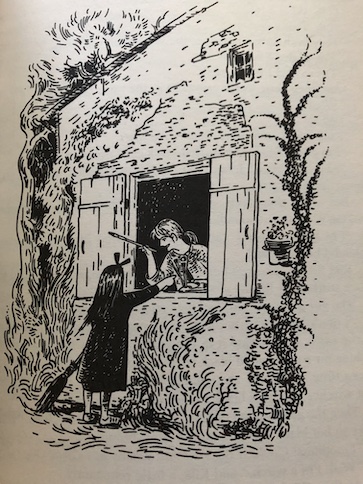
Once Kiki locates a city with no other witches, she has to find a place to stay and a job to earn money. She finds a city by the sea, which seems exciting to her. As she explores the city, she meets Osono, a woman who owns a bakery with her husband. When she helps deliver a baby’s pacifier to a bakery customer who left it behind, flying to the customer’s house on her on her broom, Osono offers to let her stay in a small apartment attached to the bakery. Kiki feels a little overwhelmed by the big city at first, but she realizes that, in a large city like this, there are probably a lot of people who have small delivery errands that wouldn’t be covered by ordinary parcel delivery services.
Kiki opens a delivery service, delivering small packages and running errands for people around the city. At first, business is slow, and some people are afraid of her as a witch. During a trip to the beach, a curious boy borrows her broom and breaks it. Kiki is distressed, and the boy apologizes. The boy’s name is Tombo, and he is part of a club of other kids who are interested in flying. He has made a study of flight and had hoped to learn more about how witches fly by trying Kiki’s broom, but Kiki expains that only witches can fly with brooms and that the ability is inherited. Kiki has to make a new broom, and it takes her a while to break it in, but it actually works to her benefit. People who were initially afraid of her for being a witch become less afraid of her and more concerned about her when they see that she is just a young girl, clumsily trying to master a new broom. Kiki gets some additional support and business from people who feel moved to help a struggling young witch. Tombo also makes it up to her and becomes a friend when he helps Kiki to figure out a way to carry a difficult object on her broom.
During her very first delivery assignment, Kiki was supposed to carry a toy cat to a boy who was having a birthday, but she accidentally dropped it. When she searched for it, she met a young artist, who was enchanted by Kiki as a young witch and painted a portrait of Kiki with Jiji. When the artist asks Kiki to take the painting to the place where it will be on exhibit, Kiki isn’t sure how to carry it at first. It’s kind of a bulky object to carry on her broom. Remembering that Tombo has made a study of flying, she asks him for help. Tombo ties balloons onto the painting to make it float and tells Kiki that she can now pull the painting along on a leash, as if it were a dog. The idea works, and when people see Kiki pulling a painting of herself along through the sky with balloons tied to it, it acts as advertising, bringing her more business.
Some of Kiki’s new jobs are difficult or awkward, and some customers are more difficult to deal with than others. There are times when Kiki finds herself missing home or trying to remember how her mother did certain things, wishing that she had been better at watching and remembering what her mother did. Still, Kiki learns many new things from her experiences and acquires new skills.
Kiki’s experiences also help her to realize a few things about herself and life in general. Like other girls, Kiki worries about how boys see her. When Tombo makes a comment that he can talk to her when he can’t talk to other girls, Kiki worries that he doesn’t see her as a girl at all. A job delivering a surprise present to a boy from another girl her age helps Kiki to realize that everyone is a little shy and uncertain about romance and even people who act confident feel a little awkward about first relationships.
As her first year away from home comes to an end, Kiki wonders how much she’s really changed over the year. Although she has successfully started a new business and done well living away from her parents, she still experiences a sense of imposter syndrome, where she doesn’t quite feel like she’s really done all of the things she’s done. Her first visit home to her parents reminds her that her new town has really become her new home. She has become a part of the place, and she feels her new business and friends calling her to return.
In 2018, the author, Eiko Kadono, was awarded the Hans Christian Anderson for her contributions to children’s literature.
My Reaction
I think of this story as one of those stories that takes on more meaning the older you get. Young adults can recognize Kiki’s struggles to make her own way in the world and establish herself in life as ones that we all go through when we start our working lives and gain our first independence. It can be a scary, uncertain time, when we often wonder if we really know what we’re doing. (Life Spoiler: No, we don’t, but no one else completely does, either, so it’s normal and manageable. Some things just have to be lived to be really understood, and that’s kind of the point of Kiki spending a year on her own, to see something of life and how she can fit into it.) However, it’s also a time of fun and adventure as we try new things, build new confidence, make new friends, and learn new things about ourselves. Like so many of us, Kiki doesn’t always do everything right, but she learns a lot and endears herself to the people of her new town.
The Miyazaki movie captures the feel of the story well, although the plot isn’t completely the same. There are incidents and characters that are different between the book and the movie. Tombo appears in both the book and the movie, but there are other characters who appear in the book who weren’t in the movie. In the book, Kiki makes friends with a girl named Mimi, who is her age, and the two of them discuss crushes on boys and how each of them was a little envious of the other because, while each of them is struggling with their own uncertainties in life, they each thought that the other acted more confident. The movie version developed the character of the young artist more. Kiki also didn’t lose her powers during the book, although that might be a part of one of the other books in the series, since I haven’t had the chance to read the others yet.
Tim Ingram has been feeling depressed since his parents decided to move from London to an old house in the country that they’re fixing up. It’s hard for him being separated from his friends and living in this overly-quiet place, where it seems like nothing ever happens, but the truth is that he was depressed even before his family moved. A large part of Tim’s problem is not knowing what he wants out of life. He works hard in school to get good grades, and his school has a reputation for getting its students into good universities, but it all seems so futile because Tim doesn’t know what he really wants to study or what he’ll do when he gets out of school. His father quit school early and went to work, working his way up the ladder in an advertising firm and becoming monetarily successful. However, Tim doesn’t feel like he has either the wit or self-confidence for starting off from practically nothing and working his way up in a direction he’s not even sure he wants to go. His father’s plans and suggestions for the future don’t excite him or make him happy. They actually make him feel more stressed and depressed when he thinks about them. His father is in a position to just give him a job with his company, so Tim does have a guaranteed job if he can’t think of anything else, but advertising doesn’t appeal to Tim. He’s not sure what does appeal to him. He fears and dreads the future, specifically his own future. He doesn’t know what to do with himself, and in this new place, it seems like there isn’t a lot he can do.
Tim has also been arguing with his parents, discovering that he has different interests and priorities in life than they do. While they’re enthusiastic about expanding onto this country house with a new and stylish modern wing, Tim prefers the older part of the house and its simpler style. He thinks the modern additions his parents made look ugly and out-of-place, ruining the natural beauty of the countryside. His parents feel like he’s unappreciative of their standards and the sort of lifestyle they’ve worked hard to build, and his mother even goes so far as to call him “perverse and awkward.” He kind of feels that way, too. Tim often feels like he’s a nobody, not very outstanding at anything. His ambitious parents are disappointed in him because they’ve invested so much in his education to show him off as another one of their achievements in life, and he doesn’t think he’s much to show off. He’s even a little disappointed with himself because, not only does he not seem to live up to his parents’ expectations, he doesn’t even have it in him to stand out as a rebel or a troublemaker, like some of his friends. He’s not an aggressive person, and it’s just not his nature to fight or get into trouble, and that makes him feel like even more of a nobody. If he neither excels at meeting people’s expectations or at deliberately flouting them, what is he? Who is he? Where does he fit in? With all of this, Tim hasn’t been feeling well, and he fakes being sicker than he is so he doesn’t have to get out of bed and deal with any of it. Since he’s been unwell, he’s also excused from school until after Christmas, leaving him with nothing to do in this countryside house but lie in bed and think about all the things that are worrying him.
Then, one day, the builder who’s been working on their house finds an old tin box hidden in the chimney of the room that Tim has chosen for his bedroom. The box catches Tim’s attention. It looks like a very old biscuit (meaning cookie, this book is British) tin decorated with a faded pattern of flowers. The builder opens the box and is disappointed to see that it just contains papers, not anything that looks really valuable. However, Tim is curious and insists that he wants to see the papers.
The papers are drawings, quite old and done in black crayon. Most of them are landscapes and buildings, but there is also a girl, who is labeled “Netty.” Netty’s name is written in a heart, so the artist must have loved her. The date on one of the drawings is February 17, 1910 (the story seems to be contemporary with the time when it was written in the early 1970s because Tim thinks that was 60 years ago), and to Tim’s surprise, the author signed with his initials: T.R.I. Tim’s full name is Timothy Reed Ingram. Tim is intrigued that the artist who lived so long ago had the same initials and apparently lived in his room.
The builder, called Jim, asks Tim if he likes to draw or knows anything about art. Tim gets good grades in art, but he’s not very self-confident about his abilities. Still, he knows enough to tell that the artist wasn’t particularly great at his art. There are places where he got the proportions of his drawings wrong, but Tim is impressed that they convey a lot of feeling. Even though the drawing of Netty isn’t perfect, Tim feels like he can tell what kind of girl she was. She looks like she’s in her early teens and has a kind of proud, somewhat naughty or daring look. Tim asks the builder if he knows anything about the artist or the people who lived in the house back in the 1910s. The builder says that was before his time, but he thinks that he remembers hearing that the family name was Inskip, and he says that he could ask his father if he knows more. Tim wonders why the drawings were hidden in the chimney and begins to imagine what the first T.R.I was like, picturing a boy close to his own age.
Tim is surprised at how real the boy he imagines seems because he’s often found it difficult to imagine old people as once having been young. He’s seen old men and known that they were part of the generation that fought in WWI but is unable to picture them as once having been soldiers. In fact, he knows that his own father flew a Spitfire during WWII, but even though he knows it happened, he has trouble picturing that of the middle-aged advertising manager his father has become. Yet, somehow, T.R.I. seems incredibly real to him, someone he can connect with, even more so than his own father. Details of this past boy’s life flash through Tim’s head without him knowing quite where they came from. However, Netty seems even more real to Tim because of her picture.
When Tim’s mother makes him get out of bed and go visit the local vicar to get a copy of the parish magazine, Tim has a strange vision of the boy artist he imagines as being named Tom Inskip passing him in the lane. It’s so real that Tim feels like Tom is actually there. As he pauses to look around the churchyard, he spots some beautiful purple roses by a gravestone. Taking a closer look, he sees that the grave has the initials T.R.I., a birth date of March 1894, and a death date of February 18, 1910. Tim is shocked to realize that the artist was not only a little less than 16 years old when he died, just a little younger than Tim is now, but that he also died the day after he drew that last picture. It seems like the boy’s death was sudden and unexpected, more like an accident than a long illness.
Tim doesn’t meet the vicar, but the vicar’s daughter, Rebecca, spots him in the churchyard and asks him if he’s all right. Tim just says that he’s there to get a parish magazine. Rebecca isn’t too cheerful or friendly, and she just gives him one and sends him on his way. Tim later learns that Rebecca is the youngest of the vicar’s children and the only one still in school. Her older siblings are all grown up and have jobs working for good causes and charity organizations.
Tim talks to Jim the builder about the grave he saw, and Jim is interested. He suggests that, since T.R.I. is buried in the churchyard, there will be church records about who he was and how he died. Tim has another vision of the boy, and the boy says, “Find out. But be careful it doesn’t happen to you.”
Tim returns to the vicarage and talks to Rebecca about T.R.I. Rebecca says that she doesn’t believe in ghosts and that she thinks the visions he’s had are just his imagination. However, Tim’s guess that the artist’s first name was Tom turns out to be correct. His full name was Thomas Robert Inskip. The records don’t say how he died, but Rebecca suggests that Tim ask an old local man called “Holy Moses.” The old man says that he remembers Tom Inskip but he doesn’t know what happened to him because he left the village to work somewhere else and didn’t come back until after Tom was dead. When Moses shows them an old photograph of all the children at the local school, Tim recognizes Tom instantly as the boy from his visions and strangely even knows the name of Tom’s friend, Arnold, standing next to him in the photograph, without being told.
From this point forward in the story, scenes with Tom alternate with scenes with Tim. Tom’s scenes start with the day the photograph was taken, when Tom was eleven years old. It was also the day that Tom first met the new vicar of the parish, Reverend Bellinger, a fire-and-brimstone kind of preacher, very different from the gentle man who was the last vicar. Like Tim, Tom was bright, imaginative, and artistic, but he was not much of a worrier. Tom fails to impress the new vicar because he is not very good with religious knowledge and often doesn’t pay attention. Tom loves to draw, but after he gets out of school and starts working, he finds that he doesn’t have time anymore. The vicar’s daughter, however, is kind and encourages him to draw because it’s a talent from God and must be used. People often underestimate her and don’t appreciate her because she has a disability, so she understands what it’s like not to have the opportunity to use and develop her talents to the fullest. It’s only sad that a tragic accident cuts Tom’s life short before they can see what he might have developed into, although when Tim and Rebecca manage to contact the people who knew and remember Tom best, one of them points out that, if Tom hadn’t died when he did, he might have been sent off to fight and die with the other young men during WWI, and with his gentle soul, he might have suffered more from the war than he did from the accident that took his life, when died young in an act of self-sacrifice.
Tim’s scenes involve his parents and school discussing his future, asking for little input from him, not caring about how he feels or what he wants. Tim actually does love art, and his art teacher thinks he should go further with it, but his teacher realistically acknowledges that, with Tim’s good grades in his other classes, his family and the school will want to push him into more lucrative and higher-status fields. But, does Tim really care about money and status as much as his parents? Is that really what he wants?
Gradually, Tim begins to consider the idea of the legacies people leave behind. Few living people remember that there was once a boy named Tom Inskip who died young, and after those people are gone, no one will remember. It occurs to Tim that few people would likely remember either him or his father as advertising workers. If all you care about is just getting money to afford the good things in life, any job could do, and there are many well-paying jobs that make little lasting or meaningful impact on the world. On the other hand, if what you want is to leave a lasting and meaningful legacy, you have to think a little deeper and maybe sacrifice some material gain. Money comes, and money goes, and one coin or bill looks like another, but what lasts as long and has as much individual character as a collection of imperfect but evocative drawings hidden away in an old tin box?
The question of what Tim wants to do with his life becomes the question of what Tim wants to leave as his life’s legacy. The quietness of the country, rather than being the torture it initially seemed, gives Tim a chance to think and really consider what he wants. Through his search for Tom’s past and consideration of Tom’s legacy, Tim finds a new vision of his own future that makes him more hopeful instead of more frightened and that may lead him to find what one of Tom’s friends called Tom’s “perfect spiritual grace.”
That alternate title is fitting for the theme of the story. Tom was once a living boy with choices to make in his future, much like Tim is now. That phrase also appears in the story as part of an epitaph from another tombstone, which I’ve also seen elsewhere. That same epitaph has been used in different forms in real life. It refers to the inevitability of human mortality – all those living will someday die, like every other generation before. As one of my old teachers used to say, “Nobody gets out of life alive.” But, I would also like to point out that the sentiment also refers to growing up. Every adult used to be young (although Tim has trouble picturing it), and every child will someday be an adult (if they live to grow up – Tom was unfortunate). Every person in a profession of any kind was once a student and a beginner, struggling to learn and find or make their place in the world, and every student will one day find or make some place for themselves and try to make a mark on the world. Change is inevitable. Time passes, people grow and change, and everyone moves on in one way or another. Tim won’t always be a student with his parents controlling his education. He will eventually grow up, graduate, and become an adult. That part is inevitable. What else he becomes is up to him and whatever opportunities he seeks and finds for himself. His future legacy is still in the making.
There is also a made-for-television movie version that is available to rent cheaply online through Vimeo. The movie version is notable for being Helena Bonham Carter’s first movie role. She played young Netty.
My Reaction and Spoilers
I found this story very sad, particularly Tom’s death, trying in vain to rescue beloved hunting dogs but drowning along with them in an icy lake when they all fell in. The death of the dogs was as traumatic as Tom’s, and it is described in awful detail. I also hated a part earlier in the story, where one of the dogs kills a pet cat. I love animals, and that was hard to take. It’s all a tragedy, but Tim’s story has a more hopeful ending. Besides leaving behind a box full of drawings, Tom’s effect on Tim’s life becomes a part of his legacy. Even though they lived in different periods of time, Tom and his life story helps Tim, who has been going through a personal crisis, to realize what’s really important and what he wants out of life.
Through much of the book, both Tim and Rebecca are in a similar situation when it comes to their future lives and their family’s expectations for them. As Tim gets to know Rebecca, he discovers that she has hidden depths and is inwardly quite sensitive. She often uses a blunt and abrasive manner to keep people at a distance and hide how sensitive she really is. Like Tim, she is also unimpressed by the money and business-oriented priorities of the modern world and Tim’s parents, preferring things with an old-fashioned, natural beauty – things that, sadly, are often cleared away by modern people in the name of money, business, and being modern. Yet, Rebecca also doesn’t feel like she fits with the lives that her family lives. She doesn’t have the patience to deal with the people her family tries to help, many of whom are nasty and ungrateful instead of kind and appreciative of the help they get, and she feels like her parents don’t have time for her because they spend all of their time helping everyone else. Rebecca is considering a career in social work, but it’s mostly because it’s what her parents want and expect of her. As they compare their family lives, Tim and Rebecca both realize that neither of them quite fits their families’ lifestyles and expectations. They both feel pressured. Their families are also extremes: extreme business and high-achievement vs. extreme charity. Tim and Rebecca are looking for a happy medium that neither one of them knows how to achieve. They feel overwhelmed by a world full of choices, their parents’ expectations, and their own uncertainty about what path to choose.
It occurs to them that a boy like Tom in the 1910s would have limited choices in life and expectations from his family and community. Tom died young, but if he hadn’t, he probably would have been expected to do what other young men in his community did, which was mostly farming or joining the army. In some ways, Rebecca thinks life was probably much easier for those who had no choices than it is for modern people with many more choices and little to no guidance about how to use them. Tim and Rebecca aren’t really bound to their parents expectations because there is less social stigma with being different in their time, but being young, inexperienced, and uncertain of their options in life, they aren’t sure what to do with their relative freedom. They feel trapped, but not in quite the same way as each other and in a different way from people in the past.
Perhaps all people have limits and obstacles no matter when or where they live, and nobody is ever fully in control of their destiny because they are subject to limits in knowledge, ability, and available options. Maybe not everybody is even really suited to where they end up in life. They learn that the man who was the vicar in Tom’s time was more of a bully than a loving and charitable man. Tim’s art teacher comments that he used to work in a job similar to Tim’s father before he found his calling teaching art. Having followed two different professions in his life and seen the people who thrive in each, he thinks that Tim’s personality fits better in the art world than the business world, but he can also see that Tim is going to have to learn to fight and stand up for himself to get where he really needs to be.
But, happiness in life depends on more than fighting or earning money. May, the vicar’s daughter, who is still alive and has lived a happier life than anyone expected after the death of her father, says that one of Tom’s greatest gifts was “perfect spiritual grace.” She explains that Tom never asked a lot out of life and was satisfied with what he had. His life was tragically short, but he enjoyed it to the fullest as long as he lived. Tim thinks that Tom might have gotten less satisfied with his limited prospects in life if he had lived longer, but it’s difficult to say. However, May’s description makes Tim realize that he wants that same sense of “perfect spiritual grace”, making the most of the opportunities open to him and being satisfied that he pursued those opportunities to the best of his ability.
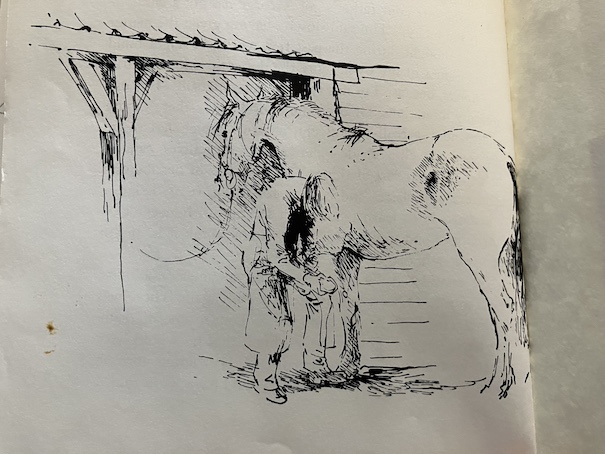
Life has a way of taking many people in directions that they never expected. People often don’t know what they want to do with their lives when they’re young, some of us still question our career choices when we’re older, and many of us end up doing things we didn’t expect or entering fields we didn’t originally study. Tim’s new home and new acquaintances and the inspiration that he receives from Tom’s life story cause him to consider different directions that his life might take. Tim finds a job in the country as the local blacksmith’s assistant. Blacksmithing appeals to Tim’s creative side, and there is enough demand for specially-crafted decorative metal objects that Tim is confident that he can build his own business around it. He’s confident enough about it that he finds the ability to stand up to his parents and insist on the future he really wants. He probably won’t make as much money at it as his father does in his advertising firm, but he’ll be independent and creating real things that will leave the lasting legacy that he now craves. He hopes that, along the way, he’ll also find the “perfect spiritual grace” that Tom had.
Tim also comes to realize that the company that his father built was his father’s act of creation, and that’s why he takes so much pride in it, wanting Tim to continue it as his legacy. However, Tim also realizes that what his father did with his life was his decision, done for his own reasons and his own sense of fulfillment, and he doesn’t need to stifle his own creative urges to validate his father. Tim is adamant that he wants to create something of his own, to know the satisfaction of that kind of creation for himself. His parents are angry with him, seeing his decision as throwing away all that they’ve given him and all they say that they’ve sacrificed for. Still, Tim points out that the lifestyle that his parents chose was their choice, not his. He didn’t ask them to do any of it, they did it because it was what they wanted to do, and he wants the right to make his own choices. It affects their relationship, but Tim already had the feeling that their relationship was strained because of his parents’ expectations for his future, which were making him unhappy. When they argue about it, it becomes apparent that his parents have been emotionally manipulative, and having a say in his own future isn’t an unreasonable thing for Tim to ask for, even though his parents claim that it is. His parents really have been selfish and even neurotic, planning to use Tim as something to show off, ultimately depending on him to make themselves feel successful and fulfilled and validating their life choices. They make it clear to him that their support for him hinges on him doing exactly what they want him to do. Their love is conditional and transactional. In an odd way, it feels like a relief to Tim to have it all out in the open and to take control of his destiny in spite of their opposition. Whether or not his parents will eventually accept Tim’s decision and independence or whether they will remain estranged is unknown.
I don’t think I’d read this book again because of the sad and stressful parts, but it does offer a lot to think about. I’d also like to point out that this story is not for young kids because of the subject matter, and there are also instances of smoking and underage drinking.
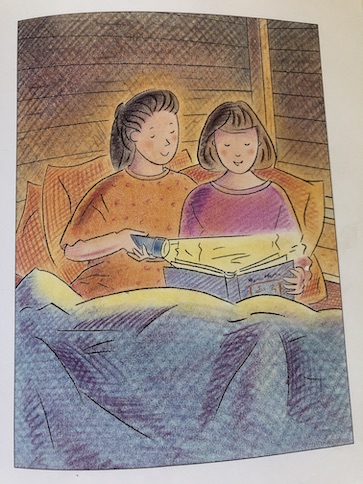
A young girl (unnamed, like in the other books in this series) who likes reading more than anything is sent to summer camp by her parents. When her parents first suggest the idea, the girl thinks that she might like camp, but then she gets worried that maybe she won’t or maybe she won’t make any friends there. She takes some of her books with her in case she needs something to do.
At first, it seems like camp isn’t going to be much fun after all. While the other kids seem to enjoy the typical camp activities, the girl doesn’t seem to be any good at them and doesn’t enjoy them much. However, she does make a friend, Jenny. When Jenny is homesick at night, the girl reads to her to help her feel better.
During the day, the girl keeps slipping back to her cabin to read while the other campers play volleyball because she isn’t good at the game. The camp counselor catches her reading all by herself, but she understands why the girl feels like she isn’t good at the other camp activities. To help her feel better, the counselor promises her an activity that she will be good at.
That night, while the campers are gathered around the campfire, ready to tell campfire stories, the counselor suggests that the girl read to them out of one of her favorite books. With Jenny’s encouragement, the girl reads to the other campers.
The other campers like the way the girl reads to them by the campfire, and Jenny helps the girl to improve at other camp activities. At the end of camp, the counselor gives the girl a charm shaped like a book as a reward for her storytelling skills.
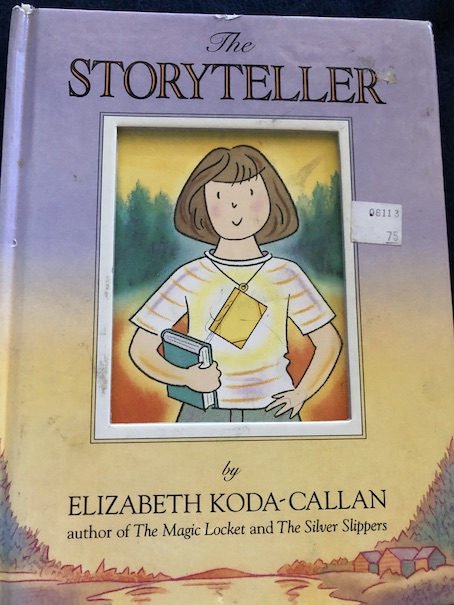
All of the books in this series originally came with charms like the ones described in the stories. This book originally included a little golden book charm for the reader to wear. The hole in the cover of the book was where the charm was displayed when the book was new. The books in the series often focus on the unnamed main character (who could represent any girl reading this story – the books were aimed at young girls) developing new self confidence, and the charms were meant to be either a sign of their new self confidence or inspiration for developing it. In this case, the charm is a reward for the way the girl used her skills to make camp better for everyone while developing new skills in other activities.
The book is available to borrow for free online through Internet Archive.
Erich was a foundling, taken in by the Goddhart family as a baby after he was found on their doorstep. Frau Goddhart has a reputation for kindness, but sadly, that reputation is really all she has. She is outwardly kind, participating in local charities, only to enhance her reputation. At home, she is selfish and cruel, ruling the house with an iron fist and having tantrums when things don’t go her way. She sees Erich as an unwanted responsibility, only grudgingly raising him along with her own children because if she refused, it would ruin her reputation. Her husband is kind to Erich, but Frau Goddhart treats him more like a servant.
Erich only comes to know real love when he becomes Ula’s assistant. Ula is the town clockmaker, a master in his craft. Ula teaches Erich his craft and how to play the violin.
When Ula dies, leaving Erich his carving tools and his violin, the selfish Frau Goddhart tries to take them away, thinking that such things are too good for a mere foundling, a charity case. Before she can get these precious things, Erich runs away to seek his fortune elsewhere, but he leaves behind something that convinces the town that, although he may be the ungrateful wretch that Frau Goddhart says that he is, he has a talent that will lead him on to greater things.
One of the fascinating things about this book is the pictures, which are charming pencil drawings in a realistic style. There is also a note in the back about the unusual typeface of the book.
#1 The Beast in Ms. Rooney’s Room by Patricia Reilly Giff, 1984.
It’s the start of a new school year, and Richard Best (nicknamed “Beast”) is embarrassed to find himself in Ms. Rooney’s room once again because he was held back a year for his poor reading skills. Everyone he knows has moved on to the third grade, and he’s still in a second grade class with kids who were first grade babies last year. He feels awkward, being the tallest, oldest person in class, and kids in his old class tease him and refuse to let him play baseball on the playground with them because he’s a pathetic “left-back.”
At first, Beast tries to pretend that it was all a horrible mistake that will be straightened out soon, but that just makes him feel bad for lying. The kids who are now in the same class he is, who he still thinks of as “babies,” try to make friends with him, but he doesn’t accept them at first because of his embarrassment at being older and still not as good at reading as some of them are.
However, even though he’s embarrassed at having to attend special reading classes with Mrs. Paris while most of the rest of his class has normal reading, these special classes really help him, not just to improve his reading skills, but to connect with other kids in his new class who have the same reading difficulties he does and who understand how he feels.
Beast discovers that it’s no shame to not know something or to have trouble doing something because everyone has different skills and it can take some people longer to learn certain things than others. Emily Arrow, the girl who now sits next to him in class is a whiz at math but has as much trouble reading as he does. Beast learns some new skills from his new, younger classmates and realizes that they’re not really babies. They also really appreciate him and help him see some of the good things about himself.
The book is currently available online through Internet Archive.
A Plague of Sorcerers by Mary Frances Zambreno, 1991.
Jermyn Graves comes from a family of sorcerers, but although he seems to have the talent, it takes him unusually long to get his familiar. Familiars, animals with a special link to a wizard, assisting them in their magic, come to their masters when they are ready to begin learning magic, and without one, Jermyn cannot really be a wizard.
When Jermyn’s familiar finally appears, everyone is surprised to find that it is a skunk. Some people make fun of him for having such a strange familiar. No one is quite sure what the meaning of his familiar is, and the exact nature of Jermyn’s magical talent is still unknown. Still, his aunt apprentices him to a theoretician, a man who does not actually practice magic himself, but who studies the theory behind it. He can assist Jermyn until Jermyn’s true talents become known and he can study with a master who shares his specialty.
Jermyn likes his new master and the young orphan girl who lives with him. However, disaster soon strikes the city. Sorcerers are falling victim to a strange disease that sends them into a coma. Despite their best efforts, none of the remaining sorcerers can discover the source of the disease or its cure, and all the time, there are less and less sorcerers to continue the work. Time is running out, and Jermyn and his unusual familiar may be the only ones capable of finding the answer.
Jermyn does have a special talent which he comes to fully understand, and he uses it to save the other sorcerers and put an end to the mysterious plague. Although the others had laughed at Jermyn’s skunk, he later comes to realize that she was the one keeping him from getting the plague himself because of some unusual qualities of her own. The combination of mystery and fantasy is exciting, and there is a mysterious villain who may not even be aware of their villainy because of their own hidden sides.
This book is currently out of print, but there are used copies still available, and you can also buy an electronic copy from American Fantasy Press.
There is a note in the beginning of the book that says that the first two chapters are based on a short story written by the author earlier. The book is currently available online through Internet Archive. There is also a sequel to this book, Journeyman Wizard.
This is a great fantasy story about a girl who learns to face her fears and persevere in spite of them. It has a good moral and is encouraging to anyone who failed at something but wanted to try again.
Elynne Danneby is afraid of dragons, which is a shame because her family makes its living by dragon charming. Every year, the dragons stop by her family’s farm on their migratory path, and Elynne’s father puts on a show for people who come to see the dragons. By playing a special tune on his pipes, Dan Danneby can put the dragons into a trance and safely walk among them. Only certain people have the ability to charm dragons. Elynne possesses that talent, but she has been unable to use it since she made a mistake while trying to charm dragons when she was a small child. They tried to attack her, and her father had to save her from them. Ever since, the dragons have terrified Elynne, but she is still fascinated by them and desperately wants to conquer her fear in order to charm them like her father does.
Then, one day, a rare crimson dragon comes to the farm and lays an egg. It is extremely uncommon to see a dragon’s nest or a baby dragon, and Dan is excited about trying to charm the baby after the egg hatches. However, Dan’s assistant is greedy and decides to steal the egg and sell it. Elynne overheard him talk about his plans before the egg was stolen, but because she wasn’t sure of what she heard, she didn’t tell anyone. Elynne feels guilty about not preventing the theft of the egg, and in spite of her fear, she is determined to get it back. In the process, she not only conquers her fear but learns about a talent that she never realized she had.
The book is full of black-and-white drawings in a sort of cross-hatch style.
The book is available to borrow and read for free online through Internet Archive.
Triple Trouble in Hollywood by Michael J. Pellowski, 1989.
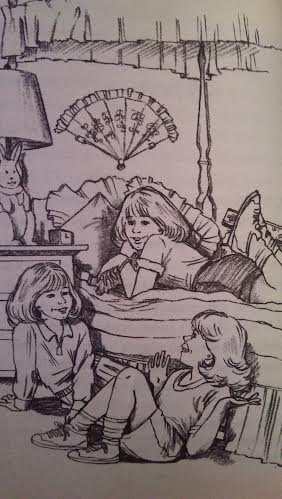
This time, Randi and Sandi to go Hollywood to visit their cousin Mandy. Mandy is no longer the same snobbish girl that she was the last time they were together, but she still has ambitions. Right now, she’s trying out for a part in a commercial, but she’s up against some stiff competition.
The commercial requires the girl to sing a jingle and do a back flip. Although Mandy has an excellent speaking voice, the other girls know that she’s terrible at singing, and Mandy doesn’t think she can do the back flip, either. Her main competitor, Tara, can do both of those things. Tara is a wealthy girl whose parents hired coaches to teach her singing and gymnastics especially for this role.
The three girls don’t think it’s fair that Tara has such advantages, and she’s an even bigger snob than Mandy ever was. Then, Randi suggests that they use their similar appearances once again to turn the situation around. Randi is athletic enough to do a back flip, and Sandi is an excellent singer. With all three of them working together, the try-outs for the commercial would be a snap!
Sandi doesn’t want to do it because it would be dishonest, but Randi and Mandy talk her into it. It’s partly to help Mandy, partly to get back at Tara for her rotten attitude, and partly for the chance to meet the heartthrob Judd Morrison who will also be in the commercial. Of course, as is always the case when the girls switch places, nothing goes as planned. But, to the girls’ surprise, their younger brother Teddy helps to make things better in the end.







 #1 The Beast in Ms. Rooney’s Room by Patricia Reilly Giff, 1984.
 However, even though he’s embarrassed at having to attend special reading classes with Mrs. Paris while most of the rest of his class has normal reading, these special classes really help him, not just to improve his reading skills, but to connect with other kids in his new class who have the same reading difficulties he does and who understand how he feels.
 A Plague of Sorcerers by Mary Frances Zambreno, 1991.
 The Dragon Charmer by Douglas Hill, 1997.
 Then, one day, a rare crimson dragon comes to the farm and lays an egg. It is extremely uncommon to see a dragon’s nest or a baby dragon, and Dan is excited about trying to charm the baby after the egg hatches. However, Dan’s assistant is greedy and decides to steal the egg and sell it. Elynne overheard him talk about his plans before the egg was stolen, but because she wasn’t sure of what she heard, she didn’t tell anyone. Elynne feels guilty about not preventing the theft of the egg, and in spite of her fear, she is determined to get it back. In the process, she not only conquers her fear but learns about a talent that she never realized she had.
 Triple Trouble in Hollywood by Michael J. Pellowski, 1989.
 Sandi doesn’t want to do it because it would be dishonest, but Randi and Mandy talk her into it. It’s partly to help Mandy, partly to get back at Tara for her rotten attitude, and partly for the chance to meet the heartthrob Judd Morrison who will also be in the commercial. Of course, as is always the case when the girls switch places, nothing goes as planned. But, to the girls’ surprise, their younger brother Teddy helps to make things better in the end.
 Jestress's Forgotten Books and Stories