Thank You, Mr. Falker

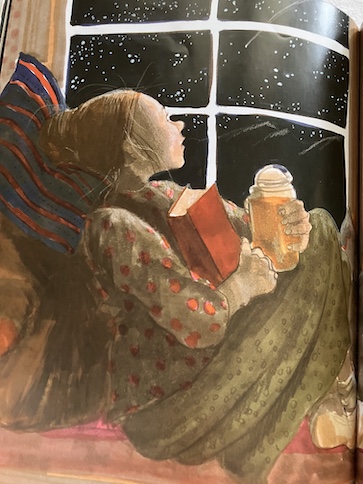
When little Trisha turns five years old, her grandfather introduces to her to reading in the same way he has done for other children in the family, with a taste of honey on a book, to remind her that knowledge is sweet. Trisha already loves books because her mother reads to her every night, and other members of the family also read to her. She’s looking forward to learning to read herself.

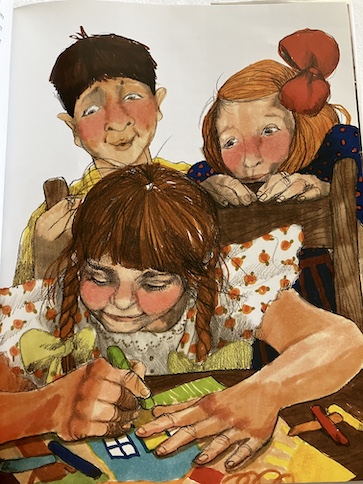
However, when she starts going to school, she finds that she has trouble learning to read. She likes drawing, and other kids at school admire her drawings, but for some reason, she struggles at deciphering the letters that other kids seem to learn so easily. When she looks at writing on a page, everything looks like wiggling shapes, and she has trouble figuring out what sounds they’re supposed to make. Other children move forward with their reading lessons, but Trisha struggles and starts to feel dumb.

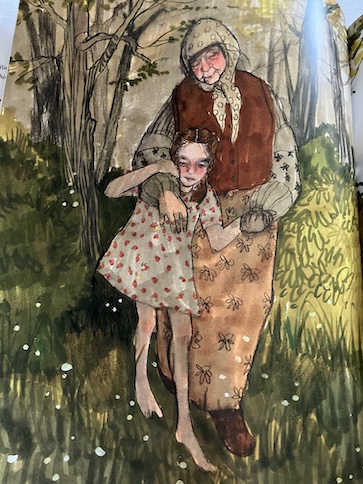
Trisha asks her grandmother if she thinks she’s different from the other kids, and her grandmother says that everyone is different and that’s “the miracle of life.” Trisha asks if she thinks she’s smart, and her grandmother says she is. That makes her feel a little better, but why can’t she read like the other kids?

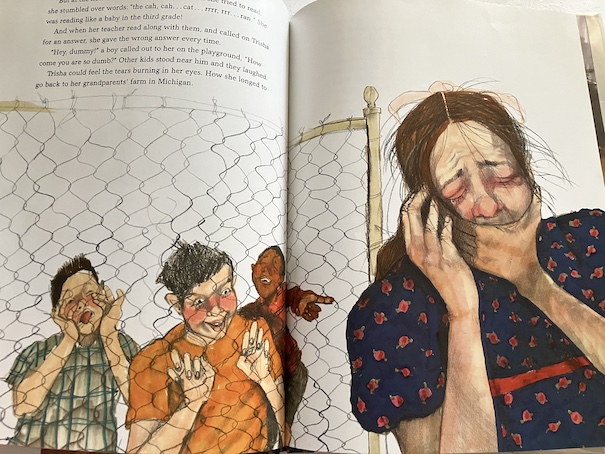
Trisha continues to struggle in school, even after the family moves from Michigan to California. She is in third grade at that point, and other children insult her and tease her when she struggles, and Trisha feels dumber than ever. She spends more time drawing and daydreaming, and she starts hating school, sometimes pretending that she’s sick so she won’t have to go.

Things only start to improve for her in fifth grade, when she gets a new teacher, Mr. Falker. Mr. Falker doesn’t cater to the teacher’s pets like other teachers do, and he notices Trisha’s artistic talent and praises her for it. He also stops the other kids from teasing Trisha in class when she struggles, although one boy, Eric, continues to bully Trisha terribly and get other kids to gang up on her when the teacher isn’t looking until Mr. Falker finally catches him.

Mr. Falker works with Trisha to improve her reading and reassures her that she is not stupid. He realizes that the reason she has struggled with reading is that Trisha doesn’t see letters the way other kids do, and he points out that she’s actually been clever in the way she’s managed to hide just how much she’s been struggling all this time.

Mr. Falker introduces Trisha to Miss Plessy, a reading teacher, and the two of them work with her to develop techniques that improve her reading skills. Gradually, Trisha begins to make real progress, and she begins to feel the sweetness of knowledge that her grandfather talked about.

The book is available to borrow and read for free online through Internet Archive.

The end of the book explains that the story is autobiographical. Patricia Polacco was the Trisha in the story, and she did have trouble learning to read until the read Mr. Falker realized how she was struggling and helped her. At the end of the story, the author says that she met Mr. Falker again years later and thanked him, telling him that she can become a children’s author.

There is a difference between real life and the story, though. In the book, Trisha is in the fifth grade when she gets help with her reading, but in real life, Patricia Polacco was apparently 14 years old and in junior high school. The book doesn’t say exactly what the cause of Trisha’s learning difficulties is, but she is apparently dyslexic, based on the description and because Patricia Polacco was dyslexic in real life.

I enjoyed seeing this part of the author’s childhood, although I found the part with the school bullies stressful. I do think it was important to include that part, though, because that can be part of the experience of children who struggle in school. Although Eric is an obvious bully in the story, the other kids also make Trisha miserable with their teasing and insults. It occurred to me that they may not all think of themselves as bullies, but at the same time, a person doesn’t have to think of themselves a bully in order to be one. Bullying is a behavior, and it exists independently of self-identity. Part of me wondered, if the girl and the teacher in the story are both real, were the bullies also real, and if so, did any of them ever read this story and recognize themselves? Maybe some did, and maybe they didn’t. Maybe not all of them would even care, if they had.

Regardless, I do think stories like this can be useful as a preemptive measure against bullying by showing kids how their behavior can affect other people and what may be going on in the life of a person they’re teasing or bullying. While I’m sure that everyone thinks of themselves as being the heroes of their own story, I think people sometimes need a reminder that, at the very same time, they are also supporting characters in everyone else’s story, for good or bad. In a way, we’re all self-casting in every story we’re in by the ways we choose to act as we go through life’s story in general.

The bully antagonists aren’t really the main focus of the story, though. They act as further obstacles to the problem that Trisha is trying to solve, but ultimately, the story is really one of gratitude toward the teacher. Part of what the teacher does for Trisha is to shut down the bullies so Trisha can focus on what she needs to learn and he can focus on helping her. Even more importantly, Mr. Falker helps Trisha to see that she is smart and capable. It takes a little more work for her to make progress than others because she has a condition to overcome, but with a little help, she can do it. It really opens up a whole new world for her, and she finally gets to taste that sweetness that comes with knowledge.

I’ve heard of the tradition of giving children a taste of honey before they begin their lessons. When I was a student, I thought I remembered a teacher mentioning this tradition to us as a Greek tradition. It might be, although when I tried to look it up, I couldn’t find anything about Greece. I found references to it as a Jewish tradition, which would make sense for Patricia Polacco’s family.

Patricia Polacco’s real-life grandmother also appears in the story, the same grandmother who appears in another of Polacco’s books, Thunder Cake. Her grandfather wasn’t present in that story, but he is in this one. Both of the grandparents are mentioned as dying before the story ends.

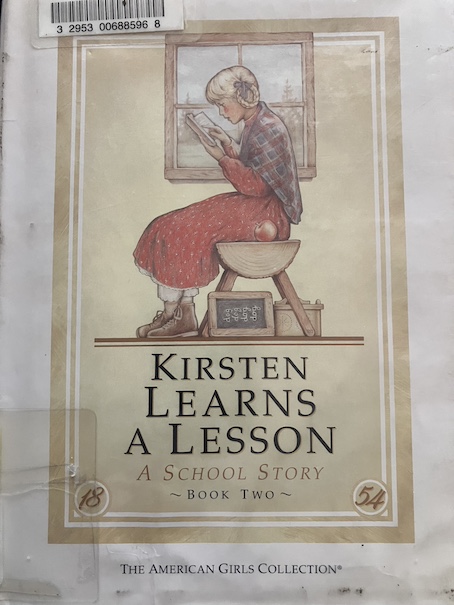
Kirsten Learns a Lesson

Kirsten, An American Girl

It’s November, 1854, and now that nine-year-old Kirsten’s family has settled in their new home in Minnesota and the harvest season is over, it’s time for the children to go to school. Kirsten and her brothers, Lars and Peter, will go to the small local school with their cousins, Lisbeth and Anna. Powderkeg School is a one-room schoolhouse in a little log cabin. Lisbeth and Anna’s stories about what Powderkeg School is like worry Kirsten. They talk about how strict their teacher, Mr. Coogan, is. Sometimes, the boys in class get rowdy and fight, and Mr. Coogan uses physical punishment on them. However, the girls tell Kirsten that she probably won’t have any problems with Mr. Coogan because he likes children who are well-behaved, and Kirsten is well-behaved. Still, Kirsten is nervous about what her new school will be like.

When they get to school, they learn that Mr. Coogan was injured in a fall from his horse, so they will have a replacement teacher, Miss Winston, who has only recently arrived from Maine. When one of the mean boys in class says he hops the horse also stepped on Mr. Coogan, Miss Winston tells him that nobody talks out of turn in her class and, although they live in the country, “we are not savages like the Indians.” (This is a 19th century attitude toward Native Americans, but this concept is challenged later in the story.)

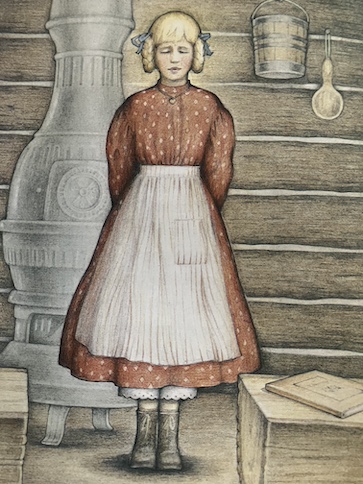
Miss Winston has each of the children in class introduce themselves so she can get to know everyone. When it’s Kirsten’s turn to say her name, she forgets to address her teacher as ma’am, like the other students. Miss Winston insists that she say “ma’am”, and when she sees Kirsten struggling with the language, she asks Kirsten if she speaks English. Kirsten says that she speaks a little, and her cousins explain that her family just came from Sweden and that they speak Swedish at home. Miss Winston says that “practice makes perfect”, so Kirsten will practice her English in school. For now, she will have the easiest lessons and share seven-year-old Anna’s schoolbook.

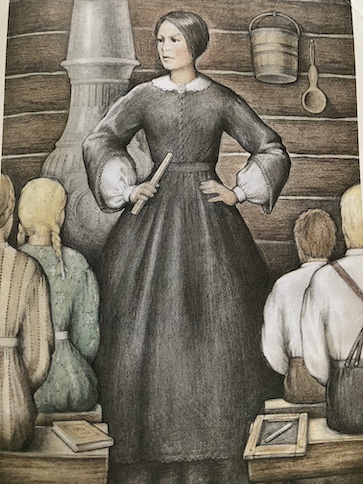
When the mean boy, Amos, laughs at Kirsten, Miss Winston glares at him and strikes the school’s iron stove with her ruler, startling the students. Miss Winston says that her father was a ship’s captain, so she knows how to be in charge of her students, like he was in charge of his crew. Then, she deconstructs the sentence “Miss Winston hit the stove”, pointing out which words are the subject, verb, and direct object of the sentence. Then she warns the class to “Be careful that the direct object of hit isn’t the student.” The implication is that Miss Winston is just as willing to use physical punishment against her students as Mr. Coogan was.

When Amos introduces himself to Miss Winston, we learn that he is nineteen years old, the same age as the new teacher, but the new teacher says that, in spite of being the same age, she’s still the teacher, and he’s the student. In spite of being more a young man than a boy in age, Amos has only just finished the third reader, and Miss Winston says her role is to help him read and do math like a man would, embarrassing Amos. (He can’t use his age to put himself on an equal footing with the new teacher because they are not intellectual equals. She’s the same age, but she has graduated from her own school and become a teacher, and he’s still struggling along with low level math and reading.)

Anna helps Kirsten with her lessons, and Miss Winston praises her for helping to teach Kirsten, but she doesn’t praise Kirsten for doing a good job. At the end of the school day, Kirsten and her cousins talk about the new teacher. Anna thinks that Miss Winston seems nice, but Kirsten thinks that Miss Winston doesn’t like her and that she seems very strict. She asks if that was what Mr. Coogan was like, and Lisbeth says he was worse. The best part of the day for Kirsten was lunchtime, when the children were allowed some play time. When she ran around and played tag with the other children, it didn’t matter if she didn’t speak much English.

When the girls play school with their dolls, Anna imitates Miss Winston and her comment about “savages.” Kirsten asks the other girls what that word means. They say it means “wild.” Kirsten asks them if the Indians (Native Americans) are really like that, and they say that some people say they’re kind and will help people if they need food but others day that they’re “cruel and bloodthirsty.” They’ve seen an Indian man before. He came to their house when their mother was roasting meat, and he left when their mother gave him some. They thought he looked pretty “savage” because his face was painted, and he had eagle feathers in his hair. The girls say that Native Americans also wear knives and live in tents. As a farmer, their father is concerned about the Native Americans. He knows that, if the farmers take too much of their usual hunting grounds for farming, it will drive away the animals, and the Native Americans will be starving and angry. While he is happy that he has been able to secure some farmland for his family (I explained a little about the famine conditions and lack of farmland in Sweden around this time that caused people like the Larsons to leave their country when I covered Meet Kirsten), he is aware that the Native Americans also need land for their survival.

At school, Miss Winston announces that each student will memorize a poem and recite it for the class. When they recite their poems, she wants them to say them with feeling and show the emotions their poem is trying to convey. Kirsten worries about this assignment because she’s still learning English. It’s hard enough for her to learn to read anything in English and understand the meaning of the words. She doesn’t know how she can also learn to memorize an entire poem and say it in front of everyone. Miss Winston gives Kirsten a short poem to learn, but having even a short one doesn’t seem to help Kirsten.

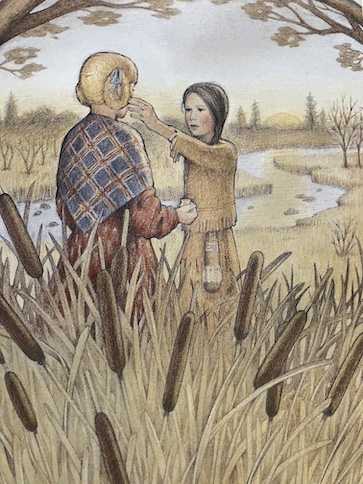
Meanwhile, Kirsten has her first encounter with a Native American when she spots an Indian (Native American) girl watching her while she’s getting water from the stream. The girl runs away, but Kirsten finds a blue bead that she dropped. Kirsten takes it and leaves her a little pretend cake that she and her cousins made for their dolls. Later, she finds that the cake is missing and that there’s a green duck feather in its place. She and the Indian girl trade little objects in this way, gradually becoming friends.

Kirsten’s secret friendship with the Native American girl becomes a comfort to her when school is stressful. Frontier teachers often board with families who live near the school, and when Miss Winston comes to stay at Kirsten’s aunt and uncle’s house, Kirsten feels like school is following her home. What’s worse is that Kirsten’s family will be joining them for dinner, and they will practice English during the meal. Kirsten knows that the meals, instead of being comfortable family time, will now be like lessons, and they will struggle to say things they would want to say because her family still hardly knows English. Worse yet, Miss Winston is cross with Kirsten because she can’t seem to memorize even her short poem.

Sneaking away to visit the Native American girl, who is called Singing Bird, gives Kirsten an escape from her struggles with English. Somehow, Kirsten and Singing Bird manage to communicate well enough with each other, even though neither of them speaks each other’s language. Then, Singing Bird takes Kirsten to see her village. To her surprise, Kirsten realizes that she has been gradually teaching Singing Bird English words without realizing it. However, Singing Bird’s people are going to be moving on soon. Kirsten’s uncle is correct that farming is driving away the animals the Native Americans depend on for food, and they’re suffering for it. Singing Bird invites Kirsten to come with her tribe when they leave, and it’s tempting to think of living an exciting life, traveling with Singing Bird and not going to school. But, is that what Kirsten really wants?

The book ends with a section of historical information about frontier schools in the mid-1800s.

The book is available to borrow and read for free online through Internet Archive (multiple copies).

Along with the first book in the series, this is the book that I remember the best of the Kirsten books. I think I either didn’t read the others or didn’t finish them because there are some sad things in the Kirsten stories that I didn’t like. In the first book, Meet Kirsten, another child Kirsten befriends on the journey to Minnesota dies of cholera. It’s historically accurate that some children died of disease on the journey west, but it was still hard to take. I also talked about how the reason why families like Kirsten’s wanted to come to America was that Sweden was experiencing famine around this time. The first book didn’t say much about that, but in this book, Kirsten remembers experiencing hunger in Sweden when her father’s crops failed and how her little brother cried from hunger.

Kirsten understands the plight of the Native Americans when they have to move to a new area when their food supplies run low. However, when Singing Bird invites Kirsten to come with them, she realizes that would mean leaving the rest of her family, and she can’t do that. While it’s tempting to go with her friend and escape the problems in her life, Kirsten can’t do that without also giving up the good things in her life and trading the problems in her life for a different set of problems. Although there are appealing aspects to their lives, the Native Americans also have their own struggles. To use an old adage, the grass isn’t always greener on the other side of the fence. People say it in different ways, but just because someone else’s situation is different doesn’t always mean that it’s better.

In this book, we also see what it’s like for Kirsten’s family as they begin learning English, so they can communicate with other people in their new country, and the children begin going to school. The little frontier school is different from other schools they’ve experienced before, and the teachers are strict. They have to be strict because some of the students are rough and fight with each other physically, and they have to make it clear that they’re not going to put up with that. This is a real-life aspect of schools from this time period. Fortunately, we never see the teacher actually using physical punishment against anybody. She just threatens to do it so her students will think twice about misbehaving.

When Miss Winston comes to board with Kirsten’s relatives, Kirsten thinks that everything is going to be worse, that she’s constantly going to be bombarded with lessons and the problems she’s been having at school. However, it turns into an opportunity for Kirsten and Miss Winston to get to know each other better. At first, Miss Winston can’t understand why Kirsten is having such a difficult time remembering her poem, even though it’s pretty short and easy. It’s partly because she’s still having difficulties with her English, but also, the content of the poem has no relation to anything currently happening in Kirsten’s life. It doesn’t interest her, and her mind is preoccupied with all the changes happening in her life, making it difficult for her to focus on the poem and remember it. When Miss Winston shows Kirsten a model of her father’s ship, it brings back memories of the ship Kirsten’s family traveled on when they came from Sweden. Miss Winston realizes that Kirsten has strong memories of the ship, so she gives her a different poem to memorize, one about a ship. Kirsten finds this poem easier to remember because it connects to memories she already has.

Although Miss Winston can be tough, she genuinely does care about Kirsten and looks for ways to help her learn. It just takes time to figure out the best way to help her, and Kirsten also needs time to adjust to her new language and new home. Once Kirsten sees that it’s possible for her to learn and for her new home to begin feeling like home, she begins to feel better about her new life in Minnesota.

I enjoyed the realistic aspects of the story and the references to historical events and real life conditions on the frontier. I think I liked this story better as an adult because I understood more about the historical background than I did when I was a kid. Parts of this series are still sad. Kirsten remembers people being sick and dying on the journey to America, and although she doesn’t go into detail about it, her family did suffer genuine hardship in Sweden.

The Clue in the Classroom

The Bobbsey Twins

#9 The Clue in the Classroom by Laura Lee Hope (Stratemeyer Syndicate), 1988.

Before I begin, I’d like to acknowledge Sean Hagins, for supplying me with photos of this book! Usually, I take pictures of books myself, but I just couldn’t find a physical copy of this one. Sean is a big fan of the Bobbsey Twins, particularly the New Bobbsey Twins mysteries, and you can see some of his video reviews as well as videos about his photography work on his YouTube channel, SJHFoto. Thanks, Sean!

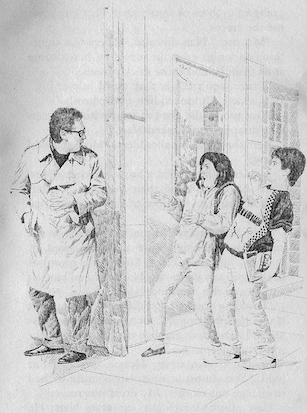
Nan and Bert are walking to school when Bert starts trying to follow Nan, practicing shadowing someone, like his favorite comic book detective, Rex Sleuther. Nan thinks that Bert’s attempts at following her are ridiculous, especially since she already knows he’s there. Then, she spots a tall man who is really being shadowed.

The tall man keeps looking over his shoulder and ducking into doorways, like someone is after them. It doesn’t take the kids long to realize who is following him because a man in a trenchcoat, who is walking behind the tall man, keeps pausing and pretending to tie his shoe or look in store windows every time the tall man glances back. It’s not very subtle. When the man in the trenchcoat sees Nan and Bert watching him, he gives them a menacing look and seems like he’s about to confront them, but then, he leaves. They lose sight of the tall man. It’s a bizarre experience, and it ends when the kids’ mother drives up with their younger siblings and gives them a ride.

At school, Nan meets her new science teacher, and she realizes that he is the tall man who was being followed by the man in the trenchcoat. He introduces himself as Mr. Newman (ha, ha), and he seems much more relaxed than he was before. That is, until they all see the message written on the blackboard in the classroom: “Newman, give up your plans. We’re watching you.” Mr. Newman exclaims, “Oh, no! They’ve found out! They know!” (I seriously wish that at least one of my old teachers had started their first day in class by saying that exact thing.) Mr. Newman doesn’t explain what it’s about. He just quickly erases the message on the board and begins talking about the science project he’s assigning.

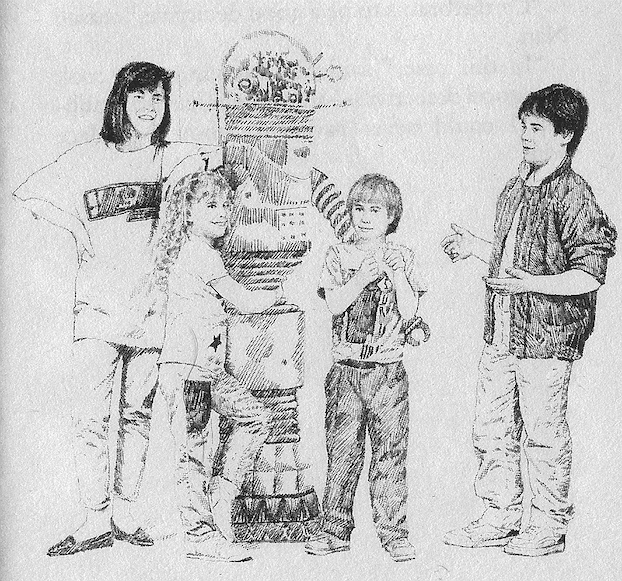
When Nan tells her siblings about Mr. Newman and what happened in class, Freddie says that Mr. Newman will also be teaching the afternoon science club that he joined. Mr. Newman will be teaching them about robots, and they’re going to have a meeting at his house, where Mr. Newman will show the club his inventions. Bert says that Freddie can help them figure out what Mr. Newman is doing and what and who he’s afraid of after he’s seen the projects that Mr. Newman is working on.

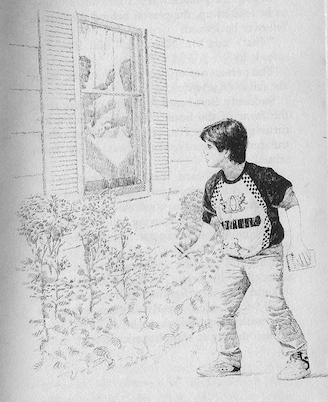
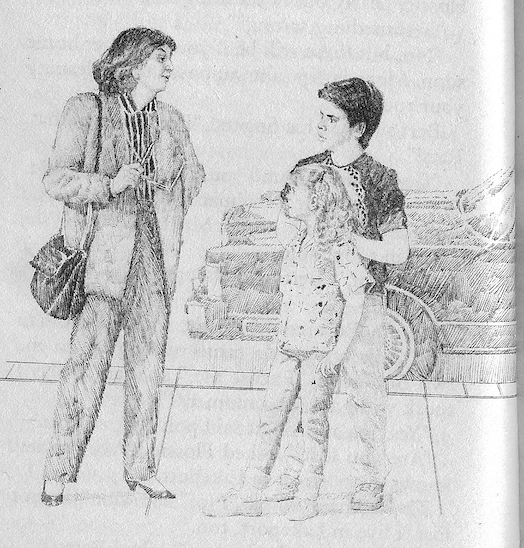
Bert decides to take a walk past Mr. Newman’s house to get a look at it before Freddie goes there. While he’s doing his reconnaissance, Bert sees what looks like people fighting in one of the windows. When he knocks on the door to see if Mr. Newman is all right, Mr. Newman says that he is and insists that there’s no one else there. Then, a strange woman shows up and starts asking Bert questions about Mr. Newman. She says that she’s his former boss at a computer company and wants to know if Bert saw anything in his house. She seems very interested in what he might be working on, but Bert just says that Mr. Newman was too busy for visitors.

Is this woman really Mr. Newman’s former boss, and does she have anything to do with the mysterious man in the trenchcoat? Someone breaks into the school and trashes Mr. Newman’s classroom. What is this secret invention of Mr. Newman’s that everyone seems so interested in, and why would someone threaten him over it or try to put a stop to his work?

The book is available to borrow and read for free online through Internet Archive.

My Reaction

The kids’ first thoughts about the mysterious people who are after Mr. Newman is that they might be spies, and they’re partly right. This is a matter of industrial espionage. People are after Mr. Newman’s invention because they can make a lot of money from it.

The robot Mr. Newman is building is really impressive, even by modern 21st century standards. Back in the 1980s, when this was written, a robot that large and sophisticated would have seemed almost like science fiction, although increasing developments in robotics technology would have made it seem more possible. Companies were working on developing robots during the 1980s, and Honda was working on a humanoid robot that could walk on two feet. Kids had toy robots. (I wanted one but never got one.) I don’t remember any classes for building robots for kids, but there may have been some that I didn’t know about at the time because I was still pretty young in the 1980s. In the 21st century, there are modern robotics classes for kids, and they sometimes show off their robots at competitions.

Two Are Better Than One

Two Are Better Than One by Carol Ryrie Brink, 1968.

This is a gentle coming-of-age story about two thirteen-year-old girls in Idaho during the early 1900s, but it’s told in a interesting format, as the reminiscences of one of the girls as an old woman and focusing on a story that the girls were writing together as teenagers. It’s like a story about a story within a story.

One Christmas, elderly Chrystal Banks receives a special present from her old friend, Cordelia Crump. The package contains two miniature dolls (she calls them “pocket dolls”) that Chrystal gave to Cordelia 60 years before. At first, Chrystal doesn’t remember giving her friend Cordy” these dolls but admits that her memory is starting to fail her. As she studies the little china dolls and their exquisite details, she begins to remember them and when she gave them to her friend. The dolls’ names are Lester and Lynette, and Chyrstal remembers how Cordy used to say that the little dolls were magical because any day she carried them seemed to become special and exciting. Even when Chrystal and Cordy grew older, supposedly too old for dolls, they still continued to love and believe in the magic of their special pocket dolls.

Before young Chrystal Reese (as she was known before her marriage) gave the dolls to Cordy, they were a Christmas present to Chrystal from her Uncle Dick. That was the Christmas when the girls were in seventh grade and were early thirteen years old. Uncle Dick had acquired a number of interesting presents for Chrystal on his trip to Europe. He doted on his niece because she had no parents or siblings, living only with her grandmother and Aunt Eugenia and their dog, Rowdy. All of the presents are wonderful, but the little dolls are something special. As she unwraps them, they are hidden within a small box inside another box inside of another box (not unlike the story itself). Chrystal loves the elegant, detailed, jointed dolls immediately and names them Lester and Lynette because they just seem like the right names for the dolls.

Immediately, she goes to see if the little dolls will work well in the dollhouse that she’s made out of orange crates. She has spent considerable time and most of her allowance money putting paint and wallpaper into the little house and making furniture for it. She made all of the dollhouse furniture to fit two small dolls that she already has, Elsie and Eileen. However, Elsie and Eileen are four inches tall, and Lester and Lynette are only about two-and-a-half inches tall, so they won’t work in the house. At first, Chrystal is unsure what to do with the tiny dolls. She loves them, but she’s going to have to figure out where to put them and how to play with them if they won’t fit into the doll house. Then, she gets the idea to give the little dolls to her best friend, Cordy. It’s a sacrifice to part with such a lovely present so soon after getting it, but she wasn’t satisfied that the little bottle of perfume she was going to give Cordy was really a good present. Besides, the girls are so close that they already share everything with each other, and as they like to say “Two are better than one.” Giving the dolls to Cordy won’t be like giving them so much as sharing them with someone who can help to make them even more fun.

Cordelia Lark (her maiden name) grew up in a well-off family with mostly boys. Her father was president of the local bank and president of the school board and a civic leader in other ways, and Cordy had four brothers and no sisters. Cordy and Chrystal are kind of like the sisters neither of them ever had. They like to call each other “Tween”, which is their special pronunciation of “Twin.” They justify being twins because their birthdays are only two weeks apart, so they’re almost exactly the same age.

On the way to Cordy’s house to give her the special Christmas present, Chrystal passes by the courthouse. When she and Cordy pass the courthouse, they can see the barred windows of the jail, and they make up stories to spook each other about how one of the prisoners might escape. On this particular day, Chrystal sees one of the prisoners gripping the bars of his window and looking out. He’s the first prisoner Chrystal has ever actually seen. She’s a little afraid of him, and when he starts talking to her, she doesn’t know what to say at first. The man first asks her what she’s staring at, and then he wishes her a Merry Christmas, even though he’s not having one. Not knowing what else to do, Chrystal murmurs “Merry Christmas” back and hurries on.

When Chrystal gets to Cordy’s house, the two girls exchange presents. It turns out that each of them almost got the other some perfume, but each of them changed their mind at the last minute and decided on something better. Cordy’s present to Chrys (as she sometimes calls her) is a book, which makes Chrystal happy because she loves books and didn’t get any for Christmas this year. But, it’s not just any book. This is Chrystal’s first grown-up novel instead of a children’s book. (They mention the Oz books, the Little Peppers, and the Little Colonel series as books they’ve read.) It makes Chrys feel grown-up. It’s a romantic story about a Southern girl during the Civil War who falls in love with a Northern soldier and eventually marries him. Chrys says that Cordy shouldn’t have told her the ending before she’s read it, but she’s still thrilled at having her first grown-up book.

Chrys worries that, since Cordy gave her a grown-up present, she’ll think that the little dolls are babyish, but Cordy loves Lester and Lynette immediately. She says nobody gave her a doll this year, and she felt disappointed because she loves dolls, and it just didn’t seem like Christmas without one. Chrys explains that these are pocket dolls, and they’re meant to be carried around in pockets, so they can go everywhere with the owner. Cordy says that they’re so tiny and perfect that they must be magic, and she decides to keep the names that Chrys gave them, Lester and Lynette. Cordy thinks that the little dolls are perfect to take along on adventures.

When Chrys tells Cordy about the prisoner, the two of them are nervous, although they don’t really think he can escape. Chrys asks Cordy to walk her home, but after they pass the courthouse, Cordy realizes that she’d have to walk past the courthouse alone on her way home. So, Chrys and Cordy turn around and walk the other way again, but then, they realize that they still have the same problem. No matter which way they go, they have to pass the courthouse, and no matter who walks who home, one of them will have to go alone at least partway. After they go back and forth a couple of times, they pause in front of the courthouse, and Cordy has an idea. She gives Chrys the Lester doll, keeping the Lynette doll for herself. That way, each of them will have someone to keep them company, and it will be like they aren’t alone. It gives each of them enough courage to go the rest of the way home, and it’s the beginning of their adventures with the dolls.

Chrys is inspired by her first grown-up book, and she thinks that maybe she’d like to write novels when she grows up. When the girls are in school, they like to write notes and funny poems with each other when they’re supposed to be studying, and Chrys suggests to Cordy that they start writing a novel together. Cordy agrees, and they decide to take turns writing chapters. They decide that the story will be about Lester and Lynette, and Chrystal writes the first chapter. Chrystal calls the story “The Romantical Perils of Lester and Lynette.”

However, the girls get in trouble for goofing off and not paying attention in class. Their strict teacher, Miss Hickenlooper, decides that the two girls can’t sit together anymore, and she confiscates Lester and Lynette and locks them in her desk. The girls are devastated. If the teacher wanted them to move desks, that was disappointing but justified, but she had no right to just take the dolls. The girls think that they’ll have to wait until the end of term to get them back, but they continue writing the story about the dolls. Chrystal had been going to write the first chapter about an elopement, but because the dolls are now imprisoned in the teacher’s desk, she decides to write it as a prison escape instead.

In the new version of the first chapter of the story, Lester and Lynette are brother and sister, and they are imprisoned in a castle overlooking the Rhine river in Germany (part of the the girls’ geography lesson in school) by their evil guardian, Baron von Hickenlooper. Lynette is rescued/kidnapped by a Viking pirate named Oskar, who carries her away from her brother, who still remains in the castle.

From this point on, the events in Chrys and Cordy’s lives alternate with new chapters of their tandem story about Lester and Lynette. Pieces of the girls’ lives work their way into the story. When the girls are ready to trade turns writing the story, they give each other what they’ve written so far and say “Muggins!” (The word comes from playing games like Dominoes and Cribbage where, if one player spots that another has missed a score or failed to count something properly, they can call “Muggins!” and add the overlooked points to their own score. I think what they’re implying is that this story is a game where one person picks up whatever the other one has left unfinished.) The girls also continue adding verses to an unflattering poem that they started writing about their teacher.

By accident, the girls loose track of the mean poem about their teacher, and Miss Hickenlooper finds it. At first, the girls are terrified that Miss Hickenlooper is going to be furious with them and do something horrible in punishment, but to their surprise, she starts crying. Miss Hickenlooper end up having a heart-to-heart talk about the girls’ experiences in Miss Hickenlooper’s class, what Miss Hickenlooper hoped for when she started teaching, and why she took Lester and Lynette from them. Miss Hickenlooper had wanted to be a teacher for a long time and was looking forward to it, but she had been away from it for a long time because she had to take care of her mother during a lengthy illness. Since she started teaching again, she can tell that her students haven’t been happy with her, but after reading the poem, she realizes that it’s worse than she thought. Even strict teachers can be respected by their students as long as they’ve taught their principles well and the students are learning valuable lessons. Miss Hickenlooper feels like she’s failed as a teacher because she hasn’t managed to connect with her students at all, and she’s making them miserable. The girls come to the surprising realization that their teacher really does care about her students and what they think of her.

The talk between the girls and Miss Hickenlooper was a little uncomfortable because the girls realize that they’ve done an injustice to Miss Hickenlooper by writing the mean poem about her, but I actually liked this part of the story because it’s the kind of honest communication that I often find missing in stories. Rather than anyone blustering or dodging or trying to save face, the girls and their teacher honestly discuss what happened and how they feel, and everyone involved learns something from the experience. The girls appreciate having this “human” communication with their teacher, and it earns their respect, more than any angry tirade or show of strength on their teacher’s part ever would have. It’s this very kind of open honesty and humanity with real feeling behind it that’s been missing from the class so far, and it’s what has prevented Miss Hickenlooper from really connecting with her students.

The girls apologize to Miss Hickenlooper about the poem, and Miss Hickenlooper admits the justice of some of their complaints. Miss Hickenlooper admits that maybe she went a little far in making Cordy turn out her pockets and taking her dolls from her for an extended period of time. Getting into someone’s pockets and taking personal possessions is a kind of invasion of privacy, and Miss Hickenlooper says that she only did it because the girls weren’t paying attention in class, which is true. In return, Chrys and Cordy acknowledge that they only wrote the poem to blow off steam because they were angry, but they also went too far, and they really should have considered their teacher’s feelings. The girls promise not to write any more poems like that, and Miss Hickenlooper gives Lester and Lynette back to them. Miss Hickenlooper says Cordy can keep the dolls in her pocket if she wants as long as the girls pay attention in class from now on. To further apologize, the girls make cards for their teacher and give her the two bottles of perfume that they almost gave each other for Christmas (“Two are better than one.”), and they start going out of their way to be nicer to her.

The girls’ talks with Miss Hickenlooper through the rest of the school year give her feedback that helps her to improve as a teacher. Later, when the girls are watching a lightning artist (someone who paints pictures very fast, not the more modern definition of someone who works in animation) at work and happen to see Miss Hickenlooper in the store as well, they point out that one of the artist’s pictures reminds them of the Rhine that they studied in class. Miss Hickenlooper doesn’t think much of the quality of the painting, but she admits that it does look like the Rhine and that another painting the artist did reminds her of Switzerland when she was there. The girls are amazed that Miss Hickenlooper has been to Europe because, other than Chrys’s Uncle Dick, they don’t know anyone who has. They ask her why she never talked about it in their geography lessons because that would have made them much more exciting, hearing about other countries from the perspective of someone who was actually there. Miss Hickenlooper is surprised. She says that she was only focused on teaching the lessons that she was assigned to teach and just never thought about including anything personal because she didn’t think her students would be interested in her personal stories. Again, it’s that personal element that Miss Hickenlooper needs if she wants to connect with her students on a personal level.

As the story continues, the girls also start to consider their attitudes about boys and men and future husbands. So far, most of their knowledge of boys has come from the boys at school and Sunday school and Cordy’s brothers, all pretty immature and rowdy. But, the girls are growing up, and so are some of the boys. New young men also come into the girls’ lives.

A friend of Chrystal’s grandmother asks her if she would be willing to rent a room to her 19-year-old son, who is looking for a place to stay as he takes his first teaching job at the local college. (That sounds young for a college teacher. In modern times, a nineteen-year-old would be a college student himself. Remember, this is the early 1900s, and education in the United States was very different then. Back then, teachers didn’t need to have the advanced degrees that they do now, and Mr. Banks later explains that he skipped grades when he was younger to get through school faster.) Chrystal’s grandmother agrees, although Chrystal isn’t anxious to have a teacher living in her house after her problems with her own teacher at school. Chrys also isn’t sure what to expect from a man living in the house because there’s never been a man in this house before. Cordy’s brothers are pretty rowdy. However, their new lodger, Mr. Banks, turns out to be quiet, polite, and very nice. (His last name is an indication that he’s going to be Chrystal’s future husband. There’s six years’ difference in their ages, but as times goes on, and Chrystal gets older, that’s not going to seem like as much of a gap.) He is the first person to ever address Chrystal as “Miss Reese”, which makes her feel grown-up.

Cordy’s family also has a boarder, Mr. Crump, who is attending the local college (obviously, Cordy’s future husband, based on her future last name). Mr. Crump is working his way through college by selling pots and pans, and Cordy goes with him to help carry things, bringing along Chrys because “Two are better than one.” The girls end up giving him some advice on his sales patter that helps him make more sales.

Meanwhile, the girls’ Sunday school class, which calls itself the Dorcas Club, decides to host a masquerade party with the boys’ class (who have dubbed themselves the Armored Knights) as their guests. Chrys and Cordy think of the boys as immature and uncouth and roll their eyes at the older girls who are boy-crazy. Then, because the party is on Presidents’ Day, all of the girls in the group want to go dressed as Martha Washington, and there’s a big argument about it. Originally, Chrys and Cordy wanted to be Martha Washington, too, but since that’s what all the others want, they decide that they want to do something completely original. Inspired again by the dolls, they decide to go dressed as dolls. However, because they don’t want to be like the prissy girls trying to be pretty and impress the boys, they decide not to go as elegant dolls but as old rag dolls in patched clothing.

The girls do win prizes for both the funniest and most original costumes at the party because they’re the only girls who don’t show up as some version of Martha Washington. However, the triumph turns against them because the girls who are in charge of the main entertainment for the evening have decided to turn it into the girls’ very first dance party with the boys, something that Cordy and Chrys weren’t expecting. Rag doll costumes are good for fun and games, but not so much for serious dancing and the possibility of budding romance. While all of the boys are wearing various fanciful costumes themselves, like pirates and clowns and cannibals, it turns out that they’re only interested in the girls who dressed in pretty clothes as Martha Washington, and none of them want to dance with the rag dolls. Chrys and Cordy were proud of themselves for being more original than the other girls, but it seems that the boys prefer “pretty” to “original.” At the end of the evening, none of the boys even want to walk Chrys and Cordy home. Chrys and Cordy feel embarrassed because their efforts to be “original” seem to have strayed a little into the outlandish at a time when the other girls and boys are starting to seriously get interested in each other.

Fortunately, their families guessed that something of the sort might happen and asked the young men boarding with them to go to the house hosting the party and walk the girls home if they had no one else to walk with them. Mr. Crump confirms to the girls that boys would prefer to walk with girls who made an effort to look pretty instead of girls who look like rag dolls. Mr. Crump says that there will be other parties, and next time maybe they’ll go as something more elegant, like Martha Washington, but the girls aren’t too thrilled about doing this type of party again. Mr. Banks takes a different view and says that he actually thought that the rag doll costumes were rather clever and that it was really better for the girls to be different instead of trying to be like every other girl in order to not stand out. “Sometimes it may hurt, but I think it’s better to be original.” Mr. Banks the college teacher is more mature than Mr. Crump the college student, and I think he has the right idea. Looks and clothing styles change, and people have different priorities when they get older, but original thinking and an interesting personality are hard to replace and never go out style. When Chrystal says that she doesn’t even know how to dance, Mr. Banks offers to teach her, so she can be more confident at future parties.

Having the boarders walk them home actually turns out to be an unexpected victory for Chrys and Cordy because, while the other girls were making fun of them for not having any of the boys dance with them or walk them home, Chrys and Cordy ended up being escorted by young men. Getting boys is all well and good for young girls, but being escorted by young men makes Chrys and Cordy look like young women, putting them on a higher level than mere girls. Chrys and Cordy don’t see it that way at first because Mr. Crump and Mr. Banks are just their families’ boarders and friends and treat them like younger sisters (at this point in their lives, anyway), but the other girls notice that the young men are more mature than the Sunday school boys, and it causes them to look at Chrys and Cordy with a little more respect for having their attention. In some respects, Chrys and Cordy might seem less mature than the girls who are excited about wearing makeup and getting boys because they’re into outlandish costumes and dolls and “romantical” stories, but in other respects, they may actually be a little more mature than the other girls for being confident in their individuality and the new awareness they’re acquiring of other people’s feelings. In the end, girls want to marry men, not little boys, anyway.

Through the spring, the girls have other adventures and continue writing their story with their dolls. Along the way, there are other signs that the girls are growing up. They notice that this is the first year when they’re more interested in getting new Easter bonnets than they are in their Easter eggs. Cordy’s family is heavily involved in the social life of the local college because two of their boys are students there, and Cordy even gets to go to some of the campus parties. She helps to serve punch there and sometimes gets to dance. She eventually arranges for Chrys to come with her to help with serving and have her first dance, too. Miss Hickenlooper also discusses the girls’ future with them, suggesting that they take exams to see if they can skip the eighth grade and go straight into high school because she thinks they’re smart enough to pass. The girls are uncertain if they want to go on to high school so quickly. They know they’re growing up, but they haven’t thought about high school yet (and this is a time period when not everyone even attended high school). There is also the horrible thought that one of them might pass the test while the other didn’t, and they might end up going to different schools and being in different grades. Miss Hickenlooper says that they don’t necessarily have to go on to high school yet, if they feel that they’re not ready, even if they’re offered the opportunity, but she urges them to take the tests anyway to see if they have the option. It makes the girls start questioning their future lives, what they really want, and where their education will take them.

At one point, Cordy’s brothers find their unfinished novel in Cordy’s room, steal it, and use it to make fun of the girls. The story isn’t really very well written because Chrys and Cordy are only thirteen years old. As readers will have noticed, there are spelling mistakes all through the story, and the girls also get mixed up about geography because they’re just focused on making the story exciting instead of really thinking about the setting. After their characters’ adventures on the Rhine, the girls send them floating in a boat to a tropical island with coconuts and palm trees because they don’t think about just how far away the tropics actually are. (Being shipwrecked on an island is also a common trope of vintage and antique children’s books, so they’ve probably read this type of story themselves. Just scroll through my lists of children’s books from the 1900s and earlier, and you’ll see what I mean.) Although Mr. Crump was laughing at the girls, too, he rescues the story from Cordy’s brothers and gives it back to them when he sees that the joke is going too far. However, the girls are somewhat dispirited, thinking that their story might be deeply flawed. At first, they don’t know if they really want to continue writing it, but in their desperation, they turn to the one person they know will be honest with them about what they’ve written and can not only tell them whether or not the story can be fixed but how to do it – their teacher, Miss Hickenlooper.

The book is available to borrow and read for free online through Internet Archive (multiple copies).

Themes, Spoilers, and My Reaction

The story is one of those gentle, calm stories with a few funny episodes and some genuinely touching moments. Fans of slice-of-life historical books like the Betsy-Tacy series will like this book. It is a coming-of-age story for Chrys and Cordy, as they begin to develop new attitudes and come to a deeper understanding of themselves and other people and start thinking about the future. However, the girls’ adventures also teach other people around them some lessons.

One of the themes of the book involves how people let their personalities show. Although the girls were originally thought silly for their outlandish rag doll costumes at the party, they were more bold and creative than the girls who just wanted to look like everyone else. Even though their creativity wasn’t fully appreciated at first, it ends up working in their favor in the long run.

One of the biggest developments in the story is the relationship between the girls and their teacher, and the keys to that relationship are learning how to see other people as people, how to be open about showing their personal sides, and how to appreciate people with different personalities. The girls begin as thoughtless students, and their teacher is a strict disciplinarian with little patience for their goofing off, which is why the girls see her as their antagonist. However, the girls’ eventually realize that, through their mean and complaining poem, they’ve hurt their teacher’s feelings as much as she’s hurt theirs, maybe more. It leads them to see her in a new light, as a person and just just their jailer (the role of her alter ego in the girls’ story). The honest talks between the girls and their teacher not only helps the girls to become more thoughtful and considerate of others’ feelings but also show their teacher that the key to improving her teaching and developing a better relationship with her students is to be a little more personal with her students. She gradually learns that letting her students see her as a person with interesting life experiences earns their respect more than just acting like an unfeeling drill sergeant enforcing discipline. Inspired by the girls’ interest in her travels when she was younger, Miss Hickenlooper starts bringing postcards and souvenirs from her travels to class to show during geography lessons. The students are fascinated by her souvenirs and stories and start thinking of her as an a kind of intrepid explorer or sophisticated world traveler instead of a dull woman who focuses on dry memorization and gets mad at them for daydreaming in class. As she tries new ways of approaching her lessons and adding in personal experiences, Miss Hickenlooper takes on a whole new role in the children’s lives and sparks all of their imaginations. All of the students, not just Chrys and Cordy, start behaving better because they become genuinely interested in what Miss Hickenlooper has to say and show them. They don’t want to make her angry because she’ll stop telling the interesting stories if they don’t get their work done. Just because she’s gotten more interesting and personal doesn’t mean she’s gotten soft. Don’t be afraid to be interesting and different!

The girls never actually show Miss Hickenlooper their story because they’re a little embarrassed by what they’ve gotten wrong, but they ask her questions about some of the things that they put in their story to find out what’s right. They do end up finishing the story and giving Lester and Lynette a grand wedding, but they also acknowledge that they are getting too old and busy with other things to continue playing with dolls, even Lester and Lynette. They plan to put Lester and Lynette away for now as souvenirs of their childhoods. Later, they do tell Miss Hickenlooper about their novel, and while she hasn’t read it, she has the feeling that she knows what it’s like from knowing the girls and their writing. (The girls wrote about scenes from their novel when asked to describe places they know for their high school entrance exams.) She tells them that she appreciates their imaginations but that they should remember to focus on the real world around them and gaining real experiences to write about in the future.

There are also themes that focus on what growing up and maturity mean. Because the story focuses on one school semester in the girls’ lives, there are many questions that the book leaves unresolved about what happened in the girls’ later lives, but it seems that their lives turned out well, and they look back on their experiences with Lester and Lynette as a turning point when they really started growing up. Toward the end of the story, the girls begin appreciating some of the possibilities of life and the wider world that they never considered before. Through it all, there is also the girls’ constant friendship. At the very end, elderly Chrys writes a letter to elderly Cordy, thanking her for sending the dolls and reminding her of this special time in their lives.

The author of this book, Carol Ryrie Brink, was also a child around the time that Chrys and Cordy were children. There is a picture of her as a child above her biography on the dust jacket of the book. She is also the author of Caddie Woodlawn, which is better known than this book.

I love books that contain details about life in the past, and there are a lot of fun details included in this story. I’ve mentioned some above, but that’s just scratching the surface. At one point, Chrystal says that the only paper she has that’s good for painting pictures is the pieced of paper that separate pieces of Shredded Wheat in the box. The lined paper from the notebooks she uses for school isn’t as good. When she’s out of those pieces of paper, she has to eat more Shredded Wheat to get more. I don’t remember seeing any similar kind of paper in shredded wheat boxes in my lifetime, so this must be something that existed before modern packaging.

At the college dances, the girls have dance cards for the young men to write their names and initials in to secure spots for dances. There are also occasional mentions of food, and Chrys mentions having floating island pudding for dessert, which I’d never heard of before. It’s a kind of meringue that floats on a base of vanilla custard.

Spot Goes to School

Spot

Spot Goes to School by Eric Hill, 1984.

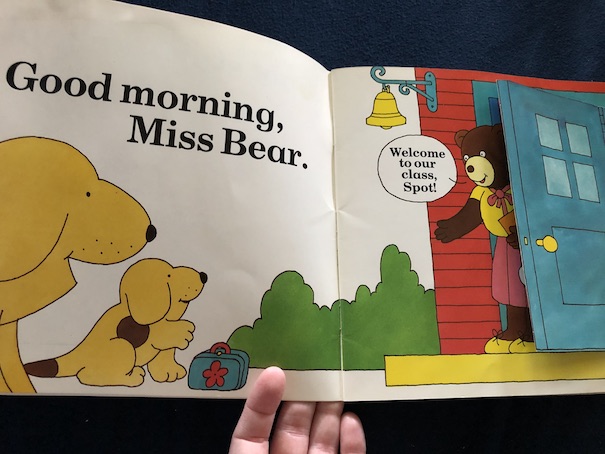
Spot is going to school for the first time. His mother drops him off at the school, where he meets his teacher, Miss Bear.

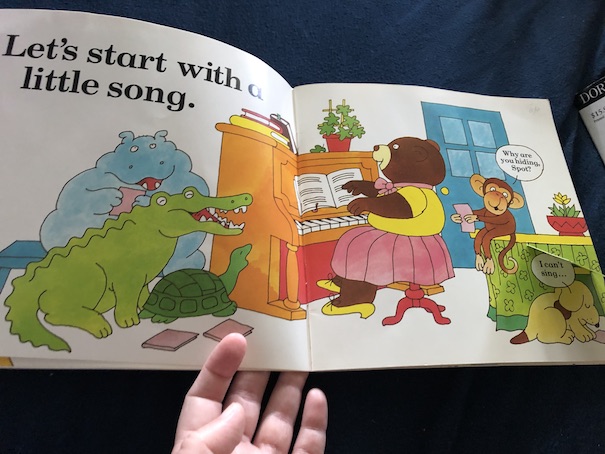
Spot and his animal friends participate in typical kindergarten activities. They sing a song while their teacher plays the piano (although Spot hides because he can’t sing), and they play dress up in the classroom playhouse.

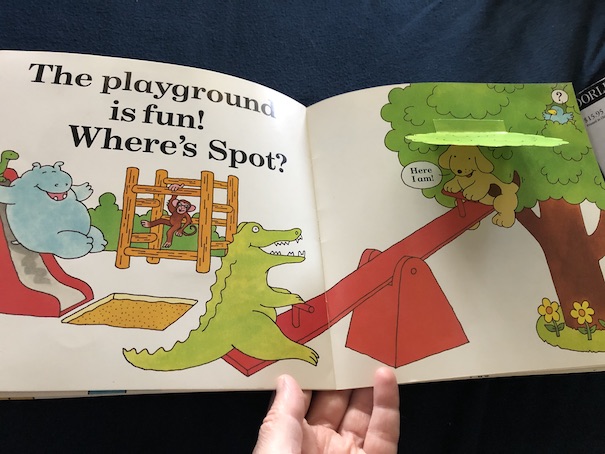
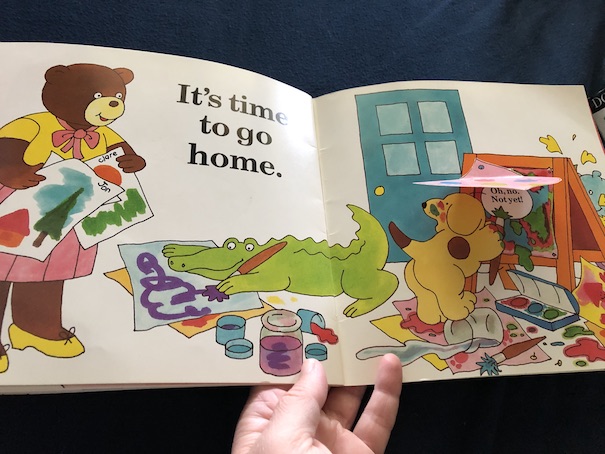
They play on the playground and show what they brought for show-and-tell. Spot roughhouses with a friend during storytime, and he loves painting pictures with his friends. When school is over, Spot doesn’t even want to go home because he’s had so much fun!

Like other Spot books, this is a lift-the-flap book. It is available to borrow and read for free online through Internet Archive (multiple copies), but to be honest, it’s not as much fun to read electronically because you can’t experience the lift-the-flap effect.

Once Upon a Dark November

Once Upon a Dark November by Carol Beach York, 1989.

Katie Allen likes her part-time job helping Mrs. Herron with her housework. One of the best parts of the job is that she gets to see Mr. Herron, her English teacher, at home. Katie has a crush on Mr. Herron, although no one but her best friend knows it.

One day, while she’s at the Herrons’ house, Mrs. Herron tells her that her cousin Martin is coming for a visit. She says that Martin hasn’t been in Granville in years, although he used to live with their aunt when he was young. Their aunt is Miss Gorley, the creepy lady who lives across the street from Katie’s house. When Martin arrives, he turns out to be pretty creepy himself. He never says very much to anyone and spends a lot of his time just staring out the window. Mrs. Herron is not happy to have him there and wishes that he would leave.

One day, Martin disappears, and the next day, Miss Gorley is found murdered in her house. Did Martin return to Granville just to murder his aunt? Where is he now, and who is that mysterious person who tried to attack Katie at her house, dressed in a Frankenstein costume? Did Katie see something that she wasn’t meant to see?  Katie doesn’t remember seeing anything important, but now she has to figure out what it was before it’s too late!

This book is not for young children.  It would be best for kids in middle school (about 12 and up).  There is murder and attempted murder, including the attempted murder of Katie, who is a child, because the murderer of Miss Gorley thinks that she knows too much.  There is also some discussion of child abuse, which was part of the motive behind Miss Gorley’s murder.  Katie did see some things that are important to the case, but their full importance doesn’t occur to her until the attempt on her own life.  People are not quite who they seem to be, and some of Katie’s initial impressions were closer to the truth than someone wants her to know.

The book is currently available to borrow for free online through Internet Archive.

The Secret School

The Secret School by Avi, 2001.

The year is 1925, and what 14-year-old Ida Bidson wants most is to graduate from her community’s small, one-room schoolhouse so that she can go to high school in a nearby city.  She dreams of becoming a teacher when she grows up, and she knows that she can’t do that without more education.  The problem is that, in her rural community in Colorado, not everyone thinks that higher education is important, especially for girls.

When their teacher’s mother becomes ill toward the end of the school year and the teacher has to leave, the man in charge of the local school board, Mr. Jordan, doesn’t want to bother to hire a new teacher to finish off the year.  In fact, it seems a little dubious about whether they’ll even get a new teacher in the fall.  Ida is crushed because, without a teacher, she can’t graduate this year as planned, and she had just about persuaded her parents to let her attend high school in the fall.  Her friend, Tom, is in a similar position.  More than anything, he wants to work with radio, the latest technological development of their time, and he also needs to attend high school.  (So far, he’s just been teaching himself by reading Popular Mechanics – the magazine started in 1902 and is still in circulation today.)  However, Tom comes up with a plan that could help everyone: What if Ida becomes their teacher?

Ida knows that there’s no way that Mr. Jordan would actually hire her as the new teacher.  Everyone knows that he’s a miser and that a large part of the reason they’re not getting a new teacher is that he doesn’t want to have to pay for one.  Besides, what school board would hire a 14-year-old girl who hasn’t yet graduated?  After discussing it with the other children, they make the decision to keep their school open secretly with Ida as their secret teacher.  Although Ida confesses the truth about what they’re doing to her parents, most of the others don’t, figuring that they’ll wait to tell them when the school year officially ends in another month.

Although it’s a daunting challenge, going from student to teacher while still continuing her own studies, Ida sees it as the only way to get what she wants.  She does her best to act out the part of teacher, telling her friends to call her “Miss Bidson” when she’s teaching instead of “Ida”, giving them their assignments to study, and checking their work. 

Most of the other children agree to her terms as their new, secret teacher, although one boy, Herbert, deliberately gives her a hard time.  Herbert’s future ambitions don’t include higher education, and he was originally looking forward to having an early summer break.  At first, he delights in trying to push Ida, to see how she’ll deal with him as a discipline problem.  Ida partly earns his cooperation by pointing out with him that their secret school is voluntary, that no one is making him come, that they had all voted to make her the teacher, and that if he makes problems for the other students, they can also vote him out of the school.  The thought of being rejected by his friends for making problems keeps him more or less in line.

Then, a woman from the County Education Office, Miss Sedgewick, comes to the school and finds Ida teaching there.  She is the one who administers tests to graduating students, and she has come to ask how many students will be tested this year.  Ida is forced to admit her circumstances to Miss Sedgewick.  Miss Sedgewick is surprised to discover that Ida is both teacher and student and says that she isn’t quite sure if she can give the exams if the local school board has officially closed the school.  She leaves, promising to look into the matter.  What she eventually tells them is that they can keep the school open with Ida as the teacher, but in order for the children to get credit for their work, they will all have to take exams at the end of the year, not just Tom and Ida.

As the end of the school year approaches, Ida does her best to prepare the other children for the exams and thinks about how her relationships with them have changed.  Tom, her best friend, has become more her student and less her friend, which feels uncomfortable to her.  She also has her own studying to do if she hopes to pass the exams herself, which is difficult both with her teaching work and the work that she must do on her family’s sheep farm.

Then, Herbert’s father, who doesn’t value education at all and just wants Herbert home to work their farm, finds out what they’re doing and gets Mr. Jordan to shut the school down for good.  Ida feels like all her dreams and hard work have been for nothing.  However, a talk with Herbert changes her mind.  Herbert knows that his father fears his education.  Herbert’s father is afraid that Herbert will look down on him for not having as much education or that Herbert will want to leave him.  Herbert admits that he’s been very unhappy at home because his father is a bitter, angry man who doesn’t treat him much better than he does other people.  Herbert has actually learned more than he pretends at school and really does have plans to leave home.  Herbert also tells Ida that his father and Mr. Jordan are planning a secret meeting to close the local school permanently, purposely telling only people they know will agree about it, not local people who value education. 

Knowing about the secret meeting gives Ida’s parents, as well as other parents in the community who support their children’s education, to show their support for their children’s hard work.  Faced with their opposition, Mr. Jordan agrees to let the school remain open while the children take their final exams.  Ida not only does better on the final exam than she had feared, but she finds an ally in Miss Sedgewick, who will help her fulfill her wish to attend high school and become a real teacher.

The book is available to borrow for free online through Internet Archive (multiple copies).

Thomas’ Snowsuit

ThomasSnowsuit

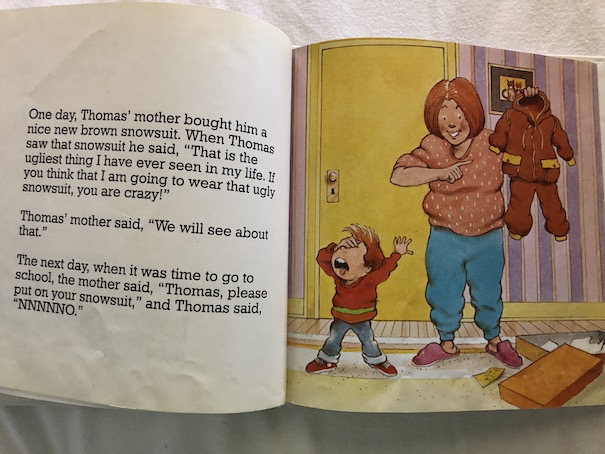
Thomas’ Snowsuit by Robert Munsch, 1985.

Thomas absolutely hates the new snowsuit that his mother bought him.  He thinks it’s ugly.  When it’s time for him to go to school, his mother has to wrestle him into it because he refuses to put it on himself.

ThomasSnowsuitNew

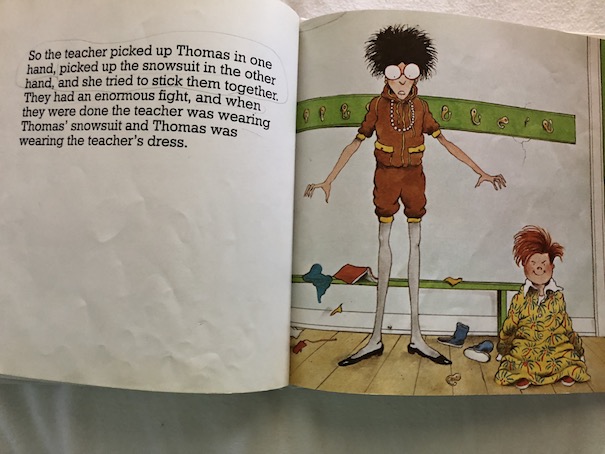
That’s fine until it’s time for Thomas to once again put on his snowsuit so he can go outside for recess.  His teacher insists that he has to wear it, but he refuses.  When the teacher tries to wrestle Thomas into his snowsuit, the results are hilarious!

ThomasSnowsuitTeacherSwitch

Thomas and his teacher end up getting their clothes all mixed up.  When the school’s principal tries to help, it only makes things worse.

ThomasSnowsuitTeacherPrincipalSwitch

Finally, Thomas is persuaded to put on his snowsuit when a friend of his wants him to come out and play.

ThomasSnowsuitFixed

Thomas eventually helps set the teacher and principal right again after recess, and the principal decides that it’s time to retire to Arizona, so he won’t have to deal with snowsuits again.

ThomasSnowsuitArizona

Like all Munsch books, the storyline is bizarre and hilarious, and half the fun is watching it unfold in the pictures!

The book is currently available online through Internet Archive.

Molly’s Pilgrim

MollysPilgrim

Molly’s Pilgrim by Barbara Cohen, 1983.

Molly has been unhappy since her family moved to the smaller town of Winter Hill, New Jersey so that her father could get a better job. In New York City, there were other Jewish girls like her, and she didn’t feel so strange and out-of-place. The Winter Hollow girls don’t understand her at all and don’t like her. Molly’s family fled Russia to escape persecution, and they’ve only been living in America for about a year.  Molly still has a Yiddish accent and doesn’t quite speak proper English yet.  Molly is constantly teased about the way she talks and her unfamiliarity with American habits.

MollysPilgrimSchool

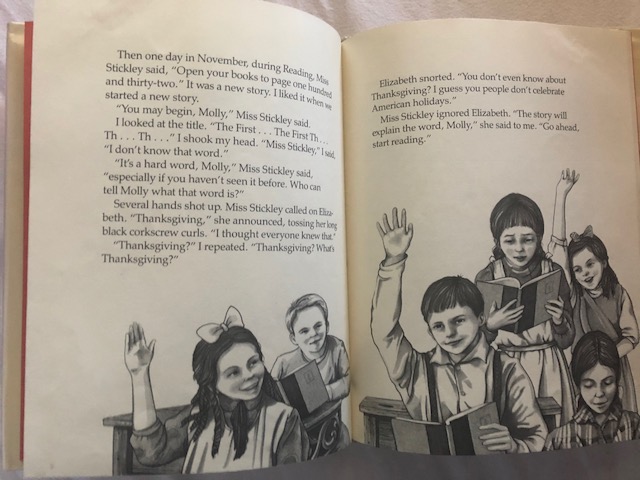
One girl in particular, Elizabeth, makes up rhymes to make fun of Molly, even following her home from school like a creepy stalker, to continue singing them at her. The other girls follow Elizabeth’s lead because they kind of admire her and because she is always giving them candy.

MollysPilgrimBullies

Then, one day, the girls’ teacher begins teaching them about Thanksgiving. Of course, Elizabeth makes a big deal about the fact that Molly has never heard about Thanksgiving before. But, Molly finds the story about the pilgrims interesting. The teacher says that for their Thanksgiving activity, instead of making paper turkeys like they usually do, the children are going to make clothespin dolls to look like American Indians and pilgrims, so they can create a scene like the first Thanksgiving.

MollysPilgrimClass

When Molly gets home and explains the assignment to her mother, she has to tell her mother what a “pilgrim” is. She explains it by saying that they were people who came from across the ocean in search of religious freedom. Her mother understands that and offers to help Molly with the doll.

However, when Molly sees what her mother has done with the doll, she is worried. The doll is beautiful, but her mother has dressed the doll in the clothes of a Russian refugee, like Molly’s family, not in the traditional Puritan garb of the pilgrims. At first, Molly is sure that she’ll be teased more than ever at school when she shows up with a doll wearing the wrong clothes and that people will think that she’s stupid for not understanding how pilgrims dressed.

MollysPilgrimDoll

But, Molly’s mother is correct in pointing out that their family are modern pilgrims, coming to America for the same reasons that the original pilgrims did. Molly does get some teasing from Elizabeth (that’s not a surprise, since it’s Elizabeth, after all), but when the teacher asks Molly about the meaning of her doll, it leads everyone to a better understanding, both of the holiday and where Molly and her family fit in with their new country and its history.

Molly’s teacher points out that the holiday of Thanksgiving wasn’t entirely an original idea that the pilgrims invented all by themselves but that they took their inspiration from a much older Jewish tradition from the Old Testament.  Human beings do not exist in a vacuum, and we all regularly take ideas that we’re exposed to and build on them in our own lives.  Although Puritans were generally known for their belief in religious “purity” (hence, their name) and noted for their intolerance to different religions and beliefs, they also strongly believed in education, which frequently involves taking past ideas and knowledge and applying them toward new situations.  Their Thanksgiving celebration was just an example of that, an older idea that they used for their own purpose, adapted to the lives of the people who adopted the tradition.  It was their celebration, but not their sole intellectual property.

The book is currently available online through Internet Archive (multiple copies).

There is also a sequel to this book called Make a Wish, Molly, in which Molly learns about birthday parties in the United States.

My Reaction and Additional Information

The book doesn’t mention it, but the word “pilgrim” itself is also much older than the early Puritan colonists in America.  Before the development of the America colonies, it referred to any religious traveler on their way to a holy place, and many people still use it in that sense.  A person on a pilgrimage could be just about anyone from anywhere going to anywhere else as long as the journey has spiritual significance.  The Puritan colonists used that term for themselves to emphasize the reasons why they were seeking new homes in a new land.  For them, it was a kind of pilgrimage to a place where they could start again.  Molly’s family came to America in search of religious freedom, just as the Puritans did.  Their journeys weren’t quite the same, but they shared a common purpose and ended up in the same place (more or less).

By showing the links between Molly and her family and the pilgrims, Molly’s mother and her teacher help the other students to understand that Molly really does fit in, that her being there makes sense, and that she has a place in their class and in their celebration of Thanksgiving.

This story was also made into a short film. I remember seeing it in school when I was a kid in the early 1990s.  I checked on YouTube, and there are trailers posted for this film.  One thing that I hadn’t remembered from when I was a kid was that the time period of the book was earlier than the film.  In the film, the characters are shown to be contemporary with the time the film was made, but the style of dress of the girls in the book’s pictures and the things that Molly’s mother says about why the family left Russia indicate that the book probably takes place during the late 19th century or early 20th century, possibly around the same time as the events in the famous play/movie Fiddler on the Roof.

As a side note, if you’re wondering why the girl is named Molly, which doesn’t sound particularly Russian, Molly is typically a nickname for Mary and other, similar-sounding, related names.  Molly’s mother also calls her Malkeleh, which may be her original name or perhaps another variant, if her original name was Malka, as another reviewer suggests.

In spite of the warning on that last site I linked to about reading a book with your child that may be covered in class, I say to go ahead and read it anyway.  It’s hard to say what books may or may not be used in classes by individual teachers, and if your child’s teacher doesn’t happen to use this one, it’s still a good story.  Perhaps just warn your child not to say something that would spoil the ending for their classmates who haven’t read it yet.

Blossom Culp and the Sleep of Death

BlossomSleepDeathBlossom Culp and the Sleep of Death by Richard Peck, 1986.

This book starts shortly after the previous book in the series ends.  After Blossom’s old history teacher was run out of town for his scandalous behavior, he was replaced by Miss Fairweather.  Miss Fairweather is a tough, no-nonsense woman who pushes her students to study hard and take history seriously.  Unexpectedly, she comes to appreciate Blossom, an outcast from a poor family, because Blossom demonstrates some knowledge of Ancient Egypt.  Little does Miss Fairweather know that Blossom’s comments in class were inspired by one of the visions that Blossom occasionally gets because of her psychic gifts.

Blossom experiences a visitation from the spirit of an Ancient Egyptian princess who says that she needs Blossom’s help.  Years ago, her mummy and some precious objects were stolen from her tomb.  The princess doesn’t seem to know exactly where her “earthly form” is now, but she’s sure that it’s somewhere nearby.  She’s very concerned because she senses that archaeologists in Egypt are digging to find her tomb and knows that when they finally reach it, they will discover that she isn’t there.  Rather than being concerned about her tomb being violated by the archaeologists, the princess senses that they are searching for her remains in order to venerate them, that if they find her mummy, they will take it to a place of great beauty where it will be treated with the utmost care and respect (a museum).  She wants that and fears that she will miss her chance at the kind of immortality that this form of glorification, care, and study will provide.  So, she asks Blossom to find her earthly remains and inform the searchers of her true whereabouts.  At first, Blossom has no idea how she can accomplish that, but the princess threatens her with a true Egyptian curse if she doesn’t try.

Then, Blossom receives a clue to the mystery in the form of a beautiful Egyptian scarab that her mother found one day while she was out scavenging.  If Blossom can find the place where her mother found the jewel, she can also find the princess’s mummy.  Fortunately, Miss Fairweather has assigned the class special projects about Ancient Egypt, and she is thrilled when Blossom says that she wants to study grave robbers.  Blossom sees this as a good way to collect some extra information about grave robbers that she can use to find the princess’s mummy as well as get a good grade in Miss Fairweather’s class.  It also proves to be an excellent way to draw Alexander Armsworth into her search for the mummy.

Alexander still denies to Blossom that he has real psychic abilities like hers, even after their previous adventures together.  He insists that it was just a phase that they were going through, one that he wants to leave behind.  He’s been busy flirting with Letty, the class snob, and he’s trying hard to get into a prestigious fraternity so that he can give Letty his fraternity pin.  Not only does Blossom think that the boys in the fraternity are a bunch of idiots who do stupid things, but the idea of Alexander giving Letty his pin as a sign of their relationship is just sickening.

Blossom is reluctant to admit her real feelings for Alexander, but the two of them are close in ways that Letty and Alexander never will be because of their shared abilities and adventures, and Blossom has a sense that their futures will be intertwined as well.  Alexander is angry that Blossom is roping her into yet another supernatural escapade, but he has to go along with her project idea because he has already gotten on Miss Fairweather’s bad side and needs to do well on the project to save his grade in class.

Along with the supernatural adventure, there is also a look into the past, the world of 1910s America as well as Ancient Egypt.  First, there are the traditions of stunts associated with Alexander’s initiation into his fraternity and the tradition of giving a girl a fraternity pin as a precursor to engagement (“engaged to be engaged”).  Then, they discover that Miss Fairweather is a suffragette, which is the reason why she left her previous teaching job.  Her feminist ideals cause problems for her in her new, small town when they become known, but with Blossom’s help, she wins over some of the influential women in town as well as a male admirer.

The book is currently available online through Internet Archive.