The Day Jimmy’s Boa Ate the Wash

JimmysBoa

The Day Jimmy’s Boa Ate the Wash by Trinka Hakes Noble, pictures by Steven Kellogg, 1980.

The fun thing about this story is the backward way that the girl begins telling it, somewhat resembling The House that Jack Built, or better yet, the old No News Joke. The joke is really closer to the format of the story, with someone explaining the least eventful thing that happened as though it were the most important when it was just the end result of everything else.

A young girl (unnamed) arrives home, and her mother asks her how she liked her class trip to a farm that day. She says that it was boring until the cow started crying. When the mother asks her why the cow was crying, she says that the farmer wasn’t paying attention to where he was driving his tractor and knocked a haystack over on the cow.

As the mother continues to ask her daughter questions about what happened, backtracking through events, the real story begins to reveal itself:

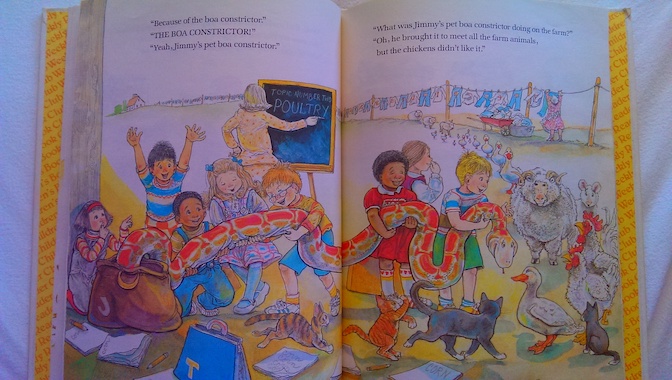
The girl’s friend, Jimmy, had a pet boa constrictor, and he brought it along on the field trip so it could meet all the farm animals.

JimmysBoaFieldTrip

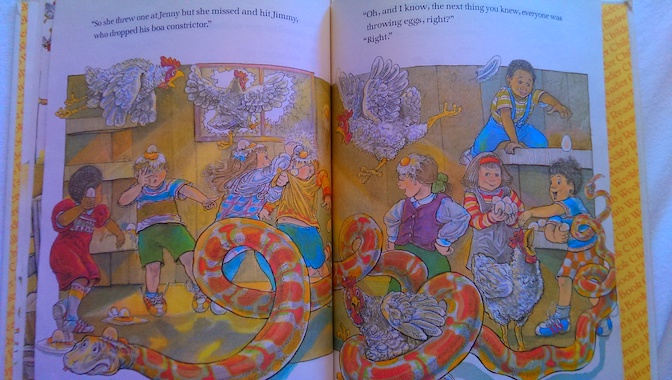
However, the chickens became frightened, and one of them laid an egg on one of their classmates. She thought that someone else threw it at her, so she threw another egg at him, which hit yet another student.

JimmysBoaEggs

From there, it turned into one big food fight, with students throwing eggs at each other, and when they ran out of eggs, they threw corn at each other. The corn was for the pigs to eat, so the pigs wandered onto the school bus and started eating the children’s lunches. From there, chaos ensued until the farmer’s wife suddenly screamed, and the children’s teacher hustled the children onto the school bus to go home.

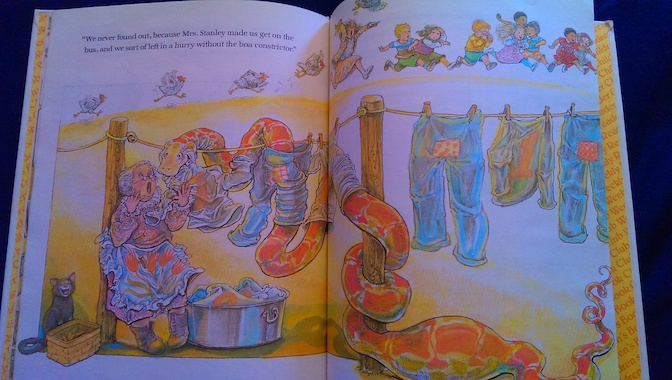
JimmyBoaLeaving

The children never knew exactly why the farmer’s wife screamed (although the reason is actually in the title to the book), but two things quickly became evident: Jimmy accidentally left his boa constrictor behind on the farm, but he has acquired a pet pig because there was still one left on the bus.

This summary doesn’t quite do the story justice because the backwards way the story starts out is part of the fun. The pictures in the book are hilarious, and the boa constrictor is shown at the end to have become a beloved pet of the farmer and his wife, even making friends with the chickens.

This is a Reading Rainbow Book.  It is currently available online through Internet Archive.

Blair’s Nightmare

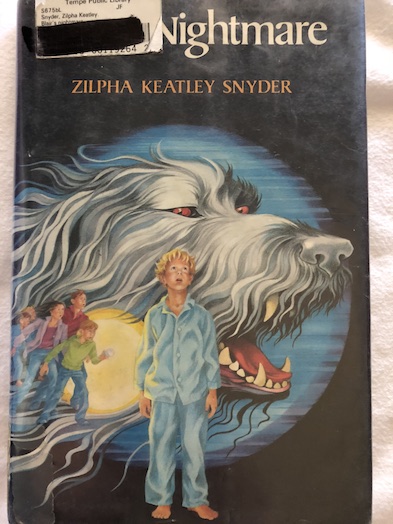
BlairsNightmareBlair’s Nightmare by Zilpha Keatley Snyder, 1984.

Now that school has started in the small town of Steven’s Corners, the Stanley family kids are dealing with the problems that kids have, handling teachers, friends, and the local bullies.  David has become the new favorite target of Pete Garvey, the bully in his grade in school. (At one point, he compares managing his time around Garvey to that old riddle about crossing a river where the boatman (a teacher, in this case) can’t leave one of the things he’s transporting alone with the other because one of them will eat the other – David sees himself as the prey and Garvey as the predator. Only, David, the prey, has to be the one to manage the maneuvering because the boatmen/teachers don’t.)  Blair, David’s younger brother, also seems to be suffering from school stress, reverting to an old habit of walking in his sleep at night.  Blair keeps saying that he’s getting up to see a nice dog who visits at night, but everyone thinks that he’s just dreaming while sleepwalking.  David thinks that having a dog actually sounds nice and is hoping that he can somehow convince his dad of that, too.

Mrs. Bowen, Blair’s teacher, isn’t amused by his stories about the dog or some of the other things Blair has been saying at school, like his friend “Harriette”, whom no one else has been able to see but apparently lives in the Stanleys’ house (see The Headless Cupid).  She thinks that Blair is “out of touch with reality,” and that his family should work on teaching him the difference between reality and fantasy.

In the middle of all this, things have been disappearing around Steven’s Corners, and people think that it might be the work of escaped prisoners.  The police have been looking for some escaped prisoners in the area, although they haven’t found anything, and the prisoners might not really be around.  David thinks that the things that have disappeared don’t really sound like the kinds of things that prison escapees would steal.  He thinks it’s more likely that Garvey and his trouble-making friends took them.

Then, David starts hearing that, for some reason, the sheriff’s dog has become afraid of going near the woods.  When they brought him out there to sniff for the escapees, he suddenly smelled something that seemed to make him very afraid, and now he shakes when they try to take him back to the area.  Janie, David’s younger sister, has also become very interested in the story of the escapees and seems to be trying to start her own investigation into the matter.

Part of the story has to do with the differences between perception and reality.  Amanda, David’s stepsister, proves to be an unexpected help in dealing with Garvey, taking it upon herself to punch him in the face when he tries to pick a fight with David.  However, it makes David embarrassed that Amanda feels like she has to stand up for him, and it’s further complicated by the fact that Amanda and Garvey seem to have a mutual crush on each other.  Life is full of mixed emotions, and David begins to discover that people’s personalities are more complicated than he once thought.  Some of Garvey’s bullying and trouble-making is really a bid for attention.  Garvey later admits that he didn’t really have intentions of beating David up; he was mostly hanging around David as an excuse to see Amanda and maybe do something that would get her attention.  However, learning that being mean and threatening isn’t the best way to get the kind of attention he wants from people isn’t a bad lesson.

David also learns that Amanda’s feelings toward him are more complicated than he originally thought.  Amanda and David fight a lot, and David thinks that she still doesn’t like having step-siblings, but she says that the reason she punched Garvey was that she suddenly realized that she couldn’t let anyone treat her brother badly.  It surprises her as much as David that, somewhere during their past couple of years of living together as siblings, having adventures, and having fights and arguments, she has come to think of him as her brother.  She shrugs it off as a sign that people just change over time.  She also tells him not to worry about their parents getting divorced when her mother, Molly, argues with David’s father about Blair’s sleepwalking and “dream” dog.  She says that their arguments are nothing like the ones that Molly used to have with her father and that it’s just human for people to fight once in a while.

As you might have guessed, there is also a lot more to Blair’s “sleepwalking” and his dog than his teacher suspects.  One night, while Garvey is over with David and Amanda, they learn how very real (not to mention extremely huge) Blair’s dog is.  For a time, all the kids in the family keep the dog a secret because they’re worried that their father will just send the dog to the pound.  All the while, David’s father and stepmother argue about whether discouraging Blair’s “fantasies” is healthy for him or not.  Molly doesn’t think it’s bad for a six-year-old child to daydream and have imaginary friends, but Blair’s father thinks that they should do as Blair’s teacher says and punishes the other children by revoking their allowance whenever they talk about Blair’s dog.  They have no idea that they’re actually the ones who have the least sense of what the true reality of the children’s situation actually is, and the children find themselves having to accept their punishments without argument in order to keep the secret, seeing it as a noble sacrifice for the safety of their dog.

Eventually, the secret does come out after the dog, now called Nightmare, helps to save the children when they finally encounter the escapees.  (You just knew they were hiding somewhere nearby, didn’t you?)  Nightmare’s backstory is rather sad and involves animal abuse.  His former owner actually tried to kill him, and he is injured.  When the kids’ parents finally learn the full truth, David’s father tries to insist that his rule about no new pets applies until Molly says that having Nightmare around would actually make her feel safer.

Personally, I think that the father could have been a little more apologetic.  He admits that the children were “not guilty” and that they can have their allowances back, but I would have liked to hear him actually say that he was “wrong”, using that word, and maybe add the word “sorry” to it.  It feels like the father is still dodging the reality of his own actions himself, especially considering that the lessons that he was basically instilling in the children were that the “truth” is whatever the people with authority and the ability to punish you decide it is; if that doesn’t happen to be the real truth, you’re not allowed to speak up and say so or argue with them to have some compassion; and if you need to handle real-life problems that they’re denying exist, you have to do so in secret, behind the backs of authority, which is basically there to be part of the problem, not a source of help or solutions.  Real life might sometimes work that way, but I don’t think it’s good to teach children that it’s the way things are supposed to be and that it’s the way they should behave themselves when they become the adults.  Lots of things could have been cleared up much faster if the father had allowed open discussion or asked further questions or even done a little investigating on his own to figure things out.  Parents not listening is a plot device used in a lot of children’s mysteries to set things up for the children to do their own investigating, but it always pains me a little because I’m the type to ask more questions.  I like to be sure of my ground before I stand on it, and I don’t leave things alone if I think there’s a real problem.  It also seems oddly out of character for the father of this story, considering that, in the first book, they established that he had never had a problem in the past with the kids keeping little animals that they found, like lizards and snakes.  So, why wouldn’t he even entertain the notion that Blair might have really found a dog and started feeding it at night?  If it had been me, given the kids’ history with animals and doing things in secret, I would have checked on what was really happening at night, just to be sure.

The matter of “Harriette”, who is a carry-over from the first book in the series (and may possibly be a ghost), is never cleared up.  Blair says that Harriette helped lead him to Nightmare and told him that everything would be all right.  The books in the series imply that Blair is psychic and that he can communicate with a girl who used to live in their house years ago, but it’s never established for certain.  At the end of the story, David, who has been been considering the issue of perceptions vs. reality decides that who or what “Harriette” is – ghost or just Blair’s imaginary friend – may also be just a matter of perception, and that it is probably best left that way.  Other than Blair’s occasional comments about Harriette, her presence is not felt by anyone else in the family, and there are no unexplained supernatural happenings in this story.  There are, however, some dated references to ’80s celebrities, like Magnum and Burt Reynolds.

The book is currently available online through Internet Archive.

I Hate English

HateEnglish

I Hate English! by Ellen Levine, 1989.

When Mei Mei’s family moves from Hong Kong to New York, she finds herself forced to go to a school where no one else speaks Chinese.  She is expected to learn English and to read, write, and speak in English, and she hates it!  To her, English is a very strange language, and the writing system is nothing like Chinese.  For a time, Mei Mei refuses to speak in English, even when she understands what is being said around her, because she hates it so much.

HateEnglishArrival

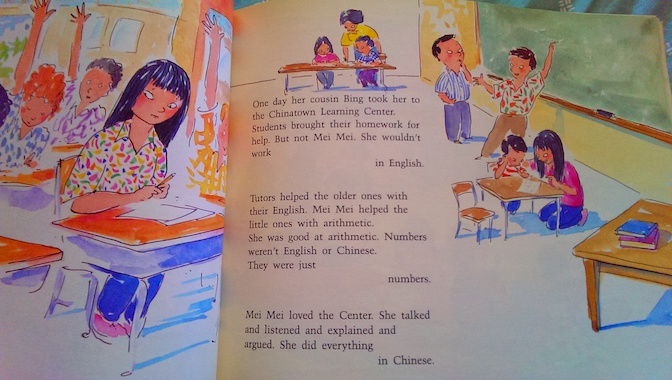
The only part of New York that Mei Mei really likes is Chinatown and the Chinatown Learning Center.  Mei Mei likes it because she is surrounded by people speaking Chinese. There, she can relax and be herself because people there understand her.

HateEnglishLearningCenter

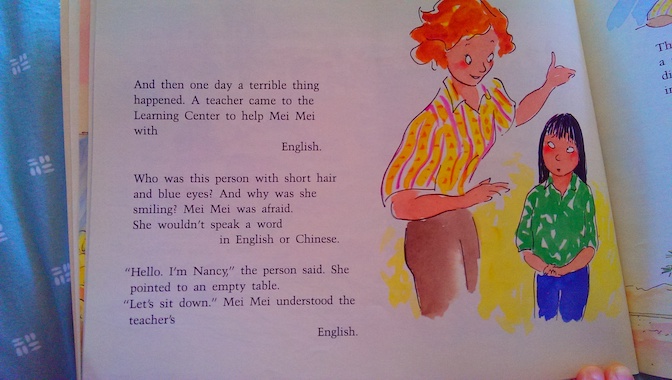
However, Mei Mei’s refusal to speak English isn’t helping her at school or anywhere else.  It’s keeping her from speaking to anyone outside of Chinatown, and it can’t continue.  When an English teacher, Nancy, comes to the Learning Center to help Mei Mei with her English, she resists learning at first.  She feels like she’ll lose her Chinese and part of her identity if she uses English.

HateEnglishNancy

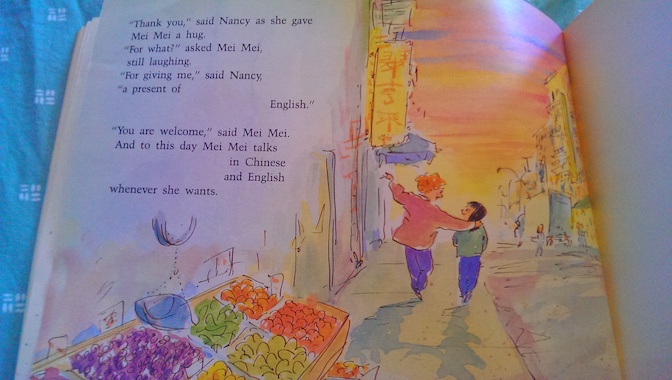
At first, Mei Mei’s worries about speaking English intensify with Nancy’s lessons.  It disturbs her how English has words that would be difficult or impossible to translate into Chinese and English words seem to be coming more easily to her, even when she doesn’t really want to speak the language.  Nancy explains to Mei Mei that English is necessary for her because she will need it to talk to many people in America, and there are many people who also want to talk to Mei Mei and be her friend, including Nancy.  It’s only when Nancy overwhelms her by constantly talking in English and Mei Mei becomes desperate to talk about herself and be understood in English that Mei Mei realizes that speaking a new language doesn’t mean losing her identity.  It’s just another way of expressing herself, and she can go back and forth between the two any time she wants.

HateEnglishNancyTalking
HateEnglishMeiMei

Mei Mei’s feelings of strangeness in her new home and the difficulties of learning a new language are relatable.  The hardest part of the experience for Mei Mei is feeling like she might be giving up a part of her past, her culture, and herself by switching from Chinese to English.  But, refusing to speak English puts Mei Mei in the position of being someone who can only listen, never talk, limiting her ability to be understood and to make friends.  In the end, she comes to realize that speaking a new language is not a matter of giving up anything, just adding to what she knows and making herself understood in a new way.  It’s the beginning of expanding her horizons and building relationships with new people.

HateEnglishFriends

My favorite part as a kid was the part where Mei Mei and her friends went to the beach and cooked shellfish that they found.  It was interesting to me because I never lived near a beach when I was young.  The lifeguard at the beach tells Mei Mei and her friends that they can’t eat the shellfish, and they realize that he thinks that because he doesn’t know how to cook them.  I never did either and still don’t, but I liked hearing about it.

The book is currently available online through Internet Archive.

Mirette on the High Wire

Mirette

Mirette on the High Wire by Emily Arnold McCully, 1992.

About 100 years ago (the book says, so it’s around the 1890s), a young girl named Mirette and her widowed mother run a boardinghouse in Paris. Most of the people who live there are actors and performers of various kinds.

MiretteBoardinghouse

One day, a strange, quiet man named Bellini comes to stay at the boardinghouse. Most of the time, Bellini prefers to keep to himself, but then Mirette catches him walking on the rope they are using for clothesline in the courtyard of the house. It turns out that Bellini is a tightrope walker. Mirette begs him to teach her how to do it, but he refuses.

MIretteRequest

Not to be daunted, Mirette begins experimenting with tightrope walking herself. After repeated falls, Mirette eventually learns to balance on the rope. When she shows Bellini that she can walk the length of the rope, he is impressed with her perseverance and teaches her more things to develop her skills. However, he becomes very upset when she boasts that she will never fall again.

MirettePractice

Mirette learns that Bellini was a world-famous tightrope walker until a friend of his was killed in a fall, and he lost his nerve. She talks to Bellini about it, and he says that he doesn’t know how to get over being afraid. Seeing Mirette’s disappointment and worry, however, gives Bellini the courage to try once again.

MiretteBellini

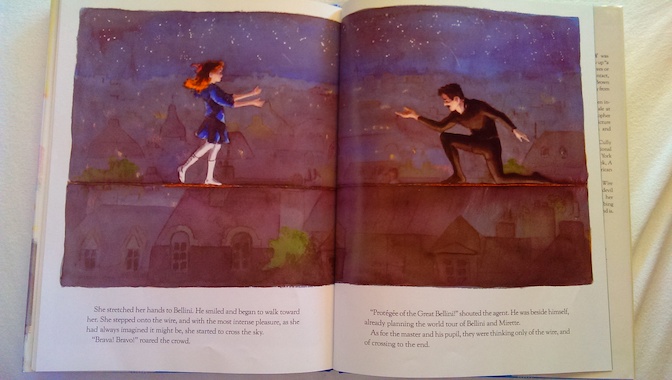
After talking with a performing agent staying at the boardinghouse, Bellini arranges a performance where he will walk a tightrope over a Paris street. When Mirette sees him hesitating at the beginning of the performance, she joins him on the wire, bolstering his courage and realizing her own dreams of becoming a real tightrope walker.

MiretteBelliniTightrope

There are other books in a series about Mirette and Bellini, where they perform tightrope acts and have adventures around the world, but I think that the first book is really the best.  The pictures are beautiful, done in an impressionistic style.

This book is a Caldecott Award winner.  It is currently available online through Internet Archive.

Kathleen: The Celtic Knot

KathleenKathleen: The Celtic Knot by Siobhan Parkinson, 2003.
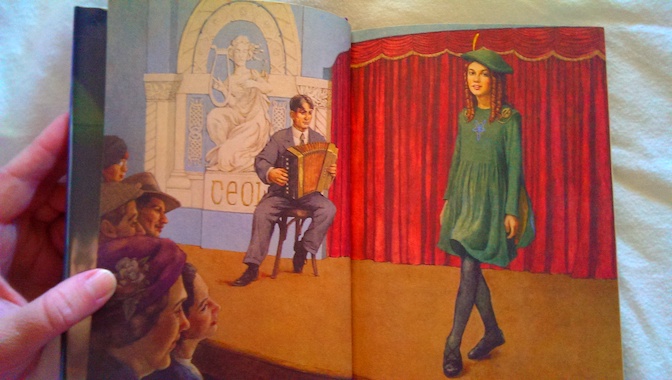
Twelve-year-old Kathleen lives with her family in Dublin, Ireland in 1937. Like the rest of the world, Ireland is suffering under the Great Depression, and Kathleen’s father has been having trouble finding work. Her mother helps to support the family by working as a midwife.

One day, when Kathleen’s mother is off delivering a baby, Kathleen accidentally burns the porridge at breakfast, making her and her sisters late for school. Although they should have been marked as being on time, they are considered one minute late because the nun’s watch was fast. Discipline is harsh at the Catholic school they attend, and after a harsh lecture to Kathleen, the headmistress, Mother Rosario, calls for a conference with her mother. Kathleen is very upset about it, but Mother Rosario softens somewhat and says that she merely wants to see that everything is alright with Kathleen’s family because a nice girl like her shouldn’t be acting up.  Kathleen still worries because she knows that the nuns look down on poor families like theirs and consider their authority higher than the parents of the children they teach.  They are often unaware of the circumstances that families live in.

However, Kathleen’s mother isn’t fazed by the nuns’ attitude and is blunt with the Mother Rosario, telling it like it is. The headmistress does show that she has some compassion and is somewhat aware of their circumstances because she says that Kathleen’s lateness was only part of the reason she wanted this meeting. She has guessed that Kathleen’s father is looking for work, and there is a position for an assistant gardener open at the school. It doesn’t pay much, and it’s not as good as her father’s old job was before the factory where he worked closed, but he agrees to take it because it’s better than nothing.

The headmistress also says that she has noticed that Kathleen is musically-talented. She likes to sing and has a good voice. Mother Rosario thinks it would be a good idea for her to take piano or dance lessons. The family doesn’t have a piano, so the headmistress suggest that Kathleen join the Irish dancing lessons because it’s a wholesome activity that reflects her heritage and that would keep her out of trouble. Kathleen’s mother isn’t big on heritage, but she agrees that dancing might be a good activity for Kathleen.

Kathleen isn’t happy about the dance lessons at first because the other girls who are involved are snobs. But, once she tries it, she realizes that she actually loves dancing. The problem is that the lessons aren’t free, like the other girls told her. At first, Kathleen feels cheated, finding out that she loves something that she can’t have after all, but her teacher says that she’s talented, so she offers Kathleen some free lessons anyway. She’s been looking for new talent so that her dancers can do well in the next dancing competition, and she doesn’t want to let a promising dancer like Kathleen slip through her fingers.

The snobby girls in class are all the more irritated when Kathleen is among those chosen to enter the next competition, but everyone also knows that there is one more obstacle for Kathleen: she doesn’t have a proper dancing costume or any money to buy one. She prays for one, even promising God that she’d become a nun if he gives her the costume she wants. Her mother has her eye on some beautiful cloth that she hopes to buy as a remnant, but the cloth gets snapped up by some of the wealthier, snobby girls, and her mother comes down with a serious illness shortly before the competition.

Kathleen begins to think that she was wicked for being so concerned about dancing and costumes when there are much more serious things in life. However, her aunt, Polly, understands how she feels and comes up with a plan to make the needed costume for Kathleen, using her favorite book, Gone With the Wind, as inspiration. Remember what Scarlett O’Hara did when she needed a new dress and couldn’t afford one?

KathleenDancing

One of the themes that runs through the story is questions and answers. Kathleen has a lot of questions about life. She knows that her mother deliveries babies for money, but she doesn’t really understand much about it, and her mother doesn’t answer the questions she asks. In fact, Kathleen notices that most of the adults she knows (with the exception of her father) brush aside her questions about the way the way the world works or the things people do because they simply don’t want to be bothered with them. They have too many concerns of their own, and they don’t really know most of the answers themselves. It kind of contrasts with the answers that Mother Rosario demands from Kathleen and immediately dismisses upon getting. Most of the time, she doesn’t really want to bother with answering questions or even dealing with the answers to questions she’s just asked. Only once does she answer a question that Kathleen had asked about St. Patrick, and Kathleen is astonished at getting an answer about something.

I have to admit that the attitudes about questions and answers from most of the adults in the story really irritated me, especially the way Mother Rosario demanded answers from Kathleen about her lateness and then dismissed everything that Kathleen said, angry that she had “answers.”  I’ve met people like that before in real life, and they’re just as illogical and crazy-making as this headmistress. I’m not talking about teachers who refuse to listen to flimsy excuses like “the dog ate my homework,” but people who get angry at others who have real explanations just because they have real explanations. People who demand to know the reasons why things happen and then immediately reject any explanation offered without a real reason for doing so are obnoxious. I’ve encountered people like that before, and it’s hard to have anything resembling a meaningful conversation with them.   They don’t want to talk to you; they just want to yell or lecture at you.  They don’t really care what the answers or explanations are for anything, and no answer would make any difference to them because what they really want is for the other person to just feel bad. It’s an unethical one-upmanship tactic, and it loses my respect the moment I hear someone use it because I recognize what they’re attempting to do. It’s so obvious, but frustrating at the same time (Kathleen in the story wonders why Mother Rosario is trying to torture her in this way) because there’s nothing you can say to stop the other person once they start (at least, I haven’t figured it out). Kathleen’s approach was probably the most effective.  She just stopped talking and prepared herself for the headmistress to hit her, which caused the headmistress to wake up a bit to the fact that the message that she was sending to Kathleen was that her only intentions were to hurt her.  Fortunately, those were not her only intentions, but I have to admit that I never really had any respect for Mother Rosario after that, in spite of what she did to help Kathleen’s family.  You can tell this is one of my pet peeves.  One-upmanship really bothers me in all of its forms, and I have even less time for that kind of nonsense than these characters do for answering a twelve-year-old’s questions.  At least you can talk to a twelve-year-old. Getting back to that, part of Kathleen’s trouble with some of her questions is that her elders often underestimate her, thinking that she’s really too young to understand anything, but the fact that she’s asking questions says that she’s really not. In fact, she might even be putting more thought into some issues than the people who have decided that some things aren’t worth thinking about in the first place.

Another theme of the story is growing up and changing goals in life. By discovering her talent as a dancer, Kathleen has found something that she would like to dedicate her life to, and if she becomes a dance teacher herself, it would give her a job to do in her future that could make her life better. Her aunt, Polly, who is twenty years old, also changes her mind about what she wants in life. As a single young woman, she likes to go out and have fun with her small earnings, hoping to meet a man as elegant as Rhett Butler.   However, when her latest young man turns out to be a cad, she accepts a proposal from the very shy but much nicer young man who she had previous thought wasn’t handsome enough. Polly’s experiences make her realize that handsomeness by itself isn’t much, and she and her new husband have plans for building a life together. At first, Kathleen is disappointed because she and Polly had talked about leading a carefree life together as single ladies when Kathleen was grown, but Polly explains to her that things will be better this way and that grown-ups have to build real lives for themselves, not live on dreams alone. Kathleen is still in the process of discovering the possibilities that life might hold for her and the talents that she can use to build her life.

I also found the parts about Irish history and politics during 1930s interesting.  One of the reasons why Kathleen’s family isn’t big on the Irish heritage movement is because her grandfather fought during World War I and wasn’t treated well as a veteran when he returned. During the meeting with Mother Rosario, Kathleen’s mother is blunt about her views on things, and Mother Rosario is surprised how much she understands of politics, showing that she looks down on poor people (possibly the source of her general rudeness and bullying tactics, even when she’s trying to be helpful – she’s decided that she’s superior and will remain so, whether she’s right or wrong), thinking that they aren’t smart enough to understand what’s going on around them.  The story makes it clear that the nuns at school are often out of touch with what ordinary families go through in their daily lives.  They underestimate what people know or read about, they have trouble understanding their daily struggles with money and how they are barely able to keep food on the table, and they seem unable to grasp what it’s like to be part of a family where any family member’s actions can affect all of the others.  For me, they were far more aggravating than the snobby little girl characters because I usually expect adults of a certain age to have grown out of some of these behaviors.

While reading the story, I was kind of comparing Kathleen’s circumstances in Ireland in the 1930s to life in America during the Great Depression, and many of their struggles were the same.  I was also kind of fascinated by Polly’s fascination with Gone With the Wind because it shows how pieces of culture and entertainment could become popular in other countries during this time.

This book is part of a series by the same publishers of the American Girls Books.  There is a section in the back of the book with historical information about the period.

KathleenHistorical

Addy Learns a Lesson

American Girls

AddyLesson

Addy Learns a Lesson by Connie Porter, 1993.

AddyLessonArrivalAfter escaping from slavery, Addy and her mother finally arrive in Philadelphia, Pennsylvania, where they will start a new life.  Philadelphia is a big city, and at first, Addy feels lost, not knowing where to go and what to do.  They have no family or friends to turn to, and neither she or her mother can even read the street signs, never having been taught to read.  They are dependent on help from other free black people, former slaves who have already established themselves in the community.

The first people they meet in Philadelphia are Mrs. Moore and her daughter, Sarah.  They are part of the Freedom Society of Trinity A.M.E. Church, which helps new arrivals escaping from slavery, like Addy and her mother.  The Moores take them to the church, where they attend a church supper, along with some other new arrivals.  Mrs. Moore asks Addy’s mother what work skills she has, and when she says that she can sew, Mrs. Moore says that she might be able to get a job in a dress shop.  Mrs. Ford, the white woman who owns the shop, is strict and fussy, but she hires Addy’s mother and gives them a room to live in.

Life in freedom isn’t as glamorous as Addy thought it would be at first.  Her mother works hard for little pay, and the attic room where they live is small and uncomfortable. She misses the rest of their family and still doesn’t know where her father and brother are.  There are also things that black people in Philadelphia can’t do, even though they aren’t slaves, like riding on the streetcar.

However, there is one thing that Addy is looking forward to: going to school for the first time.  Sarah Moore is Addy’s age, and she tells Addy about her family escaped from slavery in Virginia.  Like Addy, she couldn’t read when she first arrived, but now, Sarah attends school.  Addy is excited about attending the same school as Sarah and happy that she has made a new friend.  Addy’s new teacher, Miss Dunn, was also a former slave from North Carolina, and she reassures Addy that, although she hasn’t been to school before or learned to read yet, it won’t be long before she learns.


All of the other children at school are black, many of them former slaves.  However, Addy can’t help but notice that some of their families are more prosperous than others.  In particular, a girl named Harriet wears beautiful dresses, the kind that Addy has dreamed of having herself.  Sarah and Harriet don’t get along because Harriet is snobbish, but Addy is fascinated by her, wishing that she could have things like Harriet has.  Harriet says that her family were never slaves, and as bossy as Harriet is, Addy can’t help but admire her.  Harriet is nice to Addy at first, bragging about how smart she is and how much she can help Addy, but she isn’t as patient or as helpful to Addy as Sarah is.

When there is a spelling match at school, Addy accepts Harriet’s invitation to go to her house to study.  Harriet always seems to do well in class, and Addy is curious to see what her house is like.  However, Harriet and her friends force Addy to be their “flunky,” carrying all of their books, and they say insulting things about Sarah.  Then, Harriet retracts the invitation to study.

As Addy sees the way Harriet takes advantage of her, she comes to realize some important things about the way people act and about herself and the type of friends she really wants in her new life.  Unlike Harriet, Sarah is Addy’s real friend.  Addy realizes that she doesn’t need to admire people like Harriet because she is smart and works hard and can do just fine without Harriet’s false friendship.


In the back of the book, there is a section of historical information about education during the American Civil War, especially for black children.  It was actually against the law to teach slaves to read during Addy’s time, although some were able to learn in secret.  Even for free blacks in the North, there were few educational opportunities.  Black children couldn’t go to school with white children, and the schools for black children were poor, unable to afford many supplies.  Over time, more and more black people were able to get an education, in spite of the difficulties involved, and education helped to improve their lives.  However, segregated schools remained the norm until the 20th century.

I liked the way they showed the medal that Addy wins in the spelling bee.  Students who particularly excelled at a subject in class were sometimes given a small medal on a pin to wear as a badge of honor, something that people don’t do in modern times.