The Magic School Bus Inside the Earth

The Magic School Bus

MSBEarth

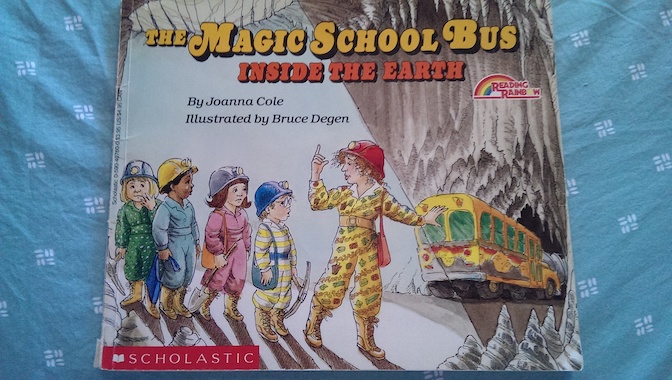
The Magic School Bus Inside the Earth by Joanna Cole, 1987.

Ms. Frizzle’s class has a new student, Phoebe, who is about to discover that Ms. Frizzle is no ordinary teacher and that her class trips are nothing like any other field trip.  Ms. Frizzle’s class is studying the earth and rocks, and she assigns the students homework to find a rock and bring it to class.

MSBEarthHomework

However, even though it sounds like an easy assignment, only one person actually brought a real rock to class.  The others either didn’t bring anything or brought in pieces of old Styrofoam, bits of broken glass, or chips of concrete from the sidewalk.  With only one real rock for the class’s rock collection, Ms. Frizzle decides that the class should to on a trip to collect more.

MSBEarthFieldTrip

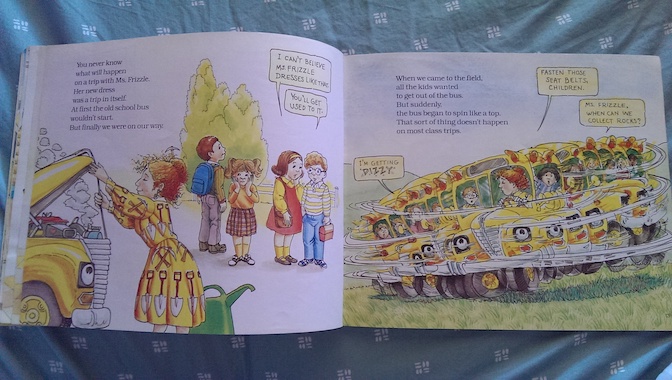
She takes the class on a field trip to a real field, but they’re not just going to collect rocks that they find lying on the ground.  The bus changes itself into a steam shovel, and Ms. Frizzle passes out shovels and jackhammers to the students.  They start digging down into the earth, uncovering new layers of rock as Ms. Frizzle explains what types of rocks are in the layers and how they formed.

MSBEarthDigging

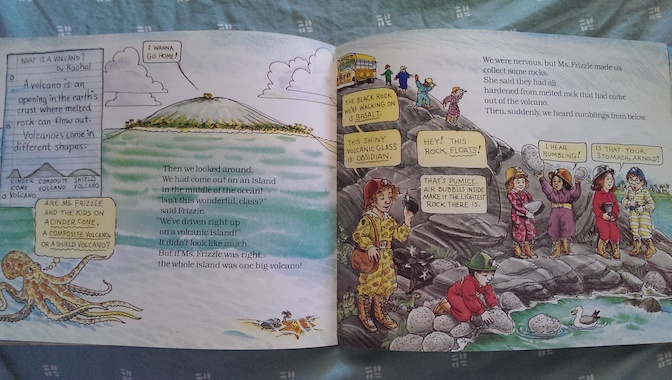
Before the field trip is over, the school bus, along with all the students, falls through the ground and into a massive cave.  They continue traveling all the way down through the center of the earth and out the other side, ending up on a volcano, where Ms. Frizzle calmly explains about volcanic rocks.

MSBEarthVolcano.jpg

I like the picture at the end of the book, after the kids return to school, which points out that there are things all around them that are made out of the different kinds of rocks and minerals that they learned about on their trip.  Each type of rock is also shown in the class’s rock collection along with notes about the type of each rock and how it can be used.

MSBEarthReturn

The book ends with a mock phone conversation between a reader and the author and artist about the impossible things that happen in the book but noting the factual information contained in the story.  The book was featured on Reading Rainbow.  It is currently available online through Internet Archive.

MSBEarthRockCollection

The Candy Corn Contest

The Kids of the Polk Street School

CandyCornContest#3 The Candy Corn Contest by Patricia Reilly Giff, 1984.

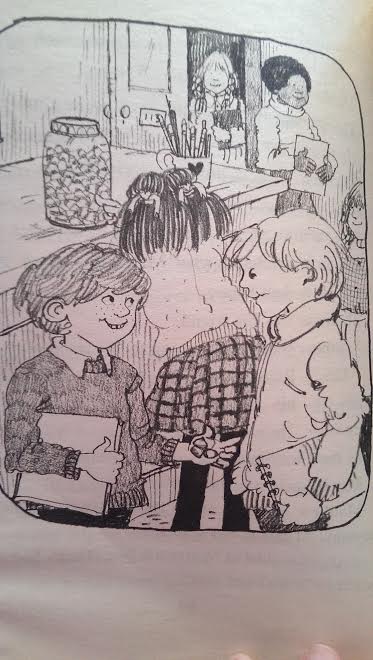
As Ms. Rooney’s class prepares for the upcoming Thanksgiving holiday, she gives them a contest: students can win the jar of candy corn on her desk if they can guess how many pieces of candy corn are in it (or get the closest to the right answer).  Richard “Beast” Best wants to win very badly because he loves candy corn and his mother never lets him eat many sweets at home.

The only problem is that students can only earn the ability to make guesses by reading books.  They get one guess for each page they read.  Richard has always been a slow reader, so he knows that this contest is going to be hard for him.  One day, while studying the jar of candy corn, trying to plan out his guess to make the best use of it he can, Richard gives in to temptation and eats three pieces.  Now, he doesn’t know what to do.  Ms. Rooney knows exactly how many pieces of candy there were in the jar, and if three are missing, she’ll find out.

CandyCornContestPic2While Richard is worrying over his mistake, he’s also worrying about the sleep-over party his parents are letting him have over the Thanksgiving break.  At first, he was looking forward to it, but some of the other boys in class can’t come and some of those who said they could are concerned because Matthew is coming.  Matthew and Richard are friends, and people in class generally like Matthew, but everyone knows that Matthew still wets the bed.  Some of the other boys are worried that they’ll have to sleep next to Matthew at the sleep-over.  As much as Richard likes Matthew, it feels like his problem is going to ruin the party, and when Matthew is nice to him, it only makes Richard feel worse.

For awhile, Richard is short-tempered with Matthew and says some things that he later regrets.  His mean comments make Matthew decide not to go to his party, but Richard feels terrible because he realizes what Matthew’s friendship really means to him. Richard’s apologies later help to fix the situation.  It also helps that Richard admits to Matthew that he ate three pieces of the candy corn.  Richard’s confession that he did something wrong (more than one thing, actually) and that he wants to fix it helps Matthew to forgive him.  Matthew helps Richard to decide how to solve his candy corn problem honorably, and Matthew’s mother gives Matthew a suggestion that will help him to avoid problems at the sleep-over.

The book is currently available online through Internet Archive.

Fish Face

The Kids of the Polk Street School

FishFace#2 Fish Face by Patricia Reilly Giff, 1984.

When there’s a new girl in Ms. Rooney’s class, Emily Arrow is happy at first that she’ll be sitting next to her and thinks maybe they’ll be friends.  However, that feeling doesn’t last very long.  Dawn Bosco doesn’t seem interested in making friends.  She doesn’t respond to the compliments that Emily gives her.  Instead, she brags about herself, saying things that Emily learns later aren’t true.  Worst still, she steals Emily’s toy unicorn, Uni.

Uni is Emily’s best friend, and she’s convinced that he brings her good luck.  Without him, everything seems to go wrong.  Emily even has trouble sleeping because she always sleeps with Uni.  When she tries to get Dawn to give Uni back, she denies taking him, but Emily knows that Dawn is hiding him in her pencil box.  She saw him there, but she just can’t get to him.  Will Emily ever get Uni back?

The book is currently available online through Internet Archive.

My Reaction and  Spoilers

FishFacePic1The title of the story comes from the fish faces that Emily was making, imitating the classroom pet fish.  She shows Dawn her fish face when she’s trying to joke with her, but Dawn just thinks it’s weird.  Dawn worries that she’s not making friends, but at the same time, she also seems determined not to like things and people at her new school and stealing Emily’s unicorn and lying about it was a sure way to make her angry.

I didn’t like this book as well as others in the series.  The kids in the series don’t always explain their actions or completely understand them, which is somewhat true to life.  Young children don’t always understand their true feelings or motives because they don’t have the words or the experience to explain what they feel.  However, this book felt more unexplained than normal.

Dawn steals Emily’s toy unicorn just moments after they first meet, while sitting in the desk next to her in their classroom.  Emily doesn’t get help getting her unicorn back right away, and by the time she does, it’s too little help, and Dawn gets away with keeping the unicorn.  We’re supposed to believe that Dawn did it just because she felt awkward in a new place with no friends, but that’s shaky because even a second-grader would know that stealing something isn’t going to win friends.  The kids later find a letter Dawn was writing to a friend at her old school, saying that she’d done something bad but that Emily was mean and that she was upset about not having friends.  So, she understands that she did something wrong, but still thinks Emily is mean for trying to recover her stolen property?  Children can say and do some odd, sometimes contradictory, things, but Dawn’s feelings seem to be all over the place and her character difficult to pin down.

It’s difficult to tell what, if any, lesson to take away from this story.  That if someone steals your stuff, it’s because they’re lonely and you just don’t understand them?  Things partly get resolved because Emily is interrupted in searching for her unicorn and ends up taking Dawn’s reader out of her desk.  Returning the reader seems to be what causes Dawn to have a change of heart, maybe because missing it made her understand Emily’s feelings about the loss of her unicorn, but we never really find out.

Fortunately, Dawn does become a more distinct character in other books, and later, because she wants to be a detective, she gets her own series of mysteries.  One of the mysteries in her spin-off series references this story because something else disappears in class, and Dawn is suspected because people know that she stole something before.  In that book, Dawn has to figure out the mystery in order to clear herself of suspicion.

One thing I did like about this book was that, although losing Uni was very hard for Emily at first, she does come to realize that she can do without him, that he is not her sole source of good luck, and that she can sleep without him at night.  She is pleased when Dawn agrees to give him back, but she does recognize that learning that she can be okay on her own is a sign of growing up.

The Beast in Ms. Rooney’s Room

The Kids of the Polk Street School

BeastMsRooney#1 The Beast in Ms. Rooney’s Room by Patricia Reilly Giff, 1984.

It’s the start of a new school year, and Richard Best (nicknamed “Beast”) is embarrassed to find himself in Ms. Rooney’s room once again because he was held back a year for his poor reading skills.  Everyone he knows has moved on to the third grade, and he’s still in a second grade class with kids who were first grade babies last year.  He feels awkward, being the tallest, oldest person in class, and kids in his old class tease him and refuse to let him play baseball on the playground with them because he’s a pathetic “left-back.”

At first, Beast tries to pretend that it was all a horrible mistake that will be straightened out soon, but that just makes him feel bad for lying.  The kids who are now in the same class he is, who he still thinks of as “babies,” try to make friends with him, but he doesn’t accept them at first because of his embarrassment at being older and still not as good at reading as some of them are.

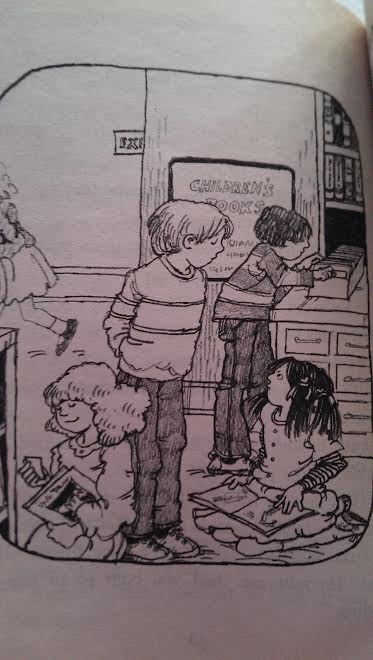
BeastMsRooneyPic1However, even though he’s embarrassed at having to attend special reading classes with Mrs. Paris while most of the rest of his class has normal reading, these special classes really help him, not just to improve his reading skills, but to connect with other kids in his new class who have the same reading difficulties he does and who understand how he feels.

Beast discovers that it’s no shame to not know something or to have trouble doing something because everyone has different skills and it can take some people longer to learn certain things than others.  Emily Arrow, the girl who now sits next to him in class is a whiz at math but has as much trouble reading as he does.  Beast learns some new skills from his new, younger classmates and realizes that they’re not really babies.  They also really appreciate him and help him see some of the good things about himself.

The book is currently available online through Internet Archive.

Journeyman Wizard

JourneymanWizardJourneyman Wizard by Mary Frances Zambreno, 1994.

This book is the sequel to A Plague of Sorcerers.

Jermyn Graves has finished his apprenticeship and is ready to move onto his Journeyman studies.  As a Spellmaker, an especially rare type of wizard, he really needs to study with a Master Spellmaker, and for years, there has only been one in the Wizard’s Guild: Lady Jean Allons.  Jermyn’s current teacher, Theoretician William Eschar, once studied under her himself.

Mistress Allons is a formidable old woman, and Jermyn is nervous about going to live with her and completing the next part of his training. Master Eschar says that she is strict but an excellent teacher, and he has fond memories of her from his own youth.  However, much has changed for Mistress Allons since those days.

Mistress Allons lives in her manor house in the small town of Land’s End with her widower son-in-law, Duncan, and her granddaughter, Brianne, who is only a little younger than Jermyn himself. Since the death of her only daughter, Annalise, in a mysterious accident during a magical experiment, Mistress Allons has not really practiced magic and no longer even keeps a familiar.  As Jermyn soon learns, everyone in Land’s End is still haunted by Annalise’s death.

Although Brianne has magical talent, both her father and grandmother refuse to let her study magic.  In defiance and because her talent will not allow her to leave magic alone, Brianne has taken to studying magic with a local Hedgewitch, Maudie.  Hedgewitches, or Wise Women as they call themselves, practice a very natural form of magic, but it can also be very dangerous because of its raw, undisciplined nature.  Although magical accidents are usually rare, that type of magic is more prone to them than the more formal kind that Jermyn is studying.  Jermyn tries to convince Brianne of the danger, but Brianne sees it as her only hope for learning anything, in view of her father and grandmother’s opposition.

Jermyn is not there for very long before Mistress Allons herself dies, the victim of another strange magical accident. Was it really just a terrible accident, or was it actually murder?  Jermyn struggles to find the answers while some people believe that he may have been responsible for Mistress Allons’s death himself.

I enjoyed the fascinating combination of mystery and fantasy in this short series.  While Jermyn’s magical studies are fictional, the book has some interesting insights into cross-disciplinary studies as Jermyn comes to understand something that Mistress Allons was trying to explain to him about using lessons from art and science to solve magical problems because different fields of knowledge are connected and the principles of one discipline have some bearing on the other.

There is also something interesting that Jermyn says to the evil wizard who is responsible for everything about how he can’t really do all the things that he thinks he can do (specifically flying) because the kind of drugs that evil wizards use to boost their powers also cause hallucinations.  When I was in college, I did a report about witchcraft trials, and some of the plants used by supposed “witches” in their potions also had hallucinogenic properties, which is probably the origin of the belief in flying witches.  Just an interesting little cross-over from real history.

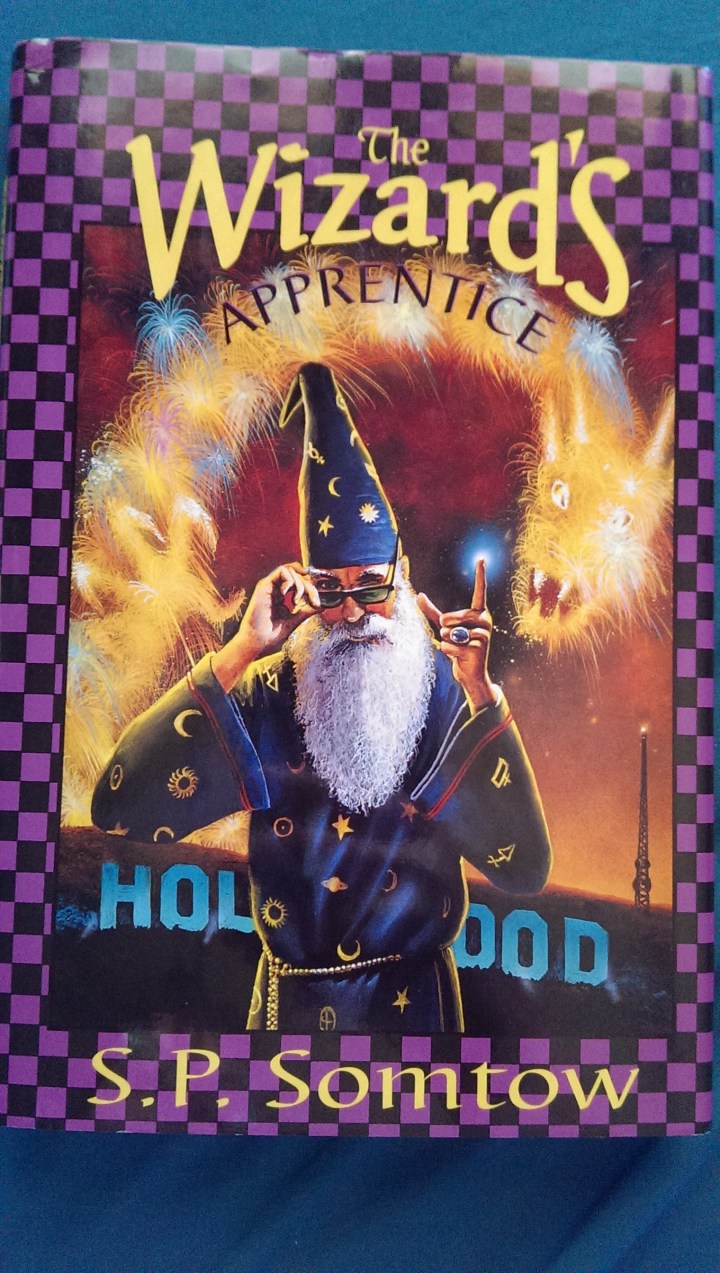
The Wizard’s Apprentice

WizardsApprentice

The Wizard’s Apprentice by S.P. Somtow, 1993.

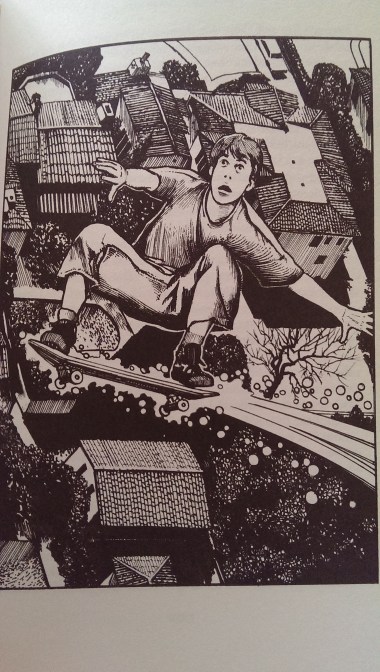
WizardsApprenticePic1Sixteen-year-old Aaron Maguire thinks of himself as a typical teenager, even though his family is far from typical.  His mother is a buyer for a fashion boutique, and his father does special effects for monster movies in Hollywood.  They’re also officially “separated” and preparing for a divorce, even though they’re still living in the same house.  So far, they’ve just kind of divided the house in two in order to have their own space.  Aaron goes back and forth between the two halves of the same house as his parents share him.  It’s a little weird (and, to Aaron, also a little depressing), but there’s weirder to come.

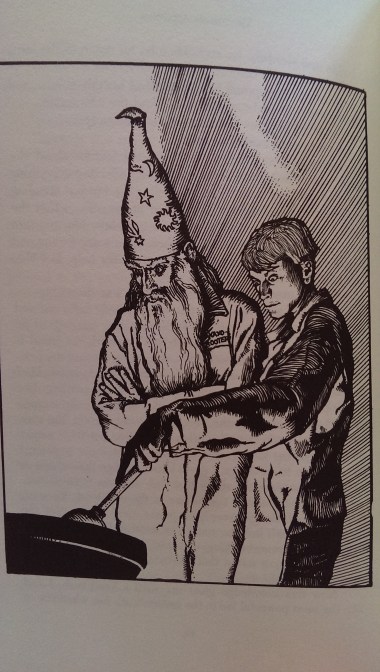
An old man approaches Aaron and tells him that he’s destined to be a wizard and that he will teach Aaron what he needs to know.  At first, Aaron thinks this man is nuts and probably homeless, but what he says is true.  The old man is the wizard Anaxagoras.  Anaxagoras demonstrates to Aaron how the skateboarding maneuver he had just pulled off defies the laws of physics and tells Aaron things about his personal life that no one should know (how angry he is with his parents about their separation and about his crush on Penelope Karpovsky, a girl he knows from biology class).  He also changes the dollar Aaron had offered him into a $100 bill and shows him that they can travel to magical lands and even through time.  Although Aaron still has trouble believing what he sees (his father does special effects for a living, after all), he becomes Anaxagoras’s apprentice.

Partly because Aaron still has doubts and needs something physical to convince him of the wizard’s powers and trustworthiness, Anaxagoras gives him a mirror.  It looks basically like an ordinary pocket mirror with a neon pink frame, but Anaxagoras invites him to ponder it and figure out what it does, telling him that what he does with it is important.

WizardsApprenticePic2However, when Aaron meets the divine Penelope for pizza and she asks to borrow a mirror to check her hair, Aaron lets her borrow Anaxagoras’s mirror.  He instantly regrets it because the mirror suddenly changes in Penelope’s hands.  Now, it has a tortoiseshell frame and is shaped like a heart.  Penelope, who has low self-esteem in spite of her prettiness, is suddenly really happy when she looks in the mirror and refuses to give it back, insisting that she wants to borrow it for a few days.  Because Aaron is in love with Penelope, he finally agrees to let her keep it for awhile.

When Aaron tries to tell Anaxagoras about Penelope borrowing the mirror, he doesn’t seem concerned.  He just hurries Aaron on to his next lesson, which involves a plumbing problem.  Anaxagoras’s lessons are pretty weird, although Aaron finds himself learning that there is more magic in the everyday world than he ever suspected.

Aaron later attempts his own feat of magical plumbing at the studio where his dad is working and encounters a creature of darkness.  The mirror gets out of his hands, and he enchants a car in order to chase it down.  Finally, a dare from some classmates causes him to unleash a dragon on the unsuspecting city, one that only Aaron can understand and defeat, once he realizes the true nature of his magical mirror.

Aaron has a distinctive voice as a California teenager, and his first experiments with magic lead him to some surprising discoveries about himself which help him to understand and reconcile his feelings about his parents’ divorce.

Going to School in 1776

School1776Going to School in 1776 by John J. Loeper, 1973.

The grass is green,
The rose is red,
Remember me
When I am dead.

Ruth Widmer”

This is a non-fiction book about what it was like for children to go to school around the time of the American Revolution.  The quote that begins the book, a short poem, was written by a real girl from 1776 in her copybook.  The book’s introduction says that it was included to remind readers that, “History is not just facts.  History is people.”  Part of the purpose of the book is to remind people about the lives of ordinary people, of real children, making history come alive in a way that mere recitation of important names and battle dates never can.

The book explains some basic facts about the Americas in 1776 and what led up to the Revolutionary War.  Then, it begins discussing what it was like to be a child at the time in different parts of the American Colonies.  The colonies were largely rural and even major cities were not the size that they are today.  However, there were differences in the ways families lived and the type of education the children received, depending upon where they lived and if they lived in towns or in the countryside.
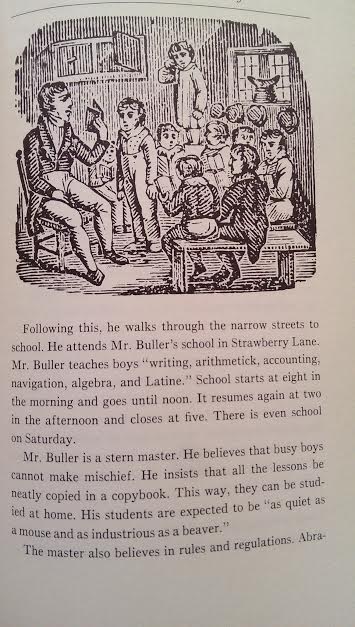
School1776Pic1These explanations are told in story form, rather than simply explaining listing the ways children could live, learn, and go to school, trying to help readers see their lives through the eyes of the children themselves.  The children’s lives are affected by the war around them.  As the book says, many town schools in New England were closed during the war, so the students would attend “dame schools” instead.  A dame school was a series of lessons taught in private homes by older women in the community.  In other places, such as cities like Philadelphia, official schools were still open.  Discipline was often strict, and school hours could be much longer than those in modern schools.  Sometimes, children would argue with each other over their parents’ positions on the war.

Some schools were similar to modern public schools, open to all children of a certain area and operated by the town fathers.  Others were church schools and included religious lessons.  Families with money were more likely to send their children to school than poorer families, who could not always afford tuition, although public schools would not always charge the students an extra tuition fee because the schools were funded with local taxes.  These systems varied throughout the colonies, and poor children in the South were less likely to be formally educated.  Wealthy plantation owners would open schools for the upper class children, and lower class children might receive lessons in “field schools.”  The field schools were just occasional, informal lessons given to the children in the fields by any adult who happened to be interested in the task.

Teaching in schools was not easy.  Sometimes, teachers were itinerant, moving from one school to another and finding work in agricultural areas between the growing seasons, when children would be free from chores to attend school.  Some teachers were even indentured servants, forced to remain in the employ of a person to whom they were indebted, often because that person paid for their passage from Europe to the Colonies.
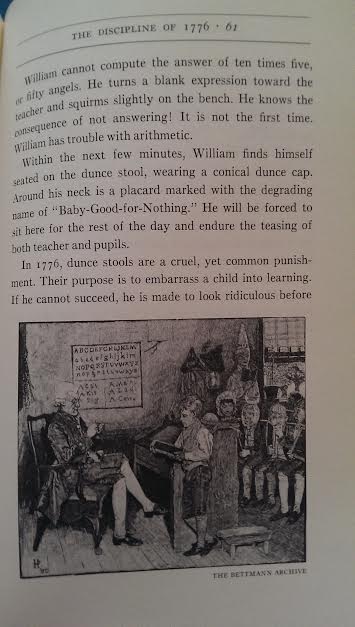
School1776Pic2There were different standards for what girls and boys were expected to learn because their learning was guided by what they were each expected to do with their adult lives.  A typical school might teach boys subjects like, “writing, arithmetick [sic], accounting, navigation, algebra, and Latine.”  Generally, “reading, writing, arithmetic, and religion” were common elementary school subjects.  Latin lessons and other advanced subjects were typically for boys who planned to become lawyers or clergymen.  Girls were likely to receive little formal education beyond reading and writing, and black people were less likely to receive even that.

Of course, not every child went to school.  There were other ways for children to learn, depending on what they expected to do with their lives.  Apprenticeships were common.  Boys would go to live in the house of a person with a particular profession and learn that profession from the master.  Aside from basic training for a profession, the master would provide room, board, basic necessities such as clothing, and training in the “three Rs”, which were “reading, ‘riting, and reckoning.”  In return, the apprentice would provide his master with his labor for a period of time.

Girls could also serve apprenticeships, although theirs were more focused on the domestic arts because most of them were expected to marry, and they often married young, about the age of sixteen.  Beyond reading and writing, girls would also learn practical skills such as various kinds of needlework and also music and dancing.  The book describes in some detail the various types of needlework a girl could learn and the materials they used.  Typically, girls would create a “sampler” to show off all the stitches they’d learned, kind of like an apprentice’s master piece or a certificate of completion done in cloth.  Unlike modern “samplers”, these would not be just cross-stitch alone because the idea was for the girl to demonstrate her skill and versatility, and using only one stitch would not impress anyone.  Commonly, the sampler would include the alphabet and the numbers one through ten, which would all be done in cross-stitch (which was the basic embroidery stitch), but there would also be an inspirational quote, message or Bible verse, the girl’s name and the date of the sampler’s completion, and other decorative embellishments, which would be done in other stitches such as tent stitch, eyelet stitch, chain stitch, and French knot.  There could be as many as twenty different types of stitches in a single sampler, depending on the girl’s skill and what she had learned.  Girls hoped to do at least as well as their mothers in terms of the number of stitches they knew and skill in execution.

There are also sections in the book which describe the lessons that children learned, the types of school books they used, discipline in the classroom, ways children liked to have fun, and types of clothing that children wore in 1776.

This book is currently available through Internet Archive.
The Secret at the Polk Street School

The Polka Dot Private Eye

SecretPolkStreet#3 The Secret at the Polk Street School by Patricia Reilly Giff, 1987.

Dawn’s class is competing against other classes in a contest to see which class does the most for the school.  All of the classes are working on their own special projects, trying hard to keep them a secret until the judging.  Dawn, as the class’s resident detective, suggests that she could solve a mystery on behalf of the class, but unfortunately, there is no mystery for her to solve.  Yet.

Instead, Ms. Rooney’s class decides to put on a play for the rest of the school.  It’s Little Red Riding Hood, and Dawn is playing the starring role.  Jason gets to be the Wolf, borrowing an old wolf costume from his sister without her permission.

At the class’s rehearsal, Dawn gets mad when someone dressed in the wolf costume tries to scare her, and she thinks that it’s Jason, goofing off.  But, it turns out that Jason wasn’t even there, and the wolf costume is missing.  Suddenly, Dawn has a mystery!

Dawn starts receiving messages from “The Wolf” saying that someone is going to get her and Jason.  Then, someone takes a bite out of the loaf of bread that Dawn has been using as a prop (the food that she’s taking to “Grandma’s House” in the play).  Could “The Wolf” be someone in a rival class, hoping to sabotage their play so they can win the contest?

The book is currently available online through Internet Archive.

Mystery of the Roman Ransom

romanransomMystery of the Roman Ransom by Henry Winterfeld, 1971.

This is the sequel to Detectives in Togas, a mystery story about a group of boys in Ancient Rome.  Like the first book, it was originally written in German and translated into English.

On Xantippus’s birthday, his students decide that they want to give him a special present because they think he’s turning 50.  Actually, it turns out that they did their math wrong because Xantippus (whose real name is Xanthos and only known as Xantippus as a nickname among his students) was born in Athens, and the Greeks use a different dating system from the Romans.  His Roman students forgot even after he had explained that in their history lessons, which really annoys him.  He is also really annoyed that the special present they decided to give him was a slave of his very own so that he can concentrate on his studies while the slave does all of his chores.  Xantippus points out that, far from being a present, slaves are actually a burden because there are extra expenses for owning them and it would end up costing him more money than he could afford (much like the “free” cars that Oprah Winfrey gave to some of her audience members), and Xantippus wants no part of it.  He gives the boys the day off from lessons to reward them for being thoughtful (although, not quite thoughtful enough), and tells them to return the slave to the dealer who sold him and get their money back.  But, it turns out that this slave isn’t just any ordinary slave.

romanransompicWhen they return to the slave dealer’s home, he is gone, and the place is boarded up.  An elderly slave who was left behind said that all of the other slaves were sold, and then the dealer simply fled, abandoning him.  He also says that there was someone else who had come to see the dealer, demanding that he hand over the slave called Udo (the one that the boys had already bought).  This man was a former gladiator with only one eye, and he was very angry that Udo was gone.  He swore that he would he would get Udo one way or another, dead or alive.  He threatened the dealer, saying that he would return later and kill the dealer and all of his slaves if Udo was not among them then.  The slave dealer, not knowing the names of the boys who had bought Udo or where he could be found and therefore unable to get Udo back, fled in fear of the former gladiator’s threats.
During this time in Rome’s history, crime rates were high because gangs of ex-gladiators, runaway slaves, and criminals roamed the city, robbing and terrorizing the citizens.  The boys soon learn that the dealer’s fears were well-founded when the ex-gladiator finds them in the marketplace while they are trying to decide what to do with Udo.  He tries to take Udo from them by force, but they fight with him and manage to escape by dumping a pail of honey over his head.

Once the boys are safely away and in their secret hideout with Udo, he reveals his true story to them.  At first, they had believed that Udo was deaf and mute because he acted like he couldn’t speak, but he tells them that he was afraid to do so because he is a hunted man.  He was the slave of a powerful Roman army commander now stationed in Germania.  He was sent to Rome by his master in order to deliver an important letter, but upon learning that he would be killed after handing over this letter, he did not complete his mission.

The meeting was to take place in a cemetery at midnight, and when Udo arrived, he became frightened and hid.  Then, he overheard his contacts, two men who did not seem to even know each other, talking about how he would be eliminated after passing on his message.  Now, these men are looking for him for the message that he did not give to them, and Udo cannot go back to his master because his master would probably kill him for disobeying orders.

Udo discovered that the letter contained instructions for an assassin to murder an important Roman senator, and upon learning that, all of the boys are immediately worried because they are all the sons of senators.  They demand to know which senator will be murdered, but Udo cannot tell them because that information was in the letter, and he lost it after he fled from the cemetery.  He thinks that it’s in a cellar where he hid and spent the rest of the night before he was found by a group of gladiators who sold him as a slave the next day.  Now, he’s not quite sure where that cellar was.  Udo also says that his master will arrive in Rome himself in three days and will probably just pass on the name of the intended target to the assassins then when he learns that Udo didn’t.  With time running out and their fathers’ lives possibly on the line, the boys and Udo struggle to find the letter and stop the assassination plot before it’s too late!

In Ancient Rome, slaves were common among the wealthy, and owners had the power of life and death over them.  They could punish a slave severely for even a small mistake, abandon them if they were sick or elderly, and even sell them to the gladiatoral arenas, where they would have to fight for their lives or die as public entertainment.  To the boys in the story, such things are simply facts of life as they have always known it.  Rome in general was a violent place.

The book is available to borrow and read for free online through Internet Archive.

Detectives in Togas

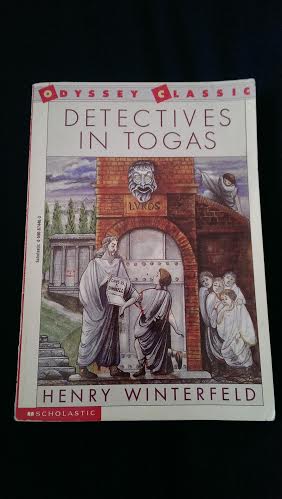
detectivestogasDetectives in Togas by Henry Winterfeld, 1956.

Seven Roman boys, all the sons of wealthy families, attend the school run by the Greek mathematician and scholar, Xanthos. Although the boys are proud of their school, the lessons are sometimes boring, and everyone has given Xanthos the nickname Xantippus, in reference to the wife of Socrates, who was known for her nagging.

During a rather boring lesson on Greek vocabulary, a fight breaks out between two of the students that ends up creating a strange mystery for all of them. Caius was poking Rufus with his stylus, so Rufus wrote “Caius is a dumbbell” on the wax tablet where he was supposed to write his lesson. The boys get into a fight, and when Xantippus breaks it up, he sends Rufus home with the threat that he will expel him from the school.

detectivestogaspicThe next day, when the other boys arrive at school, they discover that their teacher has been attacked and robbed during the night. Worse still, when they go to Rufus’s house to visit him, they learn that someone has written “Caius is a dumbbell” on the side of the Temple of Minerva, which has been dedicated to the emperor. Defacing a temple is a crime, and soon Rufus is arrested and sent to prison (being young and part of an important family does not guarantee him special treatment). Rufus swears that he was not the one who defaced the temple, but who else could have done it?

Rufus disappeared that night, but if he didn’t go to the temple, where was he? Does the vandalism have anything to do with the attack on their teacher?  The key to the mystery seems to be a mysterious soothsayer with ties to some of the highest officials in Rome. Something sinister is happening in Rome, and the boys are the only ones who can discover what it is!

This story was inspired by a piece of graffiti found during excavations of Pompeii in 1936. (This video doesn’t actually show the Caius inscription but similar types of graffiti, including ones done by children. I keep looking for the Caius graffiti, but I can’t find pictures of it. This video of a lecture at the Western Australian Museum about ancient graffiti in Pompeii shows the more graphic adult kind of graffiti with swear words, if you’re interested.) In ancient Pompeii, someone wrote “CAIUS ASINUS EST” on the wall of a temple, which basically means “Cauis is a dumbbell” (or similar type of insult) in Latin.

Although the book was originally from 1956, it was also originally written in German. I have a later reprinting that was translated into English.  The book is available to borrow and read for free online through Internet Archive.  There is a sequel called Mystery of the Roman Ransom.