
Molly Learns a Lesson by Valerie Tripp, 1986.
 In 1944, everyone is concerned with finding ways to help the war effort. In Molly’s third grade class at school, her teacher announces that their class is invited to participate in the Lend-a-Hand contest. The class will be divided in half, and each half will compete against the other to find the best way to help the war effort. The class decides to make the contest boys against girls, and Molly immediately starts trying to figure out a spectacular idea that will impress everyone. Unfortunately, one of the other girls says that the girls in class should knit socks for soldiers, and the teacher accepts that as the goal for the girls’ team, before Molly can say anything.
 Molly is appalled at the idea of knitting socks. It’s partly that she had wanted to be the one to come up with the best idea, and it’s also partly because she has tried knitting before, and she knows that socks are difficult, time-consuming projects, especially for beginning knitters. Molly is sure that the other girls are going to find it too difficult and that, in the end, they’ll have nothing to show for their project. Her friend Susan doesn’t think that the project sounds so bad, but Linda also dreads the idea of knitting because she’s not very good at it. Talking it over in their secret hideout in the storage area of Molly’s garage, the three girls decide that they’ll work on a secret project by themselves, something that will save the day when the other girls’ project falls through.
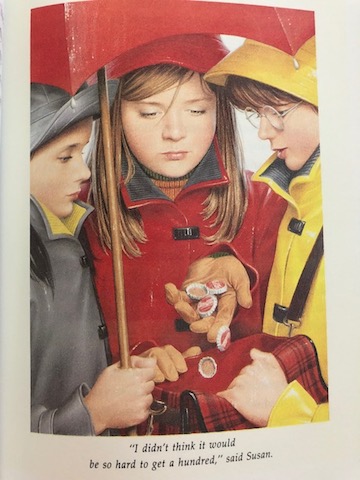
At first, the idea of doing something in secret sounds exciting. However, coming up with a good secret project and seeing it through turn out to be more difficult than they expected. All they can think of to do is to collect bottle tops for scrap metal, and as they go door to door in the rain, asking for them, they learn that most people have already given theirs to the Boy Scouts who were collecting scrap metal. Tired, wet, and discouraged, the Molly and her friends decide to look in on the other girls and see what progress they’re making.
 The other girls are certainly a lot more comfortable, knitting inside. However, as Molly predicted, they are finding their project harder than they thought it would be. None of them has completed an entire sock yet; all they really have are the square shapes at the top of the sock, and they’re getting discouraged. That’s when Molly gets a better idea: why not take the squares they’ve made and turn them into a blanket? Simple squares are much easier to make than socks, they can make a lot of them quickly with everyone helping, and the girls who can’t knit well can sew the squares together. A blanket is still a good war effort project because Molly’s father has told her that the hospital where he works is always in need of blankets for the wounded soldiers. With this new idea, the other girls become much more excited, and they make more progress.
The theme of this story is that working together and sharing ideas benefits everyone more than working alone or trying to be too competitive. Molly’s first ideas weren’t very good by themselves, and neither was the sock-knitting idea. However, when Molly and her friends join the other girls, Molly finds a way to help them build on the idea that they already had (knitting) and take it in a better direction. Molly and her friends also explain to the other girls about the bottle tops they were trying to collect, and some of them think of other places where Molly and her friends didn’t go for their collecting. All of the girls working together manage to finish the blanket and collect 100 bottle tops in a single day, surprising and pleasing their teacher.
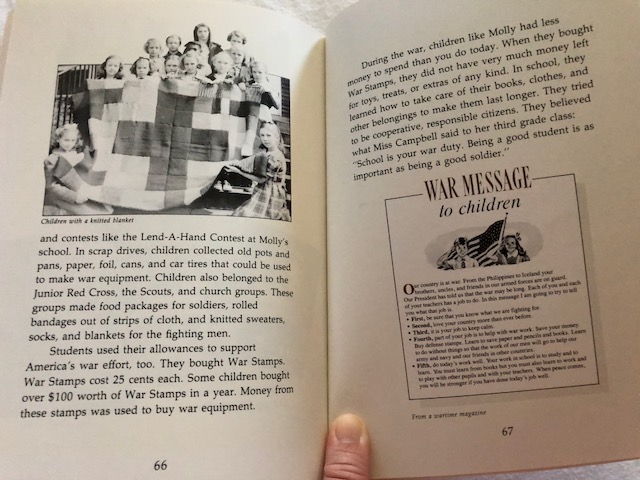
In the back of the book, there is a section with historical information about what it was like to go to school in America during World War II. Discipline was more strict than it was in schools during the late 20th century, and there was also more separation between boys and girls. Sometimes, boys and girls going to the same school and attending the same classes played on completely separate playgrounds, and sometimes, they even had to enter and exit the school through different doors (this is something that was also mentioned in the book Cheaper By the Dozen, which takes place during the late 1910s/early 1920s). Teachers emphasized patriotism and taught the children about the war, why soldiers were fighting, and what life was like in other countries that were involved in the war. It was common for schools to have drives to collect scrap metal or other materials to help the war effort. Special projects like knitting clothing or blankets for soldiers were also popular.
The book is currently available online through Internet Archive.



 The Haunting of Grade Three by Grace Maccarone, 1984.
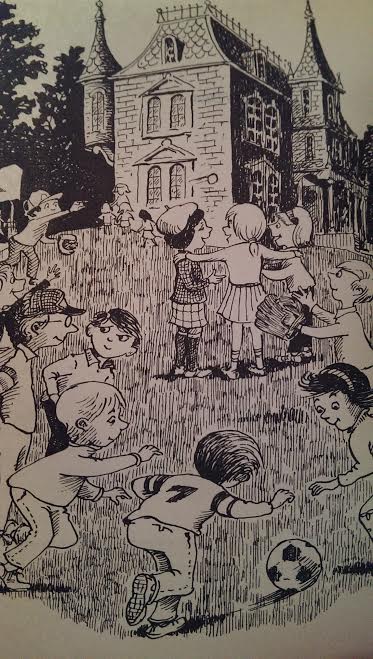 Most of the group members are misfits in one way or another. Norma Hamburger is a shy girl, frequently teased about her last name. Debbie Clark is a talkative girl who’s really into science. Chuck Webber, Adam’s best friend, is the class clown, always telling stupid jokes (and one of the main people who teases Norma about her name). Danny Biddicker is strong and good at sports, but he worries that he’s not as smart as the others. Joey Baker feels overshadowed by his large family, so he tells tall tales to get attention. The other kids don’t understand and get annoyed with his lies. By working together, they not only learn the secret of Blackwell House, but they learn more about each other and become a real team and friends.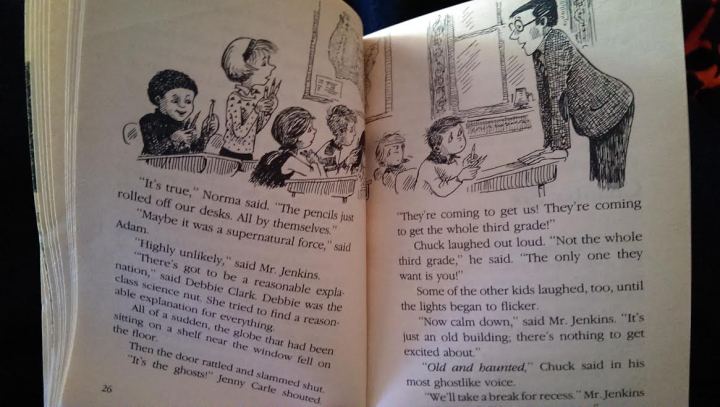
 Jestress's Forgotten Books and Stories