Danny Dunn and the Homework Machine

Danny Dunn

At the beginning of the book, Danny develops a device that allows him to do his homework and his friend Joe’s homework at the same time by using a system of pulleys and a board that holds two pens at once. (This seems like an unnecessarily complicated device, since he and his friend could accomplish the same thing just by sitting next to each other and talking over their answers as they both write them down at the same time, although Danny says that he plans to build a second pen board so Joe can work on their English homework at the same time as Danny does their math homework.) Danny thinks that it would save even more time if he could find a way to build a robot that will just do the homework for them, but Joe warns him to be careful because things often go wrong with his inventions.

Joe leaves to get more materials for their homework device, and suddenly, Danny is surprised by a tapping at the window, and he sees a girl’s face looking in at him. It’s surprising because Danny is on the second floor of his house. At first, he thinks that this girl who seems to be hovering in the air must be from outer space or something, but it turns out that she’s just an ordinary girl on a ladder.

The girl tells Danny that her name is Irene Miller and that her family just moved in next door. Her father, Dr. Miller, is an astronomer who will be working at Midston University. The reason why Irene is up on a ladder is that she’s built a weather balloon, and now, it’s stuck on the roof of Danny’s house. Unfortunately, she’s just discovered that her ladder isn’t quite long enough to reach the roof. Danny, who loves science, is intrigued by Irene’s weather balloon, and he helps Irene retrieve it by climbing out an attic window and onto the roof.

Danny shows Irene his device for doing homework, but Irene says it doesn’t seem quite honest because it’s basically like copying from someone else. Danny defends his idea, saying it’s not really cheating if the second person actually does know how to do the homework and would give the right answers anyway. He just sees it as a time-saving device. He also says that Professor Bullfinch, an inventor and physicist at the university, says that homework isn’t relevant to the learning kids do in the classroom. Danny’s father is dead, and his mother is Professor Bullfinch’s housekeeper, so Danny and his mother live with him.

Danny is surprised at how much Irene knows about science because he didn’t think girls would be into science. Irene says that there have always been female scientists, like Marie Curie, and she also wants to study physics. Although Danny has learned a lot from Professor Bullfinch, he’s a little intimidated that there are things that Irene knows that he doesn’t.

When Joe returns, he isn’t enthusiastic that Danny has made friends with a girl. When Joe is derisive about women and girls, Danny even defends Irene and how much she knows. Irene confesses to Danny that getting her weather balloon stuck on the roof wasn’t an accident. Her mother had already talked to Danny’s mother, so she knew Danny was interested in science. She purposely got the balloon stuck on the roof to get his attention and give them a reason for meeting. Joe uses that as part of his assertion that women are trouble.

Irene joins Danny and Joe’s class at school, and she starts making some other friends there. There is one boy in class, Eddie, who seems to have a crush on Irene. She’s a little flattered that he thinks she’s pretty, but she begins to feel uncomfortable with his attention because he keeps staring at her. Danny explains to Irene that people call Eddie “Snitcher” because he’s always telling on somebody for things they do, seemingly out of spite.
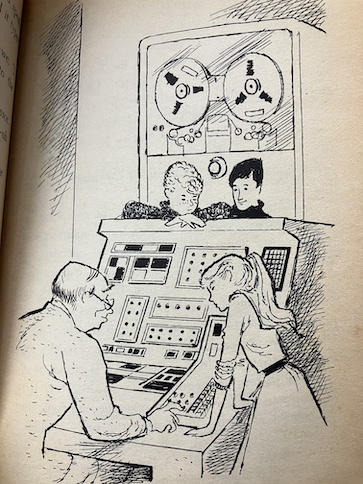
When Danny invites Irene to come to his house for cookies after school, Professor Bullfinch surprises them by telling them that he’s going on a business trip, and while he’s gone, he’s going to let Danny take care of his new computer. The computer is called Miniac, which is short for “miniature automatic computer.” It’s much smaller than most computers of its time. During the 1950s, computers could take up an entire room. The Miniac is about the side of a large sideboard.

Joe asks Professor Bullfinch how the Minaic works, and he explains that they can ask it questions through a microphone. The computer prints out answers with an electric typewriter. Irene asks if they can ask it a question to see how it works, and she asks the Miniac a question from their homework. Joe is amazed at how quickly the computer answers the question, and Professor Bullfinch explain a little more about how computer work, with a memory unit that stores information. He says that facts are stored on magnetic tape. (This was true at the time this book was written, although 21st century computers are constructed differently, in ways that allow them to be made much smaller than 1950s computers. What he says next about the nature of computer intelligence is still true, although I’m going to have some things to say about AI in my reaction section.)

Irene marvels at how the computer seems almost like something from science fiction (for her time) and how amazing it is to have a device that can give you the answers to everything. Professor Bullfinch explains to her that’s not quite true, and that there’s something more amazing: the human mind.

It is only a kind of supertool. Everything in this machine is inside the human head, in the much smaller space of the human brain. Just think of it — all the hundreds of thousands of switches, core memory planes, miles of wire, tubes — all that’s in that big case and in this console — are all huge and awkward compared to the delicate, tiny cells of the human brain which is capable of doing as much as, or more than, the best of these machines. It’s the human brain which can produce a mechanical brain like this one. … The computer can reason … It can do sums and give information and draw logical conclusions, but it can’t create anything. It could give you all the words that rhyme with moon, for instance, but it couldn’t put them together into a poem. … It’s a wonderful, complex tool, but it has no mind. It doesn’t know it exists.”

Danny’s assignment while the professor is away is to feed data to the computer. The professor has laid out the information and code tables that Danny will need, although the professor says that Danny can add some extra information if he comes across something new and interesting in Scientific American or one of the other science magazines he reads. Irene asks if she can help with this task because she finds it interesting, and the professor gives her permission. Before he leaves, he warns Danny not to get too carry away with his enthusiasm. He knows that Danny likes to experiment, and sometimes, he gets carried away when he has an idea, without stopping to think first. The computer is a tool, not a toy, and the professor wants him to treat it as such.

However, a few days after Professor Bullfinch leaves, Irene has a question about their homework that Danny and Joe can’t answer because they also don’t really understand the subject. Then, Danny gets the idea of asking the computer about it. Inspired by how easily the computer answers the question, Danny suggests to the others that they use the professor’s computer as a “homework machine.” After all, it can answer questions and supply them with information, and Danny thinks he could even program it to write short compositions. Irene is a bit dubious about it, but Danny amends his idea to say that the computer would “help” them with their homework.

The book is available to borrow and read for free online through Internet Archive (multiple copies).

One of the interesting things about reading a vintage book like this that focuses on the technology of its time is seeing how things have changed and how people’s perceptions of technology have changed. The kids in this book are amazed by the professor’s computer, which is cutting edge for their time, although 21st century children grow up accustomed to computers in their homes that they are allowed to use. Modern children do use computers as toys, playing computer games, and they are also tools for doing homework.

However, even though things have greatly changed in the decades since this book was written, some of the issues surrounding the ethical use of technology are still concerns in the modern world. This story brings up the issue of how much a reliance on technology to do homework borders on cheating and keeps students from gaining the skills they’re supposed to use. This has become a major issue in modern education in the 2020s, with the rise of AI technology. In the story, Professor Bullfinch says that a computer cannot write poetry, which might get a smirk from modern readers because AI has achieved compositional writing skills. What I’d like to point out, though, is that there are still limits on that. As of this writing, the ideal way to use AI in writing is as a starting point for writing and research but not as a replacement for human writers or the human mind to edit and control the content of the writing. AI also uses human writing as the basis for its compositions, not writing everything from scratch:

“… an AI writing tool will gather information based on what other people have said in response to a similar prompt. The bot will search the internet for information about what you’ve asked it to write, then compile that information into a response. While this used to come back as clunky and robotic, the algorithms and programming for AI writers have become much more advanced and can write human-like responses. … AI writers are, so far, limited in their abilities to create emotional and engaging content. Humans, by nature, are storytellers. We have been since the beginning. Robots, however, are not. They are limited by what they’re programmed to do, and AI bots are programmed to gather information and make an educated guess about what you want to hear.”

(AI Writing: What Is It And How Does It Work?, July 2023)

Computers, even those in the 21st century, which are both smaller and more efficient than the ones from the 1950s, still rely on input from human sources to do anything. AI work is not original, it only builds on what humans have given it to use. In spite of the word “intelligence” in the name “artificial intelligence”, it still “has no mind“, as Professor Bullfinch put it. It’s literally artificially intelligent. It knows nothing independently of human beings, and one of the current problems with AI is that, although it can write convincingly and sound almost human, it not only does so only because it’s basing its writing on human writing that has been supplied to it but also, it has no idea whether or not anything it says is true or not. As the Microsoft article points out, it’s only using predictive technology to guess at what you want to hear and just tell you what you want to hear. It still takes a human being to reason out how much sense AI writing actually makes or whether or not it’s accurate.

One of the current problems with AI in the 2020s is AI hallucinations. Sometimes, AI seems to make things up that aren’t true at all because the way it processes information sometimes produces errors, and by itself, AI has no way of knowing when this has occurred. It has no understanding of the subject its writing about. It’s only attempting to predict and supply what it thinks the human who supplied the prompt wants it to supply.

“AI hallucination is a phenomenon wherein a large language model (LLM)—often a generative AI chatbot or computer vision tool—perceives patterns or objects that are nonexistent or imperceptible to human observers, creating outputs that are nonsensical or altogether inaccurate.

Generally, if a user makes a request of a generative AI tool, they desire an output that appropriately addresses the prompt (that is, a correct answer to a question). However, sometimes AI algorithms produce outputs that are not based on training data, are incorrectly decoded by the transformer or do not follow any identifiable pattern. In other words, it “hallucinates” the response.”

There are currently problems with students relying too much on AI to do both their thinking and writing for them, and even professionals who rely too much on AI tools to get through their work faster sometimes fail to notice when the AI writing says things that don’t make sense or are just blatantly untrue. The AI doesn’t know what’s true or not, it’s just telling you what it thinks you want to hear, based on information given to it, put together, and rearranged in its logic programming. Because it doesn’t actually understand the information fed into it, it has no idea when it gets the story wrong. Computers are faster at processing data than a human, but actual understanding of information is still entirely a human quality. A computer cannot understand anything on behalf of a human mind because it “has no mind” of its own to do the understanding.

There have been cases where professional lawyers who have relied on AI writing instead of doing their writing themselves have been sanctioned when AI hallucinations included information that was not only inaccurate but actually fictitious, citing court cases that never actually existed. The lawyers who received disciplinary action about this did not proofread the writing produced by AI, just trusting it to do all of their writing and thinking for them. Yet, the errors jumped out immediately when actual humans read the writing.

The more complex the writing is, the more the limitations of AI become apparent. AI can sound convincing in a short article (especially if you’re not doing any fact checking to see whether it’s talking about something real or not), but it isn’t always consistent or coherent in longer writing. The drama department of one of the local colleges where I lived put on a performance of a play written entirely by AI as a kind of thought experiment, and the results were hilarious. It was a mystery play, and the script was confusingly written. The AI had trouble keeping track of which characters were currently on stage and which were not, so actors who were not actually present in particular scenes had dialogue. At one point, when the detective was questioning everybody, he even talked to the person who was murdered, and the corpse responded. The play didn’t make sense because the AI doing the writing didn’t really understand the story it was telling. It just told a story in the pattern that was requested of it. It was, technically, a complete play, and if you gave it a cursory glance, it would have looked like a fully written play. It’s just that it had absent people and dead people talking. Perhaps at some point in the future, AI can do its own proofreading and learn to catch these types of problems, but for it to do so with the accuracy of an actual human, it would have to have a human level of understanding about the world and the subject matter it writes about. That is, it would have to have real intelligence, not just artificial intelligence.

This video from Wired on YouTube features AI and machine learning professor Graham Morehead from Gonzaga University, answering common questions about the nature of AI. In the video, he explains some of the differences between how AI “thinks” and how a human brain thinks, which help explain why AI can do some things that a human being would find pretty stupid. AI often thinks in terms of two-dimensional images as opposed to the three-dimensional world we live in as humans, and it doesn’t always understand the consequences of actions because, to AI, everything comes down to simple numbers and data as opposed to a physical world where actions have context and consequences.

Overall, I think this story did a good job of evaluating the differences between the human brain and the electronic brain at a point in history where the technology was relatively new and evolving. It also did a surprisingly good job of anticipating some of the developments and problems associated with the use of artificial intelligence, although the form it takes in this story isn’t quite what we’ve seen in the 21st century, and the kids in this story encounter an issue that modern students attempting to use AI to do their homework aren’t likely to encounter.

At the end of this story (spoilers), Danny and his friends come to realize, to their surprise, that they’ve actually been doing more homework than their classmates in order to make their wonderful homework machine function. They had to teach the machine the subjects they’re studying in order to have it do the assignments because the machine doesn’t innately understand the subject matter. The kids have to supply the knowledge base for the machine learning to function, and that ultimately takes more work and study for them than simply understanding the subjects in their own minds and just doing the assignments themselves. Danny’s mother and his teacher allow the kids to continue using the machine once Danny’s mother explains to the teacher how the process works so the kids can experience how a seeming shortcut can actually take more effort.

This is a little different from the 21st century AI tools, where someone else has already done the basic programming work, and students don’t have to actually understand the subjects themselves to use the AI tools. Of course, if the student doesn’t understand the subject matter of the assignment, there’s less chance that they’ll even notice when the AI produces an AI hallucination and says something that isn’t true or doesn’t make sense. There is an incident in the book where the computer messes up and outputs something that makes no sense, and the kids have to figure out why it did that.

The kids also consider the issue of whether or not using the machine to do their homework is cheating or not. Irene has serious reservations about it at first, and their teacher and some classmates think it gives them an unfair advantage when they find out. Danny, on the other hand, defends it, thinking of the computer as just a time-saving tool, like a typewriter, although the computer is doing more for them than a typewriter does. Danny is only focused on the idea of saving time so he can do things other than homework because he’s confident in his own ability to understand the academic subjects and thinks that practicing his skills or proving his knowledge through homework is a waste of his time.

The only reason why the teacher agrees to let them continue using the computer is that Danny’s mother figures out before he does how much extra work he and his friends are doing to teach the computer how to do their homework. This becomes obvious after the teacher gives them a special assignment, beyond what was covered in class, so Danny and his friends have to work extra hard and spend far more time to understand the material themselves and then teach the computer to understand it well enough to do the work. The first assignments weren’t so hard for Danny and his friends to teach the computer how to complete because the kids are at the top of their class, and they do know the material. However, the more difficult the assignments get, and the less familiar they are with the subject matter, the harder it gets to program the computer to handle the assignments. This exposes the flaws in their system and highlights the need for them to understand the material themselves rather than depend on the computer to do their work for them or even necessarily do it more efficiently. The great use of computers is to do tasks more efficiently, but that depends on the task and whether or not the computer has accurate instructions and an efficient knowledge base to draw on to do it. Building the programming and the knowledge base takes the work of a human mind that knows what it’s doing and is willing to put in the effort to do it correctly and to troubleshoot errors.

In this book, we get a glimpse of school in the 1950s. Something that stood out to me was when the teacher mentions that the class sizes have grown considerably in recent years, meaning that she has less time to work with individual students than she used to. This was a real problem in the 1950s, due to the effects of the Baby Boom. This generation of children was much larger than previous generations, so there were shortages of teachers and class space, and teachers and students did complain that students got less individual attention. (This documentary on YouTube shows some of the overcrowding.)

The focus on science and technology in the Danny Dunn stories is also important to the 1950s because that was the beginning of the era of the Cold War technology race, exemplified by the Space Race. The capitalistic United States and its allies competed against the USSR and its allies for world supremacy following WWII, and one of the ways they did that was by trying to develop superior technology and technological skills. This need to compete in the areas of science and technology led to changes in the US public education system, emphasizing the skills that we would call “STEM” skills today (science, technology, engineering, and mathematics). Echoes of those changes still influence the way we think about education in the 21st century.

This technological and scientific focus also influenced children’s entertainment, as adults tried to encourage children to take an interest in science and technology. The Danny Dunn series is one example of this, showing children who are interested in science and new inventions and portraying them as fun and exciting. Another example was the educational tv show Watch Mr. Wizard, which was being broadcast at the time the Danny Dunn books were written and published. Watch Mr. Wizard featured the title character performing experiments in his laboratory and demonstrating scientific concepts to child visitors. It was very popular, and in the 1950s, there were science clubs for children based around this show. This show also helped inspired new generations of shows with a similar premise, such as Bill Nye, the Science Guy, which was popular when I was a kid.
The Magicians’ Challenge

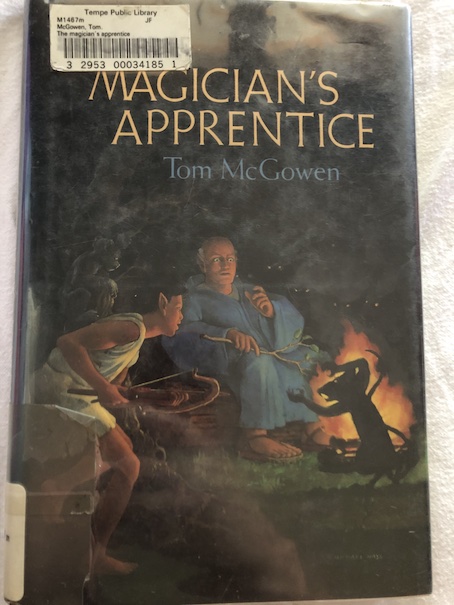
The Magicians’ Challenge by Tom McGowen, 1989.

This is the third book in The Magician’s Apprentice trilogy. It picks up soon after the second book, with the magician Armindor, his apprentice Tigg, Jilla, and Reepah the grubber on their way to the city of Ingarron, where Armindor and Tigg were originally from. They’ve already told the people of the city of Inbal of the threat posed by the reen, the ratlike creatures that are scheming to take over the world by finding old forms of lost technology and using them to dominate and destroy humanity.

Before they return to Ingarron, they want to stop in Orrello and take care of some business there, letting that city know about their discoveries about the reen and the ancient technology they’ve uncovered. On the ship to Orrello, they begin to get some insight into one of the pieces of old technology they’ve uncovered – the magnetic compass. When they first found it, they didn’t know what purpose it served. All they could tell about it was that the compass’s arrow always points in one direction, no matter how you move it. When they show it to the captain of the ship, he says that he could see a purpose in having such a thing if it pointed to a place that he knew he wanted to go, and Tigg begins to realize that the compass doesn’t point to a specific place but the general direction north. They still have a concept of north and south as directions, but they don’t think in those terms unless they’re comparing one known location to another known location, which is why they didn’t think of it before. Armindor is overjoyed at the revelation. Their people currently depend on known locations or observing the sun and stars in the sky to find their way, but with a compass (which they consider a “spell” of finding your way), people could navigate even in unfamiliar areas where the sky isn’t easily visible. This is the sort of thought and investigation that “magicians” (scientists) have had to do since the old technologies were lost and forgotten following a great nuclear war. After thousands of years, people are starting to rebuild society and redevelop technological knowledge, but because they don’t yet understand most of the principles behind it, they think of it as “magic” and “spells.”

However, as they are about to arrive in Orrello, they discover that the city has already been attacked by the reen, and many people there are dead. The captain of the ship says it’s not safe to go to the city now, so Armindor asks him to drop off his party further down the shore so they can continue to Ingarron and warn them of the danger. Now that they understand how the compass works, they can use it to find their way. (Although, readers will notice that, because language and writing have changed over the centuries, they don’t understand which of the letters on the compass actually represents “north”, and they think it’s the ‘S’ symbol, so ‘E’ represents “west” and so on. Close enough. They have the basic principle, and as long as they’re consistent, it will still work.)

On the way to Ingarron, they find a young man who escaped from the attack on Orrello. The young man, tiLammis, turns out to be the nephew of an important merchant in Ingarron, and he confirms that it was reen who attacked Orrello. The others are grateful that tiLammis witnessed the attack so he can help describe and confirm their accounts of the reen.

When they reach Ingarron, they are relieved to see that it has not yet been attacked. Tigg is promoted from Apprentice to Novice Sage and becomes a member of the Guild of Sages. They warn the other sages and the Lord Director of Ingarron about the reen, and tiLammis’s account of the attack on Orrello helps to convince them of the danger. Because they know that the reen hide among human populations and spy on them, Armindor says that they will have to make their preparations to protect Ingarron in secret. No one outside of the city leaders and sages should be told about what is happening. Rumors are already starting to spread about the destruction of Orrello, but the city leaders decide to pretend that they think some marauding barbarians are responsible. They discuss the armor and weapons they’ll need and the possibility of making a first strike on the reen by going into the sewers and tunnels beneath the city, where they know the reen are hiding, pretending to be normal rats.

Thanks to Tigg’s deprived upbringing in the streets of Ingarron, he knows someone who could be invaluable – the King of the Ratcatchers, Goorm. The Ratcatchers are a guild of intermarried families who, for generations, have made their profession catching and killing rats, thus eliminating a city pest and providing meat to poor families, who can’t afford anything else. When Tigg approaches Goorm and the other Ratcatchers to explain the problem of the reen and why the city needs their help, he discovers that they already know about it. They didn’t know exactly what the reen were or how many of them there were, but they’ve encountered them before while hunting rats, and they’ve even lost some of their members to them. They’re more than ready to help lead an expedition against them with the help of the city’s soldiers.

There is a complex system of underground roads beneath Ingarron, which the Ratcatchers explain were once above-ground roads because Ingarron was built over the ruins on a much-older city. Sometimes, Ratcatchers even find old artifacts from the Age of Magic (our time) there. The reen have poison darts that kill instantly, but the humans have improvised incendiary weapons made of flammable liquid in bottles. (Basically, they’ve figured out how to make Molotov cocktails, although they don’t call them that. They just call them “fire bottles”, which is descriptive.) The ensuing underground battle between the reens and the humans seems to end in victory for the humans with many reen dead. The humans are quick to celebrate their victory, but the story isn’t over yet. Tigg and Armindor determine that, although hundreds of reen were killed in the human attack, it’s not enough to account for the full reen population. Although the Lord Director and soldiers want to believe that the remaining reen have fled, they haven’t, and the battle has really just begun.

However, as Tigg and Jilla seek shelter from the reen’s retaliatory attack underground, they come face-to-face with the reen and realize that there is more than one faction of reen, including one that might be willing to negotiate instead of fight.

The book is available to borrow and read for free online through Internet Archive.

My Reaction

I haven’t talked about religion in this post-apocalyptic future, but they do have a different concept of religion from our time. They are polytheists in the fashion of ancient civilizations, with gods who represent different natural forces, like weather, or different professions, almost like patron saints. However, the names for their gods are completely unfamiliar, not based on any classic mythology. I haven’t explained about this before because they only make passing references to their gods and don’t go too deeply into their lore, so it’s hard to say much about them.

In the last book, they described the origins of one god, Roodemiss, who is the god of sages and “magicians”, and it seems that he might be based on some scientist or astronaut from the past because they describe him as a magician who ascended into the sky in a machine that he built in order to keep watch over the Earth from above during the nuclear holocaust that brought an end to civilization as we know it on Earth. However, they don’t explain any more about him, and he apparently never came back to Earth, which leaves a lot of unanswered questions. Was there supposed to be some kind of space station or maybe a Martian space colony where some humans went? I’m guessing a space colony would make more sense because space stations need to be resupplied from Earth, something that would be impossible for people to continue to do after the nuclear holocaust. On the other hand, because we don’t know who “Roodemiss” is, he might not necessarily be a human being, even though they describe him as being a “magician.” It occurred to me that, just as people in this time don’t really understand the difference between “science” and “magic” or “inventions” and “spells,” they might have gotten the story about “Roodemiss” wrong, and Roodemiss might actually be a satellite that would monitor conditions on Earth from above. Since they really only have legends about Roodemiss and no direct, continuing contact, it’s hard to say. Roodemiss is only represented by an eye because he is supposed to be watching over the world. If Roodemiss was a human in a space ship, space station, or space colony of some kind, we have no information about what happened to him or whatever group he may have been with in the thousands of years that have passed since his time. Sometimes, I wondered if the names of the gods are something that I should recognize, like corruptions of the names of modern people or things that I should know, but I just don’t recognize them and can’t think of what they are or would be, so that might not be the case. If anyone thinks they can recognize what “Roodemiss” or “Badoween” (the weather god) or “Durbis” or “Garmood” are supposed to reference, please comment below.

Part of the reason why I’m talking about religion now is that the Ratcatchers have made their headquarters in what is clearly an abandoned church. Tigg recognizes from the way it looks that it was once a place of worship, but he’s not quite sure what god was worshipped there. He looks at the pictures on the walls and describes seeing winged humans (angels), but he doesn’t know what to call them and doesn’t know what god they are surrounding. It gives him an odd feeling, and he worries about what happens to a god if people forget about him. We don’t know by what process this monotheistic society (we know from the previous book that Tigg’s society is located somewhere in North America) turned polytheistic or whether they will ever uncover their religious and cultural past, but there are remnants of that past still there, waiting to be uncovered, along with lost technology.

In the end, the humans and the reen do negotiate with each other. Although a large faction of the reen have wanted to destroy humans, another faction would really rather just be separate from human society. What they want is to leave human cities and build their own civilization in the uninhabited Wild Lands, where humans normally don’t go. The decision to negotiate isn’t easy for the humans because they don’t trust the reen. They consider possibly attacking the reen as they leave the city because they will be vulnerable, and if they kill them there, they could eliminate an enemy who might return to attack them again later. However, Armindor argues that a sneak attack after a peace agreement would be a dishonorable betrayal. There are also the other communities of reen in other cities to consider. If they hear stories about betrayal and massacre of their kind in Ingarron, it will only fuel their hatred of humans and lead to further war and massacre. Armindor and the other sages have the sense that, even though they don’t really understand what exactly the nuclear weapons that lead to the destruction of the past civilization were, that they were weapons of some kind that were used in a great war, and they don’t want their civilization to go the same way, just when they’re beginning to make some real progress on rebuilding it. The Lord Director is persuaded by their arguments and decides to allow Tigg to carry the message to the reen that they will be allowed to leave the city in peace and go to the Wild Lands.

It seems like a sudden end to the conflict with the reen, but only on the surface. There really are no easy answers. In the last book, the humans made the discovery of a computer with tutorials about ancient knowledge, but although the computer is telling them things they’ve always wanted to know, they first have to understand the language that the computer uses, and that’s going to take time. Even then, they’re going to have to work their way up through simple concepts to more complex ones in order to regain the level of technology that society once had. This agreement with the reen of Ingarron is also only the first step into an unknown future. The reen of Ingarron are only one faction of a much larger reen society that extends to other human cities. The reen have already destroyed and conquered Orrello, and as the book and the trilogy ends, it remains to be seen whether reen in other human cities will favor conquest and destruction or if they will join with the reen from Ingarron in building a new society of their own. They have a shared resentment of humans from generations of being treated like pests that need to be eliminated, but they’ve reached the point where they now have intelligence and abilities that are equal to those of human beings. Whatever happens to them, they now don’t have to live off of the crumbs of human society and can continue to build an independent society of their own. It’s possible that gaining recognition as an intelligent species with a society of their own that must be respected will calm some of their anger and resentment, so their future with the humans may include trading with human society as an independent, sovereign nation, but all of that is left to the imagination. It’s enough to know that all of the societies that now inhabit the Earth, both human and non-human, are beginning to change, and that’s a start.

The Magician’s Apprentice

The Magician’s Apprentice by Tom McGowen, 1987.

From the title of this book and others in this series, it sounds like the stories take place in a fantasy world. When you’re reading this book, it seems like fantasy at first, but it’s not. It’s actually science fiction.

Tigg is a poor orphan boy who makes his living in the city of Ingarron as a pickpocket because he has no other means for survival. One night, he notices that a sage has left the door to his house open, and although it’s a risk, he decides to enter and see if he can find anything worth stealing. The sage, a man called Armindor the Magician, catches Tigg. In fact, Armindor had deliberately left the door open for Tigg to enter. When, Armindor questions Tigg about who he is, Tigg says that he’s about 12 years old (he’s unsure of his exact age and defines it in terms of “summers”) and that he has no family that he knows of. He lives with an old drunk who makes him pay to live with him with the money he steals.

Tigg asks Armindor what he plans to do with him. He can’t really punish him for stealing from him because Tigg hadn’t had a chance to take anything of Armindor’s before he was caught. Armindor says that’s true, but he was planning on stealing something, so Armindor tells him that he will do the same to him – plan to take something he has while still leaving him with everything he has. Tigg is confused, and Armindor explains his riddle. He witnessed Tigg picking someone else’s pocket and was intrigued by the boy because he seemed to possess courage, wit, and poise. He left his door open for Tigg because he has been looking for a young person with those qualities to be his apprentice. If Tigg becomes his apprentice, he will have to put his good qualities to use for him, but yet, he would keep these qualities for himself as well.

Tigg likes the praise but has reservations about becoming a magician’s apprentice because an apprenticeship would limit the freedom he currently has. His current existence is precarious, but the long hours of work and study involved in an apprenticeship sound daunting. However, Armindor isn’t about to let Tigg get away. He takes a lock of Tigg’s hair and a pricks his thumb for a drop of his blood and applies them to a little wax doll. He tells Tigg that the doll is a simulacrum and that it now contains his soul, so whatever happens to the doll will also happen to him. If Tigg runs away from his apprenticeship, Armindor can do whatever he likes to the doll as his revenge or punishment. Tigg, believing in the power of the simulacrum and feeling trapped, sees no other way out, so he becomes Armindor’s apprentice.

Although Tigg is fearful and resentful of his captivity as Armindor’s apprentice, it soon becomes apparent that life with the magician is better than what he used to have living with the old drunk. Armindor gives him a better place to sleep and better food. There is work and study, but it’s not as difficult or unpleasant as Tigg first thought. At first, he is daunted at the idea of learning to read and do mathematics, but Armindor is a patient and encouraging teacher, and Tigg soon finds that he actually enjoys learning things he never thought he would be able to do.

Armindor’s magical work seems to mainly involve healing sick people. When people come to him with illnesses, he gives them medicines that he calls “spells.” He keeps a “spell book” with instructions for remedies that he’s copied from other sources. Armindor teaches Tigg about the plants he uses in these spells. Armindor also does some fortune-telling, and he teaches Tigg that, too.

However, Tigg is still uneasy because, although Armindor treats him well, he still has that simulacrum of him, and he can also tell that the money he takes in doesn’t seem to account for his personal wealth. Armindor sometimes goes to meetings with other sages, and Tigg is sure that they’re doing something secret.

It turns out that Armindor is planning a special mission involving Tigg, one that will take them on a journey through uninhabited lands to the city of Orrello. Tigg realizes that if he leaves the city with Armindor, he will be committed to whatever secret plans Armindor has. At first, Tigg wants to take the simulacrum and escape, but when Armindor intentionally leaves the simulacrum unguaded where Tigg can easily take it, Tigg realizes that Armindor is telling him that he’s not really a captive and that Armindor is giving him a choice, trusting him to make the right one. Tigg realizes that he likes being trusted and that he trusts Armindor, too. He decides to stay with Armindor as his apprentice and go with him on his mission.

Tigg and Armindor leave town with a merchant caravan. On the way, the caravan encounters a wounded creature called a grubber. Grubbers are described as furry creatures about the size of a cat and have claws, but they have faces like bears and walk on their hind legs and may be intelligent enough to make fire and have their own language. One of the soldiers with the caravan things that the grubber is wounded too badly to save and wants to put it out of its misery, but Tigg insists on trying to save it. Armindor treats the grubber for Tigg, and it recovers. It is intelligent, and Tigg teaches it some simple human words, so they can talk to it. He tells them that his name is Reepah because grubbers have names for themselves, too. Armindor asks him if he wants to return to his own people when he is well, but by then, the caravan has taken them further from the grubber’s home and people, and he says that he doesn’t know the way back, so he’d like to stay with Armindor and Tigg, which makes Tigg happy.

However, Tigg soon learns that their journey has only just begun. They’re not stopping in Orrello; they’re just going to get a ship there to take them across the sea. Their eventual destination is the Wild Lands, an uninhabited area said to be filled with monsters and poisonous mists. Tigg is frightened, but also feels strangely compelled to see the place and have an adventure. Armindor finally explains to Tigg the purpose of their secret mission.

Years ago, there was another magician in Ingarron called Karvn the Wise, and he possessed some rare “spells” that no one else had. Armindor now has one of these “spells”, which he calls the “Spell of Visual Enlargement.” Tigg describes it as looking like a round piece of ice, and when he looks through it, things look much larger than they really are. Tigg is amazed.

Anyone reading this now would know from its description that what Armindor has is a magnifying lens. Tigg and Armindor don’t know the words “magnifying lens”, which is why they call it a “spell”, but that’s what they have. This is the first hint that this book is actually science fiction, and the “spells” are really pieces of lost technology and knowledge that are being rediscovered. One of Arthur C. Clarke’s Three Laws of science fiction is “Any sufficiently advanced technology is indistinguishable from magic.” Armindor the Magician thinks of himself as practicing magic with “spells” because he’s doing things and using things he can’t fully explain, but he’s actually a doctor and scientist. He doesn’t fully understand why these things work like they do, but he’s investigating how different forms of science, technology, medicine, and knowledge work, and he’s passing that knowledge along to his student and assistant, Tigg. So, you might be asking at this point, who made the magnifying lens and why doesn’t Armindor understand exactly what it is?

Armindor knows enough to understand that the lens is made of glass, not ice. He knows what glass is, but he says that their people don’t have the ability to make glass that clear and pure themselves. This lens is the only one of its type they have, and it’s more than 3000 years old, from what Armindor calls the “Age of Magic.” Tigg has heard stories and legends about the Age of Magic, when people apparently had the ability to fly through the air, communicate over long distances, and even visit the moon. The events that brought an end to the “Age of Magic” were “The Fire from the Sky and the Winter of Death.”

Spoiler: I’m calling it a spoiler, but it really isn’t that much of a spoiler because, by the time you reach this part in the story, it starts becoming really obvious, even if the characters themselves don’t quite know what they’re describing. This fantasy world is our world, but far in the future. For some reason, thousands of years in the future, so much of our knowledge and technology has been lost, society has reached the point where people don’t know what magnifying lenses are. Also, there are creatures in this world, like grubbers, that don’t exist in other times. Something major must have happened, and it doesn’t take too long to realize what it was. Even when I read this as a kid in the early 1990s, I recognized what the characters are talking about. This book was written toward the end of the Cold War, in the 1980s, and the concept of nuclear winter was common knowledge at the time and something that was pretty widely talked about and feared, even among kids. We know, without the characters actually saying it, that the winter was caused by nuclear weapons rather than an asteroid striking the Earth because Armindor knows from writings that he’s studied that animals mutated after the “Fire from the Sky.” An asteroid or massive eruption can cause climate change due to debris in the air, but they wouldn’t cause mutation like the radiation from a nuclear explosion would. People also mutated, and Tigg and Armindor and other people now have pointed ears. People have been like that for so long, they think of it as normal, and it’s only when Armindor explains to Tigg about the concept of “mutation” that Tigg wonders what people in the past looked like.

Armindor explains that Karvn had a nephew who was a mercenary soldier. One day, this nephew came home, seriously wounded. He died of his wounds, but before he died, the nephew gave Karvn this lens, explaining that it came from a place in the Wild Lands. He said that there were many other types of “spells” and magical devices there left over from the Age of Magic. The nephew and his friends had hoped to make their fortune selling the secret of this place, but there was a battle, in which the nephew was seriously wounded and his friends were killed. He told Karvn where to find this place in the Wild Lands, but Karvn was too old to make the journey himself. He wrote an account of his nephew’s story, and after his death, all of his belongings and writings became property of the Guild of Magicians, to which Armindor also belongs. Armindor has studied Karvn’s writings, and he thinks he knows where to find this place with magic and spells, and he is going there to claim whatever he can find on behalf of the Guild.

There is danger on this journey. These lands, which Armindor says were once one country long ago, are now smaller countries that war with each other. (This is probably the United States and the different lands were once individual states. When they travel across water, I think they’re crossing one of the Great Lakes, although I’m not completely sure. The author lived in Chicago, so I think that might be the jumping off point for the crossing.) There are bandits and mercenaries and the strange creatures that inhabit this land, and it’s difficult to say whether there is more danger from the creatures or the humans.

This book is available to borrow and read for free online through Internet Archive.

My Reaction

I remembered this series from when I was a kid. It made a big impression on me because of the way that technology was treated as magic. The types of futures depicted in science fiction books, movies, and tv series can vary between extremely advanced technology and civilization, like in Star Trek, and this kind of regression to the past, where even simple forms of technology that we almost take for granted today seem wondrous and are the stuff of legends. Nobody knows what the future actually holds, but I thought this series did a nice job of showing how people who had forgotten much of the everyday knowledge of our time might think and feel when encountering it for the first time, knowing that people who lived in the past were once able to make these amazing things themselves and use them every day.

Because of the mutations that have taken place in animals, probably due to radiation from nuclear fallout, some types of animals have become intelligent. The grubbers, who call themselves weenitok, are peaceful, but the reen (which Armindor realizes are a mutated variety of rat) actually want to gain access to old technology so they can conquer the humans and take over the world for themselves. These are Armindor and Tigg’s worst enemies, along with the human they’ve hired to do their dirty work. (Yes, the mutated rats are paying a human mercenary. Even the characters in the book realize that’s weird.)

When Tigg and Armindor finally reach the special place with the magical devices, it turns out to be an old military base. Much of what they find there has been destroyed by time. Armindor tells Tigg to look for things that are made out of glass, metal that hasn’t corroded, or “that smooth, shiny material that the ancients seemed so fond of” (plastic) because these are the things that are most likely to still be usable. Tigg makes a lucky find, discovering a “Spell of Far-seeing.” It’s a tube that can extend out far or collapse to be a smaller size, and it has glass pieces similar to the magnifying lens, and when you look into it, it makes things that are far away look much closer. (Three guesses what it is.) Tigg also discovers a strange, round object with a kind of pointer thing in the middle that moves and jiggles every time the object is moved but which always points in the same direction when it settles, no matter which way the object is turned. Most of what they find isn’t usable or understandable, but they do find four other objects, including a “spell for cutting” that Armindor thinks that they might actually be able to duplicate with technology and materials that their people have. Each object that they find is described in vague terms based on its shape and materials because Armindor and Tigg don’t know what to call these things. Modern people can picture what they’ve found from the descriptions, and it isn’t difficult to figure out what they’re supposed to be. Sometimes, Armindor and Tigg can figure out what an object is supposed to do just by experimenting with it, but others remain a mystery. Armindor explains to Tigg that is what magicians do, investigate and solve these types of mysteries, “to take an unknown thing and study it, and try it out in different ways, and try to think how it might be like something you are familiar with.” (They’re using a form of reverse engineering.) Tigg decides that he really does want to be a magician and make this his life’s work. He’s going to become a scientist.

I liked it that none of the objects they find are any kind of advanced super weapon or a miraculous device that instantly solves all of their society’s problems and launches them back into an age of technology (although there is an odd sealed box that proves to be important in the next book). There are no easy answers here. In the grand scheme of things, they risked their lives for things that nobody in modern times would risk their lives to retrieve, but they have to do it because, although these things are common in our time, they are unknown in theirs. If they can figure out not only how the objects work and what they were supposed to do but why they work the way they do, they can gradually rebuild the knowledge of the past. The objects that they find are generally useful. Some are labor-saving devices, some are examples of scientific principles they would use to create other things (demonstrating concepts like optics and magnetism) and one is a medical device, which if they can figure out how to use it, will help advance their medical knowledge and treatments.

One of the fun things this book inspired me to do was to look at the world around me while imagining that I had never seen some of the basic objects in the world before. This could be a fun activity to do with kids, something like the archaeology activity that some teachers of mine did with us years ago, where we had to intentionally create objects from some kind of “lost” civilization for our classmates to analyze, to try to figure out what they were supposed to do and how that civilization would have used them. But, you don’t even have to create anything if you use your imagination and try to think what a traveler from another time or another world might think if they saw some of the things in your own home right now. Imagine what someone from a world without electricity would think of something even as basic as a toaster. How would you explain such a thing to someone who had never seen anything like it?