Corduroy’s Halloween, based on the character created by Don Freeman, pictures by Lisa McCue, 1995.
I’ve seen this book as both a regular picture book and a lift-the-flap book. The basic story is the same either way, and the illustrations are similar in either copy. I just happen to have the lift-the-flap copy. This is one of the Corduroy books where Corduroy lives on his own with his stuffed animal friends and no humans are present in the story.
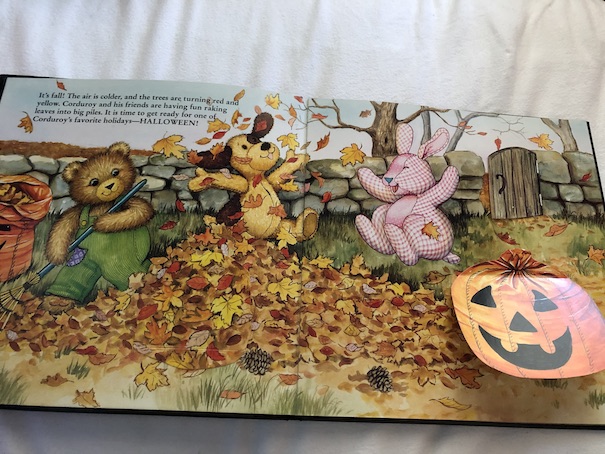
Corduroy and his friends are excited because Halloween is coming! There are many things to do, like raking leaves, choosing pumpkins for jack o’lanterns, and entering a window-painting contest.
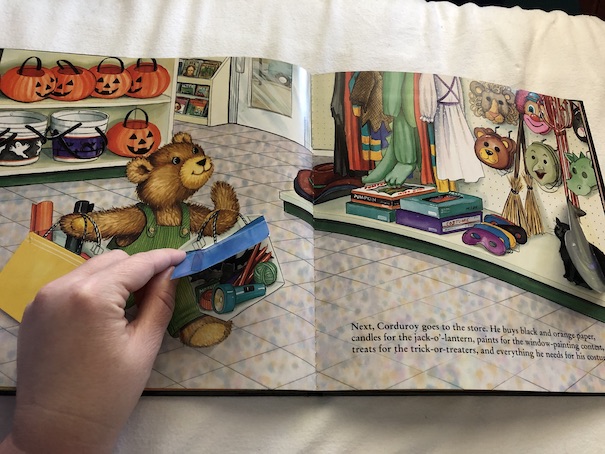
Corduroy shops for the supplies that he will need for his Halloween party.
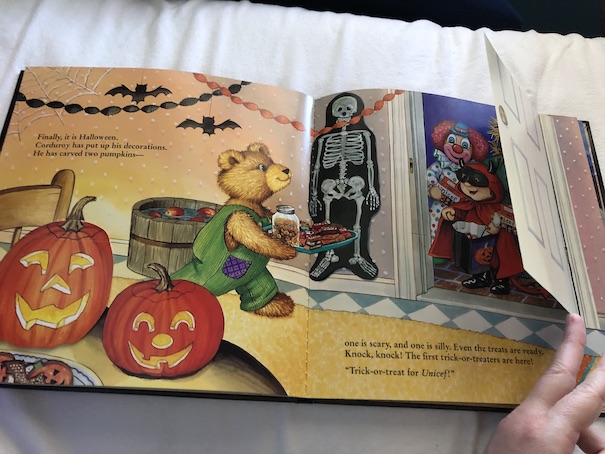
By Halloween night, all of the decorations are up, and Corduroy gets his first trick-or-treaters, including some trick-or-treating for UNICEF.
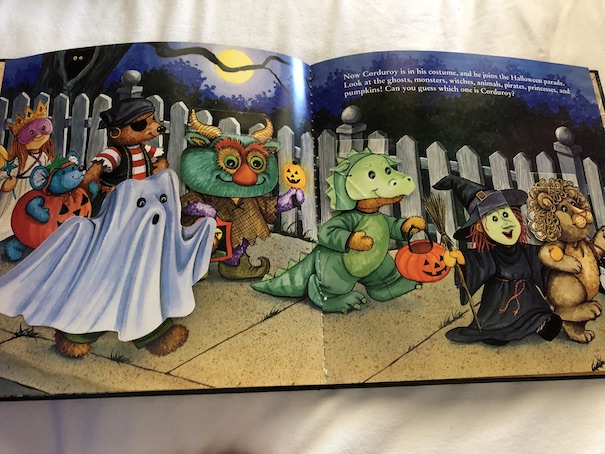
Corduroy and his friends also take part in the Halloween costume parade. In the lift-the-flap copy, you can lift up character’s masks and see their faces. I think that makes this a good book for helping to explain to young children that people in scary costumes are just ordinary people beneath the masks.
Then, they return to Corduroy’s house to have their party and bob for apples. Happy Halloween!
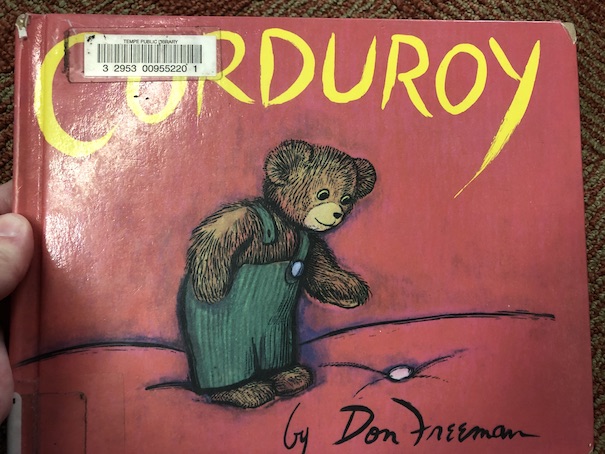
Corduroy is a small teddy bear who lives in a department store, waiting for someone to buy him and take him home. However, he is missing one of the buttons on his overalls, and it makes people reluctant to buy him.
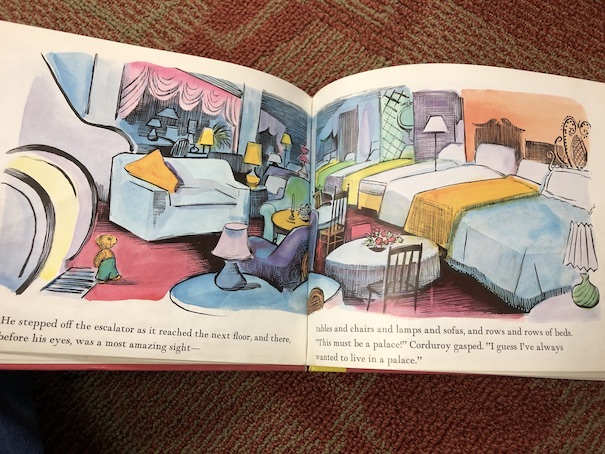
One night, after the store is closed, Corduroy sneaks out of the toy department to go looking for his lost button. After a trip up the escalator, he finds himself in the furniture department. To Corduroy, it’s like climbing a mountain and finding himself in a palace.
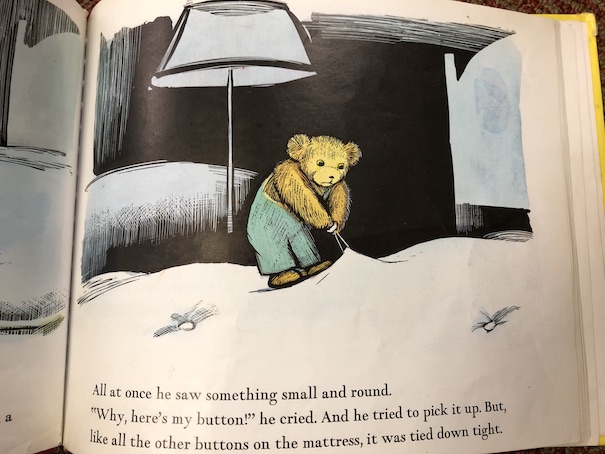
When he spots a button on a mattress, he thinks it might be his and pulls it off. By accident, he knocks over a lamp, which attracts the attention of a night watchman, who spots him and returns him to the toy department.
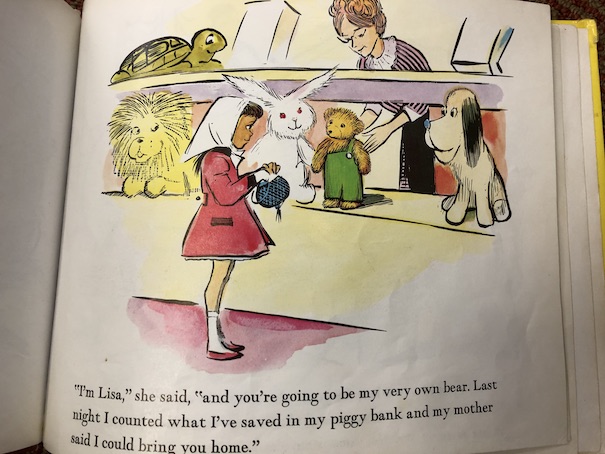
The little girl who wanted Corduroy before, Lisa, returns to the store and buys him. Lisa takes Corduroy home and sews a new button on Corduroy’s overalls. Corduroy is happy because he’s always wanted a home and a friend, and now he has both.
At first, this book was a stand-alone story, but later, the author wrote a sequel called A Pocket for Corduroy. Later, other authors continued the series.
The book is available to borrow for free online through Internet Archive.
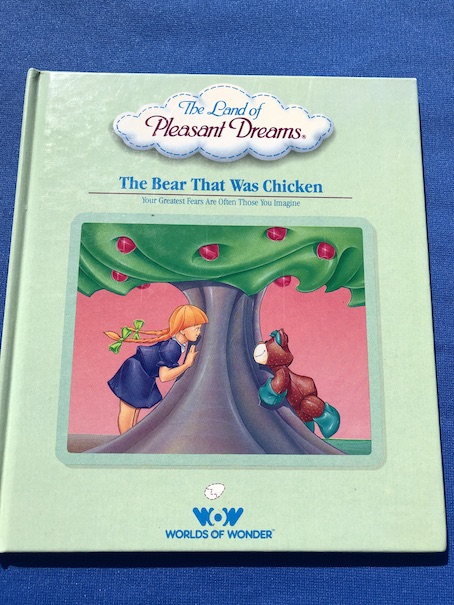
The Bear That Was Chicken by Ane Weber, Ron Krueger, Tony Salerno, 1986.
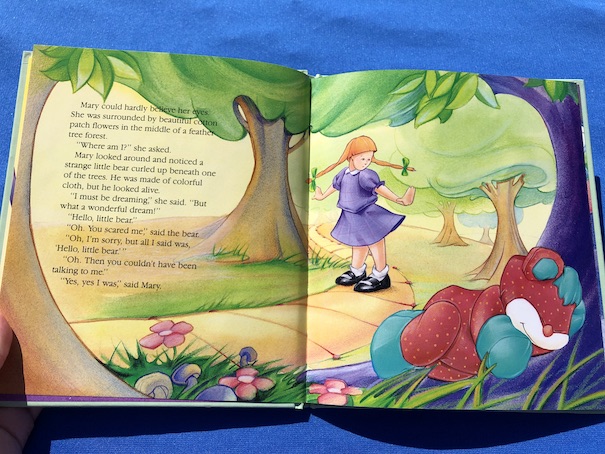
In her dream, Mary meets Threads the Bear. When she meets him, he’s trying to sleep under a tree. He’s sad and tells Mary that he thinks he’s a chicken and that all of his friends say so. (It’s not a nice thing for friends to say, and I wish the story had said so. There’s a song about it on the tape that accompanies the book with the words given in the book, but it bothers me because calling people “chicken” is something that I associate with people who are trying to goad people into doing things that they really shouldn’t do. I don’t think that it’s good to teach children to react to being called “chicken” or any other insulting names.)
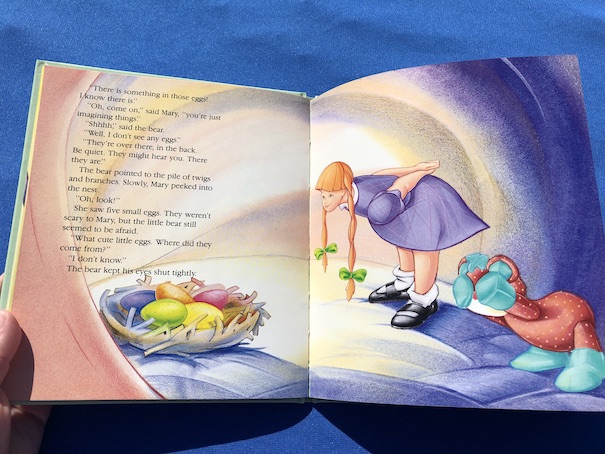
Mary thinks that Threads’ imagination is getting the better of him and that’s why he’s so afraid of so many things. However, Threads tells Mary something that isn’t imaginary: there are some strange eggs in his cave that appeared there suddenly and mysteriously. That’s why he’s sleeping in the forest, because he doesn’t know where the eggs came from or what they are. Mary bravely offers to go with him to have a look at the eggs.
When they go to look at the eggs, Mary thinks that they look pretty harmless. They’re kind of cute and colored like Easter eggs. Threads is still worried about them and what they might hatch into. Mary says again that Threads is imagining the worst and volunteers to sit with Threads while he takes his nap and keep an eye on the eggs to see what happens.
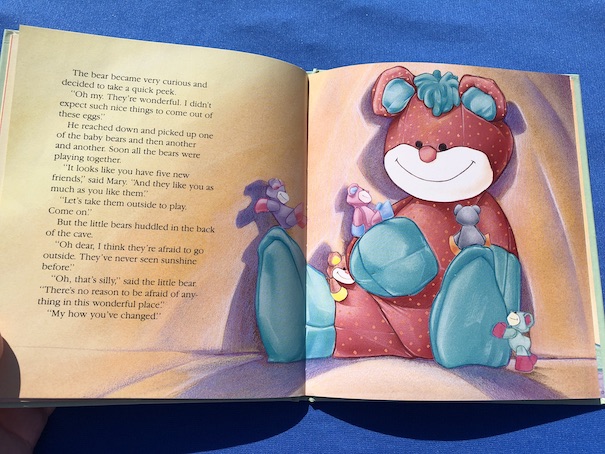
The eggs do hatch, and it turns out that they contain tiny teddy bears, very much like Threads. When Threads sees the little bears, he loves them and thinks that they’re adorable. The little bears seem worried when Threads wants to take them outside to play, but Threads encourages them, telling them that there’s nothing to be afraid of.
Moral: Your Greatest Fears Are Often Those You Imagine.
The main message of the story is that it’s better to face your fears than imagine the worst. However, I found some of this story a little confusing as a kid, and some of the implications are a little alarming when you begin to analyze it. Where did those little bear eggs come from? Did Threads lay them himself in his sleep? Are those little bears his children? Did Threads lay eggs because he was a “chicken”? But, Threads is a boy bear! Then again, this is supposed to be a dream, so I guess it doesn’t really have to make sense.
I still don’t like that the story uses “chicken” as an insult and in a way that implies that people who are called “chicken” should try to prove that they’re not. This just seems like a recipe for disaster, encouraging children to accept dares.
The book is available to borrow and read for free online through Internet Archive. This book is currently available online through Internet Archive. It was made into an episode for the tv show version of this series with puppets.
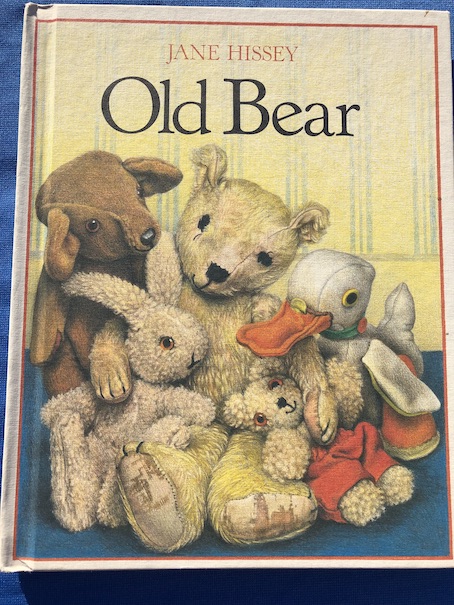
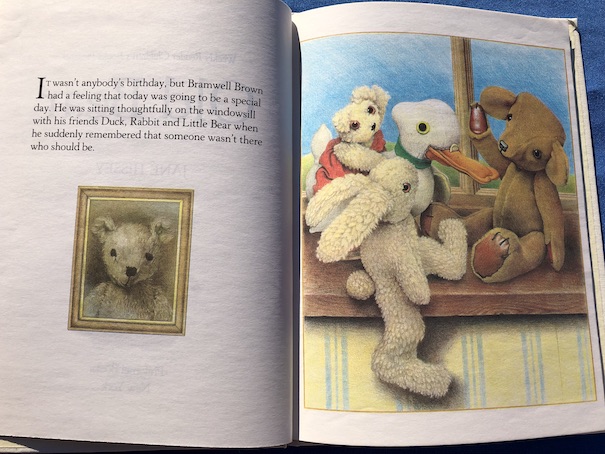
A group of stuffed animals remember that an old friend of theirs, Old Bear, was put up in the attic because he was an old toy and the children of the house were too rough with him. The other stuffed animals miss him and worry that the humans in the house have forgotten about him, so they try to think of a way to get him out of the attic.
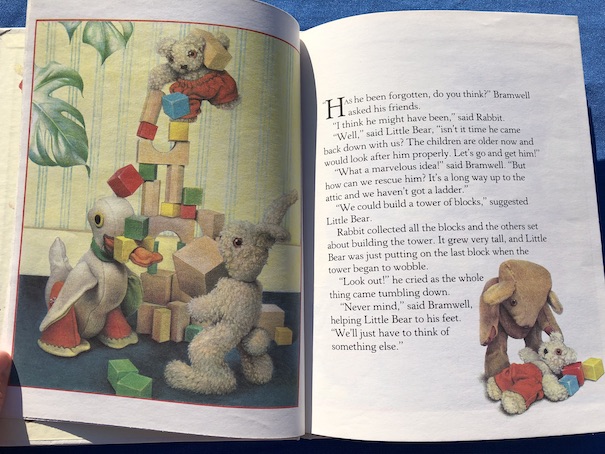
The problem is that the entrance to the attic is in the ceiling, high above their heads. The stuffed animals try various tricks to get up to the attic, from building a tall tower of blocks to jumping on the bed.
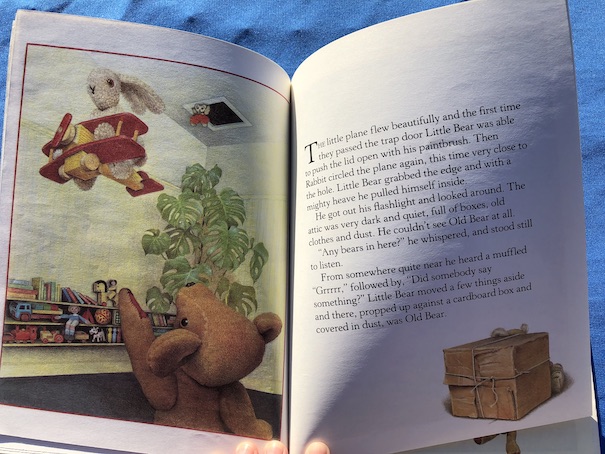
Eventually, they are successful when they use a toy airplane. After Little Bear finds Old Bear in the attic, they use parachutes made of handkerchiefs to parachute back into the playroom to rejoin the other stuffed animals.
Old Bear says that he spent most of his time in the attic sleeping, but he is glad to be back with his friends.
I remember my mother reading this book to me when I was a young child in the 1980s! One of the things that I like about this book is the detailed pictures. The textures on the stuffed animals are excellent, giving readers the feeling that they could reach into the book and touch the fluffy Little Bear, Bramwell’s paws (which look like they’re made of vinyl), and the Duck, who looks like he’s made of felt. The stuffed animals’ schemes to reach the attic are also fun and clever, using other children’s toys.
The book is part of a series originally published in the UK. The series was later made into a British television series during the 1990s. This particular story is one of the episodes, and you can see this episode on the author’s YouTube channel.
The book is available to borrow and read for free online through Internet Archive. (To borrow a book through Internet Archive, you have to sign up for an account, but it’s free, and then you read the book in your browser window.)
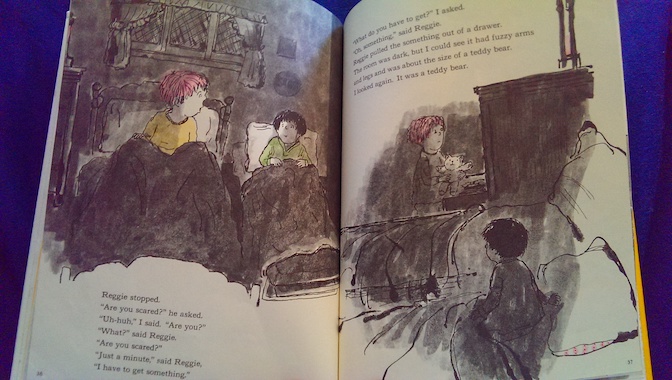
Ira, a young boy, is happy when his friend, Reggie, who lives next door, invites him to sleep over at his house. Then, his sister asks him if he’s going to take his teddy bear with him. At first, Ira says no, but his sister points out that he’s never slept without it.
Ira starts to worry about whether he should take the teddy bear with him or not. He worries that Reggie might laugh at him for having a teddy bear. His parents say that he won’t and that Ira should go ahead and take the bear with him. However, his sister says that Reggie probably will laugh.
Ira tries to talk to Reggie and sound him out on the idea of teddy bears to see if Reggie will laugh, but Reggie ignores Ira’s questions. Reggie is excited about all the things that he and Ira can do at the sleepover and eagerly explains his plans. It all sounds like fun, but Ira gets nervous when Reggie mentions ghost stories.
Ira continues to debate about whether or not he should take his bear with him. Before going over to Reggie’s house, he decides to leave his teddy bear at home.
The two boys have a lot of fun playing together at the sleepover. At bedtime, Reggie starts to tell a ghost story, and both of the boys are a little spooked. That’s when Ira discovers that Reggie has a teddy bear of his own.
The book is currently available online through Internet Archive.
My Reaction
This is a nice story about how the things that we worry other people will find ridiculous or embarrassing are often more common and less embarrassing than we think. At first, Ira worries (because of what his sister said) that Reggie will think that his teddy bear, named Tah Tah, is silly and childish, but after discovering that Reggie has a teddy bear named Foo Foo, Ira realizes that Reggie will understand how he feels about his bear and decides to run home and get it. Reggie probably dodged Ira’s earlier questions about teddy bears because he was similarly worried about what Ira would think of his bear. Sometimes, when people really open up to each other and talk honestly about the way they feel, they learn that other people have shared their feelings and experiences more than they might have thought.






 Jestress's Forgotten Books and Stories