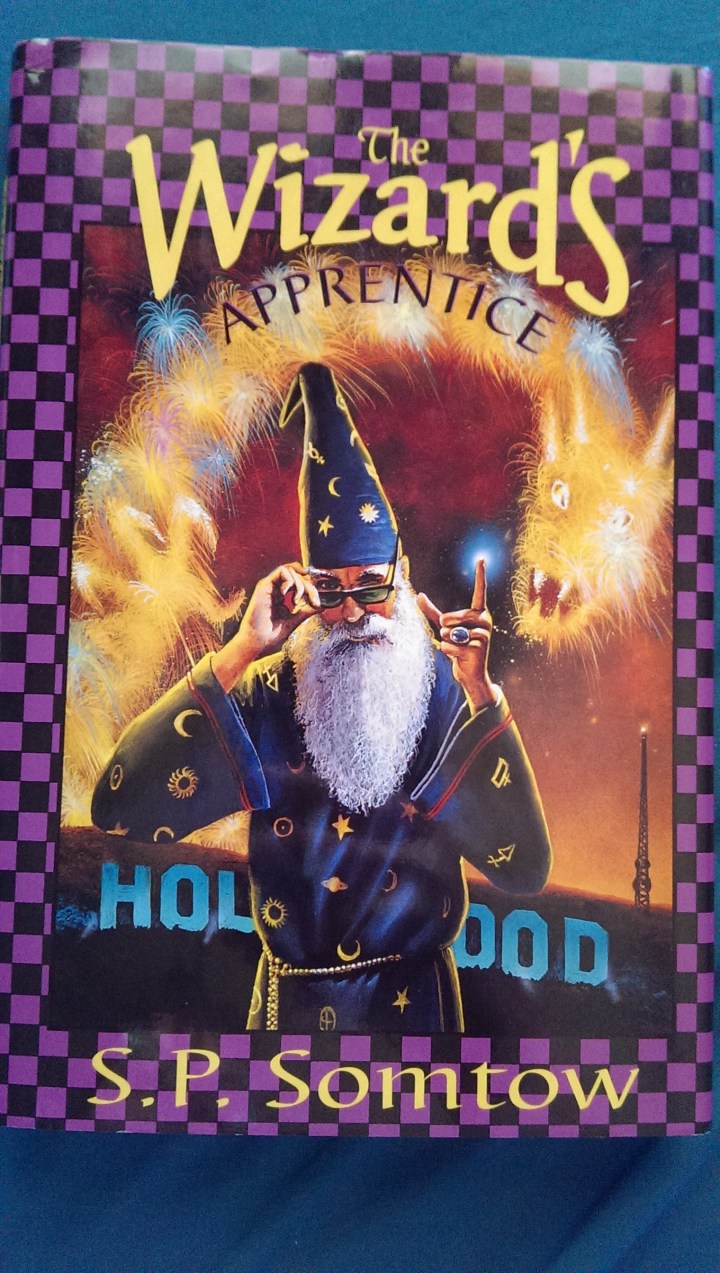
The Wizard’s Apprentice by S.P. Somtow, 1993.
 Sixteen-year-old Aaron Maguire thinks of himself as a typical teenager, even though his family is far from typical. His mother is a buyer for a fashion boutique, and his father does special effects for monster movies in Hollywood. They’re also officially “separated” and preparing for a divorce, even though they’re still living in the same house. So far, they’ve just kind of divided the house in two in order to have their own space. Aaron goes back and forth between the two halves of the same house as his parents share him. It’s a little weird (and, to Aaron, also a little depressing), but there’s weirder to come.
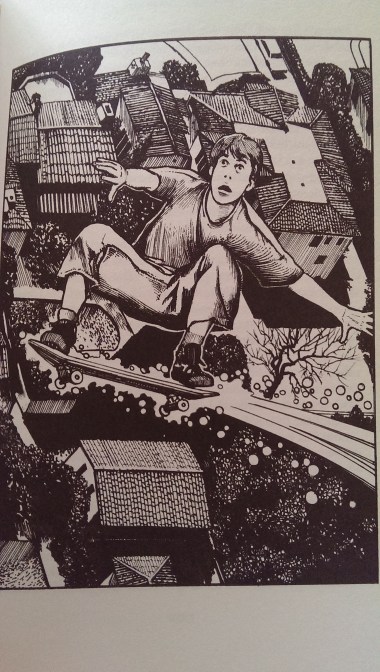
An old man approaches Aaron and tells him that he’s destined to be a wizard and that he will teach Aaron what he needs to know. At first, Aaron thinks this man is nuts and probably homeless, but what he says is true. The old man is the wizard Anaxagoras. Anaxagoras demonstrates to Aaron how the skateboarding maneuver he had just pulled off defies the laws of physics and tells Aaron things about his personal life that no one should know (how angry he is with his parents about their separation and about his crush on Penelope Karpovsky, a girl he knows from biology class). He also changes the dollar Aaron had offered him into a $100 bill and shows him that they can travel to magical lands and even through time. Although Aaron still has trouble believing what he sees (his father does special effects for a living, after all), he becomes Anaxagoras’s apprentice.
Partly because Aaron still has doubts and needs something physical to convince him of the wizard’s powers and trustworthiness, Anaxagoras gives him a mirror. It looks basically like an ordinary pocket mirror with a neon pink frame, but Anaxagoras invites him to ponder it and figure out what it does, telling him that what he does with it is important.
 However, when Aaron meets the divine Penelope for pizza and she asks to borrow a mirror to check her hair, Aaron lets her borrow Anaxagoras’s mirror. He instantly regrets it because the mirror suddenly changes in Penelope’s hands. Now, it has a tortoiseshell frame and is shaped like a heart. Penelope, who has low self-esteem in spite of her prettiness, is suddenly really happy when she looks in the mirror and refuses to give it back, insisting that she wants to borrow it for a few days. Because Aaron is in love with Penelope, he finally agrees to let her keep it for awhile.
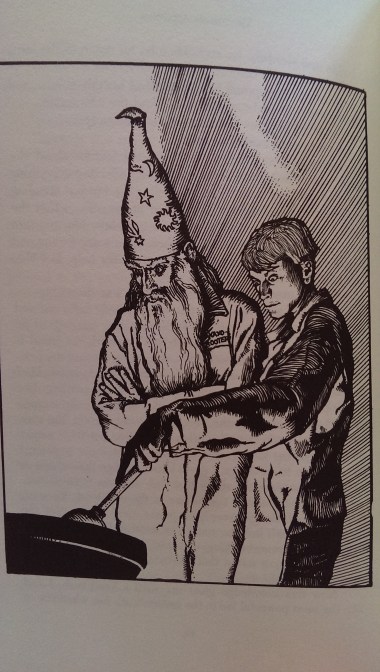
When Aaron tries to tell Anaxagoras about Penelope borrowing the mirror, he doesn’t seem concerned. He just hurries Aaron on to his next lesson, which involves a plumbing problem. Anaxagoras’s lessons are pretty weird, although Aaron finds himself learning that there is more magic in the everyday world than he ever suspected.
Aaron later attempts his own feat of magical plumbing at the studio where his dad is working and encounters a creature of darkness. The mirror gets out of his hands, and he enchants a car in order to chase it down. Finally, a dare from some classmates causes him to unleash a dragon on the unsuspecting city, one that only Aaron can understand and defeat, once he realizes the true nature of his magical mirror.
Aaron has a distinctive voice as a California teenager, and his first experiments with magic lead him to some surprising discoveries about himself which help him to understand and reconcile his feelings about his parents’ divorce.
 Mystery of the Golden Horn by Phyllis A. Whitney, 1962.
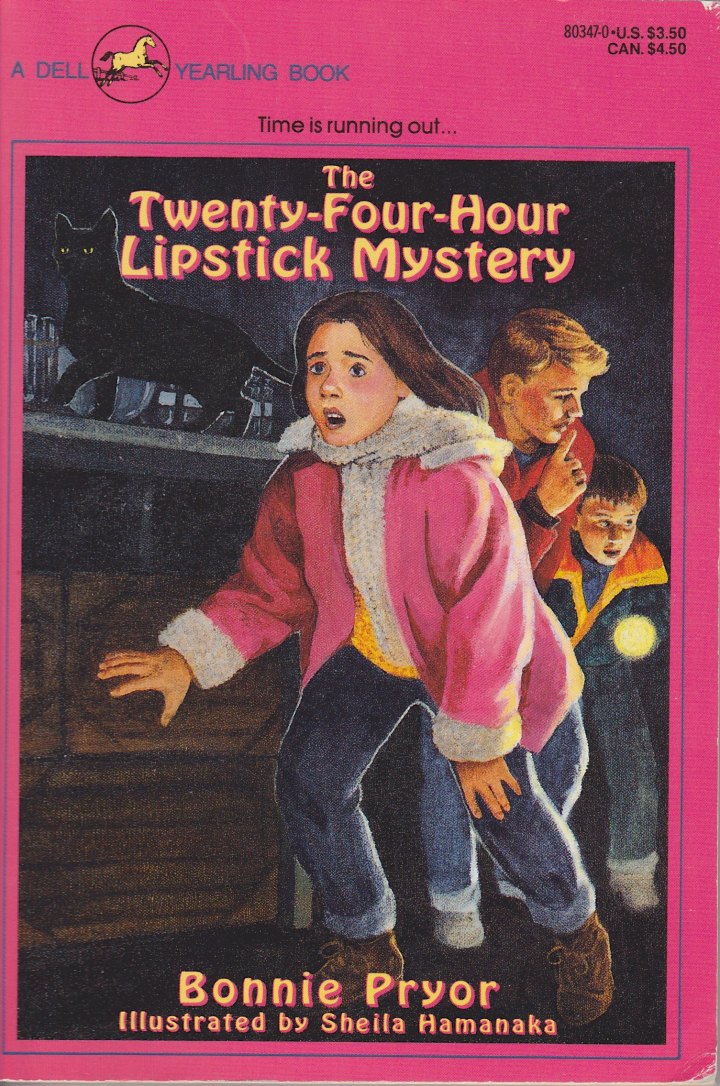 The Twenty-Four-Hour Lipstick Mystery by Bonnie Pryor, 1989.
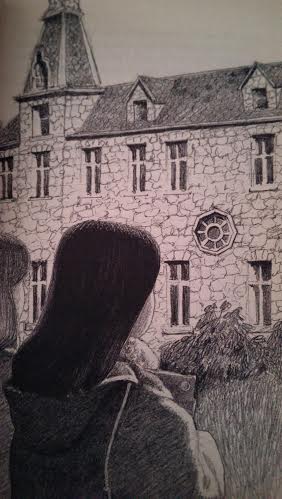 Danny is the first to notice that there is an octagonal window in the wall of the house, but none of the rooms has a window in that shape. Sometimes, lights can be seen through this window at night. Also, Cassie finds what looks like lab equipment among Miss Murdock’s boxes. Is Miss Murdock involved in something illegal? Does it have something to do with the burglaries that have been occurring around town? Why is the grumpy old gardener sneaking around? Just what is in that hidden room?
 Jestress's Forgotten Books and Stories