Monster Manual

MonsterManual

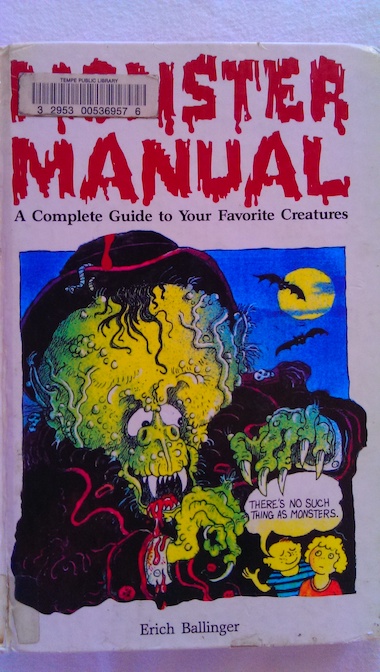
Monster Manual by Erich Ballinger, 1989, 1994.

This book was originally written in German and then translated into English.  It’s not a story about monsters but a kind of guide to monsters and other creatures found in fantasy, horror, and science fiction books and movies.  There are articles about different types of monsters, fictional characters, and monster-related concepts that are organized in alphabetical order, like a encyclopedia.  The creatures in the book range from traditional monsters from folktales and classic literature, like vampires, mummies, dragons, ogres, and creatures from Greek mythology, to modern ones from popular fiction, as seen on this monster family tree.

MonsterManualFamilyTree

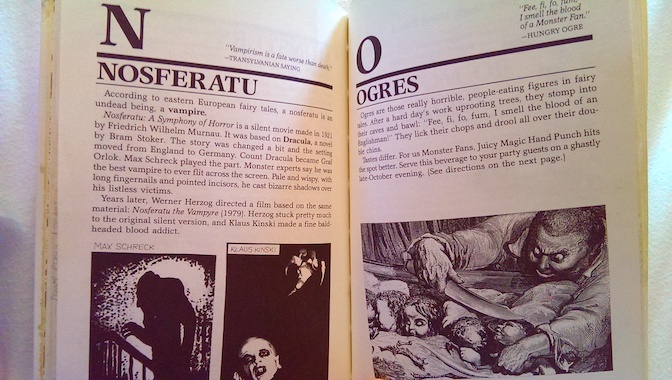
Some topics, like vampires, actually have more than one entry in the book.  There is the Vampires article, which talks about the general idea of vampires and traditional beliefs about them. Then, there are the articles about Dracula and Nosferatu, specific vampires from classic literature.  In the Nosferatu section, they tell you that the famous silent movie Nosferatu was actually based on Bram Stoker’s Dracula, just with the location and character names changed.  Unlike the suave-looking Dracula, who is not obviously a vampire at first sight, the vampire in Nosferatu was also depicted as an unearthly creature.  One thing they don’t mention is that Bram Stoker’s widow sued the studio that made Nosferatu for copyright infringement.  The studio went bankrupt, and all copies of the movie were supposed to be destroyed.  The only reason that we can see the movie now is that copies of it had already been sent overseas and preserved.  It’s now considered a classic silent film and has a cult following.

MonsterManualVampires
MonsterManualNosferatuOgres

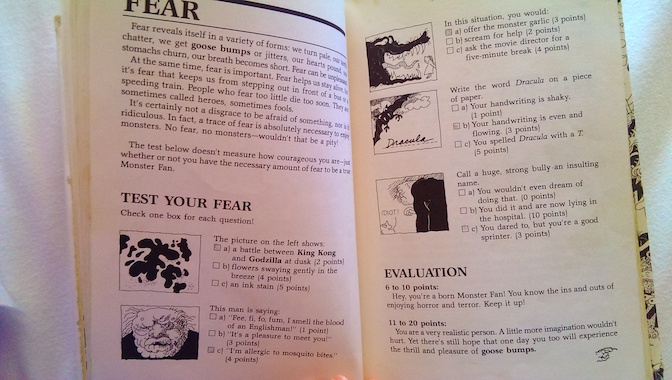
Some articles are also activities, like the one about Drawing Monsters and the quiz to see how fearful you are.
MonsterManualFearQuiz

All throughout the book, there are also segments of a comic strip at the bottoms of various pages in which a monster tries to frighten a young girl, who is unimpressed.  By the end of the comic strip, the girl and the monster become friends.

The book is available to borrow and read for free online through Internet Archive.

The Secret Life of the Underwear Champ

UnderwearChampThe Secret Life of the Underwear Champ by Betty Miles, 1981.

Ten-year-old Larry lives in Connecticut, but one day, while he and his mother are visiting his dentist in New York City, he gets spotted by the Zigmunds.  The Zigmunds own a modeling agency, and they think that Larry will be perfect for a series of tv ads.  At first, Larry is kind of excited about the idea of being on tv and earning extra money (maybe enough to get a new ten-speed bike!) until he realizes what he’s going to be advertising: underwear.

The Zigmunds like Larry because he’s a clean-cut, athletic kid who likes to play baseball, and the advertisements are supposed to feature a family playing sports together . . . in their underwear.  Larry also happens to have red hair, just like the girl already picked to play his sister in the commercials, Suzanne.  Suzanne has been in advertisements many times before, and the idea of advertising underwear doesn’t bother her at all.  The underwear kind of looks like athletic clothes and isn’t really revealing, but it’s still underwear.  Larry goes from feeling proud of his new tv advertising career to hoping that no one at school ever finds out about it.  But, how can Larry even hope for that when his underwear-clad form is going to be displayed on everyone’s tv set?

UnderwearChampPic1Now, Larry is wondering what he’s gotten himself into.  He worries about his filming schedule conflicting with baseball practice and makes up excuses about needing to visit the dentist when he has to film a commercial.  Money or no money, Larry just wishes that his life would return to normal!

After the filming is over, Larry starts to feel better about what he’s accomplished.  He and Suzanne have become friends (and she may possibly be his first girlfriend), and learning about the world of advertising was kind of fun.  But when the commercial actually makes it to tv, and Larry tells his best friend Robert about it, the dreaded teasing starts.

In some ways, Larry’s fears about teasing don’t turn out to be as bad as he fears, although it seems like it at first.  Robert laughs at him when he sees the first commercial and realizes why Larry’s been sneaking around and making excuses, but Larry tells him off for being mean and challenges him to think how he feels about it all.  Robert feels a little bad about laughing but says that he can’t help it and that other kids at school will react the same way.  He’s partly right, but he does help to put a stop to it, and the other kids do calm down.  Larry even enjoys some minor fame because he’s the only one of the kids to have been on tv at all.

There’s a lot of humor in the story, but it’s also surprisingly thoughtful as Larry considers why people find the idea of seeing someone in their underwear so funny.  After all, everyone wears underwear of some kind, even the President of the United States.  It’s a normal part of everyone’s wardrobe and a common part of everyday life.  The other people in the ad don’t act self-conscious while they’re being filmed in their underwear because it’s just part of their job, another part of daily life.  The book doesn’t mention sex, although the “mother” of the family in the ads gets a few whistles when she’s in her underwear, and Larry acknowledges that he and Robert sometimes giggle over advertisements with girls in their underwear.  Larry’s main conclusion is that people laugh about underwear because that’s just not how people normally see each other, so it seems weird.  After everyone has seen the commercial with Larry many times, people get used to the idea and it doesn’t seem so weird, so they get over the “funny” part and stop laughing.  Eventually, the other kids at school stop thinking so much about the underwear and just think it’s kind of cool that Larry was in a commercial.

The book is currently available online through Internet Archive.