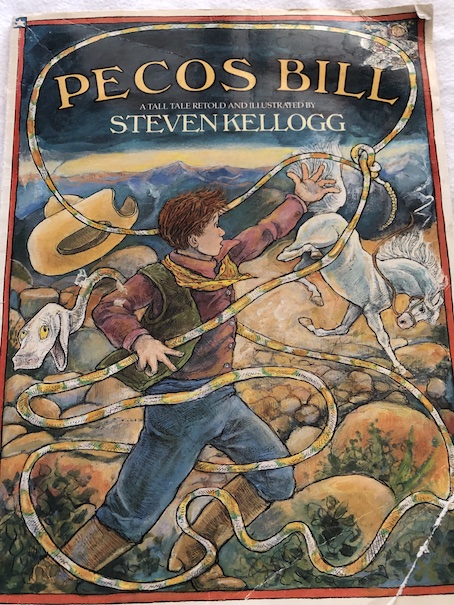
Pecos Bill

Pecos Bill retold and illustrated by Steven Kellogg, 1986.

I remember this book from when I was in elementary school! This was the book that my teacher or librarian (I forget which one now) used to introduce us to the concept of tall tales. Tall tales, like the story of Pecos Bill, are a major feature of American folklore, particularly Western American folklore.

When the story begins, young Bill is traveling west from New England with his family as part of a wagon train. As they cross the Pecos River, Bill tries to fish, but an enormous trout pulls him out of his family’s wagon. Bill is rescued by a coyote, and he spends some time living and growing up with the coyotes and other animals in Texas.

Eventually Bill meets up with a cowboy named Chuck, who explains to him that he’s a human and a Texan, not a coyote. Chuck gives him some extra clothes to wear (because he’s long outgrown his childhood clothes). Chuck tells Bill that many Texans are outlaws, but they would be better if they started herding cattle and became ranchers. Bill decides to try life as a Texas rancher.

Because of his wild upbringing, Pecos Bill is able to perform amazing feats of strength, like subduing a giant rattlesnake to the point where it becomes tame and allows Pecos Bill to use him as a lasso. He also gets the hide of a monster to make other lassos to give to the worst gang of outlaws around. The outlaws are so impressed with Bill’s ability to subdue wild creatures that they agree to make him the boss of their gang, and they all become cowboys.
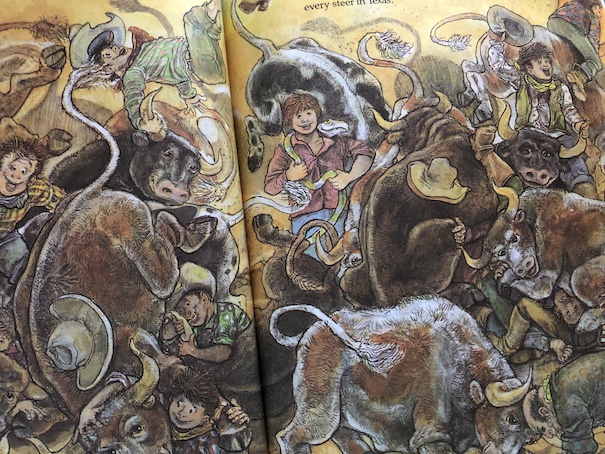
Bill subdues a wild horse called Lightning and uses the language of wild animals to befriend him. He leads the other cowboys on a massive cattle drive, and he creates the impossible Perpetual Motion Ranch on Pinnacle Peak.
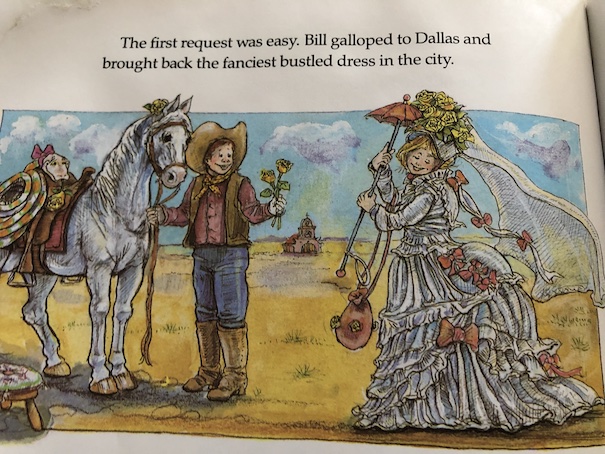
Then, Pecos Bill meets a pretty girl named Sue and decides to get married. However, Sue’s bustle is so tight that when she tries to sit on Bill’s horse, Sue bounces in the air so high that she reaches the moon. Every time she hit the ground, she bounces into the sky again, so Pecos Bill has to lasso a tornado to catch up with her.
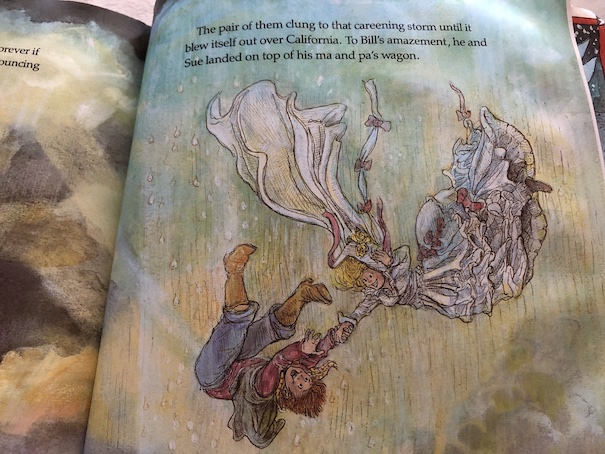
When they finally land, they land on top of Bill’s family’s wagon in California. Apparently, they’re still wandering after all these years, trying to find a place to settle. Pecos Bill convinces his family to settle with him and his bride in Texas.

I’m not very big on tall tales, in spite of having grown in the American Southwest, where many of these types of stories evolved, but I have some sentimental attachment to this one because it was my first as a kid. The pictures in the book are wild and chaotic, just like the action in the story.

The book is available to borrow and read for free online through Internet Archive (multiple copies).

Miss Nelson is Back

NelsonBack

Miss Nelson is Back by Harry Allard and James Marshall, 1982.

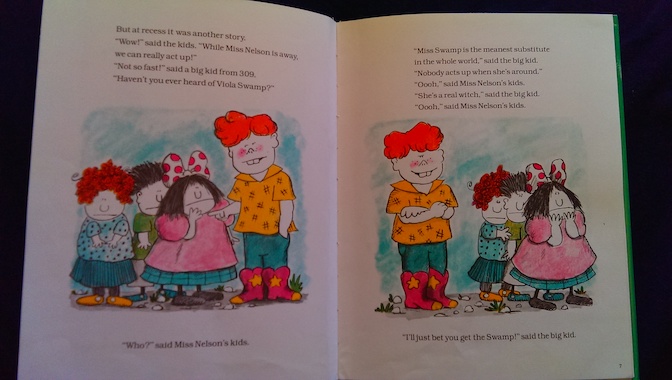
Miss Nelson, a teacher, tells her class that she will have to be away for awhile, having her tonsils removed, so someone else will be teaching their class.  At first, the kids think that they’ll be able to get away with a lot while Miss Nelson is away, but an older kid warns them that their substitute will probably turn out to be Viola Swamp, the meanest substitute ever.

NelsonBackWarning

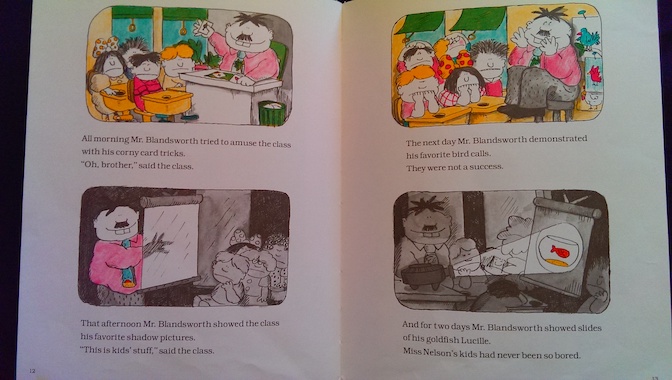
The kids are nervous until they find out that Mr. Blandsworth, the school principal, will be their substitute himself.  The worst thing about Mr. Blandsworth is that he’s boring, and he tends to treat them like they’re little kids.  They put up with it for awhile, but then, they realize that they can get rid of Mr. Blandsworth by convincing him that Miss Nelson has come back to school.

NelsonBackPrincipal

They put together their own Miss Nelson costume, with some of the kids sitting on each other’s shoulder’s to appear taller in the outfit.  It’s cheesy, but it convinces the principal.  But, the kids take it even farther than that.  Now that there’s no substitute teacher, they can do whatever they want!  Their “Miss Nelson” takes the class on an impromptu field trip to the movies and the ice cream parlor, and no one stops them because they’re with their “teacher.”

NelsonBackFieldTrip

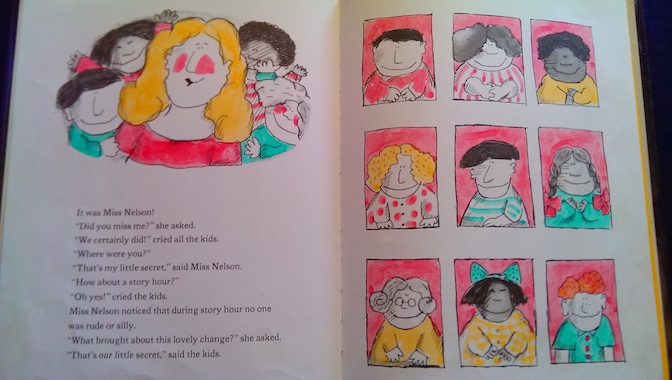
Unfortunately, they make the mistake of walking past Miss Nelson’s house, and she discovers what they’ve been doing.

NelsonBackReveal

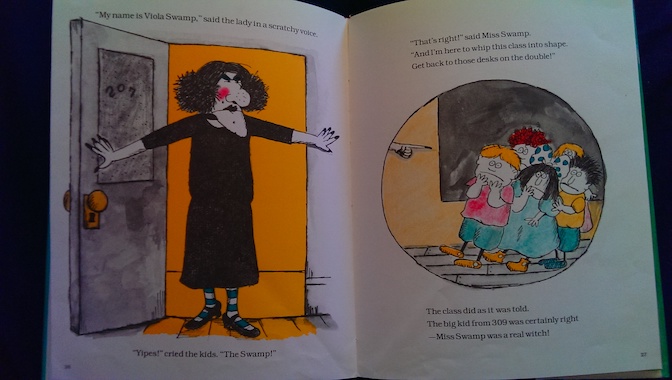
Miss Nelson arranges for Miss Viola Swamp to come and teach the class a real lesson.

NelsonBackSwamp

The book is currently available online through Internet Archive.

My Reaction

I actually like this book even better than the first book in the series because I think that the kids’ Miss Nelson costume is hilarious! Mr. Blandsworth is completely clueless about the kids’ deception, just as he never figures out what the real truth is about “Viola Swamp.”

As usual for the series, the story never explicitly states that Miss Nelson and Viola Swamp are the same person, but it’s heavily implied in the text (such as Viola Swamp’s scratchy voice from Miss Nelson having her tonsils out) and shown in clues in the pictures. Miss Nelson uses “Viola Swamp” as her alter ego whenever she needs to give her students some tough love, but that’s just a joke that Miss Nelson shares with the readers.

Miss Nelson is Missing

NelsonMissing

Miss Nelson is Missing! By Harry Allard and James Marshall, 1977.

The kids in Miss Nelson’s class at school are terrible! No matter how nice she is to them, they always act up and refuse to do their work. Miss Nelson knows that this can’t continue.

NelsonMissingClass

Then, one day, Miss Nelson doesn’t show up for class. The kids have a substitute teacher, the terrible Miss Viola Swamp. Miss Swamp is super strict. She makes the kids work harder than they’ve ever worked in their lives, and she doesn’t put up with any nonsense.

NelsonMissingMissSwamp
NelsonMissingSwampWork

Miss Swamp is so mean that the kids really start to miss nice Miss Nelson. What happened to her? The kids try to find their nice teacher so they can get rid of the mean substitute. They try to go to the police to report her as a missing person and go to her house to see if she’s there, but the only person they can find is Miss Swamp. They imagine all sorts of terrible things that could have happened to Miss Nelson.

Then, just as they’re sure that they’ll never see Miss Nelson again, suddenly she’s back. Miss Nelson never says exactly where she’s been, but the kids are so glad to see her that they behave much better.

NelsonMissingReturn

This is the first book in a series.  It is available to borrow and read for free online through Internet Archive.

My Reaction and Spoilers

The big joke of the book, and all the others in this series, is that Miss Nelson and Miss Swamp are the same person. It’s not much of a spoiler to say that because, even though the story never explicitly says that they are the same person, it’s heavily implied, especially at the end of the book. The fun is that the kids in Miss Nelson’s class never guess, leaving readers to enjoy the joke along with Miss Nelson.

NelsonMissingSecret

Some people like to take advantage of people who are “too nice”, but just because a person prefers to be nice doesn’t mean that they’re weak, stupid, or incapable of being tough when they need to be. Miss Nelson just found a creative way to be as tough and mean as she needed to be to get the kids in her class to behave without ruining her own reputation as a nice person.  “Viola Swamp” will always be there whenever Miss Nelson needs her again … and that leads into the rest of the books in the series.

Who Stole Kathy Young?

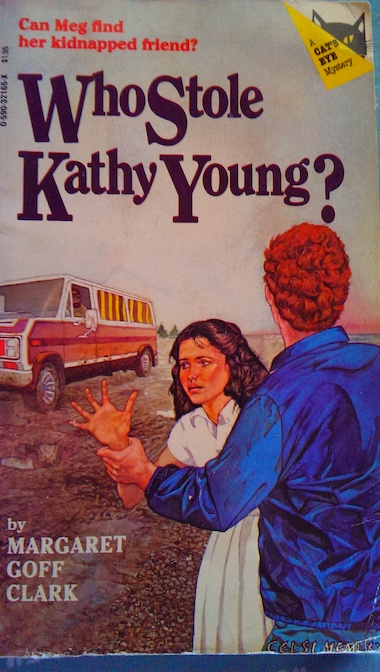
KathyYoungWho Stole Kathy Young? by Margaret Goff Clark, 1980.

Kathy Young has had her share of problems.  Her mother died a year and a half ago, and now, her father has a housekeeper with a sour personality.  A couple of months after her mother’s death, Kathy was seriously ill, and her illness caused her to lose most of her hearing.  She now depends on a hearing aid and her improving lip-reading and sign language abilities.

This summer, Kathy’s best friend, Meg, is staying with her while her parents are on a trip to Switzerland.  Meg was of great help to Kathy when she was trying to adjust to her hearing loss, practicing sign language with her during her special lessons.  Kathy’s dream is to become an artist, but Meg now wants to be a teacher for the deaf, like the teacher who taught Kathy.  Kathy is still very unsure of her abilities to cope with her deafness.  She had the opportunity to attend a special art workshop over the summer but passed it up because she was worried about whether she would be able to communicate with and understand her teacher and the other students, and she knew Meg couldn’t attend to help her.

Kathy has been enjoying Meg’s summer visit, but the girls have noticed something odd.  It seems like a couple of strangers, a man and a woman, have been hanging around everywhere they go.  Meg is worried about it, but Kathy doesn’t want to worry her father.  She thinks that they’re probably tourists, like the housekeeper said.  They nickname the strangers Heron and Toad because of their appearances.

One day, Kathy is kidnapped!  Some men in a van stop to ask her directions and when she tries to explain where they have to go, they pull her inside and drug her!  Meg witnesses the kidnapping, but is standing too far away to help Kathy.

When Kathy wakes up from being drugged, she finds herself on a boat.  Her abductors have cut her hair and changed her shirt to disguise her from anyone who might spot her.  They’ve also taken her hearing aid, hoping to render her helpless and keep her from finding out their plans because she can’t hear them.  However, Kathy isn’t as helpless as they think.  She can still read lips, and she can still think.

Kathy learns to rely on herself and her own wits as she tries to gather as much information as she can about her kidnappers and to figure out how she can save herself.  Through this experience, she develops more self-confidence, realizing that she can do more and handle more than she had thought was possible.

While Kathy is struggling in captivity and her father is dealing with the police and the ransom demand, her friend Meg is trying desperately to find her.  The story alternates viewpoints between the two girls as Meg aids the investigation into Kathy’s disappearance and puts together clues that Kathy leaves for her as her abductors move her from place to place.  The mastermind behind the kidnapping plot is closer to home than they think.

The book is available to borrow and read for free online through Internet Archive.

The Legend of the Bluebonnet

LegendBluebonnet

The Legend of the Bluebonnet by Tomie dePaola, 1983.

This is a story about the Comanche People in what is now Texas, based on an old folktale.

There has been a severe drought and famine in the land for a long time, and many people have died.  The survivors pray to the spirits for help in ending the drought, and they receive a sign that it will not end until someone among the Comanches makes a sacrifice of the thing that is most dear to them.

LegendBluebonnetShaman

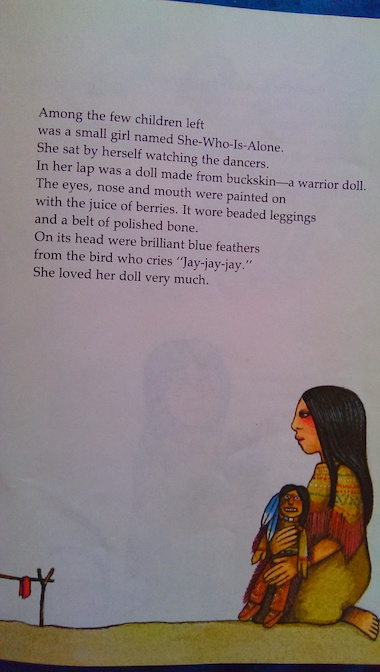
The people debate about who is supposed to make the sacrifice and what object the spirits could want, but one young girl thinks that the spirits are talking about her and her doll.  The girl is called She-Who-Is-Alone because she is the last of her family.  Her parents and grandparents are dead, victims of the famine.  The only thing she has left to remind her of them is her doll, a warrior with blue feathers in its hair, that her parents made for her before they died.

Desperate to end the drought and famine and to save her people, the girl makes the difficult decision to sacrifice her doll by burning it.  Her sacrifice is rewarded not only by the end of the drought but by the sudden appearance of a field of flowers as blue as the feathers in her doll’s hair.  The girl receives a new name from her people, acknowledging her sacrifice on their behalf.

LegendBluebonnetFlowers

A section in the back of the book explains a little about the Bluebonnet flower, which is the state flower of Texas, and the origins of the story in the book, which is based on a folktale.  This is also a little information about the Comanche People.

The book is currently available online through Internet Archive (multiple copies).